
Life, 1900-09-27 · page 4 of 20
Life — September 27, 1900 — page 4: what you’re looking at
What you’re looking at
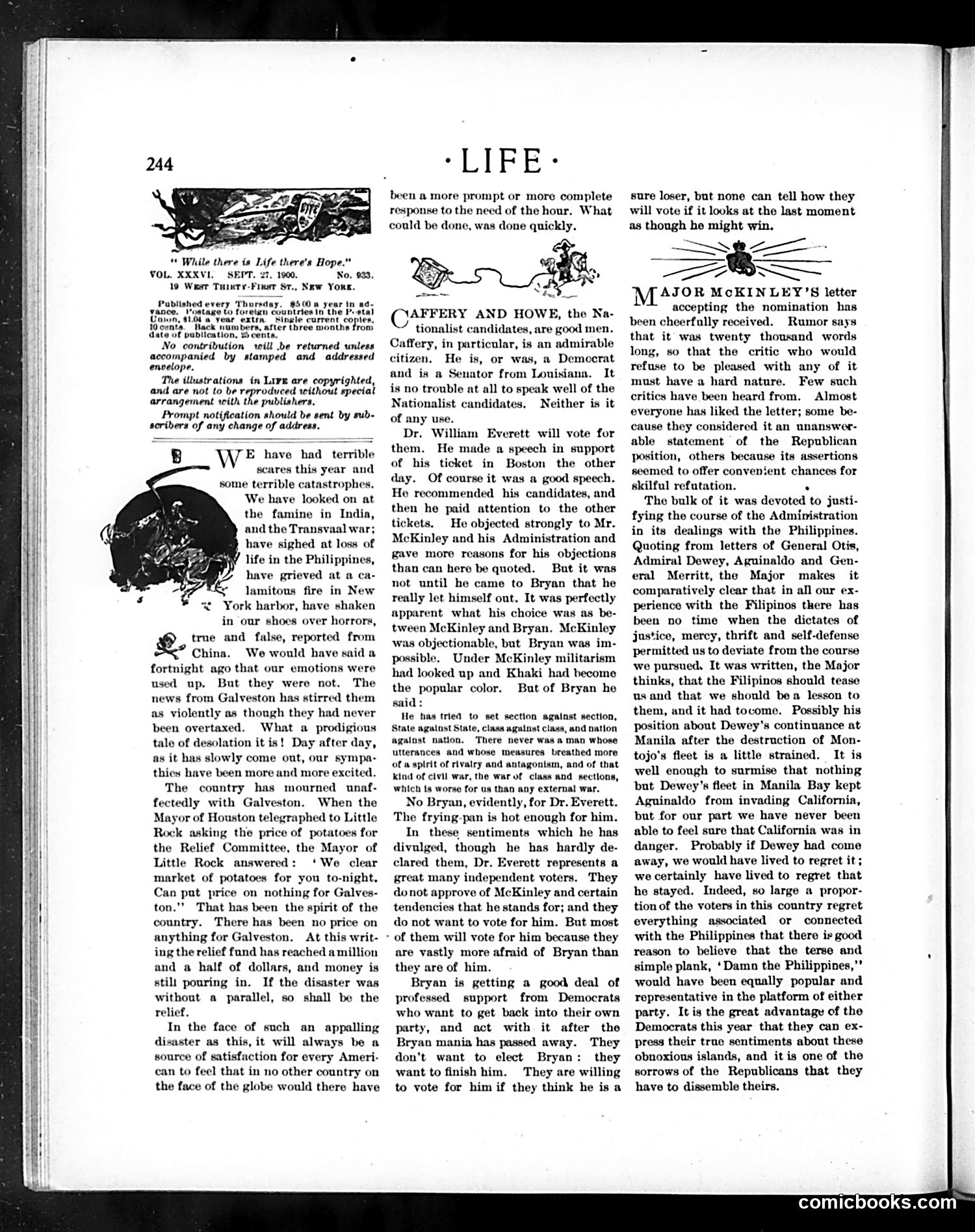
This page contains political commentary about the 1900 presidential election. The text discusses **Caffery and Howe** (Nationalist Party candidates) and **William Everett**, who supports **McKinley's Administration**. The main editorial criticizes **Bryan** and discusses voter sentiment regarding his candidacy. It references McKinley's handling of the **Philippines** and praises **Admiral Dewey**, suggesting Dewey's popularity contrasts with Bryan's declining support among Democrats. The satirical point appears to be that Bryan, despite some Democratic backing, has lost momentum—even his own party prefers other figures like Dewey. The piece mocks Bryan's "mania" as having "passed away," suggesting his political relevance has diminished since the 1896 election. The decorative illustration (top left) appears ornamental rather than directly satirical.
📄 Transcribed text from this page (OCR, searchable)
Machine-transcribed from the original scan — historical spelling and the odd misread are preserved.
| Sree eg “| While there is Life there's Hope.” VOL. XXXVI. SEPT. 27, 1900. No. 933. 19 West Turury-Fiest St, New York. Published every Thursday. $500 a year ance. Hostage to foreign countries In the Petal extra Single current copies, Cowon, $1.06 0 cents. “Back numbers, after three months from date of publication, % cent No contribution will .be returned untess accompanied by stamped and addressed envelope. The illustrations in Live are copyrighted, and are not to be reproduced without special arrangement with the publishers. Prompt notification should be sent by sub- scribers of any change of address. B__ WWE have had terrible scares this year and some terrible catastrophes. We have looked on at the famine in India, and the Transvaal war; have sighed at loss of life in the Philippines, have grieved at a ca- lamitous fire in New ‘~ York harbor, have shaken in our shoes over horrors, true and false, reported from x. China. We would have said a fortnight ago that our emotions were used up. But they were not. The news from Galveston has stirred them as violently as though they had never been overtaxed. What a prodigious tale of desolation it is! Day after day, as it has slowly come ont, our sympa- thiex have been more and more excited. The country has mourned unaf- fectedly with Galveston. When the Mayor of Houston telegraphed to Little Rock asking the price of potatoes for the Relief Committee, the Mayor of Little Rock answered: ‘We clear market of potatoes for you to-night. Can put price on nothing for Galves- ton.’ That has been the spirit of the country. There has been no price on anything for Galveston. At this writ- ing the relief fund has reached a million and a half of dollars, and money is still pouring in. If the disaster was without a parallel, so shall be the relief. In the face of such an appalling disaster as this, it will always be a source of satisfaction for every Ameri- can to feel that in no other country on the face of the globe would there have >LIFE> been a more prompt or more complete response to the need of the hour, What could be done, was done quickly. AFFERY AND HOWE, the Na- tionalist candidates, are good men. Caffery, in particular, is an admirable citizen. He is, or was, a Democrat and is a Senator from Louisiana. It is no trouble at all to speak well of the Nationalist candidates. Neither is it of any use. Dr. William Everett will vote for them. He made a speech in support of his ticket in Boston the other day. Of course it was a good speech. He recommended his candidates, and then he paid attention to the other tickets. He objected strongly to Mr. McKinley and his Administration and gave more reasons for his objections than can here be quoted. But it was not until he came to Bryan that he really let himself out. It was perfectly apparent what his choice was as be- tween McKinley and Bryan. McKinley was objectionable, but Bryan was im- possible. Under McKinley militarism had looked up and Khaki had become the popular color. But of Bryan he said: He has tried to set section against section, State against State, class against class, and nation agalnst nation. There never was a man whose utterances and whose measures breathed more of # spirit of rivalry and antagonism, and of that kind of civil war, the war of class and sections, which is worse for us than any external war. No Bryan, evidently, for Dr. Everett. The frying-pan is hot enough for him. In these sentiments which he has divulged, though he has hardly de- clared them, Dr. Everett represents a great many independent voters. They donot approve of McKinley and certain tendencies that he stands for; and they do not want to vote for him. But most ee - of them will vote for him because they are vastly more afraid of Bryan than they are of him. Bryan is getting a good deal of professed support from Democrats who want to get back into their own party, and act with it after the Bryan mania has passed away. They don’t want to elect Bryan: they want to finish him. They are willing to vote for him if they think he is a sure loser, but none can tell how they will vote if it looks at the last moment as though he might win. a ee AJOR McKINLEY’S letter 2D accepting the nomination has been cheerfully received. Rumor says that it was twenty thousand words long, so that the critic who would refuse to be pleased with any of it must have a hard nature. Few such critics have been heard from, Almost everyone has liked the letter; some be- cause they considered it an unanswer- able statement of the Republican position, others because its assertions seemed to offer convenient chances for skilful refutation. . The bulk of it was devoted to justi- fying the course of the Administration in its dealings with the Philippines. Quoting from letters of General Otis, Admiral Dewey, Aguinaldo and Gen- eral Merritt, the Major makes it comparatively clear that in all our ex- perience with the Filipinos there has been no time when the dictates of justice, mercy, thrift and self-defense permitted us to deviate from the course we pursued, It was written, the Major thinks, that the Filipinos should tease us and that we should bea lesson to them, and it had tocome. Possibly his position about Dewey’s continuance at Manila after the destruction of Mon- tojo's fleet is a little strained. It is well enongh to surmise that nothing but Dewey's fleet in Manila Bay kept Aguinaldo from invading California, but for our part we have never been able to feel sure that California was in danger. Probably if Dewey had come away, we would have lived to regret it; we certainly have lived to regret that he stayed. Indeed, so large a propor- tion of the voters in this country regret everything associated or connected with the Philippines that there ir good reason to believe that the terse and simple plank, ‘Damn the Philippines,"’ would have been equally popular and representative in the platform of either party. It is the great advantage of the Democrats this year that they can ex- press their true sentiments about these obnoxious islands, and it is one of the sorrows of the Republicans that they have to dissemble theirs. comicbooks.com