
Life, 1900-09-27 · page 12 of 20
Life — September 27, 1900 — page 12: what you’re looking at
What you’re looking at
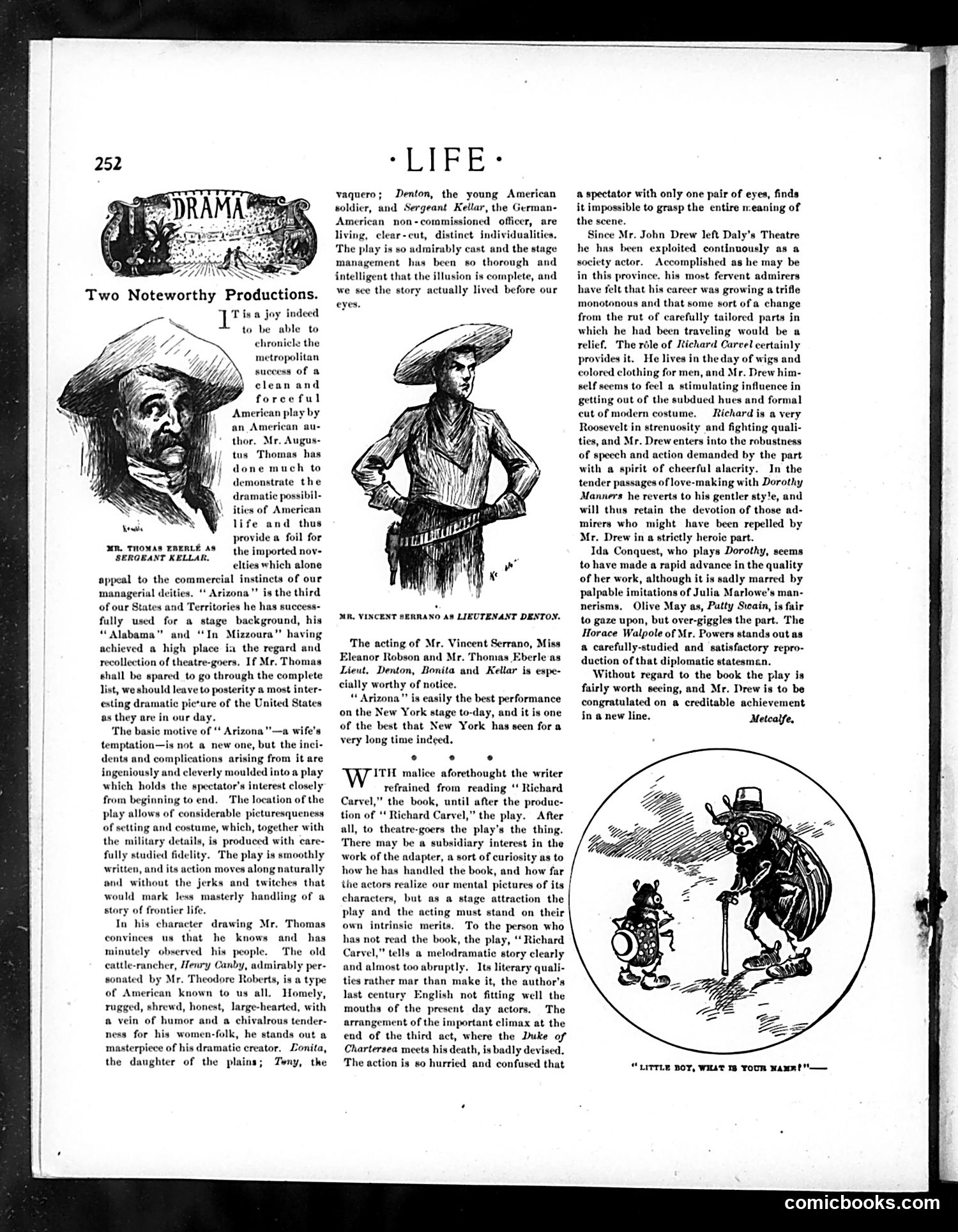
This page reviews two theatrical productions. The left illustration shows **Mr. Thomas Eberle as Sergeant Kellar** in "Arizona," a play about American frontier life. The text praises the production's authenticity and Eberle's performance in depicting the rugged, honest character. The right section discusses **"Richard Carvel,"** adapted from a novel, praising actor **Mr. Vincent Serrano as Lieutenant Deston**. The review notes the play succeeds on its own merits despite the book's literary qualities. The bottom cartoon shows a small boy confronting what appears to be a chimney sweep or laborer, with the caption **"Little Boy, What is Your Name?"** — likely satirizing class encounters or social awkwardness of the era. The page reflects Life magazine's role as cultural arbiter of theatrical merit for its educated readership.
📄 Transcribed text from this page (OCR, searchable)
Machine-transcribed from the original scan — historical spelling and the odd misread are preserved.
Two Noteworthy Productions. [Tis oy indeed to be able to chronicle the metropolitan success of clean and forceful American play by an American au- thor. Mr. Augus- tus Thomas has done much to demonstrate the dramatic possibil- ities of American life and thus provide a foil for the imported nov- elties which alone appeal to the commercial instincts of our managerial deities. ‘‘ Arizona’’ is the third of our States and Territories he has success- fully used for a stage background, his “Alabama” and ‘In Mizzoura” having achieved a high place ia the regard and recollection of theatre-goers. If Mr. Thomas shall be spared to go through the complete list, we should leave to posterity a most inter- esting dramatic picture of the United States as they are in our day. ‘The basic motive of “ Arizona" —a wife's temptation—is not a new one, but the inci- dents and complications arising from it are ingeniously and cleverly moulded into a play which holds the spectator's interest closely from beginning to end. ‘The location of the play allows of considerable picturesqueness of setting and costume, which, together with the military details, is produced with care- fully studied fidelity. The play is smoothly written, and its action moves along naturally and without the jerks and twitches that would mark less masterly handling of a story of frontier life. In his character drawing Mr. Thomas convinces us that he knows and has minutely observed his people. The old ttle-rancher, Henry Canby, admirably per- sonated by Mr. Theodore Roberts, is a type of American known to us all. Homely, rugged, shrewd, honest, large-hearted, with a vein of humor and a chivalrous tende ness for his women-folk, he stands out a masterpiece of his dramatic creator. Lonita, the daughter of the plains; Teny, the MM. THOMAS EBERLE AS SERGEANT KELLAR. “LIFE * vaquero; Denton, the young American soldier, and Sergeant Kellar, the German- American non-commissioned officer, are living, clear-cut, distinct individualities, The play is so admirably cast and the stage management has been so thorough and intelligent that the illusion is complete, and we see the story actually lived before our ey MR, VINCENT SERRANO AS LIEUTENANT DENTON. ‘The acting of Mr. Vincent Serrano, Miss Eleanor Robson and Mr. Thomas Eberle as Lieut, Denton, Bonita and Kellar is espe- cially worthy of notice. “ Arizona” is easily the best performance on the New York stage to-day, and it is one of the best that New York has seen for a very long time indeed. ° ° ° ITH malice aforethought the writer refrained from reading ‘‘ Richard Carvel,” the book, until after the produc- tion of ‘Richard Carvel,” the play. After all, to theatre-goers the play's the thing. ‘There may be a subsidiary interest in the work of the adapter, a sort of curiosity as to how he has handled the book, and how far the actors realize our mental pictures of its characters, but as a stage attraction the play and the acting must stand on their own intrinsic merits. To the person who has not read the book, the play, ‘‘ Richard Carvel,” tells a melodramatic story clearly and almost too abruptly. Its literary quali- ties rather mar than make it, the author's last century English not fitting well the mouths of the present day actors. The arrangement of the important climax at the end of the third act, where the Duke of Chartersea meets his death, is badly devised. The action is so hurried and confused that a spectator with only one pair of eyes, finds it impossible to grasp the entire meaning of the scene. Since Mr. John Drew left Daly’s Theatre he has been exploited continuously as a society actor. Accomplished as he may be in this province. his most fervent admirers have felt that his career was growing a trifle monotonous and that some sort ofa change from the rut of carefully tailored parts in which he had been traveling would be a relief. The réle of Richard Carvel certainly provides it. He lives in the day of wigs and colored clothing for men, and Mr. Drew him- self seems to feel a stimulating influence in getting out of the subdued hues and formal cut of modern costume. Richard is a very Roosevelt in strenuosity and fighting quali- ties, and Mr. Drew enters into the robustness of speech and action demanded by the part with a spirit of cheerful alacrity. In the tender passages of love-making with Dorothy Manners he reverts to his gentler sty!e, and will thus retain the devotion of those ad- mirers who might have been repelled by Mr. Drew in a strictly heroic part. Ida Conquest, who plays Dorothy, seems to have made a rapid advance in the quality of her work, although it is sadly marred by palpable imitations of Julia Marlowe's man- nerisms. Olive May as, Patty Swain, is fair to gaze upon, but over-giggles the part. The Horace Walpole of Mr. Powers stands out as a carefully-studied and satisfactory repro- duction of that diplomatic statesman. Without regard to the book the play is fairly worth seeing, and Mr. Drew is to be congratulated on a creditable achievement in a new line. “LITTLE BOY, WHAT 18 YOUR wamet!'— comicbooks.com