
Life, 1900-09-27 · page 13 of 20
Life — September 27, 1900 — page 13: what you’re looking at
What you’re looking at
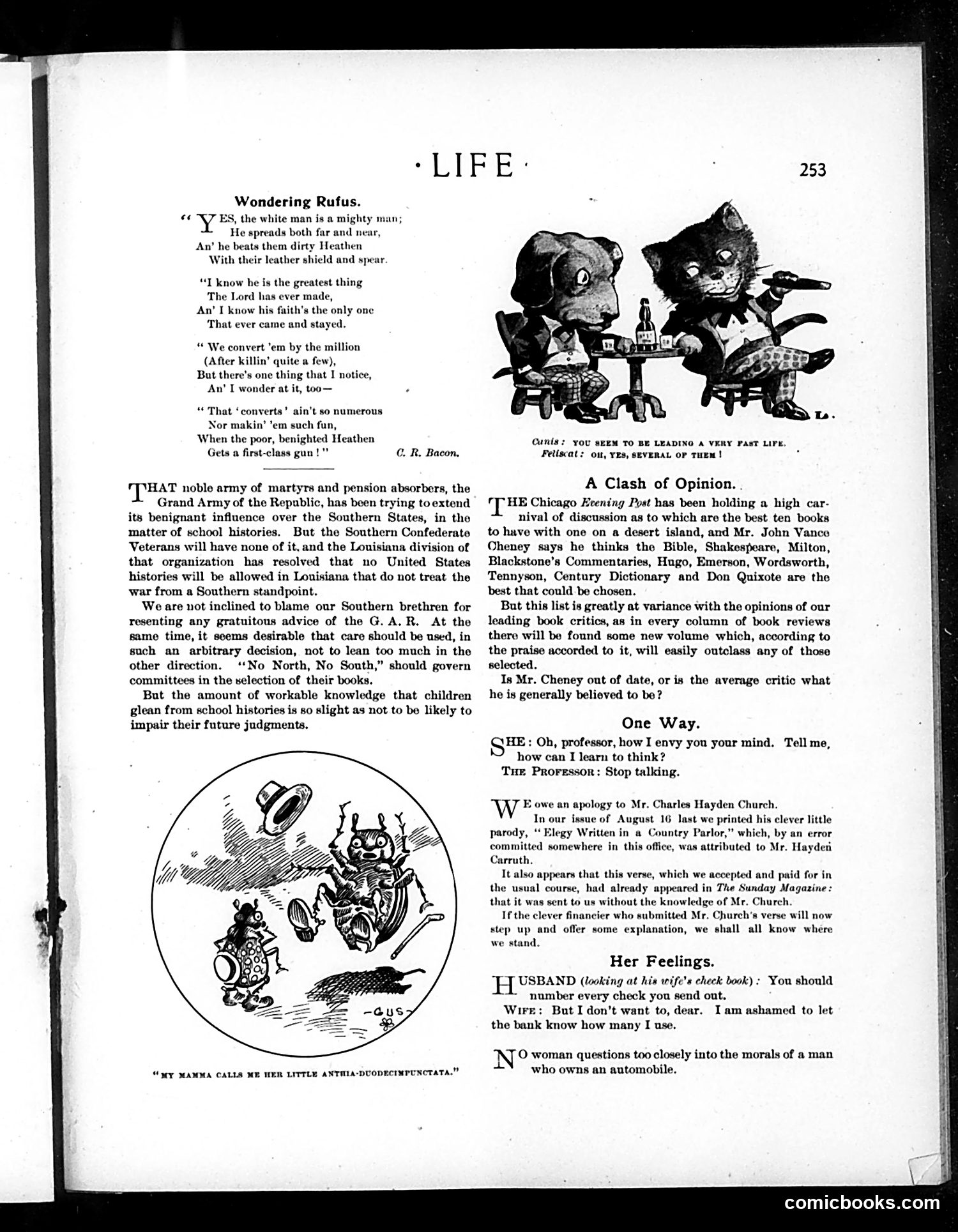
This page contains multiple satirical pieces typical of early 20th-century American humor: **"Wondering Rufus"** is a dialect poem by C.R. Bacon satirizing Christian missionary work. A Black speaker observes that white colonizers "convert" indigenous peoples "by the million" while simultaneously killing them, then notes the converts lose enthusiasm once they obtain modern weapons—undermining the moral superiority claims of Western imperialism. **The school history debate** criticizes both the Grand Army of the Republic (Union veterans' organization) for imposing Northern textbooks on the South, and Southern Confederate Veterans for rejecting them outright. Life argues neither "North, No South" bias should govern educational materials. **Animal cartoons** ("Canis/Feliscat") use anthropomorphized pets discussing fast living—light humor with no apparent deeper meaning. **"A Clash of Opinion"** disputes which books are "best"—mocking that newspaper critics constantly praise new volumes while ignoring classics like those John Vanco Cheney advocates (Bible, Shakespeare, Milton, etc.). Minor pieces include editorial corrections and jokes about professors, women's checkbooks, and automobile owners—typical period humor reflecting gender and class anxieties.
📄 Transcribed text from this page (OCR, searchable)
Machine-transcribed from the original scan — historical spelling and the odd misread are preserved.
Wondering Rufus. £¢ YES, the white man is a mighty man; He spreads both far and near, An’ he beats them dirty Heathen With their leather shield and spear. “I know he is the greatest thing The Lord has ever made, An’ I know his faith’s the only one That ever came and stayed. “We convert ‘em by the million (After killin’ quite a few), But there's one thing that I notice, An’ I wonder at it, too— “That ‘converts’ ain't so numerous Nor makin’ ‘em such fun, When the poor, benighted Heathen Gets a first-class gun @. R, Bacon, ysat noble army of martyrs and pension absorbers, the Grand Army of the Republic, has been trying toextend its benignant influence over the Southern States, in the matter of school histories. But the Southern Confederate Veterans will have none of it, and the Louisiana division of that organization has resolved that no United States histories will be allowed in Louisiana that do not treat the war from a Southern standpoint. We are not inclined to blame our Southern brethren for resenting any gratuitous advice of the G.A.R. At the same time, it seems desirable that care should be used, in such an arbitrary decision, not to lean too much in the other direction. ‘‘No North, No South,” should govern committees in the selection of their books. But the amount of workable knowledge that children glean from school histories is so slight as not to be likely to impair their future judgments. SY MAIOWA CALLS ME HER LITTLE ANTHIA-DUODECINPUNCTATA.” Canis: YoU SEEM TO BE LEADING A VERY PasT Lire. Feliscat: ow, YES, SEVERAL or THEM! A Clash of Opinion. TH Chicago Ecening Post has been holding a high car- nival of discussion as to which are the best ten books to have with one on a desert island, and Mr. John Vanco Oheney says he thinks the Bible, Shakespeare, Milton, Blackstone's Commentaries, Hugo, Emerson, Wordsworth, Tennyson, Century Dictionary and Don Quixote are the best that could be chosen. But this list is greatly at variance with the opinions of our leading book critics, as in every column of book reviews there will be found some new volume which, according to the praise accorded to it, will easily outclass any of those selected. Is Mr. Cheney out of date, or is the average critic what he is generally believed to be? One Way. SBE: Oh, professor, how I envy you your mind. Tell me, how can I learn to think? Tue Proressor: Stop talking. ‘W E owe an apology to Mr. Charles Hayden Church. In our issue of August 16 last we printed his clever little parody, ‘Elegy Written in a Country Parlor,” which, by an error committed somewhere in this office, was attributed to Mr. Hayden Carruth. It also appears that this verse, which we accepted and paid for in the usual course, had already appeared in The Sunday Magazine: that it was sent to us without the knowledge of Mr. Church. If the clever financier who submitted Mr. Church's verse will now step up and offer some explanation, we shall all know where we stand, Her Feelings. “EL OSBAND (looking at his wife's check book): You should number every check you send out. Wire: But I don’t want to, dear. Iam ashamed to let the bank know how many I use. N O woman questions too closely into the morals of a man who owns an automobile. comicbooks.com