
A complete issue · 20 pages · 1900
Life — September 20, 1900
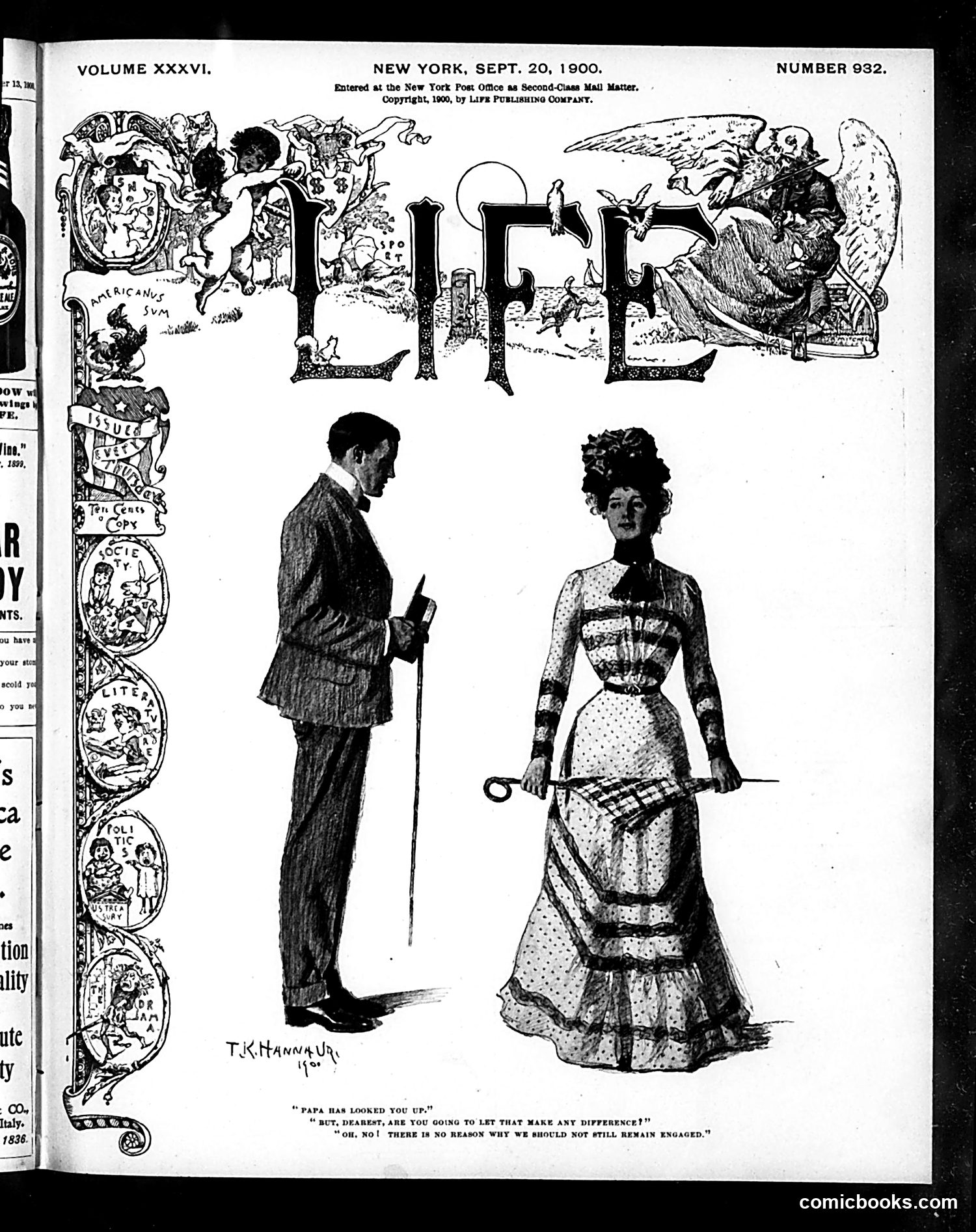
This satirical cartoon depicts a romantic tension about marriage and women's independence. A man in formal attire holds a cane while looking away from a woman in an elegant dress who holds an umbrella—a potential symbol of self-reliance or defiance. The dialogue reads: "Papa has looked you up." / "But, dearest, are you going to let that make any difference?" / "Oh, no! There is no reason why we should not still remain engaged." The joke plays on late-Victorian anxieties about courtship: a suitor's character investigation ("looked you up") by the woman's father has apparently revealed unflattering information. Yet the couple proposes to proceed anyway—suggesting either youthful defiance of parental authority or satirical commentary on how little scandal matters to modern couples.
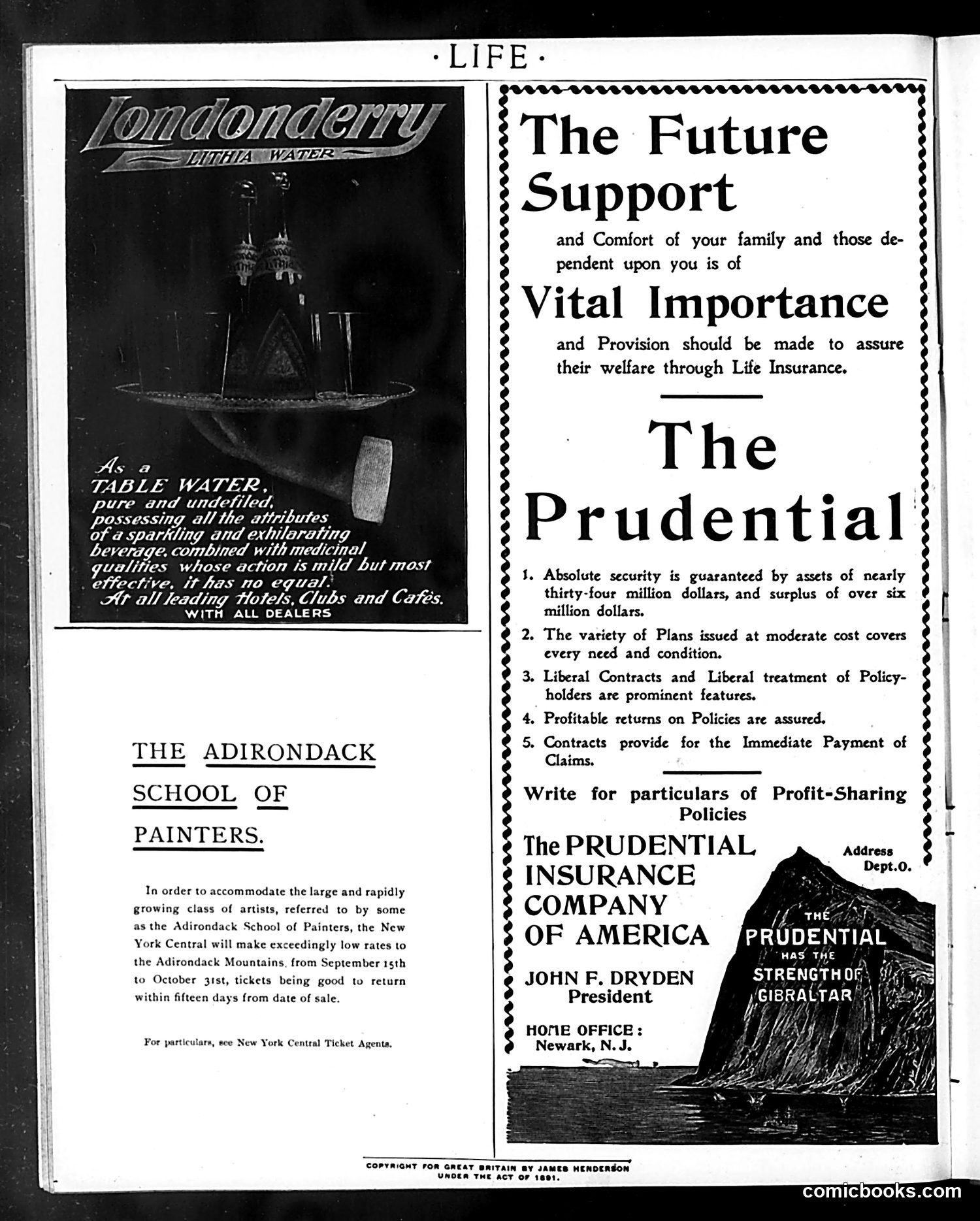
This page contains **no political cartoons or satire**—it's primarily advertising content from what appears to be an early 20th-century issue of *Life* magazine. The left side advertises **Londonderry Table Water**, a bottled water product marketed to hotels and upscale establishments, and announces the **Adirondack School of Painters**, promoting excursion tickets via the New York Central Railroad (September 15–October 31). The right side features a large advertisement for the **Prudential Insurance Company**, emphasizing life insurance as financial security for families. The company's famous slogan "The Prudential was the Strength of Gibraltar" appears with an image of the Rock of Gibraltar, a well-known advertising motif from this era. No satirical commentary or political figures are present on this page.
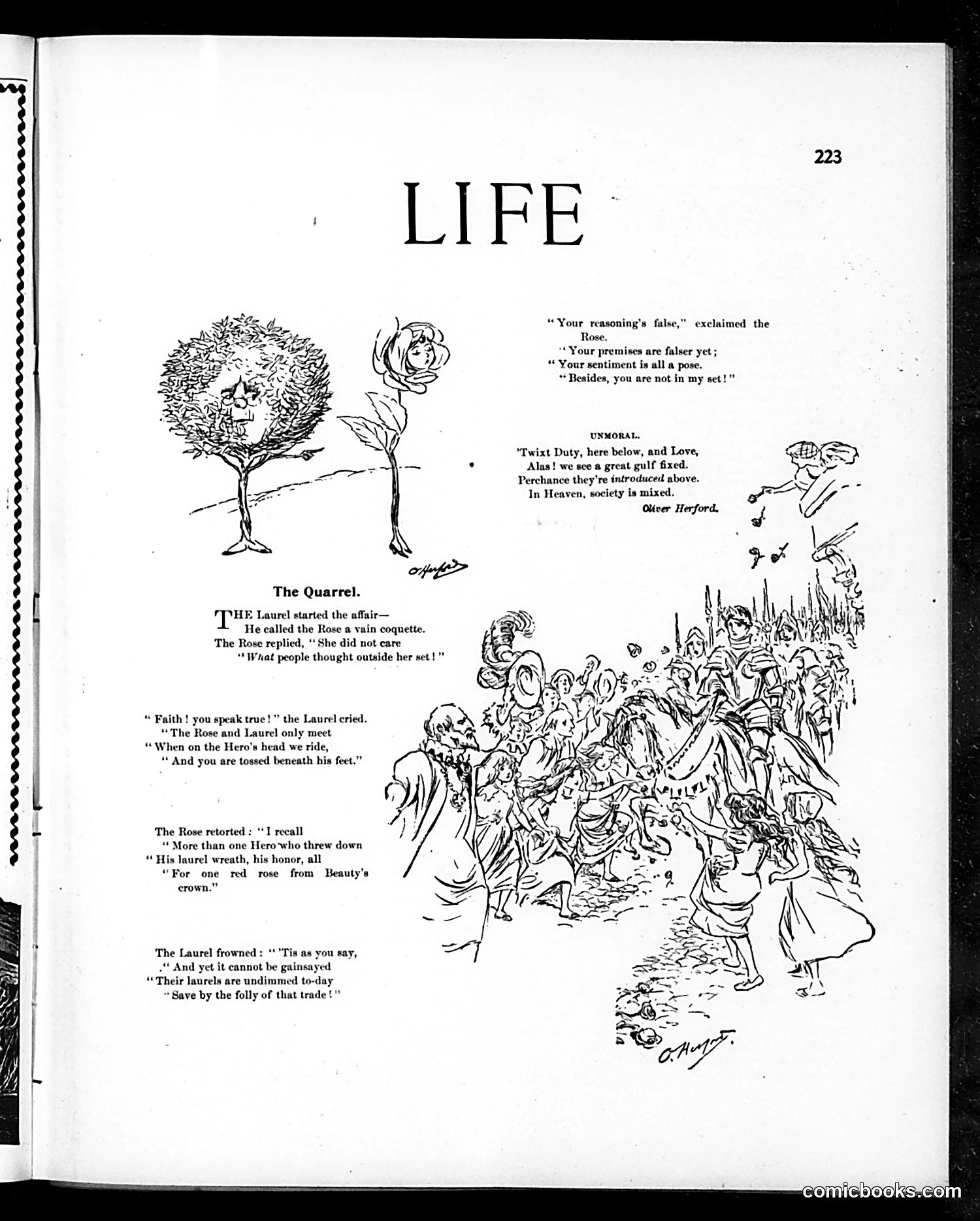
This page presents "The Quarrel," a satirical piece about the Rose and Laurel—classical symbols of beauty and honor respectively. The dialogue suggests a philosophical dispute where the Rose claims superiority based on aesthetic appeal ("I did not care if people thought outside her set"), while the Laurel asserts moral authority through association with heroic achievement. The accompanying Oliver Herford quote and large crowd scene appear to critique social hierarchy and class distinctions. The satire likely mocks Victorian-era debates about whether beauty or virtue should reign supreme, or possibly comments on tension between aristocratic pretension and democratic values. The detailed crowd illustration emphasizes how such quarrels affect society broadly, though the specific historical referent remains unclear without additional context.
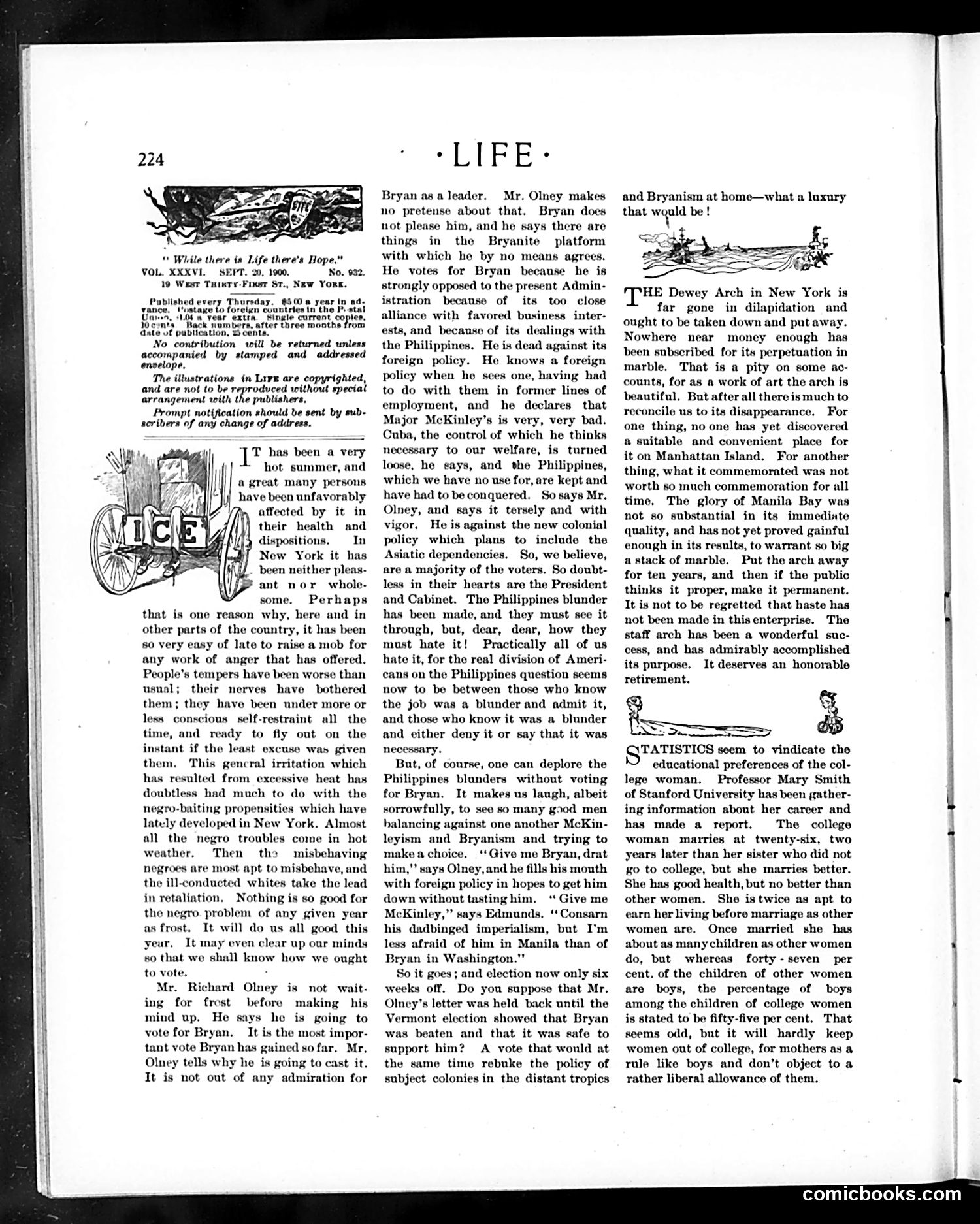
This page discusses American politics around the 1900 presidential election, specifically criticizing William Jennings Bryan's candidacy and the Democratic platform. The article references Bryan's opposition to colonial expansion (particularly the Philippines) and debates over imperialism. The left sidebar contains an illustration labeled "ICE" showing what appears to be a cart or vehicle, likely satirizing the difficulty of "cooling" public tempers during heated political debate—a common metaphor of the era. The text criticizes Bryan supporters' emotional reactions and suggests the Philippines question has divided the Democratic Party. It also includes commentary on educational statistics regarding college-educated women and marriage rates—apparently a separate satirical observation on contemporary social trends, unrelated to the Bryan discussion.
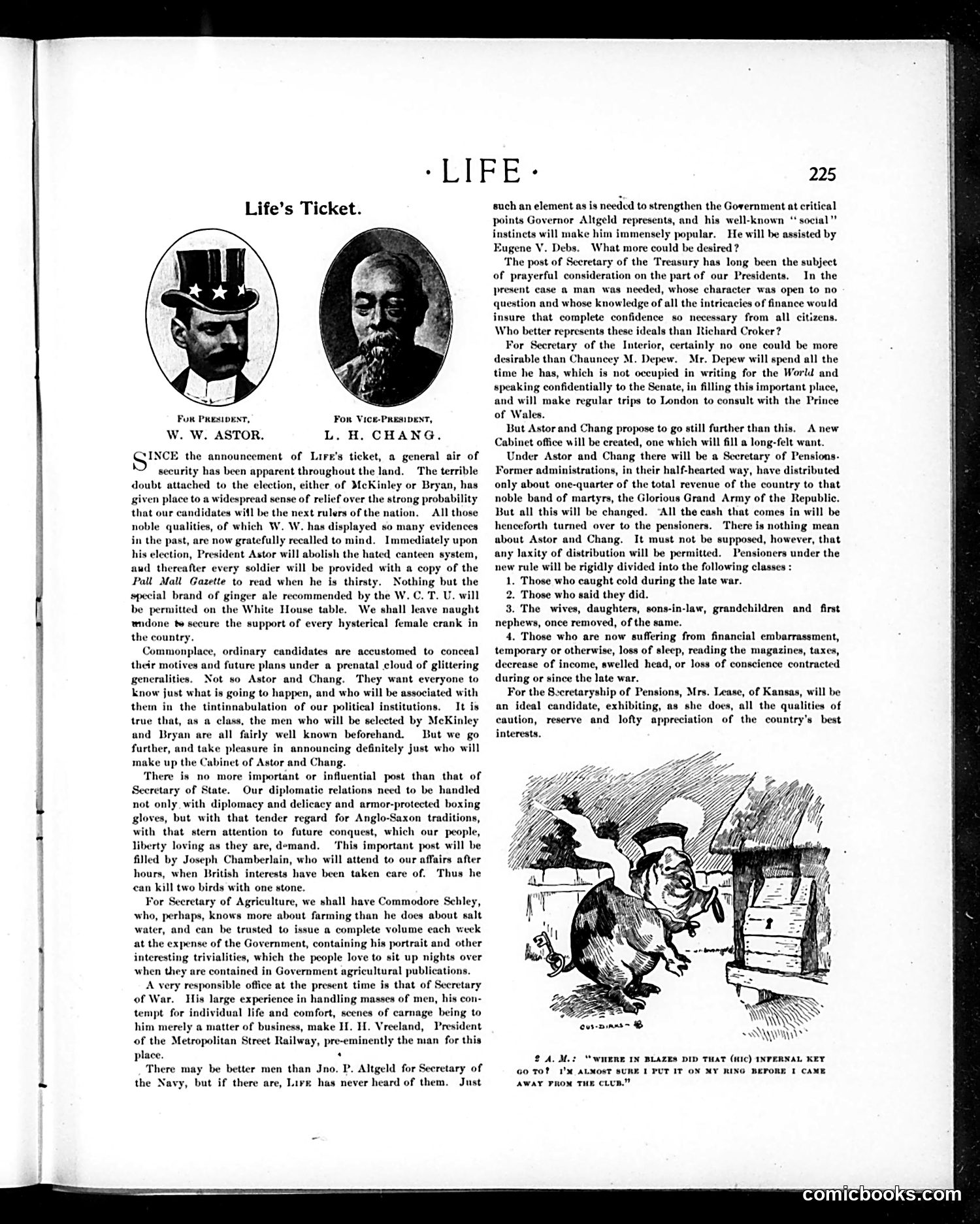
This page satirizes the 1912 U.S. presidential election through two portraits labeled "For President" (W.W. Astor) and "For Vice-President" (L.H. Chang). The accompanying text proposes a satirical "Cabinet of Astor and Chang," mocking the idea of wealthy dilettantes and foreigners holding high office. The article humorously describes absurd Cabinet positions: Commodore Shirley for Agriculture (who knows about "salt water"), Joseph Chamberlain for State (British diplomat), and others—all presented as unqualified candidates the magazine claims would somehow represent American interests. The cartoon at page bottom depicts a man unable to locate his "imperial key," suggesting government incompetence. The satire targets how wealth and connections, rather than merit or citizenship, determine political appointments.
This page contains primarily **literary notices and advertisements** rather than political cartoons. The main illustration—"The Latest Books"—is a decorative header showing a figure surrounded by stacked books and reading materials. The content focuses on book reviews and announcements, including references to works about China and the Far East, a story called "A Mountain Moloch," and papers on the Spanish War and Philippine expansion. The only satirical element appears subtle: a note about "Tommy and Grizel" by J.M. Barrie, with commentary that even if the book's publication drags on, "this is encouraging"—likely gentle mockery of delayed literary projects. There is **no clear political cartoon** on this page—it's primarily a books-and-letters section typical of Life's cultural coverage during this period.
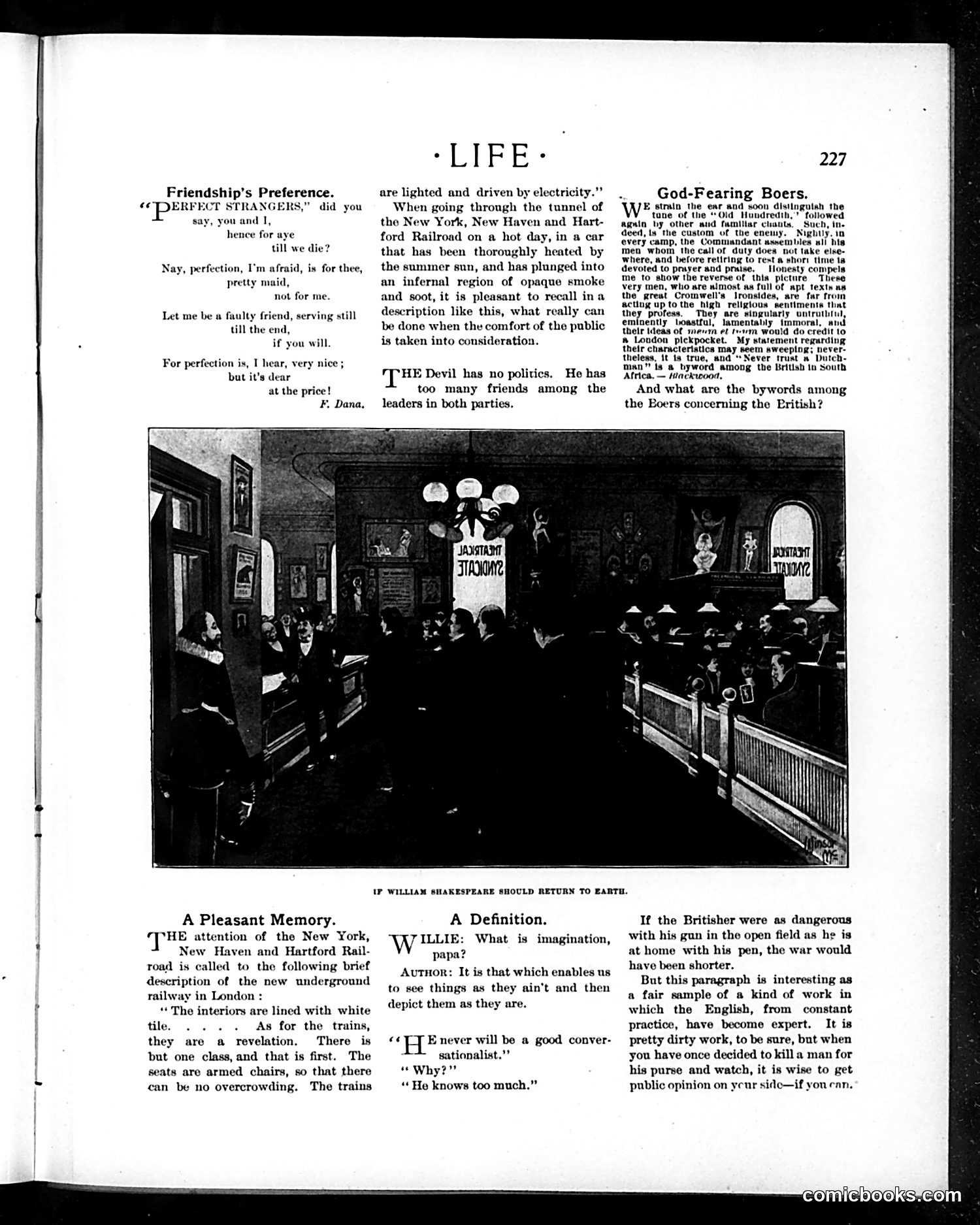
This page satirizes a theatrical or public event, likely a Shakespeare performance or lecture. The large central illustration shows a crowded indoor venue with "Shakespeare" signage visible above the stage area, packed with an engaged audience. The caption questions what would happen if Shakespeare returned to Earth—a thought experiment about whether the historical playwright could appreciate modern theatrical innovation or staging. The surrounding text includes comedic dialogues and observations about imagination, covering-up one's work, and public opinion. The satire appears to mock both pretentious literary criticism and the gap between classic literature and contemporary performance practices. This reflects early 20th-century debates about how canonical works should be staged and appreciated by modern audiences.
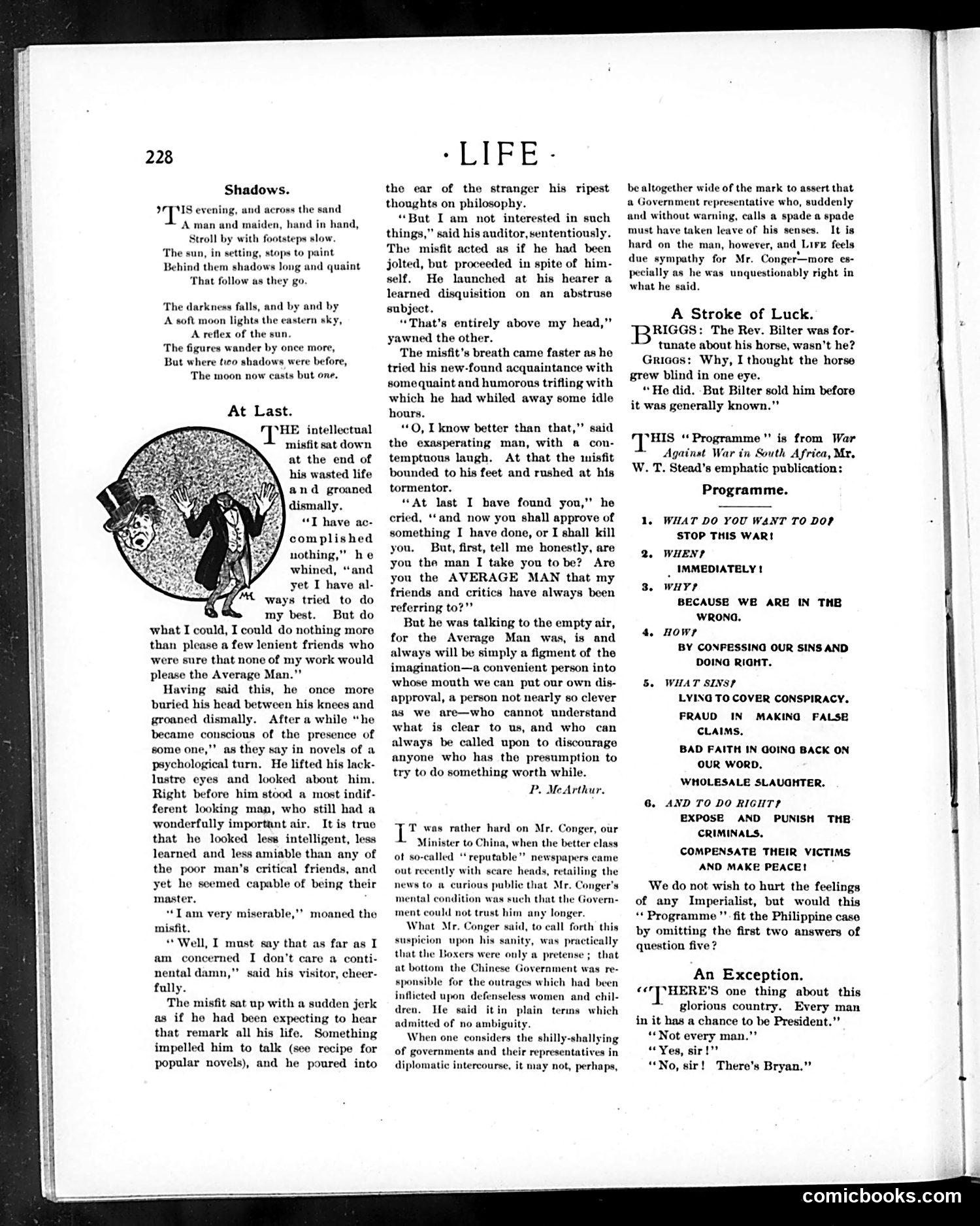
This page contains literary fiction and social commentary rather than political cartoons. The main illustrated piece, "At Last," depicts an intellectual man in despair, having wasted his life pursuing vague ideals. The narrative mocks those obsessed with abstract philosophy and the "Average Man" concept—a critique of intellectuals disconnected from practical reality. The adjacent section "A Stroke of Luck" presents a brief anecdote about a horse dealer, while "A Programme" outlines demands attributed to the "War Against War in South Africa," including calls to stop war, confess governmental sins, and expose/punish criminals. The final piece, "An Exception," is a brief political joke suggesting Bryan (likely William Jennings Bryan) as a presidential candidate, implying even he couldn't become president in this "glorious country."
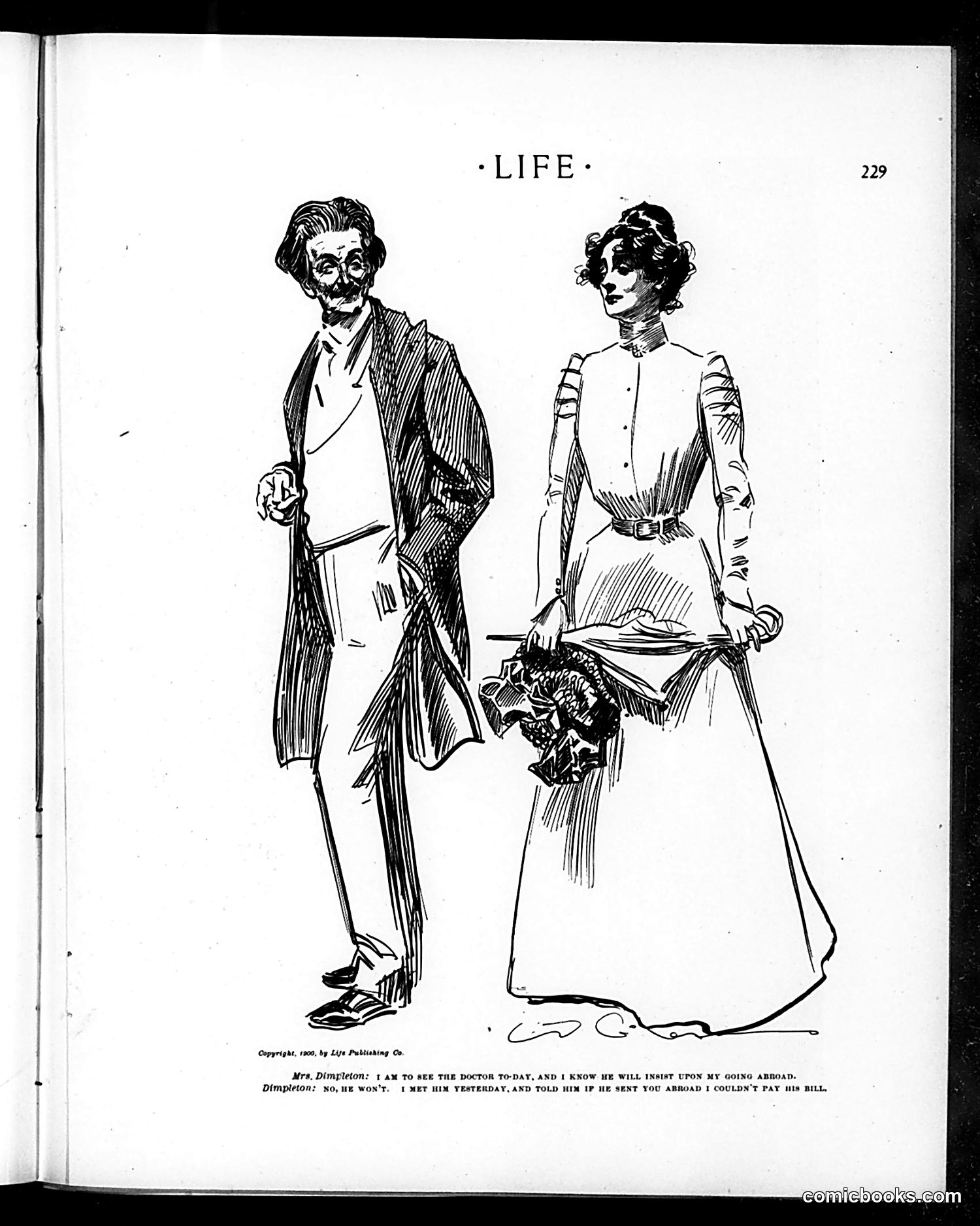
This is a satirical cartoon from Life magazine (copyright 1908) depicting a domestic disagreement about medical expenses. **The Scene:** A well-dressed couple in Edwardian-era clothing. The woman holds a doctor's bill; the man appears defensive. **The Dialogue:** - Mrs. Dimplaton: "I am to see the doctor to-day, and I know he will insist upon my going abroad." - Dimplaton: "No, he won't. I met him yesterday, and told him if he sent you abroad I couldn't pay his bill." **The Satire:** The cartoon mocks both frivolous wealthy women who use doctor's orders as pretexts for expensive travel, and husbands' attempts to control their wives' spending by manipulating their physicians. It satirizes the intersection of spousal dynamics, medical authority, and class-based consumer behavior in the early 1900s.
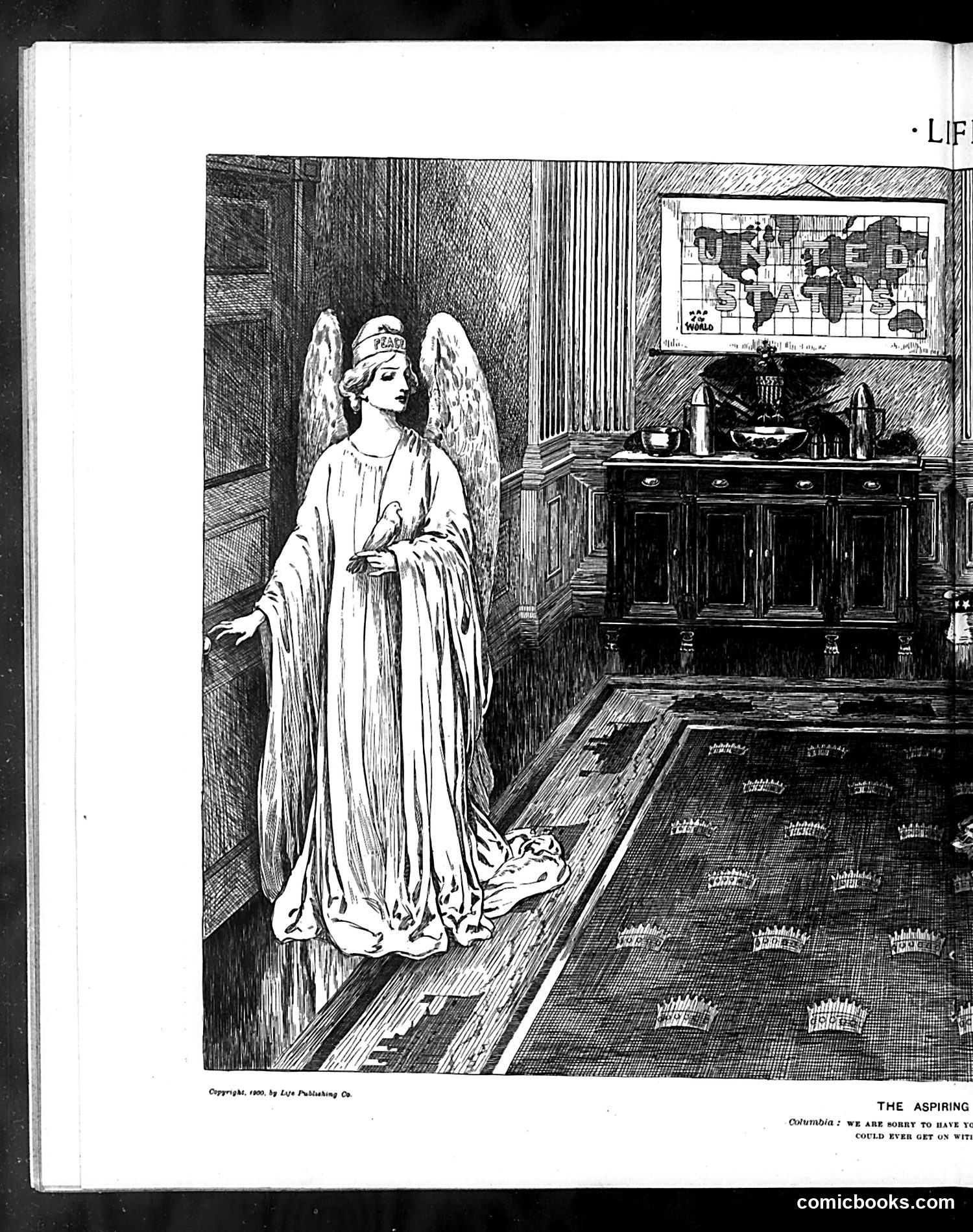
This political cartoon depicts an angel entering an ornate interior space, appearing to present or offer something (possibly represented by the small object in her hand). The room contains a large desk and a world map on the wall. The caption reads: "Columbia: WE ARE SORRY TO HAVE YOU COULD EVER GET ON WITH[...]" (text is partially cut off). "Columbia" refers to the personification of the United States. The angel likely represents an ideal or aspirational concept—possibly peace, virtue, or divine intervention. The satire appears to critique America's inability to function or succeed without external help or guidance, though the incomplete caption prevents definitive interpretation of the specific political message or event being referenced.
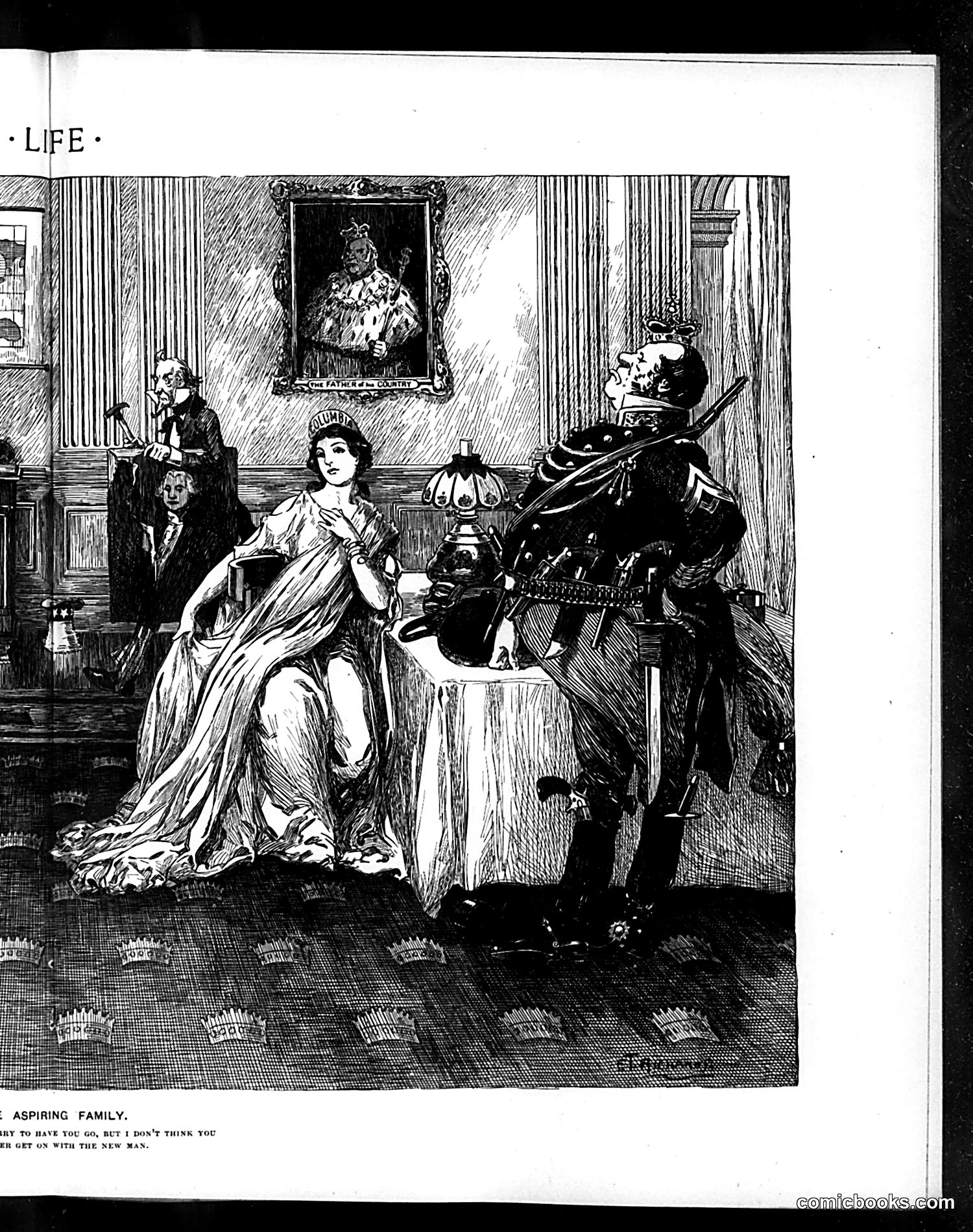
This Life magazine cartoon satirizes social climbing and class anxiety. The scene depicts an elegant woman in a drawing room with military officers and aristocratic figures. The partially visible caption suggests tension about acquiring "the new man"—likely satirizing aspiring families' efforts to marry into higher social status or military prestige. The ornate interior with its portrait and formal furnishings emphasizes the characters' wealth and pretension. The woman's elaborate gown and reclining pose suggest leisure-class affectation. The uniformed officers represent desirable social connections—marrying military or aristocratic men was a path to elevated status. The cartoon mocks the superficiality of "aspiring" middle or upper-middle-class families desperately pursuing social advancement through advantageous marriages, a recurring satirical theme in early 20th-century American humor.
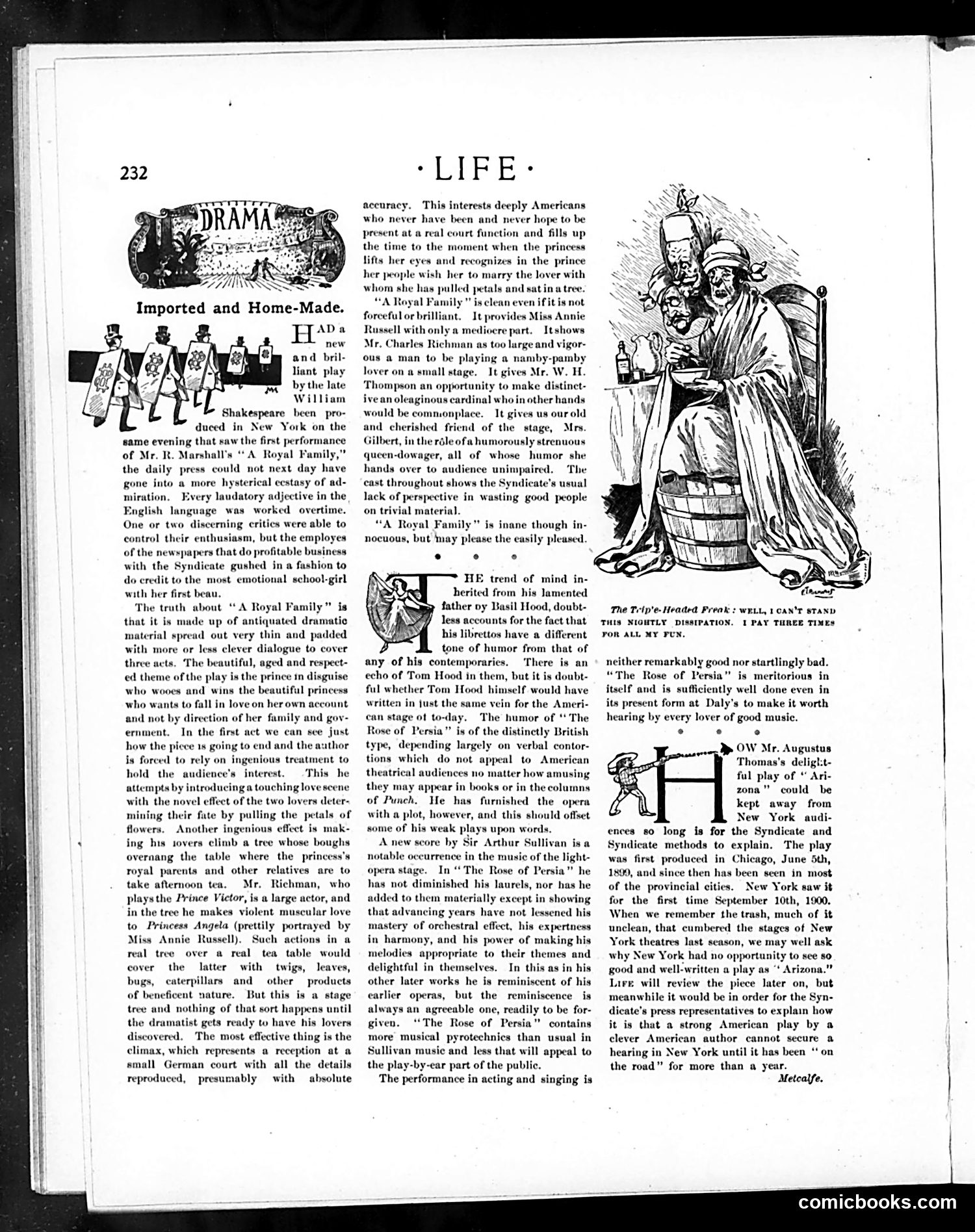
This page reviews theatrical productions, primarily focusing on "A Royal Family" by William Shakespeare (likely a contemporary adaptation). The main illustration shows characters in period costume, apparently depicting a scene from the play. The review criticizes the production as relying on "articulated dramatic material" and "clever dialogue" rather than substance. It mocks the cast—particularly noting Charles Richman as oversized for his role and Annie Russell in a "mediocre part." The text also discusses "The Rose of Persia" (an opera by Sullivan), praising its British wit while noting American audiences may find its verbal humor less appealing than its musical elements. The page represents typical turn-of-century theatrical criticism, satirizing both overwrought stage productions and the disconnect between British and American theatrical tastes.
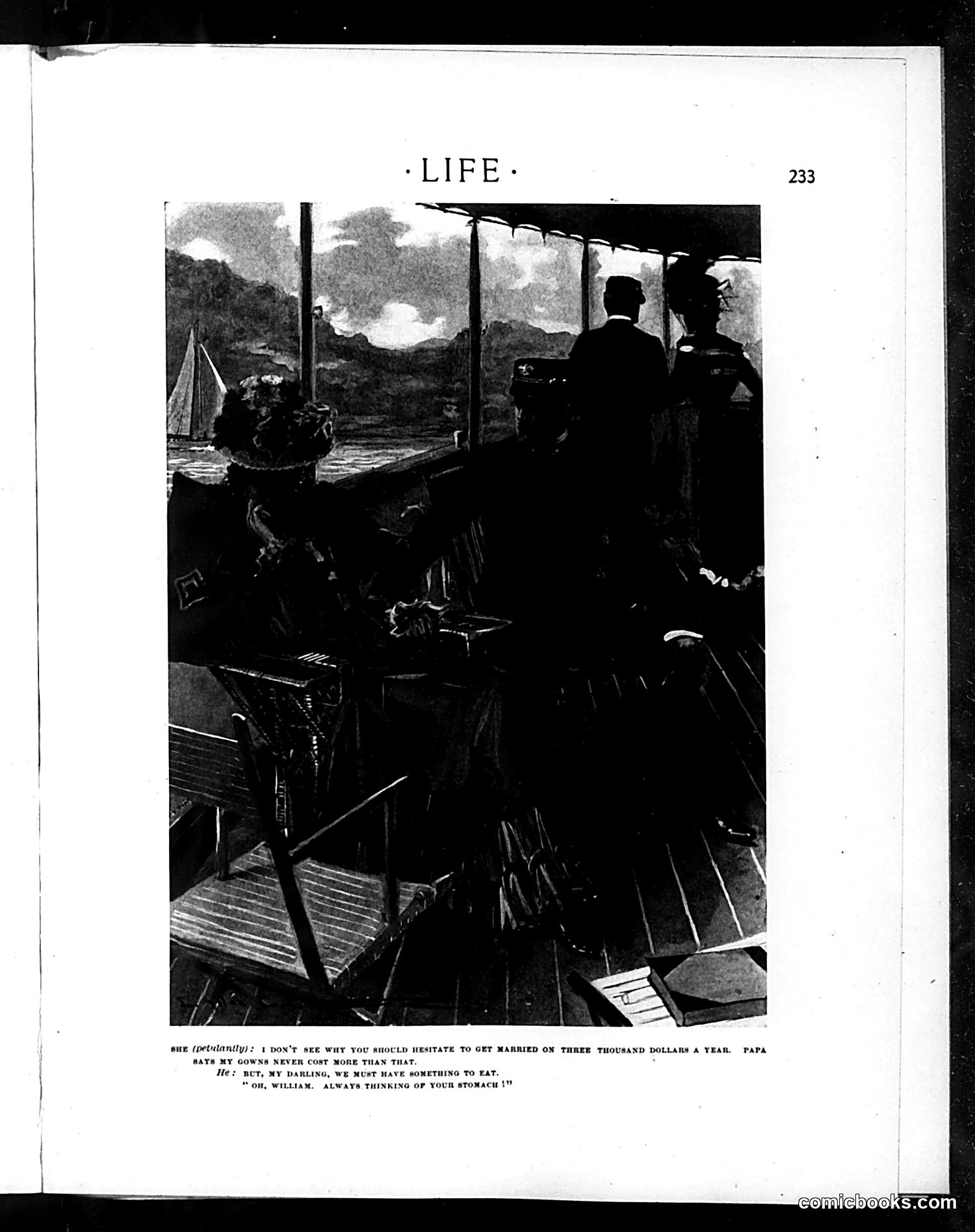
This is a satirical illustration about wealth and marriage expectations, likely from the early 20th century. The cartoon depicts an upper-class woman (labeled "she") on a boat or yacht, dismissing her suitor's financial concerns. She claims three thousand dollars annually is plenty—her clothing budget alone. He (labeled "he") pragmatically notes they need food to survive. The satire targets wealthy women's obliviousness to ordinary expenses and priorities. The woman's complaint that he's "always thinking of your stomach" mocks her detachment from basic necessities. The luxurious setting reinforces the class commentary: wealthy women lived in such insulated circumstances that feeding oneself seemed trivial compared to fashion.
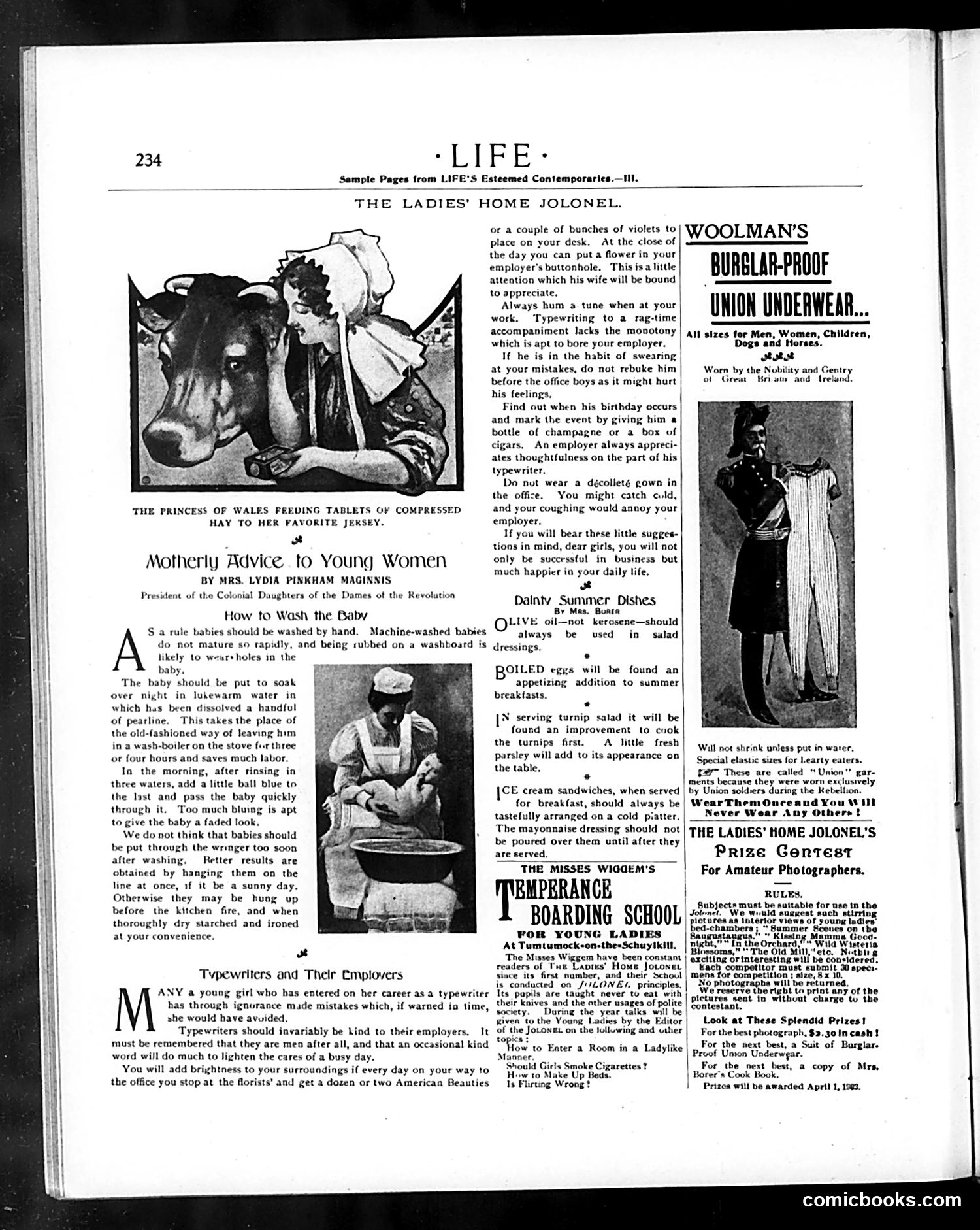
This page satirizes women's magazines of the era through mock "advice" columns. The central cartoon depicts the "Princess of Wales feeding tablets of compressed hay to her favorite Jersey" — likely mocking both the British royal family and the sentimental tone of contemporary women's publications. The accompanying "Motherly Advice to Young Women" column parodies advice columnists like Lydia Pinkham. The satire is absurdist: babies should be "machine-washed" on washboards, hung on clotheslines to dry, then starched and ironed. Female typewriter operators should wear flowers for their male employers, hum ragtime accompaniment, and tolerate their employers' swearing without complaint. The "Dainty Summer Dishes" section includes obviously ridiculous culinary tips (use "live oil—not kerosene"). Life mocks both the patronizing tone of women's magazines and the subordinate, deferential role expected of female workers, using exaggeration to expose how absurd these expectations were.
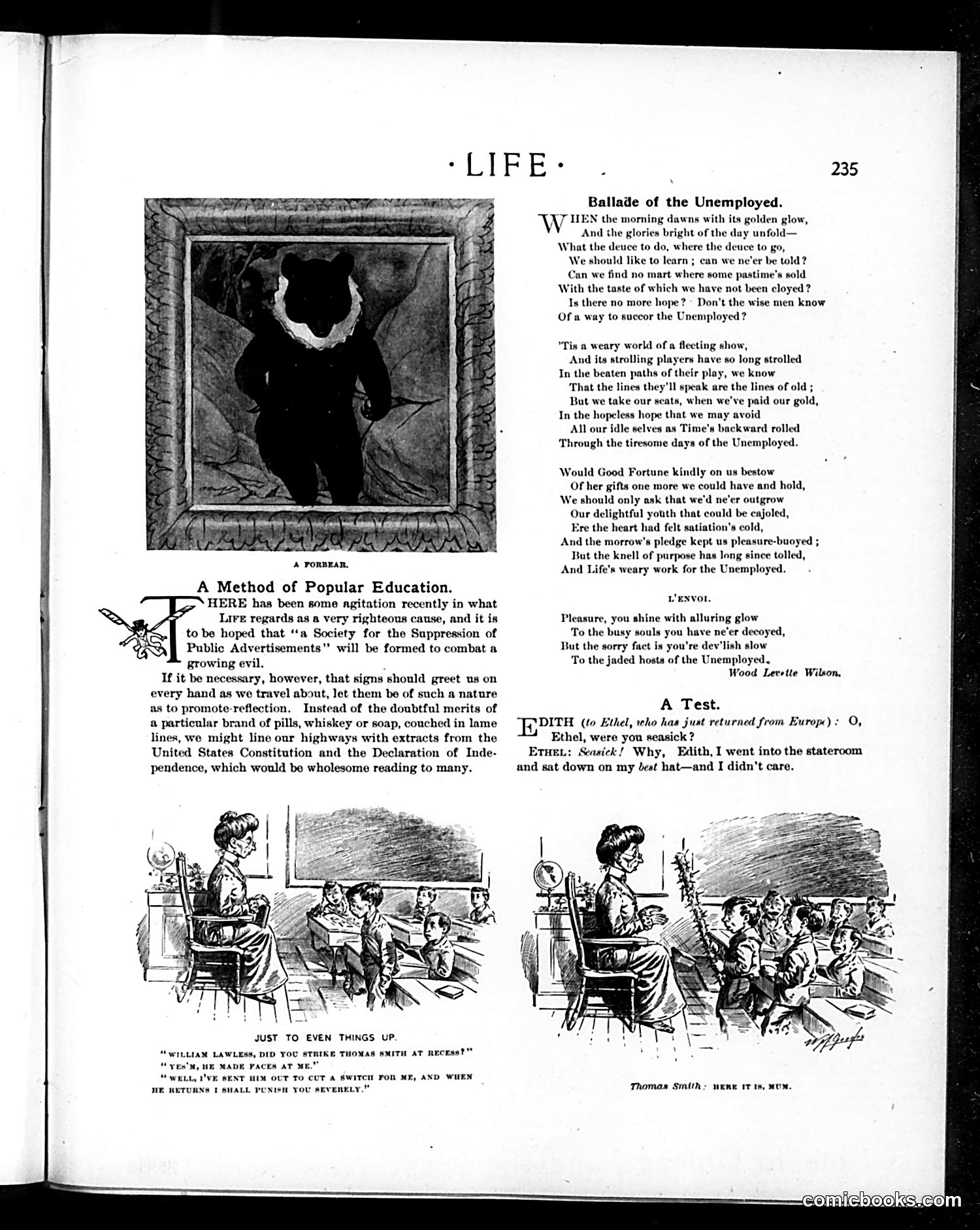
This *Life* magazine page contains three satirical pieces about early 20th-century social issues: 1. **"A Method of Popular Education"**: The article proposes that highway billboards should display excerpts from the Constitution and Declaration of Independence instead of advertisements for pills, whiskey, and soap. It's satire criticizing both aggressive commercial advertising and the naive belief that constitutional quotes would meaningfully educate the public. 2. **"Just to Even Things Up"**: A cartoon showing a teacher punishing a student (William Lawless) for striking another student (Thomas Smith) by making him cut a switch to be beaten with. The satire critiques the hypocrisy of corporal punishment as "justice"—the authority figure commits the same violence the child did. 3. **"Ballade of the Unemployed"**: A poem lamenting joblessness and boredom among the idle wealthy or leisured class—people with time but no purpose. It's unclear whether this satirizes their complaint or genuinely sympathizes with ennui. 4. **"A Test"**: A brief humorous dialogue where a woman returning from Europe demonstrates seasickness's severity by her indifference to ruining her hat.
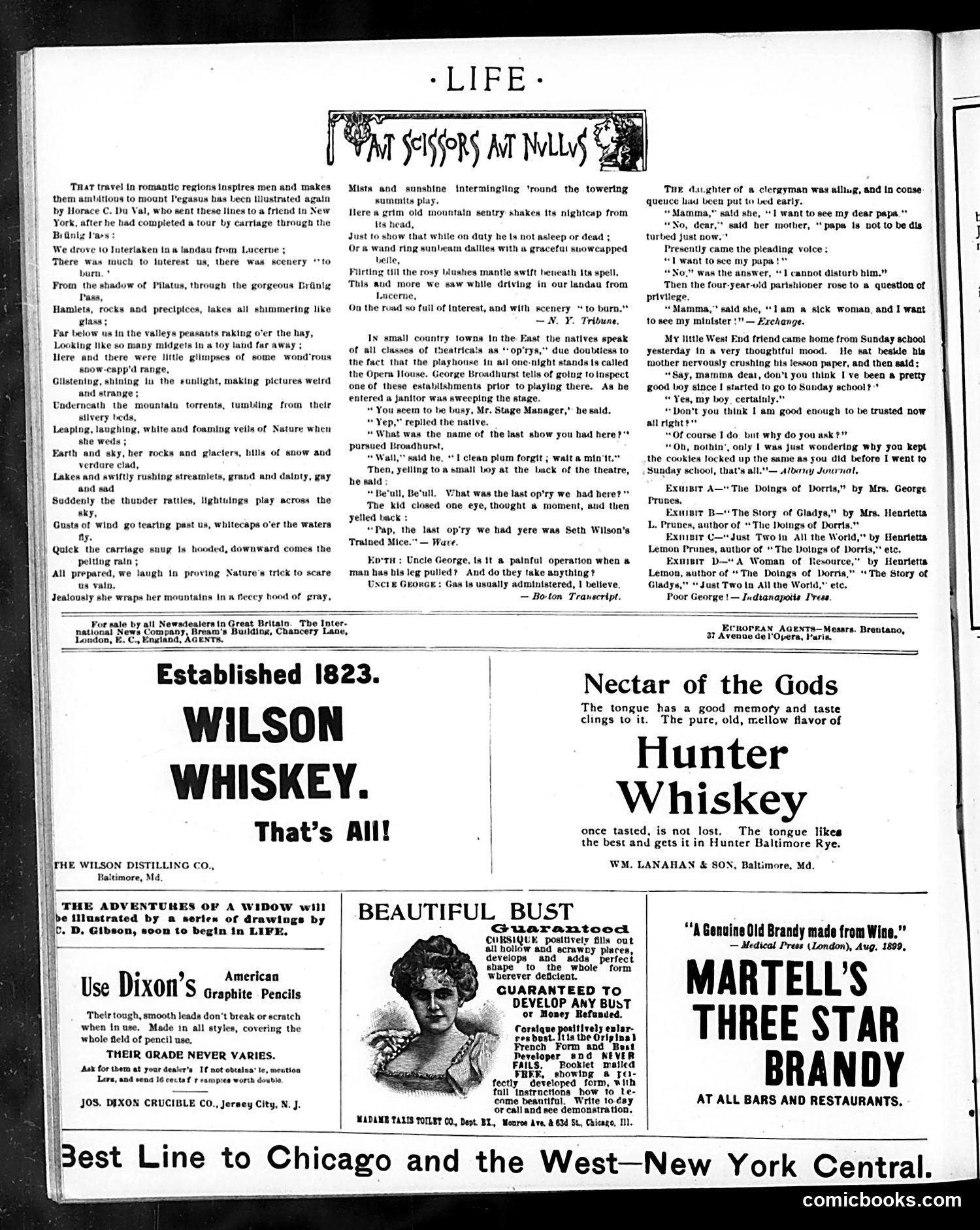
This page is primarily **advertising and light humor**, not political satire. The content includes: **Main Feature:** A romantic travel poem by Horace C. Du Val describing a carriage tour through Swiss mountain scenery (Lucerne, Pilatus, Briünig Pass). The verse celebrates dramatic landscapes—torrents, glaciers, storms—in flowery Victorian language. This illustrates the period's Romantic fascination with Alpine scenery. **Humor Pieces:** Several brief comic anecdotes, including: - A story about theater terminology: rural people call all theatrical productions "op'rys" (operas), leading to confusion when a theater manager asks about the last show - A child's logic about visiting her "minister" (misunderstanding "minister" for a family member) - A joke about anesthesia during medical procedures **Advertisements:** Wilson Whiskey, Hunter Whiskey, Martell's Brandy, Dixon's Pencils, and a bust-development product dominate the lower half. The page reflects late-19th/early-20th-century middle-class interests: travel romance, gentle domestic humor, and consumer goods.
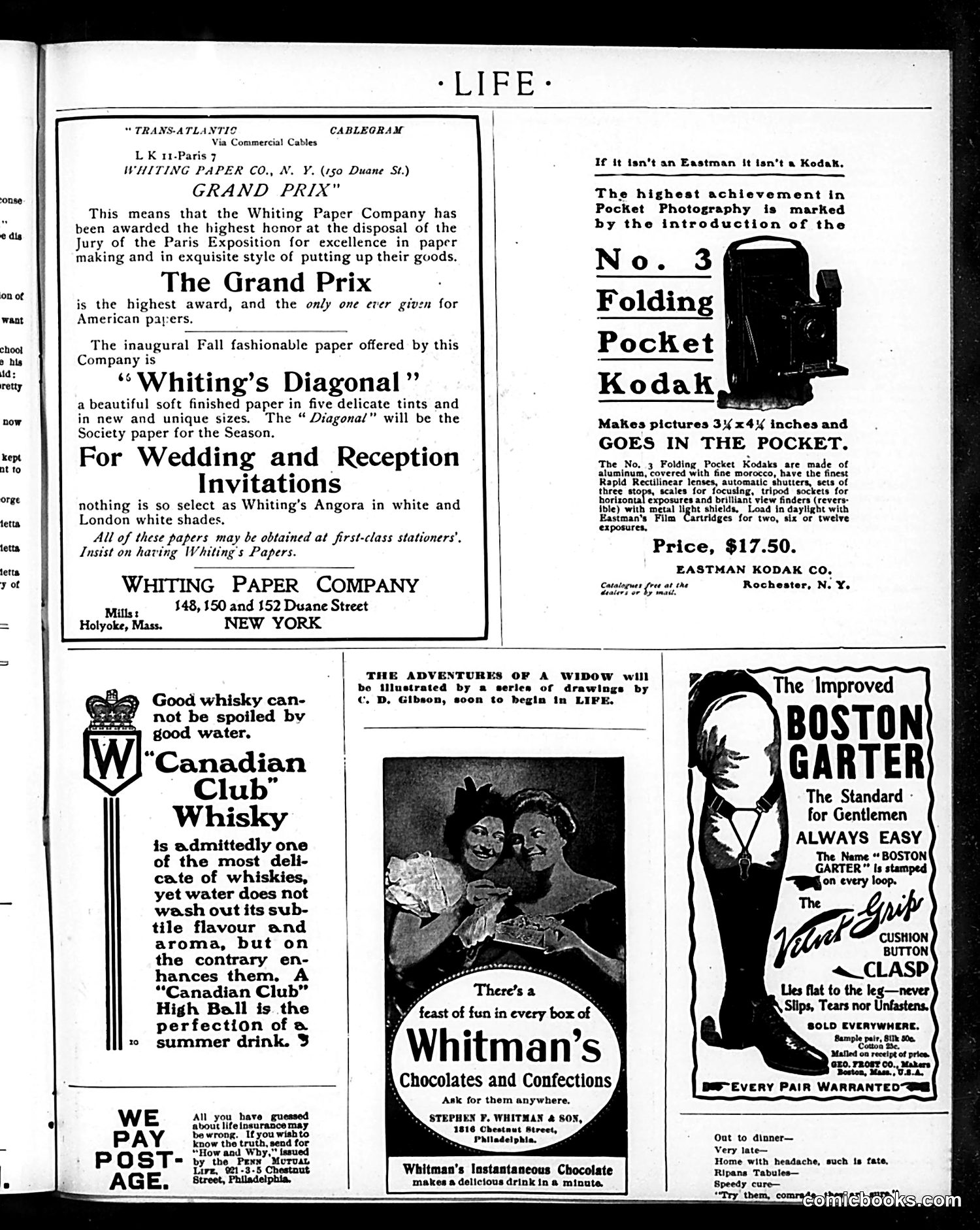
This is primarily an **advertising page** from Life magazine, with one notable editorial announcement. The main content consists of product advertisements for: - **Whiting Paper Company** (announcing a Grand Prix award from the Paris Exposition) - **Kodak No. 3 Folding Pocket Camera** - **Canadian Club Whisky** - **Boston Garter** (men's hosiery) - **Whitman's Chocolates** - **Ripans Tabules** (patent medicine/digestive aid) The only non-advertising editorial element is a **teaser announcement** for an upcoming illustrated series titled "The Adventures of a Widow," to be drawn by C.D. Gibson (a prominent illustrator of the era). Gibson's mention here suggests this was a significant feature. The small "We Pay Post-Age" notice appears to be about Life's insurance advertising policies. The page reflects early 20th-century consumer culture, with luxury goods and new technologies (pocket cameras) marketed to affluent readers. The Ripans Tabules ad humorously suggests the magazine's readers overindulge in dining and drink.
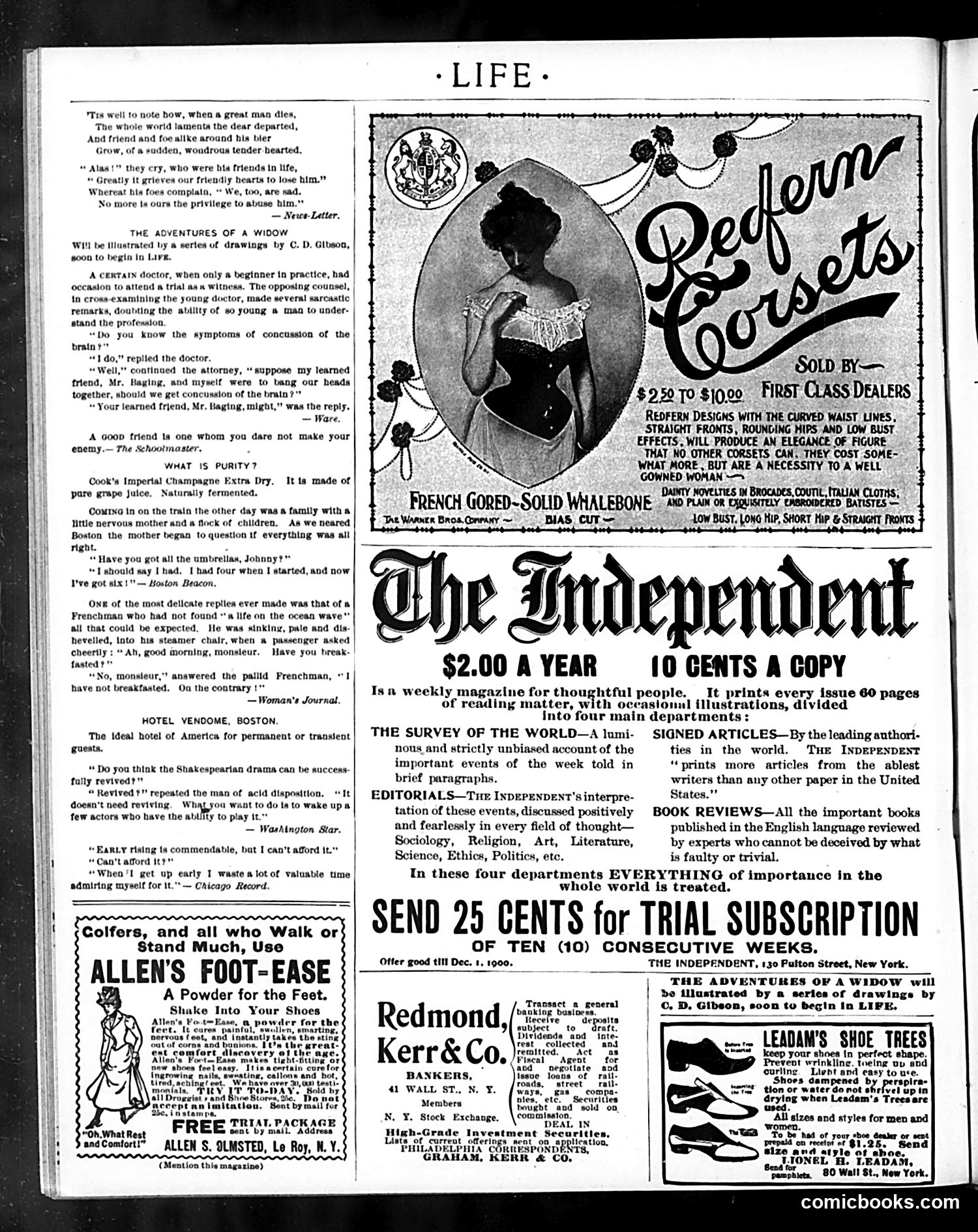
This page primarily contains **humorous anecdotes and advertisements** rather than political cartoons. The content reflects early 1900s sensibilities: **Humor sections** include jokes about: - A young doctor's witty courtroom retort about "concussion of the brain" - A mother losing umbrellas on a train (she started with 4, now has 6) - A seasick Frenchman's darkly comic response to breakfast inquiries - Critiques of Shakespearean acting **The social commentary** is gentle satire on everyday life—legal proceedings, family travel, and theater—rather than sharp political critique. **Advertisements** dominate, hawking Redfern corsets (emphasizing fashionable curved silhouettes), Allen's Foot-Ease powder, and promoting *The Independent* magazine itself as a publication for "thoughtful people." **Notable announcement**: C.D. Gibson will soon illustrate "The Adventures of a Widow" in Life—Gibson was famous for his idealized "Gibson Girl" illustrations. The page reflects a magazine aimed at middle-class readers interested in fashion, gentle humor, and self-improvement products.
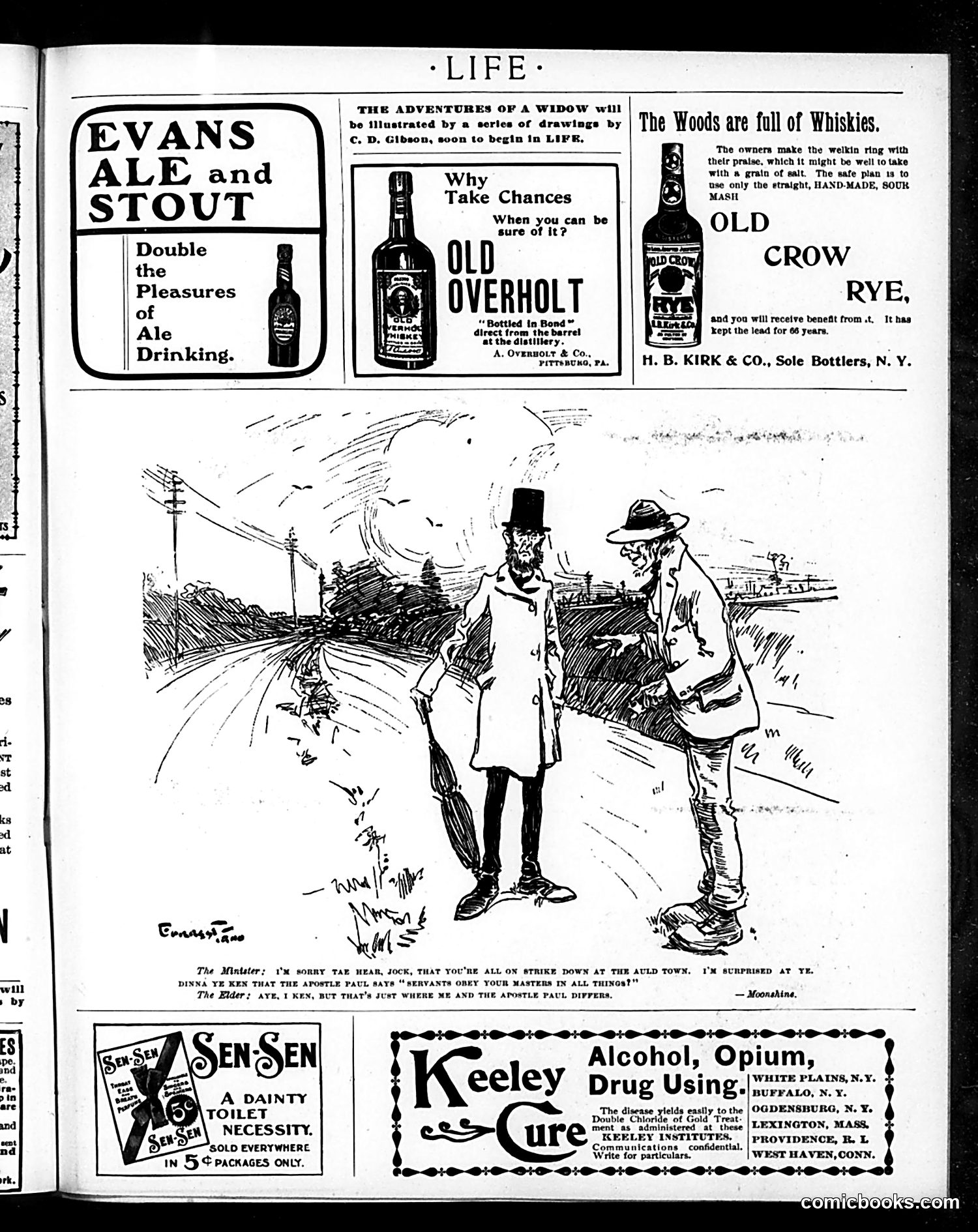
This page from Life magazine contains advertisements and one political cartoon by C.D. Gibson (credited at top). **The Main Cartoon** depicts a dialogue between a Scottish minister and elder. The minister quotes the Apostle Paul to justify worker obedience during a strike at "the auld town" (old town). The elder responds that he and Paul "differ" on this point—a direct challenge to using scripture to suppress labor organizing. **The Satire**: This mocks the use of religious authority to discourage strikes and workers' rights. The elder's defiant response suggests that appealing to biblical submission is outdated and inappropriate when workers seek better conditions. It's pro-labor commentary disguised as a humorous exchange. **Context**: This reflects early 20th-century labor disputes in Britain/Scotland. The cartoon takes the workers' side against both religious and economic authority used to suppress unionization. **Surrounding Content**: The page is otherwise filled with period advertisements for ale, whiskey, and pharmaceutical remedies (including "drug using" treatment centers), typical of Life's commercial pages.
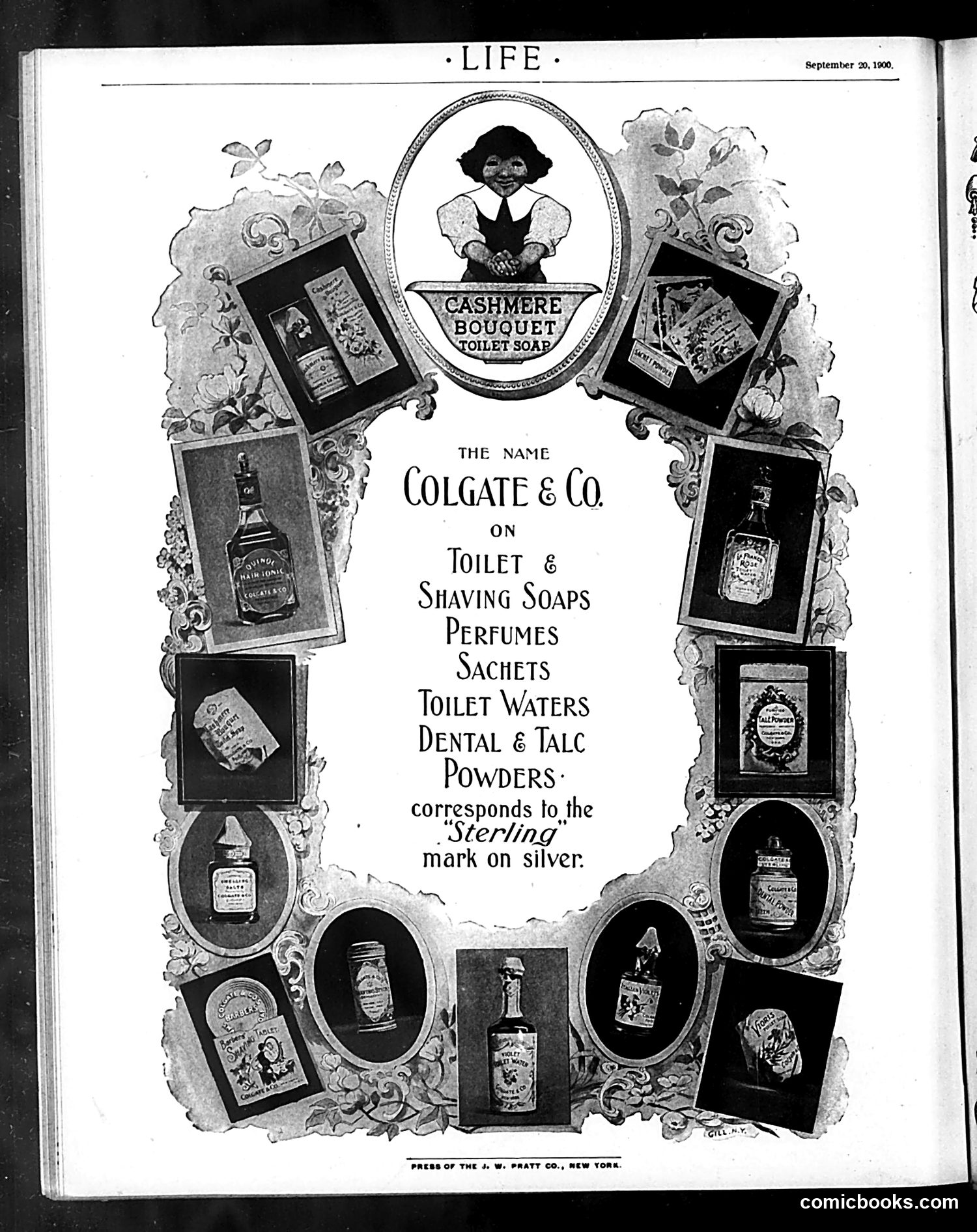
This is a full-page advertisement for Colgate & Co.'s toiletries and personal care products from September 1900. It's not a political cartoon but rather a commercial advertisement disguised as editorial content—common in early Life magazine. The ad uses an ornate decorative border displaying various Colgate products (soaps, perfumes, powders, toilet waters) surrounding a central female figure at the top. The clever marketing claim compares the Colgate brand name to the "Sterling" hallmark on silver—suggesting that just as Sterling guarantees silver's quality, the Colgate name guarantees product quality and authenticity. This reflects turn-of-the-century marketing strategy: establishing brand reputation as a mark of trustworthiness in an era before strict product regulation.