
Life, 1900-09-20 · page 12 of 20
Life — September 20, 1900 — page 12: what you’re looking at
What you’re looking at
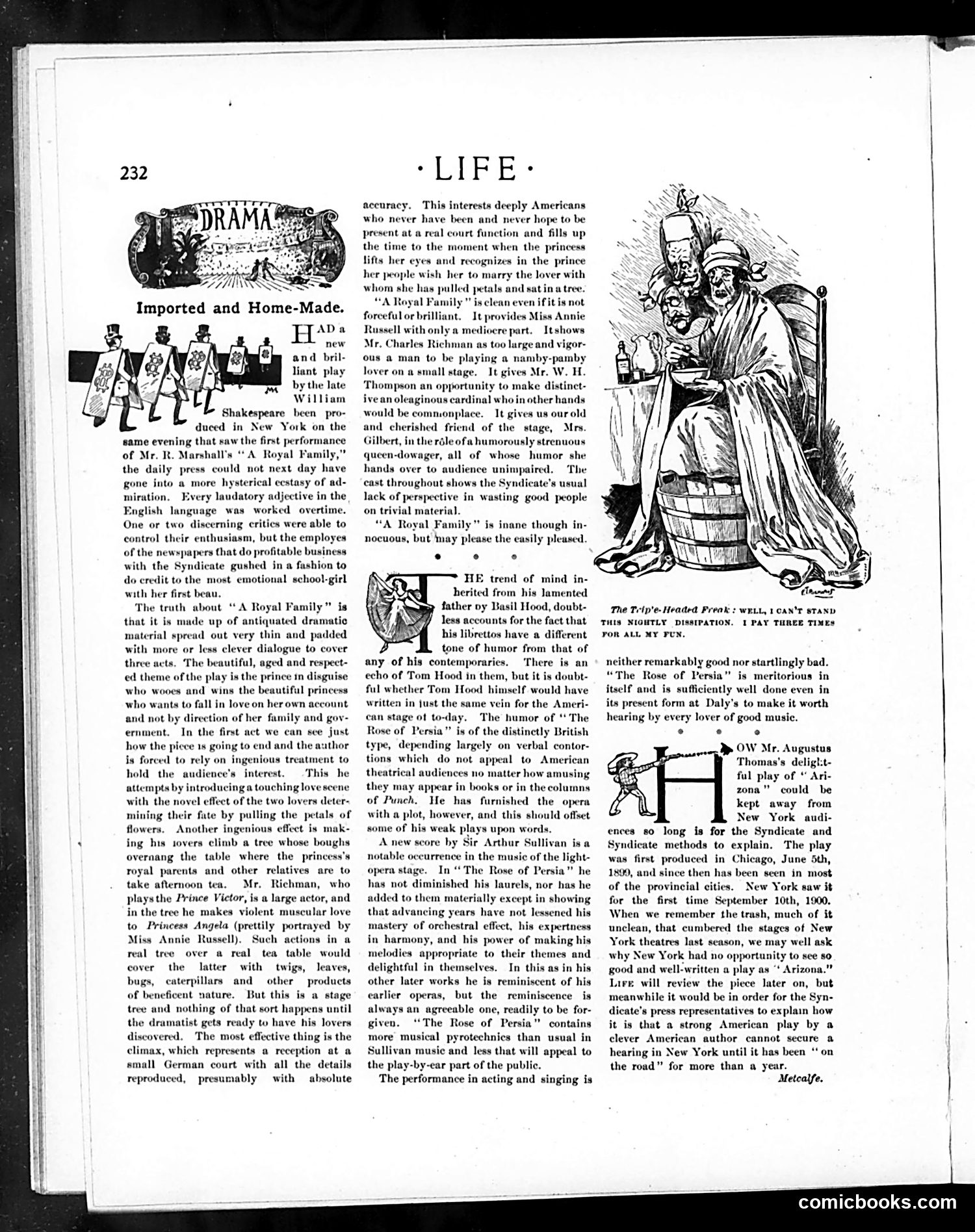
This page reviews theatrical productions, primarily focusing on "A Royal Family" by William Shakespeare (likely a contemporary adaptation). The main illustration shows characters in period costume, apparently depicting a scene from the play. The review criticizes the production as relying on "articulated dramatic material" and "clever dialogue" rather than substance. It mocks the cast—particularly noting Charles Richman as oversized for his role and Annie Russell in a "mediocre part." The text also discusses "The Rose of Persia" (an opera by Sullivan), praising its British wit while noting American audiences may find its verbal humor less appealing than its musical elements. The page represents typical turn-of-century theatrical criticism, satirizing both overwrought stage productions and the disconnect between British and American theatrical tastes.
📄 Transcribed text from this page (OCR, searchable)
Machine-transcribed from the original scan — historical spelling and the odd misread are preserved.
Imported and Home-Made. 15 tow a new and bril- liant play by the late William Shakespeare been pro- duced in New York on the same evening that saw the first performance of Mr. R. Marshall's “A Royal Famil the daily press could not next day have gone into a more hysterical cestasy of ad- miration. Every laudatory adjective in the English language was worked overtime. One or two discerning critics were able to control their enthusiasm, but the employes of the newspapers that do profitable business with the Syndicate gushed in a fashion to do credit to the most emotional school-girl with her first beau, The truth about ‘A Royal Family that it is made up of antiquated dramatic material spread out very thin and padded with more or less clever dialogue to cover three acts. The beautiful, aged and respect- ed theme of the play is the prince in disguise who wooes and wins the beautiful princess who wants to fall in love on her own account and not by direction of her family and " is ernment. In the first act we can see just how the piece 1s going to end and the author is forced to rel pious treatment to hold the audie terest. This he attempts by introducing a touching love scene ith the novel effect of the two lovers deter- mining their fate by pulling the petals of flowers. Another ingenious effect is mak- ing his sovers climb a tree whose boughs overnang the table where the princess's royal parents and other relatives are to take afternoon tea. Mr. Richman, who playsthe Prince Victor, is a large actor, and in the tree he makes violent muscular love to Princess Angela (prettily portrayed by Miss Annie Russell), Such actions in a real tree over a real tea table would cover the latter with twigs, leaves, bugs, caterpillars and other products of beneficent nature. But this is a stage tree and nothing of that sort happens until the dramatist gets ready to have his lovers discovered. The most effective thing is the climax, which represents a reception at a small German court with all the details reproduced, presumably with absolute ‘LIP E* accuracy. This interests deeply Americans who never have been and never hope to be present at a real court function and fills up the time to the moment when the princess lifts her eyes and recognizes in the prince her people wish her to marry the lover with whom she has pulled petals and sat ina tree. “A Royal Family" is clean even if it is not forceful or brilliant, It provides Miss Annie Russell with only a mediocre part. Itshows Mr. Charles Richman as too large and vigor- ous a man to be playing a namby-pamby lover on a small stage. It gives Mr. W. H. Thompson an opportunity to make distinct- ive an oleaginous cardinal who in other hands would be commonplace. It gi and cherished friend of the stage, Gilbert, in the rdle ofa humorously stret queen-dowager, all of whose humor she hands over to audience unimpaired, The cast throughout shows the Syndicate’s usual lack of perspective in wasting good people on trivial material. “A Royal Family” is inane though in- nocuous, but may please the easily pleased. . ° ° HE trend of mind in- herited from his lamented father oy Basil Hood, doubt- Jess accounts for the fact that his librettos have a different tone of humor from that of any of his contemporaries. ‘There is an echo of Tom Hood in them, but it is doubt- ful whether Tom Hood himself would have written in just the same vein for the Ame can stage of to-day. The humor of “The Rose of Persia” is of the distinctly British type, depending largely on verbal contor- tions which do not appeal to American theatrical audiences no matter how amusing they may appear in books or in the columns of Punch, He has furnished the opera with a plot, however, and this should offset some of his weak plays upon words. A new score by Sir Arthur Sullivan is a notable occurrence in the music of the light- opera stage. In “The Rose of Persia” he has not diminished his laurels, nor has he added to them materially except in showing that advancing years have not lessened his mastery of orchestral effect, his expertness in harmony, and his power of making his melodies appropriate to their themes and delightful in themselves. In this as in his other later works he is reminiscent of his earlier operas, but the reminiscence is always an agreeable one, readily to be for- given, “The Rose of Persia” contains more musical pyrotechnics than usual in Sullivan music and less that will appeal to the play-by-car part of the public. ‘The performance in acting and singing is The Trip'e- Headed Freak : w¥L.t, 1 CAN'T STAND Tuts NIGHTLY DISSIPATION, 1 PAY THREE TIMES YOR ALL MY PUN. neither remarkably good nor startlingly bad. “The Rose of Persia” is meritorious in itself and is sufficiently well done even in its present form at Daly's to make it worth by every lover of good music. ° ° ° I> OW Mr. Augustus Thomas's deligt:t- ful play of “ Ari- zona” could be kept away from New York audi- ences so long is for the Syndicate and Syndicate methods to explain. The play was first produced in Chicago, June 5th, 1899, and since then has been seen in most of the provincial cities. New York saw it for the first time September 10th, 1900. When we remember the trash, much of it unclean, that cumbered the stages of New York theatres last season, we may well ask why New York had no opportunity to see so good and well-written a play as ‘‘ Arizona.” Lire will review the piece later on, but meanwhile it would be in order for the Syn- dicate’s press representatives to explain how it is that a strong American play by a clever American author cannot secure a hearing in New York until it has been ‘‘ on the road” for more than a year. Metcalfe. comicbooks.com