
Life, 1900-09-20 · page 8 of 20
Life — September 20, 1900 — page 8: what you’re looking at
What you’re looking at
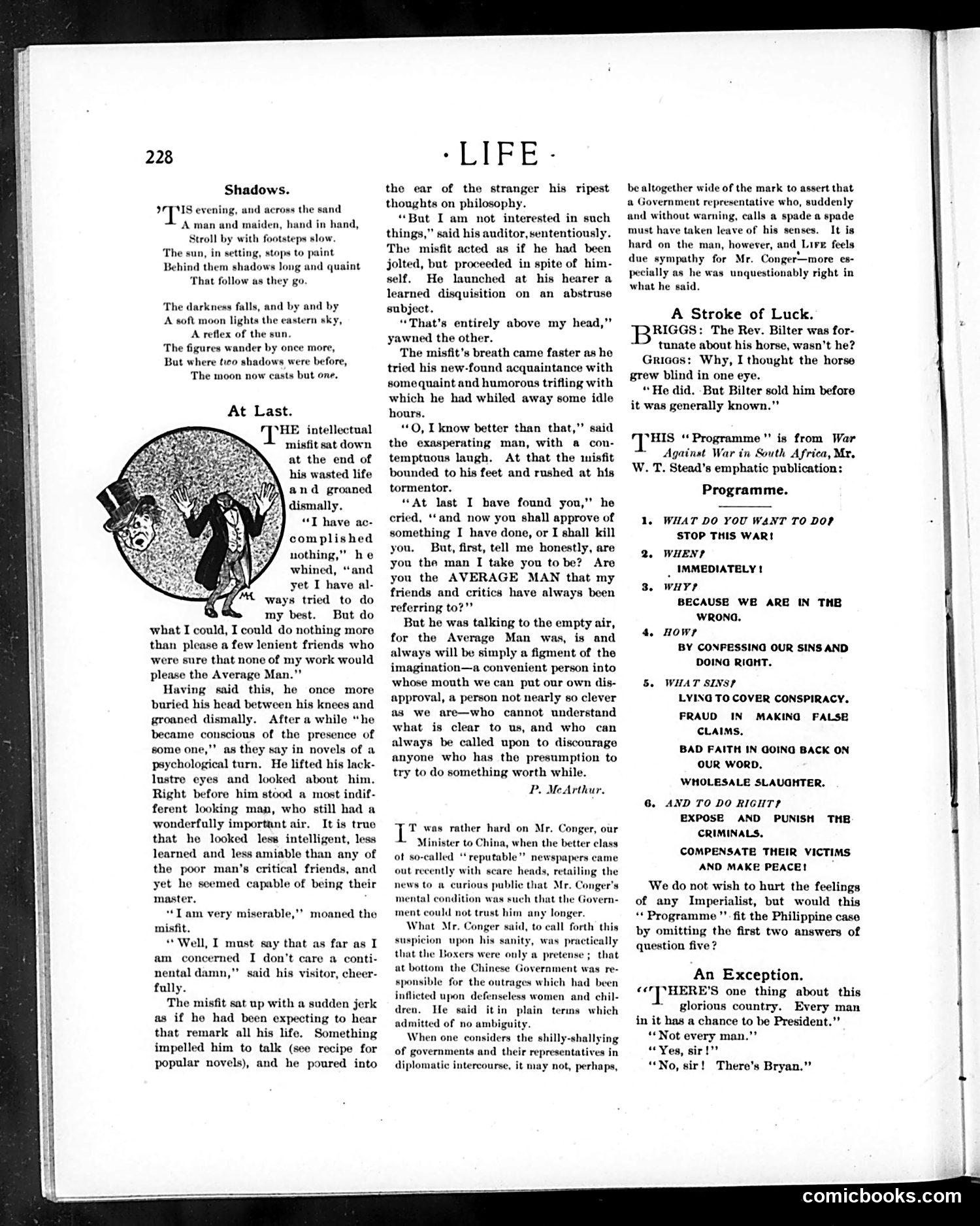
This page contains literary fiction and social commentary rather than political cartoons. The main illustrated piece, "At Last," depicts an intellectual man in despair, having wasted his life pursuing vague ideals. The narrative mocks those obsessed with abstract philosophy and the "Average Man" concept—a critique of intellectuals disconnected from practical reality. The adjacent section "A Stroke of Luck" presents a brief anecdote about a horse dealer, while "A Programme" outlines demands attributed to the "War Against War in South Africa," including calls to stop war, confess governmental sins, and expose/punish criminals. The final piece, "An Exception," is a brief political joke suggesting Bryan (likely William Jennings Bryan) as a presidential candidate, implying even he couldn't become president in this "glorious country."
📄 Transcribed text from this page (OCR, searchable)
Machine-transcribed from the original scan — historical spelling and the odd misread are preserved.
228 Shadows. IFPUIS evening, and across the sand A man and maiden, hand in hand, Stroll by with footsteps slow. ‘The sun, in setting, stops to paint Behind them shadows long and quaint That follow as they go. ; ‘The darkness falls, and by and by 1 A soft moon lights the eastern sky, A reflex of the sun. ‘The figures wander by once more, But where tivo shadows were before, The moon now casts but one, At Last. TH intellectual misfit sat down at the end of his wasted life and groaned dismally, “T have ac- complished nothing,” he whined, “and yet I have al- my best. But do what I could, I could do nothing more than please a few lenient friends who ' were sure that none of my work would He please the Average Man.” Having said this, he buried his head between his knees and groaned dismally. After a while “he became conscious of the presence of | some one,’’ as they say in novels of a 1 psychological turn. He lifted his lack- | lustre eyes and looked about him, } Right before him stood a most indif- | ferent looking man, who still had a ii i once more wonderfully important air. It is true that he looked less intelligent, less \ learned and less amiable than any of Hi the poor man’s critical friends, and yet he seemed capable of being their t master. “Lam very miserable,” misfit. i “Well, I must say that as far as I am concerned I don't care a conti- nental damn,” said his visitor, cheer- fully. The misfit sat up with a sudden jerk as if he had been expecting to hear that remark all his life. Something impelled him to talk (see recipe for popular novels), and he poured into moaned the - LIFE - the ear of the stranger his ripest thoughts on philosophy. “But I am not interested in such things,” said his auditor, sententiously. The misfit acted as if he had been jolted, but proceeded in spite of him- self. He launched at his hearer a learned disquisition on an abstruse subject. “That’s entirely above my head,” yawned the other. The misfit’s breath came faster as he tried his new-found acquaintance with some quaint and humorons trifling with which he had whiled away some idle hours. “O, I know better than that,” said the exasperating man, with a con- temptuous laugh. At that the misfit bounded to his feet and rushed at his tormentor. “At last I bave found you,’ he cried, “and now you shall approve of something I have done, or I shall kill you. But, first, tell me honestly, are you the man I take you tobe? Are you the AVERAGE MAN that my friends and critics have always been referring to?”’ But he was talking to the empty air, for the Average Man was, is and always will be simply a figment of the imagination—a convenient person into whose mouth we can put our own dis- approval, a person not nearly so clever as we are—who cannot understand what is clear to us, and who can always be called upon to discourage anyone who has the presumption to try to do something worth while. P. McArthur. T was rather hard on Mr. Conger, our Minister to China, when the better class alled “reputable” ly with sea news to a curious publ mental con of s¢ out newspapers came heads, retailing t hat Mr. ge ‘ion was such that th yern- ment could not trust him any longe What Mr. nger said, to call forth this 1 upon his sanity, was practically Loxers were only a pretense ; that at bottom the Chines ernment was re- sponsible for the outrages which had been inflicted upon defenseless women and chil- dren. He said itin plain terns which admitted of no ambiguity. When one considers the shilly-shallying of governments and their representatives in diplomatic intercourse, it may not, perhaps, be altogether wide of the mark to assert that a Government representative who, suddenly and without warning, calls a spade a spade must have taken leave of his senses. It is hard on the man, however, and Lire feels due sympathy for Mr. Conger—more es- pecially as he was unquestionably right in what he said. A Stroke of Luck. RIGGS: The Rev. Bilter was for- tunate about his horse, wasn't he? Gricos: Why, I thought the horse grew blind in one eye. “He did. But Bilter sold him before it was generally known.” THs “Programme "’ is from War Against War in South Africa, Mr, W. T. Stead’s emphatic publication: Programme. 1. WHAT DO YOU WANT TO DOP STOP THIS WARI 2. WHEN? _ IMMEDIATELY! 3. WHY? BECAUSE WE ARE IN THB ‘WRONG, 4. Howr BY CONFESSING OUR SINS AND DOING RIGHT. 5. WHAT SINS? LYING TO COVER CONSPIRACY. FRAUD IN MAKING FALSE CLAIMS, BAD FAITH IN GOING BACK ON OUR WORD, WHOLESALE SLAUGHTER. 6. AND TO DO RIGHT? EXPOSE AND PUNISH THB CRIMINALS, COMPENSATE THEIR VICTIMS AND MAKE PEACE! We do not wish to hurt the feelings of any Imperialist, but would this “Programme ’’ fit the Philippine caso by omitting the first two answers of question five? An Exception. «eT HERE'S one thing about this glorious country. Every man in it has a chance to be President.” “Not every man.’’ “Yes, sir !’’ “No, sir! There's Bryan.” comicbooks.com