
Life, 1900-09-20 · page 7 of 20
Life — September 20, 1900 — page 7: what you’re looking at
What you’re looking at
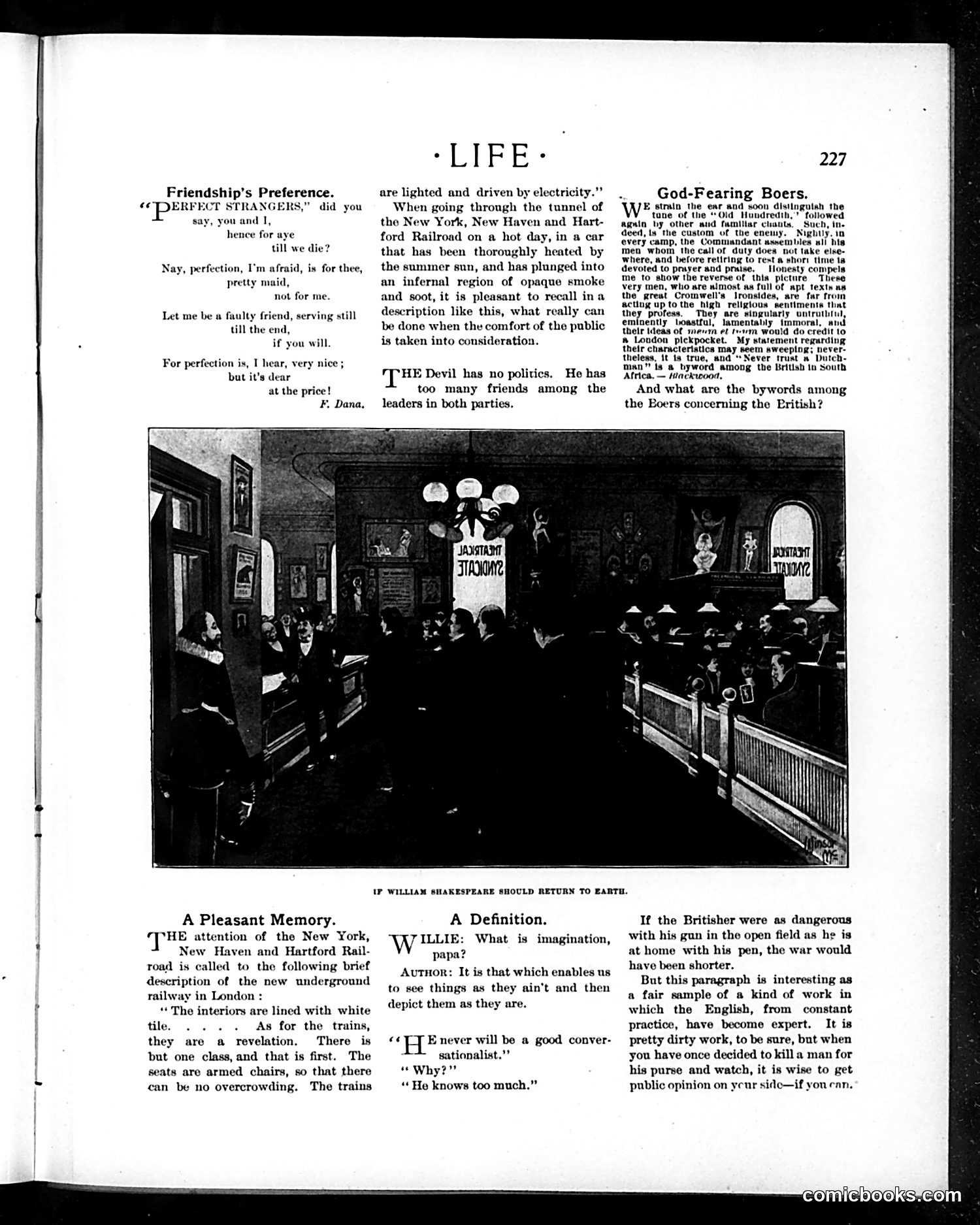
This page satirizes a theatrical or public event, likely a Shakespeare performance or lecture. The large central illustration shows a crowded indoor venue with "Shakespeare" signage visible above the stage area, packed with an engaged audience. The caption questions what would happen if Shakespeare returned to Earth—a thought experiment about whether the historical playwright could appreciate modern theatrical innovation or staging. The surrounding text includes comedic dialogues and observations about imagination, covering-up one's work, and public opinion. The satire appears to mock both pretentious literary criticism and the gap between classic literature and contemporary performance practices. This reflects early 20th-century debates about how canonical works should be staged and appreciated by modern audiences.
📄 Transcribed text from this page (OCR, searchable)
Machine-transcribed from the original scan — historical spelling and the odd misread are preserved.
Friendship’s Preference. ¢©PDERFECT STRANGERS,” did you say, you and I, hence for aye till we die? Nay, perfection, I'm afraid, is for thee, pretty maid, not for me. Let me be a faulty friend, serving still till the end, if you will. For perfection is, I hear, very nice ; but it's dear at the price! F. Dana, A Pleasant Memory. THE attention of the New York, New Haven and Hartford Rail- road is called to the following brief description of the new underground railway in London : “The interiors are lined with white tile. ... As for the trains, they are a revelation. There is but one class, and that is first. The seats are armed chairs, so that there can be no overcrowding. The trains -LIFE* | are lighted and driven by electricity.” When going through the tunnel of the New York, New Haven and Hart- ford Railroad on a hot day, in a car that has been thoroughly heated by the summer sun, and has plunged into an infernal region of opaque smoke and soot, it is pleasant to recall ina description like this, what really can be done when the comfort of the public is taken into consideration. HE Devil has no politics. He has too many friends among the leaders in both parties. 227 God-Fearing Boers. E strain the ear and soon distingutah the tane of the “Old Hundredih,’ followed again by other and famtitar cle Such, ine deed, ls the custom of the enemy. Nightly. in every camp, the Commandant assembles ali his meno whom the call of duty does not take else- where, and before retiring to rest a shori time ta devoted to prayer and praise. Ionesty compels me to show the reverse of thia picture These very men, who are almost as full of apt texts as, the great Cromwell's Jronsides, are far from acting up to the high religious sentiments that they profess. They are singularly untruthtul, eminently boastful, lamentably immoral, and thelr Ideas of mena et tem would do credit to ® London pickpocket. My statement regarding ‘their characteriatics may seem sweeping; never- theless, it 1a true, and “Never trust » Dutch- man” is a byword among the British in South Africa, — Hlackwood, And what are the bywords among the Eoers concerning the Pritish? IF WILLIAM SHAKESPEARE SHOULD RETURN TO EARTH. A Definition. ILLIE: What is imagination, papa? Avutnor: It is that which enables us to see things as they ain't and then depict them as they are. “ce H® never will be a good conver- sationalist.”” “Why?” “He knows too much.” If the Britisher were as dangerous with his gun in the open field as he is at home with his pen, the war would have been shorter. But this paragraph is interesting as a fair sample of a kind of work in which the English, from constant practice, have become expert. It is pretty dirty work, to be sure, but when you have once decided to kill a man for his purse and watch, it is wise to get public opinion on ycur side—if you can,