
A complete issue · 20 pages · 1900
Life — August 23, 1900
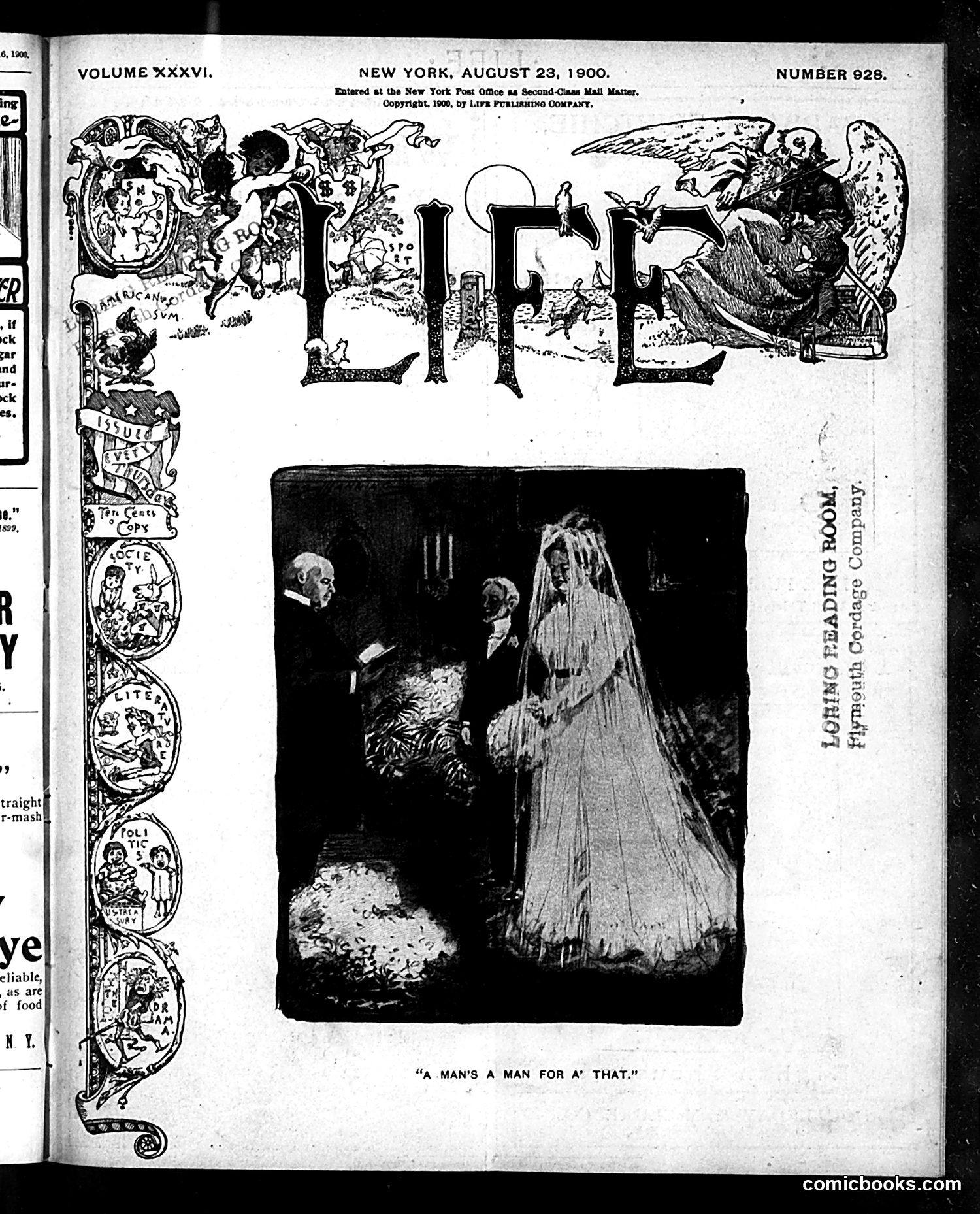
This Life magazine cover (August 23, 1900) features a satirical illustration titled "A Man's a Man for A' That"—a reference to Robert Burns's Scottish poem about human equality regardless of social class. The image shows a bride in full wedding attire meeting with two gentlemen in formal dress, apparently in a dark interior space. The satire likely critiques class divisions or social pretension surrounding marriage arrangements of the era. The bride's elaborate veil and dress contrast with the somewhat austere setting, suggesting commentary on the gap between social aspiration and reality. The decorative border on the left contains various illustrated vignettes, typical of Life's ornamental design style. The specific social critique remains somewhat unclear without additional context about 1900 wedding customs or events.
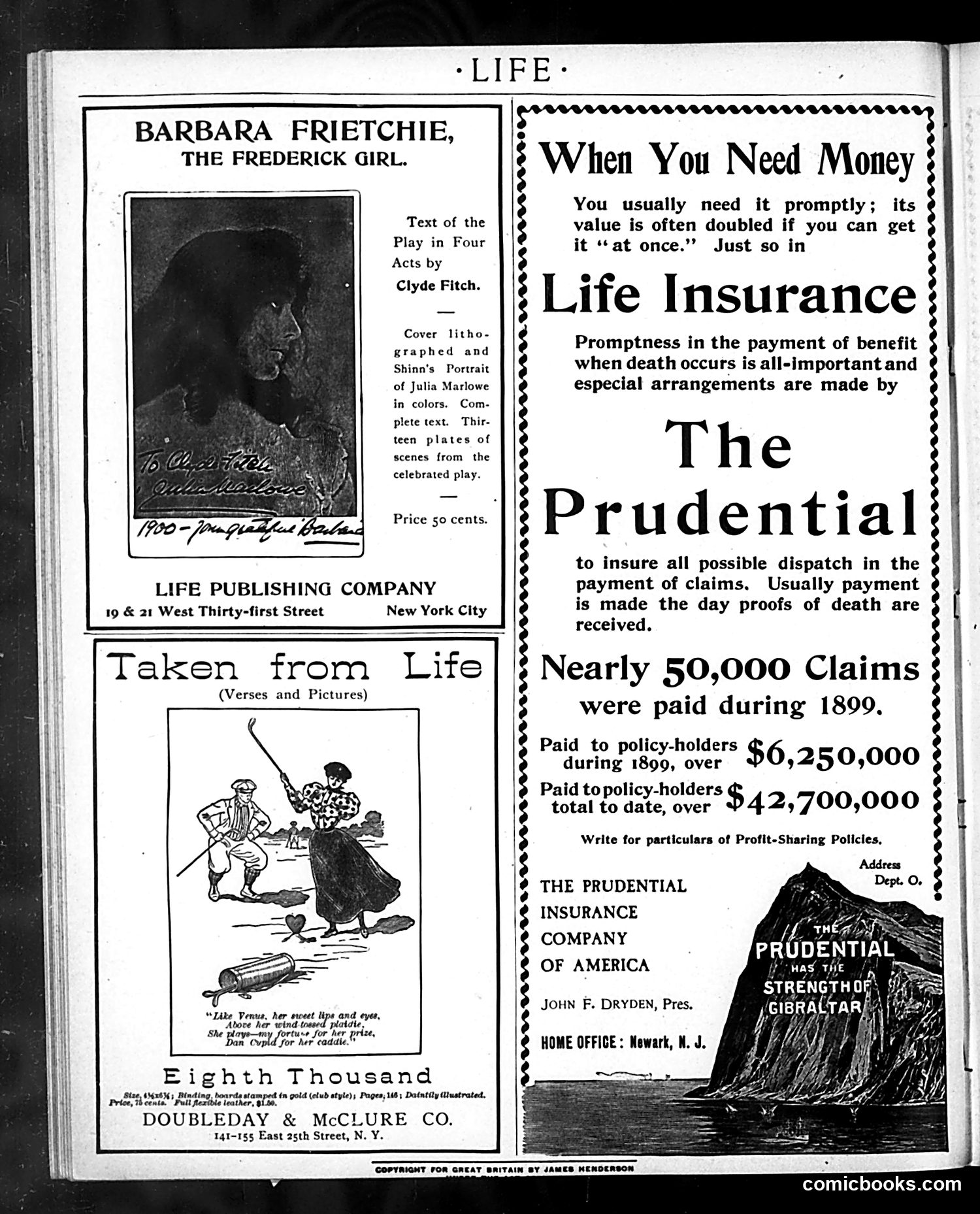
This page is primarily **advertising rather than satirical content**. The left side features a book advertisement for "Barbara Frietchie, The Frederick Girl"—a play by Clyde Fitch with a portrait and cover lithograph. Below that is "Taken from Life," a cartoon showing a woman striking a man with a stick while he holds a baby, with the caption suggesting domestic discord (unclear specific reference). The right side contains a full-page advertisement for The Prudential Insurance Company, emphasizing prompt claim payments and showcasing statistics from 1899. The insurance ad's imagery—the Rock of Gibraltar symbol—appears designed to project strength and reliability. Overall, this represents typical early-1900s magazine monetization through advertisements mixed with entertainment content.
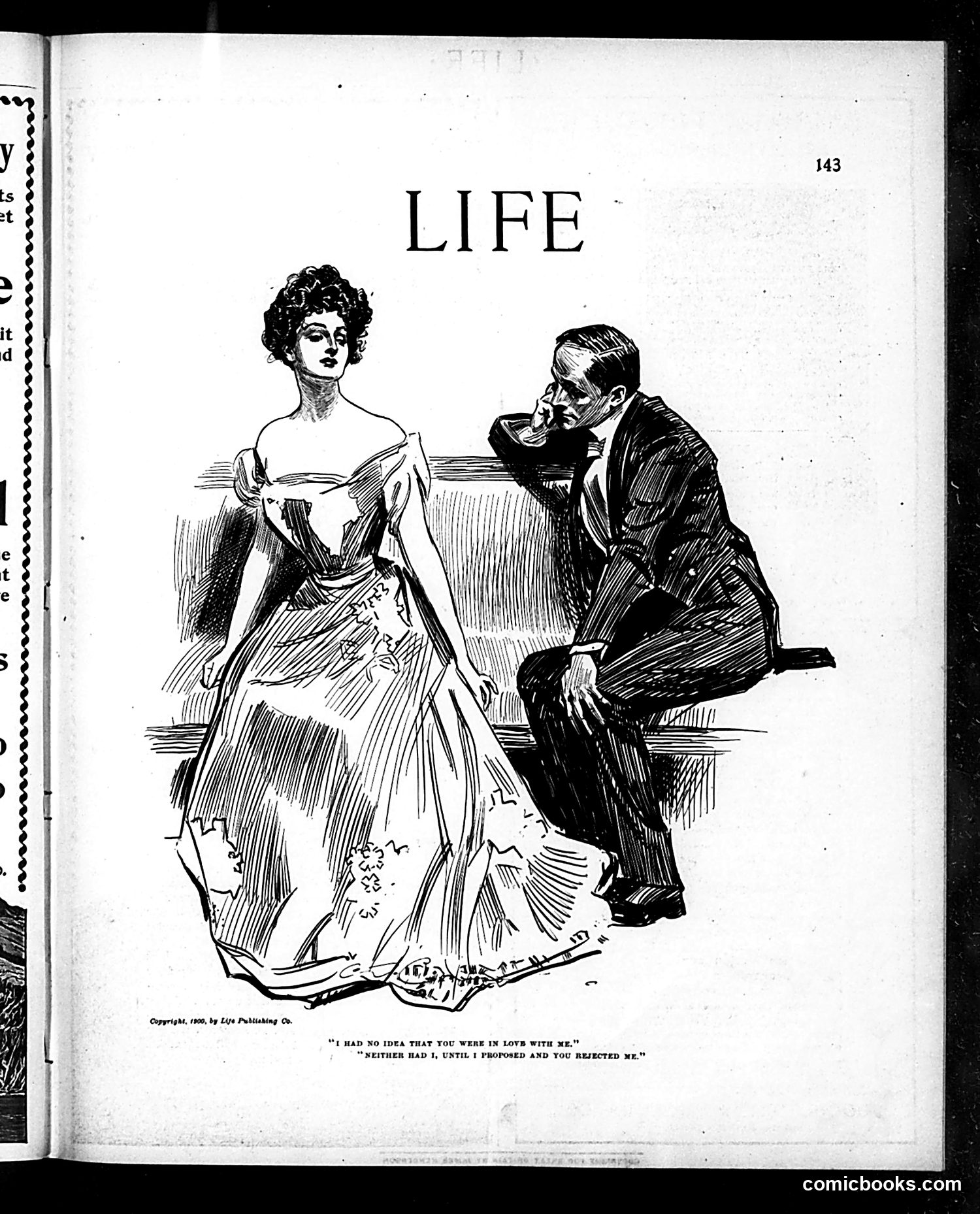
This cartoon illustrates a romantic/relationship joke from early 20th-century Life magazine. The illustration shows a well-dressed man and an elegantly gowned woman seated together, with dialogue below reading: "I HAD NO IDEA THAT YOU WERE IN LOVE WITH ME." / "NEITHER HAD I, UNTIL I PROPOSED AND YOU REJECTED ME." The satire plays on romantic irony: the man's proposal—apparently unwelcome—paradoxically reveals mutual feelings to both parties. The woman discovers she loves him only after rejecting him. This reflects period humor about courtship conventions, miscommunication between suitors, and the absurdity of romantic declarations. The sophisticated line-drawn style and social setting are typical of Life's satirical commentary on upper-class romantic entanglements.
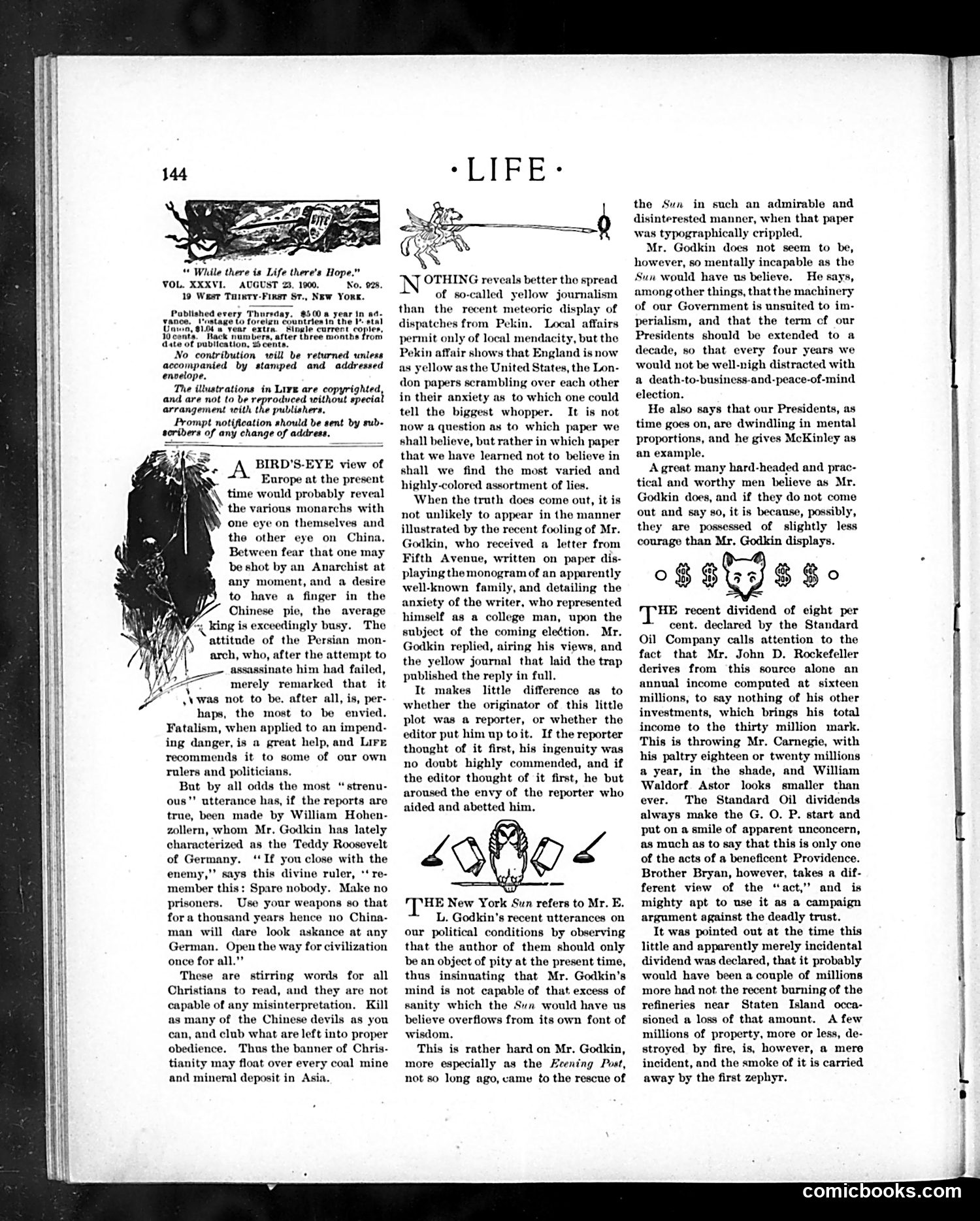
The page contains two political cartoons critiquing yellow journalism and American imperialism during the Boxer Rebellion era. The first cartoon ("While there is Life there's Hope") depicts European monarchs anxiously watching China, suggesting concern about the Boxer crisis and Chinese instability. The second cartoon illustrates a dispute between journalist E.L. Godkin (editor of the *Evening Post*) and the *New York Sun*. The article criticizes Godkin's recent political commentary as overly pessimistic about American leadership, while defending his character against accusations of disloyalty. The text mocks "yellow journalism" sensationalism, particularly regarding coverage of China and the election. The piece defends Godkin as a worthy patriot despite disagreements, contrasting his principled journalism with the sensationalism of competing newspapers.
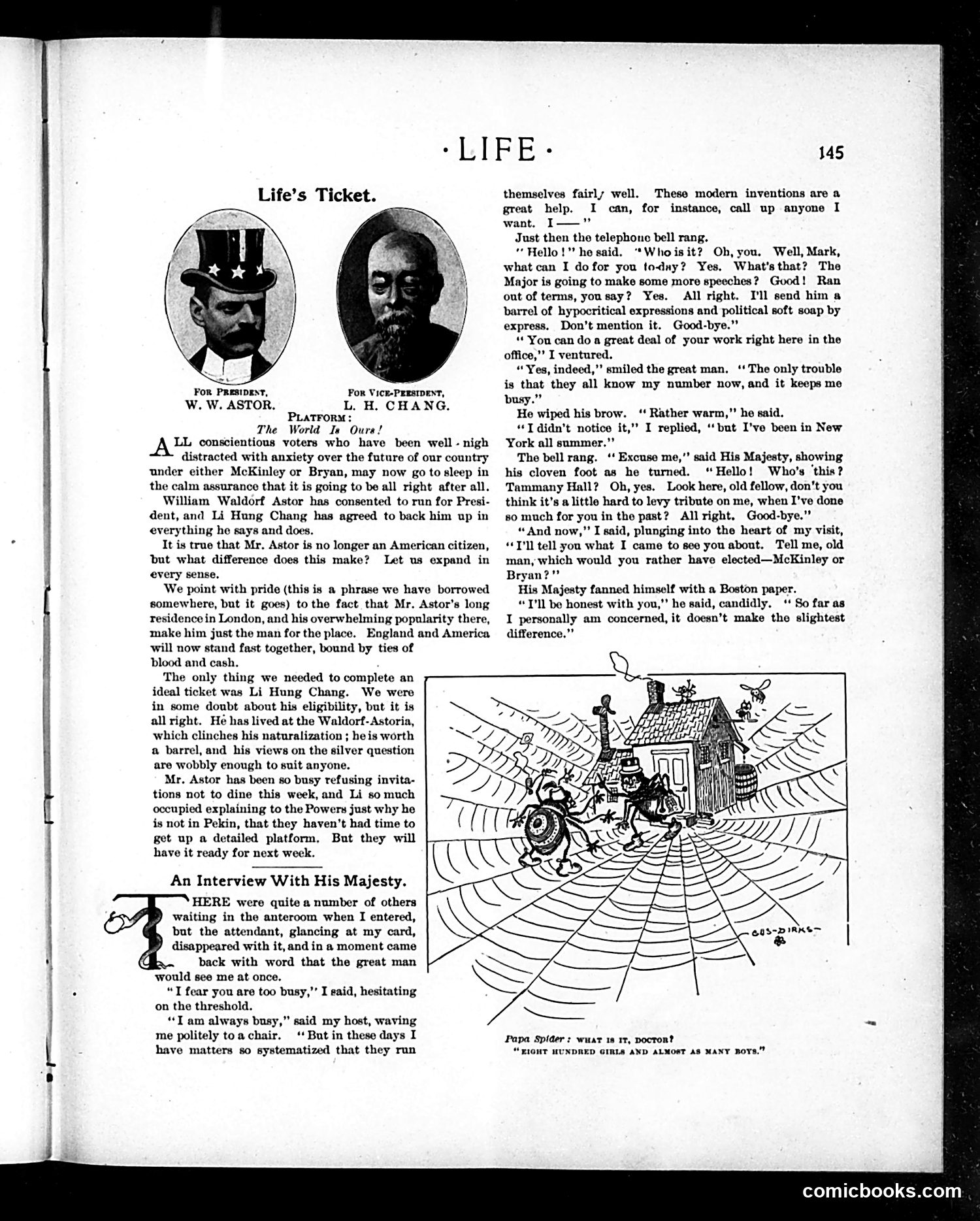
**Top Section - "Life's Ticket":** This section presents portraits labeled "For President: W. W. Astor" and "For Vice-President: L. E. Chang," proposing these figures as political candidates. The accompanying text satirizes anxieties about the 1912 presidential election, suggesting that despite concerns about choosing between McKinley or Bryan, these "outsider" candidates might be equally viable. The satire mocks American voters' uncertainty during this election cycle. **Main Article - "An Interview With His Majesty":** This humorous piece depicts a conversation with a busy, self-important political figure (referred to as "His Majesty"). The narrator critiques the subject's inaccessibility and grandiose demeanor, suggesting he's too preoccupied with minor matters to grant proper audiences. **Cartoon - "Papa Spider":** The illustration depicts a spider web with multiple figures caught within it, captioned "What is it, doctor? Eight hundred girls and almost as many boys." This appears to satirize some contemporary social or political entanglement affecting youth.
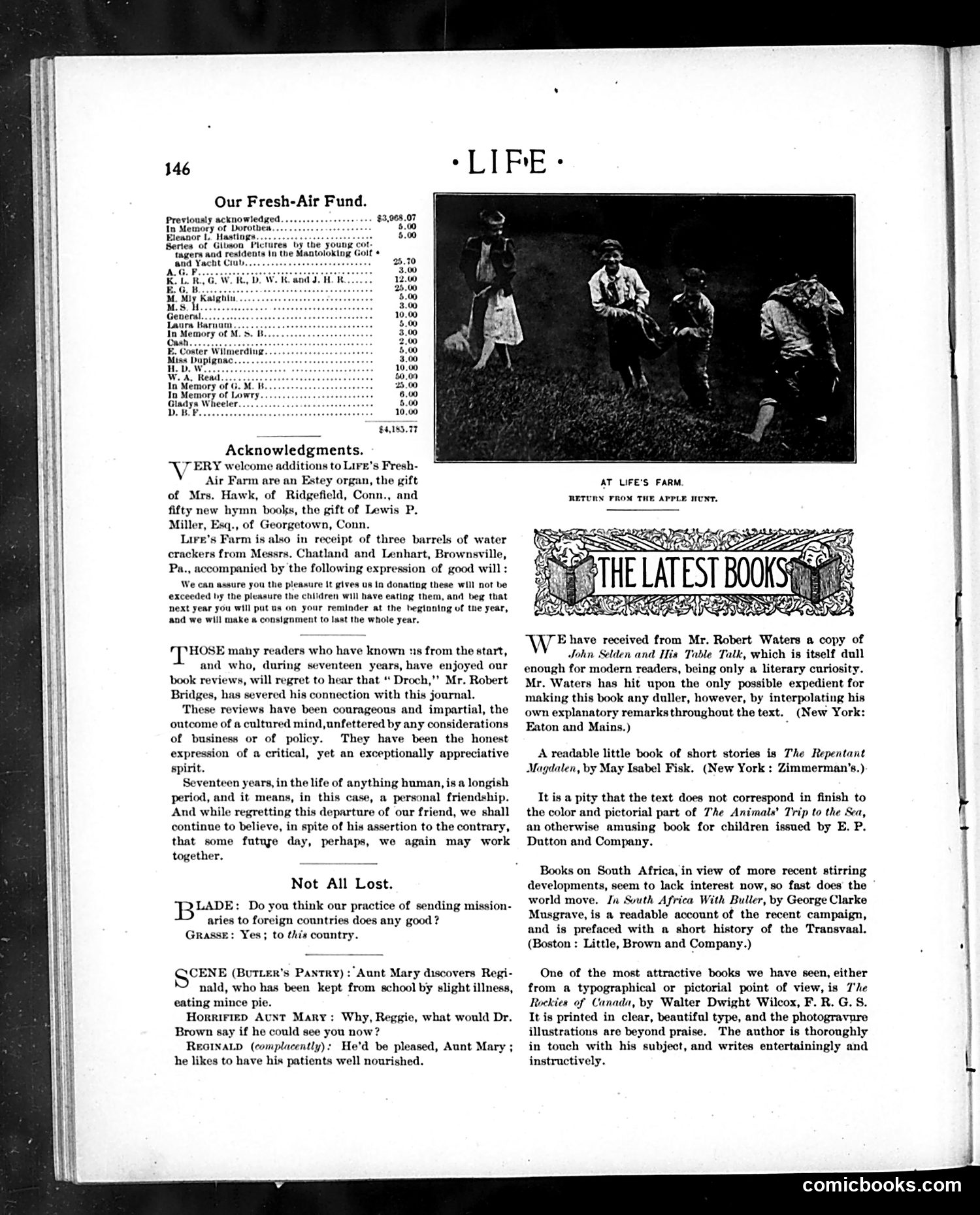
This page contains no political cartoon or satire. Instead, it's a mix of content: **Left column:** Financial acknowledgments for Life's "Fresh-Air Fund," listing donations, followed by editorial remarks about the magazine's critic "Droch" (Robert Bridges) and a brief humorous dialogue titled "Not All Lost" involving characters discussing missionary work. **Right side:** A photograph labeled "At Life's Farm: Return from the Apple Hunt," showing people outdoors, and a book review section called "The Latest Books," discussing recent publications including works on South Africa and Canadian photography. The page is primarily administrative and literary in nature—fundraising announcements, staff commentary, and book criticism—rather than satirical content.
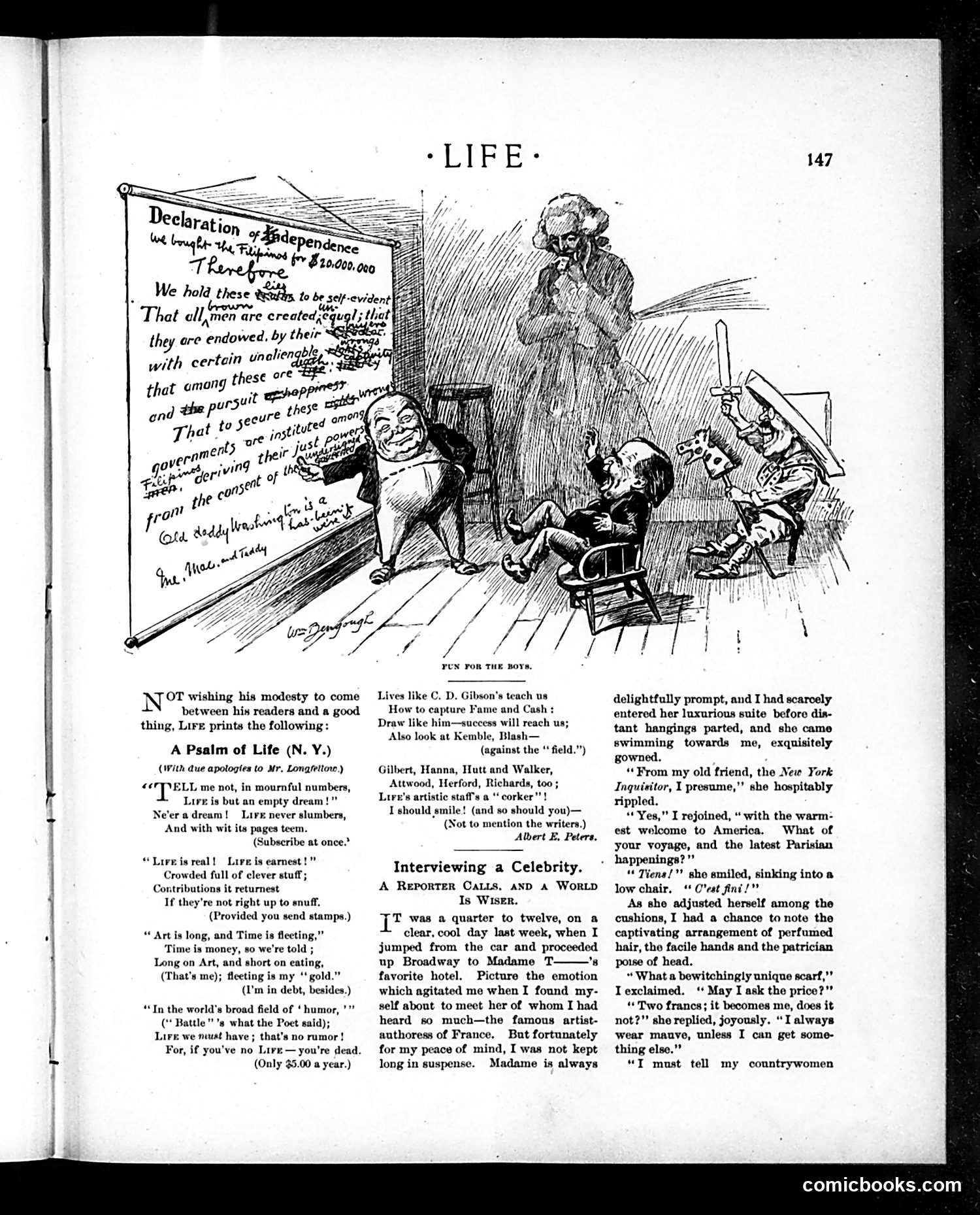
This political cartoon depicts children studying the Declaration of Independence on a wall while an elderly figure (likely representing an older generation or tradition) stands above them. The satire appears to mock the gap between America's founding ideals—"all men are created equal"—and their practical implementation. The cartoon critiques how children are taught these lofty principles while the reality of American life contradicts them. The "boys" studying the document represent youth inheriting a nation that preaches equality but fails to practice it. The stern adult figure suggests an authority figure unwilling or unable to bridge this ideological gap. The page's title "LIFE" and the magazine's satirical nature suggest this was commentary on American hypocrisy regarding democratic values.
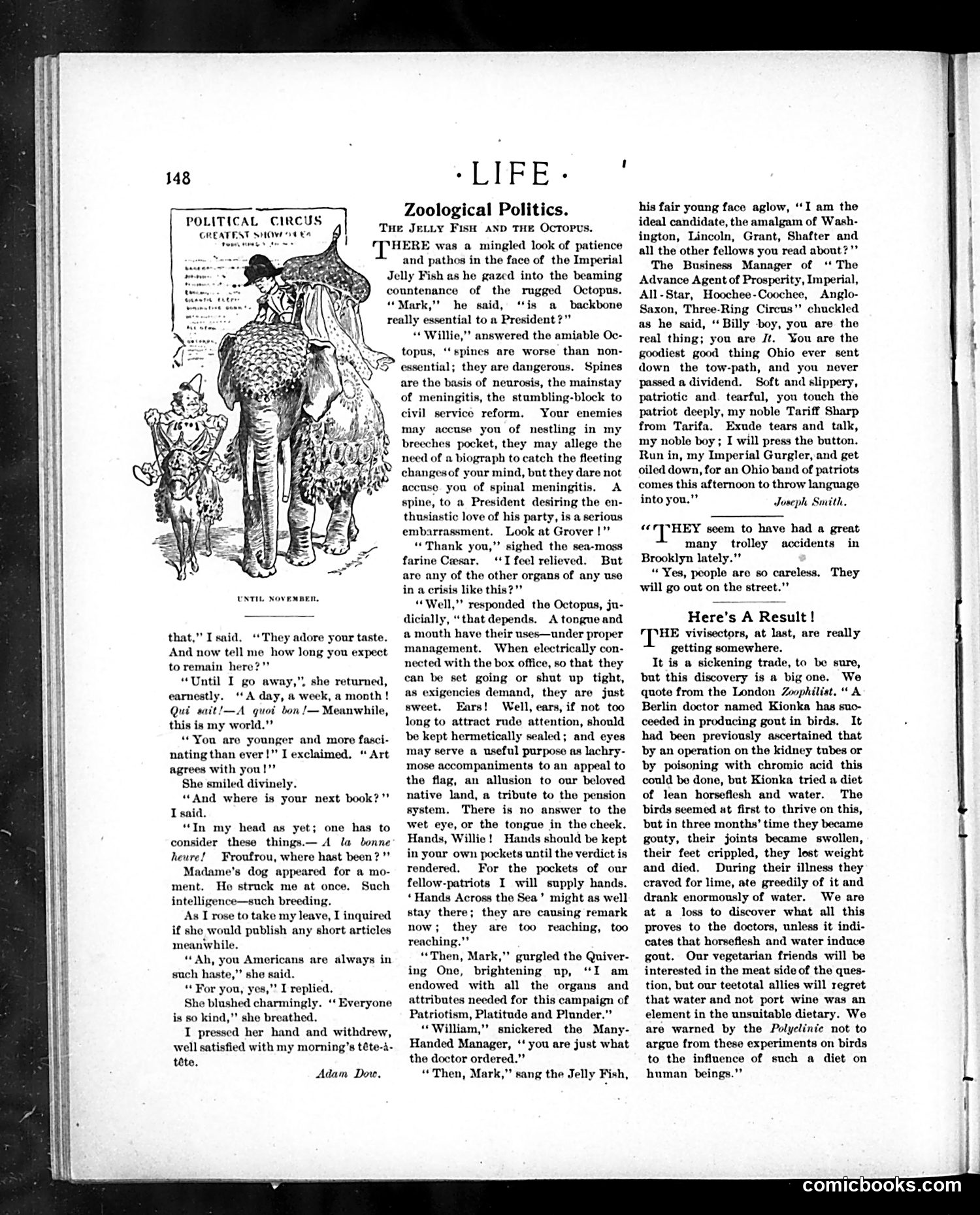
This satirical piece uses sea creatures as political metaphors. The jelly fish represents a weak or ineffectual president, while the octopus symbolizes a powerful political opponent or rival faction—likely representing political machines or corrupt party bosses of the era. The dialogue mocks political debate: the octopus defends his "spines" (political tactics) as "worse than nonessential" yet "dangerous," suggesting the satire criticizes ruthless political maneuvering and hypocrisy. The jelly fish's complaint about being accused of "nestling in my bosses' pockets" suggests patronage and corruption. The cartoon ridicules both weak leadership and aggressive political operatives, typical of early 20th-century American political satire in *Life* magazine.
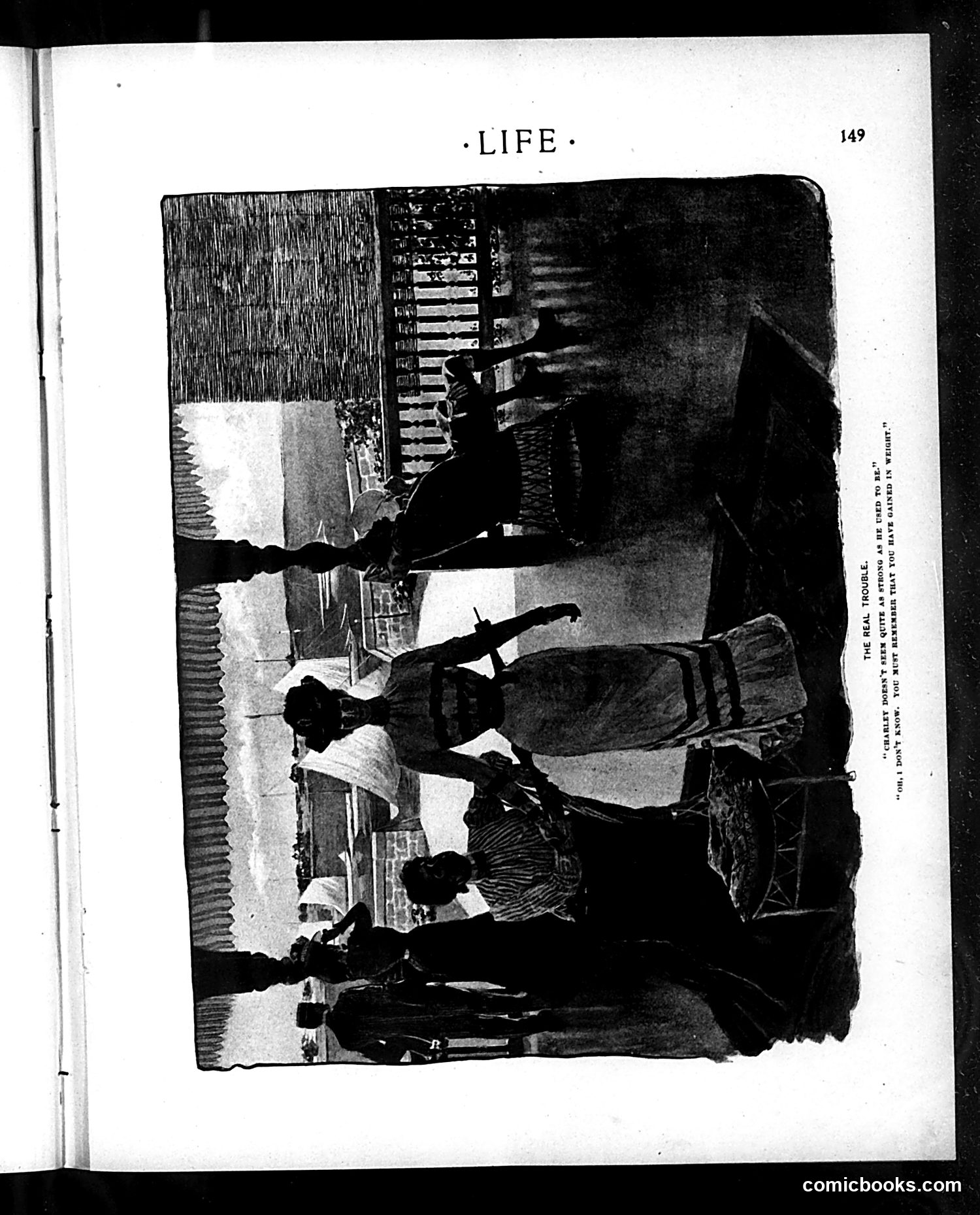
I can see this is page 149 from Life magazine, but the image quality and orientation make it difficult to read the specific OCR text clearly or identify the particular figures and their captions with confidence. What I can observe: The page contains what appears to be a black and white photograph or illustration showing several figures in what looks like an indoor setting, possibly depicting a social or political scene. The image is rotated, making detailed interpretation challenging. Without being able to read the caption text reliably or identify the specific individuals depicted, I cannot accurately explain the satirical point or historical context to a modern reader. To provide an accurate analysis meeting your accuracy standard, I would need either a clearer image or confirmation of the visible text.
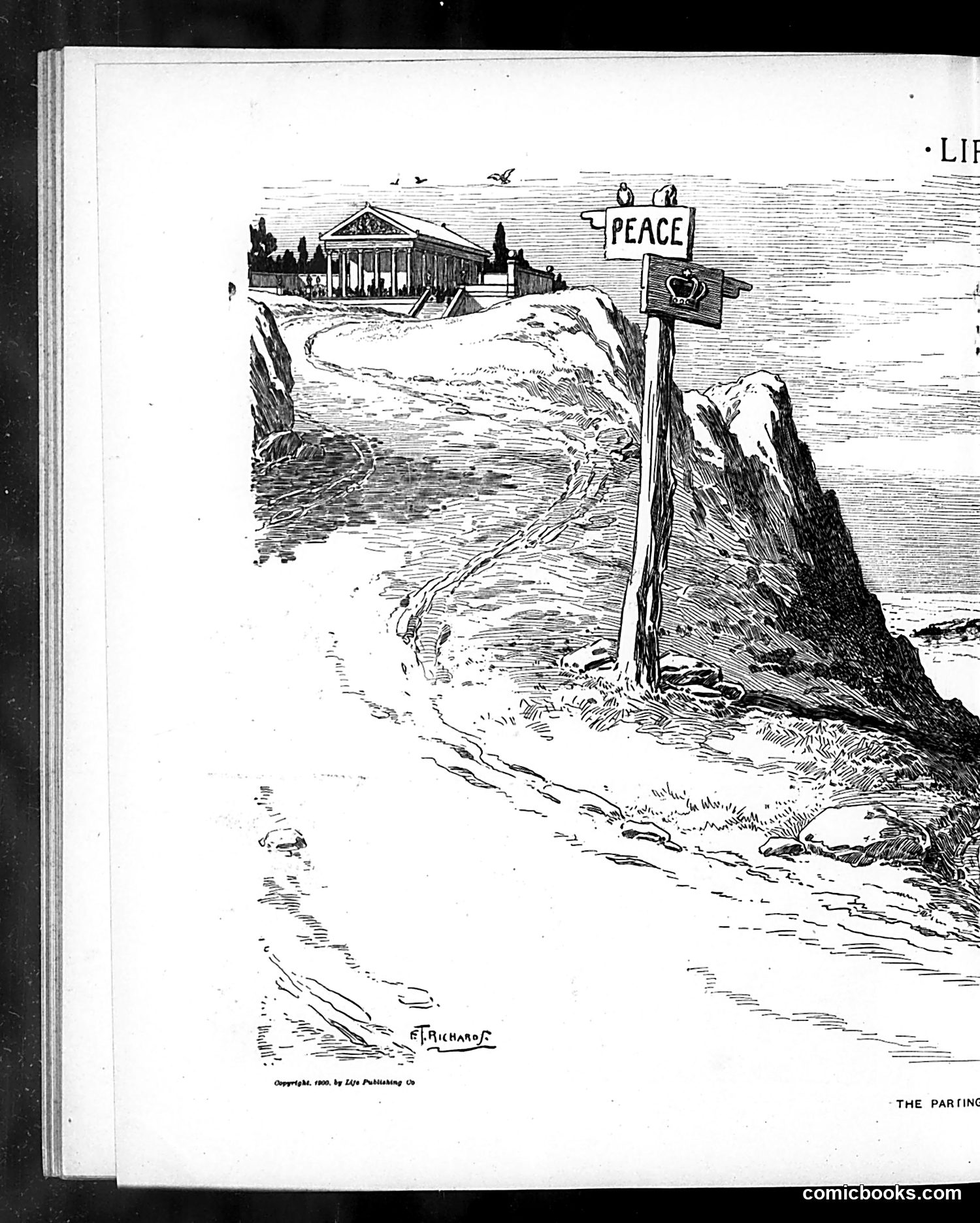
This engraving by F. T. Richards depicts a classical temple on a distant hill with a "PEACE" sign posted nearby—a stark contrast to the barren, rocky landscape in the foreground. The composition suggests peace is geographically or ideologically remote and inaccessible, perhaps even abandoned or neglected. The work likely comments on post-WWI disillusionment or failed peace efforts. The classical temple evokes ideals of peace and civilization, yet it appears isolated and unreachable across desolate terrain. The deliberate placement of the "PEACE" sign suggests either false hope, unattainable goals, or the gap between peaceful ideals and harsh reality. Without specific dating visible, the exact historical context remains unclear, though the style suggests early-to-mid 20th century publication.
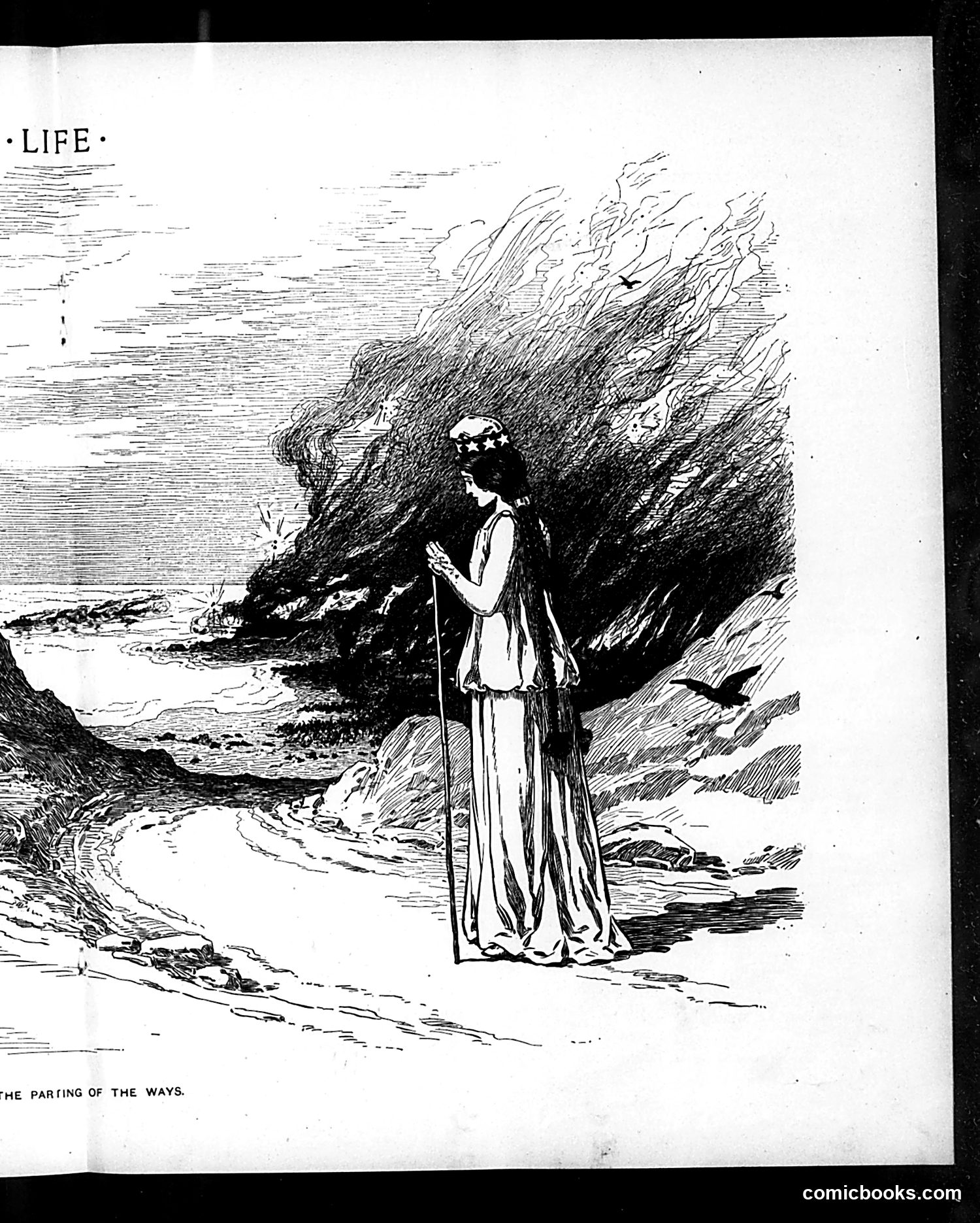
This engraving depicts a solitary female figure in classical dress standing at a crossroads by a dramatic coastal landscape, holding a walking staff. The title "The Parting of the Ways" suggests a moment of significant choice or decision. The allegorical composition—with its romanticized setting and the figure's contemplative pose—appears to represent a philosophical or life choice facing a woman. Without additional context or publication date visible, the specific political or social reference remains unclear. It could relate to women's suffrage, education, marriage choices, or career decisions—all common satirical subjects in *Life* magazine during the late 19th and early 20th centuries. The classical styling suggests timeless human deliberation rather than commentary on current events.
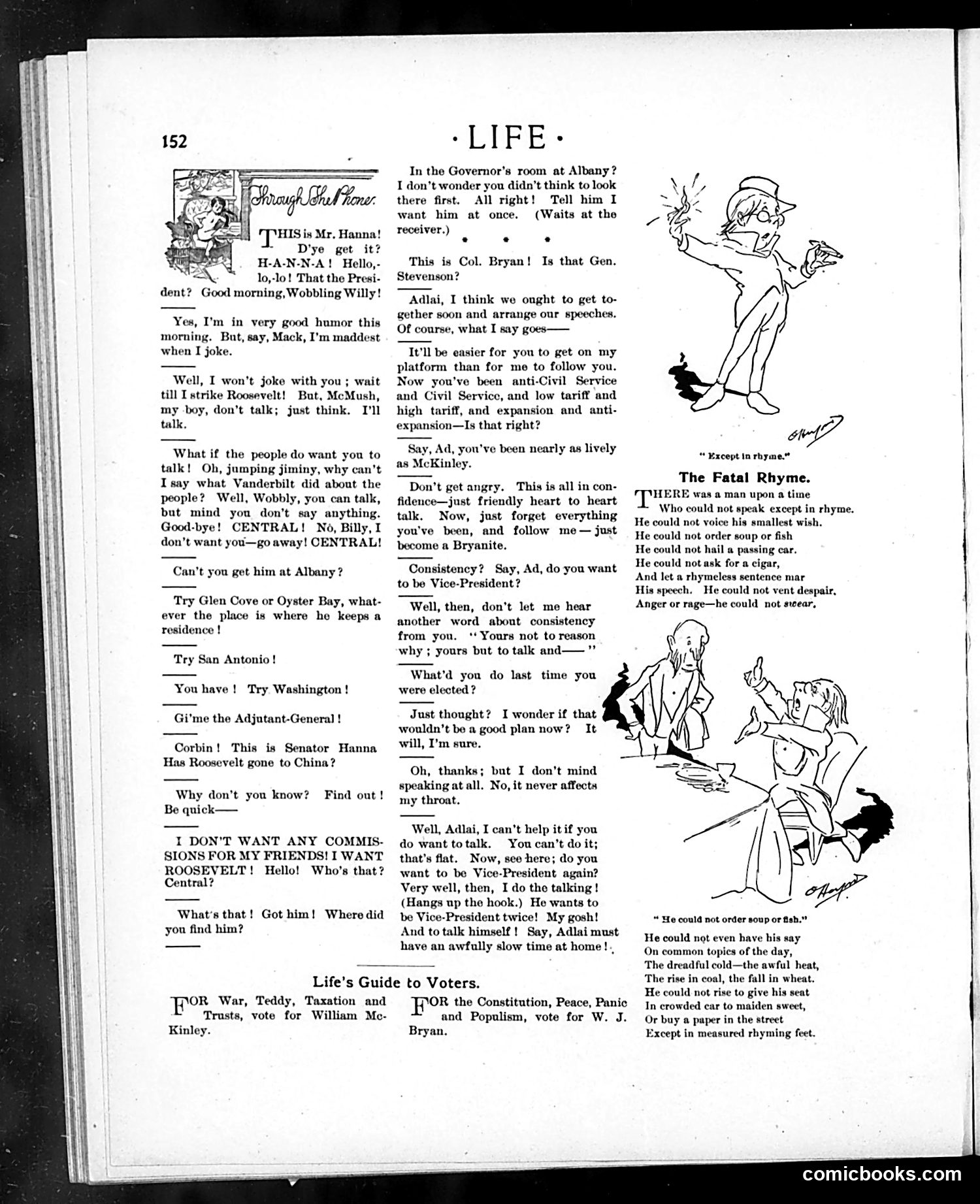
This page contains political satire about the 1912 U.S. presidential election. The dialogue mocks politicians' inconsistency and endless talk about campaigning. References include: - **Mr. Hanna** and **Col. Bryan** (likely William Jennings Bryan, three-time presidential candidate) - **McKinley** (former President William McKinley) - **Vice-President** ambitions being discussed The cartoon criticizes political figures for endless speech-making while avoiding substantive policy discussion. "The Fatal Rhyme" poem parodies a man who could only speak in verse—a metaphor for politicians bound by rhetoric rather than action. The bottom section, "Life's Guide to Voters," sarcastically advises voting based on party affiliation rather than issues, mocking voter apathy and partisan loyalty. The overall message: politicians talk endlessly without saying anything meaningful about actual governance.
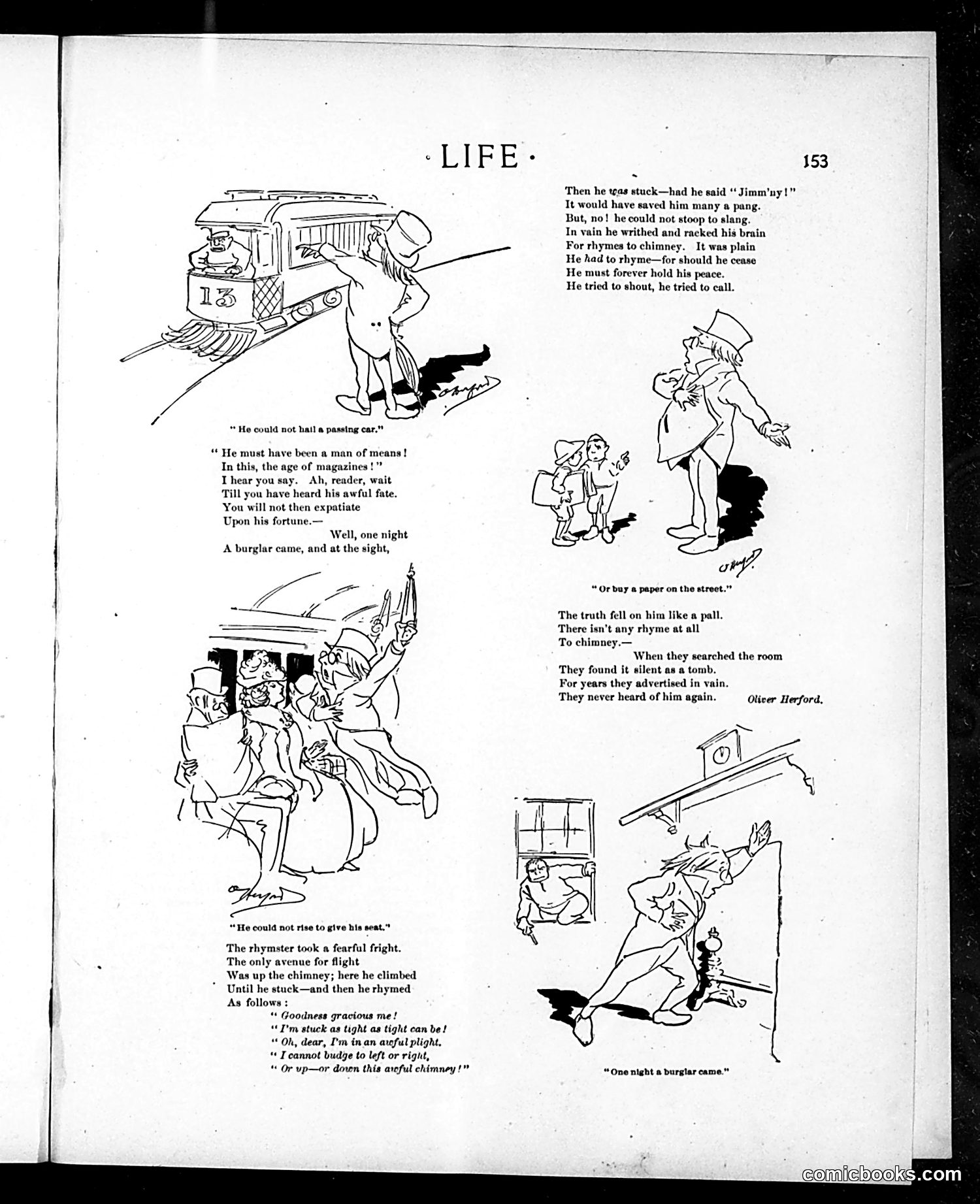
This humorous narrative poem, illustrated by Oliver Herford, satirizes a fastidious man obsessed with maintaining perfect rhymes and proper speech. The protagonist is so committed to never using slang or breaking his rhyming patterns that when a burglar forces him to flee up a chimney, he becomes literally stuck—trapped by his own linguistic rigidity. The joke mocks Victorian pretension and excessive gentility: his refinement ("a man of means") and constant rhyming become his downfall. When trapped in the chimney with no perfect rhyme for "chimney," he cannot shout for help without violating his own code. The illustrations show his increasingly desperate circumstances—burglary, entrapment, disappearance—all because he refuses to abandon his affected speech patterns, even to save his life. It's satire of linguistic snobbery and the absurd consequences of valuing form over substance.
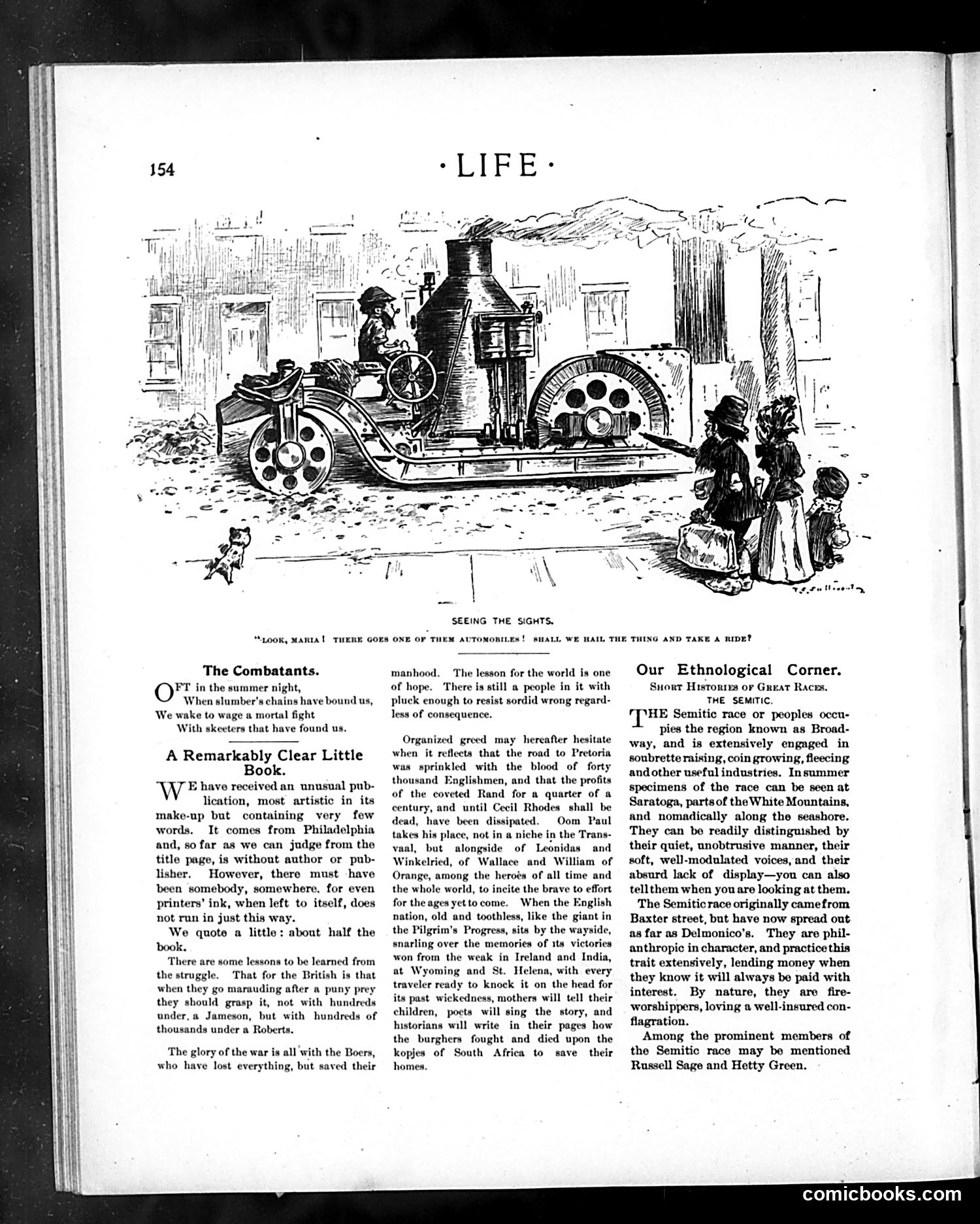
**The Main Cartoon:** "Seeing the Sights" depicts working-class immigrants (Maria and companion) marveling at an early automobile—a new technological wonder. The satire mocks both the novelty of automobiles and the immigrants' accent/speech patterns ("mail the thing"). **"The Combatants":** A humorous short poem about fighting mosquitoes on summer nights—straightforward comic relief with no political content. **"A Remarkably Clear Little Book":** This section praises a nearly wordless book (likely from Philadelphia) about the Boer War (South Africa, 1899-1902). The writer admires the Boers' resistance against British imperial expansion, criticizing Britain's colonial record in Ireland, India, and elsewhere. It lionizes Boer leaders like Paul Kruger ("Oom Paul") alongside historical freedom fighters. **"Our Ethnological Corner":** A satirical ethnic stereotype piece mocking Jewish people ("Semitic race"), characterizing them as financially shrewd, concentrated in Broadway theater and business, and mentioning wealthy figures Russell Sage and Hetty Green—meant as crude "humor" typical of the era.
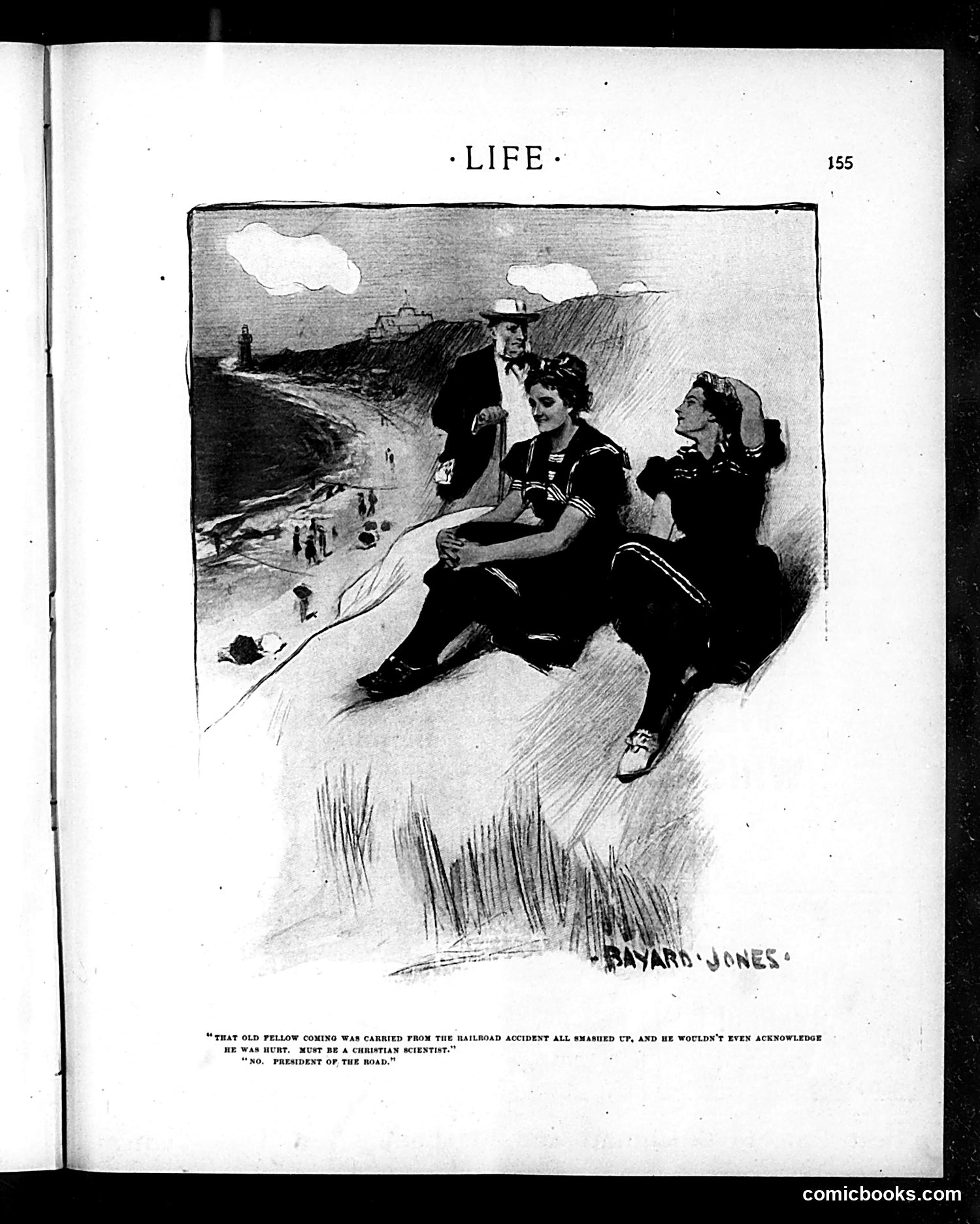
This cartoon by Bayard Jones satirizes a railroad executive's apparent indifference to injury. Two women in what appears to be military or uniform dress observe an older man (identified as a railroad president) being carried from a train accident. The joke hinges on his refusal to acknowledge his injuries—the first woman assumes he must be a Christian Scientist (who believed in faith-healing and denying physical ailment), but the second corrects her: he's actually the railroad president, implying his denial of injury stems from corporate self-interest rather than religious conviction. The satire suggests railroad executives would ignore even serious harm to avoid liability or admitting negligence. The coastal industrial setting reinforces the business context.
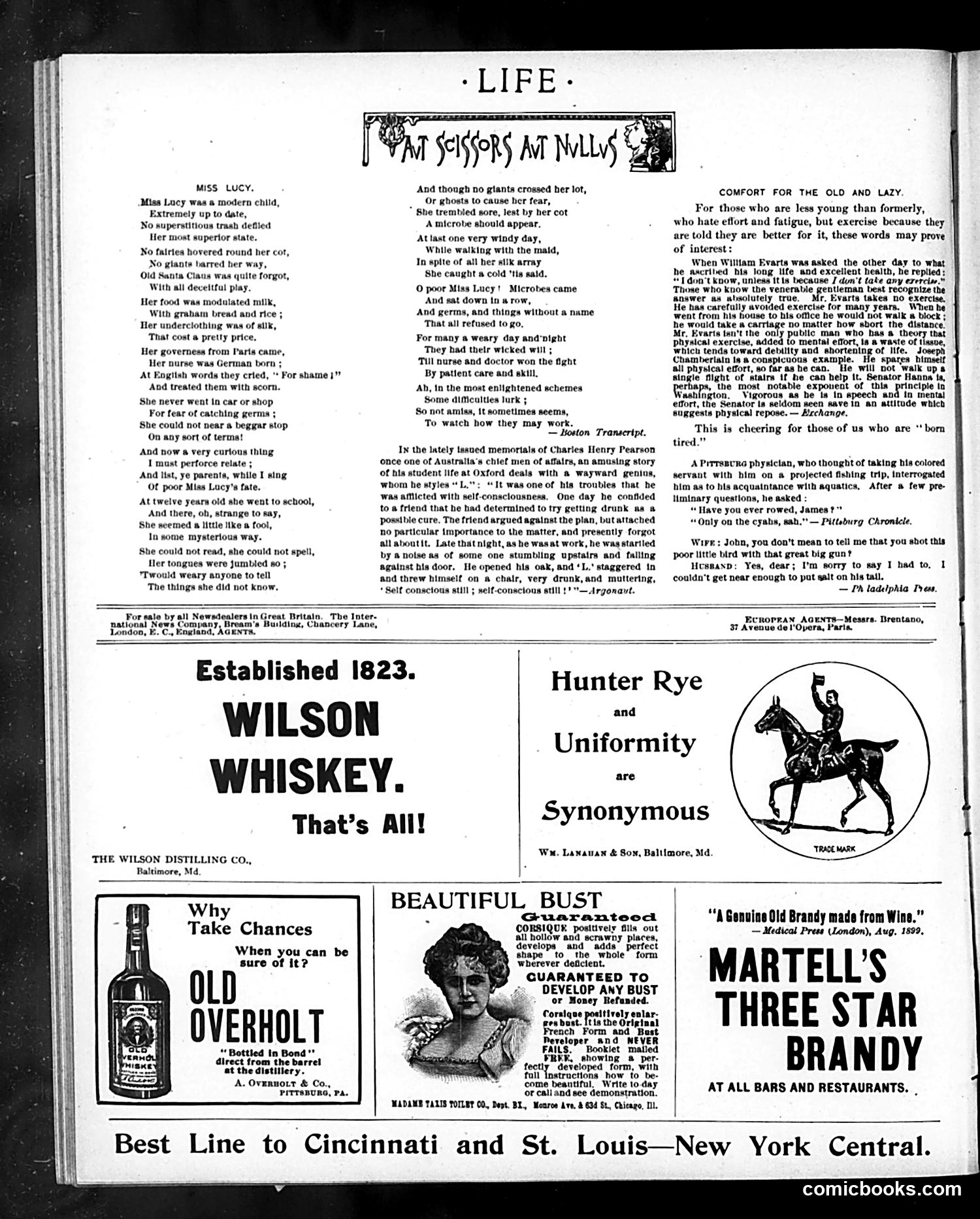
This page features a lengthy narrative poem mocking the exaggerated health anxieties of the modern era. "Miss Lucy" is a contemporary child raised without folklore or superstition, yet plagued by *scientific* fears—specifically, microbes. The joke: she's replaced old superstitions with new ones, trading ghosts and giants for germs. The satire ridicules both overprotective parenting and the emerging germ theory's cultural grip. Lucy's life becomes increasingly constrained by fear of contamination, until nurse and doctor finally cure her of her neuroses. The accompanying "Comfort for the Old and Lazy" section extends the satire, noting that prominent figures like William Evarts and Senator Hanna famously *avoid* exercise—contradicting contemporary health advice—yet remain vigorous and long-lived. The implicit joke: perhaps all this fussing over hygiene and exercise is unnecessary. The page mostly comprises this satirical content with period advertisements below, typical for Life magazine's format.
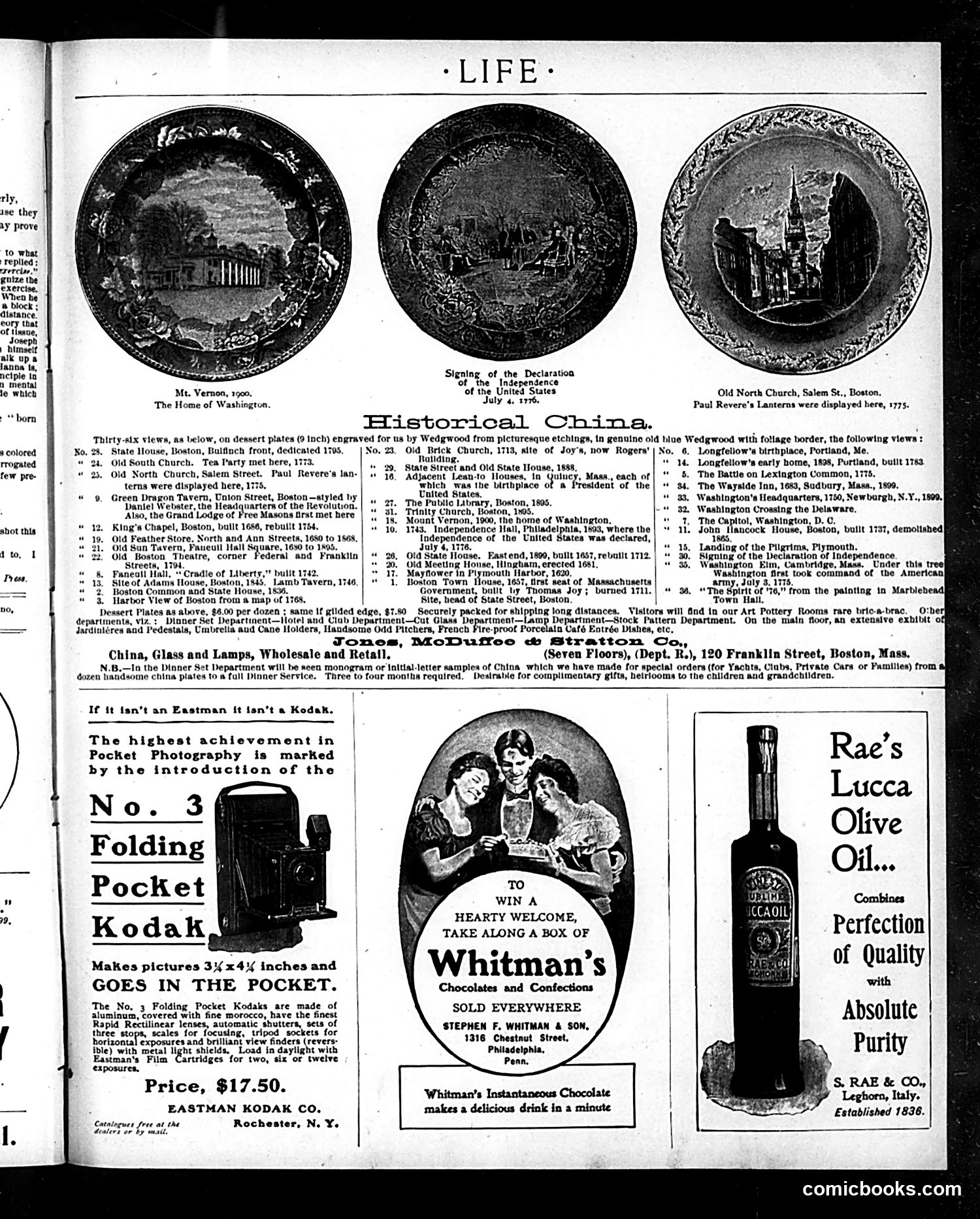
This page is primarily **advertising and product catalog**, not political satire. The top section features "Historical China"—decorative dessert plates manufactured by Wedgwood depicting 36 American Revolutionary landmarks and events (Mount Vernon, Independence Hall, Old North Church, etc.). These were sold by McDuffee & Stratton Co., a Boston china and glassware retailer. Below are three unrelated advertisements: 1. **Kodak No. 3 Folding Pocket Camera** ($17.50)—emphasizing portable pocket photography 2. **Whitman's Chocolates**—a sweepstakes promotion 3. **Rae's Lucca Olive Oil**—Italian import highlighting purity The "Historical China" itself reflects American patriotic sentiment of the era—marketing Revolutionary War history as decorative luxury goods for middle-class homes. There is no cartoon or satirical content; this is a straightforward commercial page from an early 1900s magazine.
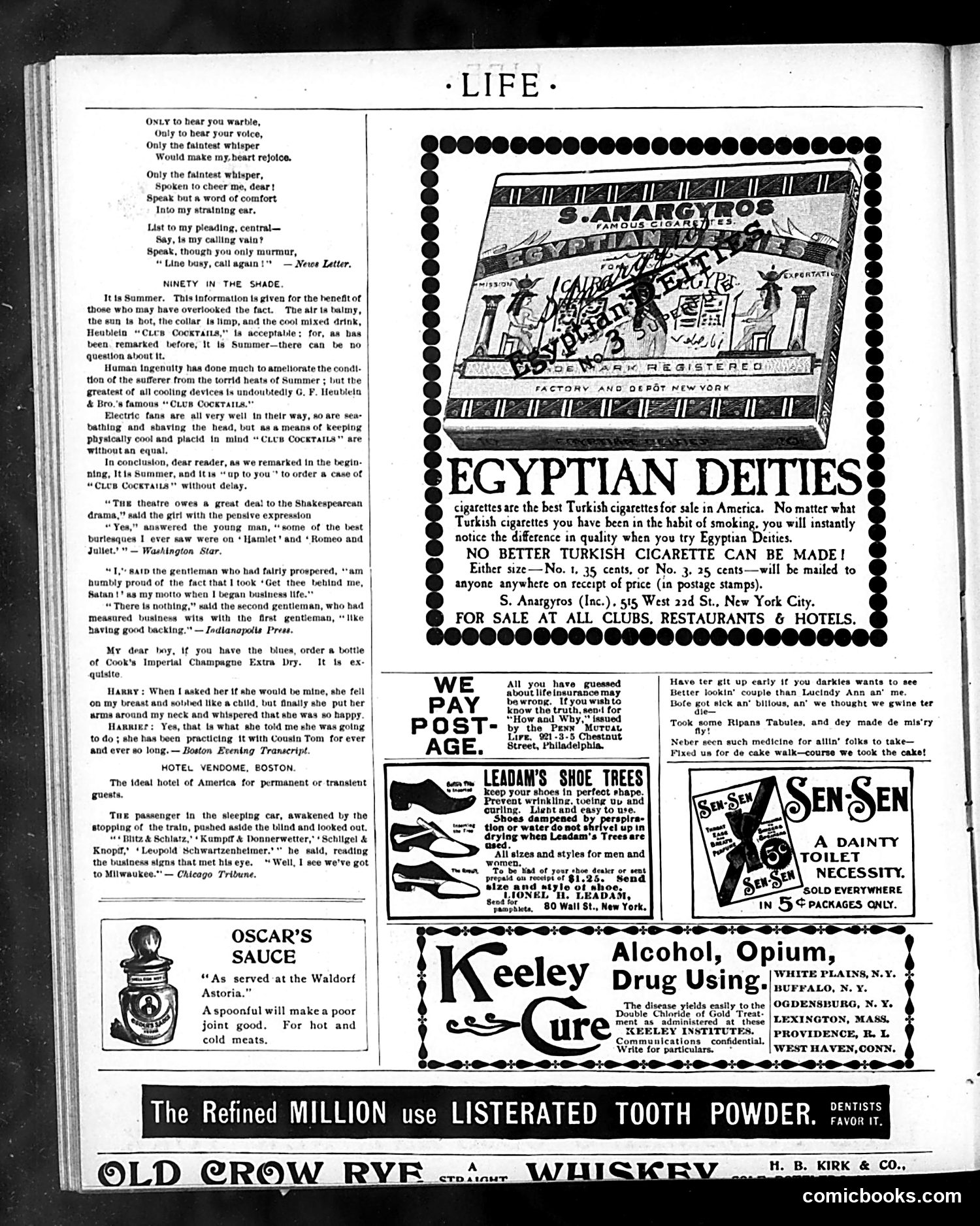
This is primarily an **advertising page** from Life magazine, with minimal editorial cartoon content. The page features several humorous anecdotes and advertisements typical of early 20th-century American magazines. The only substantive content includes: **"Ninety in the Shade"** — A promotional piece for Heublein's Club Cocktails, humorously suggesting that mixed drinks are the best remedy for summer heat, presented as quasi-editorial commentary. **Several brief jokes** about romance, business, and travel that use period dialect and situations for humor (references to telephone operators, sleeping cars, German names). The bulk of the page consists of **period advertisements**: Egyptian Deities cigarettes, Oscar's Sauce, Keeley Cure (for alcohol/drug addiction), Listered tooth powder, and other products. These ads reflect contemporary concerns and available remedies of the era. The page contains **no political cartoons** in the traditional sense—it's primarily commercial content dressed in humorous framing typical of Life's editorial-advertising blend.
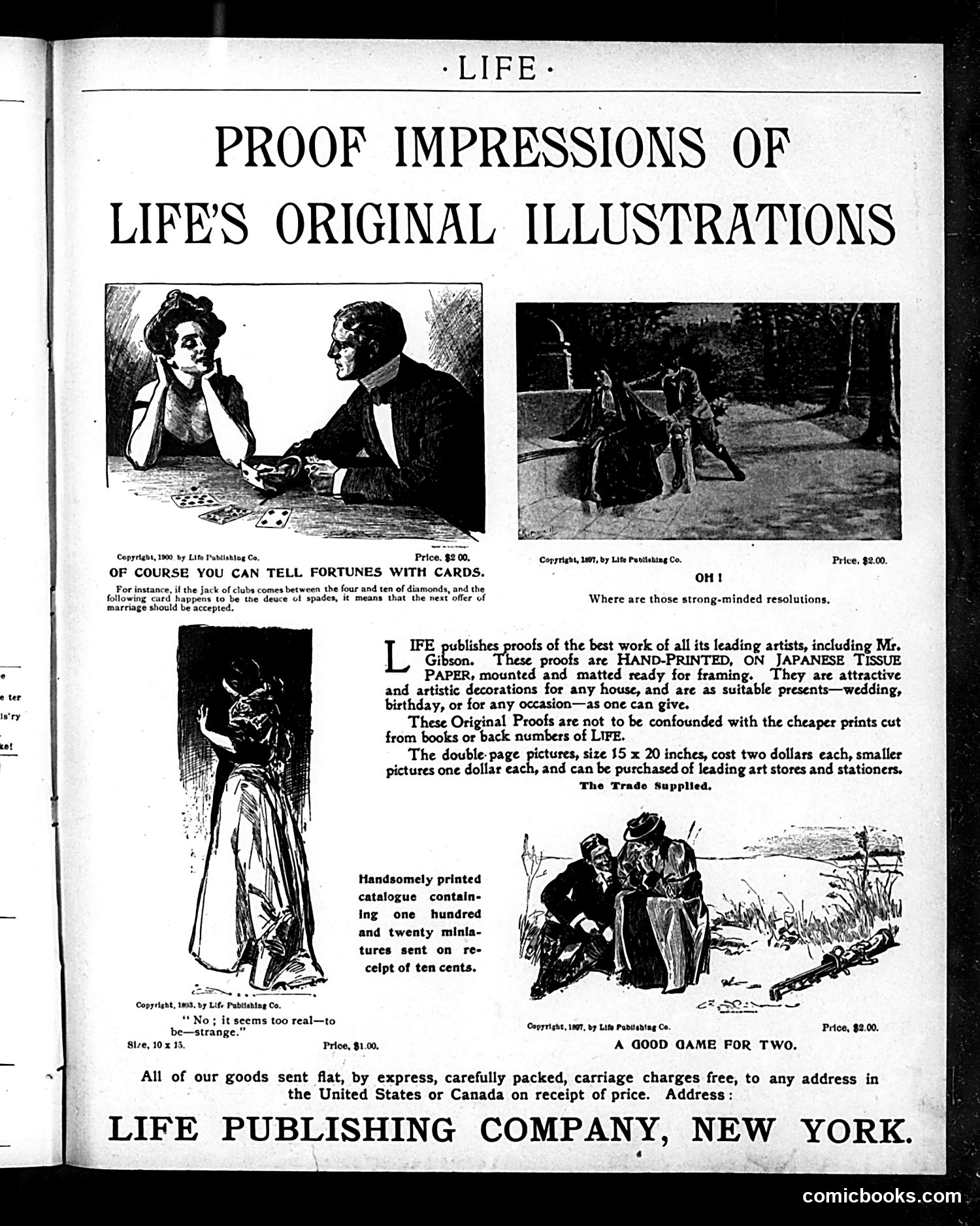
This is primarily an **advertisement page** for Life magazine's art prints, not political satire. However, the cartoon captions offer social commentary: **"Of Course You Can Tell Fortunes with Cards"** mocks superstition—showing a man explaining fortune-telling logic to a skeptical woman, satirizing people who believe in card divination. **"Oh! Where are those strong-minded resolutions?"** appears to show figures in a rural or outdoor setting, likely critiquing the failure of New Year's resolutions or similar pledges (a recurring theme in period humor). **"A Good Game for Two"** depicts people in conversation, the title's double meaning suggesting both literal games and romantic/social interaction. The page advertises hand-printed proofs of illustrations by artists including (likely) Charles Dana Gibson, available for framing as gifts. These were marketed as superior to cheaper reproductions from the magazine itself.
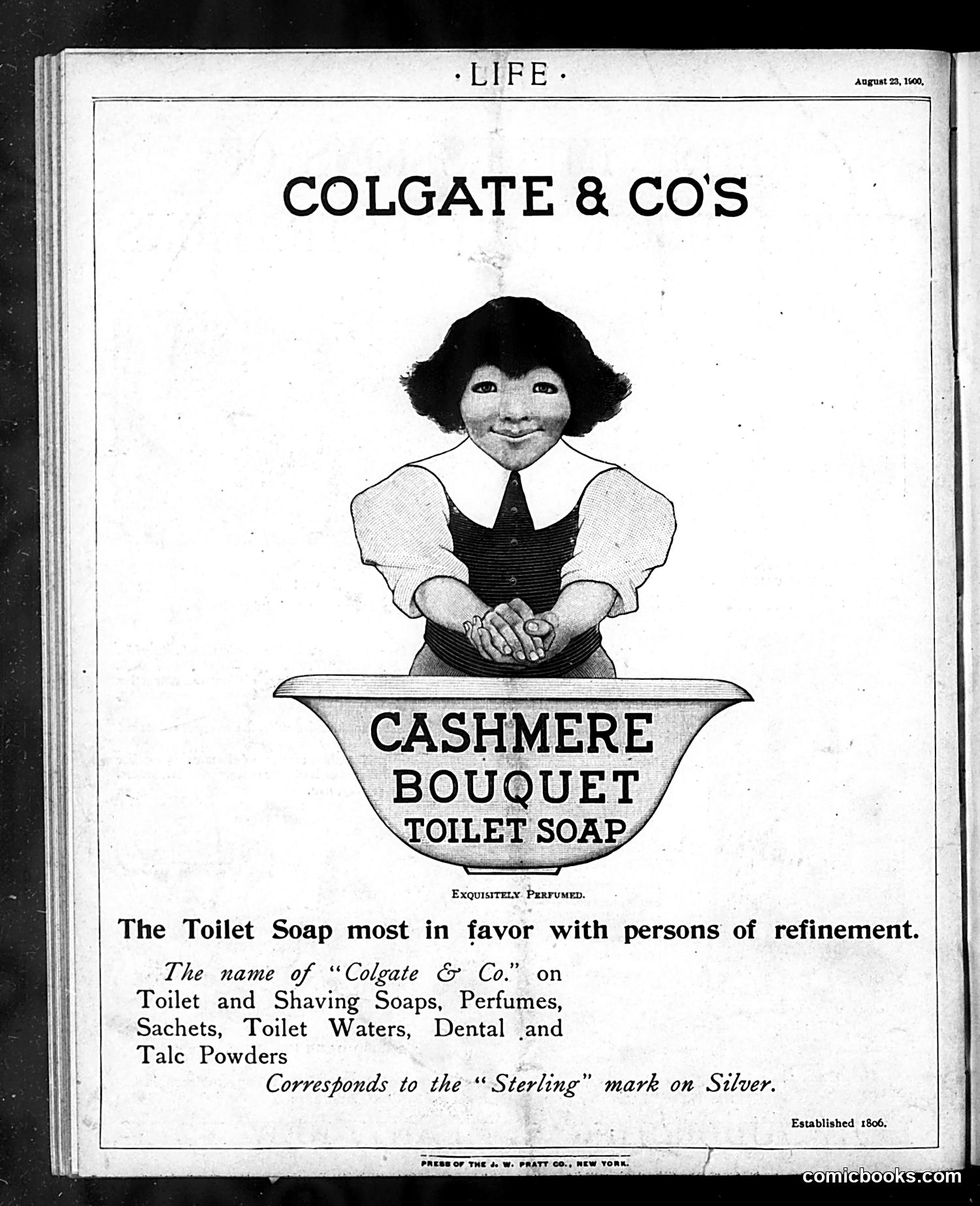
This is a **full-page advertisement**, not satire or political commentary. It promotes Colgate & Co.'s "Cashmere Bouquet" toilet soap, published in *Life* magazine on August 23, 1902. The illustration shows a smiling woman with short dark hair in period dress, positioned above a decorative soap basin. The ad targets wealthy consumers by claiming the product appeals to "persons of refinement" and compares Colgate's brand reputation to the "Sterling" hallmark on fine silver—establishing quality and prestige. The woman's cheerful demeanor and the luxurious product name ("Cashmere Bouquet") emphasize elegance and sophistication. This reflects early 1900s marketing that associated personal hygiene products with social status and refinement, particularly targeting middle and upper-class women.