
A complete issue · 20 pages · 1900
Life — July 26, 1900
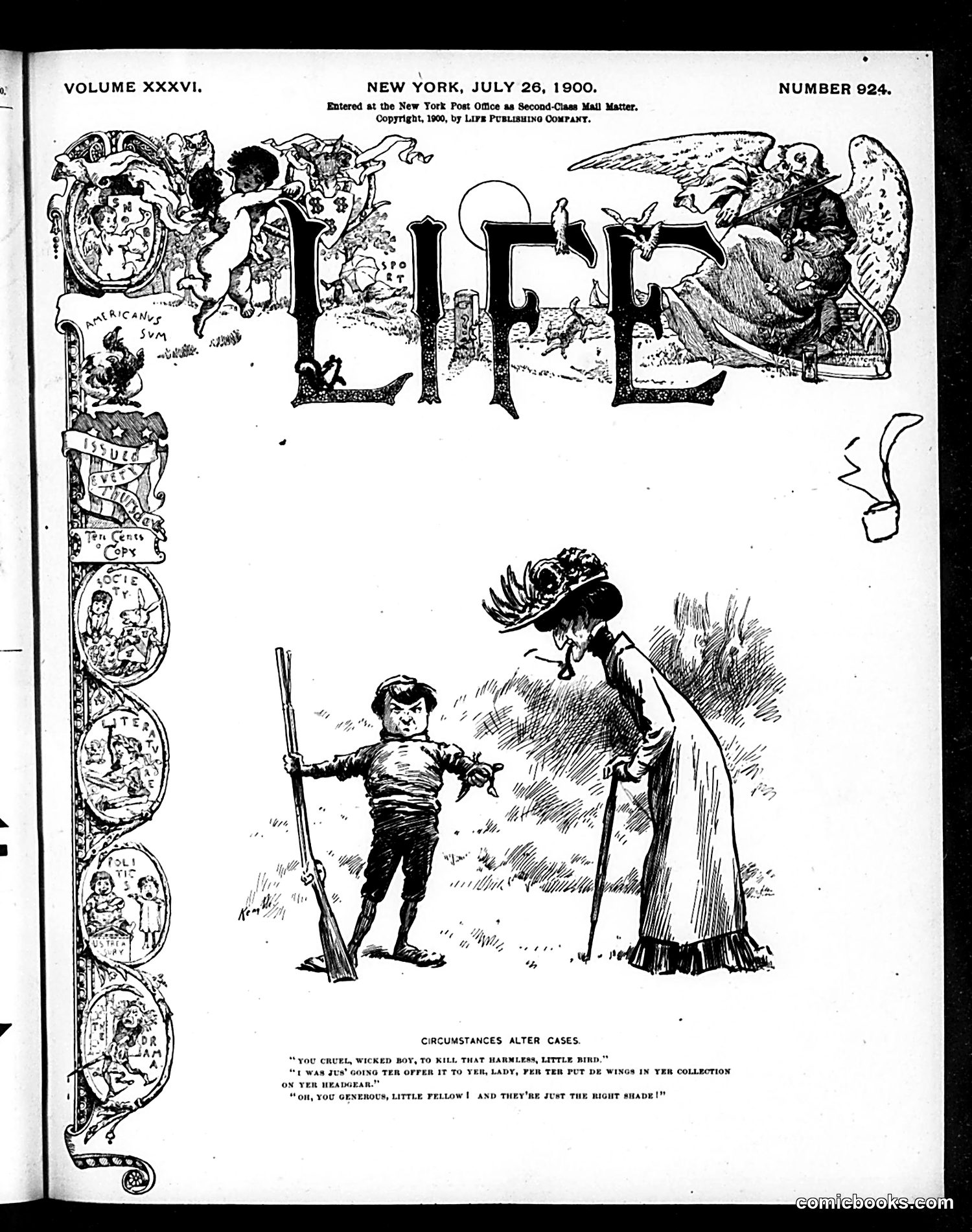
This page features a satirical cartoon titled "Circumstances Alter Cases." The image shows a young boy holding a spade confronting a well-dressed woman, depicting a moral reversal through dialogue. The three quoted statements reveal the satire: the boy admits he was "going ter offer it yer, lady, per ter put de wings in yer collection on yer headgear"—referencing the contemporary fashion of decorating women's hats with bird feathers and wings. The woman's response, calling him "generous" and "the right shade," suggests she's praising his willingness to kill birds for her fashion. The satire critiques the ethical inconsistency of Victorian society: people condemned hunting as cruel, yet eagerly purchased dead birds for millinery. The "circumstances" that "alter cases" is the promise of fashion.
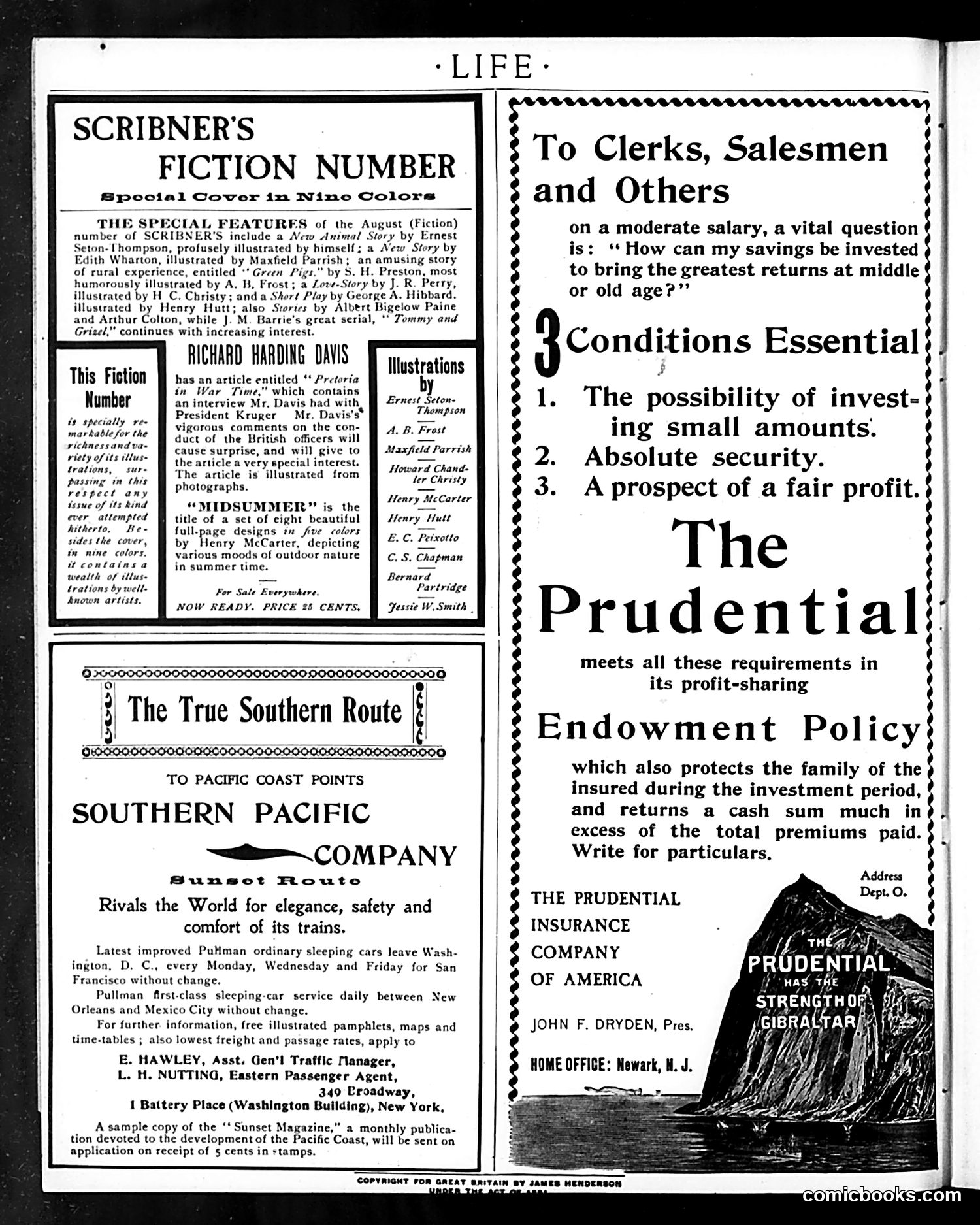
This page contains **primarily advertisements**, not editorial cartoons or satire. The visible content includes: 1. **Scribner's Fiction Number** (left): Announces the August fiction issue with stories by Ernest Hemingway, Edith Wharton, and others. Notes a special nine-color cover and illustrations by named artists. 2. **Southern Pacific Railway ad** (center-left): Promotes "The True Southern Route" to Pacific Coast, highlighting Pullman sleeping cars and service between major cities. 3. **Prudential Insurance ad** (right): Targets clerks and salesmen, promoting an endowment policy meeting three investment conditions: small investments, security, and fair profit. The page reflects early 20th-century consumer advertising and literary promotion. No political satire or caricatures are present—this is a commercial magazine page from Life's advertising section.
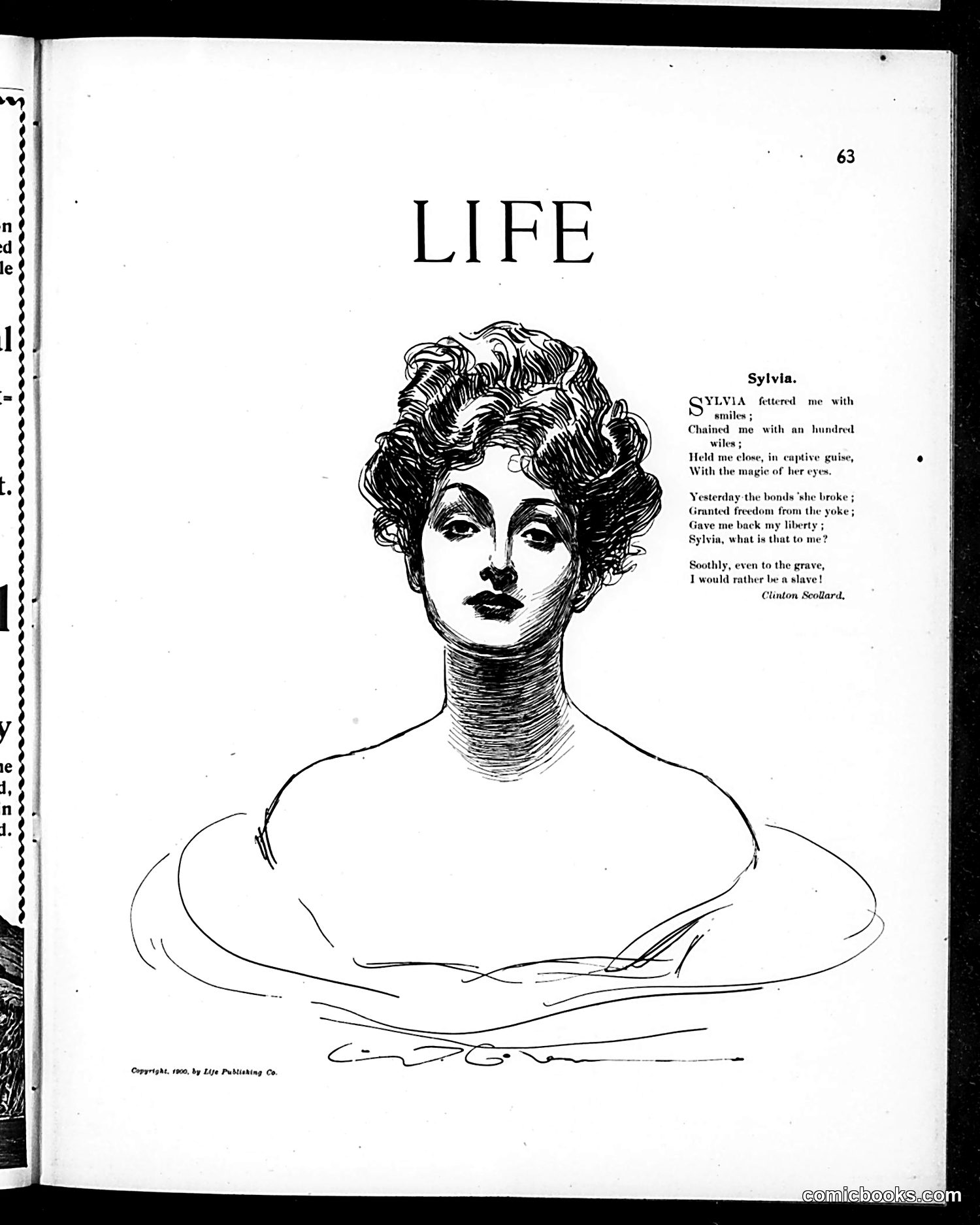
This page from *Life* magazine (copyright 1900) presents a poem titled "Sylvia" accompanying a portrait illustration of a woman's head and shoulders. The poem uses romantic language to describe Sylvia as an enchanting but ultimately destructive force—she "fettered" the speaker with "smiles," "chained" him with "wiles," and held him captive. However, she recently broke her bonds and freed him, returning his liberty. The final line attributes the sentiment to Clinton Scollard, a popular American poet of the era. This appears to be **sentimental verse rather than political satire**—typical of *Life*'s literary content. The illustration is a portrait in the Gibson Girl style, popular during this period. The page represents the magazine's mix of poetry, portraiture, and romantic themes alongside its better-known satirical cartoons.
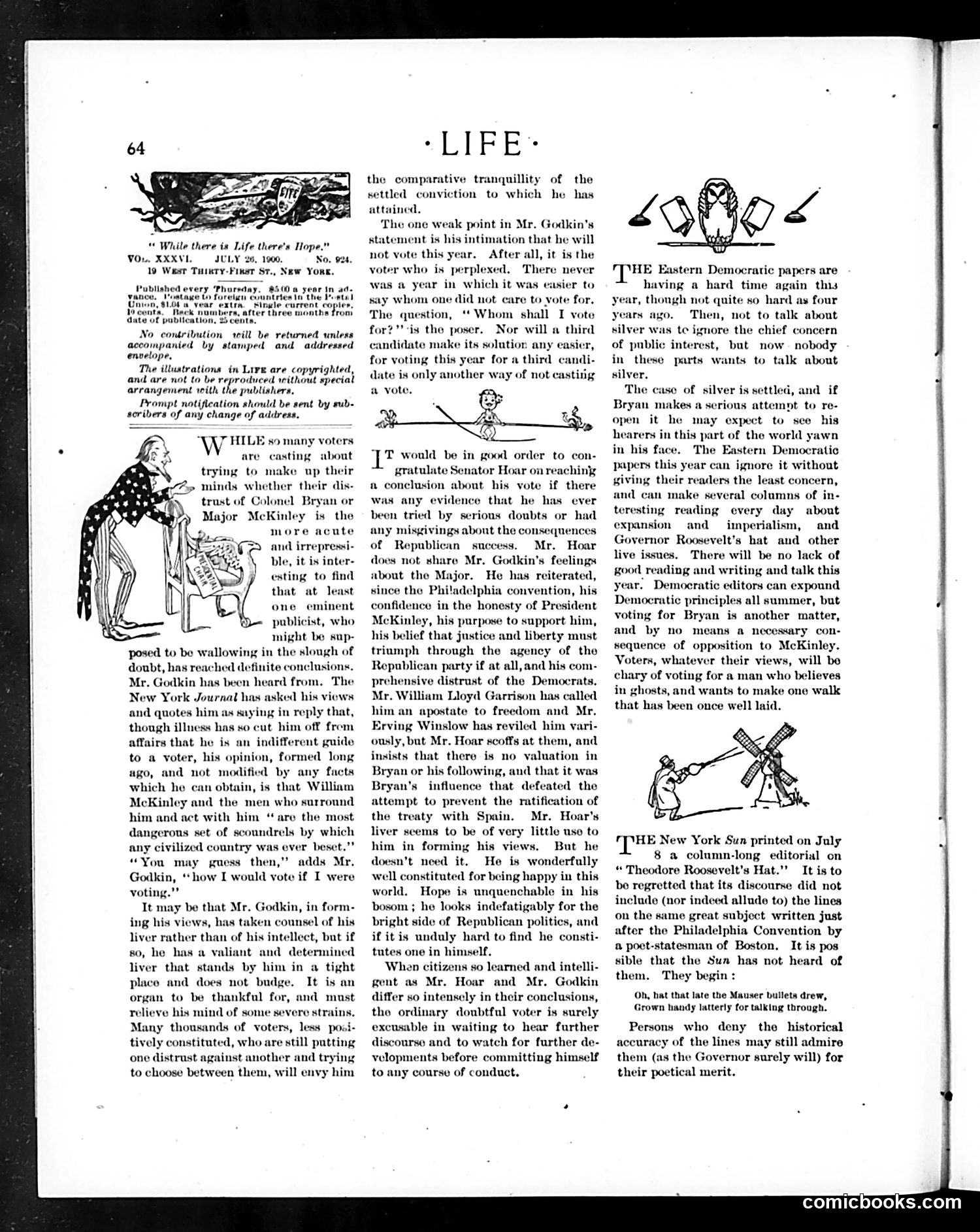
This Life magazine page (July 26, 1906) satirizes uncertainty among Democratic voters about whom to support. The left cartoon depicts a voter seemingly unable to decide between competing political figures—visualized as he appears trapped or confused between them. The text discusses Colonel Bryan and Major McKinley as candidates causing voter indecision. It critiques Eastern Democratic papers for avoiding serious discussion of Bryan's position and the party's direction. The article notes that Bryan's influence previously defeated a treaty with Spain, and questions whether voters can trust him with consequential decisions. The satire targets Democratic editorial cowardice—papers refusing to honestly debate their party's nominee rather than engaging substantively with voters' legitimate concerns about leadership capability.
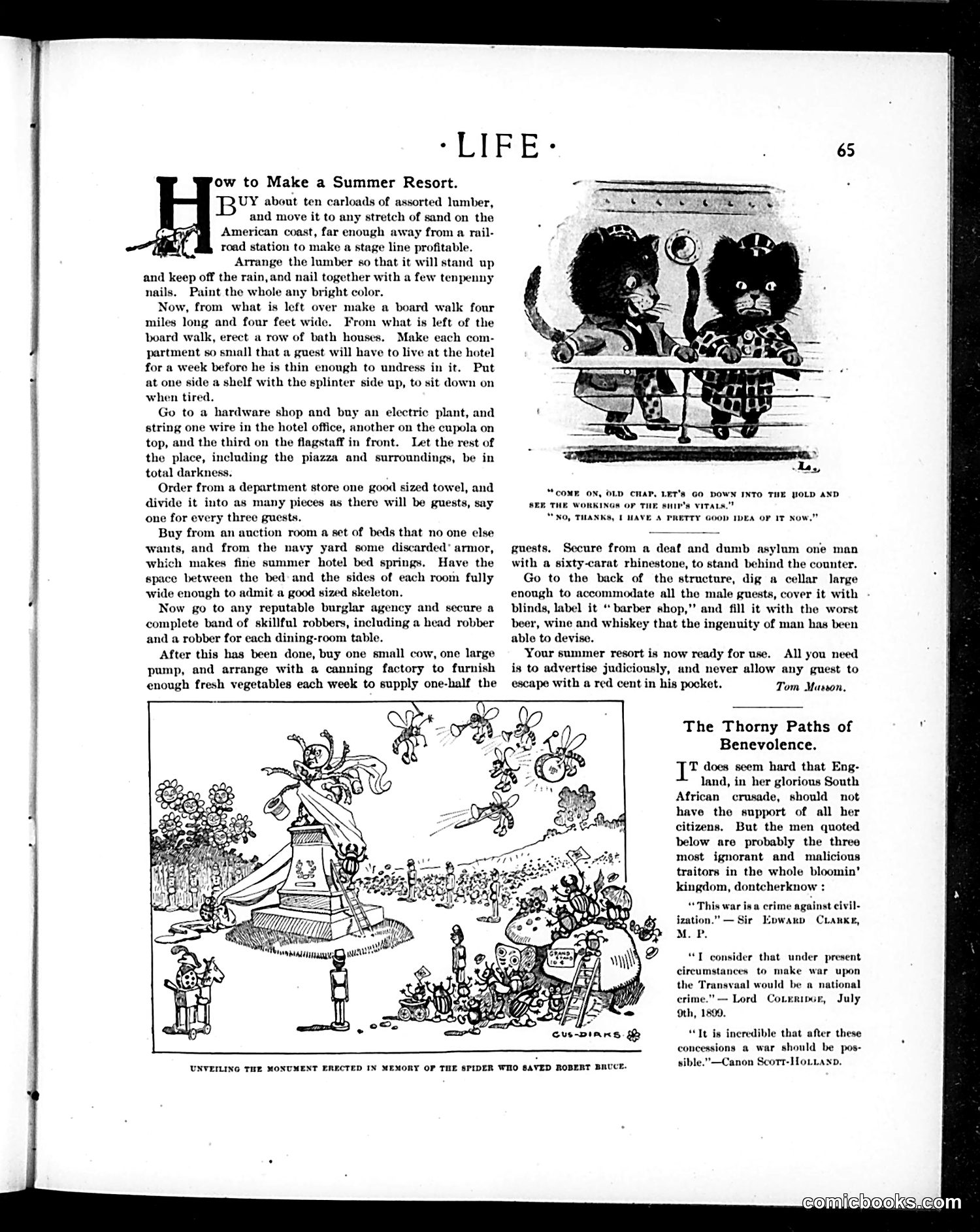
**Top Section - "How to Make a Summer Resort":** This is satirical practical advice for establishing a profitable seaside resort on cheap American coastal land. The tongue-in-cheek instructions include buying lumber, building bath houses, acquiring beds, hiring staff (including "skilled robbers"), and stocking alcohol. The cartoon illustrates two figures at what appears to be a resort counter. The satire mocks the commercialization and exploitation inherent in turn-of-the-century resort development—suggesting resorts are essentially schemes to extract money from gullible tourists through inferior accommodations and overpriced goods. **Bottom Section - "The Thorny Paths of Benevolence":** This political cartoon addresses the Boer War in South Africa. It criticizes British humanitarian claims about the conflict while quoting three contemporary figures questioning the war's justification. The monument imagery and surrounding chaos suggest mockery of Britain's moral posturing.
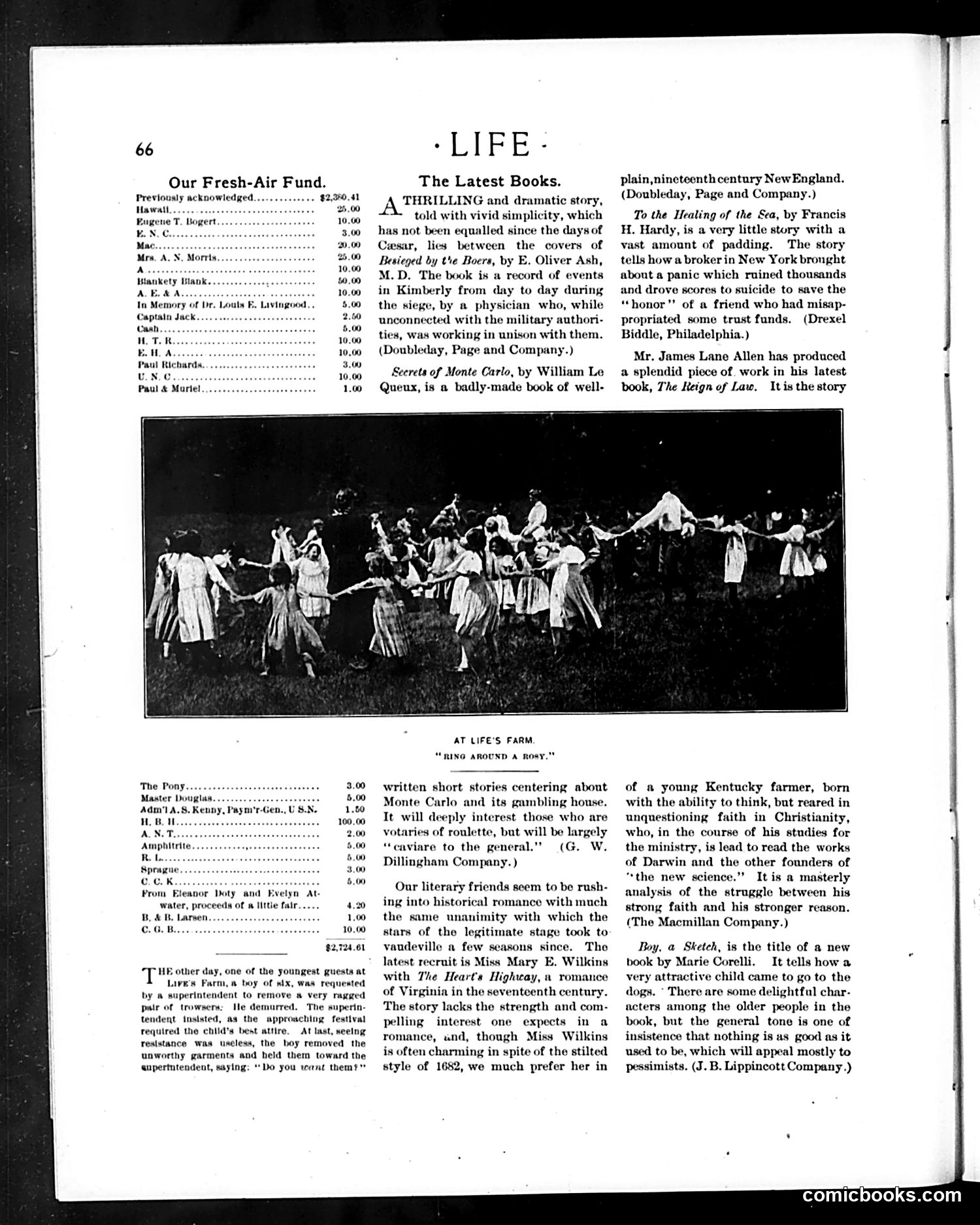
This page from *Life* magazine contains book reviews rather than political cartoons. The main image shows a photograph titled "AT LIFE'S FARM: 'RING AROUND A ROSY'" depicting a group of people (appearing to be women and children) in a circle, likely playing the children's game referenced in the title. The text reviews several new books, including *Desired by the Doors* by E. Oliver Ash, *Secrets of Monte Carlo* by William Le Queux, and works by James Lane Allen and Marie Corelli. The reviews discuss plot summaries and literary merit of these contemporary novels. There is no political satire visible on this page—it functions as a literary review section with an accompanying pastoral photograph illustrating leisure activities.
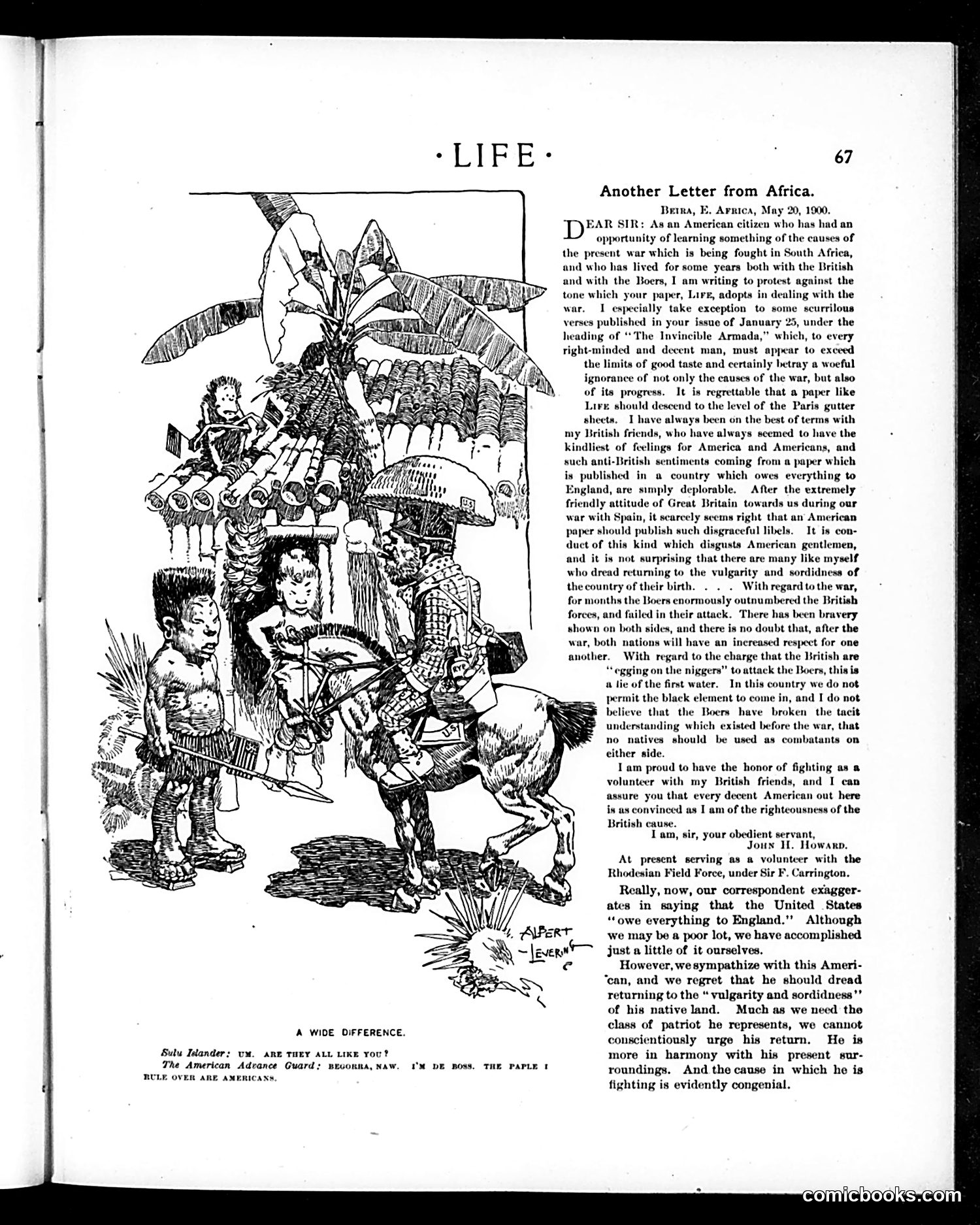
This page from *Life* magazine (May 20, 1900) contains a letter criticizing American support for British forces in the Boer War in South Africa. The writer, John H. Howard, a volunteer with British forces, protests *Life*'s satirical coverage mocking the war effort—particularly verses titled "The Invincible Armada." **The Cartoon "A Wide Difference"** depicts a Boer Islander asking an American soldier "Are they all like you?" while the American Guard responds "Begorra, naw. I'm de boss. The paple I rule over are Americans." This satirizes American imperialism and the contradiction between American democratic ideals and military aggression—likely referencing American actions in the Philippines during this same period.
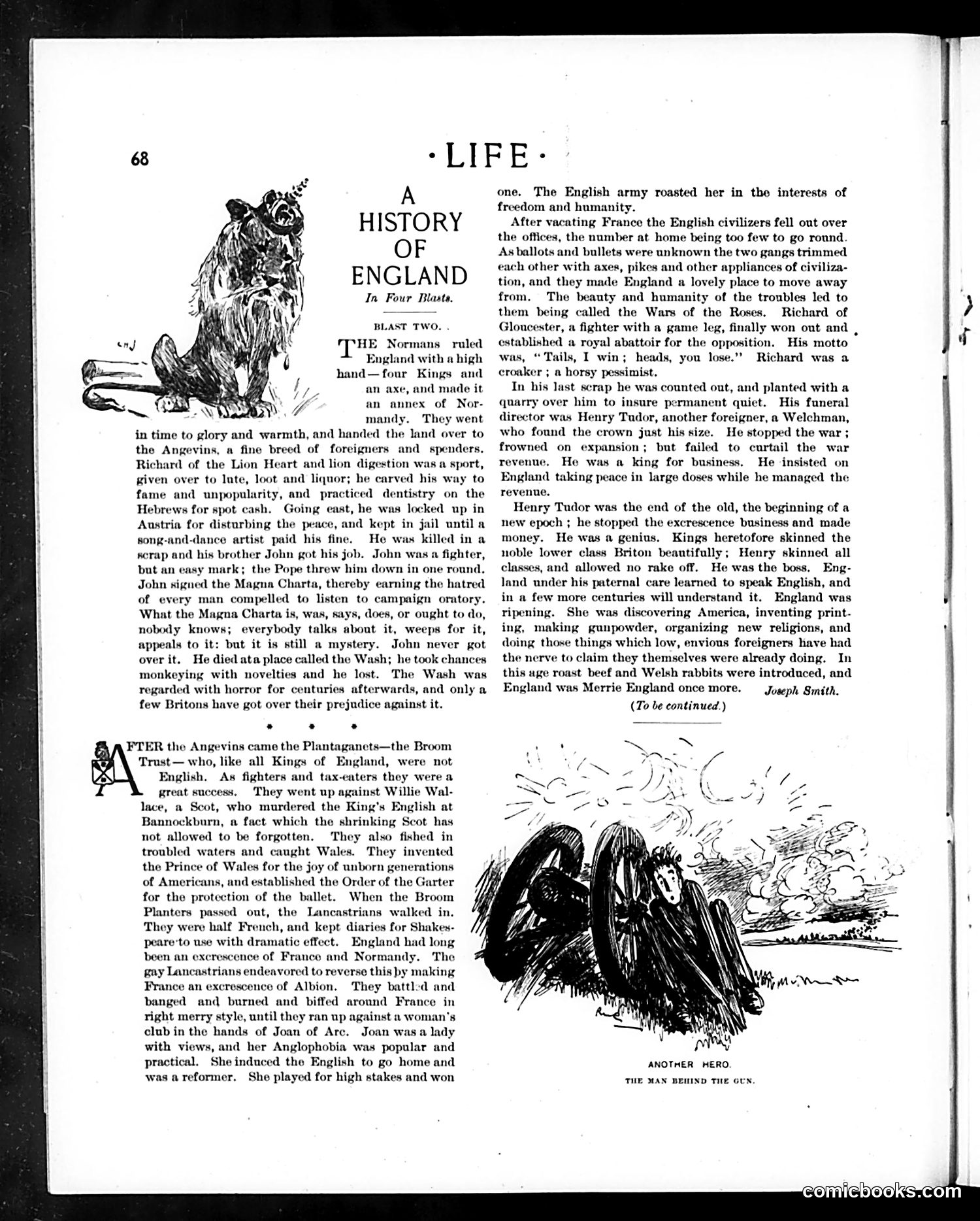
This page presents satirical historical vignettes about English rulers. The text mocks the Norman conquest, Richard the Lionheart's failed expansion plans, and particularly Henry Tudor, praising him as a genius who revolutionized kingship by making money rather than war. The illustration labeled "Another Hero: The Man Behind the Gun" depicts a dark, menacing figure wielding a cannon—likely satirizing militarism or a contemporary military leader. The image's ominous tone contrasts with the text's celebration of Tudor's peaceful approach. The overall satire criticizes traditional English warfare and conquest while praising practical governance focused on commerce and stability over military glory—a commentary on what Life saw as more enlightened rulership.
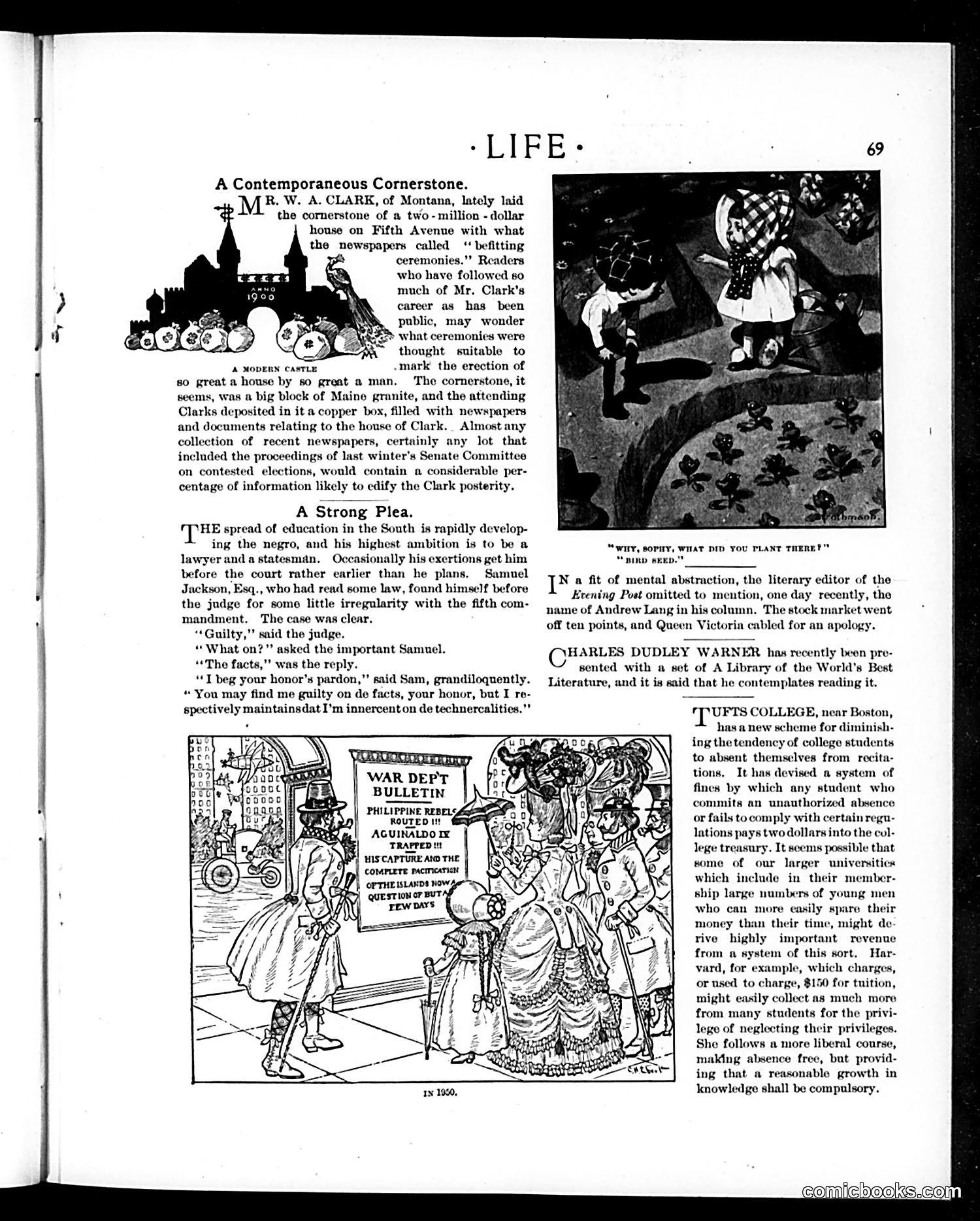
This page contains three separate items: 1. **"A Contemporaneous Cornerstone"**: A brief article about W.A. Clark of Montana laying a cornerstone for a two-million-dollar Fifth Avenue mansion, with satirical commentary about burying newspapers and documents inside—suggesting this will be the historical record of Clark's life and times. 2. **"A Strong Plea"**: An anecdote about a lawyer (Samuel Jackson) who told a judge he was "guilty on the facts" but claimed innocence on technicalities. The judge's response mocks this as absurd legal reasoning. 3. **A cartoon labeled "In 1666"**: Depicts what appears to be a medieval or historical scene with period-dressed figures and a "War Dept Bulletin" poster, though the specific satirical target is unclear from the visible text alone. The page exemplifies Life's typical format of mixing brief satirical articles with illustrations critiquing contemporary figures and social absurdities.
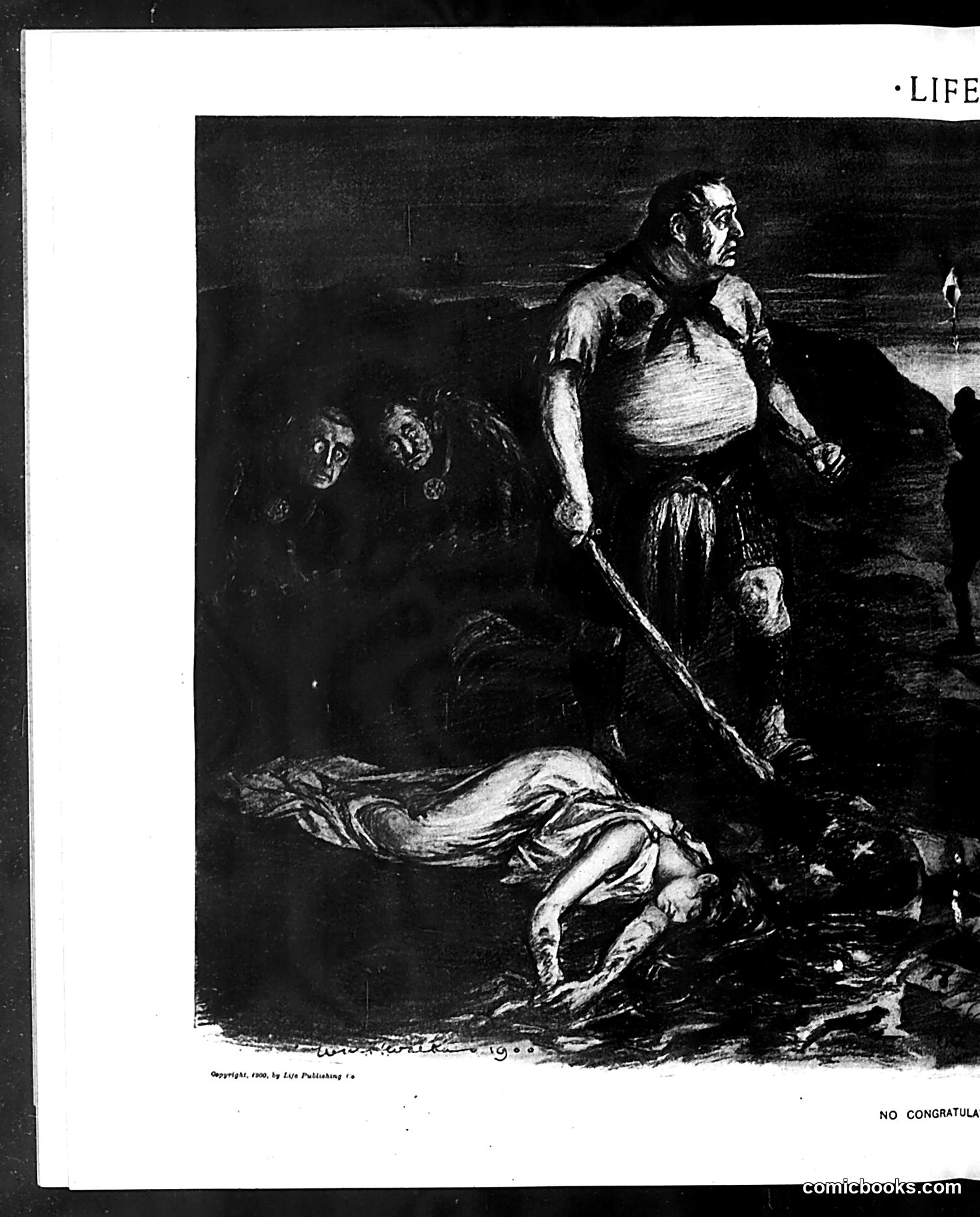
This appears to be a dramatic historical or mythological illustration rather than a political cartoon. The image shows a muscular warrior or military figure standing over a fallen nude body, with darker figures (possibly demons or attendants) in the shadowed background. A torch or light source illuminates the scene from the upper right. The copyright notice reads "1900, by Life Publishing Co," dating this to that year. The partial text at bottom reads "NO CONGRATULA[TIONS]," suggesting irony about the scene depicted. Without clearer caption text or title visible on this page, I cannot definitively identify which specific historical, mythological, or political event this illustration references. The classical style and dramatic composition suggest it may comment on warfare, conquest, or mortality, but the exact satirical point remains unclear from the image alone.
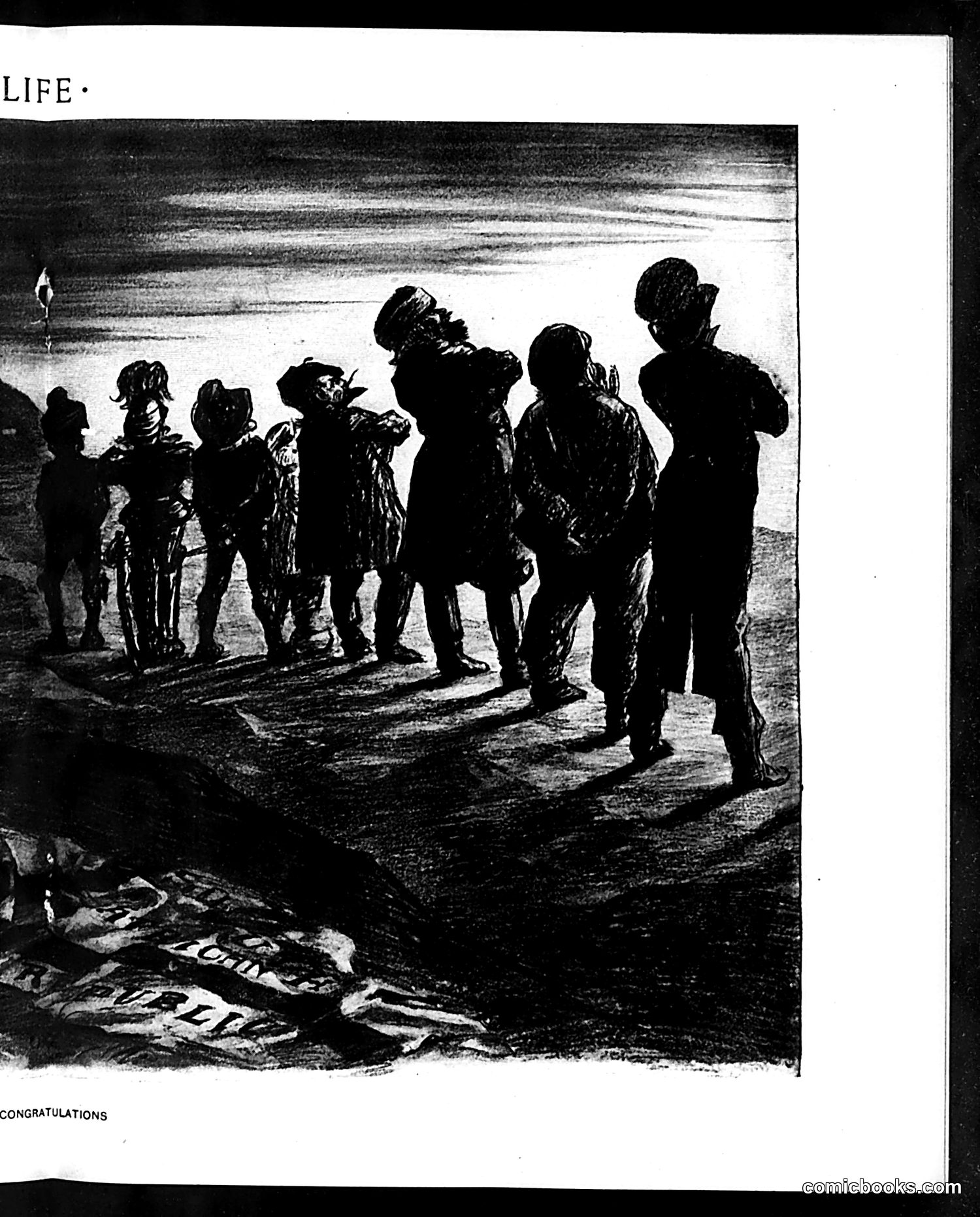
This page from *Life* magazine shows a dramatic silhouetted scene of children standing on a beach or shoreline, looking outward toward water. The word "CONGRATULATIONS" appears at the bottom. The image appears to be satirical commentary, likely from the early-to-mid 20th century based on the printing style. The children's postures suggest curiosity or wonder, while their silhouettes against the water create an ominous tone that contrasts with the "congratulations" caption. Without additional context about the publication date or accompanying article text, the specific political or social target remains unclear. The satire likely critiques something contemporary to *Life* magazine's readership—possibly parenting attitudes, education policy, or social conditions affecting children—but the exact reference cannot be definitively determined from the image alone.
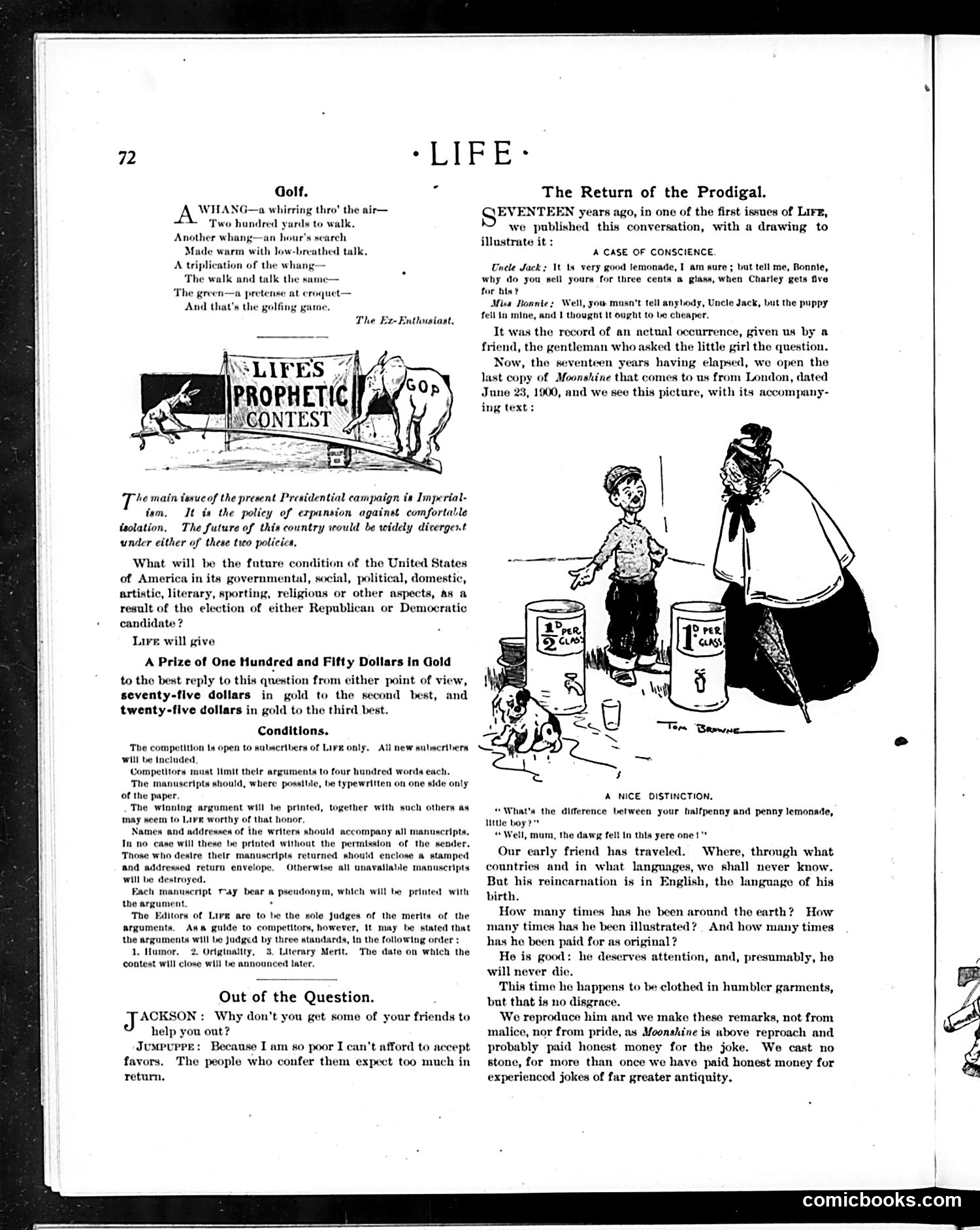
This page reprints a 17-year-old illustration from *Life* (June 23, 1900) showing a child asking an adult about the difference between "halfpenny" and "penny lemonade." The accompanying text explains the child is asking Uncle Jack why he won't help him, and Uncle Jack replies he can't afford to accept favors because "people who confer them expect too much in return." The cartoon satirizes the tension between accepting charity and maintaining independence or dignity. The "prodigal" reference suggests a wayward figure returning, possibly commenting on social climbing or someone seeking assistance after absence. The lemonade stand setup represents humble commerce, making the satire about economic desperation and pride.
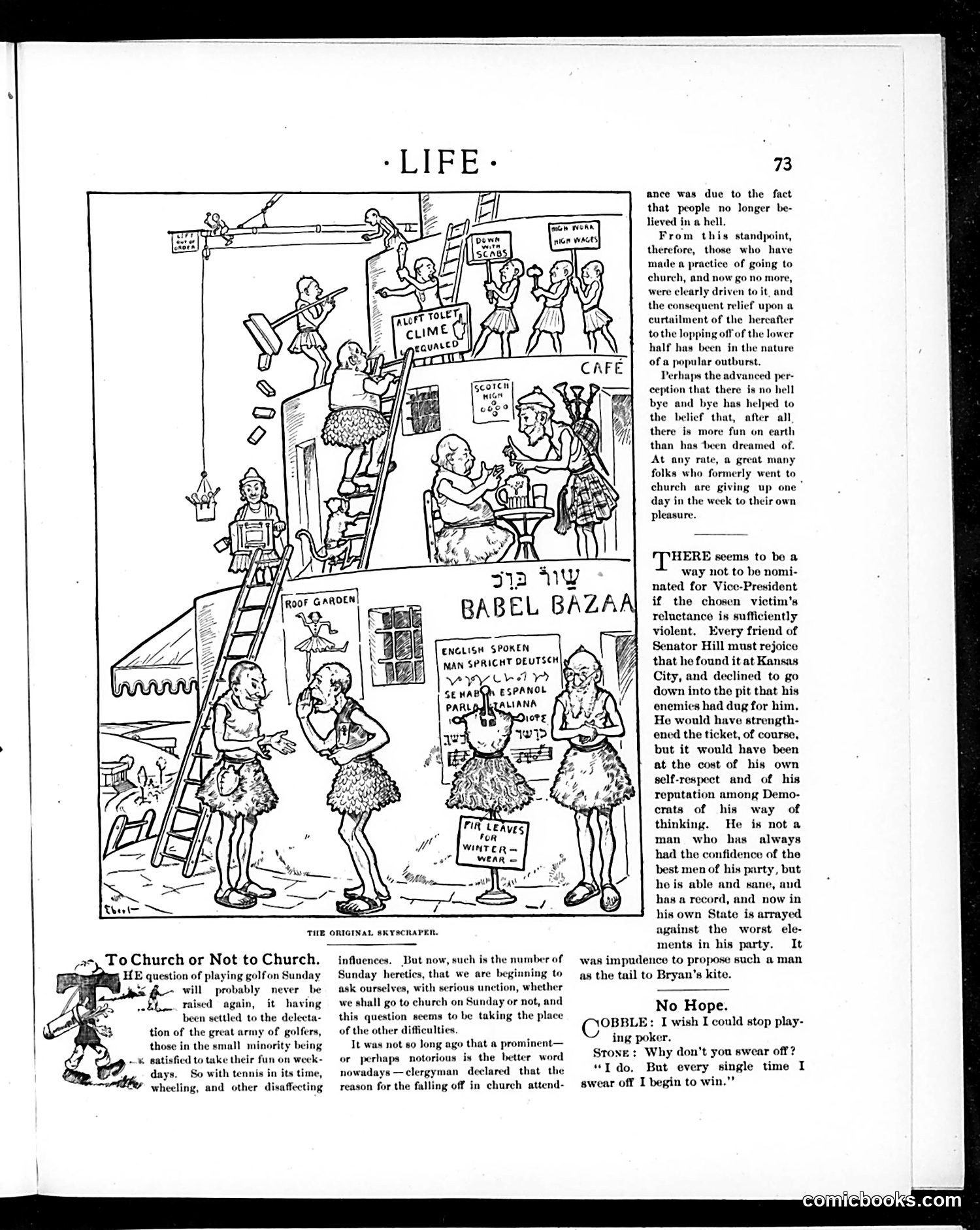
**Main Cartoon: "The Original Skyscraper"** This satirical illustration depicts a multi-story building representing the Babel Bazaar—a cosmopolitan marketplace where people of various nationalities conduct business. The cartoon's title is a pun: it's called a "skyscraper" because it's vertically stacked (like the Tower of Babel), not because it's a tall modern building. The signage shows "English Spoken / Man Spricht Deutsch / Se Habla Español / Parla Italiano" and other languages, mocking immigrant commerce and cultural diversity in American cities. The chaos and crowding satirize the perceived disorder of multicultural urban life. **"To Church or Not to Church" Article** This piece addresses declining church attendance, attributing it to a clergyman's claim that people no longer believe in hell. The article suggests that modern Americans—no longer fearing damnation—choose leisure activities (golf, cycling) over Sunday worship. **"No Hope" Joke** A brief joke about a man addicted to poker who cannot quit because winning keeps him playing.
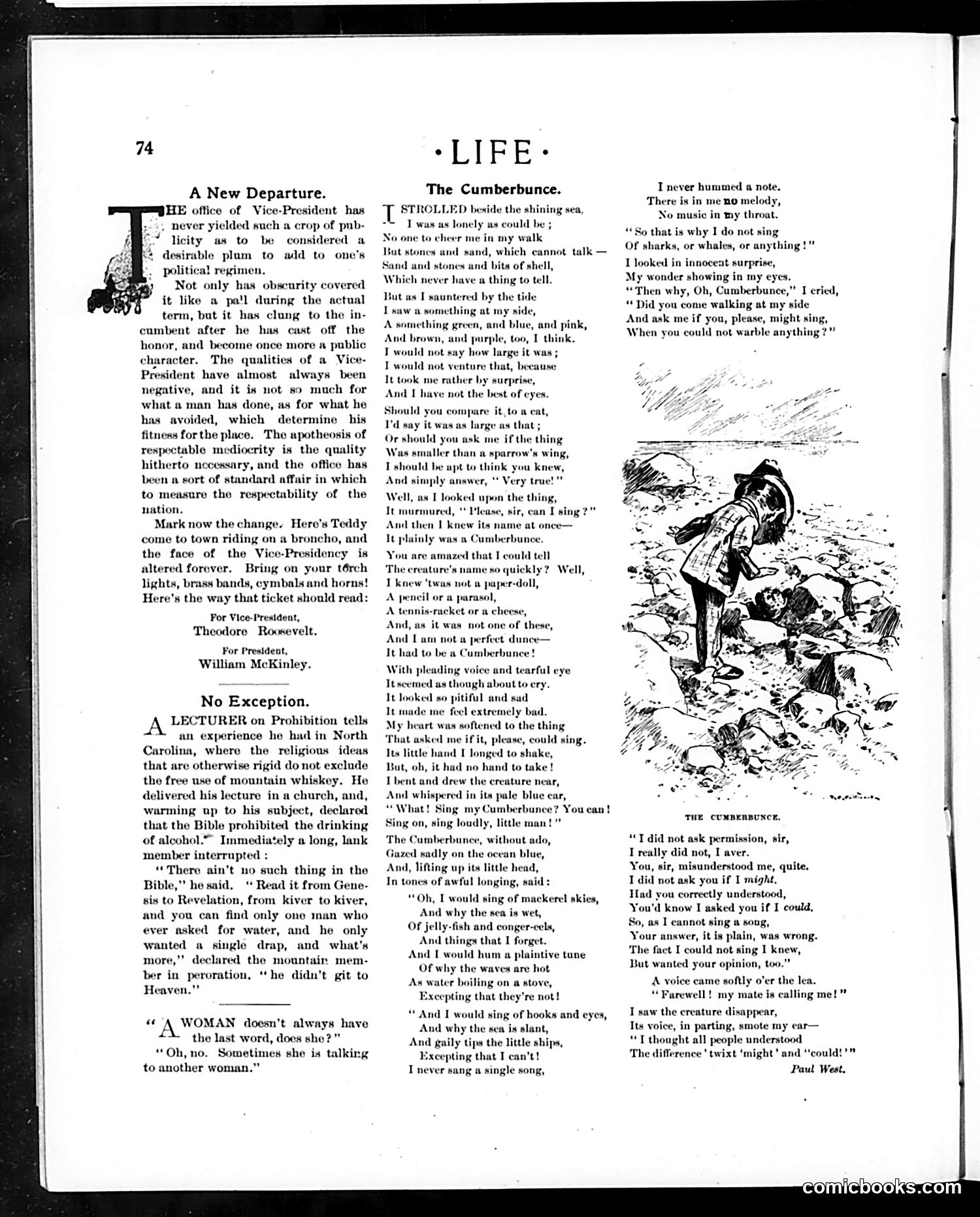
This page features a whimsical poem about an imaginary creature called a "Cumberbunce" encountered on a beach. The poem is lighthearted fantasy—the creature is indescribable (green, blue, pink, purple), has no hand to shake, and wishes to sing but cannot. The accompanying illustration shows a figure discovering this peculiar being among rocks and shells by the seaside. The humor lies in the poem's absurdist logic: the narrator identifies the creature as a Cumberbunce simply by process of elimination—it's not a paper-doll, pencil, parasol, tennis-racket, or cheese, so it *must* be a Cumberbunce. This satirizes pretentious reasoning and naming conventions. The other page content discusses Theodore Roosevelt's appointment as Vice-President and a Prohibition lecture story, but the "Cumberbunce" poem is the primary illustrated feature.
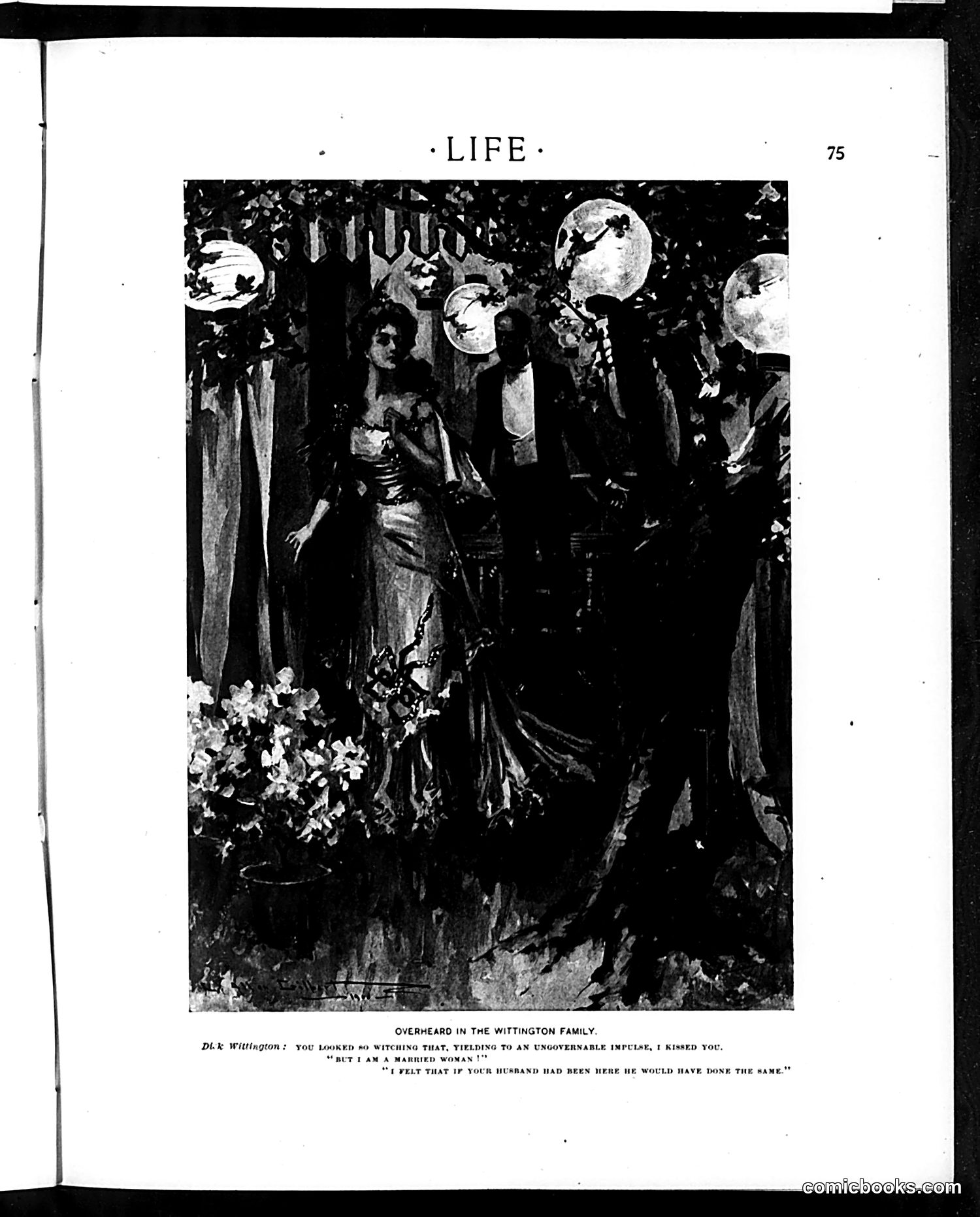
This appears to be a scene from a dramatization or comic titled "Dick Wittington" (likely referencing the classic English folk tale). The image shows an indoor scene with figures in formal/period dress and decorative elements like flowers and lanterns. The caption presents dialogue between two characters: a man explaining he kissed a woman because she "looked so witching," and the woman objecting that she's married. He responds that her husband would have done the same in his position. The satire targets male behavior and social hypocrisy—the man essentially excuses improper conduct toward a married woman by claiming any man would behave identically. It mocks both the double standard that permits men certain liberties and the self-serving logic men use to justify inappropriate advances. The "witching" pun plays on appearance versus actual propriety.
This page is primarily **advertising and editorial content** rather than political satire. The main featured articles include: 1. **"At Scissors and Nulls"** (top): An editor recounts a humorous confrontation at a magazine office where an angry visitor arrives armed but is deterred by the staff's casual confidence and "Gatling gun" readiness—satirizing editorial bravado. 2. **Mark Twain as Playwright** (center): Twain humorously discusses his 30-year career writing over 400 plays, none accepted. He jokes about reinventing the "dream play" form, only to discover it's been used for 2,600 years. The satire targets his persistent rejection despite prolific output and his envy of Henry Irving's and Pinero's success. 3. **Lawyer joke** (bottom): A brief anecdote contrasting a judge's simple gift of an orange versus a lawyer's verbose legal formulation—mocking legal obfuscation. The page also contains period advertisements for Wilson Whiskey, Hunter Rye, Martell's Brandy, a camera, and railroad service. These aren't satirical—they're genuine commercial ads.
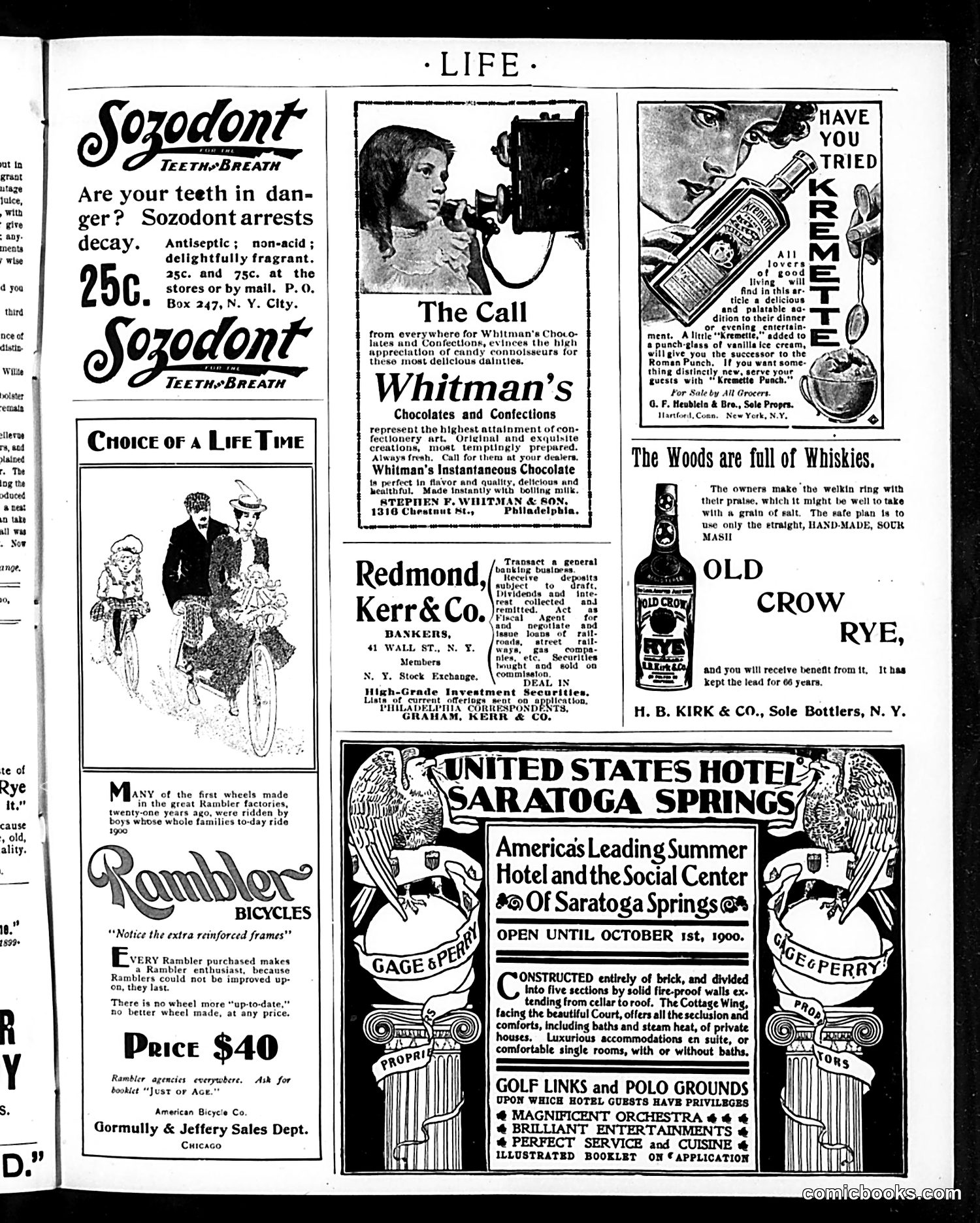
This is primarily an **advertising page** from Life magazine, circa 1900, with no political cartoons or satire. The ads reflect turn-of-century consumer products and concerns: **Notable advertisements:** - **Sozodont toothpaste**: Addresses dental decay using antiseptic formulas—reflects growing awareness of dental hygiene - **Rambler bicycles** ($40): Celebrates the bicycle craze of the 1890s-1900s; emphasizes durability and the brand's 21-year history - **Whitman's chocolates**: Marketed as premium confections from Philadelphia - **Old Crow Rye whiskey**: Positioned as superior to competitors ("woods are full of whiskies"), claiming 66 years of market leadership - **United States Hotel, Saratoga Springs**: Advertises America's premier summer resort, open until October 1900, featuring golf, polo, orchestra, and luxury accommodations The page demonstrates commercial America at the turn of the 20th century, targeting middle-class consumers with leisure goods, personal care products, and luxury travel.
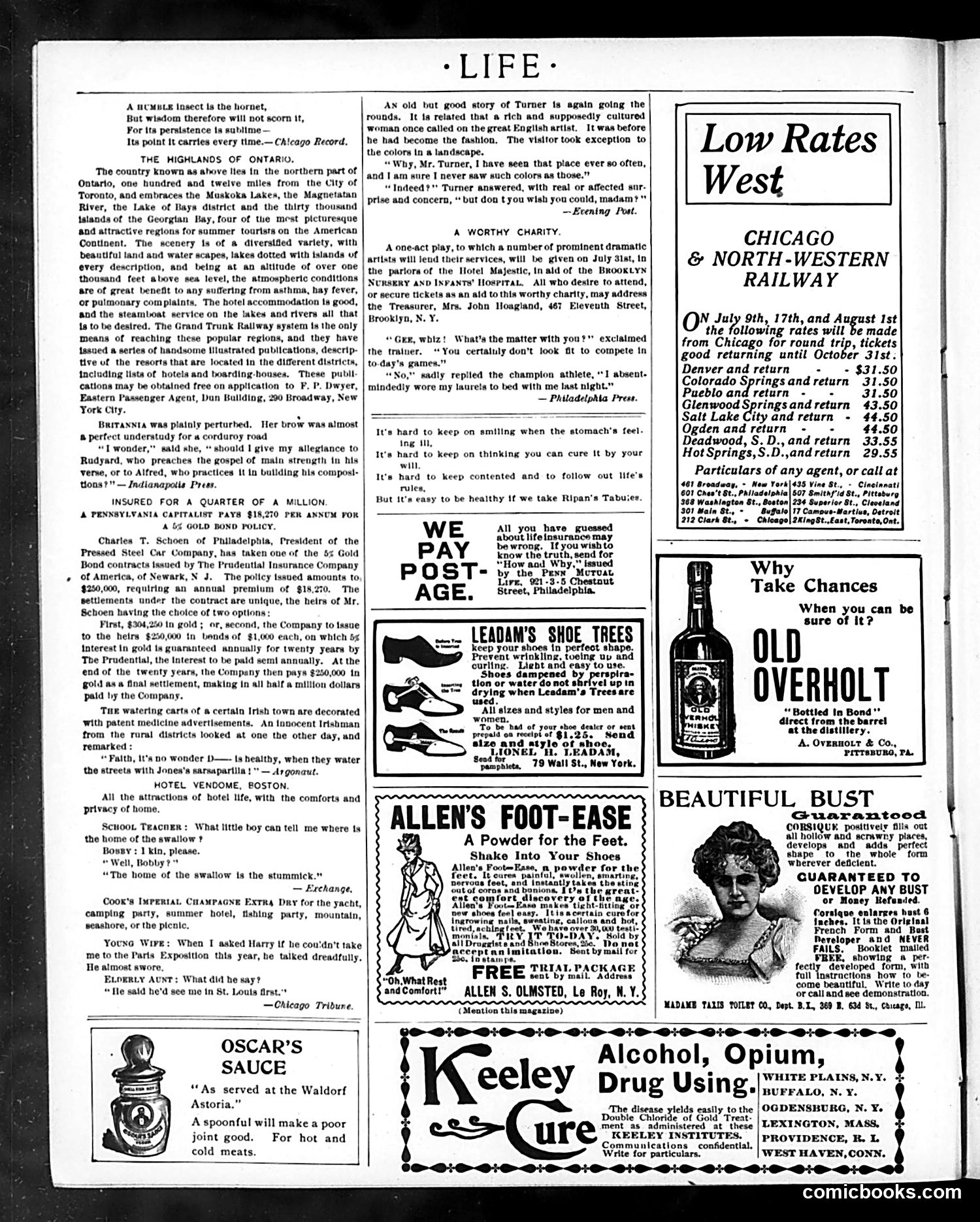
This page is primarily **advertisements and miscellaneous humor**, not political cartoons. The content includes: **Humor Pieces:** - A joke about Britannia (Britain personified) torn between Rudyard Kipling and Alfred Tennyson's literary approaches - School teacher jokes and anecdotes about mishearing (e.g., "the swallow's home is the stomach") - An Irish immigrant confused by patent medicine ads on water carts **Notable Content:** A substantial article about Pennsylvania capitalist Charles T. Schoen's $250,000 life insurance policy with The Prudential Insurance Company—illustrating late-19th-century wealth management and insurance products. **Advertisements:** Multiple period ads for shoe trees, foot powder, whiskey, insurance, and medical treatments (including a "Keeley Cure" for addiction). The page reflects **turn-of-century American life**: urban humor, insurance innovations, patent medicines, and casual Irish stereotypes typical of Life magazine's satirical approach.
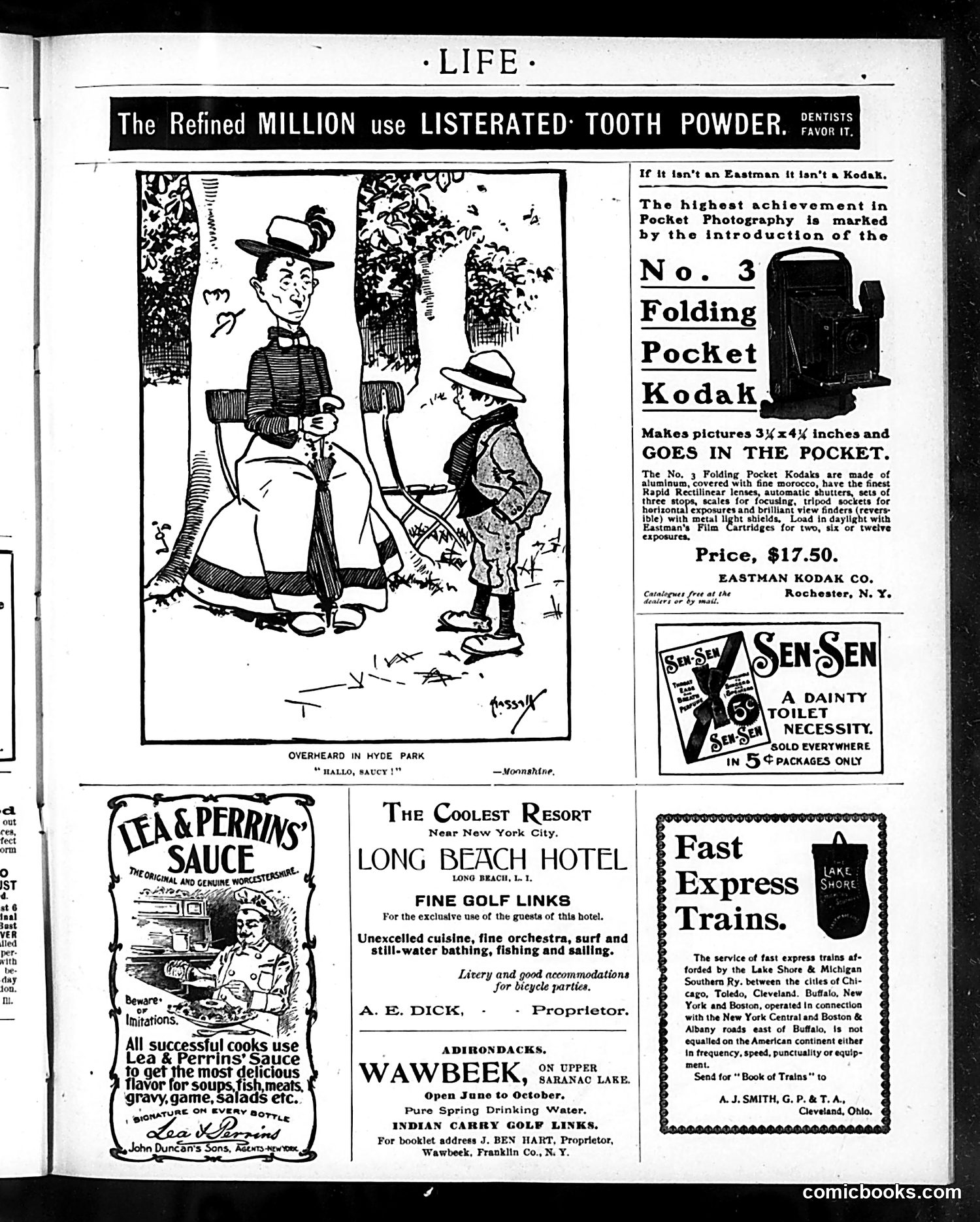
This cartoon depicts a street encounter in London's Hyde Park between two working-class men—one appears to be a street vendor or laborer (indicated by his worn clothing and cap), the other a well-dressed gentleman. The caption "'Allo, saucy!" suggests cheeky, familiar banter between social classes. The satire likely mocks the informal, irreverent speech of London's lower classes toward their "betters"—the gentleman's refined appearance contrasts with being addressed so casually and disrespectfully. The attribution to "Moonshine" (a common pseudonym for satirical cartoonists) suggests this captures a social commentary about Victorian-era class divisions and the breakdown of deference. The page is primarily advertisements for consumer goods and travel services, with this cartoon serving as the main editorial content.
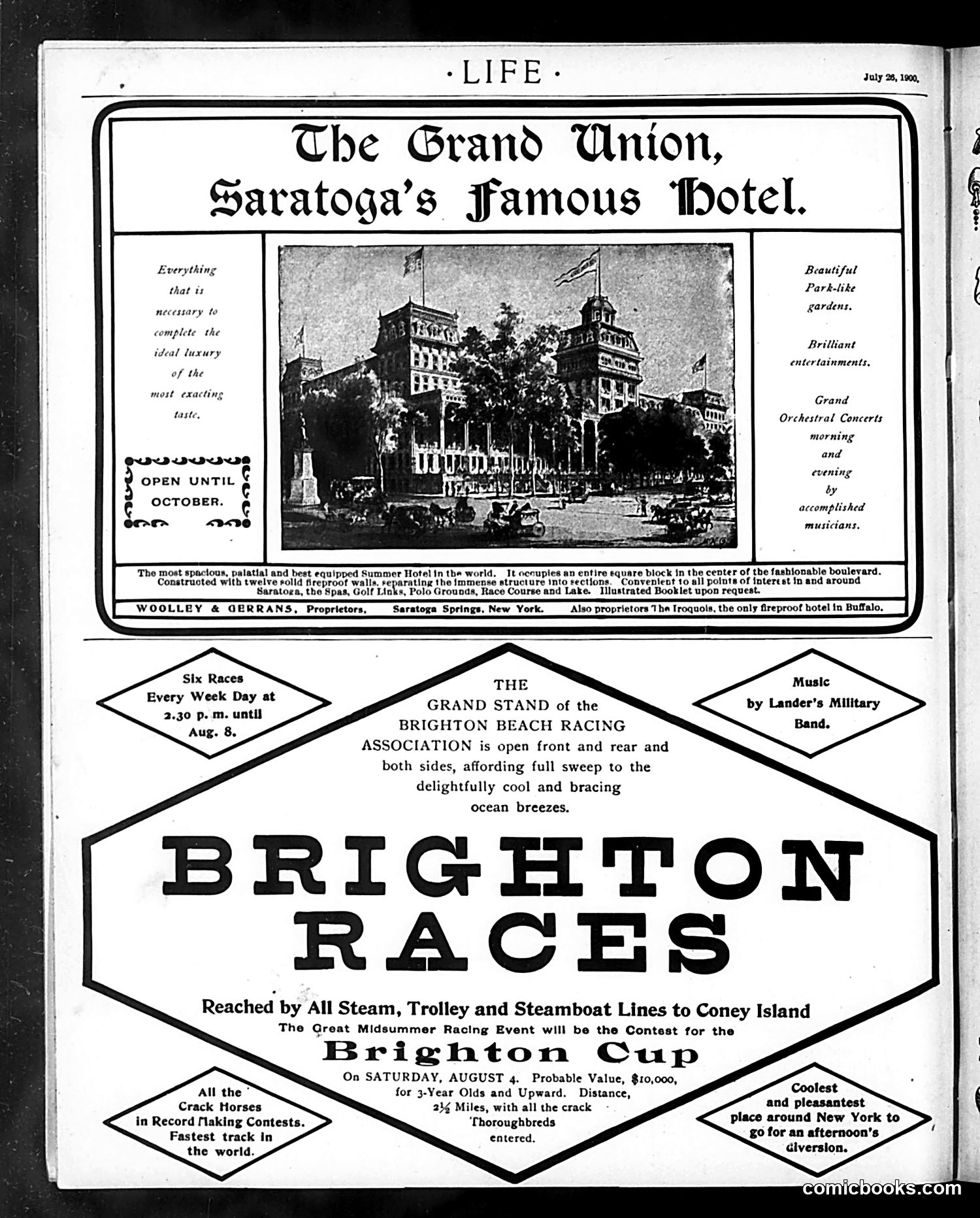
This page is **primarily advertising**, not satire or political commentary. It contains two major hotel and entertainment advertisements from July 28, 1900: 1. **The Grand Union Hotel** (Saratoga Springs, NY) — promoting a luxury summer resort with orchestral concerts, manicured gardens, and fireproof construction. It claims to be "the most spacious, palatial and best equipped Summer Hotel in the world." 2. **Brighton Races** (Coney Island) — advertising horse racing events, particularly the Brighton Cup on August 4, featuring thoroughbred racing and music by "Lander's Military Band." Both ads target wealthy leisure travelers seeking upscale summer entertainment. The Grand Union emphasizes safety (fireproof walls) and cultural refinement (orchestral concerts), while Brighton Races promotes sporting events as fashionable entertainment accessible by multiple transportation methods. There is no political satire or caricature visible on this page — it represents straightforward commercial advertising typical of Life magazine's revenue model.