
Life, 1900-07-26 · page 8 of 20
Life — July 26, 1900 — page 8: what you’re looking at
What you’re looking at
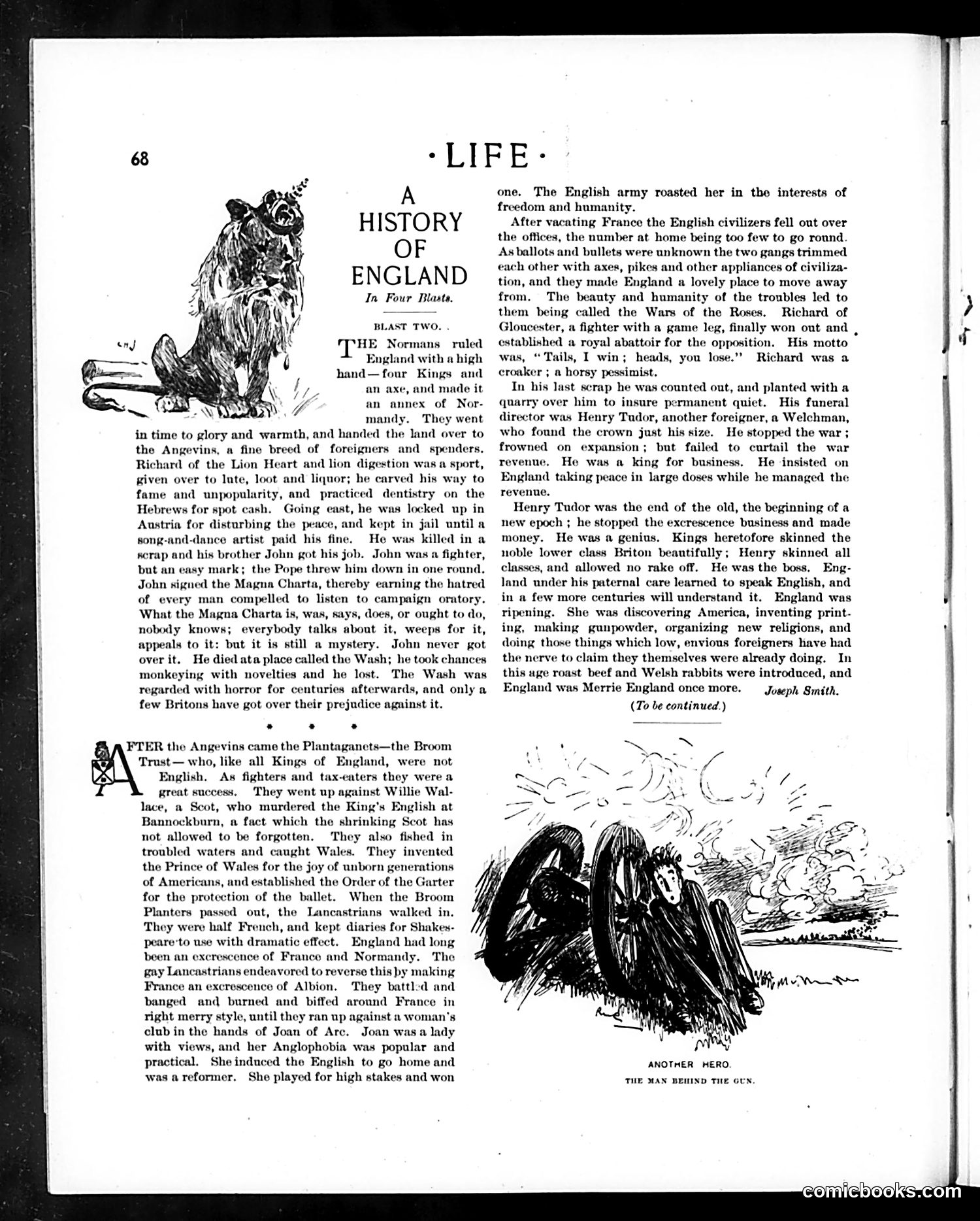
This page presents satirical historical vignettes about English rulers. The text mocks the Norman conquest, Richard the Lionheart's failed expansion plans, and particularly Henry Tudor, praising him as a genius who revolutionized kingship by making money rather than war. The illustration labeled "Another Hero: The Man Behind the Gun" depicts a dark, menacing figure wielding a cannon—likely satirizing militarism or a contemporary military leader. The image's ominous tone contrasts with the text's celebration of Tudor's peaceful approach. The overall satire criticizes traditional English warfare and conquest while praising practical governance focused on commerce and stability over military glory—a commentary on what Life saw as more enlightened rulership.
📄 Transcribed text from this page (OCR, searchable)
Machine-transcribed from the original scan — historical spelling and the odd misread are preserved.
A HISTORY OF ENGLAND In Four Blasts. BLAST TWO. HE Norn England with a high hand—four Kings and an axe, and made it an annex of Nor- mandy. They went in time to glory and warmth, and handed the land over to the Angevins, a fine breed of foreigners and spenders. Richard of the Lion Heart and lion digestion was a sport, given over to lute, loot and liquor; he carved his way to fame and unpopularity, and practiced dentistry on the Hebrews for spot cash. Going east, he was locked up in Austria for disturbing the peace, and kept in jail until a song-and-dance artist paid his fine. He was killed in a scrap and his brother John got his job. John was a fighter, but an easy mark; the Pope threw him down in one round, John signed the Magna Charta, thereby earning the hatred of every man compelled to listen to campaign oratory. What the Magna Charta is, was, says, does, or ought to do, nobody knows; everybody talks about it, weeps for it, appeals to it: but it is still a mystery. John never got over it. He died ata place called the Wash; he took chances monkeying with novelties and he lost. The Wash was regarded with horror for centuries afterwards, and only a few Britons have got over their prejudice against it. . . . FTER the Angevins came the Plantaganets—the Broom Trust— who, like all Kings of England, were not English. As fighters and tax-eaters they were a great success. They went up against Willie Wal- lace, a Scot, who murdered the King's English at Bannockburn, a fact which the shrinking Scot has not allowed to be forgotten, They also fished in troubled waters and caught Wales. They invented the Prince of Wales for the joy of unborn generations of Americans, and established the Order of the Garter for the protection of the ballet. When the Broom Planters passed out, the Lancastrians walked in, They were half French, and kept diaries for Shakes- peare‘to use with dramatic effect. England had long been an excrescence of France and Normandy. The gay Lancastrians endeavored to reverse this by making France an excrescence of Albion. They battl:d and banged and burned and biffed around France in right merry style, until they ran up against a woman's club in the hands of Joan of Arc. Joan was a lady with views, and her Anglophobia was popular and practical. She induced the English to go home and was a reformer. She played for high stakes and won «LIFE=/ one. The English army roasted her in the interests of freedom and humanity. After vacating France the English civilizers fell out over the offices, the number at home being too few to go round. As ballots and bullets were unknown the two gangs trimmed each other with axes, pikes and other appliances of civiliza- tion, and they made England a lovely place to move away from. The beauty and humanity of the troubles led to them being called the Wars of the Roses. Richard of Gloucester, a fighter with a game leg, finally won out and , established a royal abattoir for the opposition. His motto was, “Tails, I win; heads, you lose.’ Richard was a croaker ; a horsy pessimist. In his last scrap he was counted out, and planted with a quarry over him to insure permanent quiet. His funeral director was Henry Tudor, another foreigner, a Welchman, who found the crown just his size. He stopped the war ; frowned on expansion; but failed to curtail the war revenue. He was a king for business. He insisted on England taking peace in large doses while he managed the revenue. Henry Tudor was the end of the old, the beginning of a new epoch ; he stopped the excrescence business and made money. He was a genius. Kings heretofore skinned the noble lower class Briton beautifully; Henry skinned all classes, and allowed no rake off. He was the boss. Eng- land under his paternal care learned to speak English, and in a few more centuries will understand it. England was ripening. She was discovering America, inventing print- ing, making gunpowder, organizing new religions, and doing those things which low, envious foreigners have had the nerve to claim they themselves were already doing. In this uge roast beef and Welsh rabbits were introduced, and England was Merrie England once more. Joseph Smith. (To be continued.) ANOTHER HERO. THE MAN BEIIND THE GUN.