
Life, 1900-07-26 · page 4 of 20
Life — July 26, 1900 — page 4: what you’re looking at
What you’re looking at
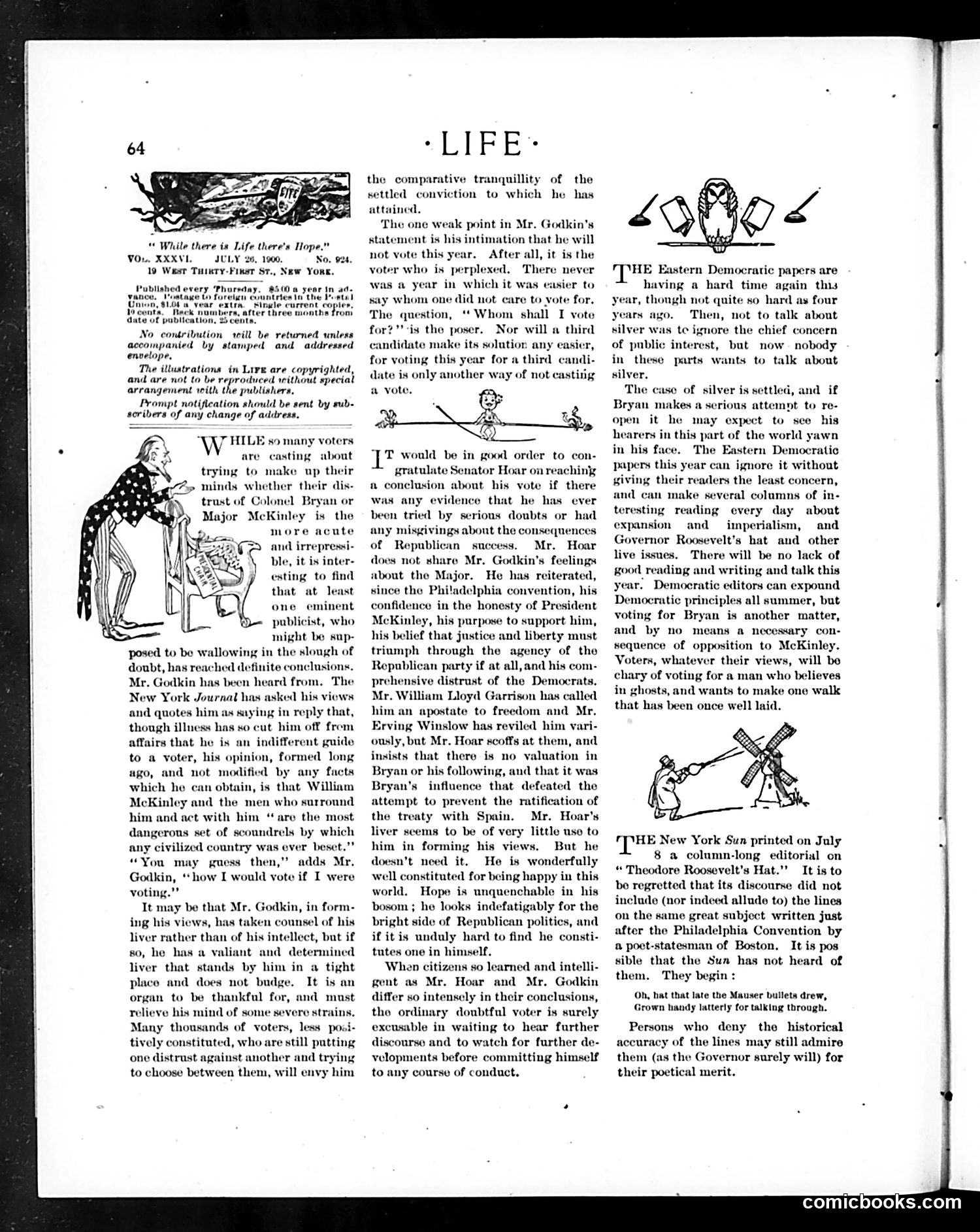
This Life magazine page (July 26, 1906) satirizes uncertainty among Democratic voters about whom to support. The left cartoon depicts a voter seemingly unable to decide between competing political figures—visualized as he appears trapped or confused between them. The text discusses Colonel Bryan and Major McKinley as candidates causing voter indecision. It critiques Eastern Democratic papers for avoiding serious discussion of Bryan's position and the party's direction. The article notes that Bryan's influence previously defeated a treaty with Spain, and questions whether voters can trust him with consequential decisions. The satire targets Democratic editorial cowardice—papers refusing to honestly debate their party's nominee rather than engaging substantively with voters' legitimate concerns about leadership capability.
📄 Transcribed text from this page (OCR, searchable)
Machine-transcribed from the original scan — historical spelling and the odd misread are preserved.
“ While there is Life there's Hope.” VOu. XXXVL JULY 2 19 West Tuxty 85.00 9 year in ad~ ries in the Ported Yo contribution will be returned unless accompanied by stamped and addressed envelope, The illustrations in Live are copyrighted, and are not to be reproduced without speciat arrangement with the publishers, Prompt notification should be sent by sub- soribers of any change of address. 7 “WHILE are casting about y to make up their Ay minds whether their dis- trust of Colonel Br Major McKinley is the more acute and irrepressi- ble, it is inter- esting to find that at least one eminent publicist, who might be sup- posed to be wallowing in the slough of doubt, has reached definite conclusions. Mr. Godkin has been heard from, The New York Journat has asked his views and quotes him as saying in reply that, though illness has so cut him off from affairs that he ix an indifferent guide to a voter, his opinion, formed long ago, and not modified by any facts which he can obtain, is that William McKinley and the men who surround him and act with him ‘are the most dangerons set of scoundrels by which any civilized country was ever beset.”” “You may guess then,” adds Mr, Godkin, ‘how I would vote if I were voting.’”’ It may be that Mr. Godkin, in form- ing his views, has taken counsel of his liver rather than of his intellect, but if so, he has a valiant and determined liver that stands by him in a tight place and does not budge. It is an organ to be thankful for, and must relieve his mind of some pre strains. Many thousands of voters, less posi- tively constituted, who are still putting one distrust against another and trying to choose between them, will envy him *LIFE- the comparative tranquillity of settled conviction to which he attained. the has veak point in Mr. Godkin’s t is his intimation that he will not vote this ye After all, it is the voter who is perplexed, There never v a year in which it was easier to say whom one did not care to vote for. The question, ‘‘ Whom shall I vote for?’?-is the poser. Nor will a third candidate make its solution any easier, for voting this year for a third candi- date is only another way of not casting a vote. Ni would be in good order to con- gratulate Senator Hoar on reaching a conclusion about his vote if there was any evidence that he has ever been tried by serious doubts or had any misgivings about the consequences of Republican success Mr. Hoar does not share Mr. Godkin’s feelings about the Major. He has reiterated, since the Philadelphia convention, his confidence in the honesty of President McKinley, his purpose to support him, his belief that justice and liberty must triumph through the agency of the Republican party if at all,and his com- prehensive distrust of the Democrats. Mr. William Lloyd Garrison has called him an apostate to freedom and Mr, Erving Winslow has reviled him vari- ously, but Mr. Hoar scoffs at them, and insists that there is no valuation in Bryan or his following, and that it was Bryan's influence that defeated the attempt to prevent the ratification of the treaty with Spain. Mr. Hoar’s liver scems to be of very little uso to him in forming his views, But he doesn’t need it. He is wonderfully well constituted for being happy in this world. Hope is unquenchable in his bosom ; he looks indefatigably for the bright side of Republican politics, and if itis unduly hard to find he consti- tutes one in himself. When citizens so learned and intel gent as Mr. Hoar and Mr. Godkin differ so intensely in their conclusions, tho ordinary doubtful voter is surely excusable in waiting to hear further discourse and to watch for further de- velopments before committing himself to any course of conduct. LOVIO & HE Eastern Democratic papers are having a hard time again this ar, though not quite so hard as four 40. Then, not to talk about te ignore the chief concern interest, but now nobody in these parts wants to talk about silver. Th se of silver is settled, and if Bryan makes a serious attempt to re- open it he may expect to see his hearers in this part of the world yawn in his face. The Eastern Democratic papers this year can ignore it without giving their readers the least concern, and can make several columns of in- teresting reading every day about expansion and imperialism, and Governor Roosevelt's hat and other live issues. There will be no lack of good reading and writing and talk this year. Democratic editors can expound Democratic principles all summer, but voting for Bryan is another matter, and by no means a necessary con- sequence of opposition to McKinley. Voters, whatever their views, will be chary of voting for a man who believes in ghosts, and wants to make one walk that has been once well laid. PHE New York Sun printed on July 8 a column-long editorial on “ Theodore Roosevelt's Hat.’ It is to be regretted that its discourse did not include (nor indeed allude to) the lines on the same great subject written just after the Philadelphia Convention by a poet-statesman of Boston, It is pos sible that the Sun has not heard of them. They begin : Oh, hat that late the Mauser bullets drew, Grown handy latterly for talking through. Persons who deny the historical accuracy of the lines may still admire them (as the Governor surely will) for their poetical merit. comicbooks.com