
Life, 1900-07-26 · page 9 of 20
Life — July 26, 1900 — page 9: what you’re looking at
What you’re looking at
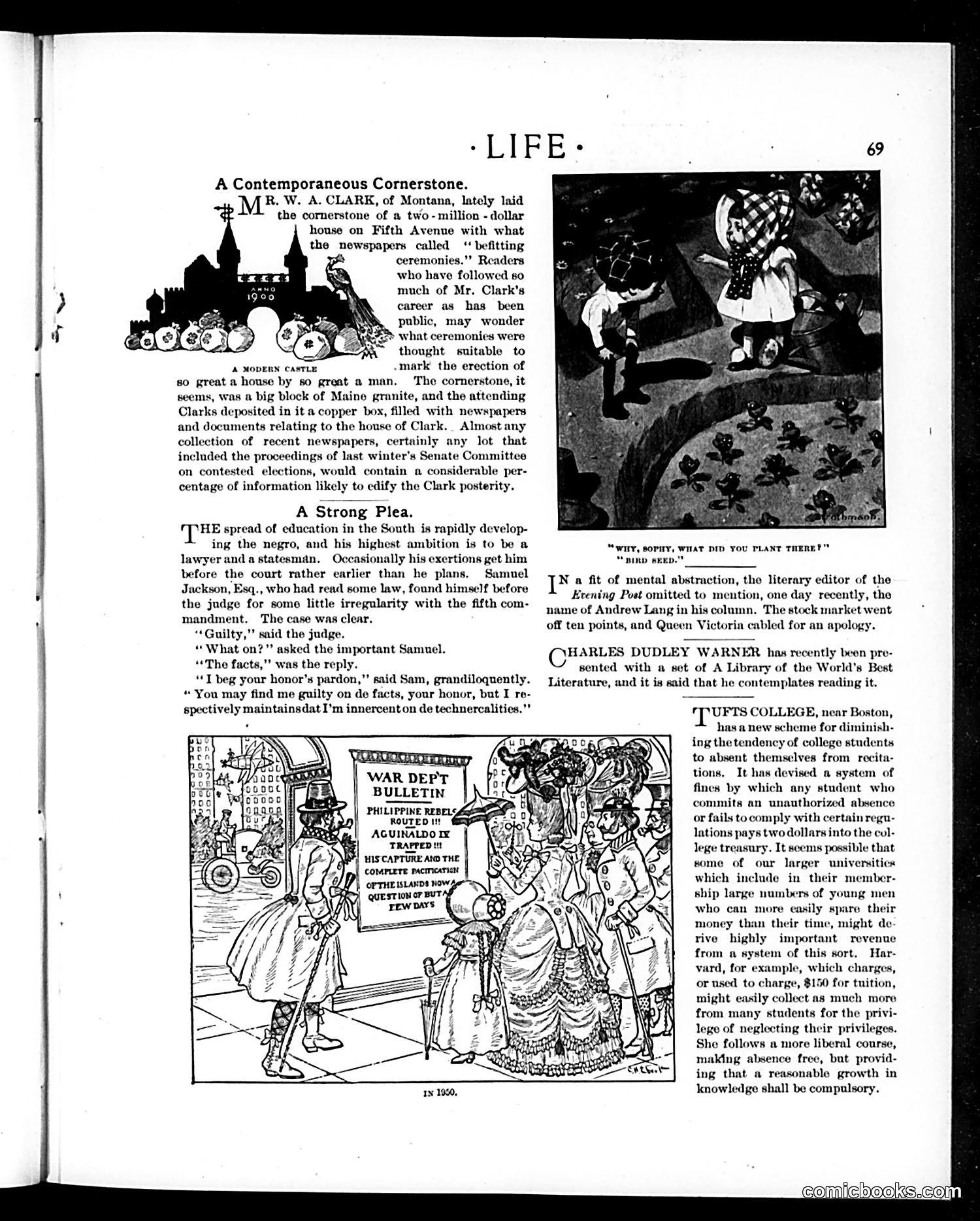
This page contains three separate items: 1. **"A Contemporaneous Cornerstone"**: A brief article about W.A. Clark of Montana laying a cornerstone for a two-million-dollar Fifth Avenue mansion, with satirical commentary about burying newspapers and documents inside—suggesting this will be the historical record of Clark's life and times. 2. **"A Strong Plea"**: An anecdote about a lawyer (Samuel Jackson) who told a judge he was "guilty on the facts" but claimed innocence on technicalities. The judge's response mocks this as absurd legal reasoning. 3. **A cartoon labeled "In 1666"**: Depicts what appears to be a medieval or historical scene with period-dressed figures and a "War Dept Bulletin" poster, though the specific satirical target is unclear from the visible text alone. The page exemplifies Life's typical format of mixing brief satirical articles with illustrations critiquing contemporary figures and social absurdities.
📄 Transcribed text from this page (OCR, searchable)
Machine-transcribed from the original scan — historical spelling and the odd misread are preserved.
iia attains A Contemporaneous Cornerstone. R, W. A. CLARK, of Montana, lately laid the cornerstone of a two- million - dollar house on Fifth Avenue with what the newspapers called “befitting ceremonies.” Readers who have followed 80 much of Mr. Clark's career as has been public, may wonder s* what ceremonies were thought suitable to A MODERN CASTLE -mark the erection of so great a house by so great a man. The cornerstone, it seems, was a big block of Maine granite, and the attending Clarks deposited in it a copper box, filled with newspapers and documents relating to the house of Clark. Almost any collection of recent newspapers, certainly any lot that included the proceedings of last winter's Senate Committee on contested elections, would contain a considerable per- centage of information likely to edify the Clark posterity. A Strong Plea. (THE spread of education in the South is rapidly develop- ing the negro, and his highest ambition is to be a lawyer and a statesman. Occasionally his exertions get him before the court rather earlier than he plans. Samuel Jackson, Esq., who had read some law, found himself before the judge for some little irregularity with the fifth com- mandment. The case was clear. “Guilty,” said tho judge. “What on?” asked the important Samuel. “The facts,” was the reply. “I beg your honor’s pardon,’’ said Sam, grandiloquently. “You may find me guilty on de facts, your honor, but I re- spectively maintainsdat I’m innercenton de technercalities.”” WAR DEPT BULLETIN ROUTED Ii! AGUINALDO Ix ‘TRAPPED !!t ‘LIFES “WITT, SOPHY, WHAT DID YOU PLANT THERE?" “puny seep.” bis a fit of mental abstraction, the literary editor of the Erening Post omitted to meution, one day recently, the name of Andrew Lang in his column. The stock market went off ten points, and Queen Victoria cabled for an apology. HHARLES DUDLEY WARNER has recently been pre- sented with a set of A Library of the World's Best Literature, and it is said that he contemplates reading it. UFTS COLLEGE, near Boston, has a new scheme for diminish- ing thetendency of college students to absent themselves from recita- tions. It has devised a system of fines by which any student who commits an unauthorized absence or fails tocomply with certain regu- lations pays two dollars into the cul- lege treasury, It seems possible that some of our larger universitics which include in their member- ship large numbers of young men who can more easily spare their money than their time, might de rive highly important revenue from a system of this sort. Har- vard, for example, which charges, or used to charge, $150 for tuition, might easily collect as much more from many students for the privi- lege of neglecting their privileges. She follows a more liberal course, making absence free, but provid- ing that a reasonable growth in knowledge shall be compulsory.