
Life, 1900-07-26 · page 14 of 20
Life — July 26, 1900 — page 14: what you’re looking at
What you’re looking at
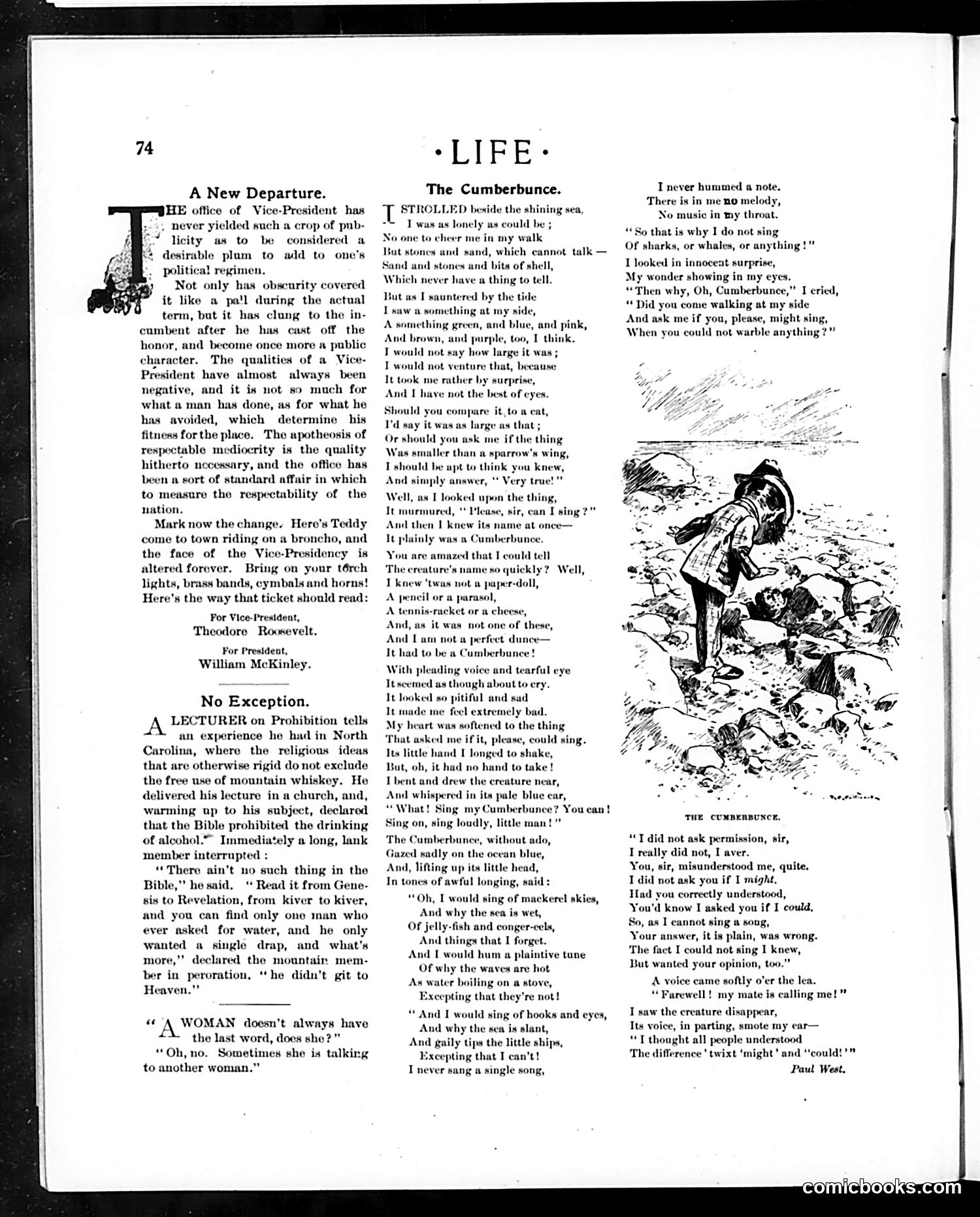
This page features a whimsical poem about an imaginary creature called a "Cumberbunce" encountered on a beach. The poem is lighthearted fantasy—the creature is indescribable (green, blue, pink, purple), has no hand to shake, and wishes to sing but cannot. The accompanying illustration shows a figure discovering this peculiar being among rocks and shells by the seaside. The humor lies in the poem's absurdist logic: the narrator identifies the creature as a Cumberbunce simply by process of elimination—it's not a paper-doll, pencil, parasol, tennis-racket, or cheese, so it *must* be a Cumberbunce. This satirizes pretentious reasoning and naming conventions. The other page content discusses Theodore Roosevelt's appointment as Vice-President and a Prohibition lecture story, but the "Cumberbunce" poem is the primary illustrated feature.
📄 Transcribed text from this page (OCR, searchable)
Machine-transcribed from the original scan — historical spelling and the odd misread are preserved.
A New Departure. JHE office of Vice-President has . never yielded such a crop of pub- licity as to be considered a 4 desirable plum to add to one’s political regimen. Not only has obscurity covered it like a pa'l during the actual term, but it has clung to the in- cumbent after he has cast off the honor, and become once more a public character. The qualities of a V President have almost always been negative, and it is not so much for what a man has done, as for what he has avoided, which determine his fitness forthe place. ‘The apotheosis of respectable mediocrity is the quality hitherto necessary, and the office has been a sort of standard affair in which to measure the respectability of the nation. Mark now the change. Here's Teddy come to town riding on a broncho, and the face of the Vice-Presidency is altered forever. Bring on your t6rch lights, brass bands, cymbals and horns! Here’s the way that ticket should read: For Vice-President, Theodore Roosevelt, For President, William McKinley. No Exception. LECTURER on Prohibition tells an experience he had in North Carolina, where the religious ideas that are otherwise rigid do not exclude the free use of mountain whiskey. He delivered his lecture in a church, and, warming up to his subject, declared that the Bible prohibited the drinking of alcohol.” Immediately a long, lank member interrupted : “There ain't no such thing in the Bible,” he said, ‘* Read it from Gene- sis to Revelation, from kiver to kiver, and you can find only one man who ever asked for water, and he only wanted a single drap, and what's more,’ declared the mountain. mem- ber in peroration, ‘he didn’t git to Heaven.” “ WOMAN doesn’t always have the last word, does sh “Oh, no. Sometimes she is talking to another woman.” The Cumberbunce. STROLLED beside the shining sea, > T was as No one ely as could be ; n my walk But stones and sand, which cannot talk — and and stones and bits of shell, Which never have a thing to tell. heer me But ax I sauntered by the tide I saw a something at A something green, and blue, and pink, And brown, and purple, too, I think. ald not aay how large it was; 11d not venture that, because k me rather by surprise, And I have not the best of eyes. Should compare it,to a cat, I'd say it was as large as that ; Or should you ask me ifthe thing Was smaller than a sparrow's wing, I should be apt to think knew, And simply answer, “ Very true!” Well, as I looked upon the thing, It murmured, “ Please, sir, ean I sing 2" And then I knew its name at once— It plainly was a Cumberbunce. You are amazed that I could tell ‘The creature's name so quickly? Well, T knew 'twas not a paper-doll, A pencil or a parasol, A tennis-racket or a cheese, And, as it was 1 of these, And Lam nota perfect dunce: Tt had to be a Cumberbunce ! With pleading voice and tearful eye Itscemed as though about to ery. Tt looked so pitiful and sad It made me feel extremely bad. My heart was softened to the thing ‘That asked me if it, please, could sing. Its little hand I longed to shake, But, oh, it had no hand to take! I bent and drew the creature near, And whispered in its pale blue ear, “What! Sing my Cumberbunce? You can! Sing on, sing loudly, little man! "" The Cumberbunce, without ado, Gazed sadly on the ocean blue, And, lifting up its little head, In tones of awful longing, said: “Oh, I would sing of mackerel skies, And why the sea is wet, Of jelly-fish and conger-cels, And things that I forget And I would hum a plaintive tune Of why the waves are hot As water boiling on a stove, Excepting that they're not! “And I would sing of hooks and eyes, ‘And why the sea is slant, And gaily tips the little ships, xcepting that I can't! T never sang a single song, T never hummed a note. ‘There is in me no melody, No music in ty throat. “So that is why I do not sing Of sharks, or whales, of anything !” I looked in innocent surprise, My wonder showing in my eyes. “Then why, Oh, Cumberbunce,” I cried, “Did you come walking at my side And ask me if you, please, might sing, Whi ‘ou could not warble anything?” THE CUMBERBUNCE. “T did not ask permission, sir, I really did not, I aver. You, sir, misunderstood me, quite. I did not ask you if I might, Had you correctly understood, You'd know I asked you if I could, So, as I cannot sing a song, Your answer, it is plain, was wrong. The fact I could not sing I knew, But wanted your opinion, too.” A voice came softly o'er the lea. “Farewell! my mate is calling me!” I saw the creature disappear, Its voice, in parting, smote my ear— “T thought all people understood The difference ' twixt ‘might’ and “‘could!’” Paul West,