
A complete issue · 20 pages · 1900
Life — July 12, 1900
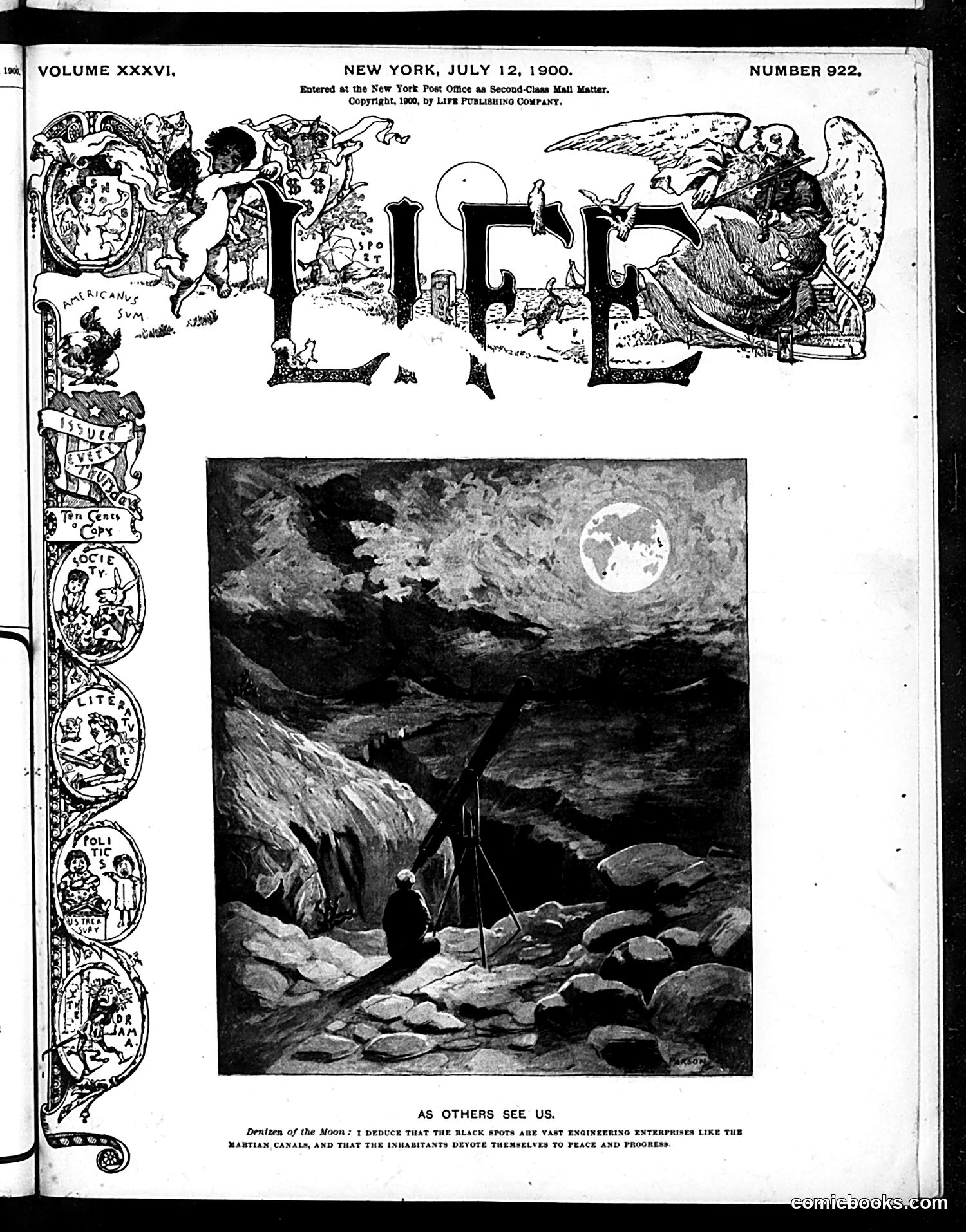
This is the cover of Life magazine (July 12, 1900). The main illustration shows a lone figure with a telescope on a lunar landscape, gazing at Earth in the night sky—a reversal of our typical perspective. The caption reads "AS OTHERS SEE US" and the subtitle mentions "Deniers of the Moon" claiming "black spots are vast engineering enterprises like the Martian canals, and that the inhabitants devote themselves to peace and progress." **The satire**: This mocks turn-of-the-century speculation about intelligent life on Mars and the Moon. The joke imagines lunar inhabitants observing Earth and seeing similar "engineering enterprises" (cities, civilization), suggesting earthly observers are equally delusional in their beliefs about extraterrestrial intelligence. It's social commentary on human hubris and scientific overconfidence regarding space exploration claims.
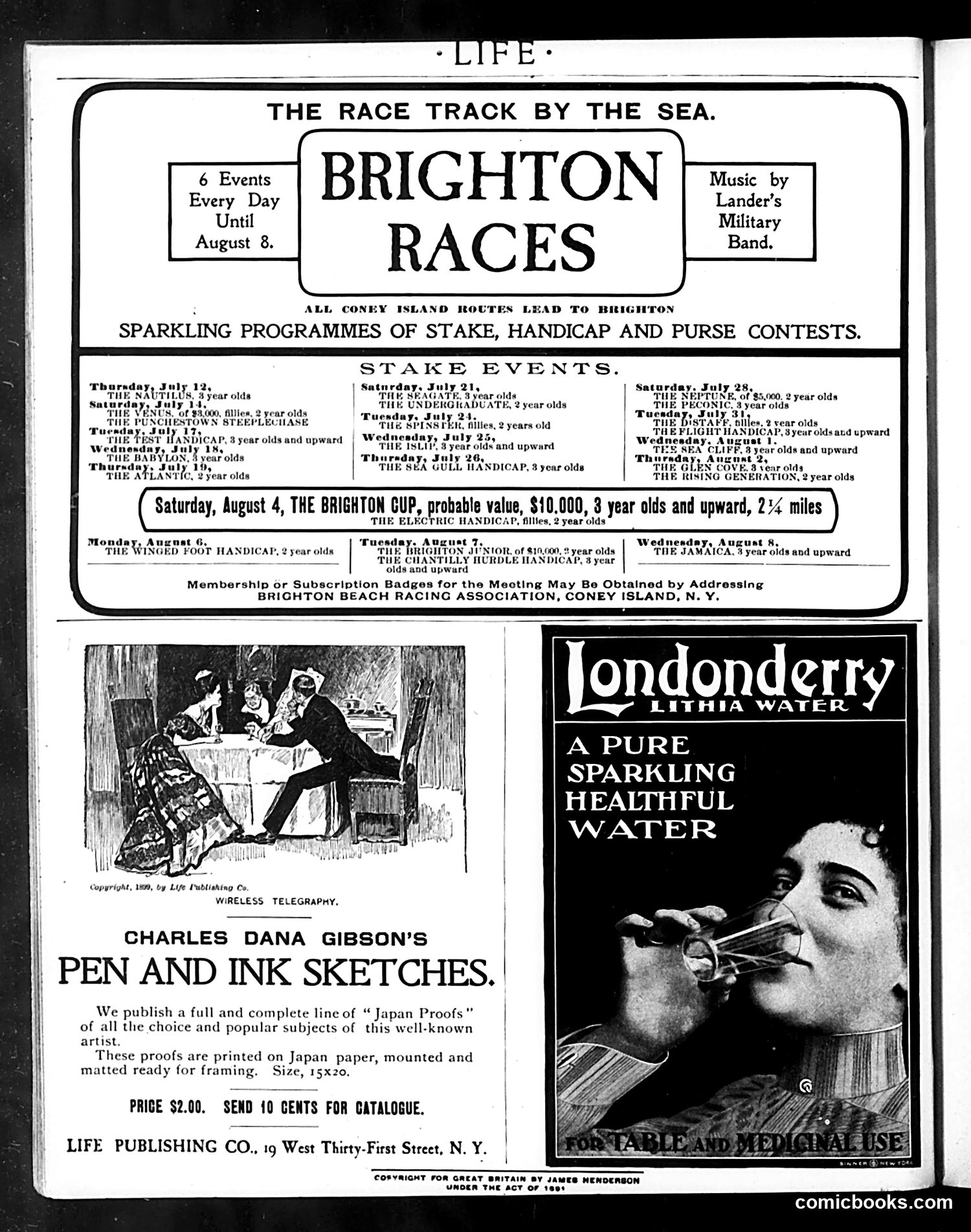
This page is primarily **advertising**, not political satire. The top half promotes the **Brighton Races**—a horse racing event at Coney Island, New York, scheduled for July-August with six daily events and music by Lander's Military Band. The featured race, the Brighton Cup, offered a $10,000 purse. The lower half contains two unrelated advertisements: Charles Dana Gibson's pen-and-ink sketches (priced at $2.00) and Londonderry Lithia Water, marketed as a "pure sparkling healthful water." The only illustration—showing figures at a dinner table—accompanies the Gibson sketches advertisement, depicting his characteristic artistic style rather than serving satirical commentary.
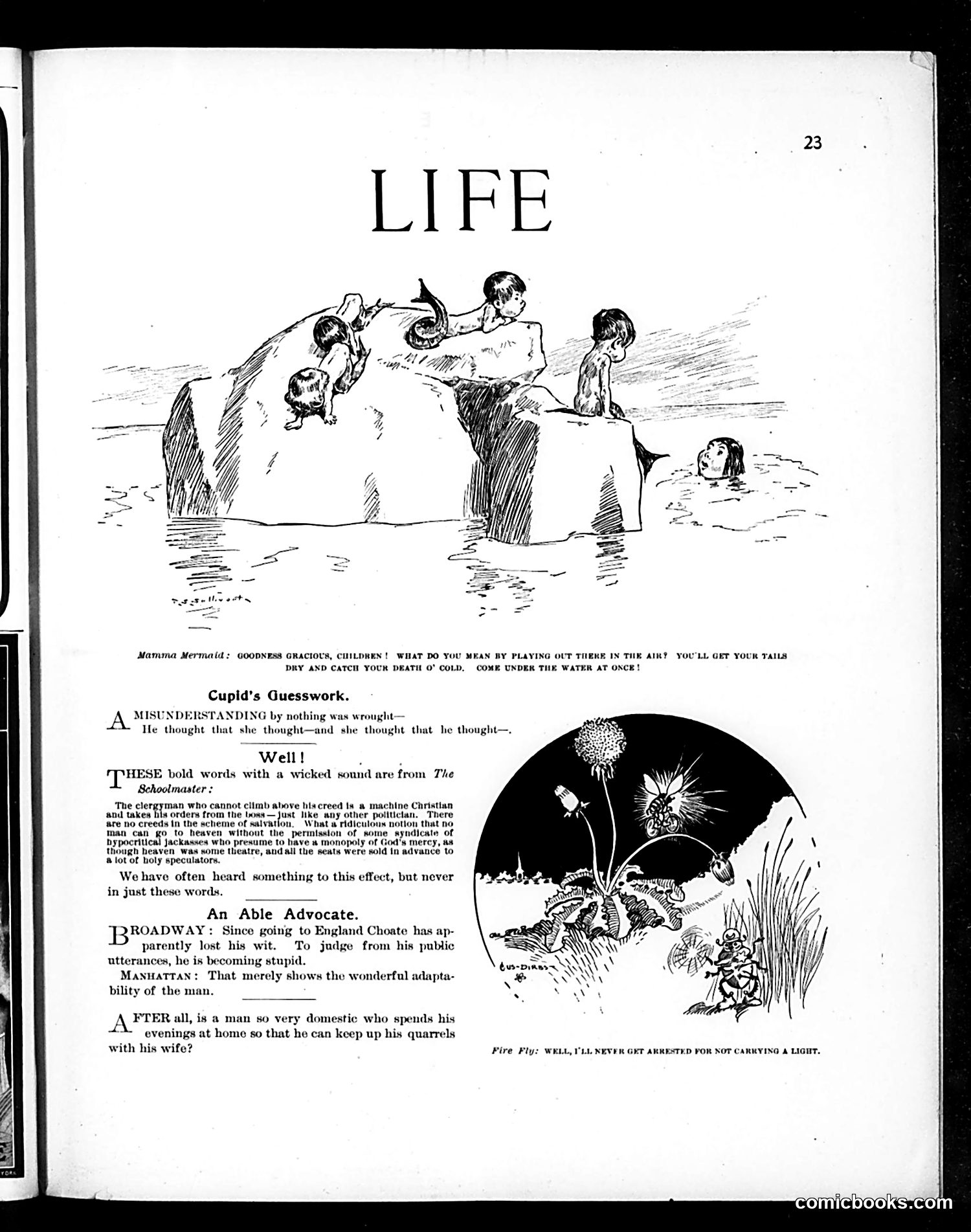
**Top Cartoon:** A mermaid scolds children playing in water, warning them of danger and cold. This appears to be a whimsical safety reminder rather than political satire. **"Cupid's Guesswork":** A brief joke about mutual misunderstanding between romantic partners—one person thinks the other thinks what they think. **"Well!":** A quote from *The Schoolmaster* criticizing hypocritical religious and political figures who claim monopolies on God's mercy while lacking charity themselves. This targets institutional hypocrisy. **"An Able Advocate":** A Broadway joke about Judge Choate becoming "stupid" since visiting England, mocking his public utterances. **"After All":** A domestic humor bit about a husband staying home to avoid quarrels with his wife. **Bottom Cartoon:** "Fire Fig" shows someone never getting arrested for not carrying a light—unclear historical reference.
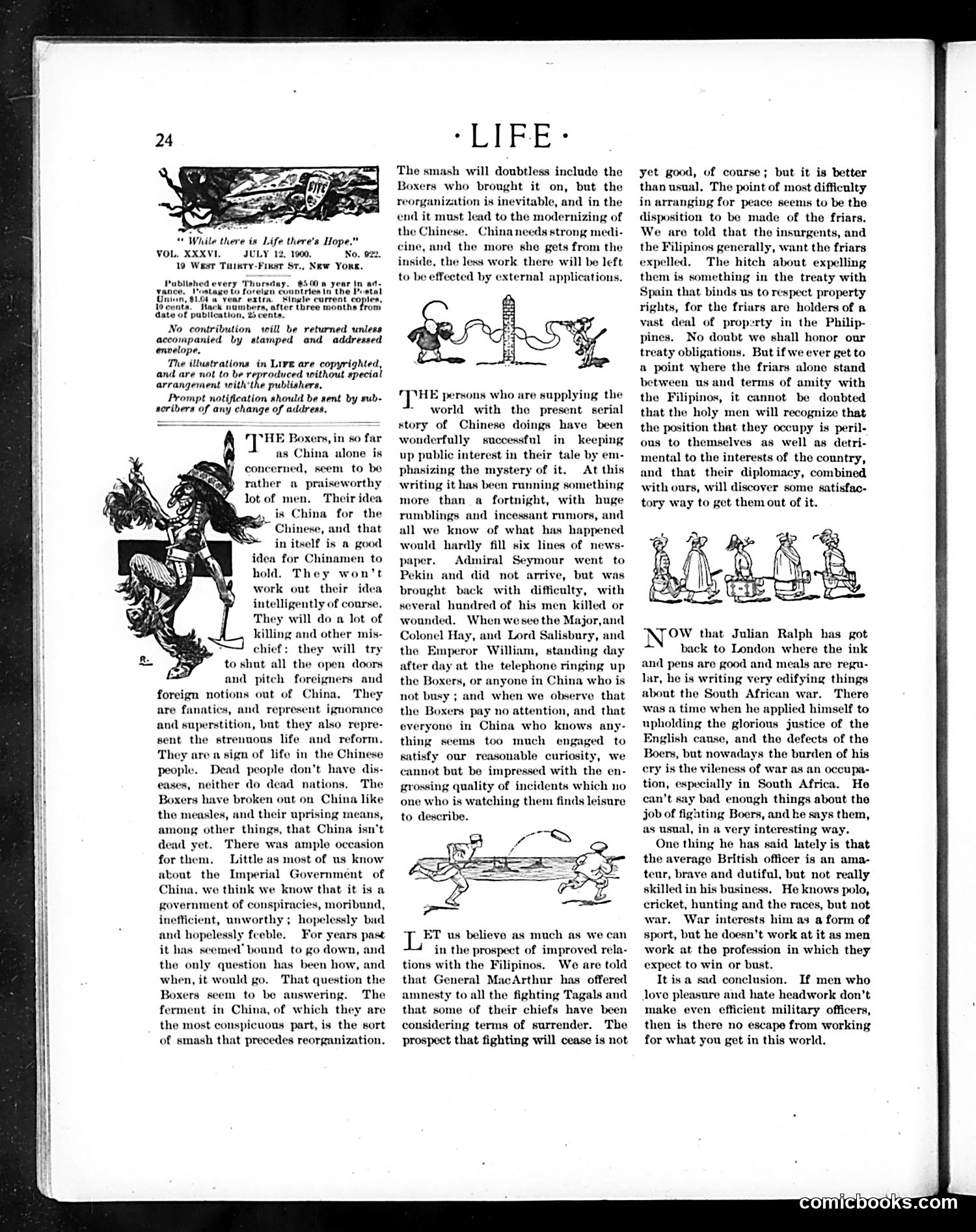
The page discusses the Boxer Rebellion in China. The text praises journalists covering Chinese events, then shifts to criticizing British military operations. It mentions Admiral Seymour's failed mission to Peking and notes that Major-General Gaselee and others are coordinating responses. The cartoon depicts a figure (likely representing China or a Chinese official) as a dragon-like creature, symbolizing the chaos and "foreignness" of the conflict to Western readers—a common racist caricature of the era. The text's main point: Western military intervention may succeed, but permanent peace requires understanding China's internal politics. The author skeptically questions whether British officers (specifically regarding South African conflicts) are truly competent at their stated mission, suggesting military adventure doesn't guarantee positive outcomes.
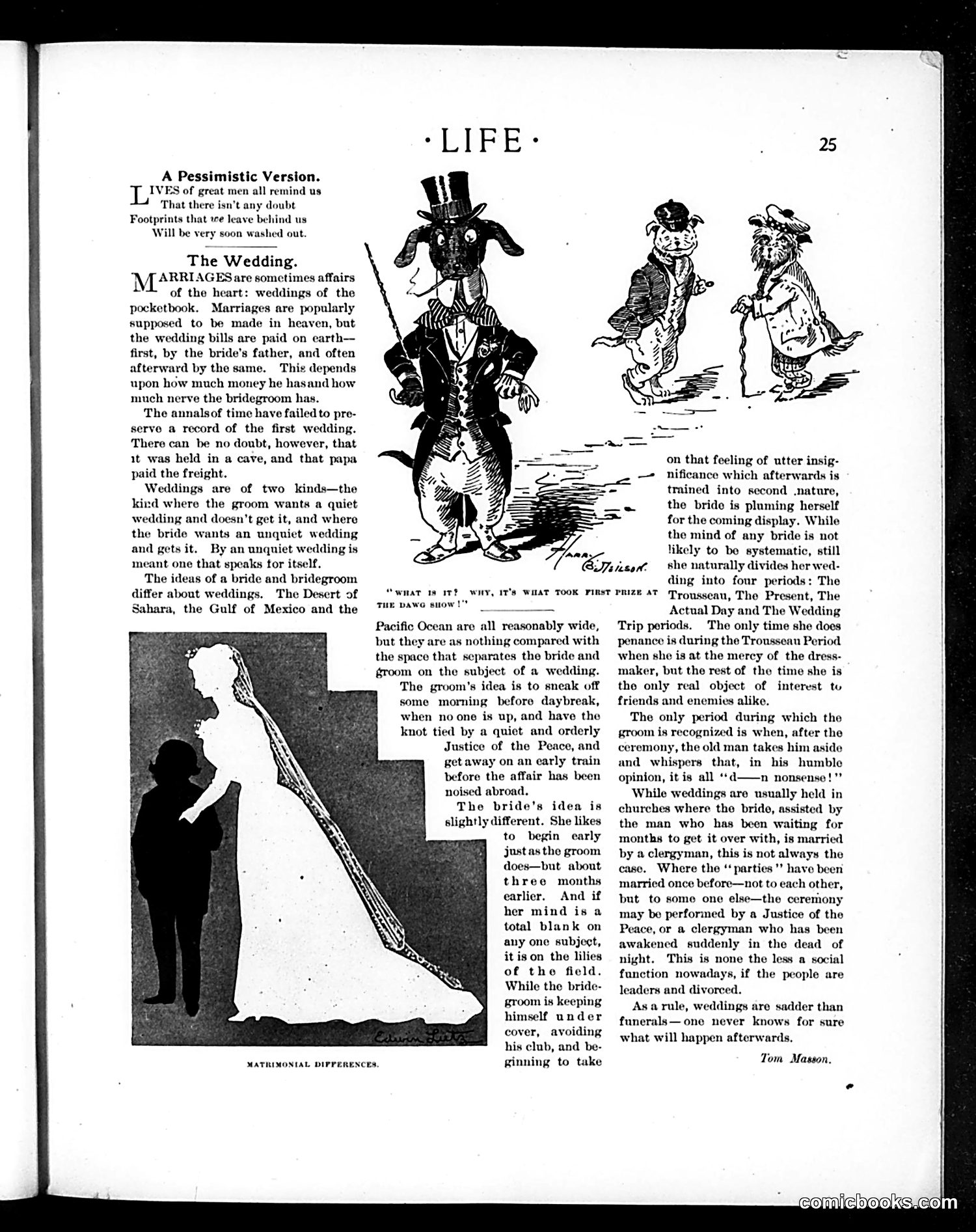
This page from *Life* magazine satirizes weddings through multiple cartoons and commentary. **Top cartoon**: A caricatured figure in formal dress asks "What is it? Why, it's what took first prize at the dawg show!" — mocking the groom's appearance by comparing him to a dog show contestant. **Left illustration** (captioned "Matrimonial Differences"): Shows a bride in her wedding dress alongside a simplified silhouette, presumably illustrating contrasting perspectives on marriage between genders. **Text and right cartoons**: The article "The Wedding" humorously describes weddings as affairs of the heart versus practical arrangements. It notes differences in how brides and grooms approach weddings, with the groom wanting quiet escape while the bride wants display. The side cartoons show wedding party members, emphasizing social awkwardness. The overall satire mocks Victorian marriage conventions, gender expectations, and the absurdity of wedding rituals.
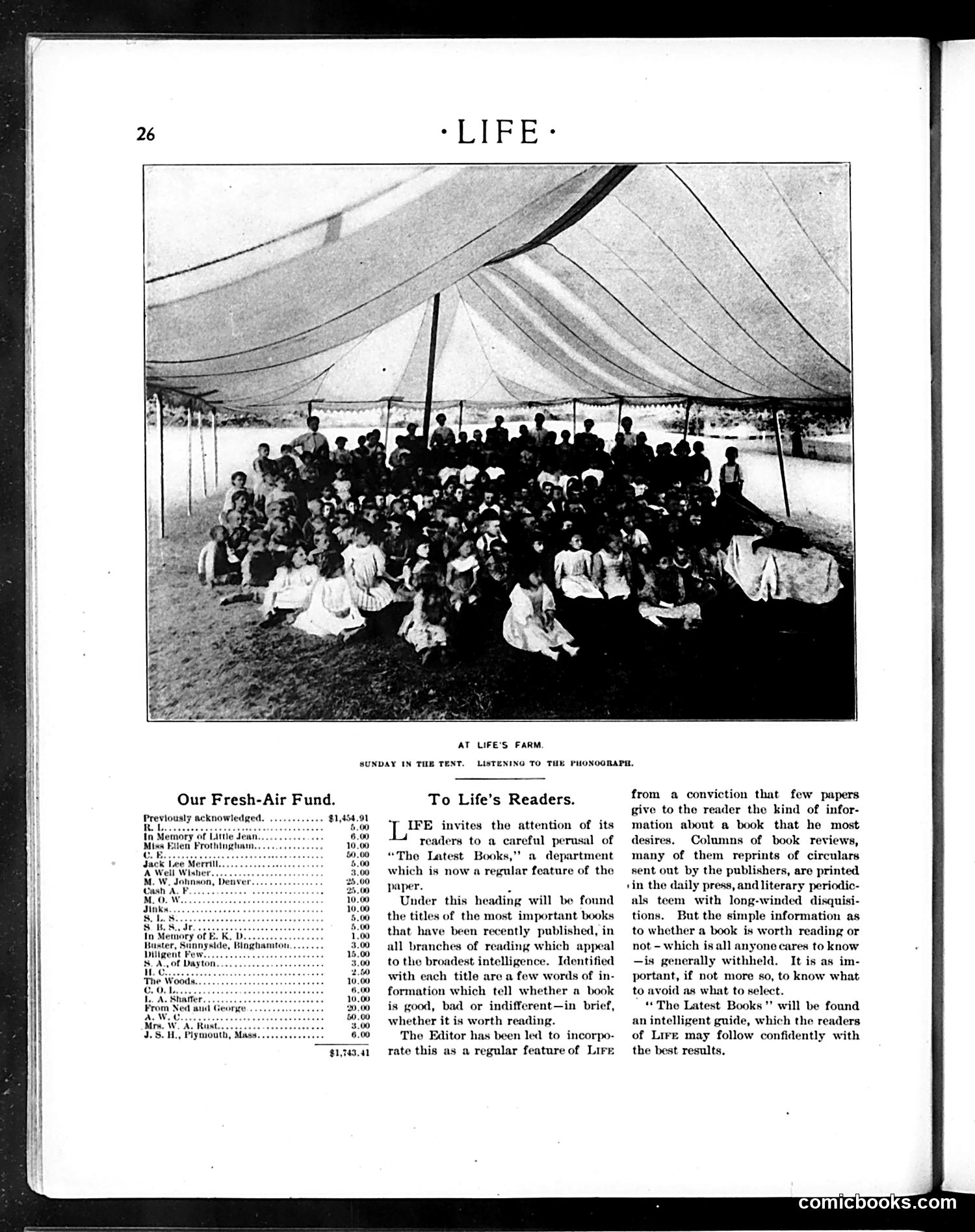
This page contains no political cartoon or satire. Instead, it features: 1. **A photograph** labeled "At Life's Farm—Sunday in the Tent. Listening to the Phonograph" showing a large gathering of people (appears to be men, women, and children) seated under a large tent at what is identified as "Life's Farm." 2. **"Our Fresh-Air Fund"** — a fundraising list acknowledging donor contributions totaling $1,743.41, with individual names and amounts. 3. **"To Life's Readers"** — an editorial announcement introducing a new regular column called "The Latest Books," which will review recently published books to help readers decide what's worth reading. The page documents Life magazine's charitable activities and editorial initiatives rather than providing political or social satire.
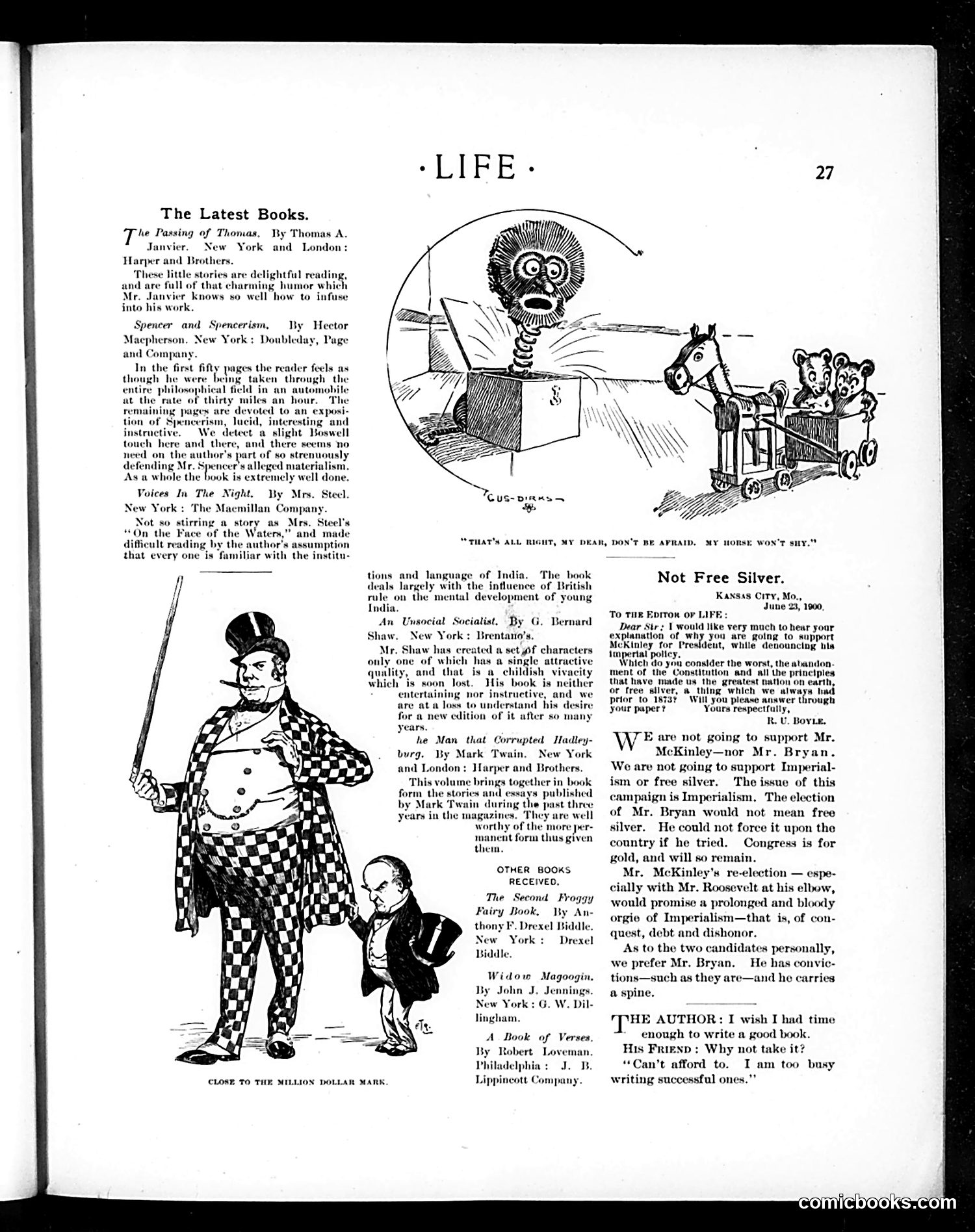
The top cartoon depicts an owl conductor leading toy animals on a train, captioned "That's all right, my dear, don't be afraid. My horse won't shy." This appears to be whimsical rather than explicitly political. The lower cartoon, labeled "Close to the Willson Dollar Mark," shows a tall figure in checkered clothing (representing wealth or capitalism) towering over a smaller man. This likely satirizes the relationship between money and political power during the McKinley-Bryan era (the text references this 1900 election debate over free silver). The size disparity suggests wealth's outsized influence on politics—a common Progressive-era critique of industrial capitalism's grip on government.
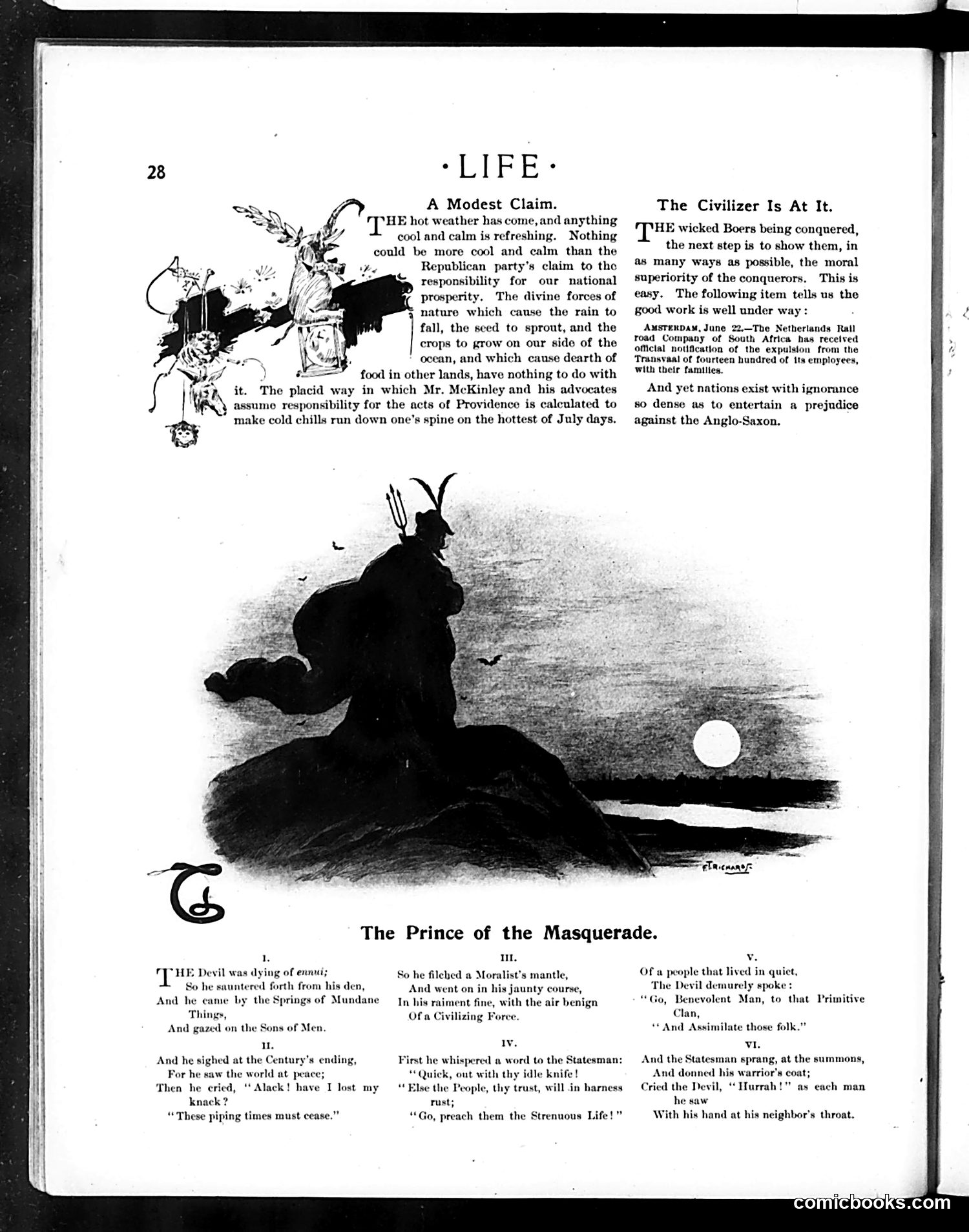
The two columns at top satirize Republican claims about prosperity and "civilization." The left column mocks McKinley's party for crediting themselves with natural phenomena (rain, crop growth) while ignoring their responsibility for national problems. The right column appears to mock imperial expansion—specifically, the conquest of the Boers in South Africa—as a supposed form of "civilization." The cartoon suggests the Republicans hypocritically claim credit for good outcomes while presenting military conquest as civilizing progress. **"The Prince of the Masquerade"** below is a poem-illustration featuring a silhouetted devil figure in moonlight. The Devil claims to be a "Moralist" and "Civilizing Force," mocking those who justify harmful actions under noble pretenses—likely referring to imperialist or interventionist policies dressed in moral language.
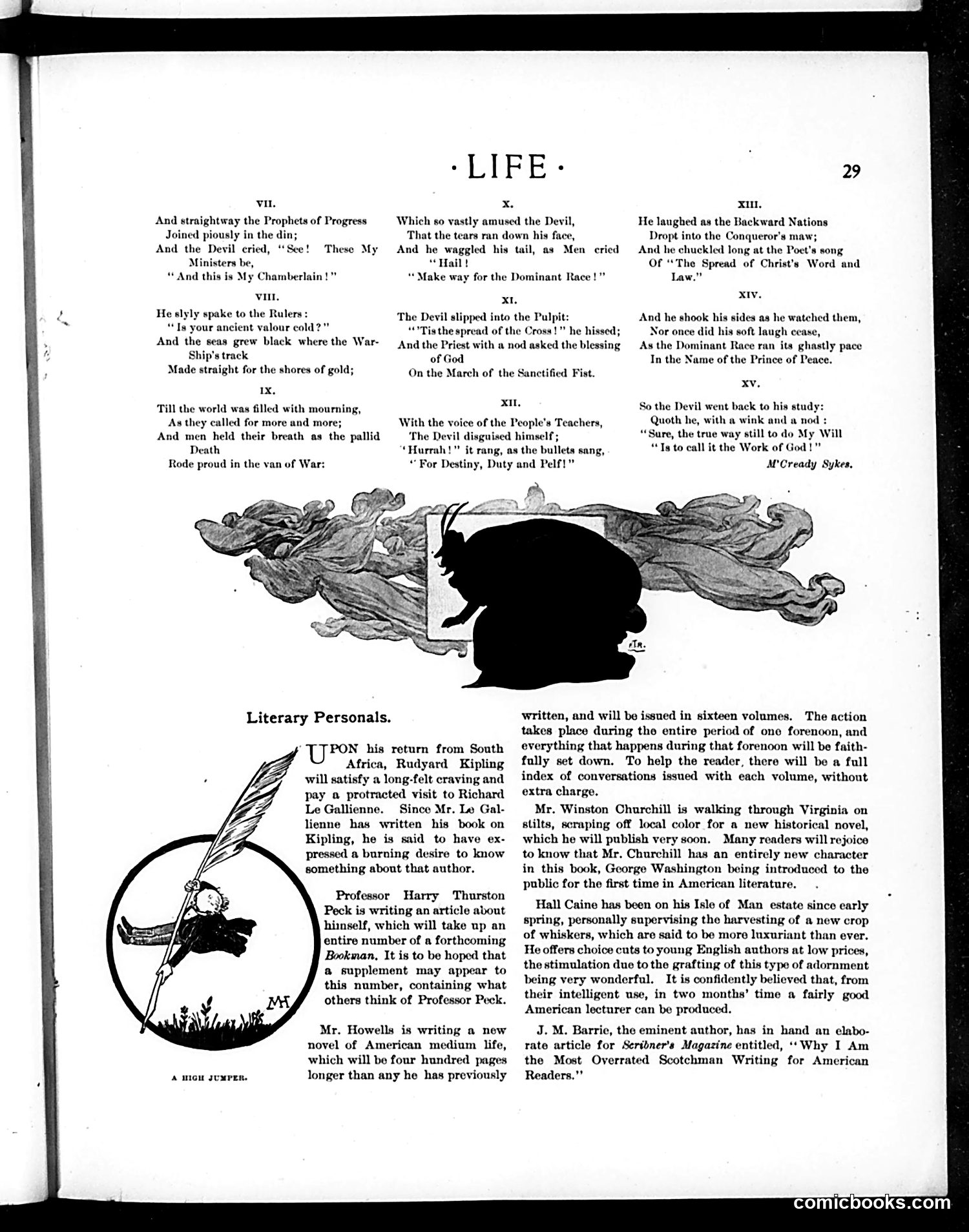
This page contains poetry (sections VII-XV) about spiritual/religious conflict, featuring what appears to be a Devil character. The central silhouette cartoon shows a horned figure (the Devil) in profile against decorative clouds. Below, the "Literary Personals" section discusses contemporary authors: Rudyard Kipling's anticipated return from South Africa; Professor Harry Thurston Peck writing about Kipling; Mr. Howells working on an American novel; and J.M. Barrie preparing an article for Scribner's Magazine. The small illustration labeled "A High Jumper" depicts a figure in athletic pose within a circular frame—likely a humorous commentary on sport or physical exertion, though its specific satirical point remains unclear without additional context about contemporary sporting debates or personalities.
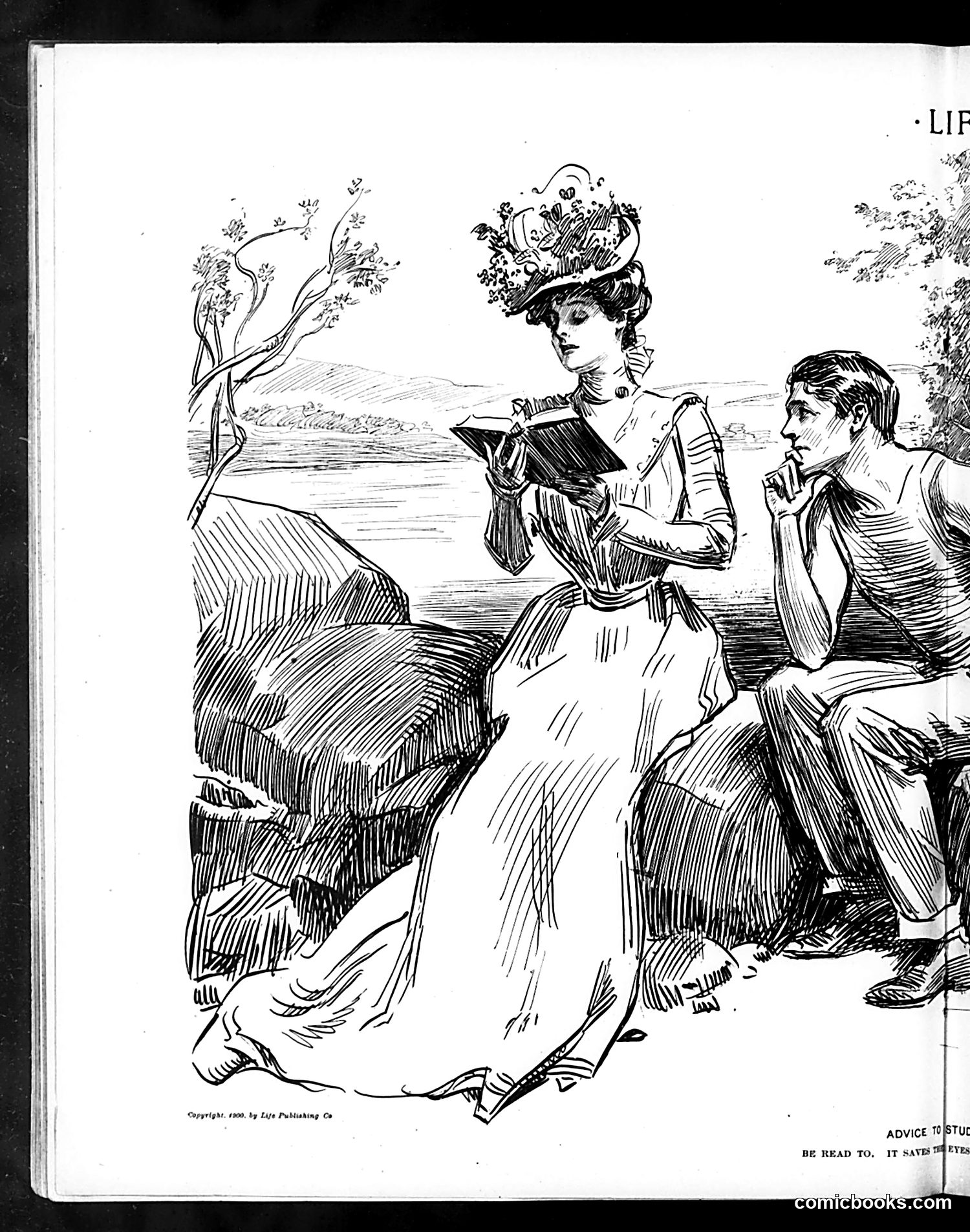
This appears to be a page from Life magazine (copyright 1908 by Life Publishing Co., visible at bottom). The illustration depicts a romantic or courtship scene with three figures: a woman in an elaborate hat and dress seated centrally, holding what appears to be a book or document, and a man beside her. The setting suggests an outdoor leisure scene by water. The partial text visible on the right mentions "ADVICE TO STUD[ENTS]" and "HE READ TO. IT SAVES [EYES]," suggesting the cartoon satirizes courtship rituals or reading habits among the educated classes of the Edwardian era. Without seeing the complete caption, the specific satirical point remains unclear, but it likely comments on social conventions or romantic practices of the period.
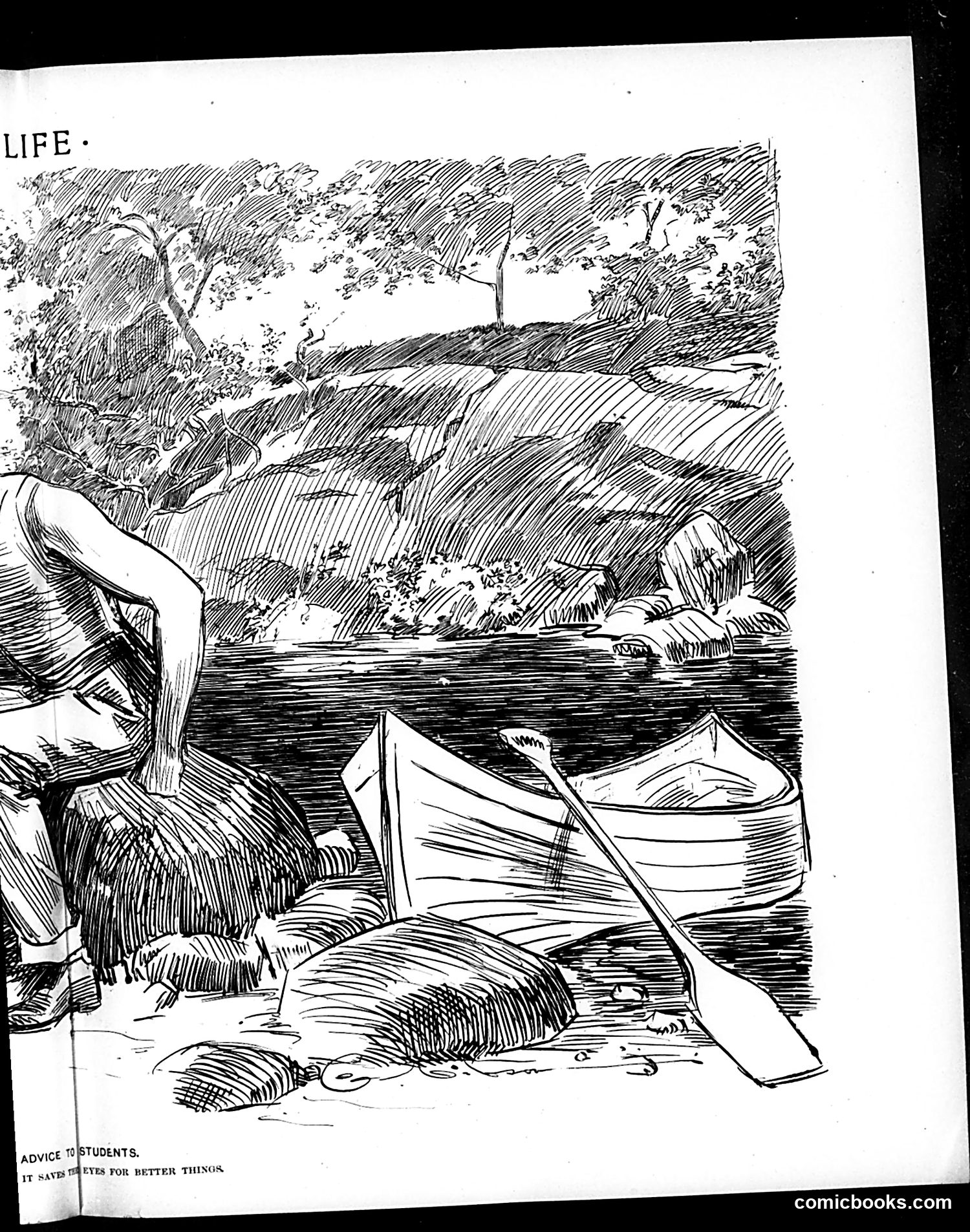
The page is titled "LIFE" and shows a pen-and-ink sketch of a riverside or lakeside scene with boats and natural scenery. At the bottom appears text reading "ADVICE TO STUDENTS" and "IT SAVES [THE?] EYES FOR BETTER THINGS." The illustration depicts a peaceful outdoor water scene with rowing boats, vegetation, and what appears to be a person in the foreground on the left. This appears to be advice advocating for students to spend time outdoors in nature rather than straining their eyes with study or indoor work. The satire or gentle humor likely mocks the common academic pressure of the era by promoting leisure and natural rest as beneficial—possibly ironic given that "LIFE" magazine itself was a product for reading. The specific context or event referenced is unclear from this image alone.
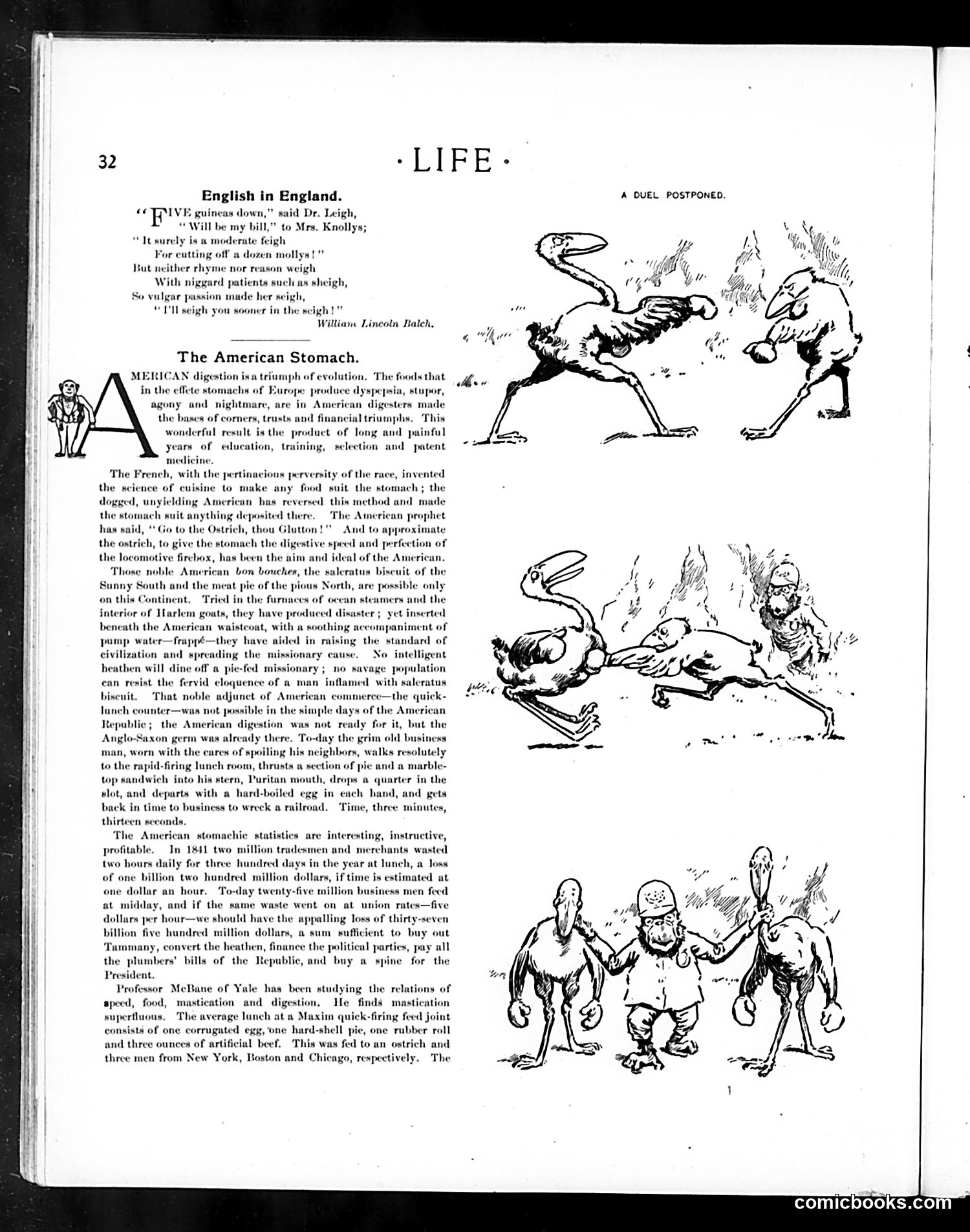
The left column satirizes American digestive superiority, claiming American stomachs efficiently process food that causes European dyspepsia. The text praises American digestion as evolutionary triumph while mocking French cuisine science and praising quick American lunches (egg, pie, beef, boiled egg consumed in three minutes, thirteen seconds). The right cartoons, titled "A Duel Postponed," depict comic figures apparently engaged in or avoiding a confrontation. The sketches show exaggerated physical comedy with characters in awkward, contorted poses—typical of Life magazine's visual humor style. Together, the page juxtaposes nationalist boasting about American vigor and efficiency with slapstick comedy, reflecting late 19th-century American confidence and satirical humor conventions.
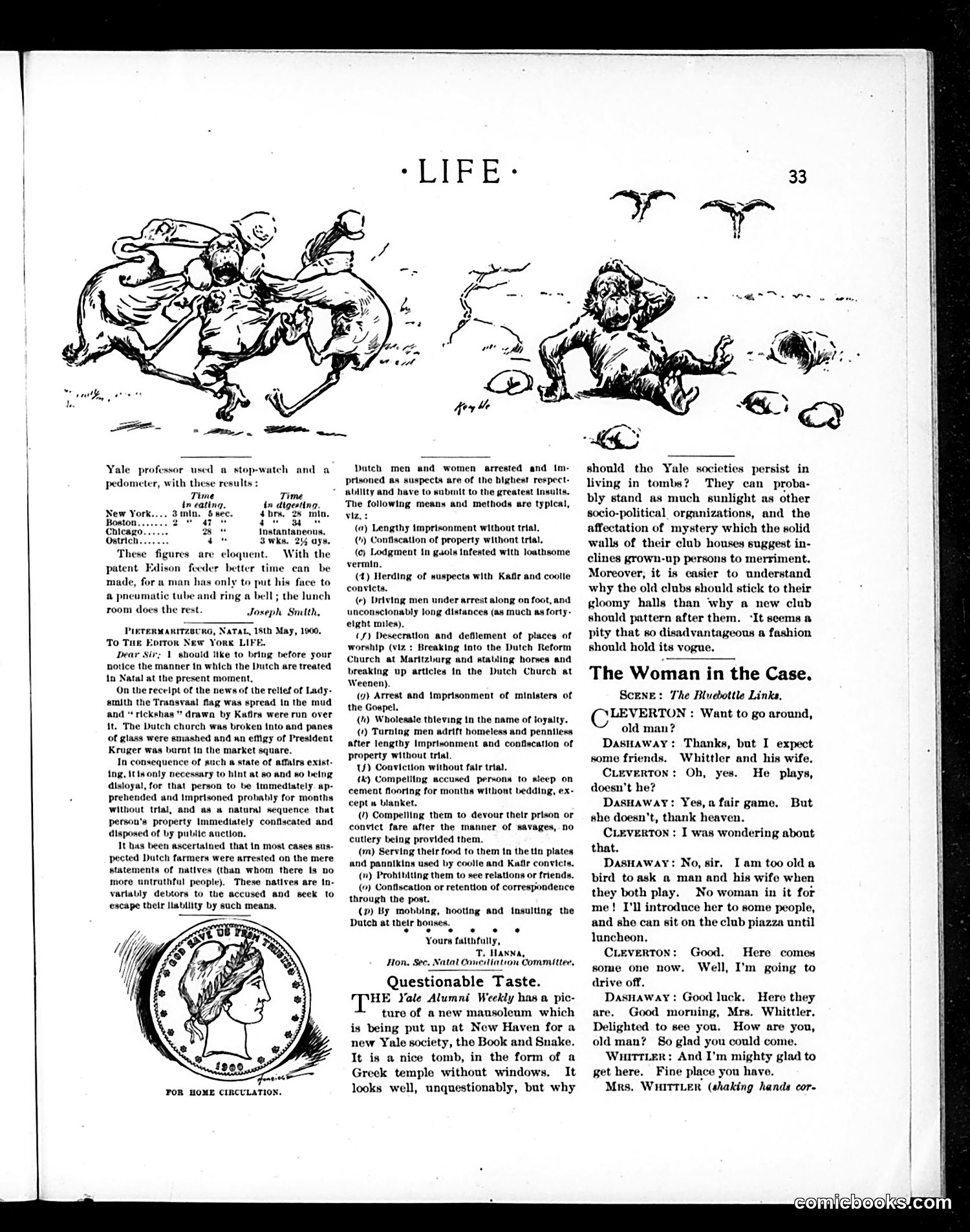
This page contains three distinct pieces of satire: **Top cartoon**: Mocks inefficient eating habits by showing a Yale professor's timed study comparing digestion speeds across cities (New York slowest). The joke satirizes modern efficiency obsession—a Edison-style "pneumatic tube feeder" is proposed as a ridiculous solution to speed up lunch. **Middle letter**: A serious complaint about British treatment of Dutch civilians during the Boer War in Natal. The writer lists systematic abuses—imprisonment without trial, property confiscation, desecration of churches, forced labor—documenting alleged war crimes against Boer settlers. This appears genuine correspondence, not satire. **Bottom section ("Questionable Taste")**: Mocks Yale's exclusive secret societies, specifically the Book and Snake club, for building their new clubhouse as a Greek temple tomb "without windows." The satire questions why elite organizations insist on fortress-like mystery when they could embrace normal transparency like other organizations. The page juxtaposes serious wartime injustice with trivial American collegiate absurdities—typical of *Life*'s satirical approach.
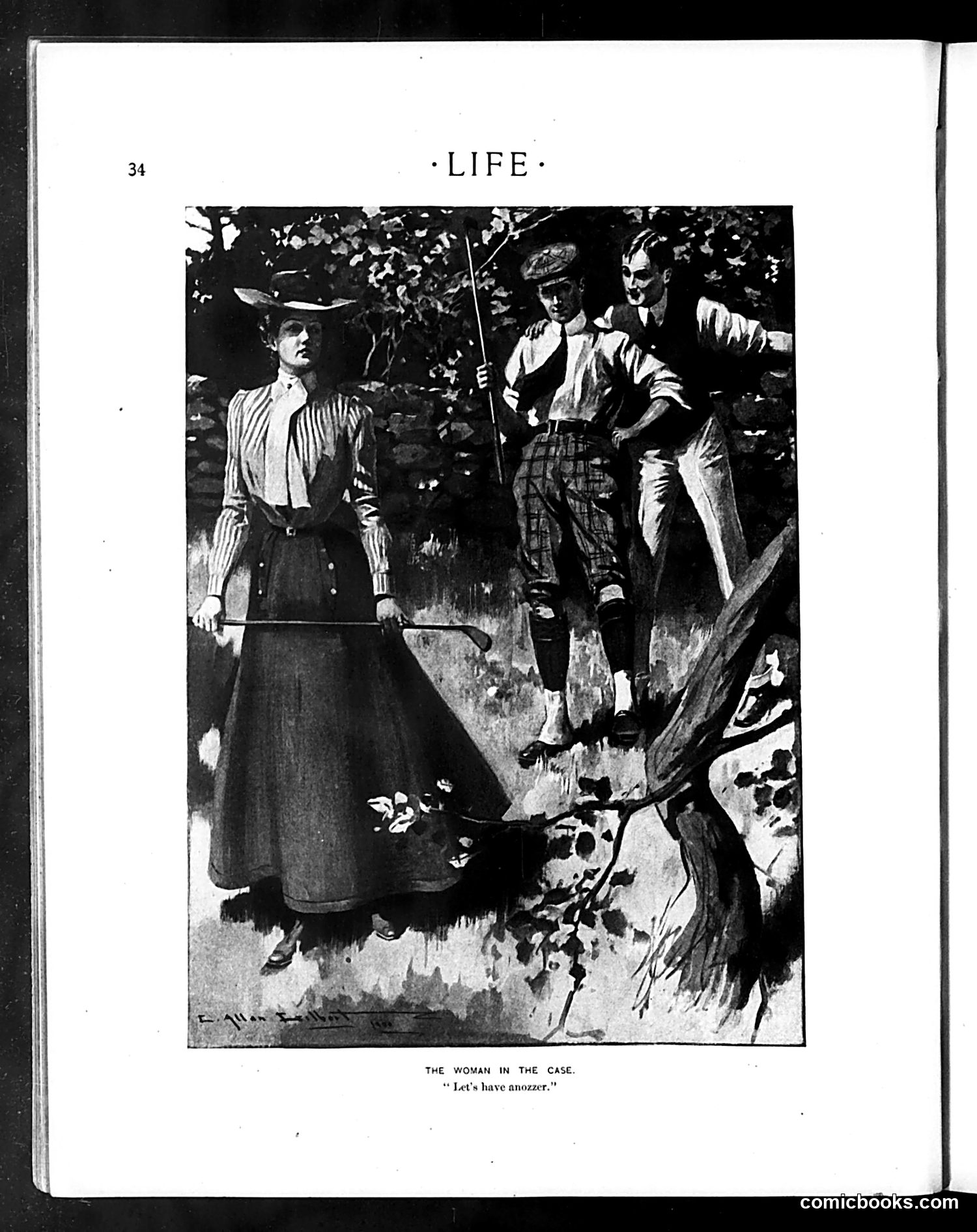
This illustration depicts a woman in early 1900s dress holding a fishing rod, standing with three men in outdoor/sporting attire. The caption "Let's have another" suggests a drinking scene, though the fishing context complicates the reference. The title "The Woman in the Case" appears to be satirizing a common literary and dramatic trope of the era—the mysterious or central female figure in a scandal or controversy. The woman's prominent position and the men's apparent deference suggests she's either the object of their attention or competition. Without additional context about the specific issue's date and content, the precise political or social reference remains unclear, though it likely comments on gender dynamics, courtship customs, or a contemporary scandal of Life magazine's readership period.
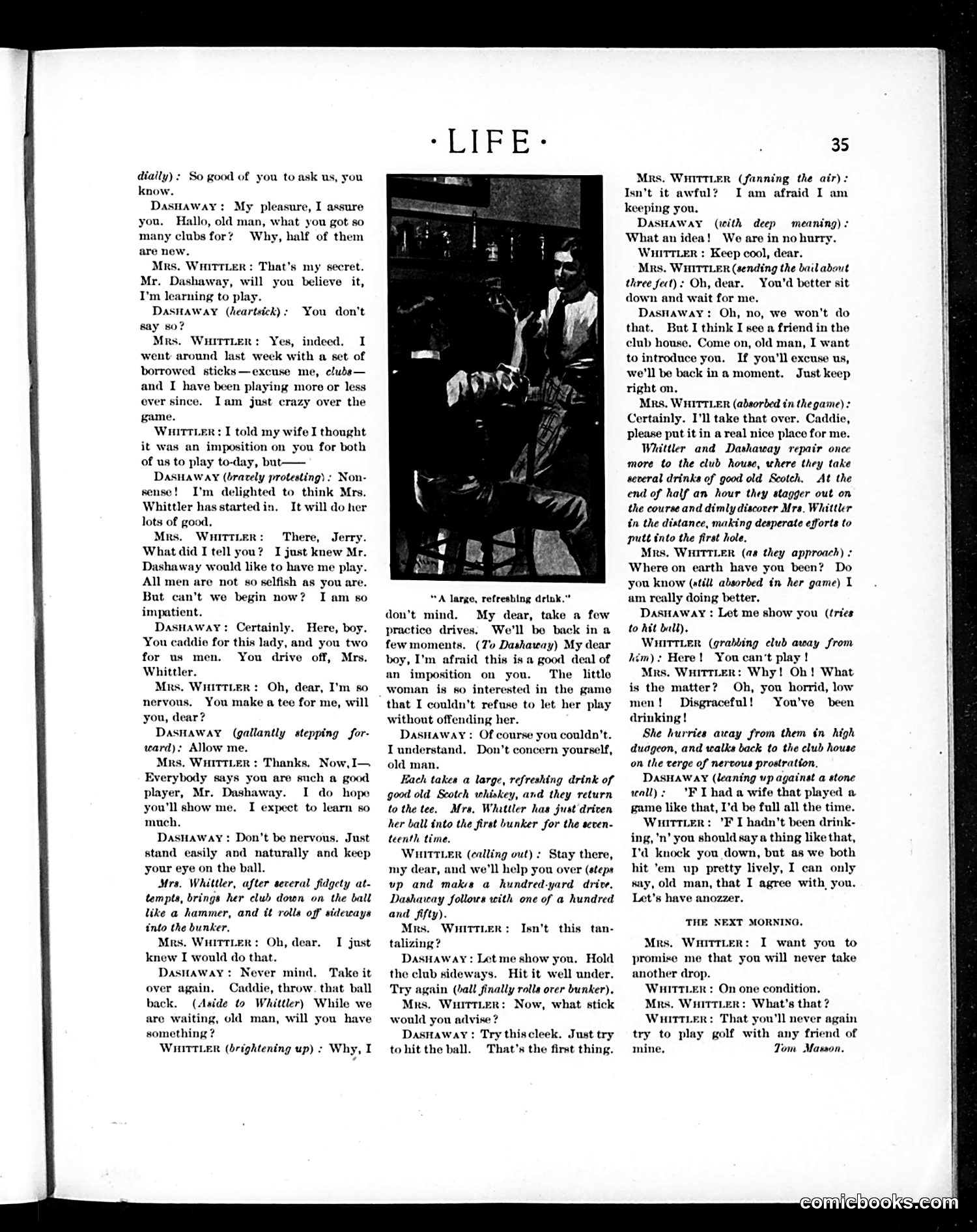
This is a satirical comic narrative about gender roles and golf in early 20th-century America. Mrs. Whittler, a society wife, has recently taken up golf—then still a largely male-dominated pastime. Her husband and his friend Mr. Dashaway pretend to be supportive, but the satire reveals their actual attitude: they find her playing incompetent and tedious. The joke unfolds through their actions: while politely encouraging her, the men repeatedly escape to the clubhouse for drinks ("refreshing drink" of Scotch whiskey), leaving her alone on the course. Mrs. Whittler, oblivious to their disdain, remains absorbed in the game, repeatedly mishitting balls into bunkers. The satire mocks both the men's false politeness masking contempt, and society's assumption that women taking up male activities would be naturally inept. It captures period attitudes about women's leisure activities being frivolous intrusions into male spaces.
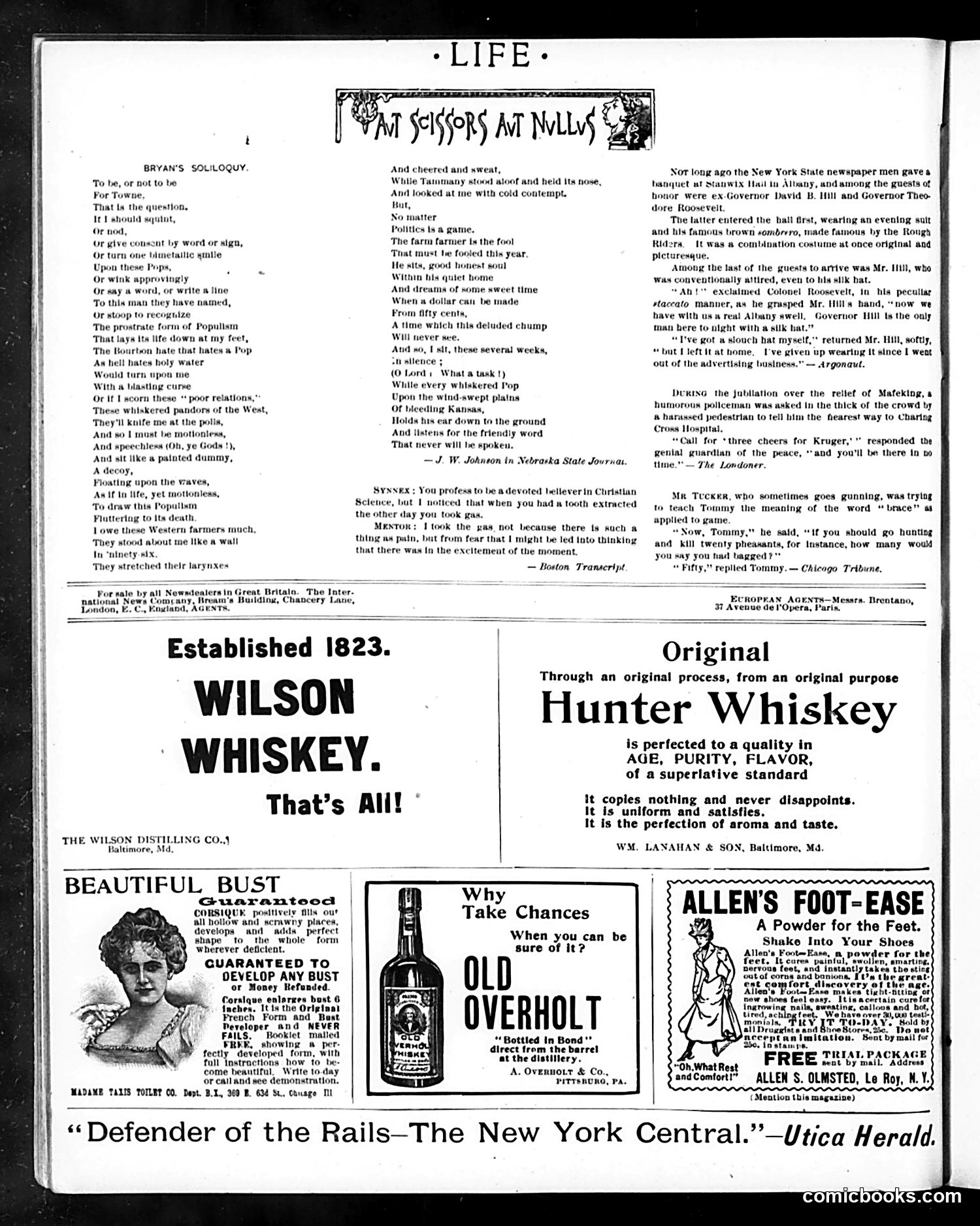
This page is primarily **advertising with satirical content**, centered around William Jennings Bryan, the three-time presidential candidate. **"Bryan's Soliloquy"** is a political parody mocking Bryan's awkward position in the 1900 election. The poem—styled as Hamlet's soliloquy—depicts Bryan paralyzed by indecision, unable to openly support the Populist Party (which endorsed him) without offending Tammany Hall (the New York Democratic machine). The satire highlights the tension between Bryan's agrarian base ("Western farmers") and urban Democratic power brokers. Bryan appears as a strategic coward, silent and motionless while farmers wait fruitlessly for his endorsement. The other items are shorter satirical pieces unrelated to Bryan: jokes about Christian hypocrisy, Roosevelt's sombrero vs. Hill's silk hat (contrasting flamboyance with convention), and wordplay about "braces" for game birds. The page fills remaining space with period whiskey and cosmetic advertisements.
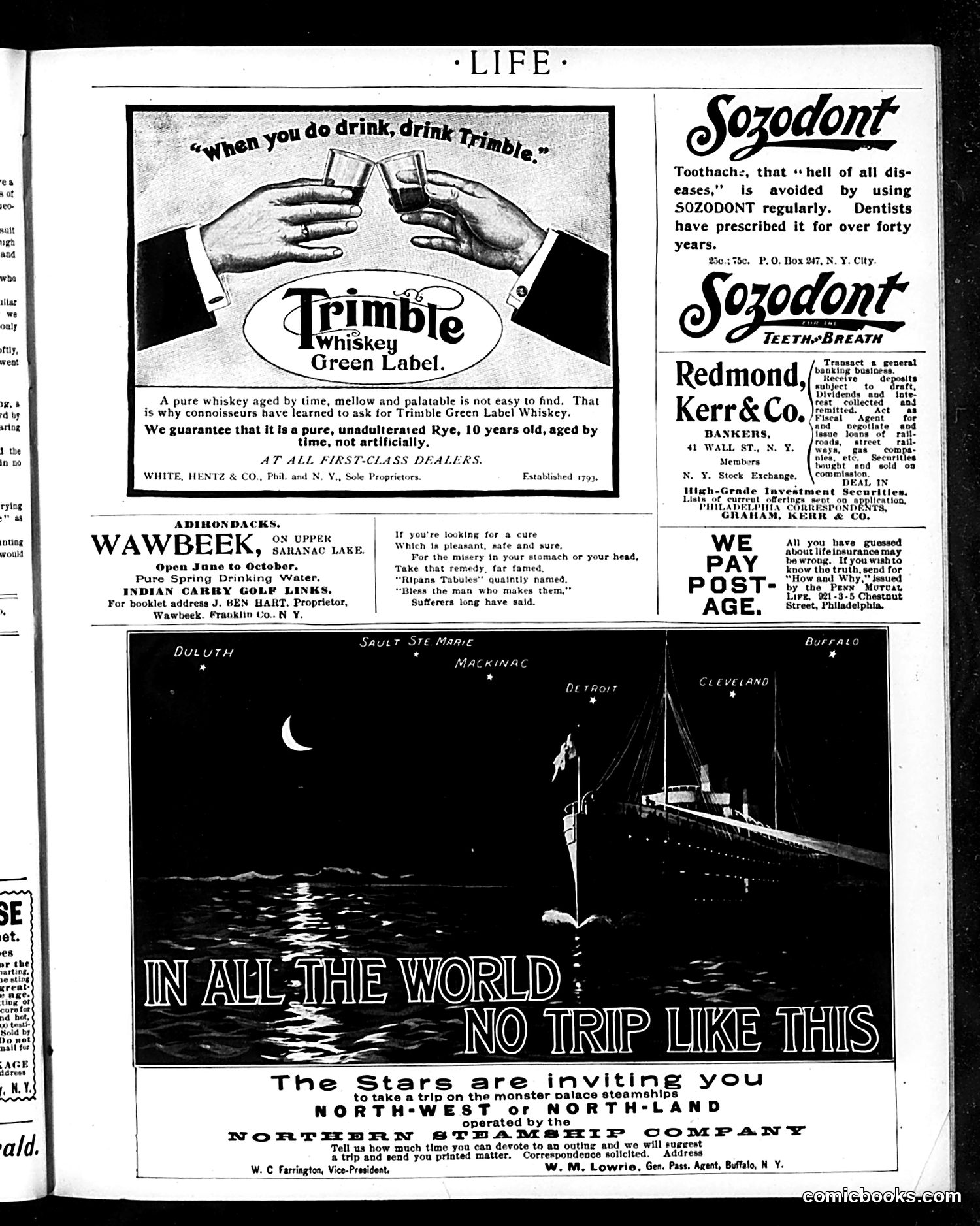
This page is primarily **advertising**, not satire or political commentary. It contains several product advertisements typical of early 20th-century magazines: **Trimble Whiskey** dominates the upper left with a "toast" image promoting "pure, unadulterated Rye, 10 years old." The ad emphasizes quality and long market presence (established 1793). Below are ads for **Wawbeek resort** (Adirondacks lodging), **Ripans Tabules** (patent medicine for digestive complaints), and **Sozodont** toothpaste—all making health/wellness claims. The lower right features **financial services** (Redmond, Kerr & Co., bankers) and **life insurance** (Penn Mutual). The largest illustration advertises **Northern Steamship Company** lake cruises on luxury vessels, depicting a nighttime ship crossing the Great Lakes, with cities (Duluth, Detroit, Buffalo, Mackinac, Cleveland) marked. This represents typical Life magazine content of the era—a mix of satirical editorial matter with lucrative advertising for consumer goods and services aimed at affluent readers.
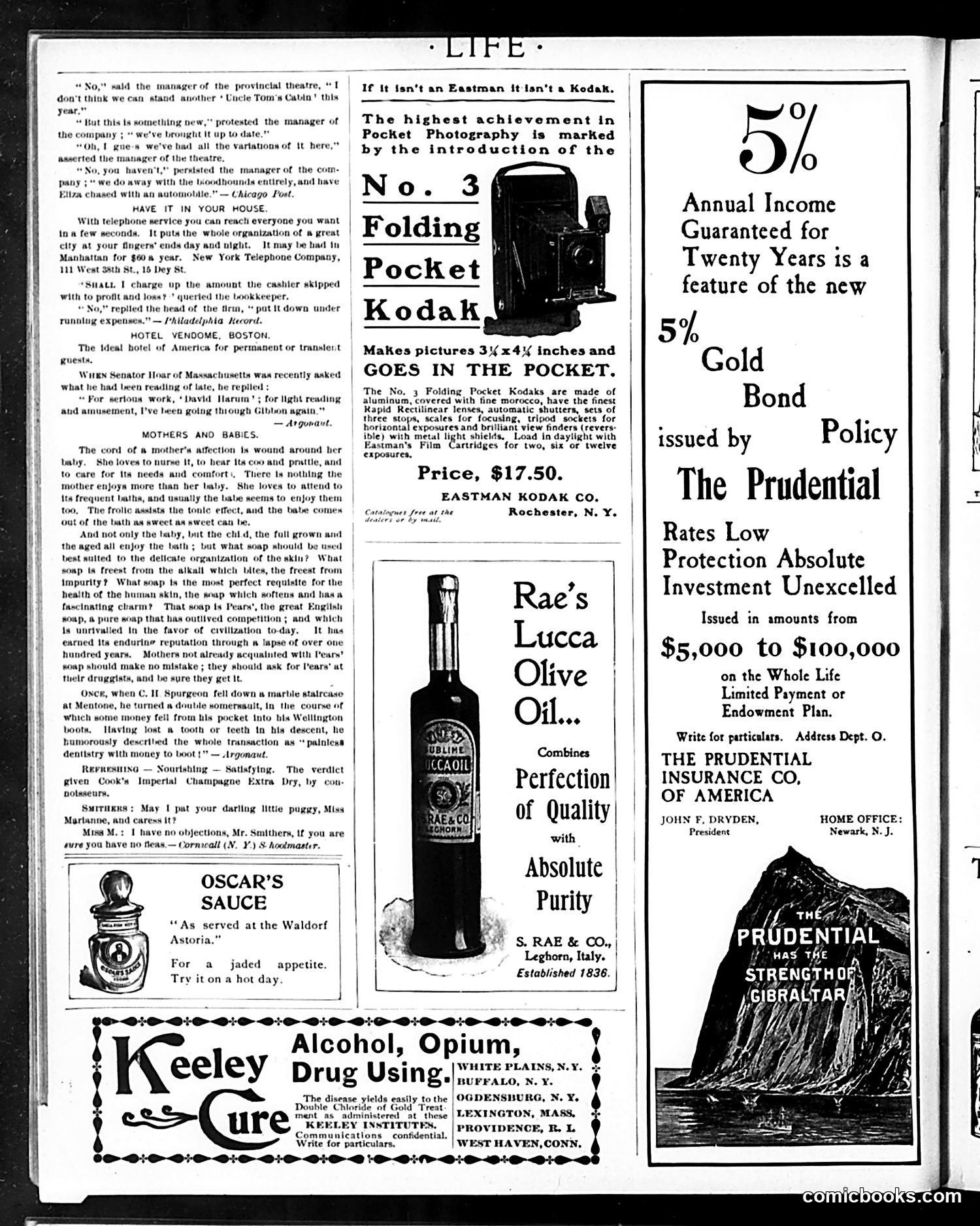
This page is primarily **advertising**, with some brief satirical snippets in the text columns. The main satirical content appears in short anecdotes lampooning 19th-century theater and bureaucratic absurdity. One joke mocks a provincial theater manager's resistance to updating "Uncle Tom's Cabin" for modern audiences—suggesting the play was so worn out it needed contemporary revision. Another brief piece ridicules corporate expense accounting, where a manager instructs bookkeeping to hide embezzled money under "running expenses." The bulk of the page features product advertisements typical of early 1900s Life: the Kodak No. 3 Folding Pocket camera, Rae's Lucca Olive Oil, Oscar's Sauce, and Pears' soap. Most notably, The Prudential Insurance Company advertises a 5% Gold Bond policy promising guaranteed income for twenty years—a financial product that would later prove problematic during economic downturns. The page reflects early-20th-century consumer culture and advertising practices rather than political satire.
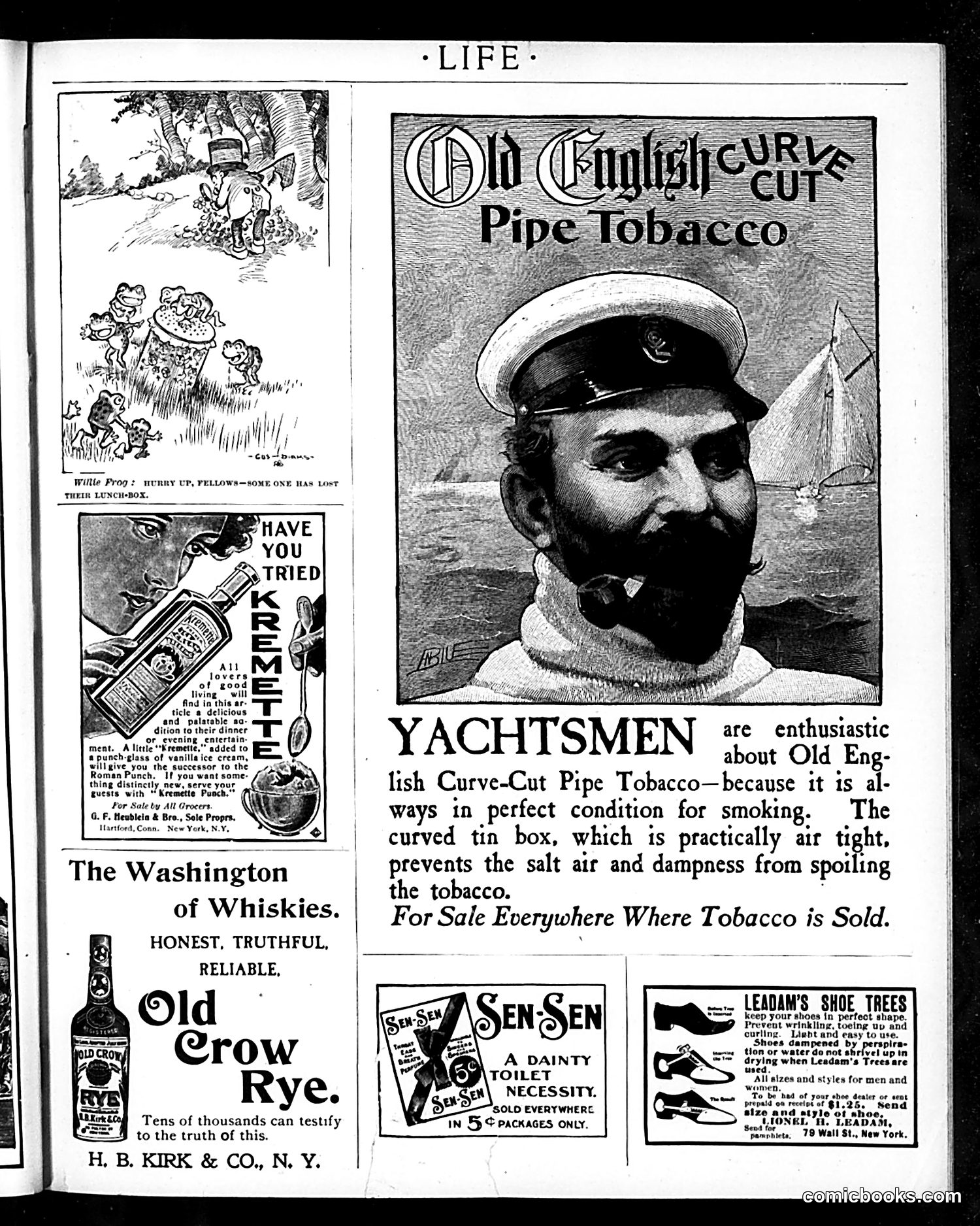
This is primarily an **advertising page** with one small cartoon and several product ads typical of early 20th-century American magazines. The only cartoon present is "Willie Frog: Hurry Up, Fellows—Some One Has Lost Their Lunch-Box," a small humorous illustration depicting frogs, likely anthropomorphized animals in a comedic situation. The joke appears simple: someone has misplaced a lunch box, creating mild chaos. Without additional context, the specific satirical or social commentary is unclear. The rest of the page consists of period advertisements: Old Crow Rye whiskey (claiming "honest, truthful, reliable" qualities), Old English Curve-Cut Pipe Tobacco (marketed to yachtsmen for its moisture-resistant tin), Kremette punch flavoring, Sen-Sen breath mints, and Leadam's Shoe Trees. These ads reflect consumer goods and social habits of the era—casual drinking, pipe smoking, and grooming products were standard advertised items. The page demonstrates Life's dual function: satirical content alongside commercial revenue from advertisements.
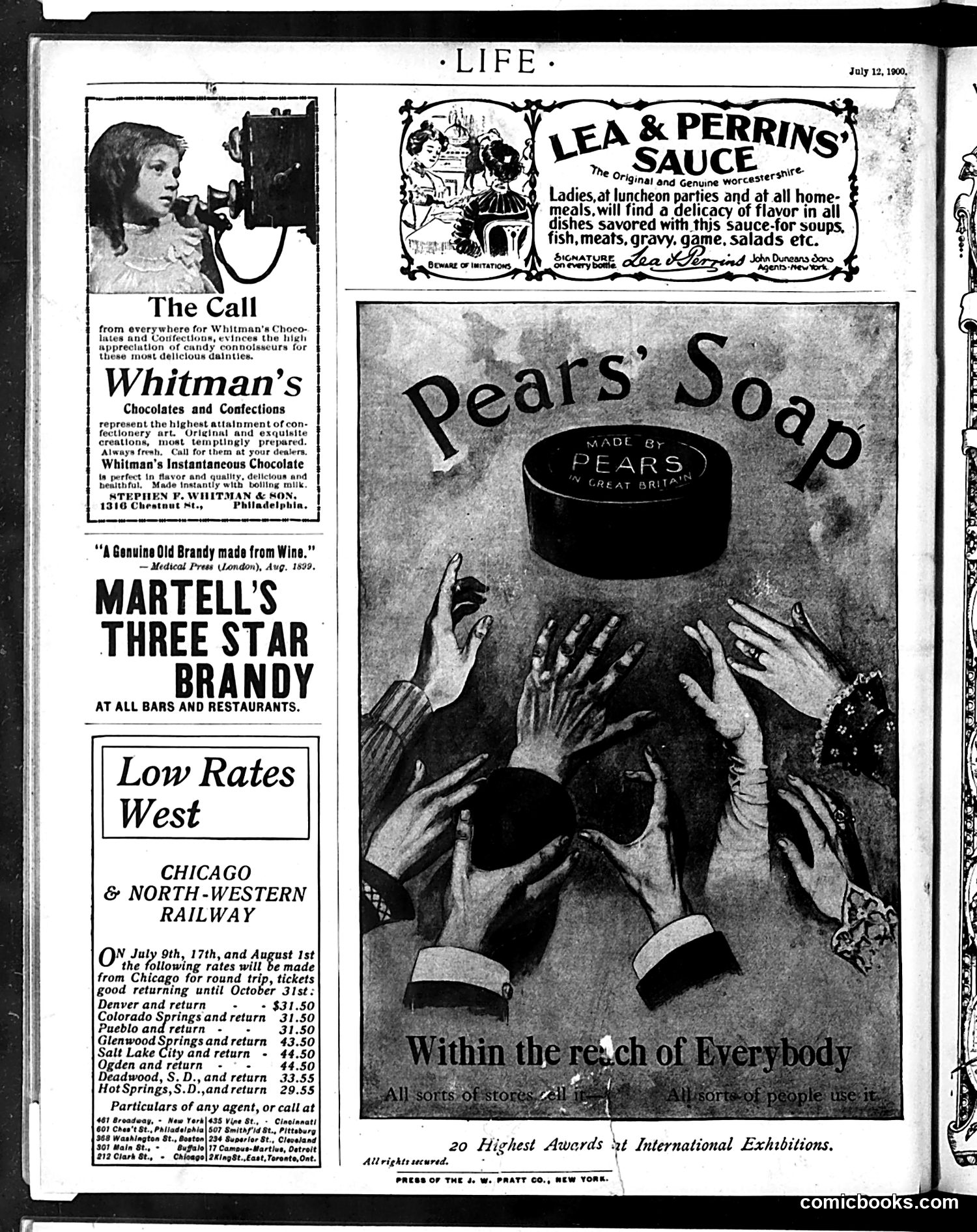
This is primarily an **advertising page** rather than editorial content or satire. The page contains multiple product advertisements typical of the era: **Left column**: Ads for Whitman's Chocolates, Martell's Three Star Brandy, and Chicago & North-Western Railway excursion rates to western destinations (Denver, Colorado Springs, etc.). **Center/Right**: Large advertisement for **Pears' Soap**, featuring an illustration of multiple hands reaching toward the product with the slogan "Within the reach of Everybody." The soap claims "20 Highest Awards at International Exhibitions." **Top right**: Advertisement for **Lea & Perrins Sauce**, marketed to women for enhancing soups, fish, and meats. There is **no political satire** evident on this page. "The Call" illustration appears to reference a Whitman's Chocolates advertisement showing demand for the product, not a political figure or event. This represents typical early-20th-century print advertising emphasizing quality, luxury goods, and testimonials of appreciation.