
Life, 1900-07-12 · page 5 of 20
Life — July 12, 1900 — page 5: what you’re looking at
What you’re looking at
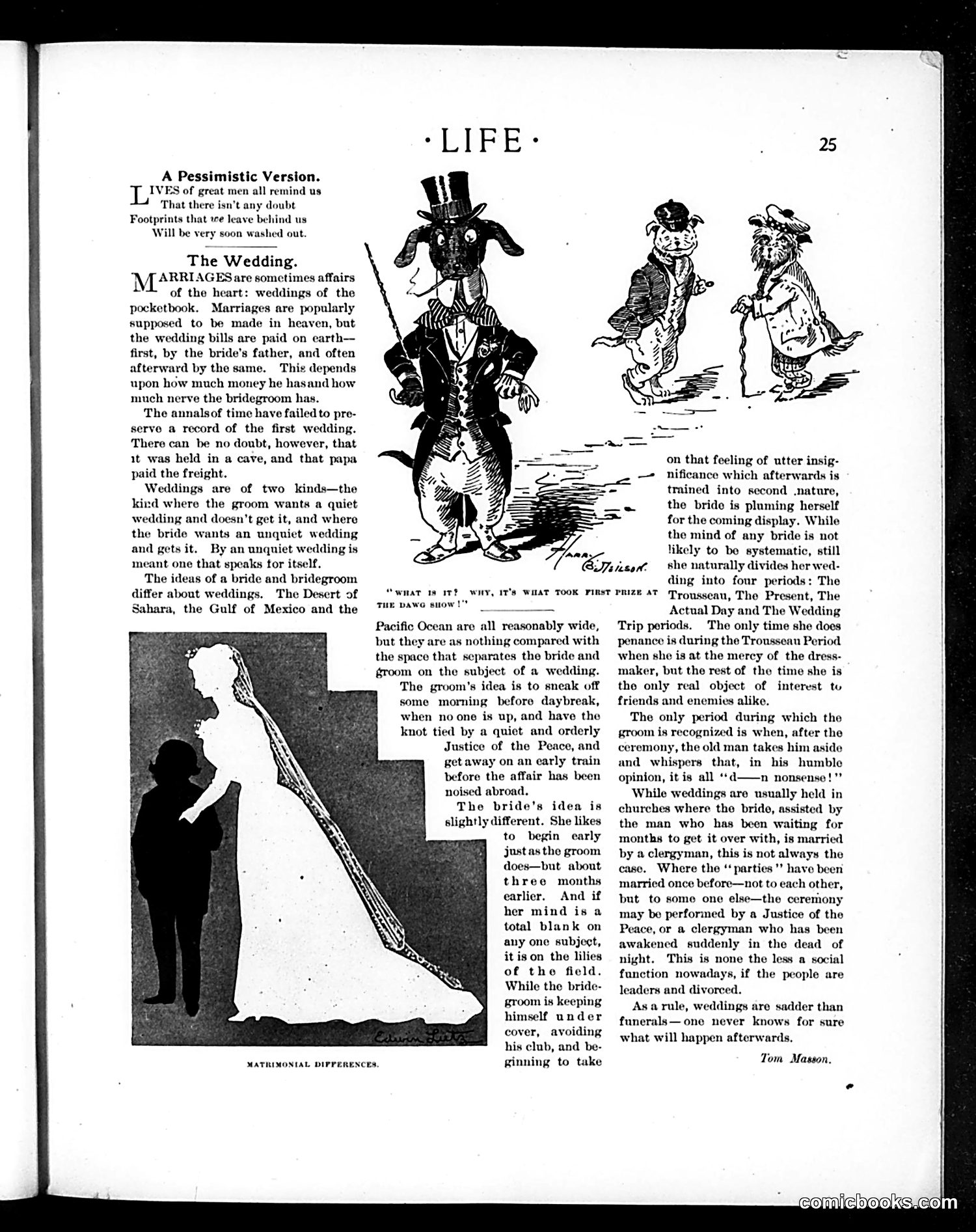
This page from *Life* magazine satirizes weddings through multiple cartoons and commentary. **Top cartoon**: A caricatured figure in formal dress asks "What is it? Why, it's what took first prize at the dawg show!" — mocking the groom's appearance by comparing him to a dog show contestant. **Left illustration** (captioned "Matrimonial Differences"): Shows a bride in her wedding dress alongside a simplified silhouette, presumably illustrating contrasting perspectives on marriage between genders. **Text and right cartoons**: The article "The Wedding" humorously describes weddings as affairs of the heart versus practical arrangements. It notes differences in how brides and grooms approach weddings, with the groom wanting quiet escape while the bride wants display. The side cartoons show wedding party members, emphasizing social awkwardness. The overall satire mocks Victorian marriage conventions, gender expectations, and the absurdity of wedding rituals.
📄 Transcribed text from this page (OCR, searchable)
Machine-transcribed from the original scan — historical spelling and the odd misread are preserved.
A Pessimistic Version. IVES of great men all remind us That there isn't any doubt Footprints that we leave behind us Will be very soon washed out. The Wedding. MAR! AGESare sometimes affairs of the heart: weddings of the pocketbook. Marriages are popularly supposed to be made in heaven, but the wedding bills are paid on earth— first, by the bride's father, and often afterward by the same. This depends upon how much money he hasand how much nerve the bridegroom has. The annalsof time have failed to pre- serve a record of the first wedding. There can be no doubt, however, that it was held in a cave, and that papa paid the freight. Weddings are of two kinds—the kird where the groom wants a quiet wedding and doesn't get it, and where the bride wants an unquiet wedding and gets it. By an unquiet wedding is meant one that speaks tor itself. The ideas of a bride and bridegroom differ about weddings. The Desert of Sahara, the Gulf of Mexico and the MATRIMONIAL DIPPERENCES. on Ce isert WHY, IT's WHAT TOOK FIRST PRIZE AT Trousseau, The Present, The wat 18 IT TUE DAWG sow Pacific Ocean are all reasonably wide, but they are as nothing compared with the space that separates the bride and Groom on the subject of a wedding. The groom's idea is to sneak off some morning before daybreak, when no one is up, and have the knot tied by a quiet and orderly Justice of the Peace, and get away on an early train before the affair has been noised abroad. The bride’s idea is slightly different. She likes to begin early just asthe groom does—but about three months earlier. And if her mind is a total blank on any one subject, it is on the lilies of the field. While the bride- groom is keeping himself under cover, avoiding his club, and be- ginning to take on that feeling of utter insig- nificance which afterwards is trained into second nature, the bride is pluming herself for the coming display. While the mind of any bride is not likely to be systematic, still she naturally divides her wed- ding into four periods: The Actual Day and The Wedding Trip periods. The only time she does penance is during the Trousseau Period when she is at the mercy of the dress- maker, but the rest of the time she is the only real object of interest tu friends and enemies alike. The only period during which the groom is recognized is when, after the ceremony, the old man takes him aside and whispers that, in his humble opinion, it is all ““d—n nonsense While weddings are usually held in churches where the bride, assisted by the man who has been waiting for months to get it over with, is married by a clergyman, this is not always the case. Where the ‘parties’ have been married once before—not to each other, but to some one else—the ceremony may be performed by a Justice of the Peace, or a clergyman who has been awakened suddenly in the dead of night. This is none the less a social function nowadays, if the people are leaders and divorced. Asa rule, weddings are sadder than funerals—one never knows for sure what will happen afterwards, Tom Masson.