
Life, 1900-07-12 · page 12 of 20
Life — July 12, 1900 — page 12: what you’re looking at
What you’re looking at
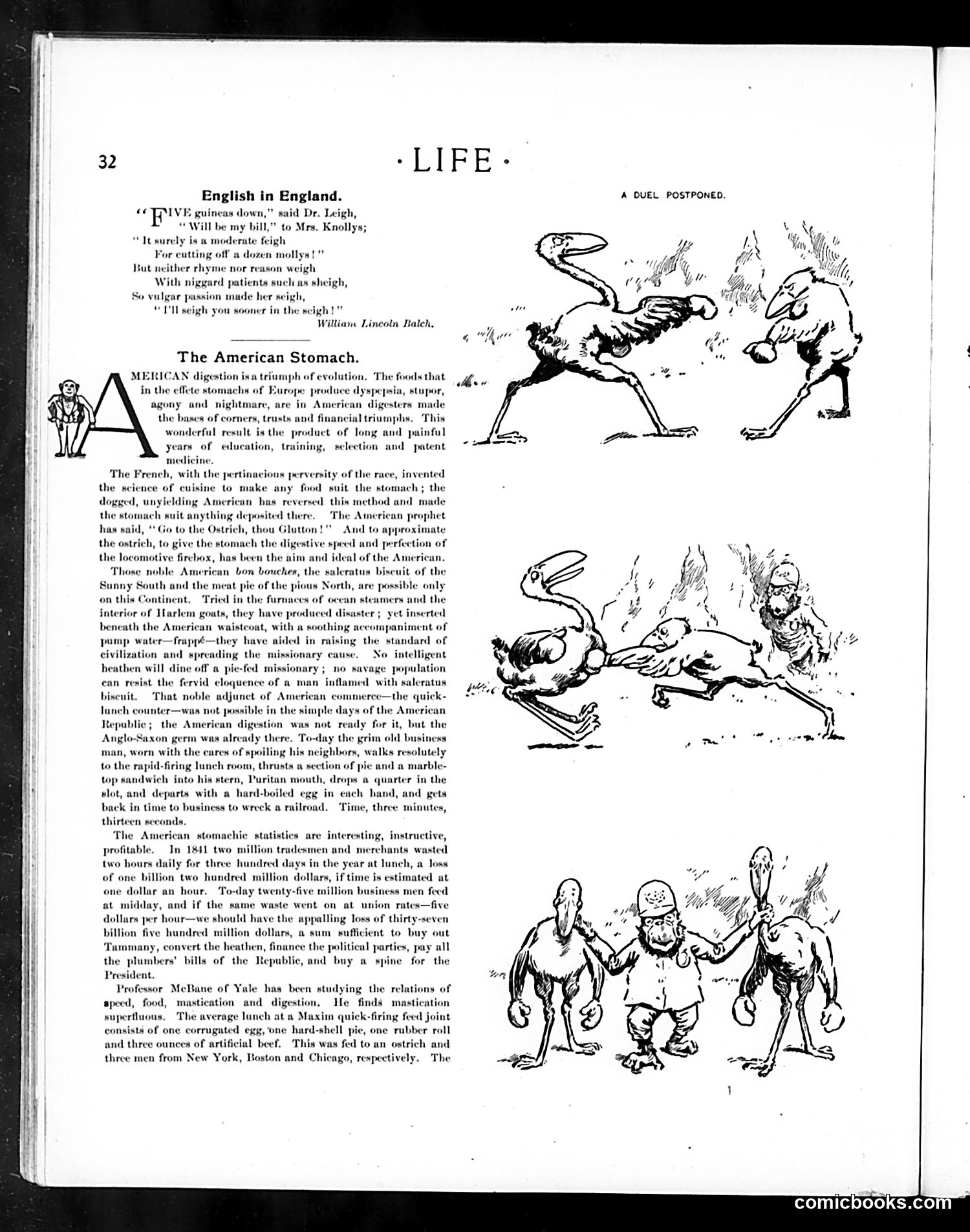
The left column satirizes American digestive superiority, claiming American stomachs efficiently process food that causes European dyspepsia. The text praises American digestion as evolutionary triumph while mocking French cuisine science and praising quick American lunches (egg, pie, beef, boiled egg consumed in three minutes, thirteen seconds). The right cartoons, titled "A Duel Postponed," depict comic figures apparently engaged in or avoiding a confrontation. The sketches show exaggerated physical comedy with characters in awkward, contorted poses—typical of Life magazine's visual humor style. Together, the page juxtaposes nationalist boasting about American vigor and efficiency with slapstick comedy, reflecting late 19th-century American confidence and satirical humor conventions.
📄 Transcribed text from this page (OCR, searchable)
Machine-transcribed from the original scan — historical spelling and the odd misread are preserved.
English in England. (6 PPIVE guineas down,” said Dr. Leigh, Hy , igh, r to Mrs. Knollys; “Te surely p feigh For cutting off a dozen mollys But neither rhyme nor So vulgar passion made The American Stomach. MERICAN digestion isa triumph of evolution, The foods that wult isthe product of long and painful ution, training, selection and patent French, with the pertinacions perversity of the race, invented the science of cuisine to make any food suit the stomach; the dogs ican bas reversed this method and made the stomach posited there, ‘The American prophet has said, ‘Go to the Ostrich, thou Glutton!” And to approximate the ostrich, to give the stomach the digestive speed and perfection of the locomotive firebox, has been the aim and ideal of the Amer Those American bon bouches, the saleratus biscuit ¢ Sunny ie of the pious North, are possible only on this Ce ; Th the furnaces of ocean steamers and the interior of Harlem goats, they have produced disaster ; yet i beneath the American waistcoat, with a soothing a pump water—frappé—th > aided in raising the standard of civilization and spread! e No intelligent heathen will dine off a pie-fed missionary ; no savage population can resist the fervid eloquence of a man inflamed with saleratus bi . That nobl jjunct of American lunch ¢ —was not possible i e of the American Republ the American digestion was not ready for it, but the Anglo-Saxon germ was already there. To-day the grim old business man, worn with the cares of spoiling his neighbors, walks resolutely to the rapid-firing lunch room, thrusts a section of pie and a marble- top sandwich into his stern, Puritan mouth ss a quarter in th slot, and departs with a har led egg ach hand, and gets back in time to business to wreck @ railroad, Time, three minutes, thirteen seeonds. The American stomachic statistics are interesting, instructive, profitable. In 1841 two million tradesmen and merchants wasted two hours daily for three hundred days in the year at lunch, a loss of billion two hundred million dollars, if time is estimated at one dollar an hour. To-day twenty-five million business men feed at midday, and if the same waste went on at union rates—five dollars per hour—we should haye the appalling loss of thirty: n billion five hundred million dollars, a sum sufficient to buy out Tammany, convert the heathen, finance the political parties, pay all the plumbers’ bills of the Republic, and buy a spine for. the President. Professor MeDBane of Yale has been studying the relations of speed, food, mastication and digestion, He finds masticati superfluous. The average lunch at a Maxim quick-firing feed joint consists of one corruguted egg, one hard-shell pie, one rubber roll and three ounces of artificial beef, ‘This was fed to an ostrich and three men from New York, Boston and Chicago, respectively. The A DUEL POSTPONED. comicbooks.com