
Life, 1900-07-12 · page 4 of 20
Life — July 12, 1900 — page 4: what you’re looking at
What you’re looking at
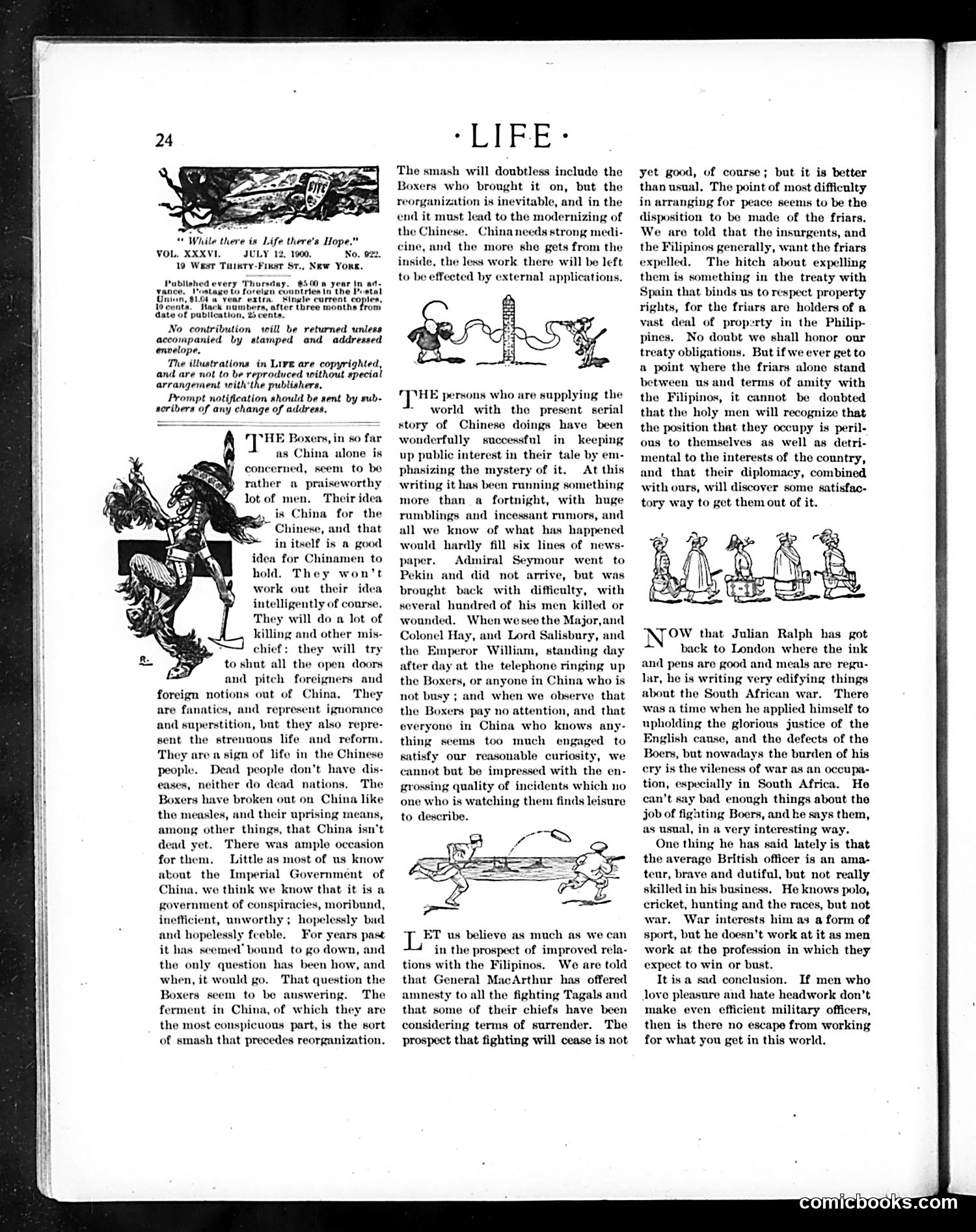
The page discusses the Boxer Rebellion in China. The text praises journalists covering Chinese events, then shifts to criticizing British military operations. It mentions Admiral Seymour's failed mission to Peking and notes that Major-General Gaselee and others are coordinating responses. The cartoon depicts a figure (likely representing China or a Chinese official) as a dragon-like creature, symbolizing the chaos and "foreignness" of the conflict to Western readers—a common racist caricature of the era. The text's main point: Western military intervention may succeed, but permanent peace requires understanding China's internal politics. The author skeptically questions whether British officers (specifically regarding South African conflicts) are truly competent at their stated mission, suggesting military adventure doesn't guarantee positive outcomes.
📄 Transcribed text from this page (OCR, searchable)
Machine-transcribed from the original scan — historical spelling and the odd misread are preserved.
“ While there is Life there’s Hope. VOL, XXXVI. JULY 12, 1900, 19 West Tuinty-Finst Sr. bilshed every Thoreday. #500 year in eto fo iuntries in the Ps tvyear extra. Single current copies, Mack numbers, after three months from dato of publication, scents. No contribution will be returned unless accompanied by stamped and addressed envelope. ‘The illustrations in Live are copyrighted, and are not to be reproduced without special arrangement with'the publishers, Prompt notification should be sent by sub- scribers of any change of address. T]HE Boxers, in so far as China alone is concerned, seem to be rather a praiseworthy lot of men, Their idea is China for the Chinese, and that in itself is a good idea for Chinamen to hold. They won't work out their idea intelligently of course. They will do a lot of killing and other mis- chief: they will try to shut all the open doors and pitch foreigners and foreign notions out of China. They are fanatics, and represent ignorance and superstition, but they also repre- sent the strenuous life and reform. They are a sign of life in the Chinese people. Dead people don’t have dis- eases, neither do dead nations, The Boxers have broken out on China like the measles, and their uprising means, among other things, that China isn't dead yet. There was ample occasion for them. Little as most of us know avout the Imperial Government of China. we think we know that it is a government of conspiracies, moribund, inefficient, unworthy ; hopelessly bad and hopelessly feeble. For years past it has seemed’ bound to go down, and the only question has been how, and when, it would go. That question the Boxers seem to be answering. The ferment in China, of which they are the most conspicuous part, is the sort of smash that precedes reorganization. *LIPE > The smash will doubtless include the Boxers who brought it on, but the reorganization is inevitable, and in the end it must lead to the modernizing of the Chinese. Chinaneeds strong medi- ine, and the more she gets from the inside, the less work there will be left to be effected by external applications. TPHE persons who are supplying the world with the present serial story of Chinese doings have been wonderfully successful in keeping up public interest in their tale by em- phasizing the mystery of it. At this writing it has been running something more than a fortnight, with huge rumblings and incessant rumors, and all we know of what has happened would hardly fill six lines of news- paper. Admiral Seymour went to Pekin and did not arrive, but was brought back with difficulty, with several hundred of his men killed or wounded. When we see the Major,and Colonel Hay, and Lord Salisbury, and the Emperor William, standing day after day at the telephone ringing up the Boxers, or anyone in China who is not busy ; and when we observe that the Boxers pay no attention, and that everyone in China who knows any- seems too much engaged to satisfy our reasonable curiosity, we cannot but be impressed with the en- grossing quality of incidents which no one who is watching them finds leisure to describe. ET us believe as much as we can in the prospect of improved rela- tions with the Filipinos. We are told that General MacArthur has offered amnesty to all the fighting Tagals and that some of their chiefs have been considering terms of surrender. The prospect that fighting will cease is not yet good, of course; but it is better than usual. The point of most difficulty in arranging for peace seems to be the disposition to be made of the friars, We are told that the insurgents, and the Filipinos generally, want the friars expelled. The hitch about expelling them is something in the treaty with Spain that binds us to respect property rights, for the friars are holders of a vast deal of property in the Philip- pines. No doubt we shall honor our treaty obligations. But if we ever get to a point where the friars alone stand between us and terms of amity with the Filipinos, it cannot be doubted that the holy men will recognize that the position that they occupy is peril- ous to themselves as well as detri- mental to the interests of the country, and that their diplomacy, combined with ours, will discover some satisfac- tory way to get them out of it. Now that Julian Ralph has got aa back to London where the ink and pens are good and meals are regu- lar, he is writing very edifying things about the South African war. There was a time when he applied himself to upholding the glorious justice of the English cause, and the defects of the Boers, but nowadays the burden of his ery is the vileness of war as an occupa- tion, especially in South Africa, He can’t say bad enough things about the job of fighting Boers, and he says them, as usual, in a very interesting way. One thing he has said lately is that the average British officer is an ama- teur, brave and dutiful, but not really skilled in his business. He knows polo, cricket, hunting and the races, but not war. War interests him as a form of sport, but he doesn’t work at it as men work at the profession in which they expect to win or bust. It isa sad conclusion. If men who love pleasure and hate headwork don’t make even efficient military officers, then is there no escape from working for what you get in this world.