
A complete issue · 20 pages · 1900
Life — July 5, 1900
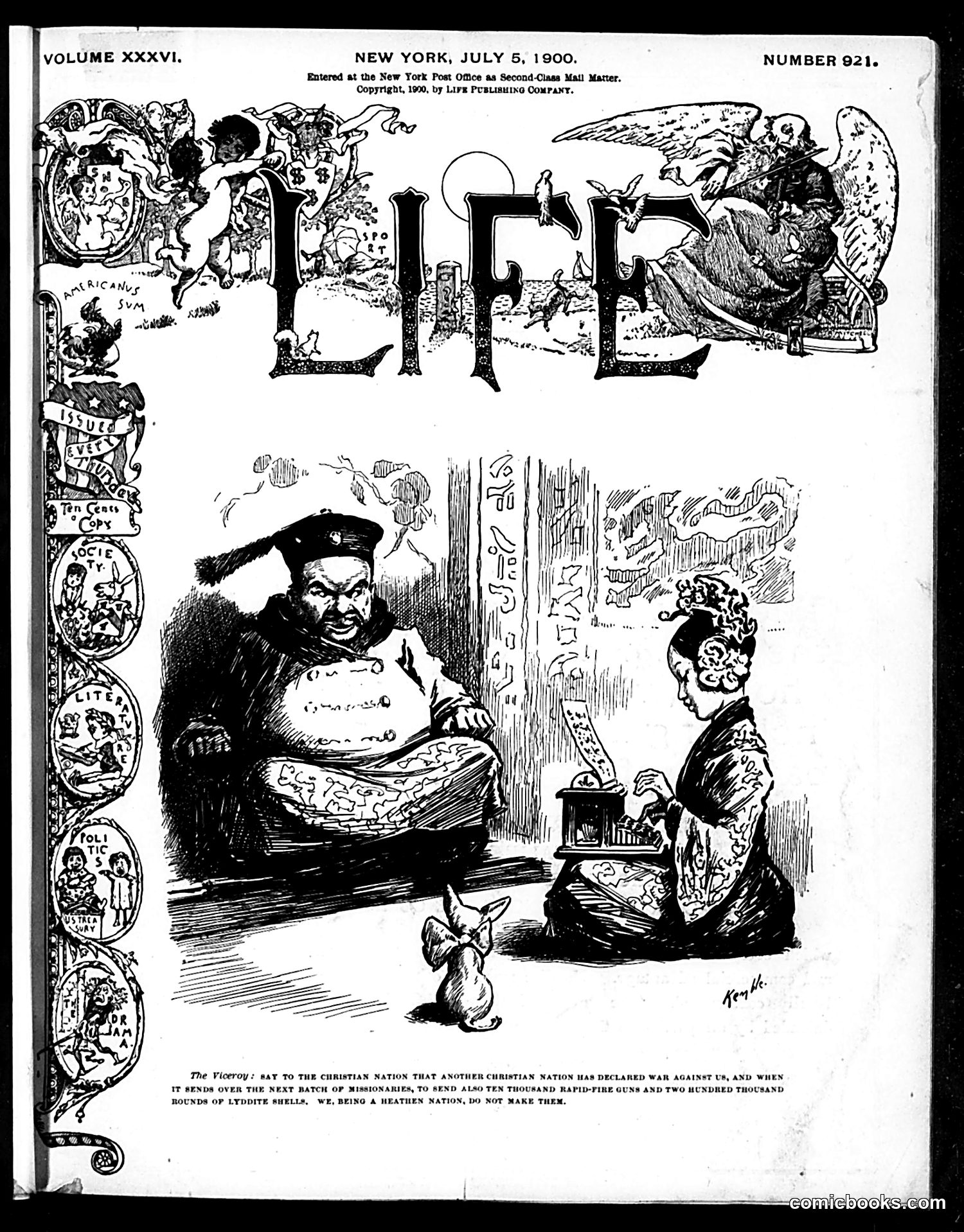
This cartoon satirizes Christian hypocrisy during wartime, specifically addressing the Boxer Rebellion in China (1900). The caption reads: "Say to the Christian nation that another Christian nation has declared war against us, and when it sends over the next batch of missionaries, we send also ten thousand rapid-fire guns and two hundred rounds of lyddite shells, we being a heathen nation, do not make them." The image shows an Asian figure (representing China/a "heathen nation") speaking mockingly to a Western woman (representing Christian nations). The satire exposes the contradiction between Christian missionary work and Western military intervention in China. While Christian nations preach morality, they simultaneously wage wars and profit from weapons sales—making them hypocritical by their own religious standards.

This is **not a cartoon or satire** — it's a straightforward advertisement for the "Zon-O-Phone," a disc-based phonograph player. The ad announces a new product combining features from the abandoned "Gram-o-phone" technology with patents from four competing companies: National Gram-O-Phone Corporation, Universal Talking Machine Co., American Graphophone Company, and Columbia Phonograph Company. The key selling point is legal exclusivity: only the Zon-O-Phone can be "legally constructed" under their joint patent agreement, giving the manufacturers competitive protection. The page demonstrates early 20th-century phonograph industry consolidation, where competing manufacturers pooled patents to create a monopoly product rather than continue competing separately.
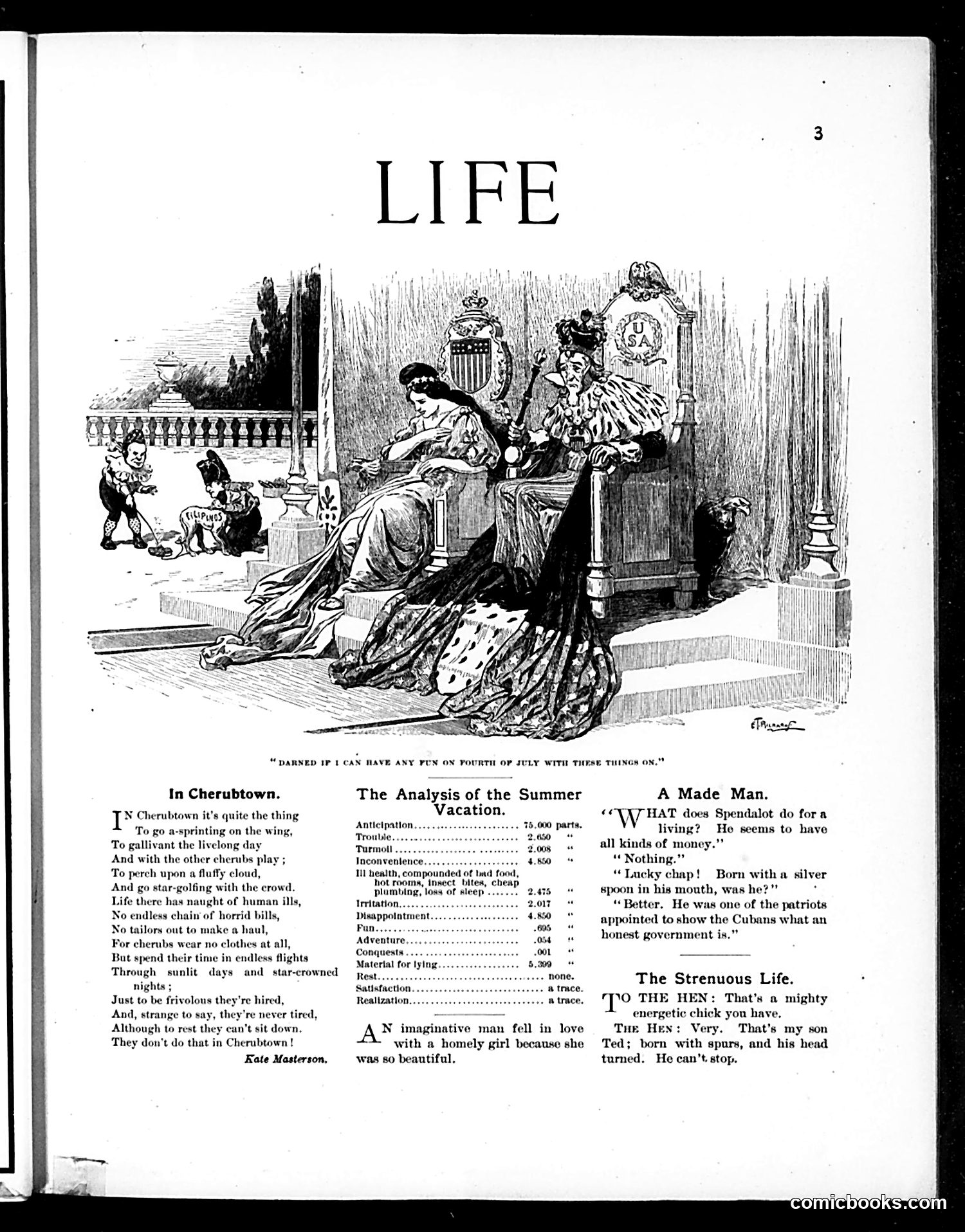
The main cartoon depicts fashionable women lounging on a porch, with one reclining dramatically. The caption reads: "DARSED IF I CAN HAVE ANY FUN ON FOURTH OF JULY WITH THESE THINGS ON." **The satire:** This mocks women's restrictive Victorian/Edwardian fashion—elaborate corsets, long skirts, and layered garments—that made outdoor summer activities uncomfortable and impractical. The joke is that women are so constrained by fashion conventions they cannot enjoy Independence Day festivities. The page also includes three brief humorous pieces about summer life: "In Cherubtown" (about lazy summer days), "The Analysis of the Summer Vacation" (a mathematical breakdown of vacation components), and "A Made Man" (wordplay about social status and patriotism). This reflects early-1900s Life magazine's typical blend of social commentary and light humor.
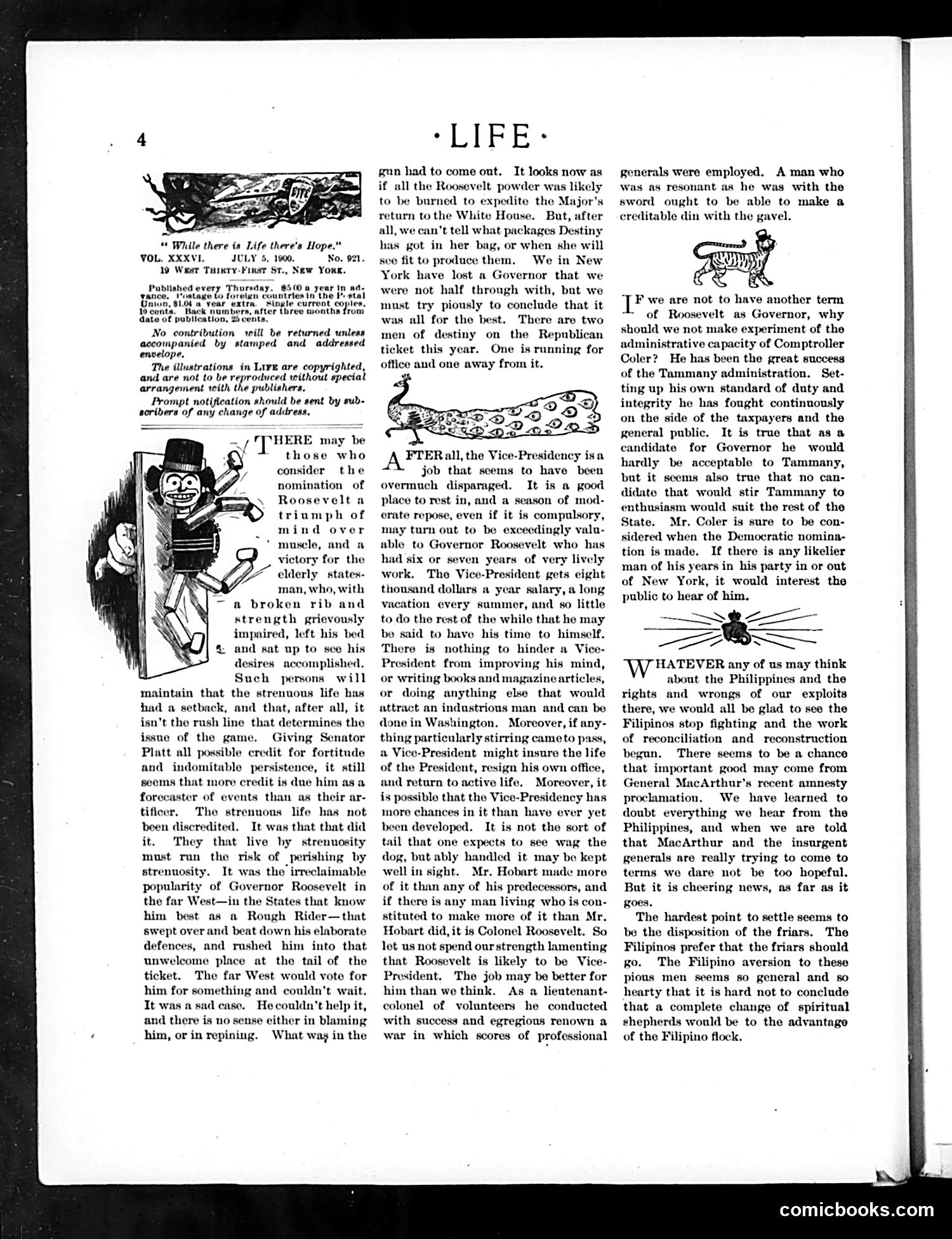
The page contains editorial commentary on Roosevelt's Vice-Presidential nomination. The left cartoon depicts a caricatured figure (likely representing political opposition or "destiny") as a menacing skeleton or death figure, reflecting anxieties about Roosevelt's nomination. The text discusses whether Roosevelt should accept the Vice-Presidency, which the author views as potentially diminishing for a dynamic leader. The piece acknowledges Roosevelt's "strenuous life" and accomplishments, but questions whether the ceremonial Vice-Presidency suits him. The second section addresses the Philippines conflict, expressing hope for reconciliation and General MacArthur's recent amnesty proclamation, while advocating for spiritual change among the Filipino population—reflecting contemporary American imperialist rhetoric and attitudes toward colonial administration.
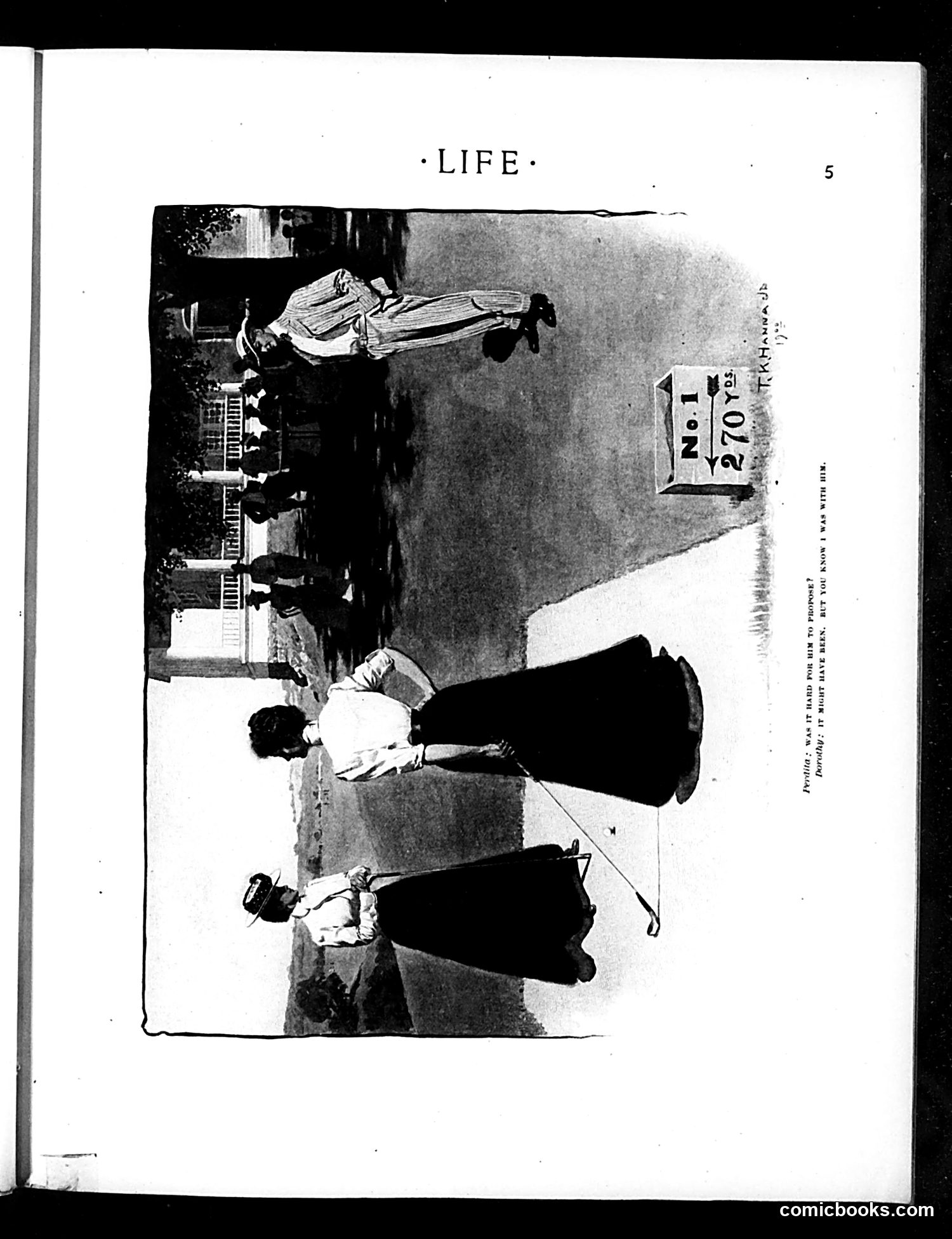
This LIFE magazine page depicts a street scene rotated 90 degrees. The image shows three figures on an urban street with period architecture visible in the background. There's a large billboard or sign reading "NO. 1 270" prominently displayed. The page header identifies this as coming from LIFE's satirical section. However, without clearer text identification or visible caricature elements typical of political cartoons, I cannot definitively identify the specific figures or the satirical point being made. The composition suggests social commentary on urban life or possibly commercial advertising culture, but the exact satirical target remains unclear from the image alone. The OCR text provided does not include identifying captions that would clarify the cartoon's meaning.
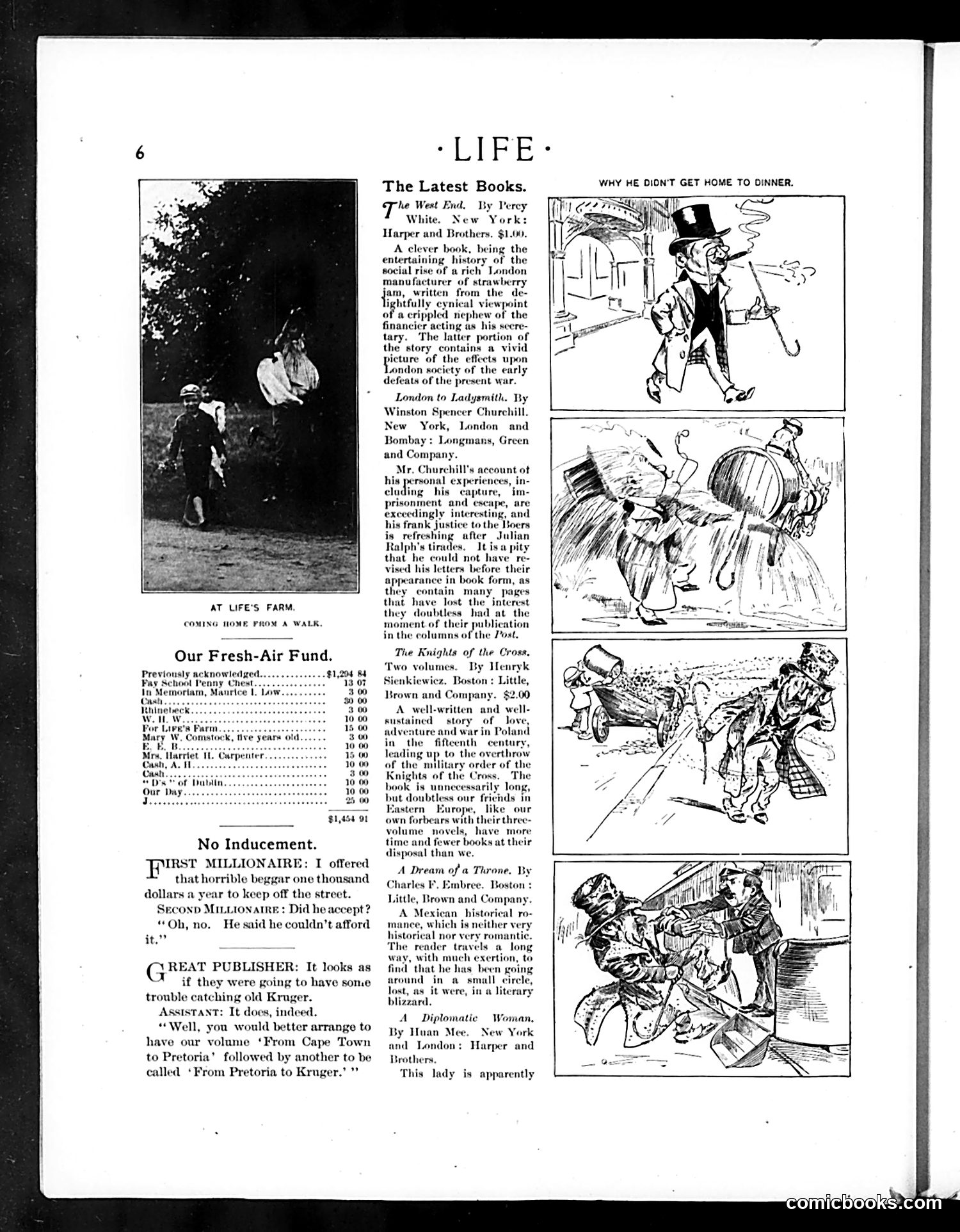
This four-panel comic depicts a man's comedic misadventures preventing him from reaching home for dinner. The sequence shows: a well-dressed gentleman encountering various obstacles—apparently getting caught in rain, struggling with an umbrella, being knocked down or tangled up, and ultimately colliding with other pedestrians or objects on a city street. The humor relies on slapstick physical comedy typical of early-20th-century Life magazine humor—the contrast between the man's formal attire and dignified bearing versus his increasingly disheveled state. The title suggests domestic comedy about a husband's excuses for tardiness, a common theme in period humor about urban middle-class life and marital expectations.
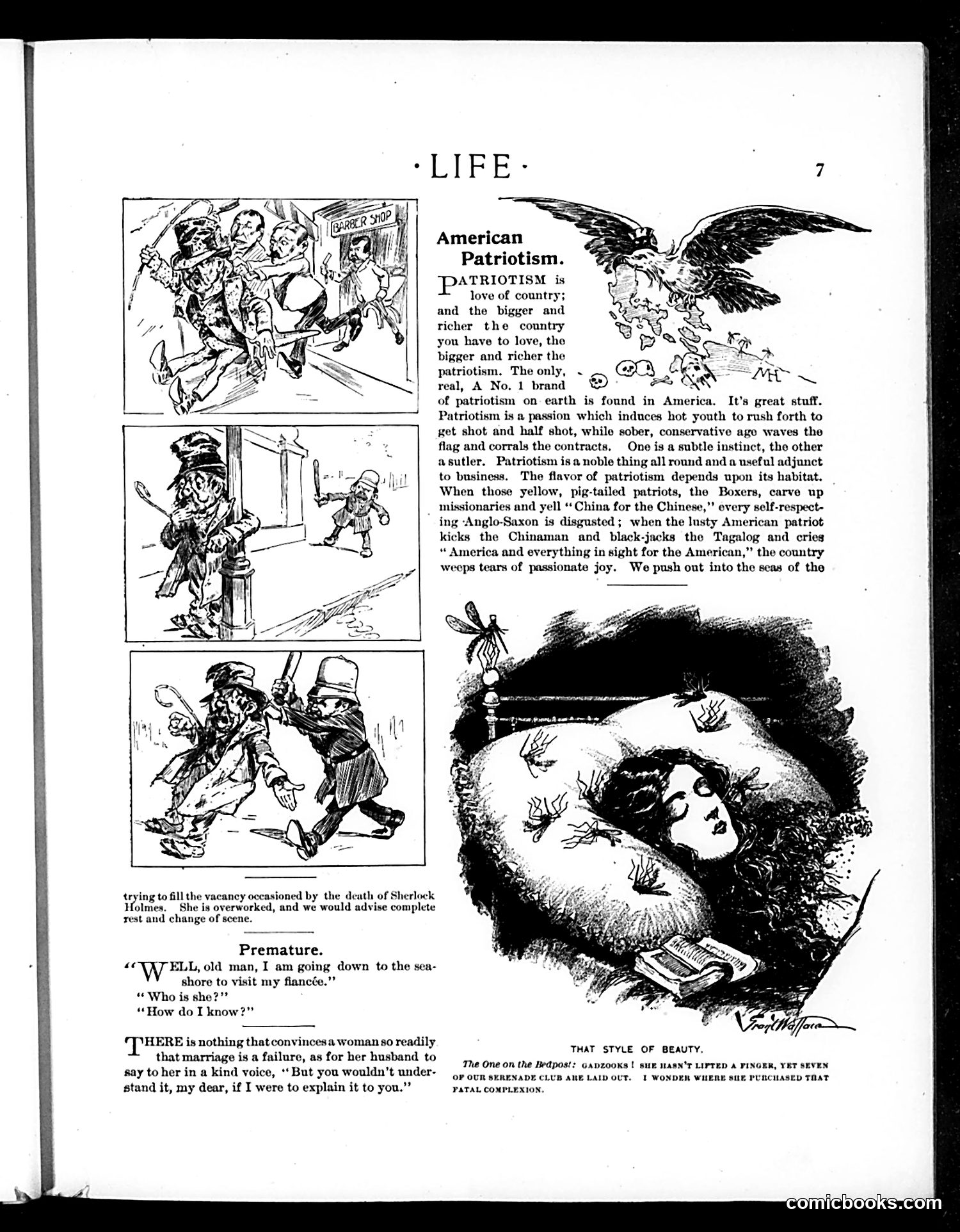
This page contains two distinct pieces: **"American Patriotism"** (top): A satirical essay with accompanying cartoons mocking jingoistic patriotism. The text contrasts "hot-blooded" patriots who rashly support military action with "sober, conservative" patriots who wave flags while opposing contracts. It criticizes extremist patriotic fervor—specifically referencing the Boxer Rebellion ("China for the Chinese") and violence against Chinese and Filipino people ("black-jacks"). The eagle illustration suggests American imperialism. The piece argues passionate patriotism can lead to excess while conservative patriotism enables it. **"Premature"** (bottom): A domestic humor piece showing a husband departing for the seaside, with his wife's skeptical response implying marital discord. The accompanying illustration titled "That Style of Beauty" depicts a reclining woman, captioned with gossip-column innuendo about lifted fingers and serenades, suggesting infidelity or scandal. Both pieces reflect early 1900s American social anxieties about imperialism, gender relations, and propriety.
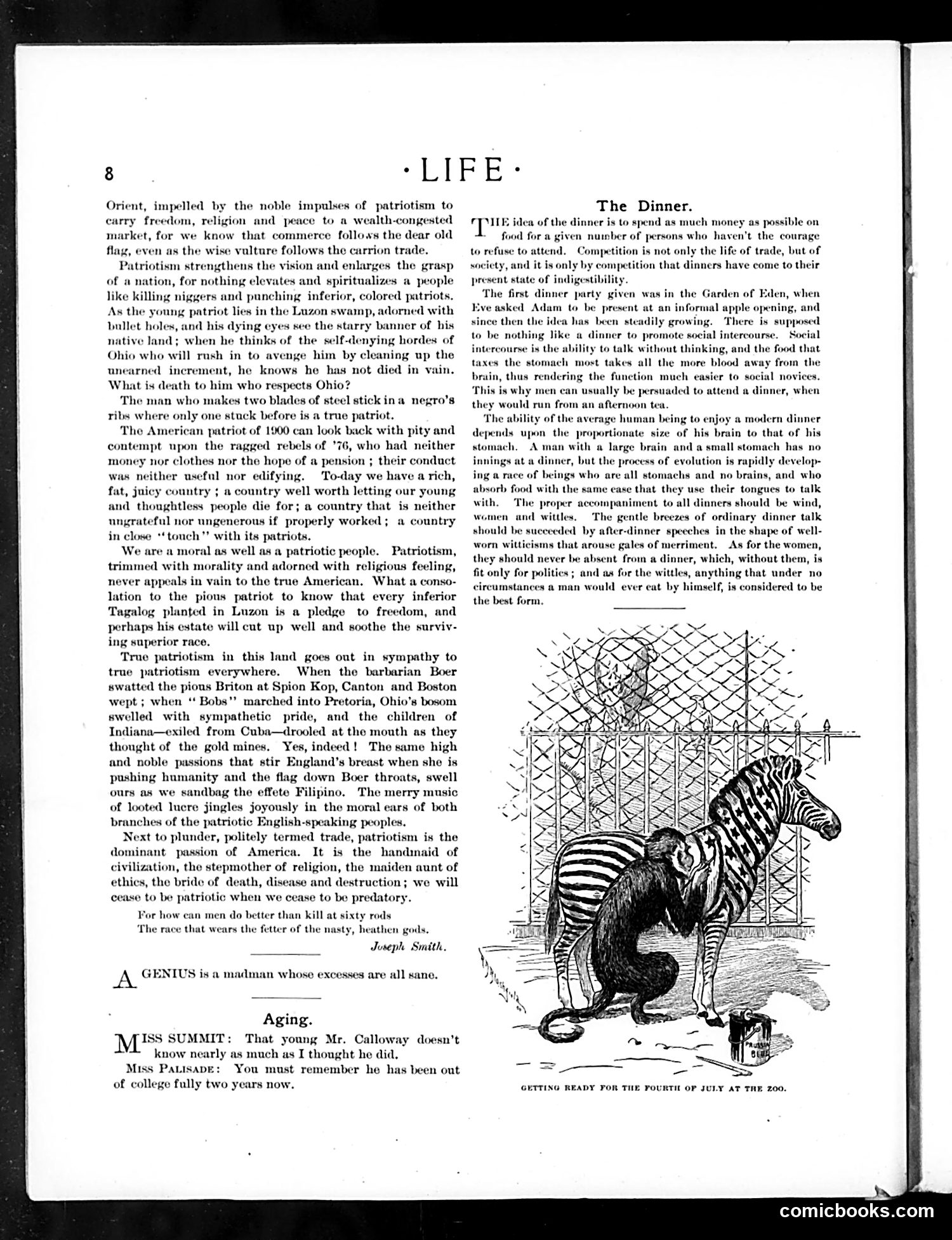
This page contains three distinct pieces: 1. **"Patriotism" essay** (left column): A lengthy commentary on American patriotism, criticizing superficial nationalism and celebrating genuine civic virtue. It references the Boer War and various patriotic moments. 2. **"The Dinner" article** (right column): A satirical piece about dinner etiquette, discussing how the wealthy display status through elaborate meals and how average people struggle with proper dining conduct. 3. **Main illustration** (bottom right): A zebra in formal dress (top hat, coat) being readied at the zoo for "Fourth of July" celebration. This cartoon satirizes the absurdity of dressing up animals for patriotic display—likely mocking superficial, performative patriotism rather than genuine civic commitment, connecting thematically to the patriotism essay above.
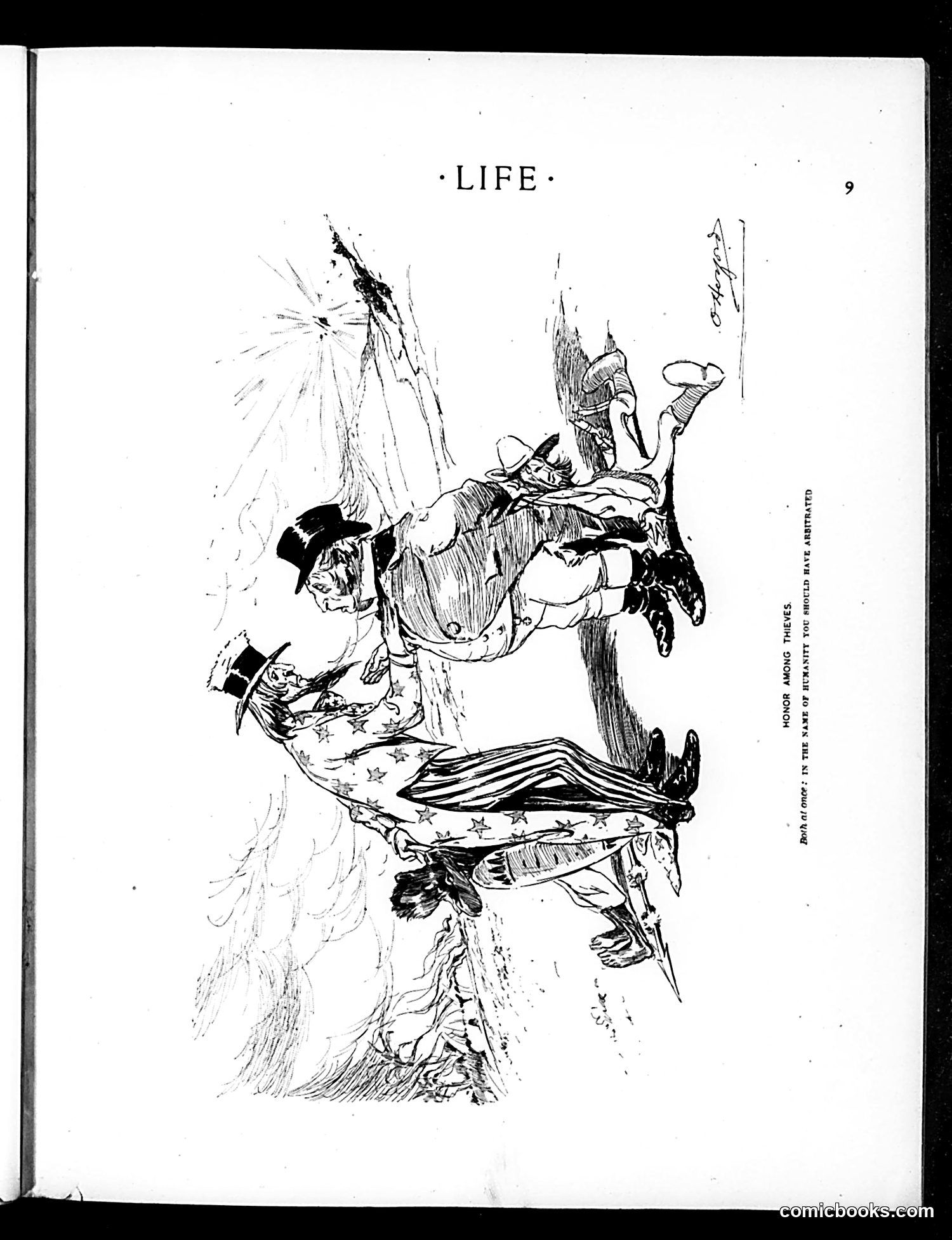
This page from *Life* magazine (page 9) features a political cartoon titled "EDISON AMONG OTHERS," though the OCR text is incomplete. The illustration shows a figure in the center wearing a top hat and formal attire, appearing to be lifted or propelled upward by explosive force or fireworks. Smaller figures around him—some wearing hats and appearing to be pursuing or reacting to the central figure—suggest chaos or competition. The cartoon likely satirizes Thomas Edison or another prominent industrialist/inventor amid competitive business or scientific rivalries of the era. The explosive energy and chaotic composition suggest mockery of ambition, conflict, or the tumultuous nature of industrial competition. Without the complete caption text, the specific satirical point remains unclear, though the central figure's dramatic elevation suggests both success and precarious instability.
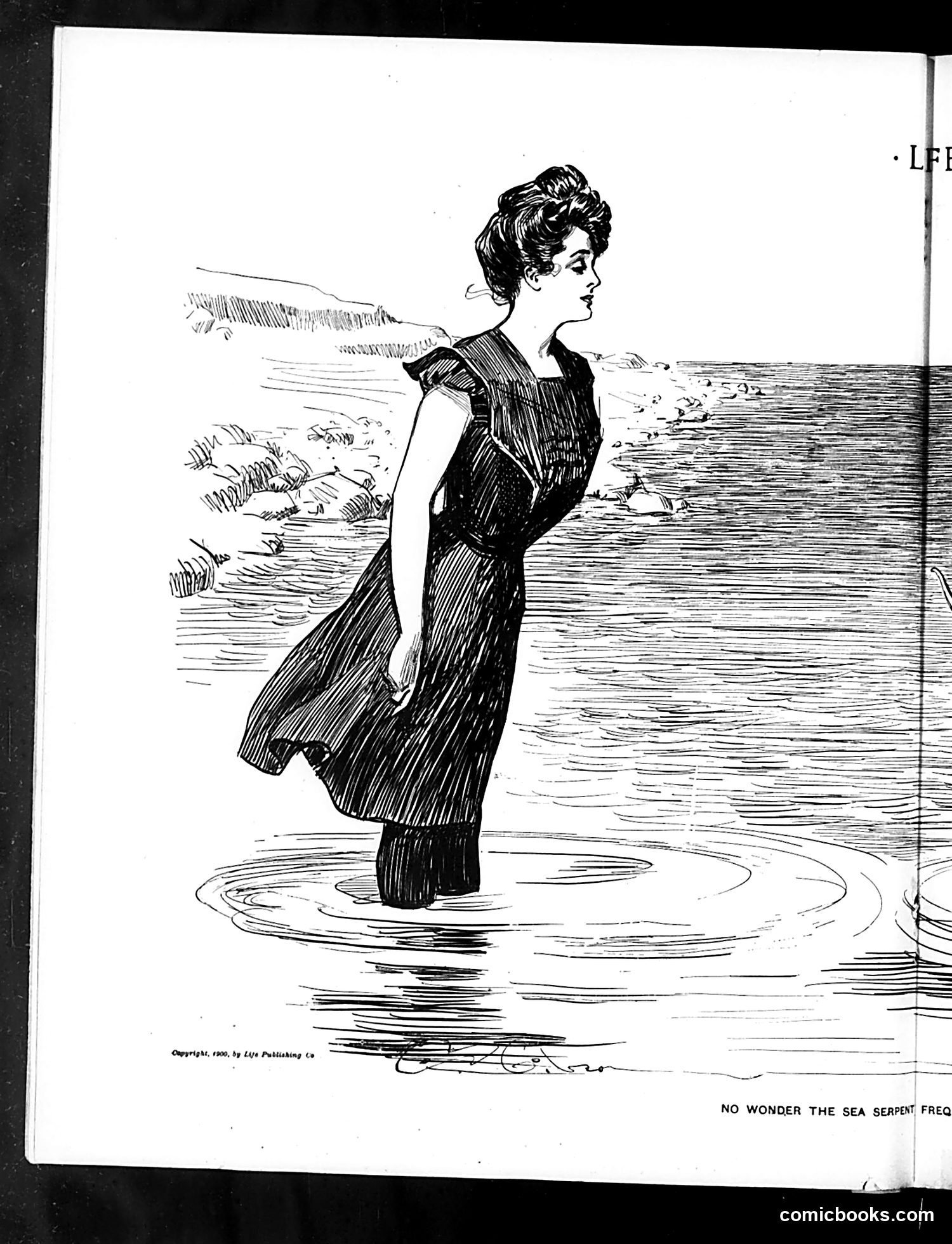
This is a pen-and-ink illustration from Life magazine (copyright 1900, by Life Publishing Co., as shown). It depicts a fashionably dressed woman wading in shallow ocean water, wearing what appears to be a swimming costume of the era—a dark, modest one-piece dress with puffed sleeves. The caption reads "NO WONDER THE SEA SERPENT FREQ[UENTLY]..." (text cut off), suggesting a joke about sea serpent sightings. The satire likely mocks either: 1. The woman's appearance in swimming attire attracting mythical creatures, or 2. The notion that sea serpent "sightings" might actually be women in period swimwear, explaining supposedly mysterious ocean phenomena This reflects turn-of-the-century humor about women's bathing fashions and the era's fascination with cryptozoological "discoveries."
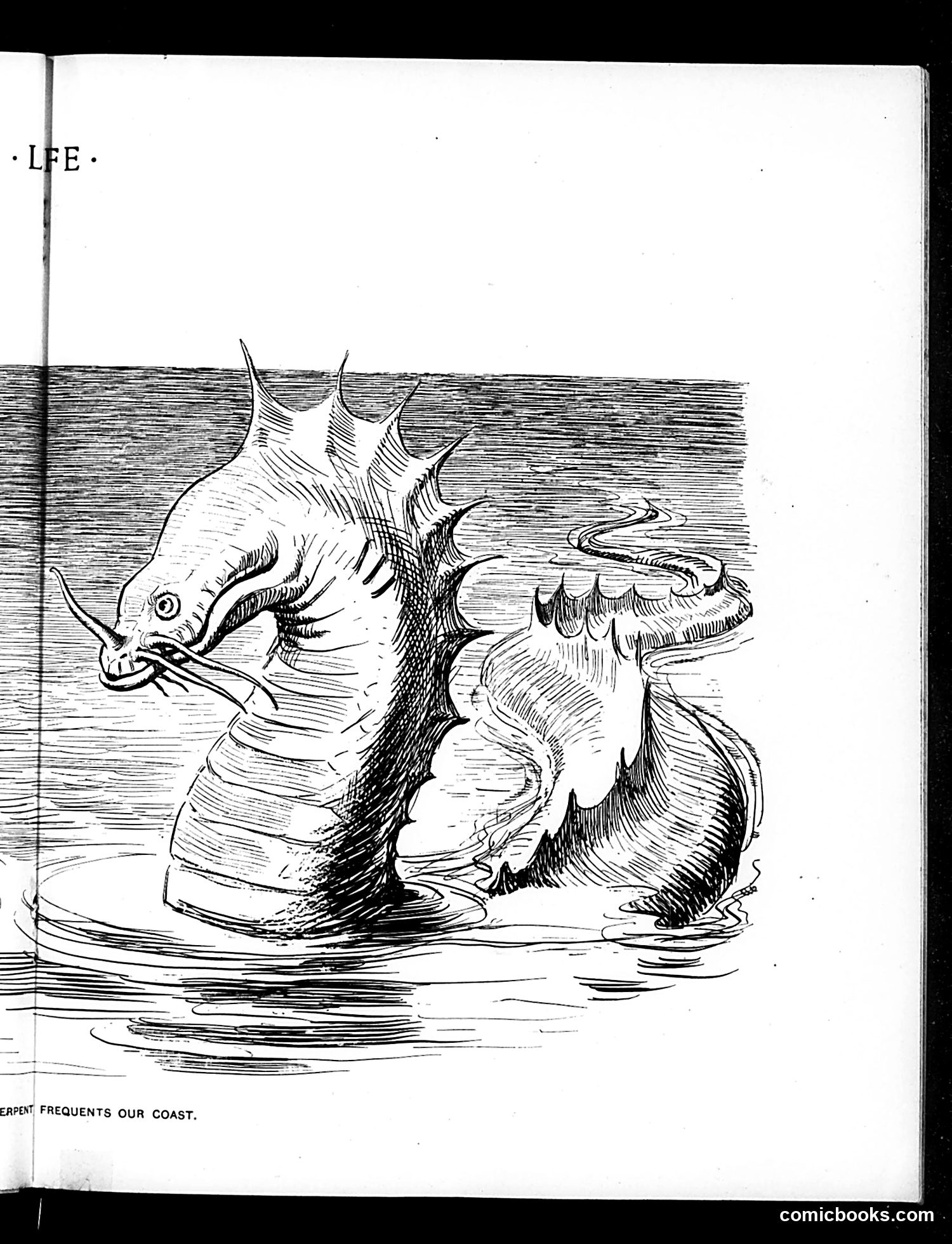
This ink drawing depicts a fantastical sea serpent with a crowned, dragon-like head emerging from water. The caption reads "SERPENT FREQUENTS OUR COAST," suggesting this is political satire about a threatening presence. Without the full magazine context or date, the specific target is unclear. However, this likely references a contemporary political threat or foreign power portrayed as a dangerous sea monster—a common satirical device in early American periodicals. The creature's elaborate spines and menacing appearance emphasize the perceived danger. The page header "LIFE" confirms this is from Life magazine's satirical tradition. The artistic style suggests late 19th or early 20th century. The exact political reference—whether military, economic, or diplomatic—requires additional historical context to definitively identify.
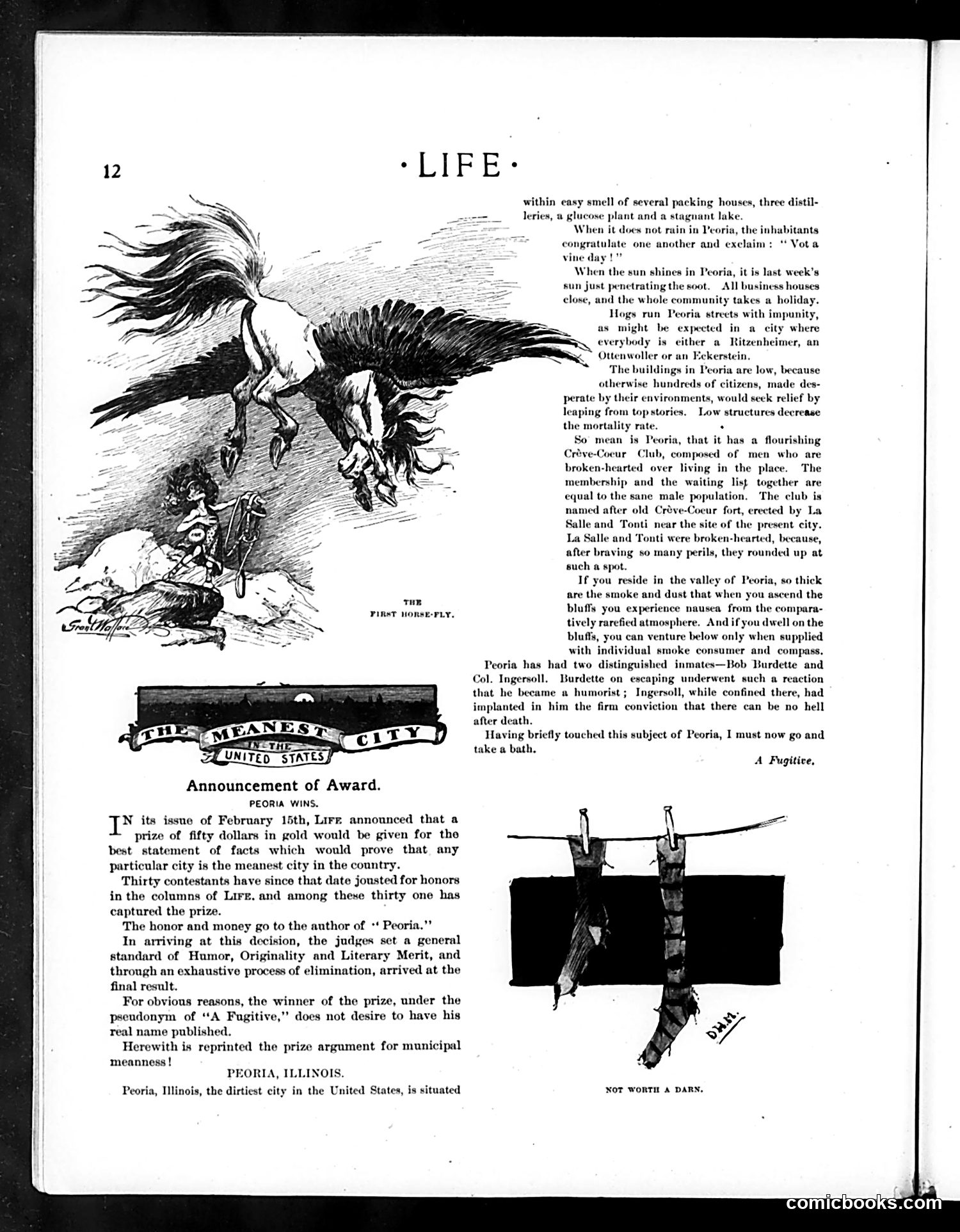
This page satirizes **Peoria, Illinois** as "the meanest city in the United States." The top illustration shows a **horse-fly** (labeled "THE FIRST HORSE-FLY"), a visual pun on the city's meanness—a grotesque, aggressive insect. The text describes Peoria's unpleasant conditions: foul air from packing houses, a custom of celebrating rainy days, low buildings (supposedly built low because residents want to jump off roofs), and a melancholic social club for broken-hearted men. Below, an "Announcement of Award" reveals that Life magazine held a contest for the "meanest city" essay. The anonymous winner ("A Fugitive") earned fifty dollars by satirizing Peoria's industrial pollution, grim atmosphere, and apparent despair—ultimately mocking the city's reputation through humorous exaggeration. The bottom cartoon ("NOT WORTH A DARN") shows ragged clothing on a clothesline, reinforcing themes of poverty and decay.
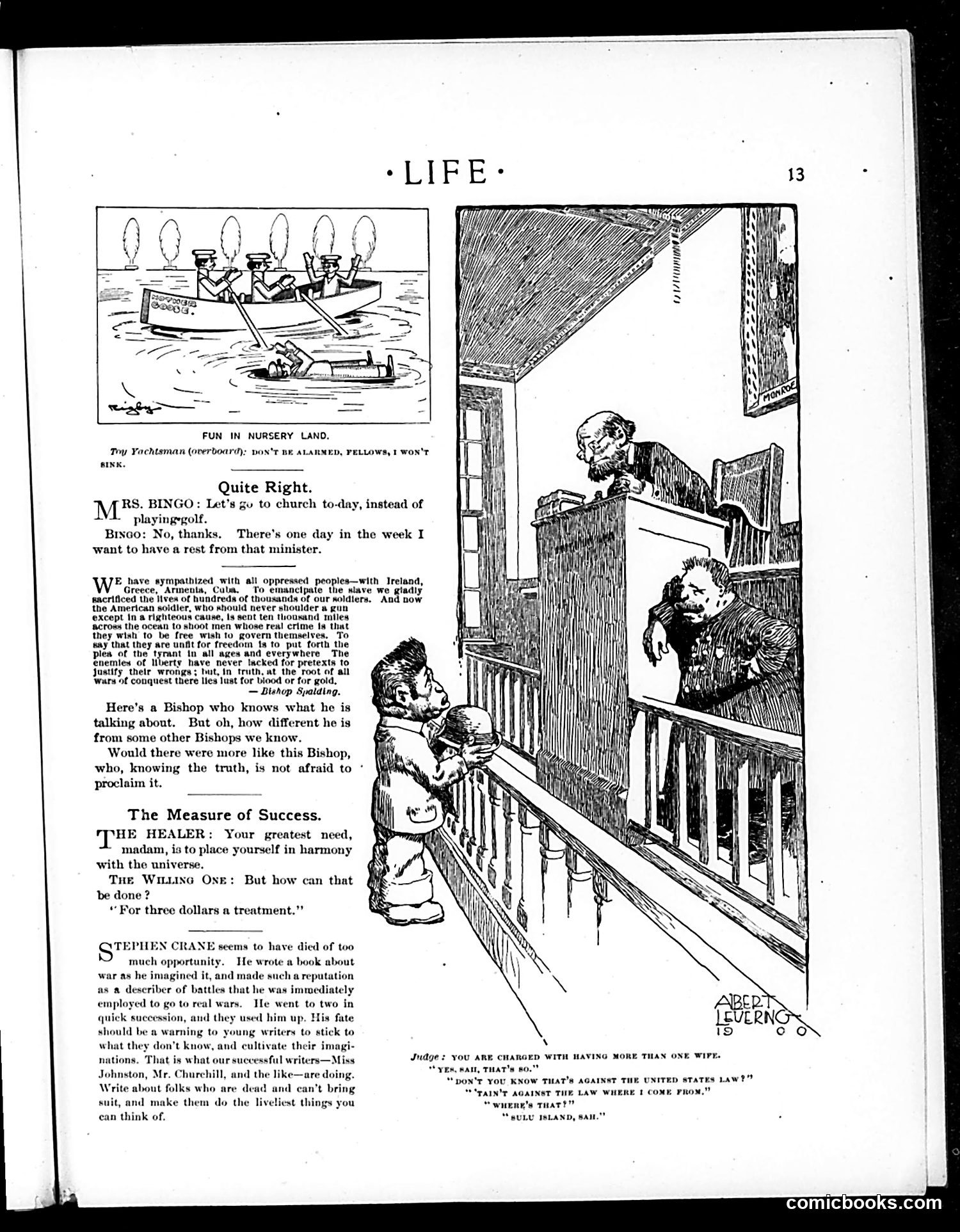
This page contains several satirical pieces: **Top cartoon ("Fun in Nursery Land"):** A toy yachtsman falls overboard but reassures companions he won't sink—likely mocking overconfidence or false bravado in trivial matters. **"Quite Right" dialogue:** Mrs. Bingo wants to attend church instead of golf; Bingo refuses because he needs a break from the minister—a joke about tedious sermons. **Bishop Spalding quote:** A lengthy passage criticizing American imperialism in the Philippines (the "real war" reference), arguing that the U.S. fights for conquest and gold under false pretenses of civilizing "unfit" peoples. This reflects anti-imperialist sentiment common in early 1900s progressive circles. **"The Measure of Success":** A charlatan "healer" charges three dollars to align patients with "the universe"—satire on quack spiritualism and wellness frauds. **Bottom cartoon:** A defendant from "Bulu Island, Hawaii" is charged with polygamy, claiming it's legal where he's from—humor based on racial stereotyping and perceived "primitive" customs. The page reflects early 20th-century American debates over imperialism, religious hypocrisy, and fraud.
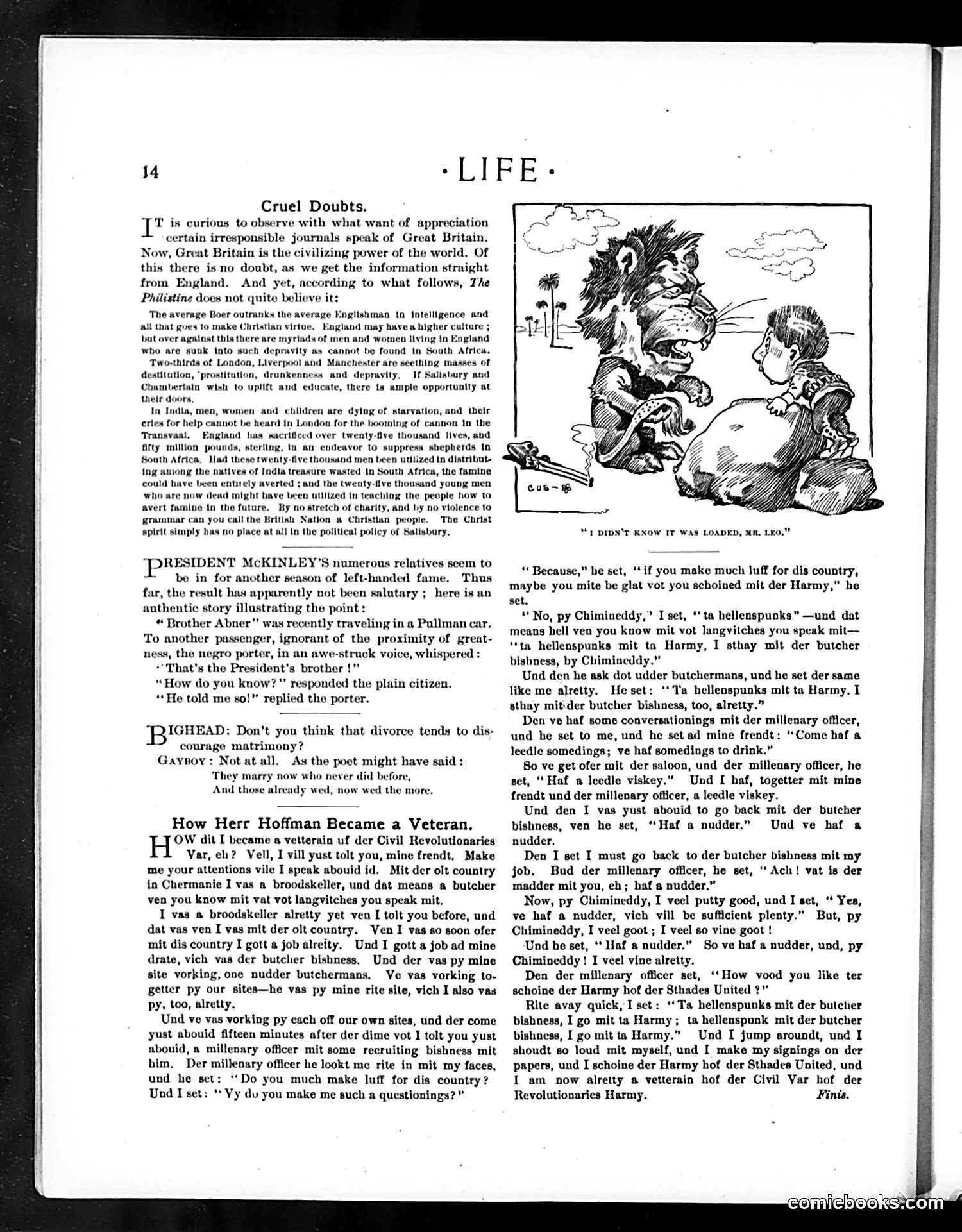
This page contains three satirical pieces critiquing British imperialism and American politics: **"Cruel Doubts"** attacks Britain's colonial hypocrisy, particularly regarding the Boer War in South Africa. The text argues Britain claims to be a "civilizing power" yet ignores massive poverty in London, Liverpool, and Manchester while spending resources and lives conquering South Africa. It also criticizes neglect of famine victims in India. The satire undercuts Britain's moral authority to "civilize" others. **The cartoon** (upper right) appears to depict colonial or imperial figures in a humorous, mocking scenario, though the specific identities are unclear from the image alone. **"How Herr Hoffman Became a Veteran"** mocks both German-American immigrants and American military recruitment through a thick German accent narrative. An unnamed military recruiter pressures a German butcher to enlist, using manipulative flattery about patriotism. The broader message critiques American and British imperial ambitions while satirizing recruitment tactics that exploited immigrant communities.
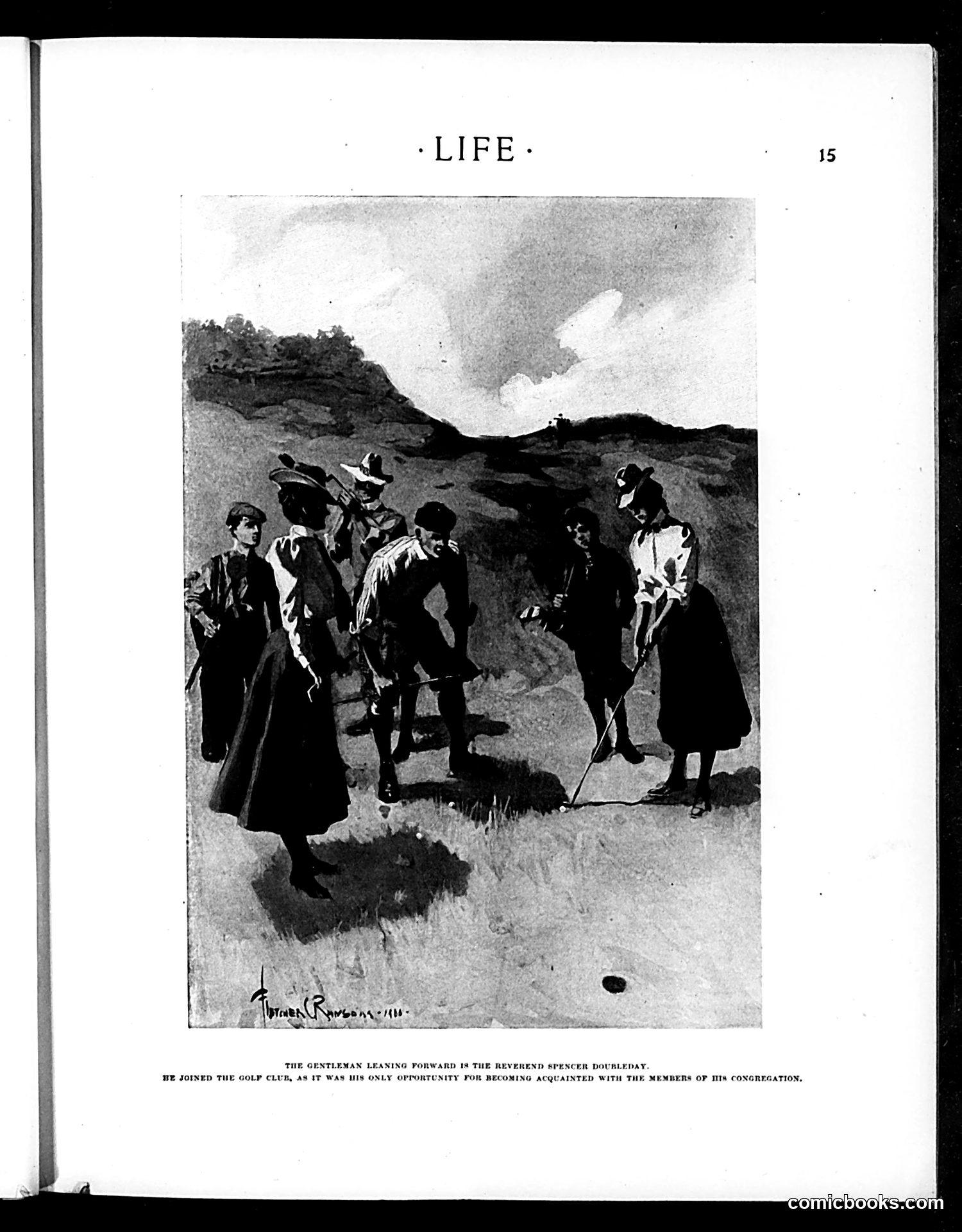
This is a satirical illustration about Reverend Spencer Doubleday, a clergyman who joined a golf club specifically to socialize with his congregation members. The caption's dry humor lies in the irony: rather than meeting his parishioners at church for spiritual purposes, he needed to join an exclusive leisure club to actually get to know them. The cartoon satirizes the class divisions of the era—suggesting that wealthy congregation members were more accessible on the golf course than at religious services. It also mocks the priorities of both the reverend (forced to pursue secular activities to do his job) and his affluent parishioners (who apparently preferred golf to attending church). The scene shows the clergyman awkwardly attempting to integrate with club members in a natural outdoor setting.
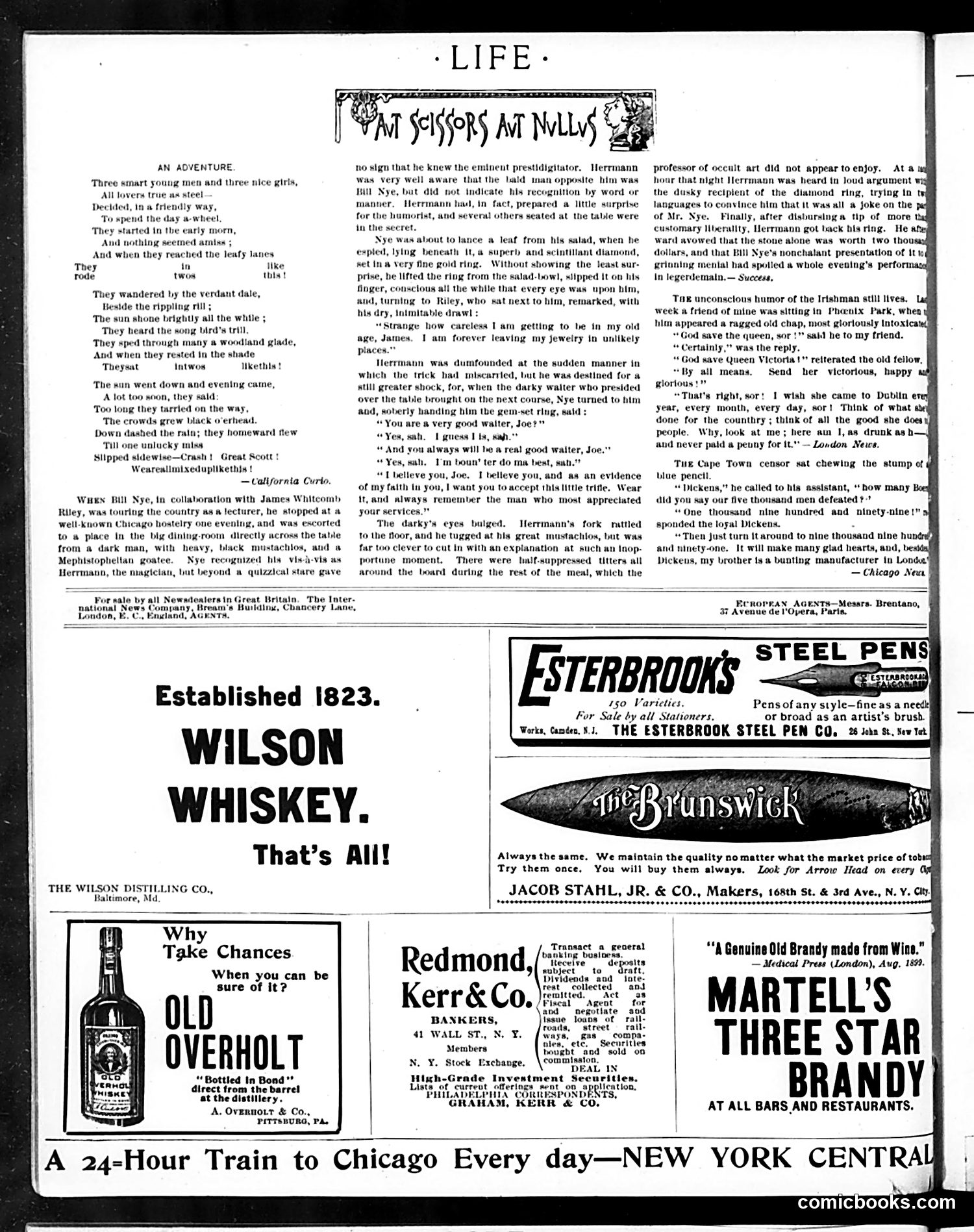
This page contains primarily **advertising and a humorous anecdote**—not political satire. The main story recounts a practical joke played on **Herrmann the Magician** by humorist **Bill Nye**. While dining together in Chicago, Herrmann attempts to amaze Nye by secretly placing a diamond ring in Nye's salad. Nye, recognizing the trick but feigning ignorance, casually thanks the Black waiter and gives him the ring as a tip, crediting him with excellent service. Herrmann is mortified—the story notes he spent the evening trying to convince the waiter it was a joke and eventually had to pay to recover his valuable diamond. The humor relies on Nye's deadpan delivery and social cleverness: he turns Herrmann's own magic trick against him by refusing to acknowledge it happened, making the magician appear foolish while rewarding the waiter. The page also features period advertisements for whiskey, brandy, steel pens, and rail service—typical of early 1900s Life magazine.
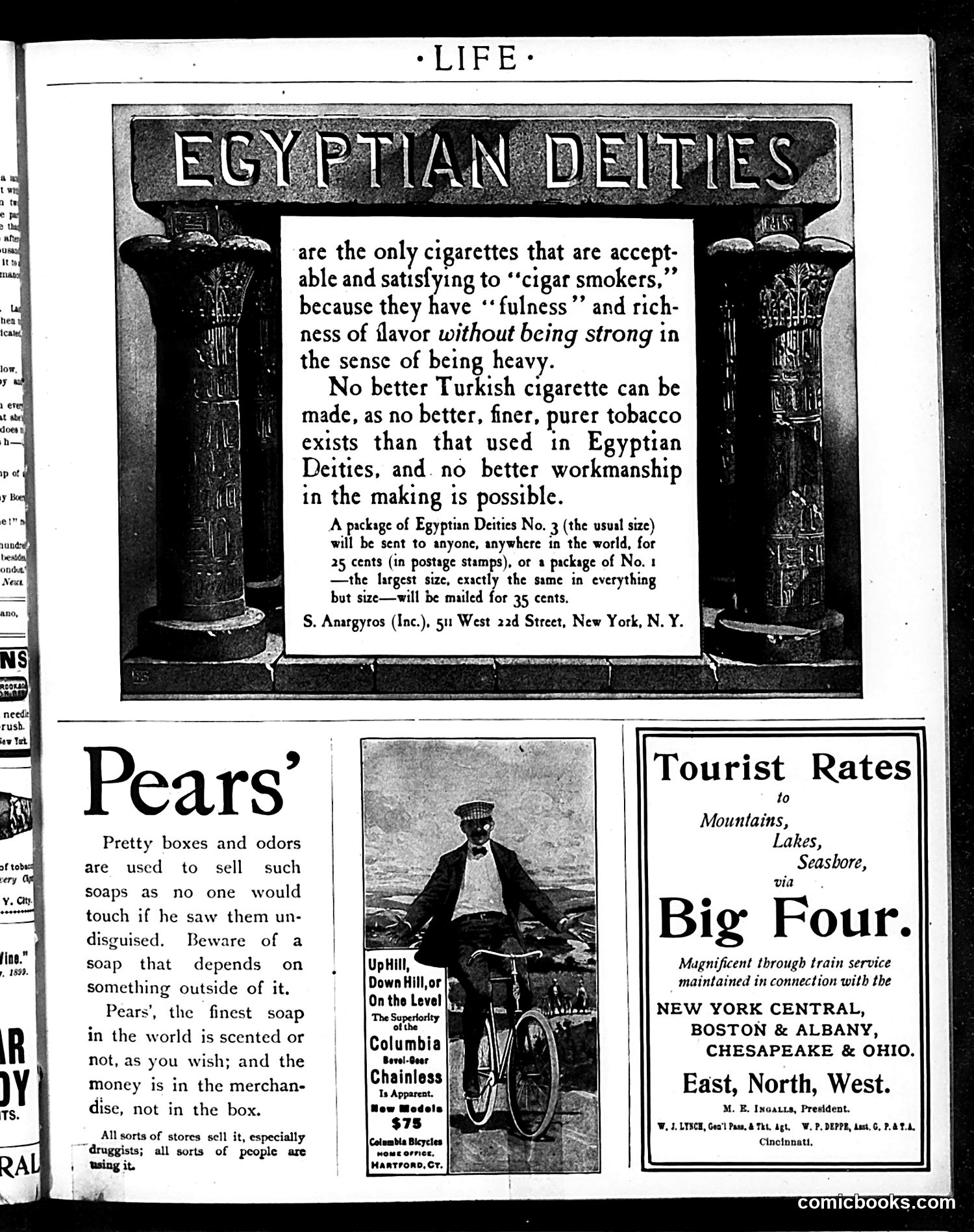
This page contains three advertisements with no political satire. **Egyptian Deities Cigarettes** (top): A straightforward ad claiming these Turkish cigarettes offer rich flavor without heaviness, appealing to "cigar smokers." The product name references Egyptian imagery to suggest exoticism and quality. **Pears' Soap** (bottom left): A pitch emphasizing that quality soap's value lies in the product itself, not packaging or fragrance—a implicit criticism of competitors who rely on "pretty boxes and odors" as marketing disguise. **Big Four Railroad** (bottom right): A tourist advertisement promoting train service to mountains, lakes, and seashores via New York Central, Boston & Albany, and Chesapeake & Ohio railroads. All three are period advertisements typical of early 20th-century Life magazine. There is no cartoon commentary or satire present on this page.
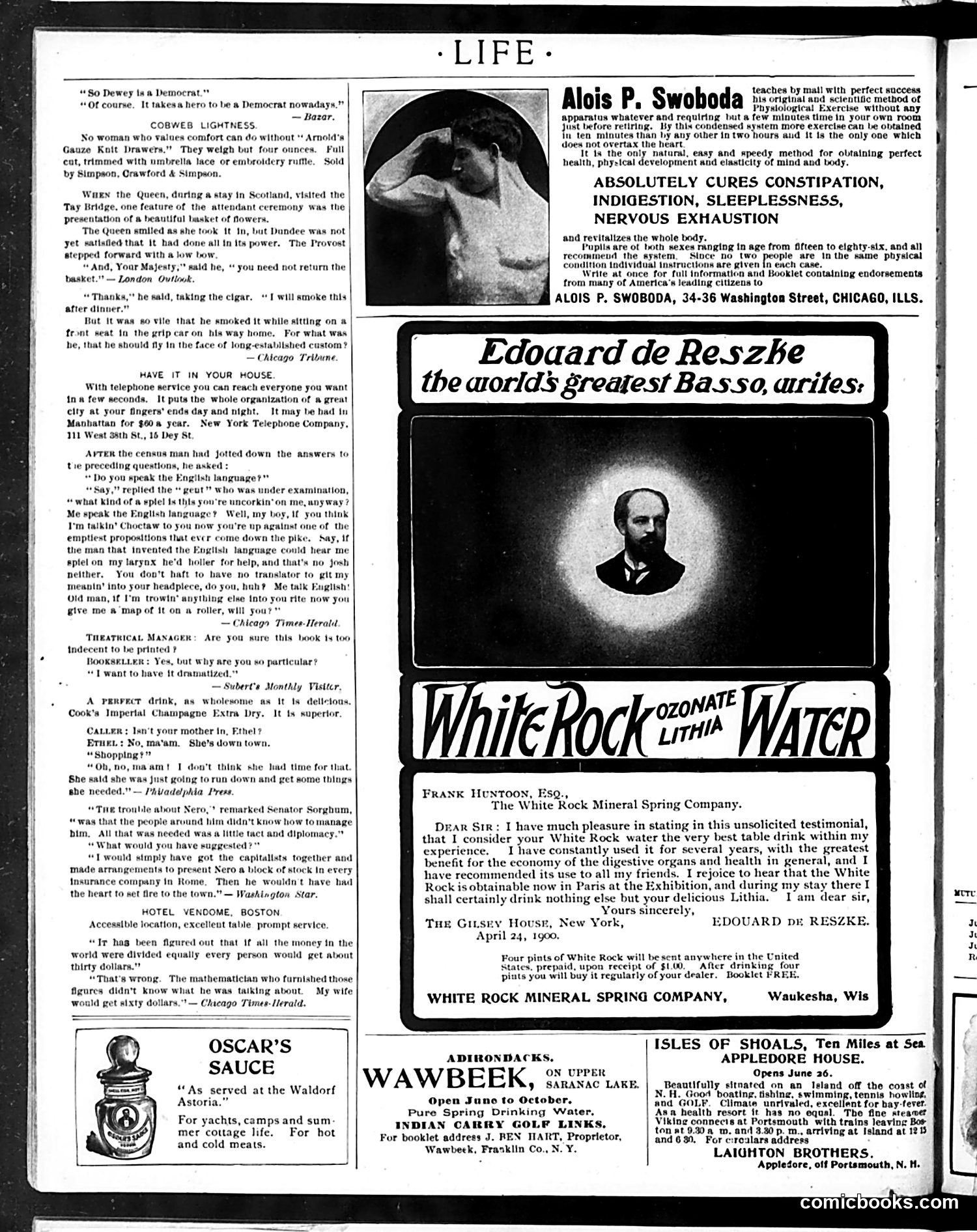
This page is primarily **advertisements and humorous anecdotes** rather than political cartoons. The opening exchange mocks the political realignment of the era: the quip "So Dewey is a Democrat/Of course, it takes a hero to be a Democrat nowadays" likely references **Admiral George Dewey** (Spanish-American War hero), suggesting that supporting the Democratic Party required unusual courage or that the party's reputation had declined. The remaining content consists of short comic vignettes about everyday life—a Scottish queen rejecting a basket, a census taker struggling to communicate with a working-class immigrant, a wife's shopping excuse. These satirize social pretension, linguistic confusion, and marital dynamics typical of *Life* magazine's humor circa 1900. The bulk of the page features **patent medicine and luxury product advertisements** (corsets, champagne, mineral water, hotels), reflecting the magazine's commercial function alongside its satirical content. No significant political cartoon appears here.
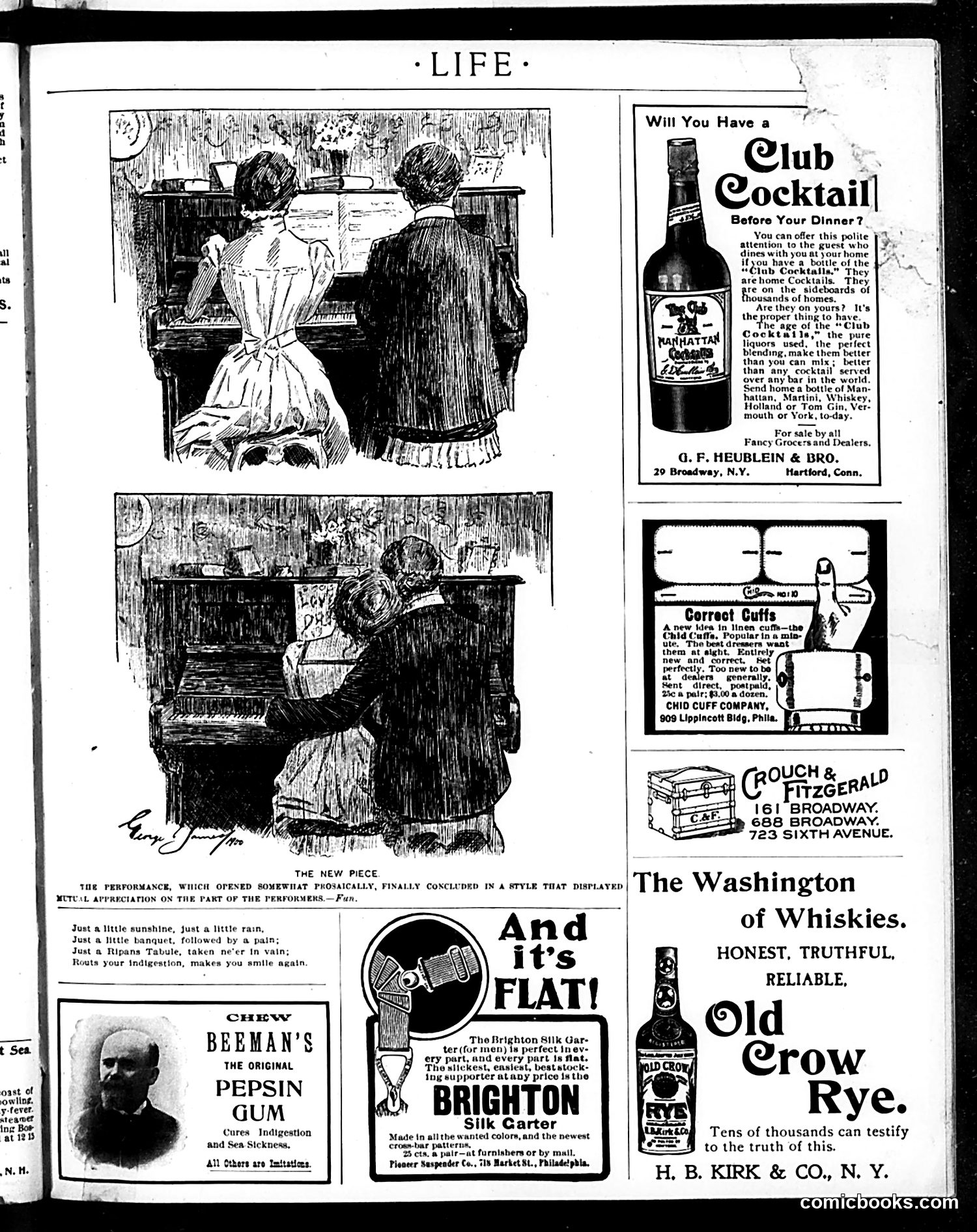
This page from *Life* magazine is primarily **advertising** with minimal editorial content. The two cartoon panels at top ("The New Piece") appear to humorously depict a musical or theatrical performance, showing audience members at a piano—likely satirizing amateur home performances or recitals that conclude with mutual relief rather than genuine appreciation. The bulk of the page consists of period product advertisements (circa early 1900s) promoting: - Beeman's Pepsin Gum (digestive aid) - Brighton Silk Garters - "Club Cocktails" spirits - Correct Cuffs (detachable collars) - Old Crow Rye whiskey The advertisements reflect Edwardian-era consumer culture and social concerns: digestive issues, proper gentleman's attire, entertaining guests at home with quality liquor, and fashionable accessories. No specific political satire is evident on this page—it's a commercial publication mixing light humor with merchandising.
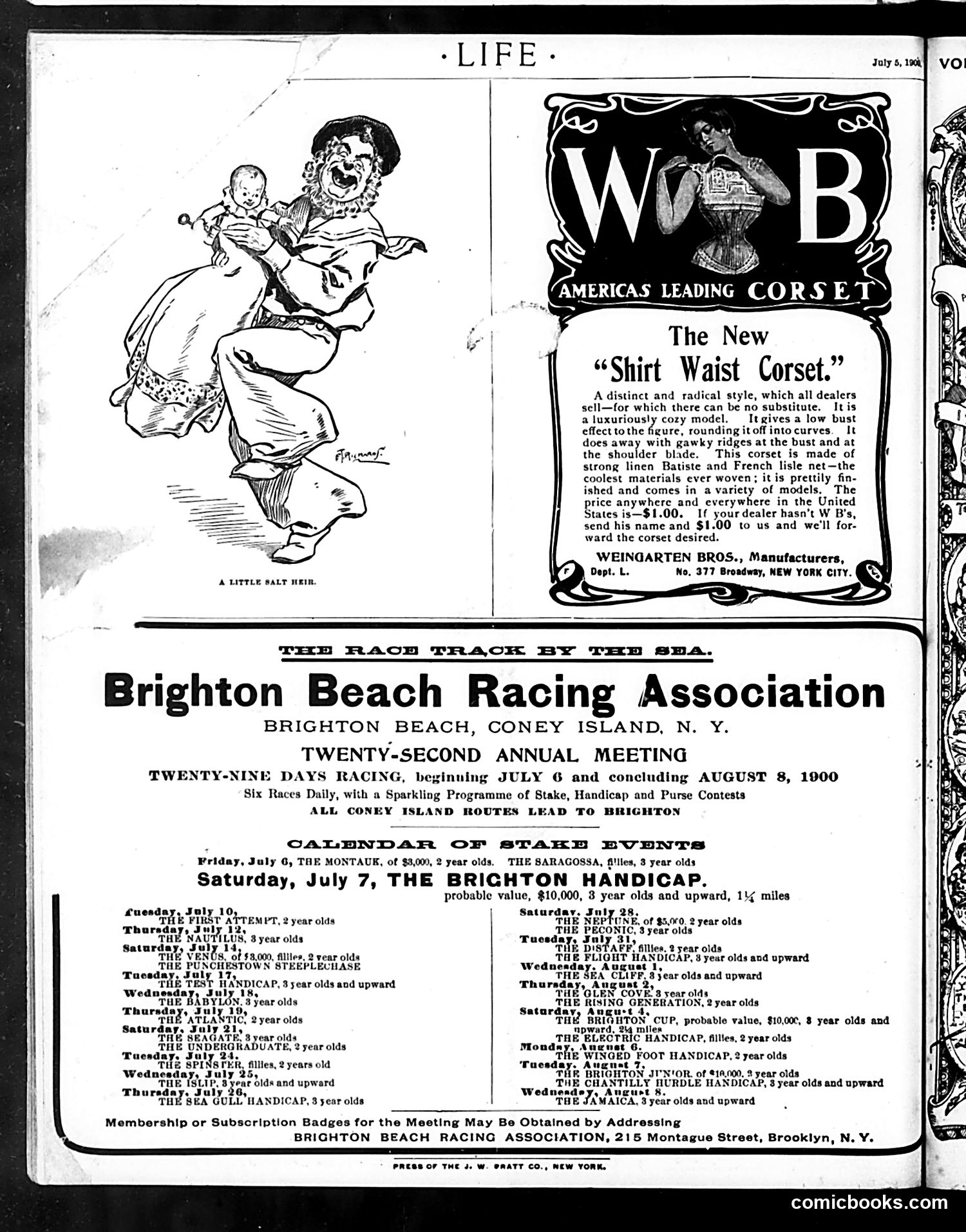
This page contains two unrelated items typical of Life's format: **The Cartoon ("A Little Salt Heir"):** A satirical drawing shows a rotund, exaggerated figure holding an infant. The caption suggests mockery of wealth and inheritance—the "salt heir" likely references a nouveau riche family (salt being a commodity associated with trade wealth). The caricature style emphasizes absurdity and social pretension, typical of Life's critique of the wealthy class. **The Advertisements:** The W.B. corset ad and Brighton Beach Racing Association announcement occupy most space. These reveal period concerns: women's fashion focused on body reshaping, and horse racing as elite entertainment. The corset's "$1.00" price point and nationwide distribution suggest mass-market luxury goods were emerging. The page reflects 1900 American society: satirical attacks on the nouveau riche, women's restrictive fashion standards, and leisure activities concentrated among the wealthy at Coney Island's Brighton Beach resort.