
A complete issue · 20 pages · 1900
Life — June 21, 1900
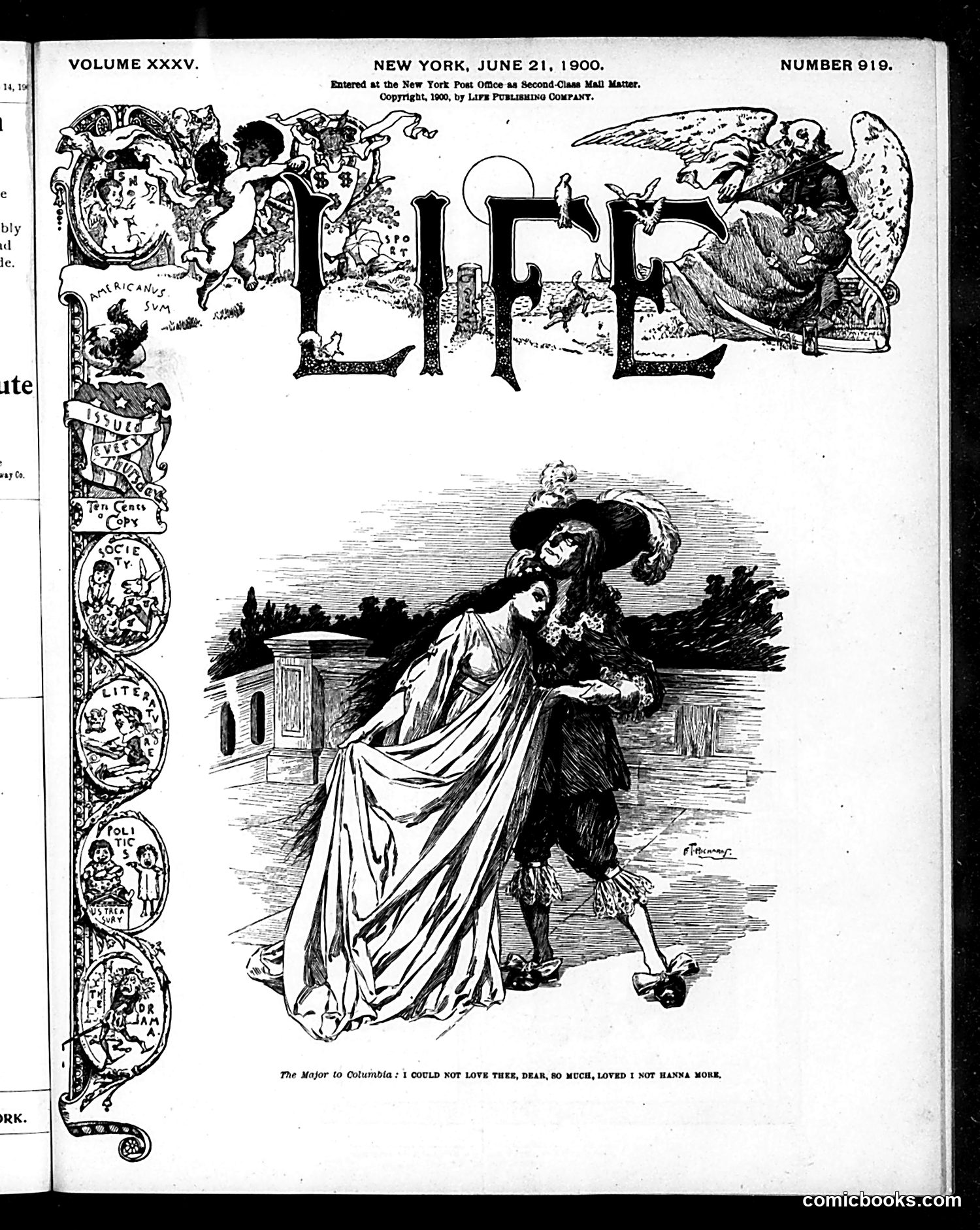
The main illustration depicts "The Mayor to Columbia," showing a rotund male figure (the Mayor) presenting himself romantically to a female figure representing Columbia (the personified United States). The caption reads: "I COULD NOT LOVE THEE, DEAR, SO MUCH, LOVED I NOT HANNA MORE." This is political satire referencing Mark Hanna, the powerful Republican political boss and McKinley supporter. The joke suggests the Mayor's affection for Columbia is insincere—motivated primarily by loyalty to Hanna rather than genuine patriotism. The classical allusion in the caption parodies romantic rhetoric to mock political opportunism and machine politics of the era. The decorative header and ornamental border are typical of Life's satirical style from this period.
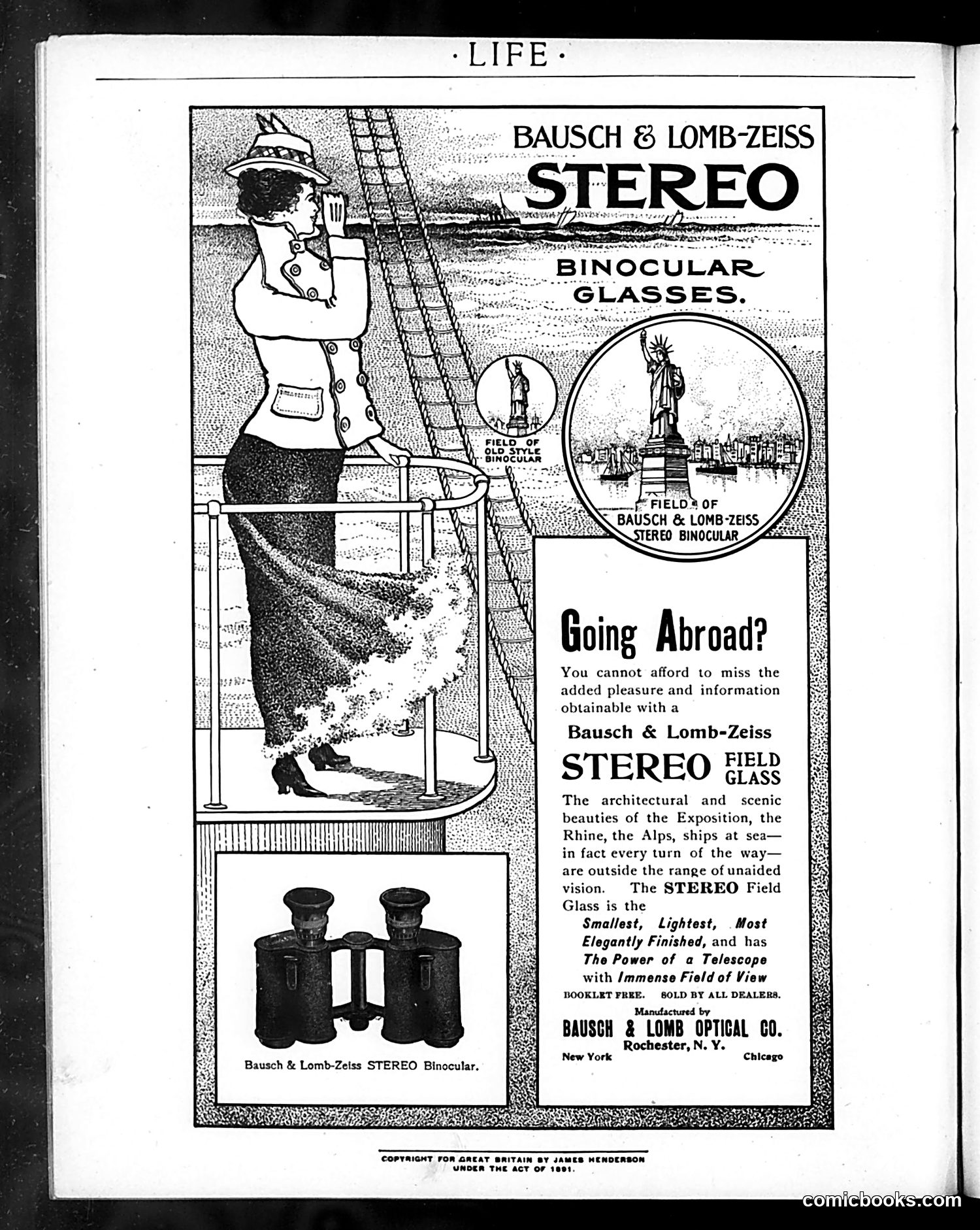
This page is **primarily an advertisement**, not satirical content. It promotes Bausch & Lomb-Zeiss Stereo binocular glasses to travelers heading abroad. The ad features a fashionably-dressed woman on what appears to be a ship's deck, gazing through binoculars at the Statue of Liberty. The imagery suggests leisure travel and tourism—a luxury activity of the era. The advertisement claims these binoculars provide superior viewing of distant architectural and scenic attractions ("Exposition, the Rhine, the Alps, ships at sea"). The product itself is shown at bottom. The pitch emphasizes the binoculars' compact size, elegance, and powerful magnification. This targets affluent travelers of the early 20th century who could afford both international travel and premium optical equipment.
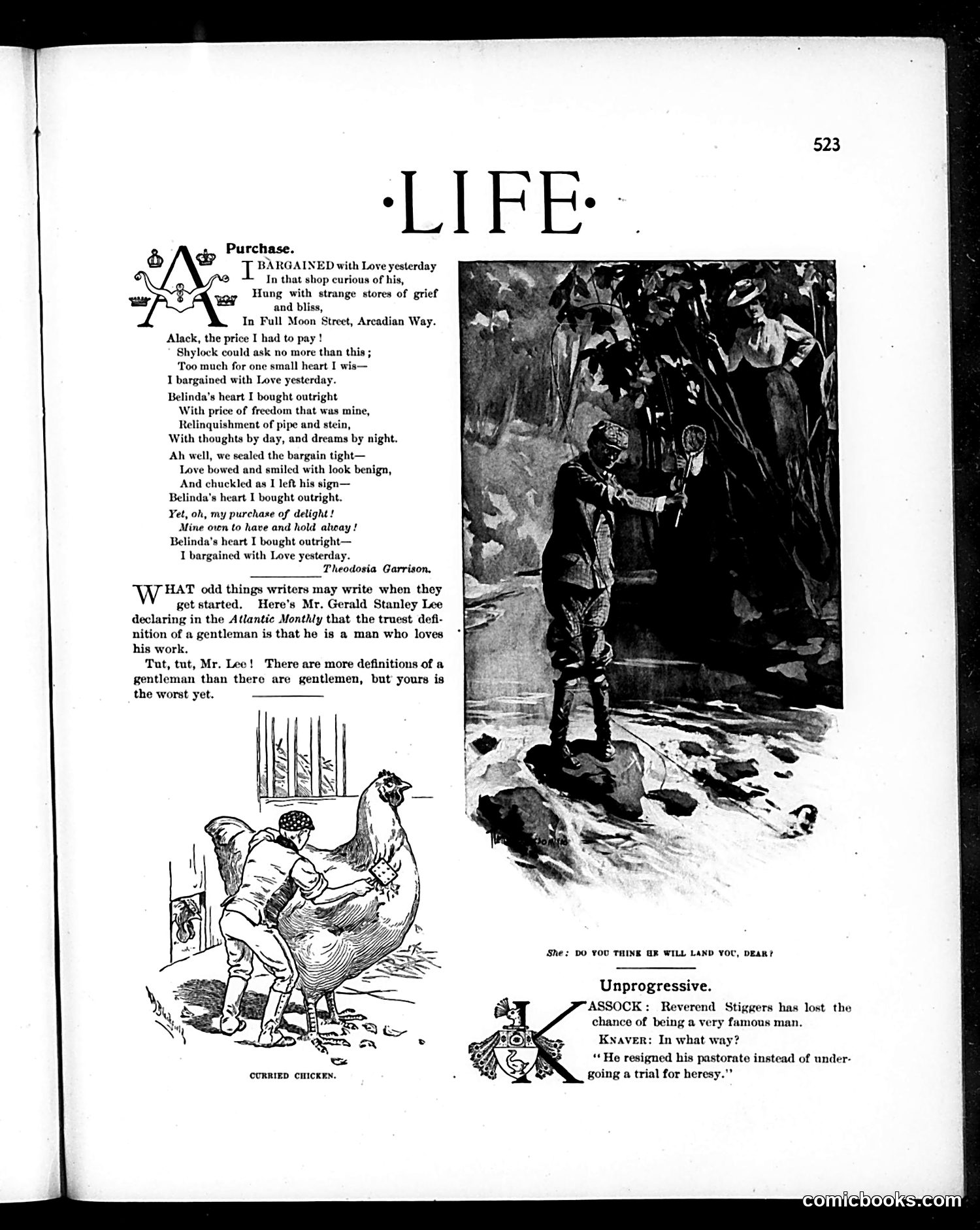
The page contains two distinct sections: **"Purchase" Poem:** A romantic verse by Theodosia Garrison about bargaining with Love, celebrating the speaker's acquisition of their lover's heart. **"Unproggressive" Section:** A satirical dialogue mocking Reverend Stiggers, who supposedly lost his chance at fame by resigning his pastorate to undergo a heresy trial instead of continuing his public prominence. The humor targets religious hypocrisy—suggesting Stiggers prioritized doctrine over maintaining his celebrity status. **"Curried Chickes" Cartoon:** A simple sketch showing a child playfully struggling with a large rooster, illustrating the poem's whimsical title about prepared poultry. The page combines light romantic sentiment with pointed social satire about religious figures prioritizing principle over public image—critiquing what the magazine views as misplaced priorities in ecclesiastical life.
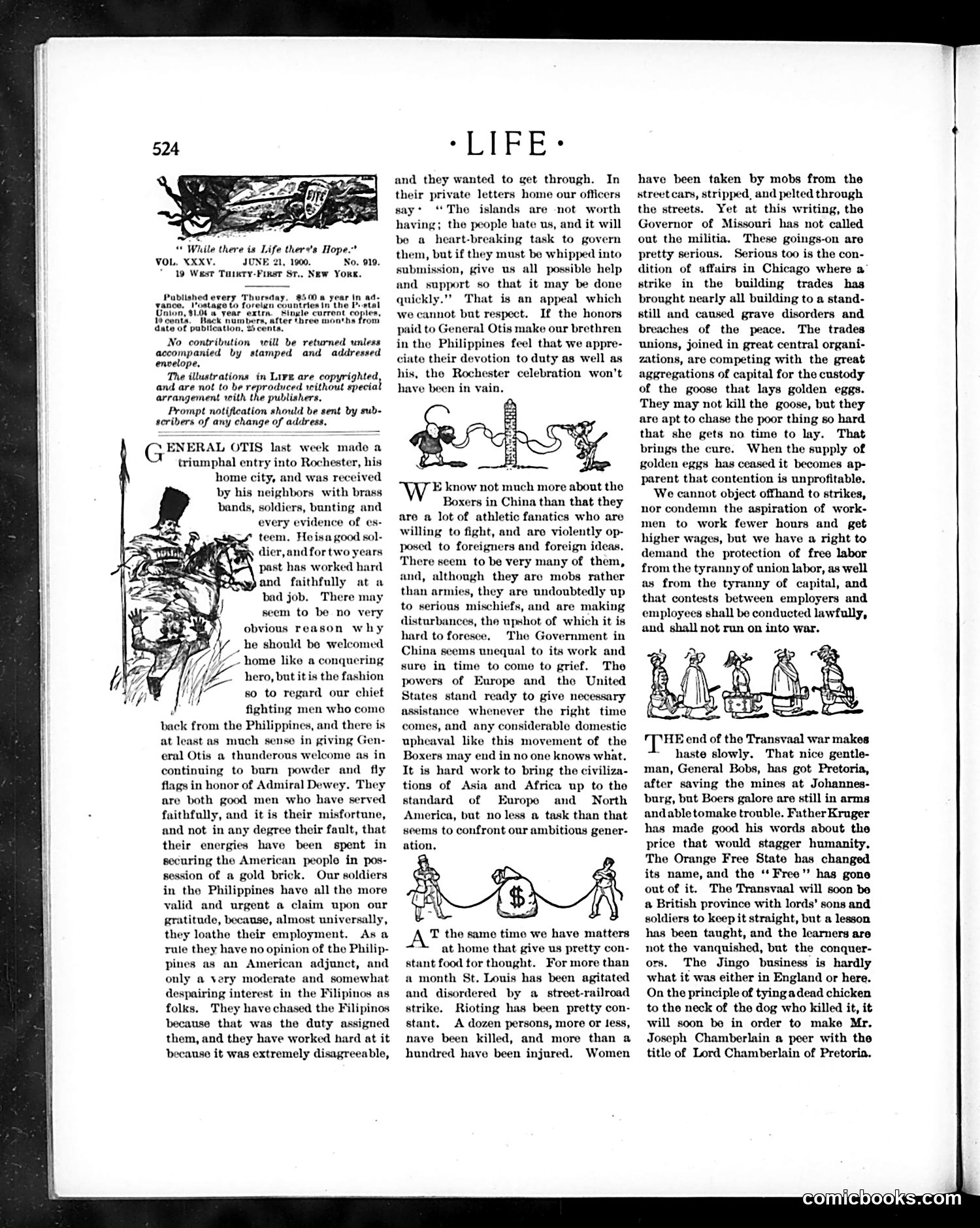
This page contains three satirical cartoons addressing contemporary issues: 1. **General Otis cartoon** (left): Celebrates General Harrison Gray Otis's return to Los Angeles from the Philippines, welcoming him as a "conquering hero." The text praises soldiers returning from the Philippine-American War. 2. **Boxers in China cartoon** (center): Depicts concerns about Chinese Boxer organizations, describing them as "athletic fanatics" prone to violence against foreigners. This references the Boxer Rebellion (1900-1901) and ongoing tensions in China. 3. **Transvaal War cartoon** (right): Comments on the post-Boer War situation in South Africa, satirizing how British control has eliminated the "Free" state, with mention of colonial administration and Joseph Chamberlain's role. All three cartoons reflect American imperial interests and anxieties during the early 20th century.
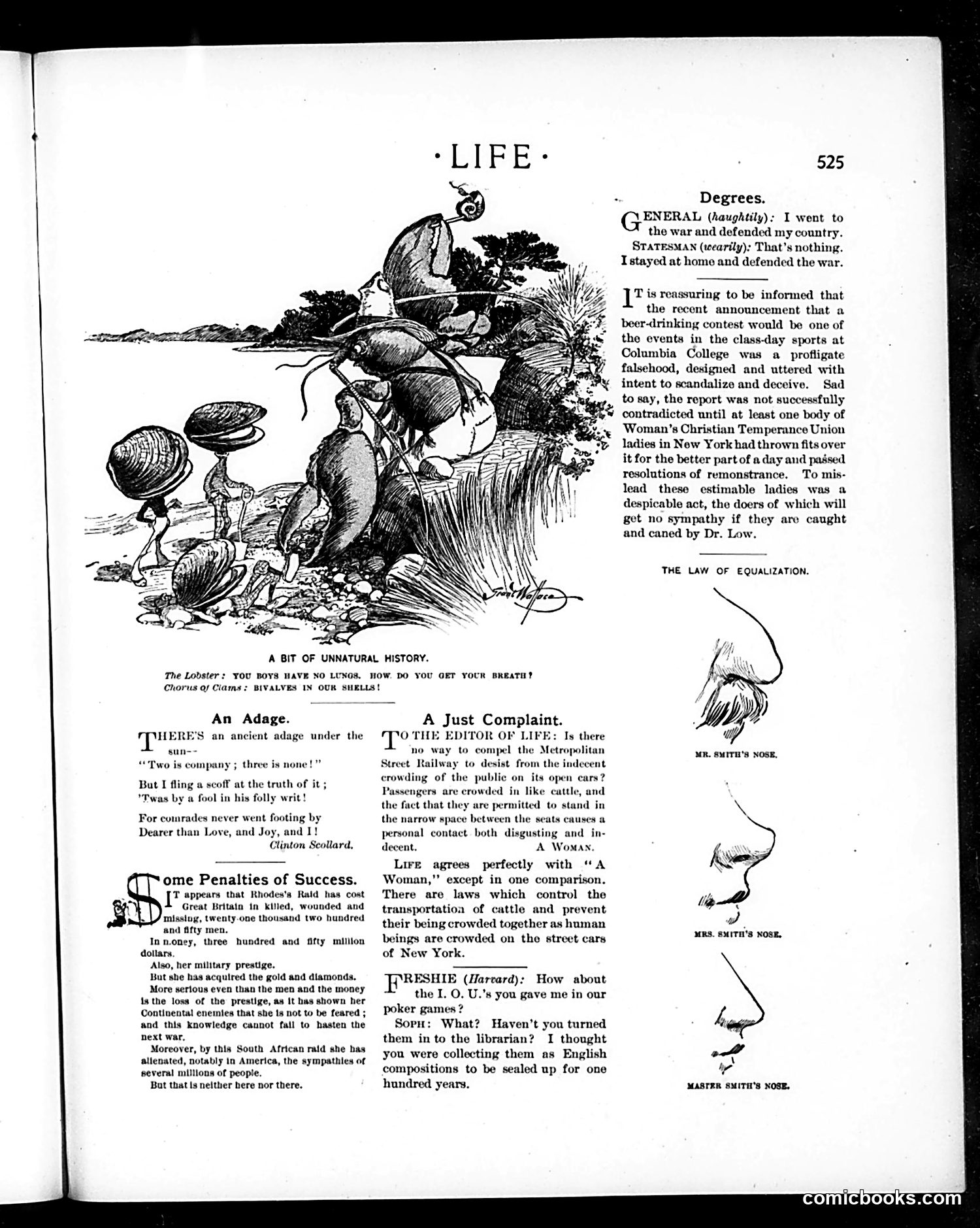
The main cartoon "A Bit of Unnatural History" depicts a lobster speaking to other crustaceans, satirizing arguments about physical capability. The dialogue—"you boys have no lungs, how do you get your breath?" with the response "we breathe in the shells!"—appears to mock illogical reasoning, possibly critiquing political or social arguments of the era. The three profile sketches labeled "Mr. Smith's Nose," "Mrs. Smith's Nose," and "Master Smith's Nose" form a humorous sequence showing how facial features vary within a family, likely satirizing pseudoscientific claims about heredity or racial characteristics popular in the early 1900s. The surrounding text pieces—"Degrees," "An Adage," "Some Penalties of Success," and complaint letters—are typical Life magazine satirical commentary on contemporary social issues.
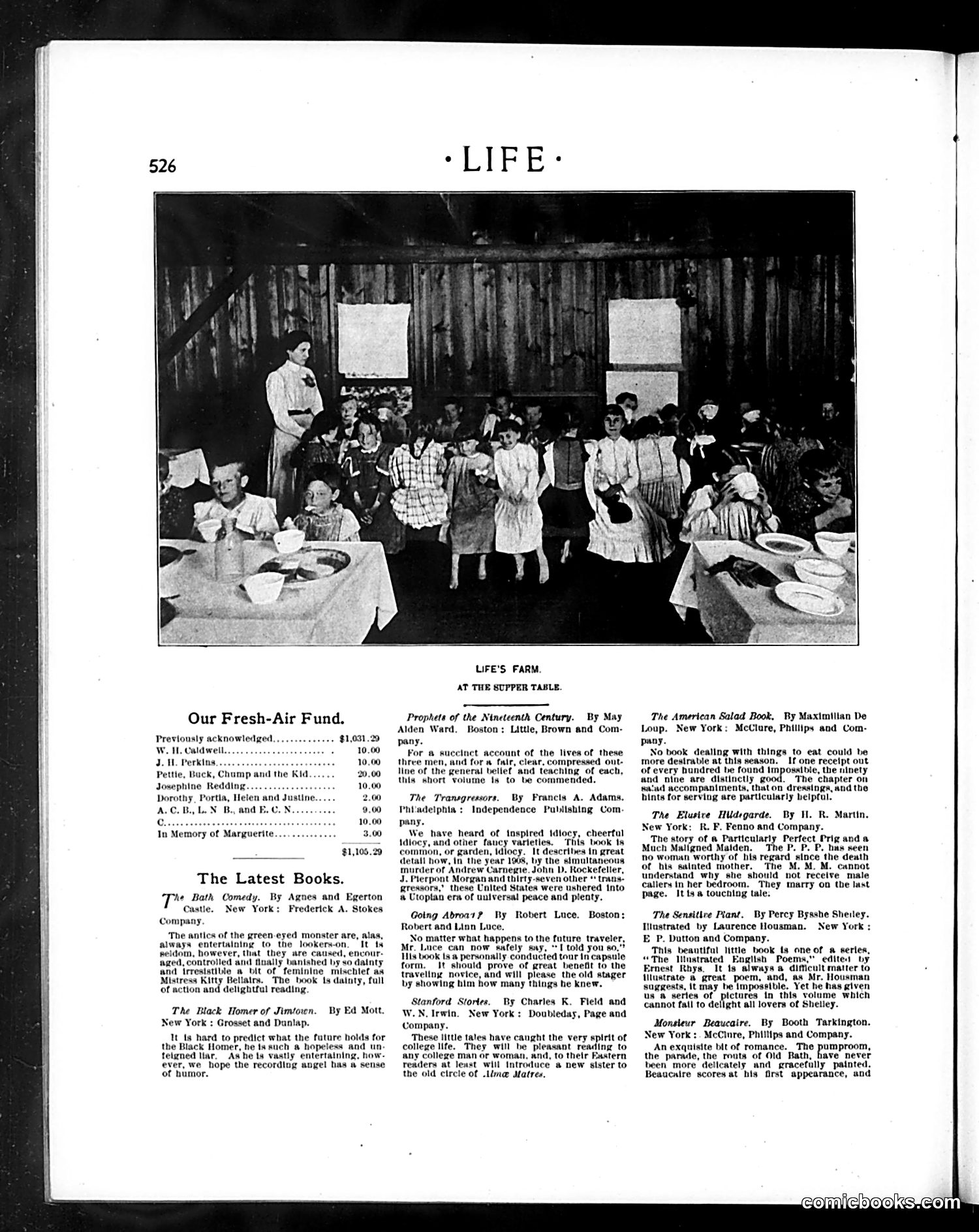
This page features a photograph titled "Life's Farm: At the Supper Table" showing a communal dining scene in what appears to be a large wooden structure. A woman stands addressing a group seated at tables with food and dishes. Below the image is "Our Fresh-Air Fund," a donation acknowledgment list recognizing contributors to what was apparently a charitable program providing relief (likely outdoor/rural experiences) for urban populations, particularly children. The remainder consists of book reviews for contemporary works, including titles about idiocy, transcendence, and romance. The "Fresh-Air Fund" reference suggests this page documents early 20th-century Progressive Era charitable initiatives aimed at providing healthful experiences for disadvantaged urban residents—a common social welfare concern of the period.
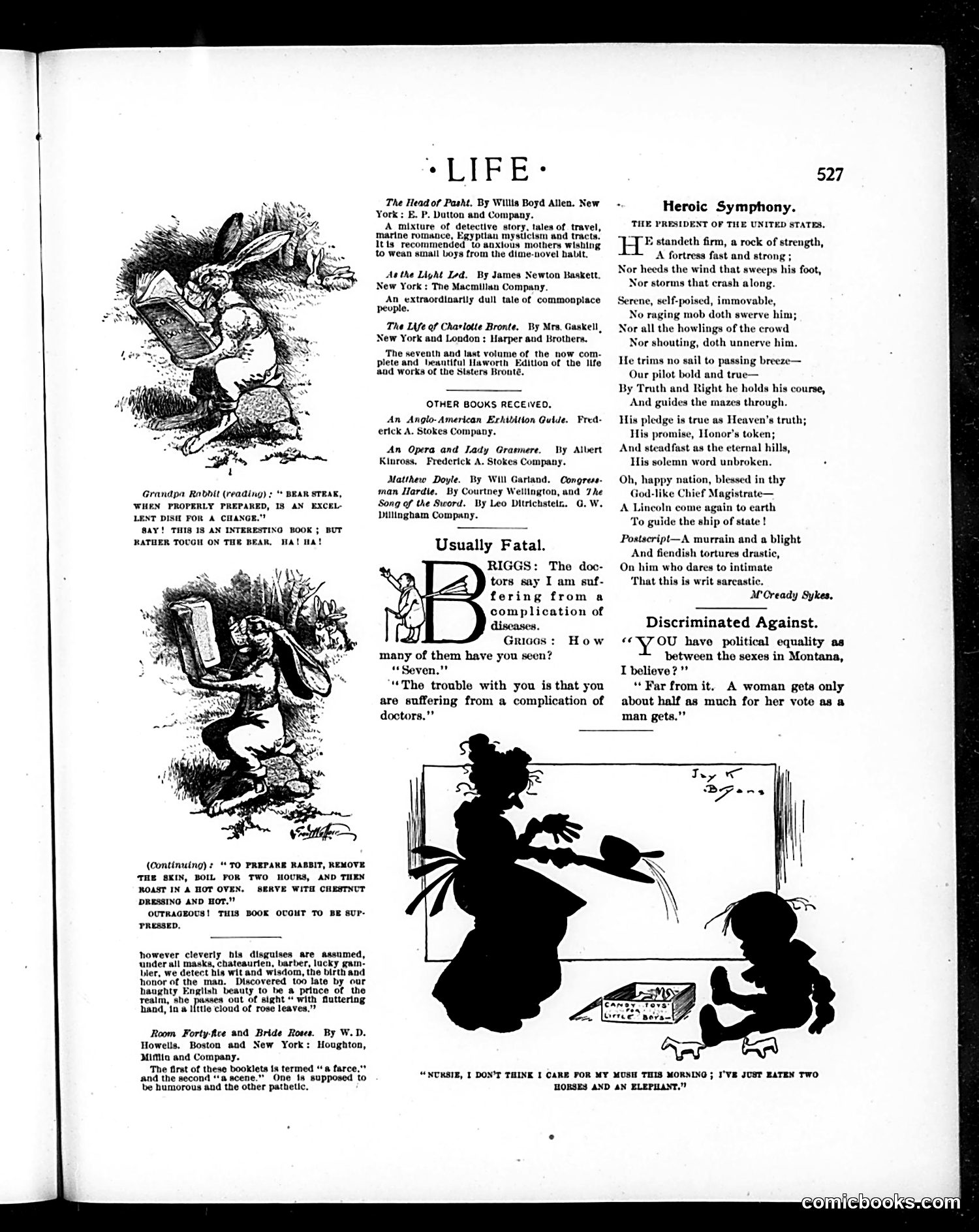
This cartoon satirizes women's unequal political rights. The silhouette shows a woman at a voting booth while a man sits comfortably at home, seemingly unconcerned. The accompanying text states: "You have political equality as between the sexes in Montana, I believe?" Response: "Far from it. A woman gets only about half as much for her vote as a man gets." **The satire:** Despite legal voting rights, women's political influence was treated as worth significantly less than men's—suggesting that formal equality masked real discrimination in how votes were weighted or valued. The cartoon highlights the gap between nominal rights and actual power during the early 20th-century women's suffrage era.
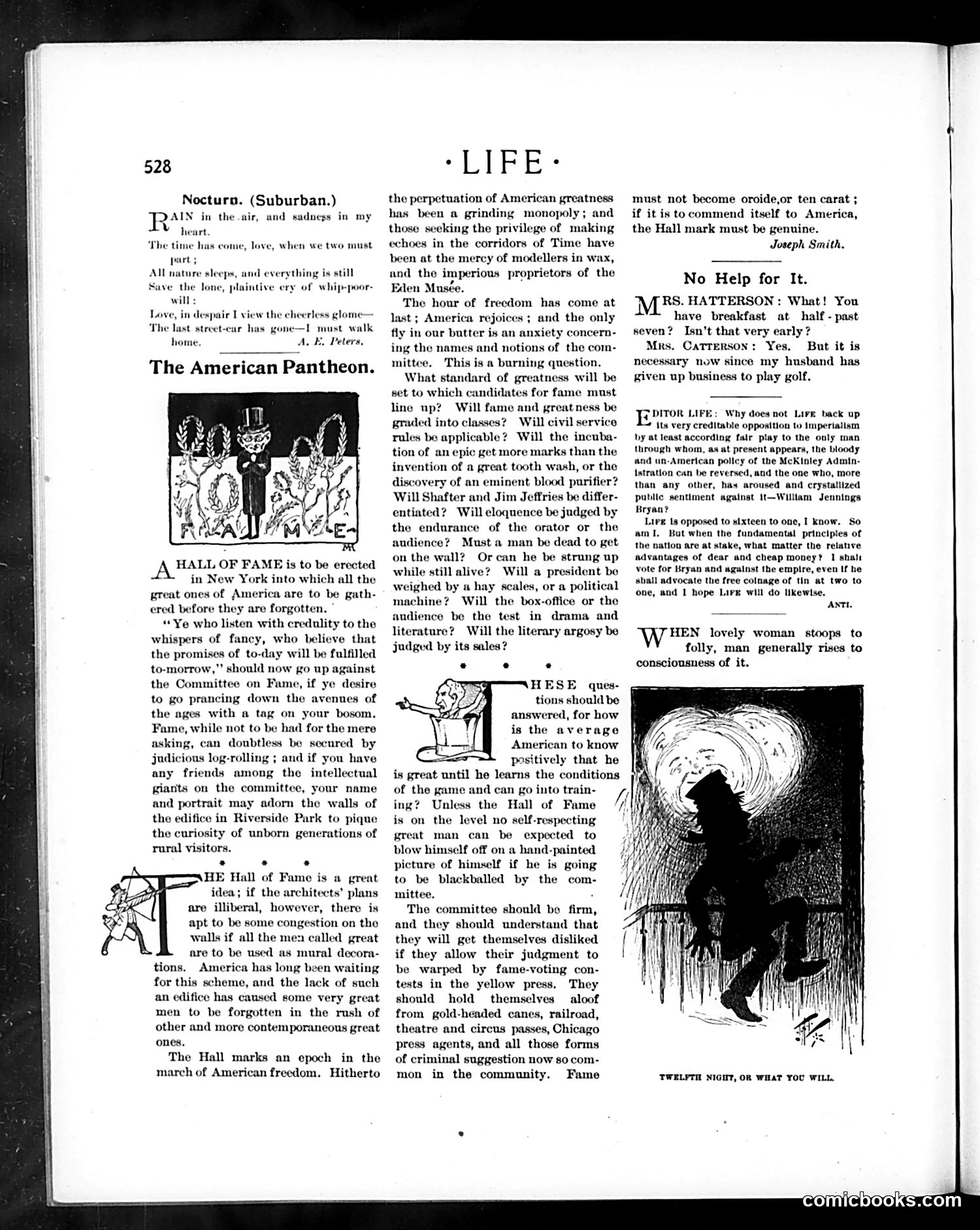
This page contains satirical commentary on proposed "Hall of Fame" institutions for America. The text critiques plans for a Hall of Fame in New York, questioning what standards would determine "greatness" and warning against potential corruption—fame-voting contests influenced by "yellow press" agents, railroad passes, and circus promoters. The accompanying illustrations depict allegorical figures, likely representing concepts of Fame or American ideals. The cartoon titled "Twelfth Night, or What You Will" appears to satirize the pretensions involved in naming great Americans. The satire's central point: such halls of fame risk becoming vehicles for commercial manipulation and vanity rather than genuine recognition of merit. The editors warn against allowing publicity-seeking interests to corrupt judgments about American achievement.
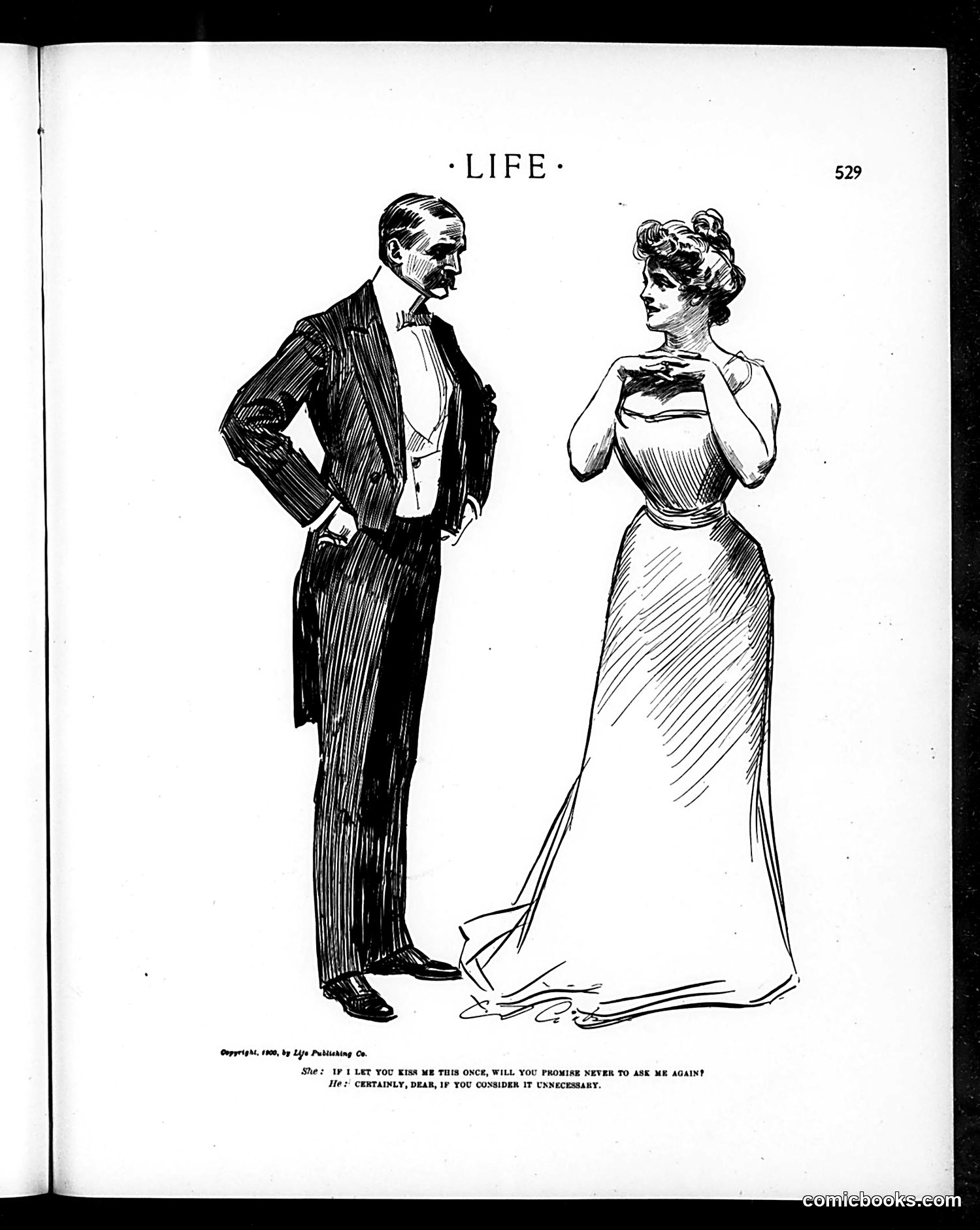
This is a satirical illustration from Life magazine (copyright 1908) depicting a romantic scene between a well-dressed man in formal evening wear and an elegantly dressed woman in a floor-length gown. The caption presents their dialogue: She requests "Let you kiss me this once. Will you promise never to ask me again?" He responds "Certainly, dear, if you consider it unnecessary." The satire targets courtship and romantic negotiation customs of the Edwardian era. The humor lies in the woman's attempt to set strict boundaries on physical affection, while the man's response suggests her condition is actually unnecessary—implying he won't need to ask again because she'll willingly comply in the future. It's a commentary on the gap between what women claim they want versus assumed romantic inevitability.
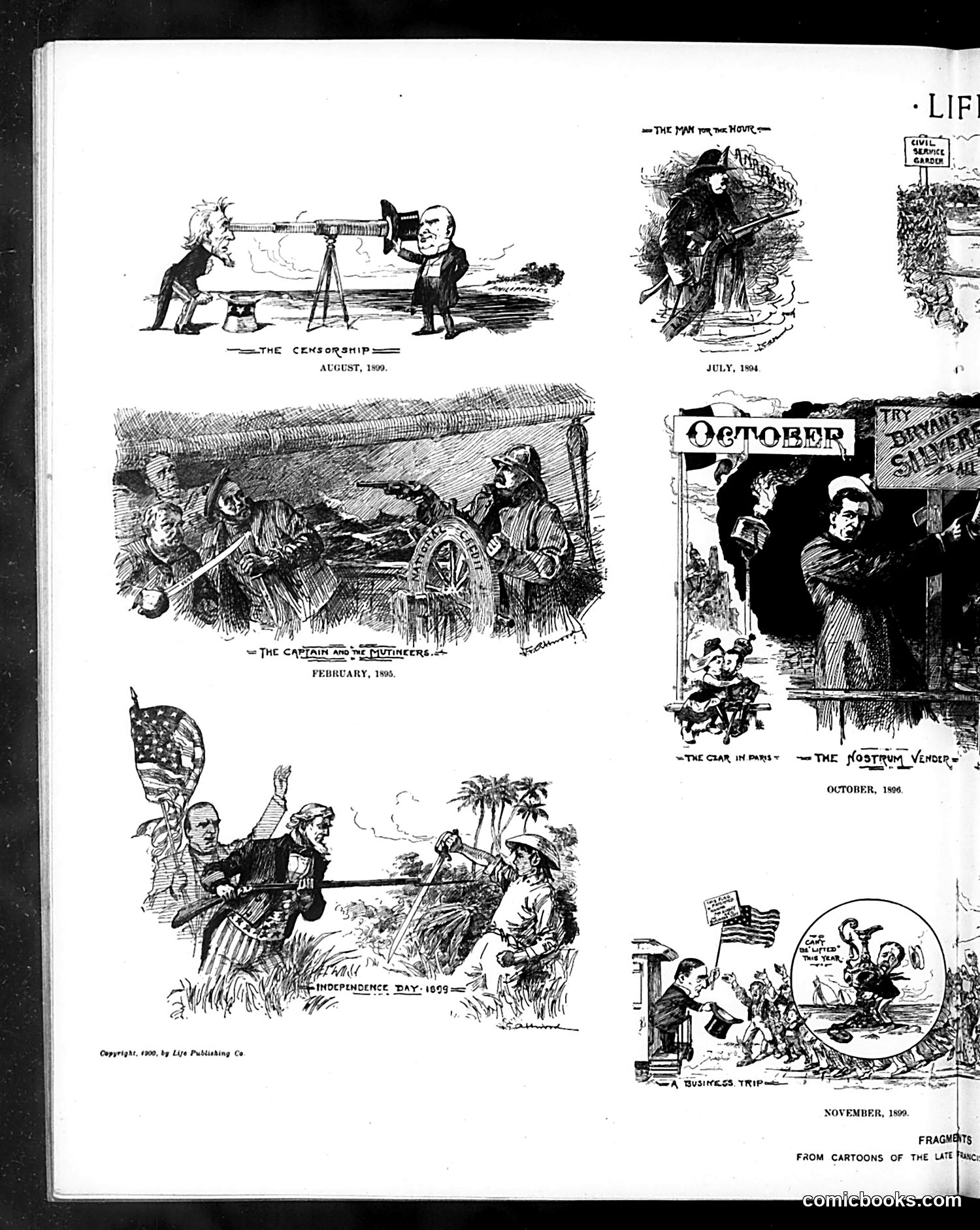
This page collects satirical cartoons spanning a decade of American politics. "The Censorship" (August 1899) depicts press freedom under restriction. "The Captain and the Mutineers" (February 1900) appears to reference military or political authority being challenged. "Independence Day" (1905) shows American imperial interests abroad, with figures wielding power over colonial territories. The October 1904 cartoons—"The Czar in Paris" and "The Kostrum Vender"—likely reference Russian autocracy and international commerce during the Russo-Japanese War era. "A Business Trip" (November 1899) depicts American commercial expansion. These cartoons employ exaggerated caricature and symbolic imagery to critique imperialism, censorship, and political power dynamics of the turn-of-the-century American era. The specific identities of some figures remain unclear without additional context.
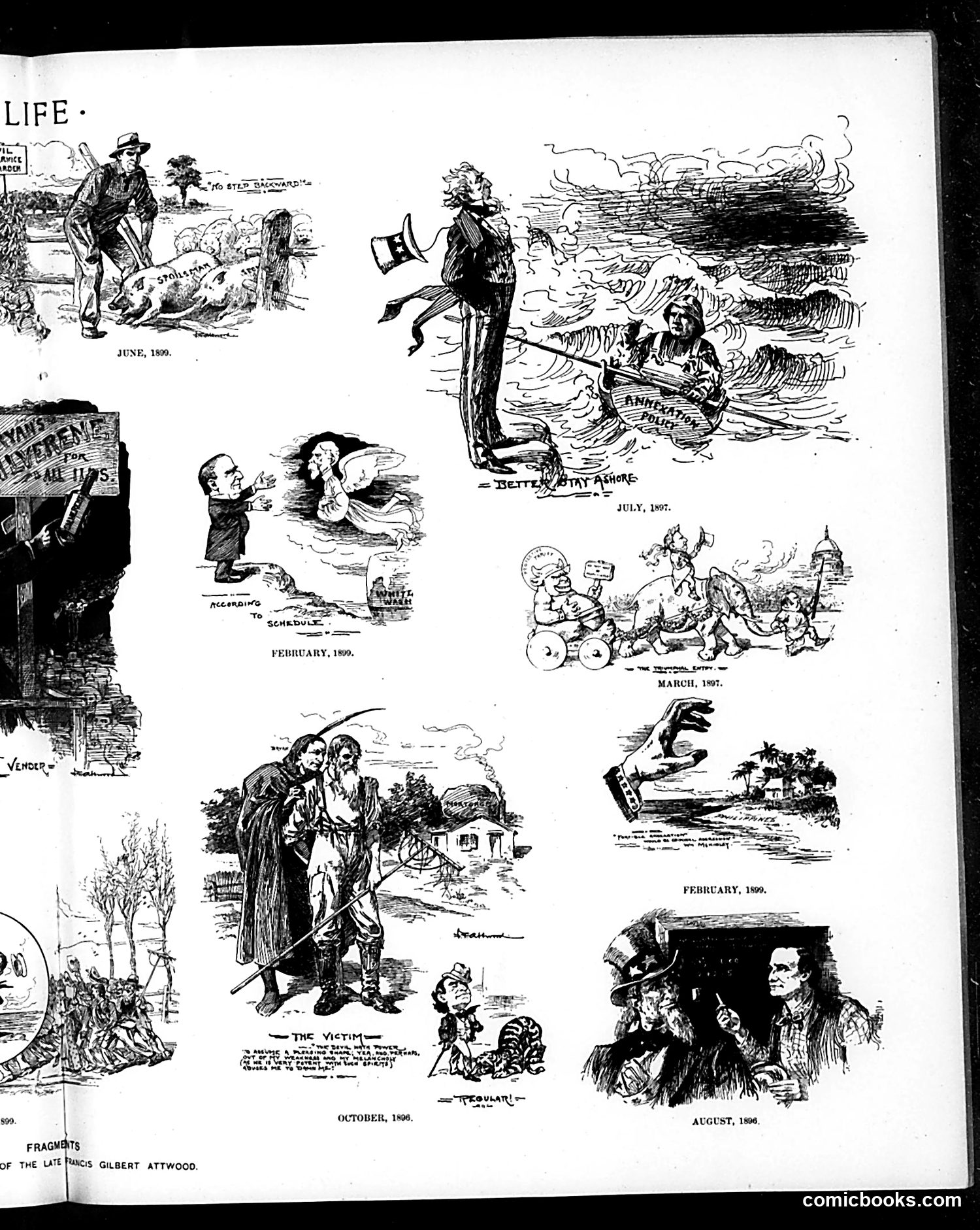
This page collects satirical cartoons by the late Francis Gilbert Attwood, dated 1896-1897. The cartoons appear to address contemporary political and social issues through allegorical imagery: **June 1899** shows a farmer discovering something troubling in his field. **July 1897** ("Better Days Ashore") depicts a figure on a pole amid turbulent waters, likely referencing maritime or economic turmoil. **February 1899** shows a small figure "According to Schedule," suggesting commentary on bureaucratic or political processes. **October 1896** ("The Victim") portrays a suffering figure, apparently critiquing some policy or circumstance. **August 1896** and **February 1899** feature additional scenes, though their specific references are unclear from the image alone. The cartoons use Attwood's characteristic detailed ink work to deliver biting social commentary typical of *Life* magazine's satirical mission during the 1890s.
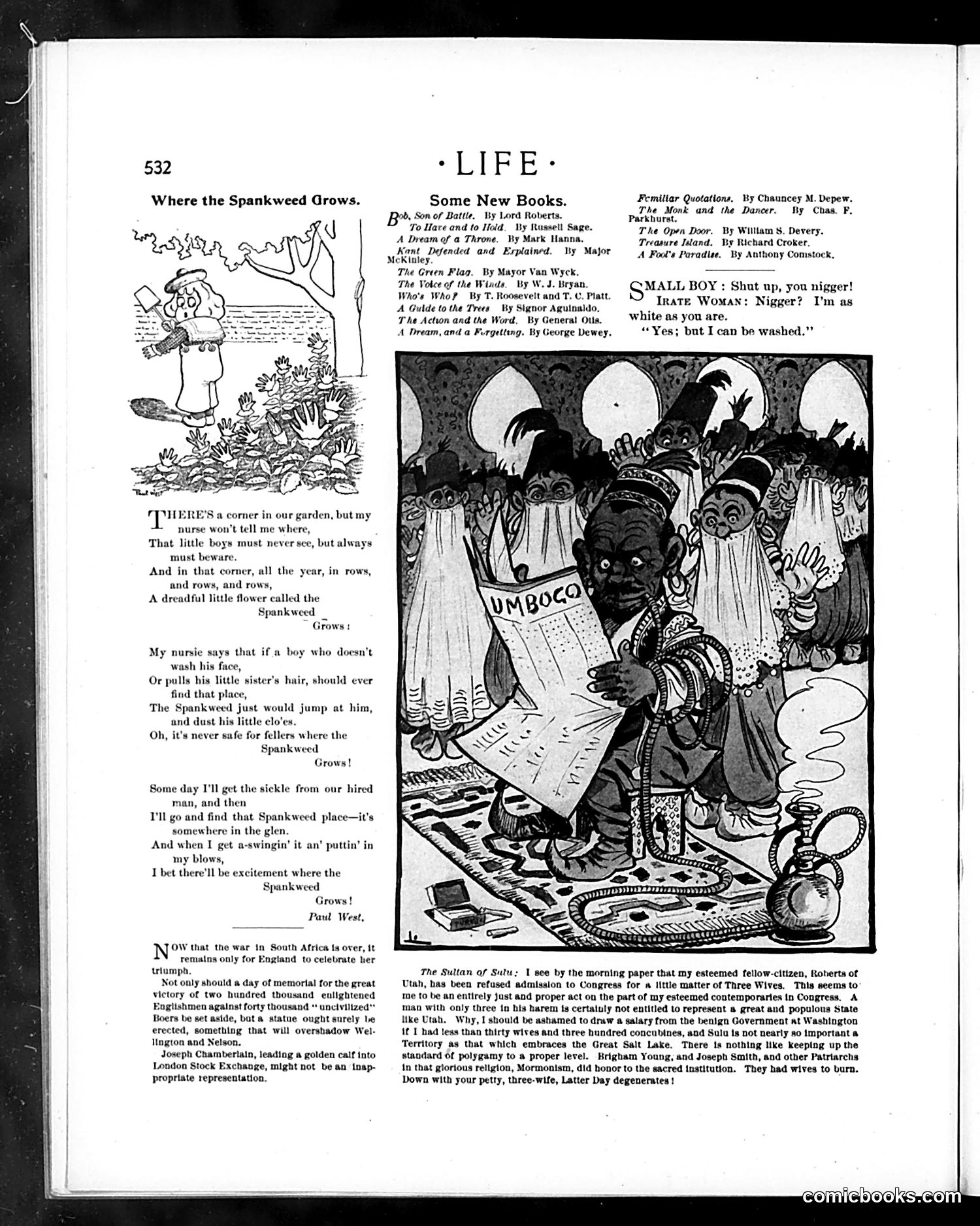
The main cartoon ("The Sultan of Sulu") depicts a caricatured figure labeled "UMBOGO" in a racist, exaggerated style characteristic of early 20th-century American periodicals. The accompanying text references Roberts of Utah being "refused admission to Congress for a little matter of Three Wives," satirizing polygamy controversies. The cartoon appears to mock both the Sultan of Sulu (a historical Filipino leader) and, through comparison, Mormon polygamy practices in Utah. The grotesque racial caricature reflects the era's deeply prejudiced visual conventions. The page also contains "Where the Spankweed Grows," a poem about a dangerous garden plant used to threaten misbehaving children—typical Victorian parenting folklore content. This material exemplifies Life's satirical approach to contemporary political and social issues, though its execution relies heavily on now-offensive racist imagery.
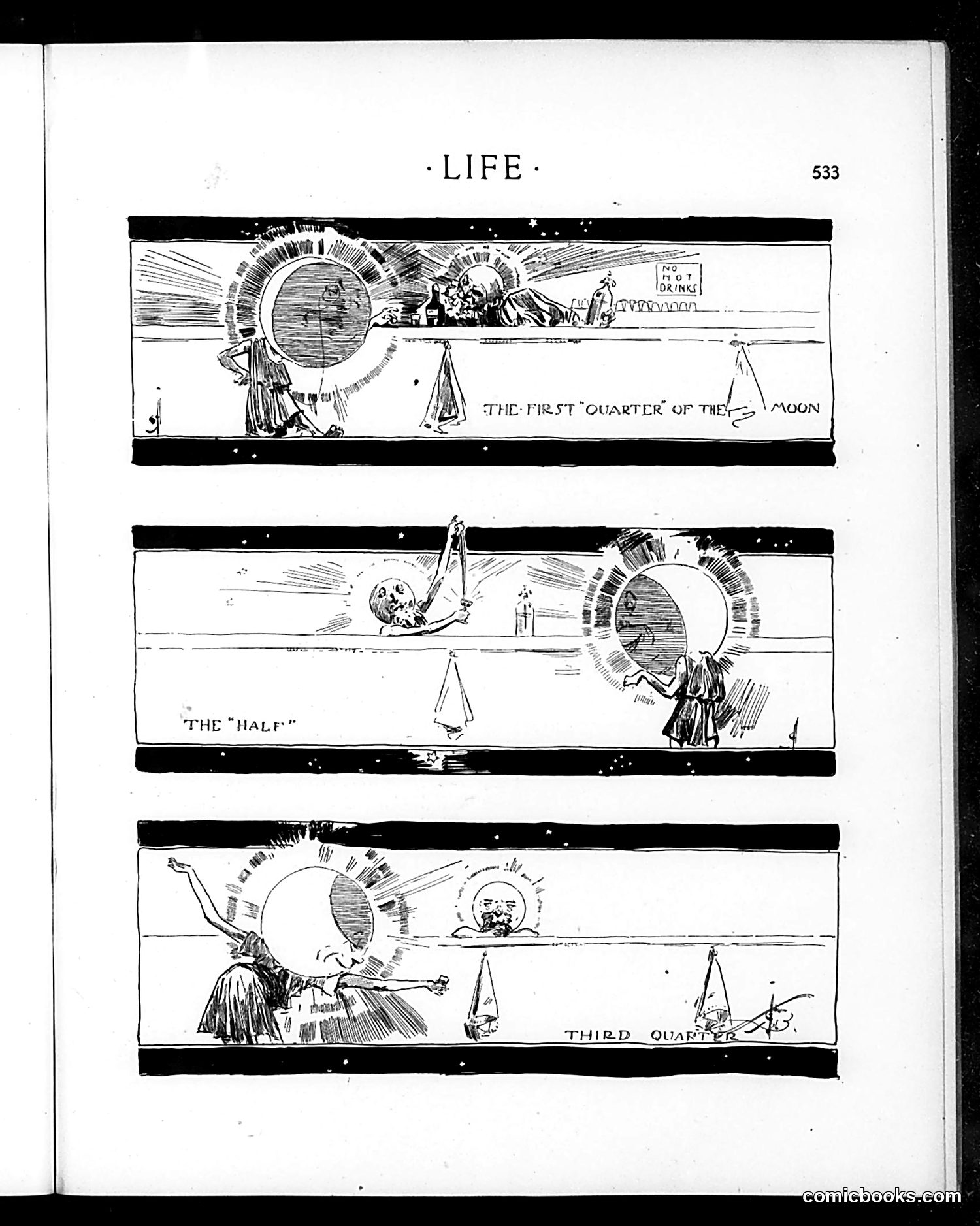
This appears to be a humorous three-panel comic depicting the moon's phases as viewed by observers on Earth. Each panel is labeled with lunar terminology: "The First Quarter," "The Half," and "Third Quarter." The satire likely mocks how ordinary people perceive and describe the moon's appearance. The figures pointing at the moon with surveying instruments suggest comedic over-analysis of something simple. The varying positions of observers and their gestures imply confusion or exaggerated solemnity about basic astronomical observation. Without additional context about the publication date, the specific joke's full meaning remains unclear, but the humor appears rooted in the gap between scientific precision and casual observation—a common Life magazine theme.
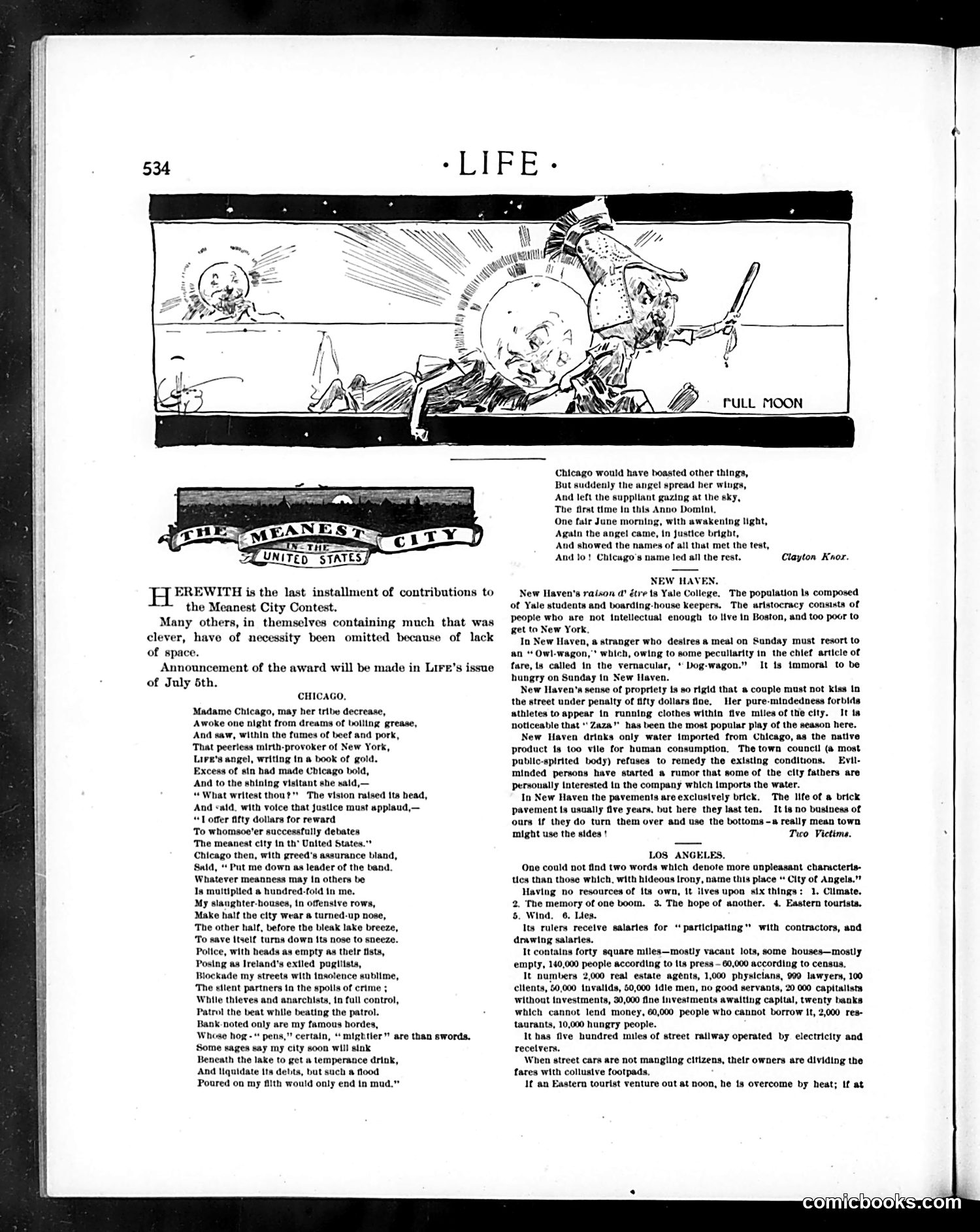
This page features the final installment of *Life*'s "Meanest City Contest," a satirical competition where readers submitted essays attacking American cities for their corruption and vice. The cartoon depicts **Chicago** personified as a woman, visited by an angel (representing Justice) who offers a fifty-dollar reward for identifying "the meanest city in th' United States." Chicago brags shamelessly about her vices: slaughterhouses creating stench, corrupt police partnering with criminals and anarchists, and filthy conditions so severe that "liquidate its debts" by sinking into the lake. The joke's twist: despite Chicago's boasts, the angel ultimately reveals that **Chicago's name led all the rest**—meaning Chicago actually *won* the contest as the meanest city, validating her self-incriminating claims. The accompanying text mocks **New Haven** (Yale's location) and **Los Angeles** with similar satirical attacks on municipal corruption, propriety obsessions, and poor conditions. This reflects *Life*'s Progressive Era critiques of urban mismanagement and civic hypocrisy.
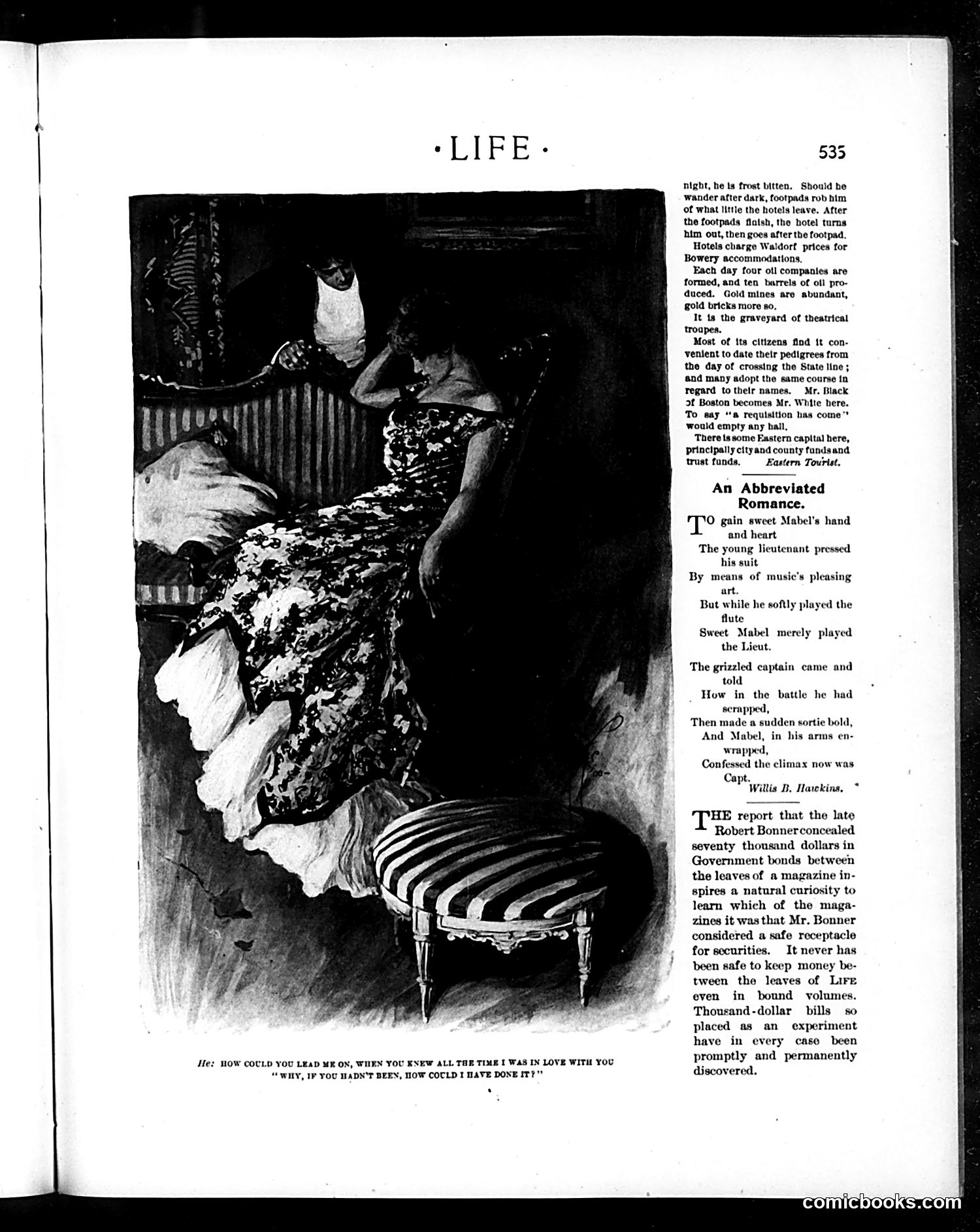
The main illustration depicts a romantic scene with a woman reclining on a striped chair, confronting a man. The caption presents their dialogue: he accuses her of leading him on despite knowing he loved her; she replies that without his love, she couldn't have done so—a cynical joke about female manipulation in romance. Below this is "An Abbreviated Romance," a satirical poem mocking melodramatic love stories. A young officer courts "sweet Mabel" through music, but she ignores him for an older, grizzled captain who impresses her with tales of battle—suggesting women prioritize status and adventure over genuine affection. The final prose piece humorously references the late Robert Bonner allegedly hiding $70,000 in bonds between magazine pages. Life jokes that *Life* magazine itself is so popular and frequently read that hidden money would inevitably be discovered there—a self-promotional jest about the magazine's circulation and readership engagement. The page satirizes romantic pretense and female materialism while subtly advertising Life's own popularity.
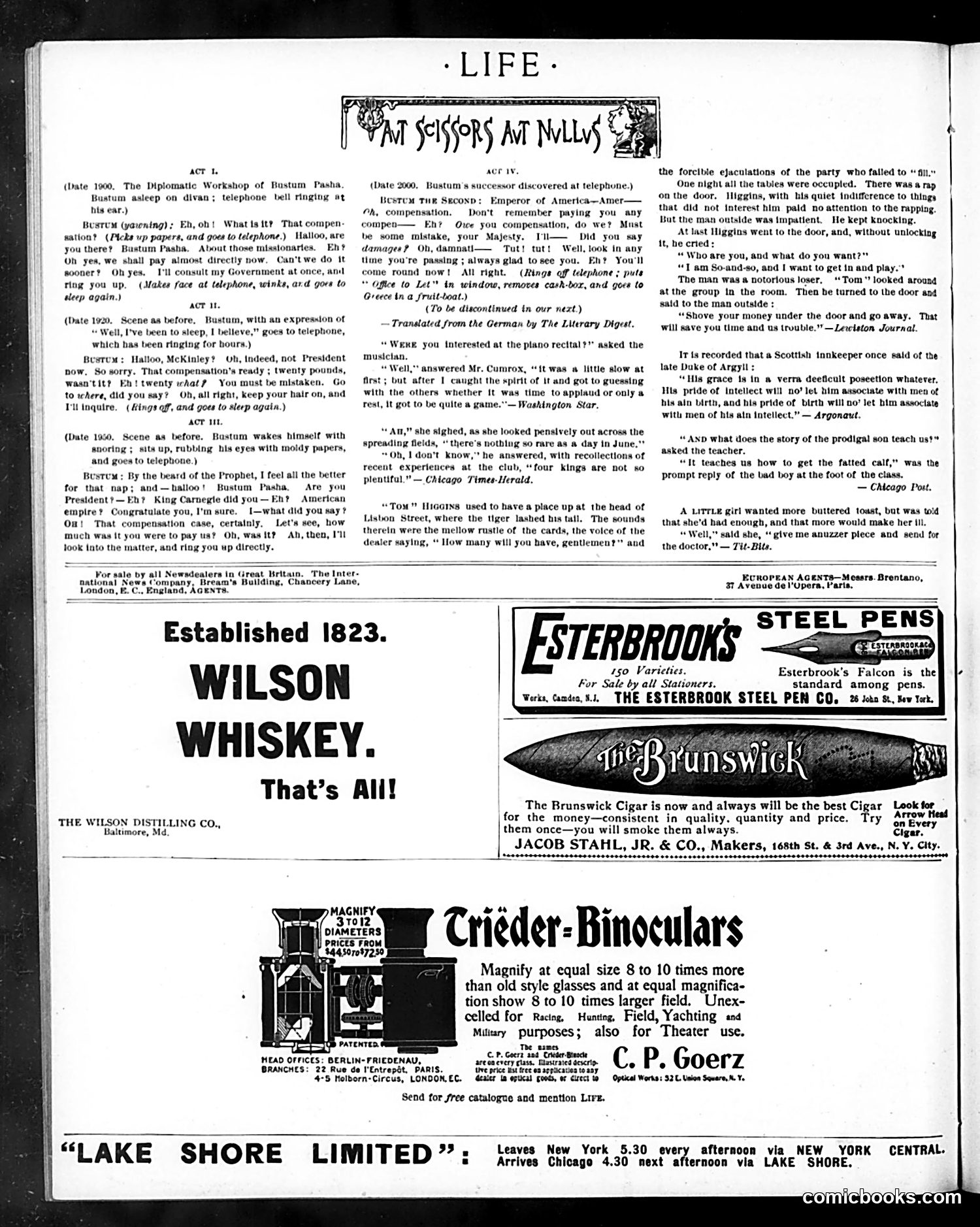
This three-act cartoon satirizes delays in diplomatic compensation settlements, likely referencing the Armenian massacres and missionary protection disputes of the 1890s-1900s. **The Setup:** Bustum Pasha (Ottoman Empire official) is repeatedly awakened by telephone calls demanding compensation payments. Each act jumps forward in time (1900, 1920, 2000), showing the same scenario: Bustum either claims he'll pay "almost directly," offers insufficient amounts, or—by 2000—denies owing anything entirely and abandons his office ("rents it out"). **The Satire:** The joke mocks Ottoman diplomatic stalling tactics regarding damages owed, likely for wrongs against American missionaries or Christian minorities. By projecting forward to 2000, the cartoonist sardonically suggests the compensation claim will remain perpetually unresolved. The repetitive telephone interruptions during sleep symbolize how the issue keeps haunting international relations. This reflects early-1900s American frustration with Ottoman evasion of accountability.
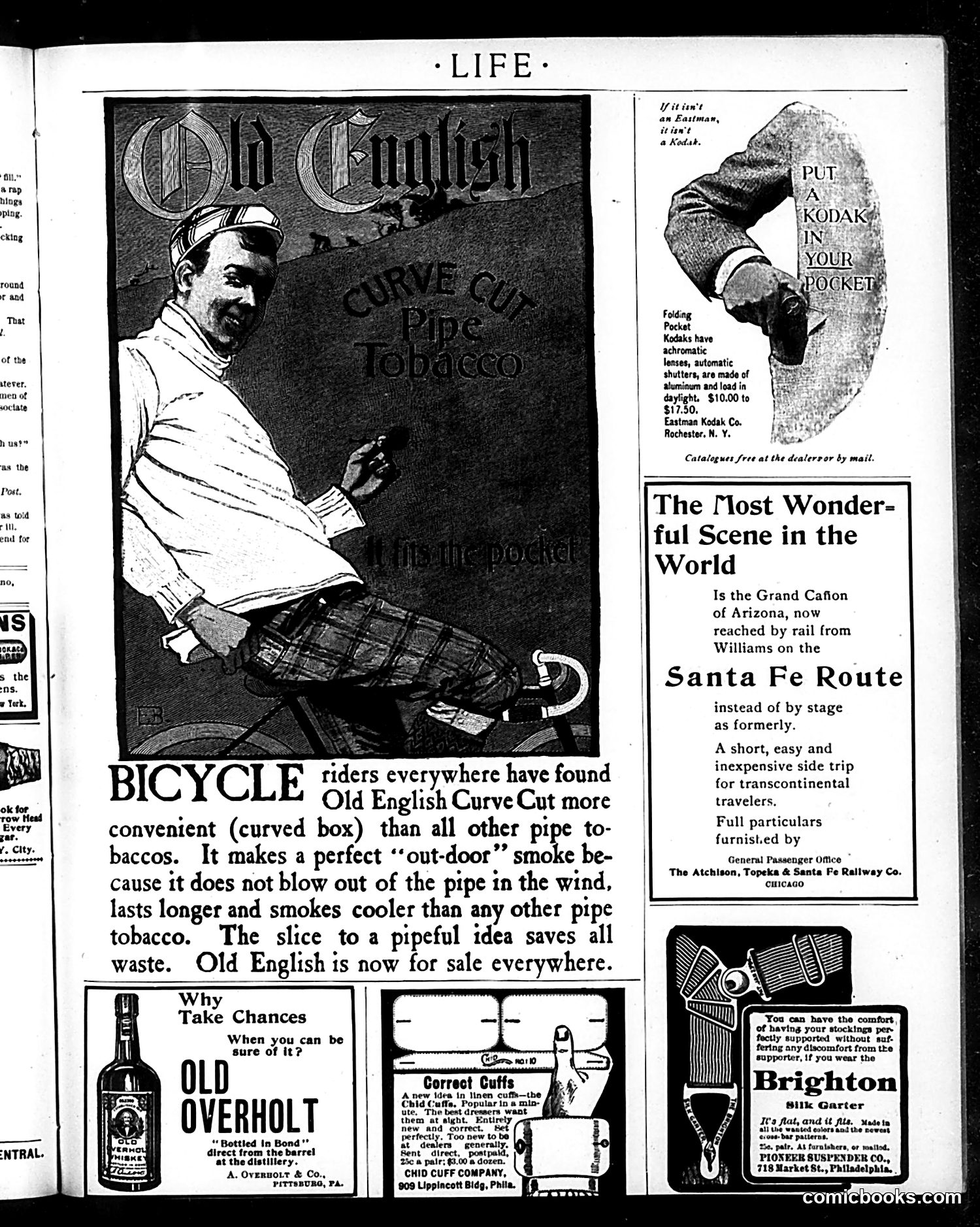
This page consists primarily of **advertisements**, not political satire. The main content includes: **Large ad (left)**: A bicycle rider endorsing "Old English Curve Cut" pipe tobacco, emphasizing its curved box design prevents tobacco from blowing out while riding—a practical feature for cyclists. **Other ads** include: - Kodak folding pocket cameras - Santa Fe Railway promoting the Grand Canyon as a tourist destination - Old Overholt whiskey ("bottled in bond") - Child Cuff shirt cuffs (linen collars) - Brighton sock garters The bicycle imagery is straightforward product promotion rather than satire. The only potentially humorous element is the gentleman cyclist's somewhat portly appearance advertising an "outdoor" smoking product, though this appears incidental rather than intentional commentary. **This is fundamentally an advertising page**, representative of Life's mixed content model during the early 20th century.
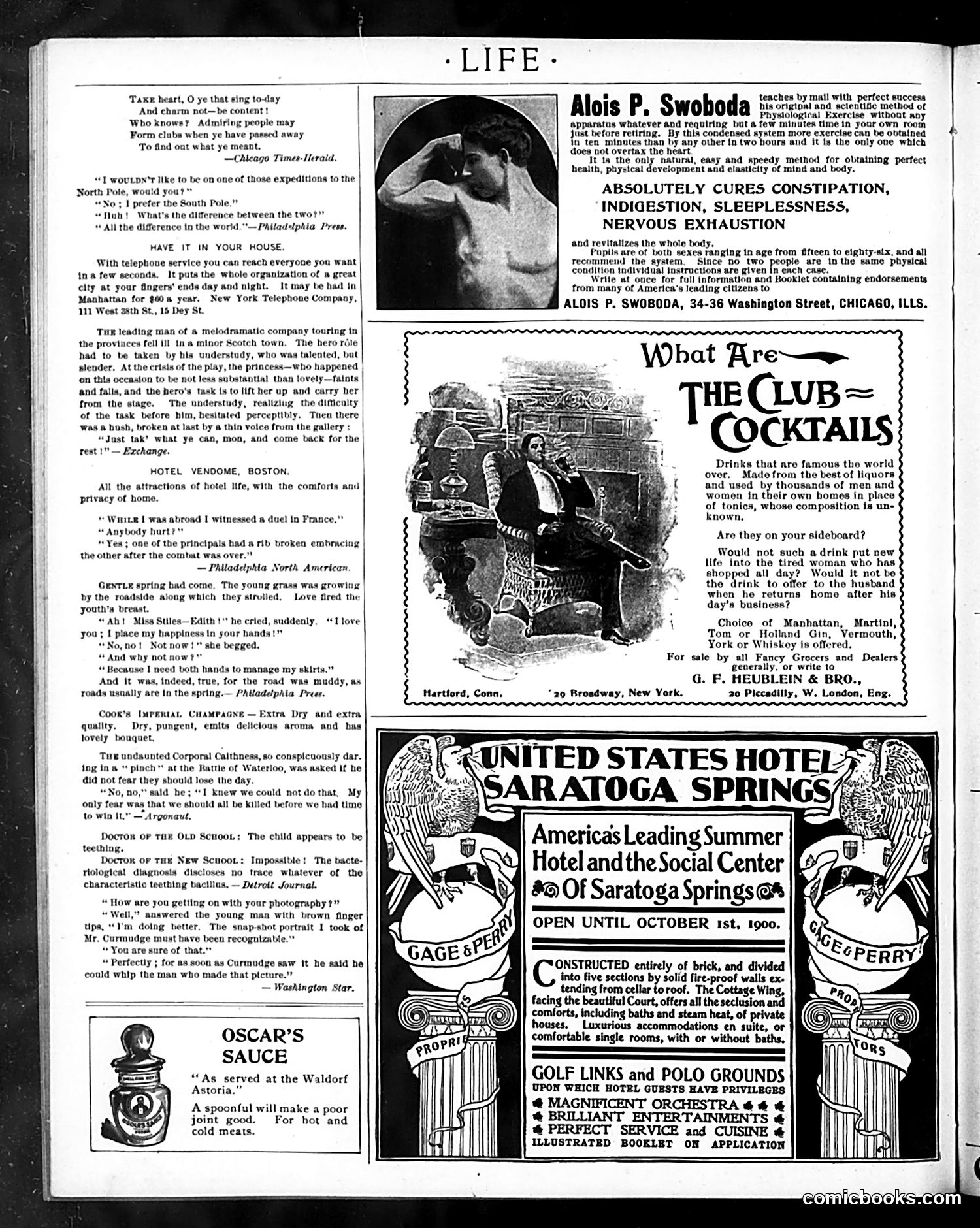
This is primarily an **advertising and humor page** from Life magazine (a satirical weekly, circa 1900 based on the Saratoga Springs hotel ad date). The content includes: **Humor pieces** (brief jokes/anecdotes) scattered throughout—mostly observational comedy about courtship, travel, and social mishaps. These rely on wordplay and gentle satire rather than specific political targets. For example: one joke contrasts North and South Pole preferences; another describes a theater understudy struggling to carry an overweight actress. **Advertisements** for hotels (Vendome, Saratoga Springs), telephone service, champagne, Oscar's Sauce, and notably **Alois P. Swoboda's mail-order "Physiological Exercise" system**—likely a dubious fitness scheme sold through magazines. **No identifiable political cartoons** appear on this page. The humor is domestic and apolitical—focused on everyday embarrassments rather than commenting on public figures or events. The page reflects early 1900s magazine culture: mixing light entertainment with patent medicine-style advertising targeting readers' insecurities.
This is primarily an **advertising page** from Life magazine, not a satirical cartoon section. It contains no political cartoons or caricatures requiring historical context. The page showcases turn-of-the-century consumer products and services: financial services (Redmond, Kerr & Co. bankers), sporting goods (Bridgeport Gun Implement Co., golf clubs), alcoholic beverages (Martell's brandy, Evans' Ale, Old Crow whiskey), and toiletries (O'Neill's corsets, Pears' soap, Beeman's gum). **Notable element:** The Pears' soap advertisement includes an **editorial claim** that luxury soap boxes use pretty packaging to disguise inferior products—a critique of consumer deception that suggests Life's satirical voice extended to advertising content itself. The page reflects Gilded Age consumer culture and advertising conventions, with celebrity endorsements and health claims now considered dubious (pepsin gum for indigestion, R.I.P.A.N.S tablets).
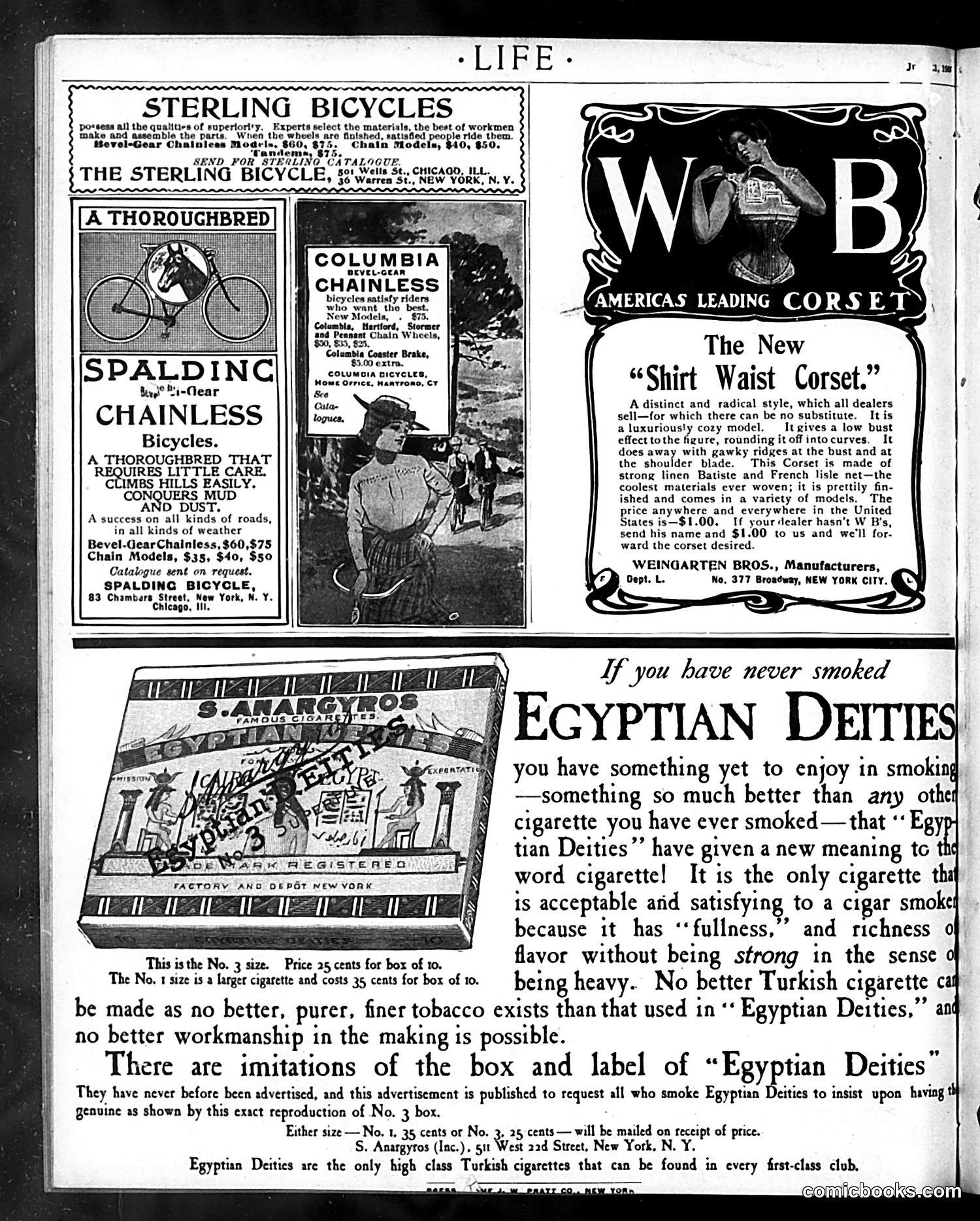
This page is primarily **advertising**, not satire or political cartoons. It contains product advertisements from the early 1900s: **Bicycles** dominate the upper portion—Sterling, Spalding, and Columbia models compete for readers' attention, emphasizing "chainless" designs as modern innovations that require "little care" and handle various road conditions. **Corsetry**: The W.B. "Shirt Waist Corset" advertisement appeals to women seeking fashionable silhouettes, promising low busts and rounded curves while using "coolest materials." **Egyptian Deities Cigarettes** occupies the lower half, marketing Turkish cigarettes as premium products for "first-class clubs." The ad defensively addresses imitations, suggesting the brand faced counterfeiting. The page reflects early 1900s consumer culture: technological advancement (bicycles replacing horse travel), evolving women's fashion standards (corsetry), and luxury goods marketed as status symbols. There is no cartoon or satirical content—this is straightforward period advertising appealing to middle and upper-class readers.