
A complete issue · 20 pages · 1900
Life — May 24, 1900
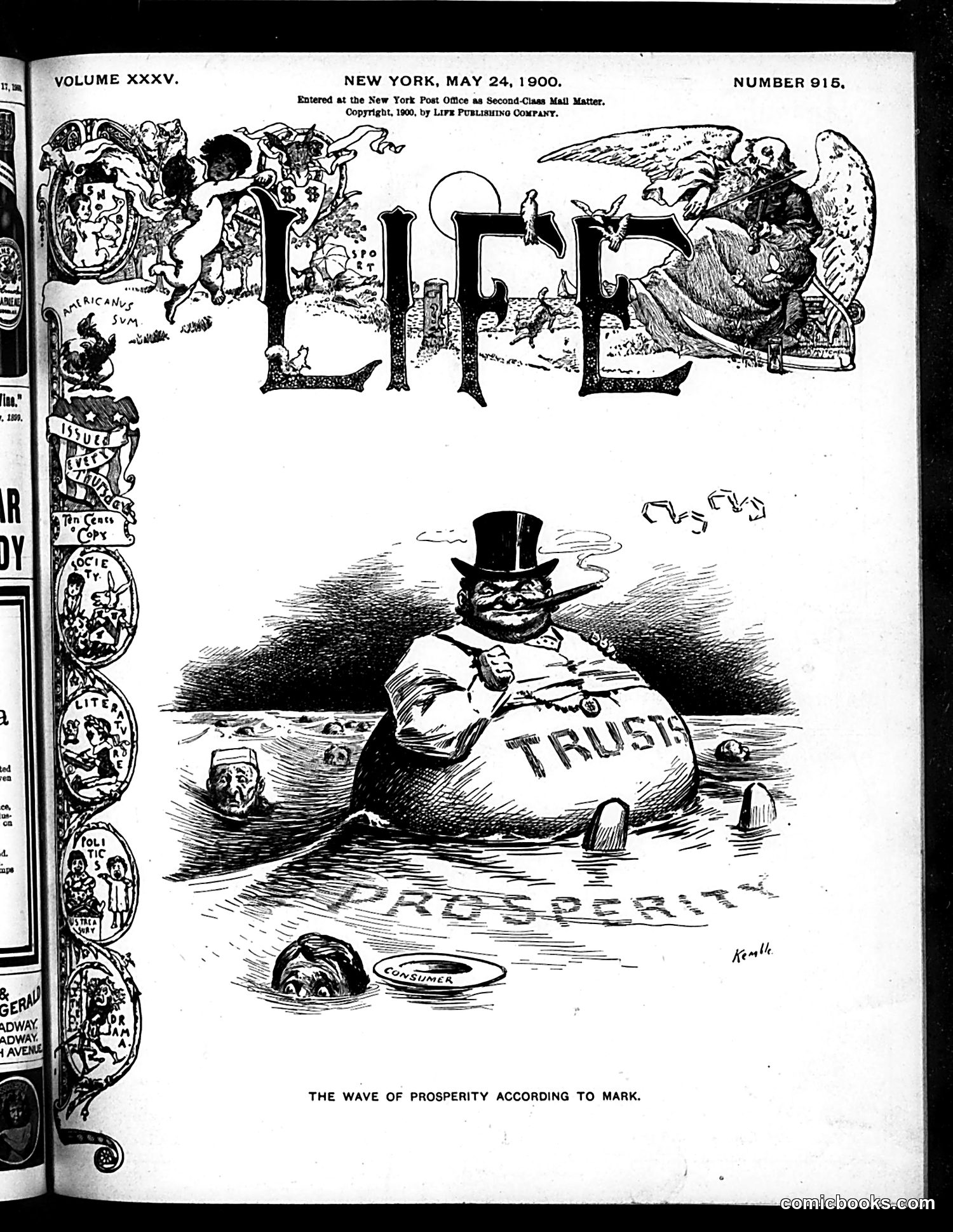
This May 24, 1900 Life magazine cartoon satirizes the concept of economic prosperity during the McKinley administration. The central figure—a bloated, well-dressed man labeled "TRUST"—floats contentedly in water marked "PROSPERITY," wearing a top hat and holding a cigar. He appears oblivious to the drowning figures (labeled "CONSUMER") struggling in the same waters around him. The satire's point is clear: while trusts and wealthy monopolists enjoy the claimed economic boom, ordinary consumers are being exploited and figuratively drowned by rising prices and unfair corporate practices. The cartoon criticizes the gap between official claims of shared prosperity and the actual suffering of average Americans under monopolistic business practices prevalent in the Gilded Age.
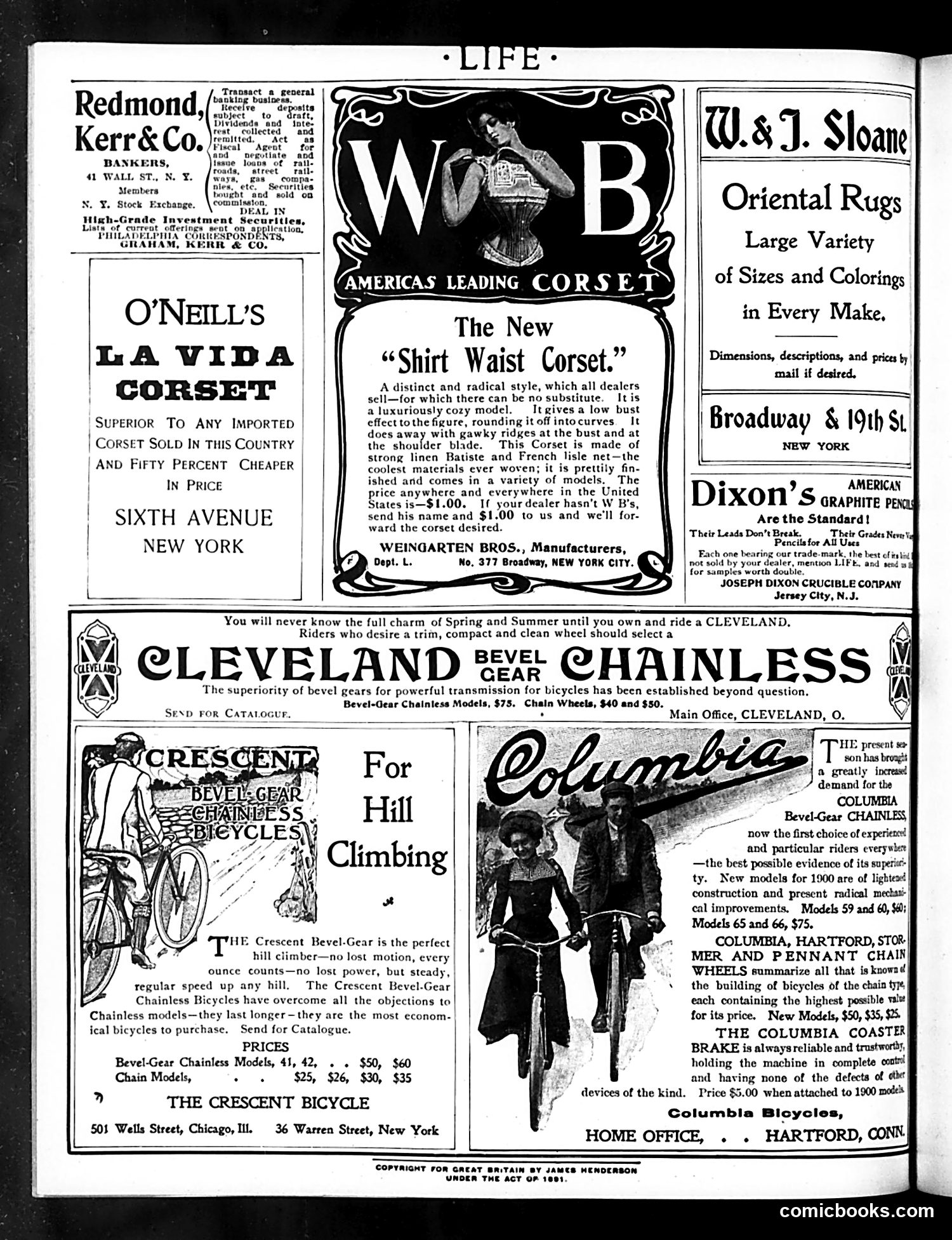
This page is **primarily advertising**, not satirical content. It contains multiple product advertisements typical of early 1900s Life magazine: - **O'Neill's Lavida Corset** (left): marketed as superior to imported corsets - **W&B Corset** (center): the "Shirt Waist Corset" for fashionable women - **W.& J. Sloane Oriental Rugs** (right): home furnishings - **Dixon's Graphite Pencils** (right): writing implements - **Cleveland Bicycles** (large center-bottom): emphasizing bevel-gear technology for hill climbing - **Columbia Bicycles** (right): competing bicycle brand with improved models The bicycle advertisements feature illustrations of women riders, reflecting the period's cycling craze and changing attitudes toward women's active participation in sports. No political satire or caricature is present on this page.
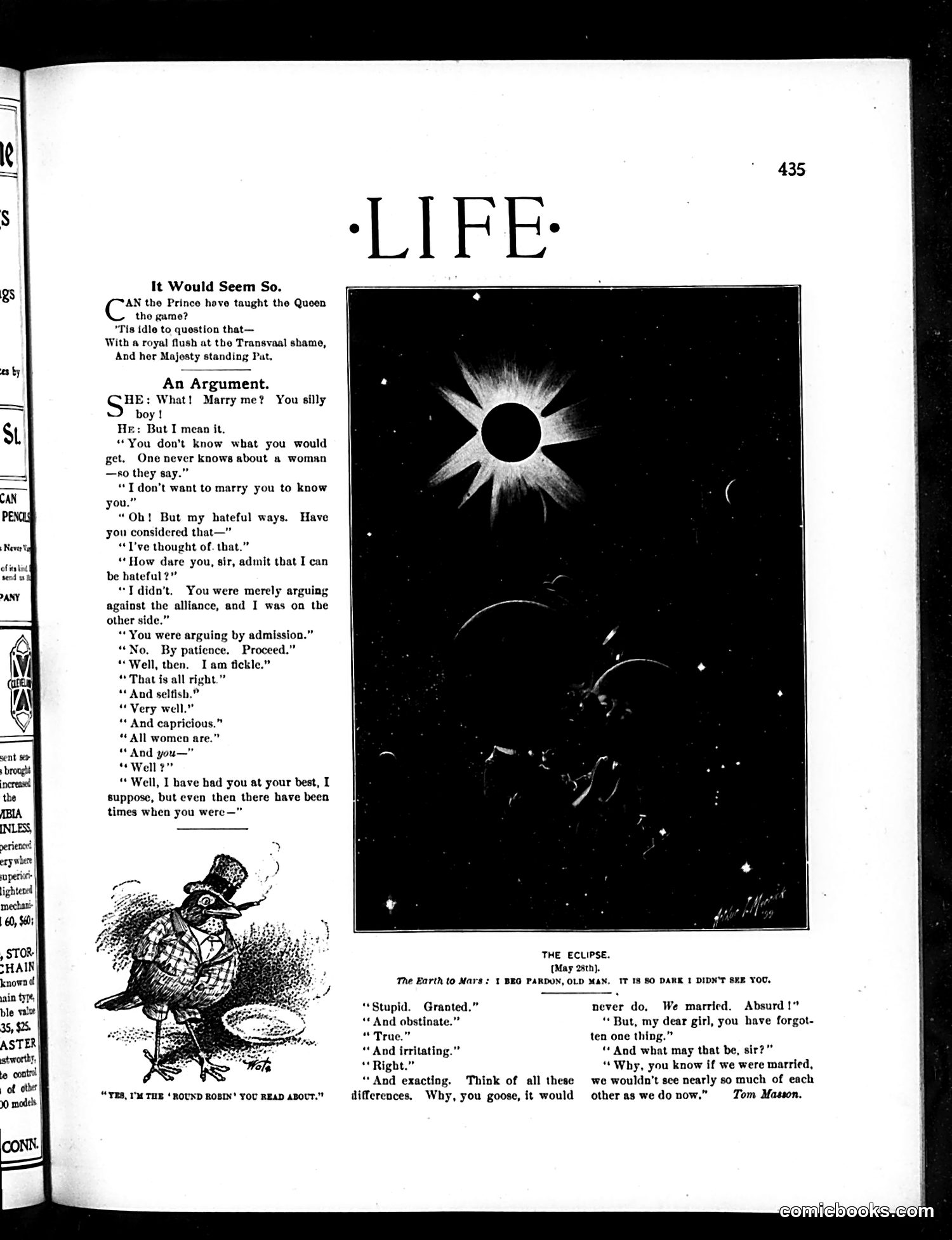
**"An Argument"** (dialogue piece): A humorous exchange between a man and woman debating marriage. He wants to marry her to know her better; she refuses, arguing women are inherently unknowable. The dialogue escalates through witty volleys about gender differences, ending with his admission that even when married, couples barely see each other—making her refusal pointless. **"The Eclipse"** (large illustration): Shows a solar eclipse with silhouetted figures below. The accompanying poem references an "old man" who didn't see the eclipse, paired with dialogue mocking his marriage—the satire being that married couples are so distant they might as well be blind to each other's existence. Both pieces satirize marriage as isolating rather than unifying.
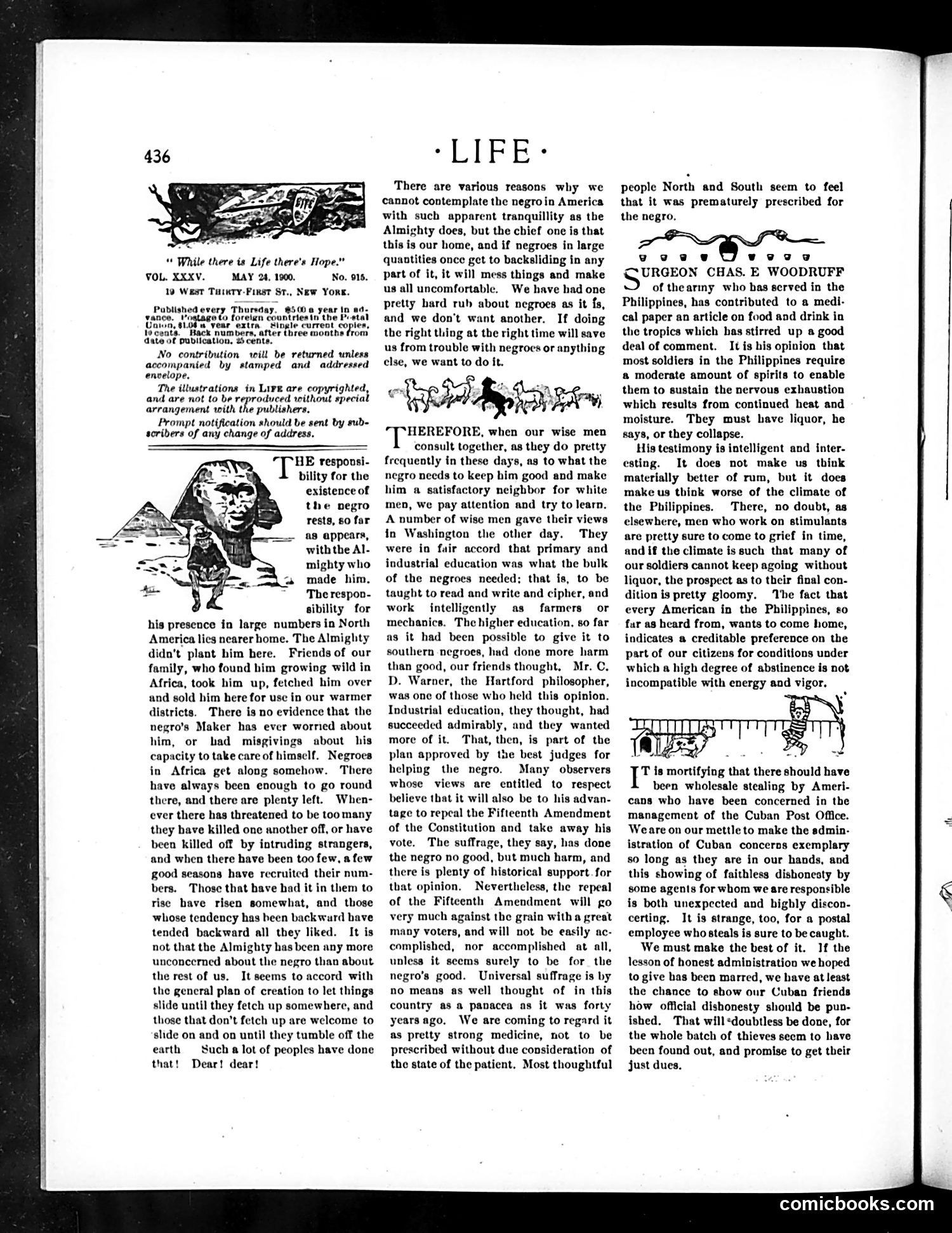
This page contains three distinct editorial cartoons addressing race and labor issues in early 20th-century America. The **left cartoon** depicts a caricatured Black figure, illustrating an article arguing that enslaved African Americans were better off under slavery than in the North, where they faced exploitation and poor conditions. The **top right cartoon** shows figures drinking, accompanying text by "Euroclio" debating whether Philippine soldiers require alcohol to endure tropical hardship—reflecting contemporary debates over colonial administration. The **bottom right cartoon** depicts what appears to be a postal worker, referencing alleged corruption in the Cuban Post Office administration and discussing official dishonesty. All three cartoons employ heavy racial and ethnic caricature typical of early 1900s satirical magazines, presenting viewpoints now recognized as deeply racist and reflecting the era's problematic attitudes toward colonialism and race.
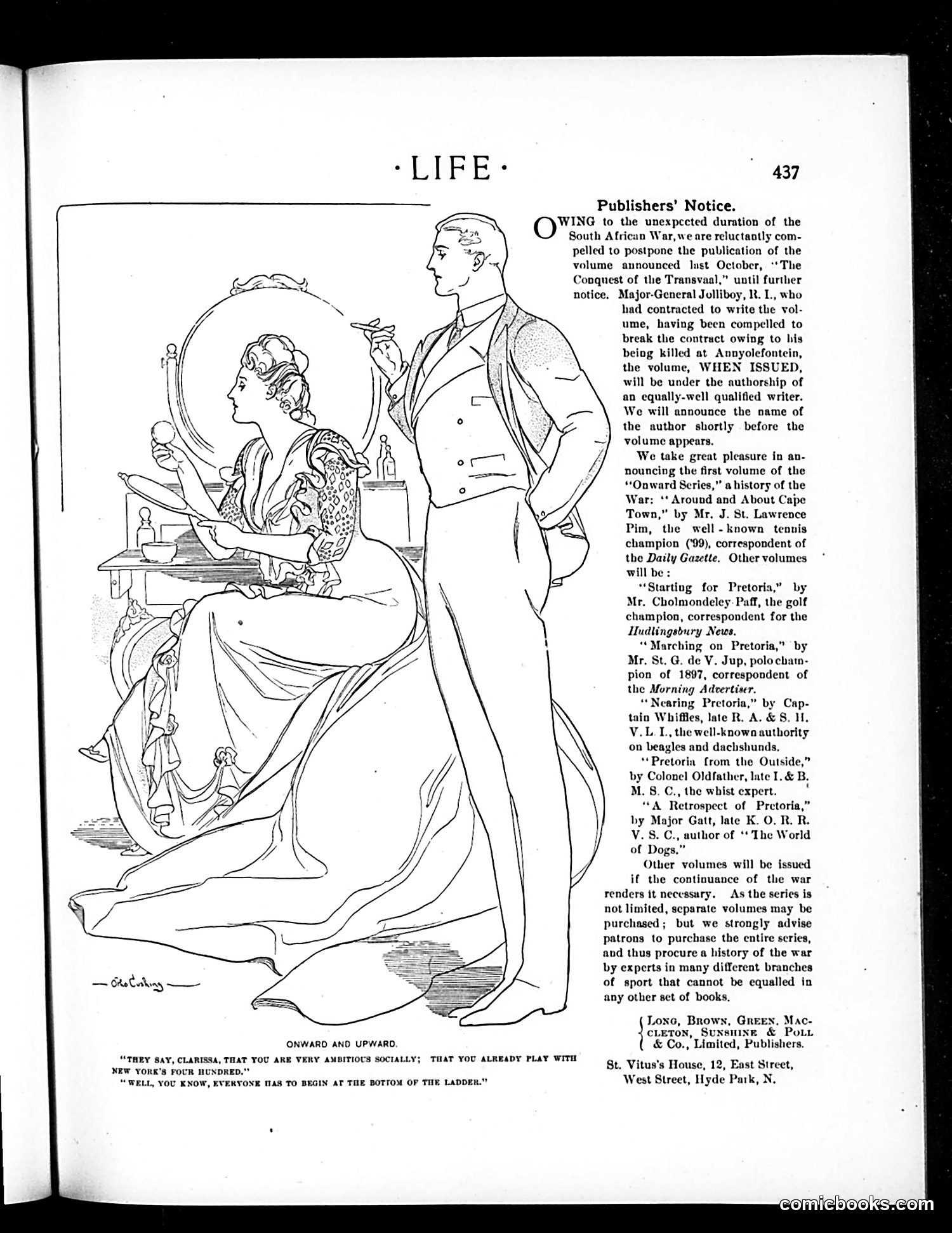
This page contains a satirical cartoon titled "Onward and Upward" by an artist signed "Cesare" (likely Cesare Biseo). The illustration depicts a woman at a vanity mirror being attended by a man in formal dress, with the caption suggesting social climbing ambitions. The cartoon satirizes upper-class social aspirations, particularly women's pursuit of status. The woman examines herself while the man—likely representing a suitor or social advisor—encourages her ambitions, referencing "New York's four hundred" (the city's elite social circle). The caption's reference to "climbing" plays on the ladder metaphor for social advancement. The majority of the page comprises a Publishers' Notice announcing postponement of a volume about the South African (Boer) War due to the author's death, with details about replacement authors and forthcoming books in the "Onward Series."
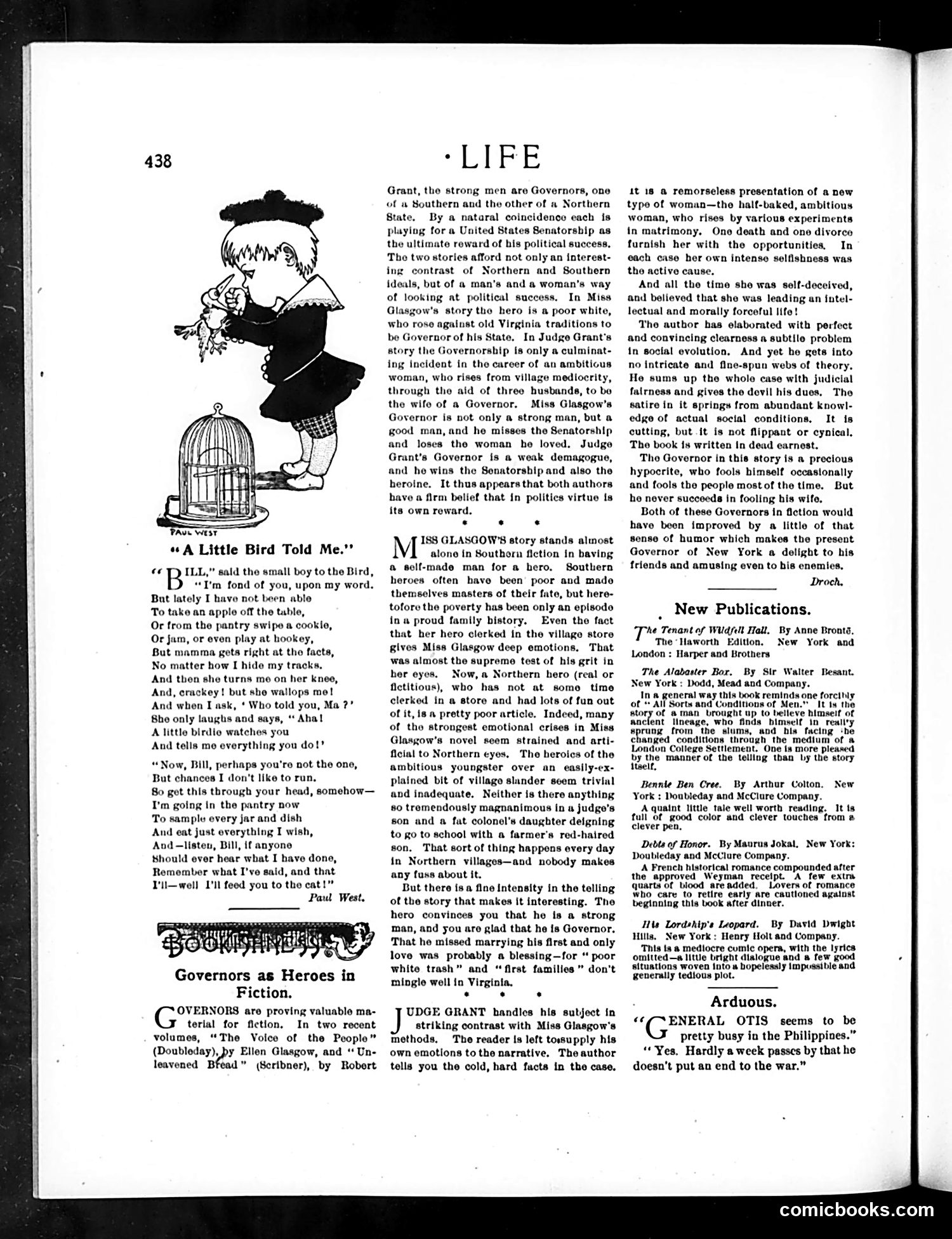
This cartoon depicts a small boy speaking to a caged bird, illustrating a poem about discretion and gossip. The boy warns the bird that although he's told it secrets, he hopes the bird won't repeat them—"who told you, Ma?"—establishing the joke that even inanimate creatures shouldn't be trusted with confidences. The accompanying article discusses two recent novels featuring ambitious politicians seeking governorships: Ellen Glasgow's story about a poor white Virginian and Judge Grant's about a Northern hero. The satire criticizes how these characters manipulate their way to power, missing marriages and genuine connections in pursuit of political success. The overall message critiques the moral compromises required in political ambition.
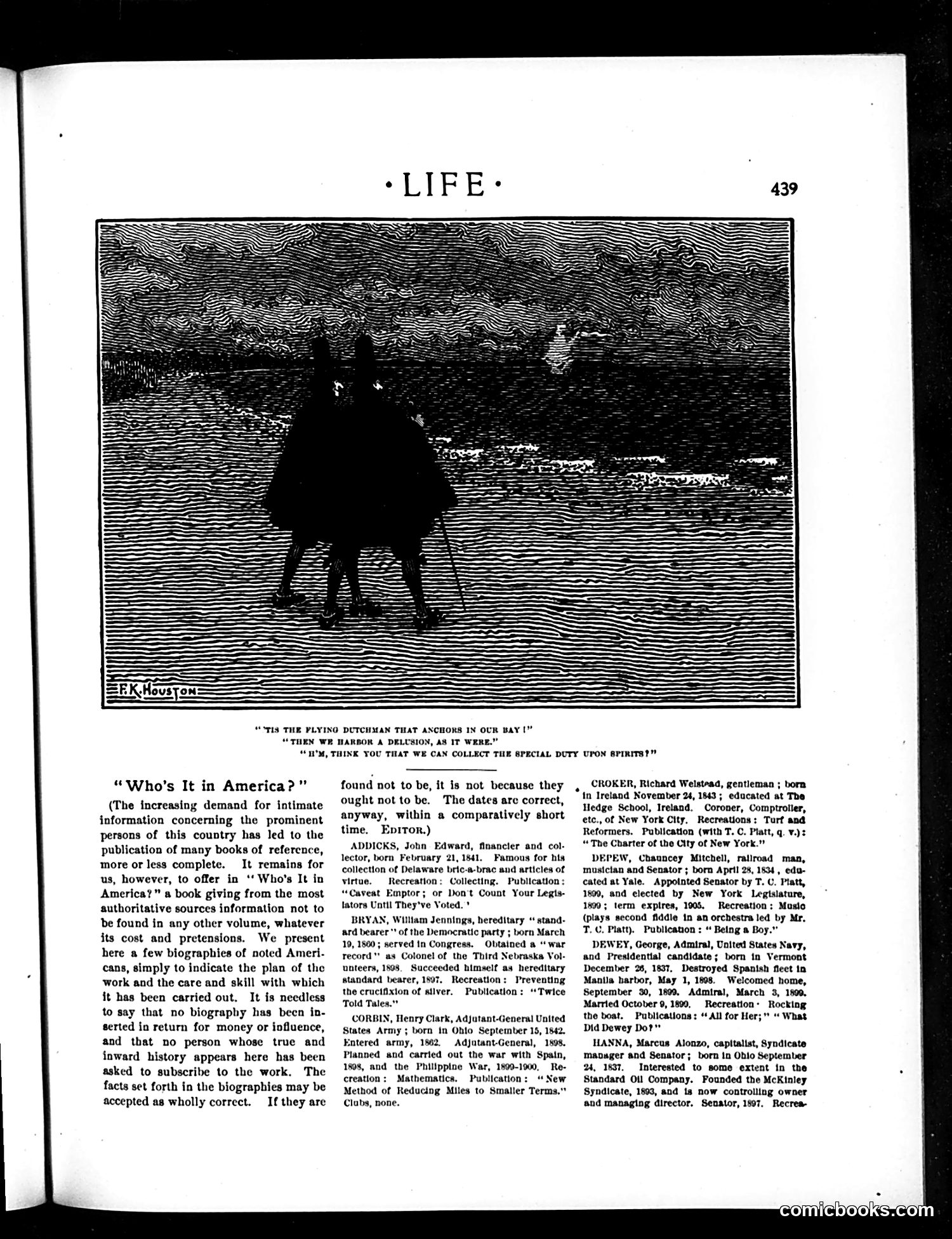
This page from *Life* magazine features an engraving by E.K. Houston depicting a silhouetted figure in a landscape. The caption references "the flying dutchman that anchors in our bay" and mentions harboring "a delicious...it were" and collecting "special duty upon spirits." The cartoon appears to be political satire about contraband liquor smuggling, likely during Prohibition era. "The Flying Dutchman" (a ghostly ship legend) serves as a metaphor for vessels bringing illegal alcohol into American harbors. The reference to "special duty upon spirits" is a pun—spirits meaning both alcohol and ghosts—satirizing the government's inability to prevent smuggling despite tariffs and enforcement efforts. The accompanying biographical entries suggest this is from a "Who's It in America?" feature providing background on notable figures.
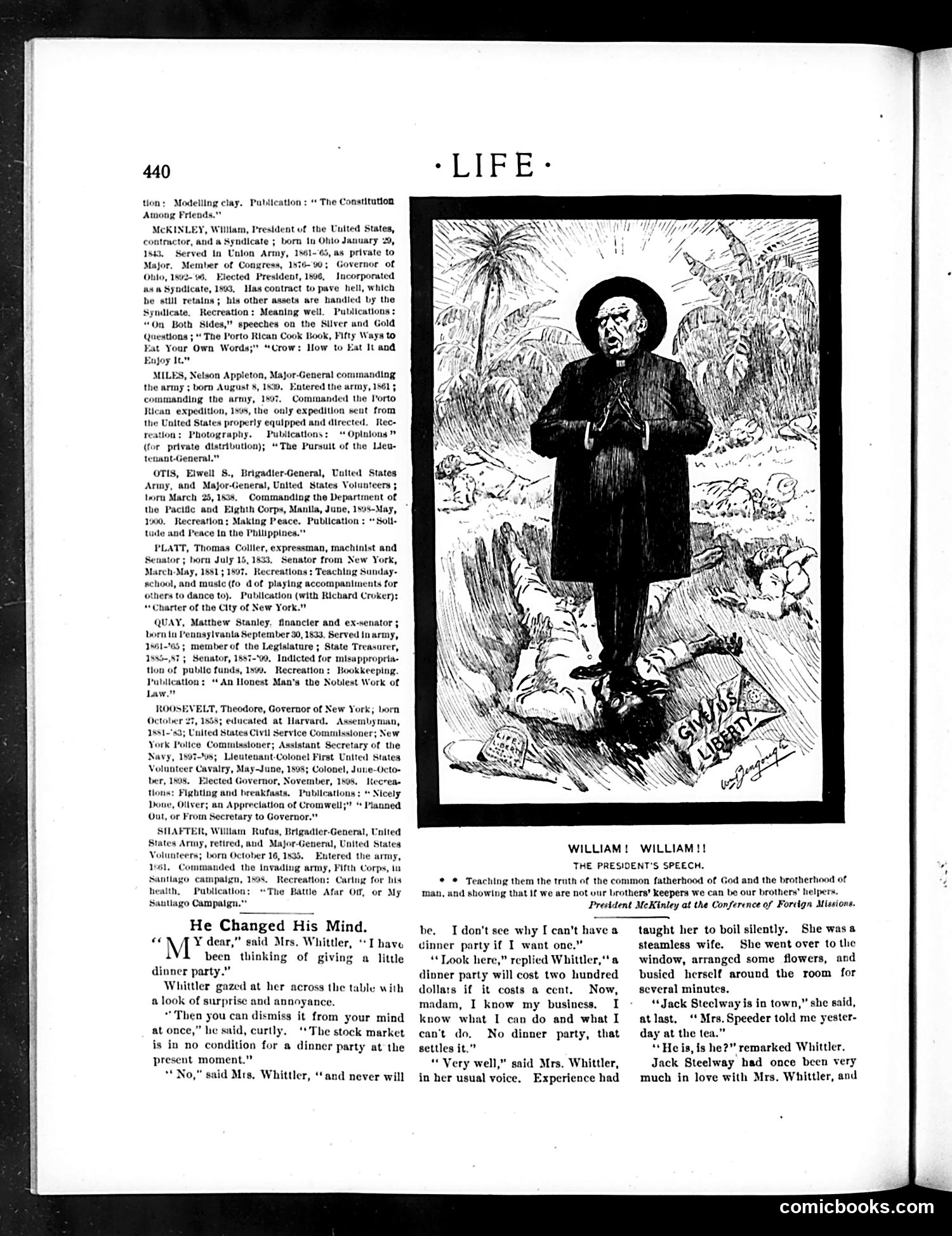
The main illustrated section titled "WILLIAM! WILLIAM!!" depicts a stern-looking figure (likely representing a authority figure or parent) lecturing to children seated below. The caption references "Teaching them the truth of the common fatherhood of God and the brotherhood of man," attributed to President McKinley's conference on Foreign Missions. The cartoon satirizes McKinley's stated moral and religious justifications for American foreign policy, particularly regarding overseas expansion and missionary work. The image suggests these lofty ideals are being imposed upon reluctant or captive audiences, ironically contrasting the rhetoric of brotherhood with what appears to be coercive instruction. The accompanying story excerpt, "He Changed His Mind," involves a domestic dispute about hosting a dinner party, providing lighter satirical content contrasting with the political cartoon above.
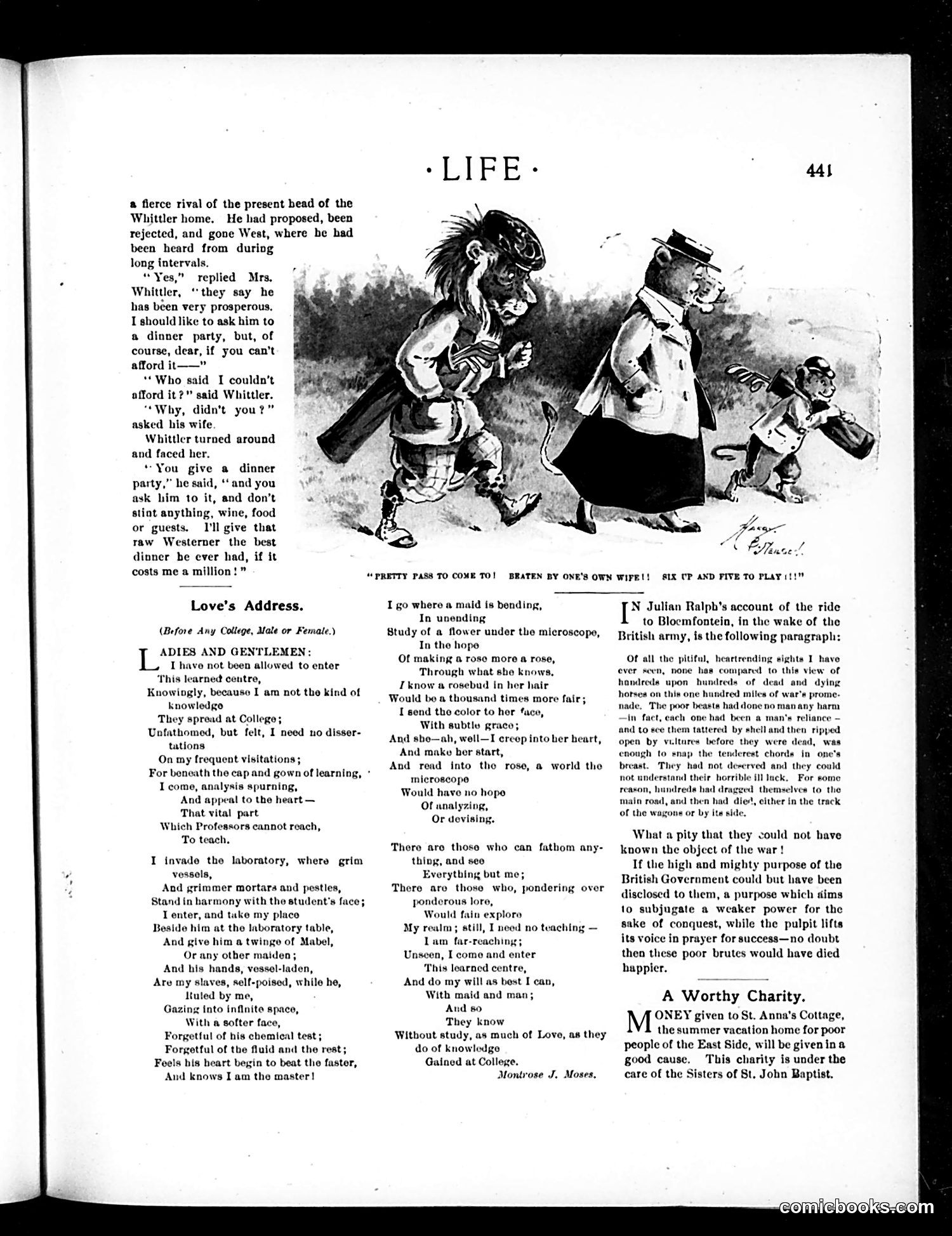
The main cartoon depicts three figures in formal dress appearing distressed or in conflict, with the caption "PRETTY PASS TO COME TO! BEATEN BY ONE'S OWN WIFE!! SIX OF AND FIVE TO PLAY!!!" The satire appears to mock a domestic dispute, likely involving a prominent figure (suggested by the formal attire and the reference to being "beaten by one's own wife"). The phrase "six of and five to play" is a golf reference, adding absurdist humor by mixing marital conflict with sports terminology. Without clearer identification of the specific figures or dated context, the exact target is unclear, though the satire seems to ridicule both marital discord and perhaps hypocrisy regarding masculinity or social status among the wealthy class that Life magazine typically lampooned.
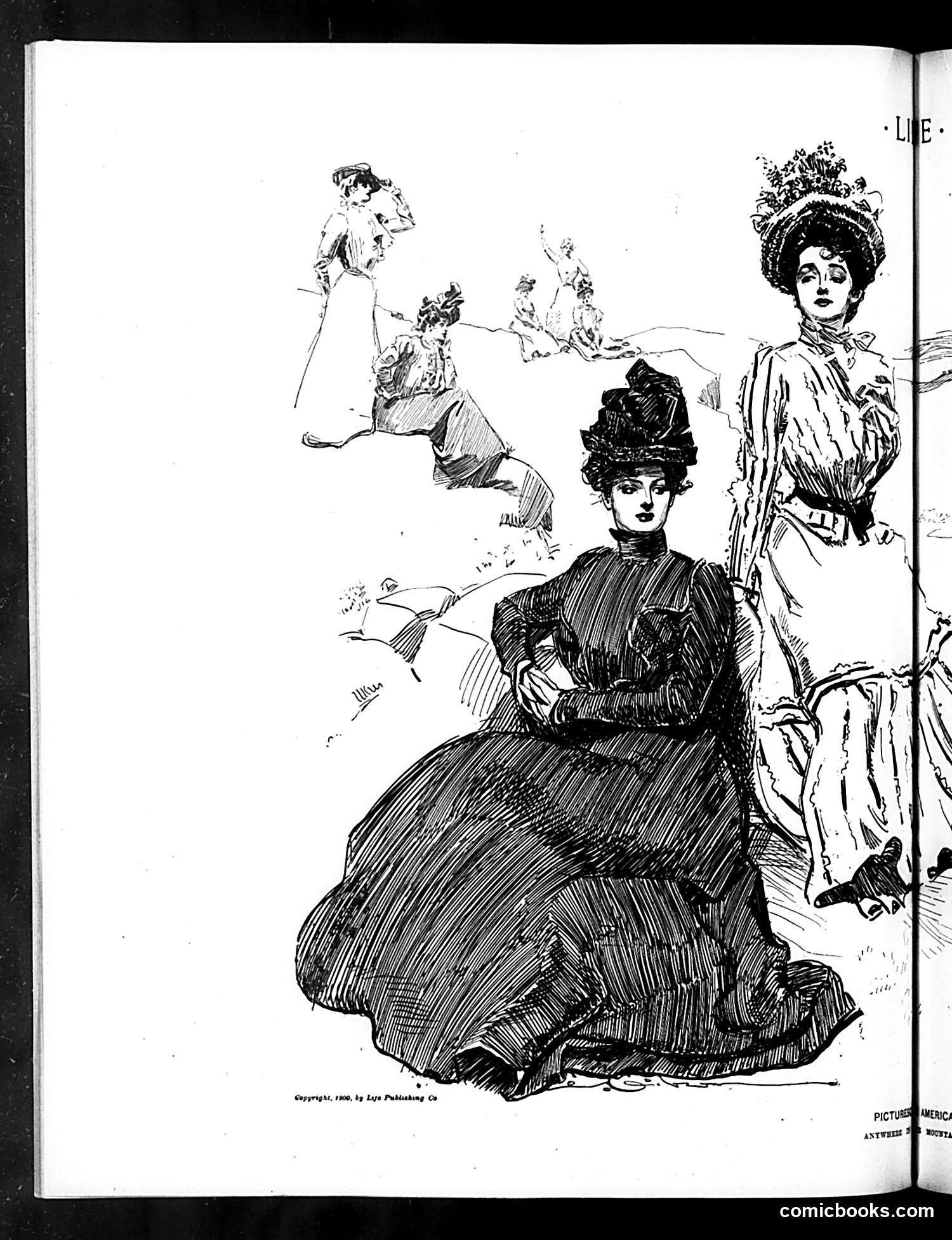
This appears to be a fashion illustration from Life magazine (copyright 1900, per the visible attribution to Life Publishing Co.). The image shows elegantly dressed women in Edwardian-era clothing, featuring the distinctive silhouettes of that period: full skirts, fitted bodices, elaborate hats, and high collars. The drawing style and composition suggest this is likely satirizing fashionable society women of the period—their ostentatious dress, posturing, and social pretensions. The sketchy, caricature-like rendering emphasizes exaggerated features and poses typical of Life's humorous approach to high society. The exact satirical point remains somewhat unclear without additional context, but it likely mocks contemporary women's fashion trends or the vanity of wealthy, fashionable circles around the turn of the twentieth century.
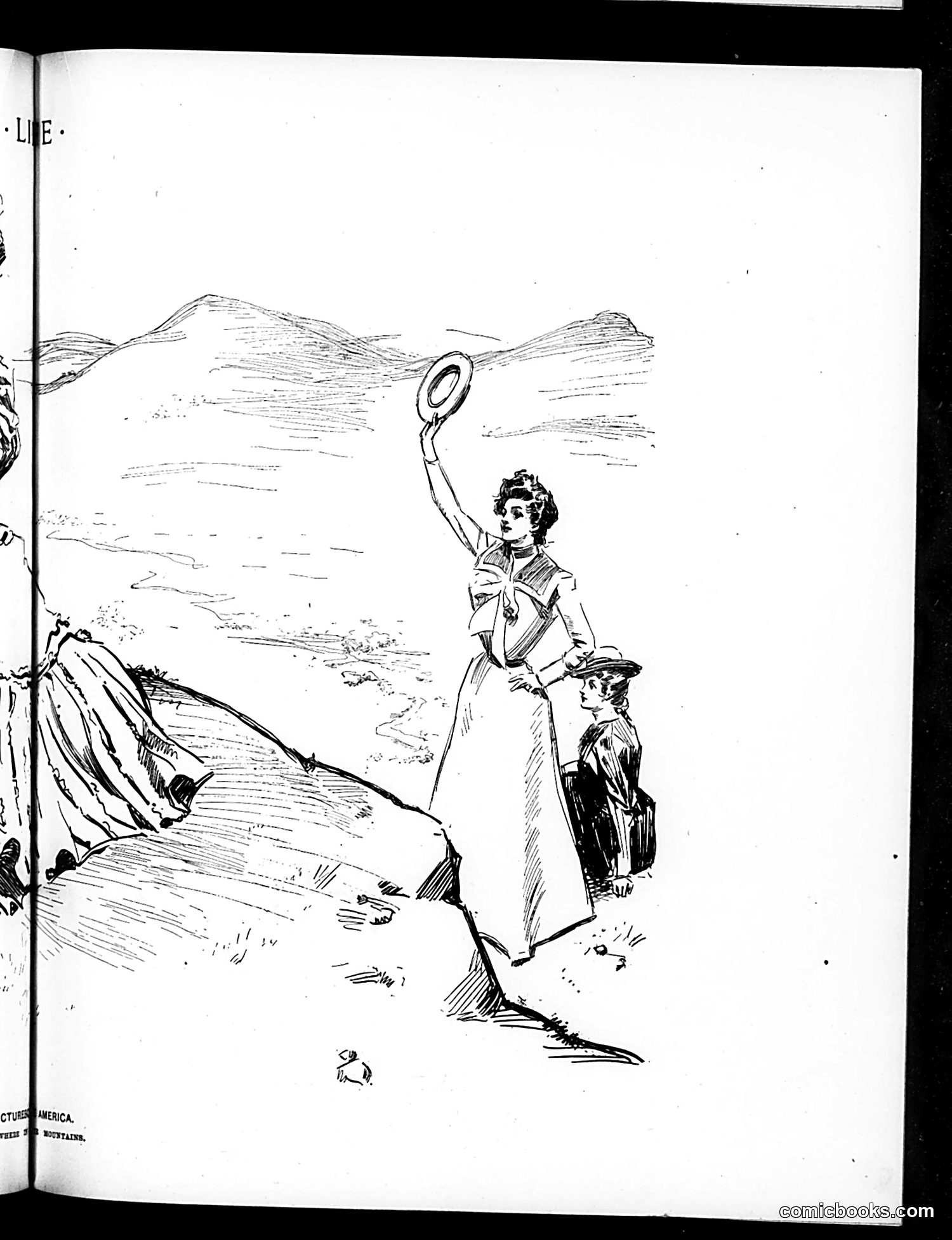
This appears to be an illustration from *Life* magazine (visible at top left) showing a woman in Edwardian-era dress holding up a hat while standing with a young boy on a beach or sandy landscape. The woman's pose is triumphant or celebratory. Without visible text or captions on this page, the specific satirical meaning is unclear. However, the scene likely comments on early 20th-century gender roles or social conventions—possibly mocking fashionable women's behavior, leisure activities, or the relationship between adults and children during this period. The exaggerated pose and the hat-waving gesture suggest the illustration is meant to be humorous or pointed social commentary, though the exact target of the satire cannot be determined from the image alone.
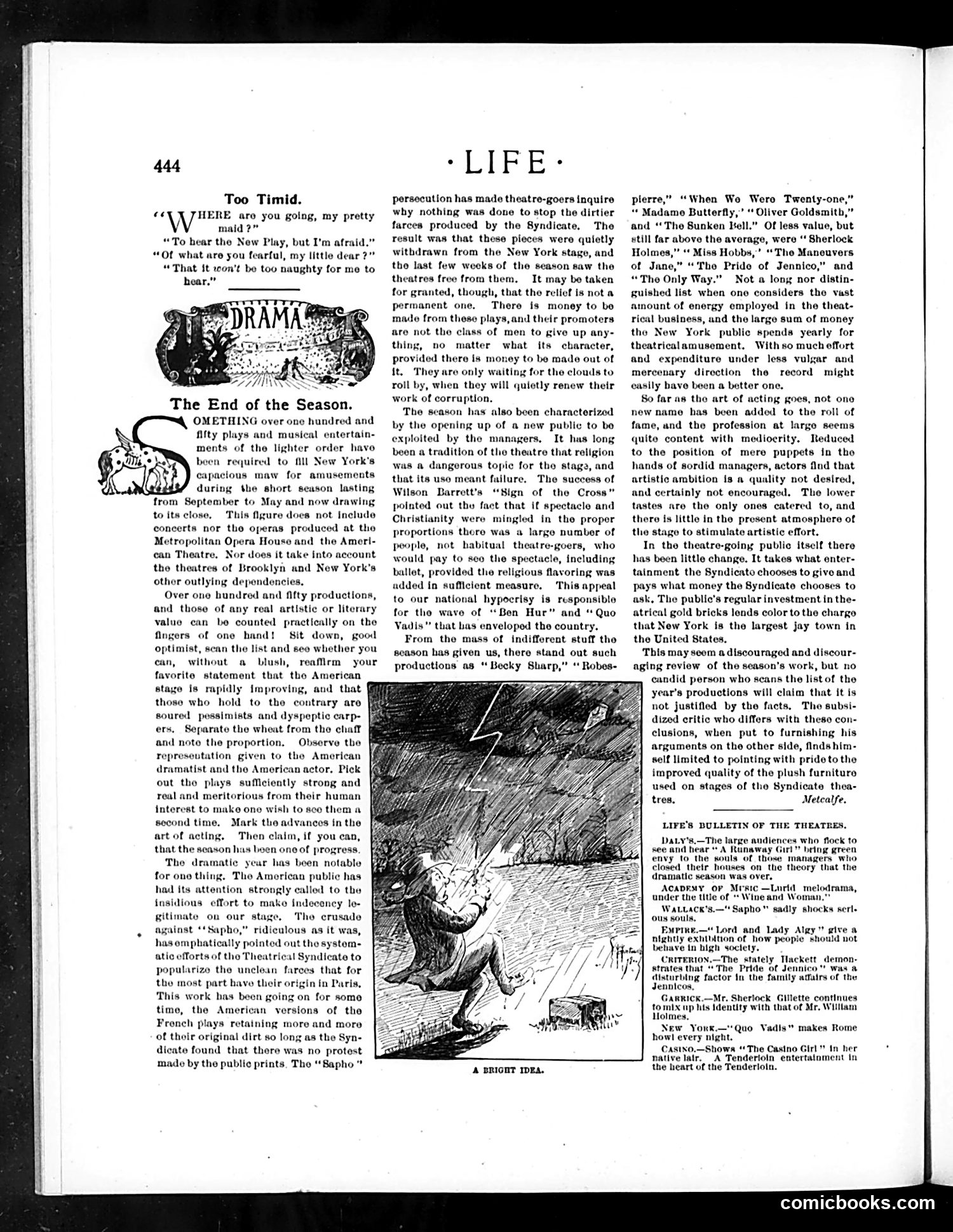
This cartoon depicts a figure (likely representing theater management or the Theatrical Syndicate) struck by lightning labeled "A BRIGHT IDEA." The accompanying article criticizes the Syndicate's monopolistic control of American theater. The text argues that over 150 theatrical productions this season represent progress, yet the Syndicate has created an "insidious effort to monopolize" legitimate theater. The article contrasts American plays (praised as "authentically strong") with French imports the Syndicate favors, suggesting the monopoly prioritizes profit over artistic merit. The lightning bolt is ironic—what appears "bright" to the Syndicate (their business strategies) is actually damaging to American theater's independence and quality.
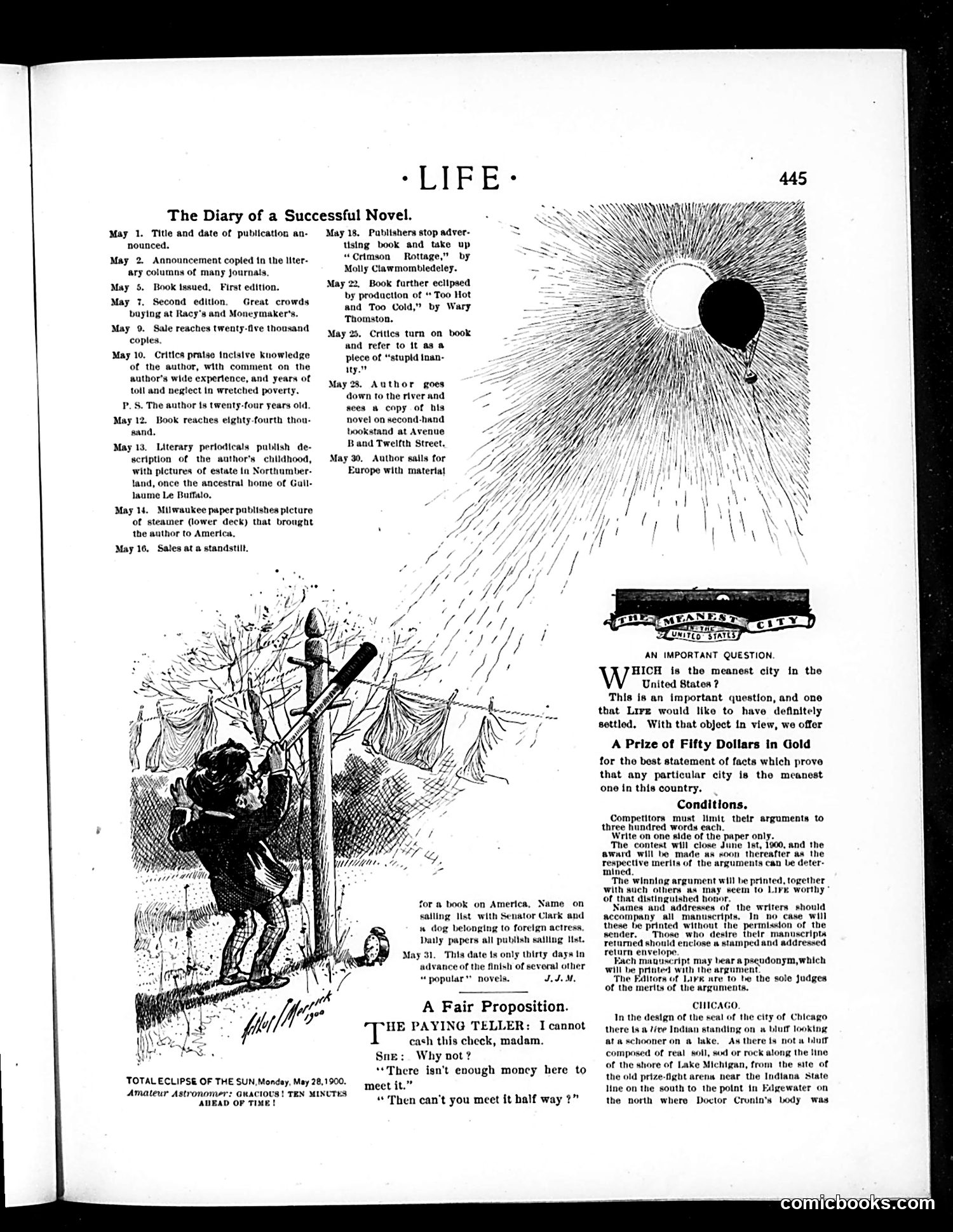
**"The Diary of a Successful Novel"** satirizes publishing's fickle nature. A book enjoys meteoric rise (May 1-14: publication through 84,000 copies sold), then crashes when critics reverse opinions and competitors release similar titles. The punchline: on May 28, a total solar eclipse overshadows the book's finale—a literal visual joke about being "eclipsed." By May 30, the author discovers their novel already discounted on remainder tables, then flees to Europe. The satire mocks how quickly literary success evaporates and how publishers cynically capitalize on trends. **"A Fair Proposition"** is a brief joke about a bank teller refusing to cash a check due to insufficient funds, and the customer's absurd counter-proposal to meet "halfway." **The bottom section** announces a contest offering fifty dollars for the best argument identifying "the meanest city in the United States," with Chicago apparently already nominated based on the editorial fragment discussing its geography and a reference to the Cronin murder case.
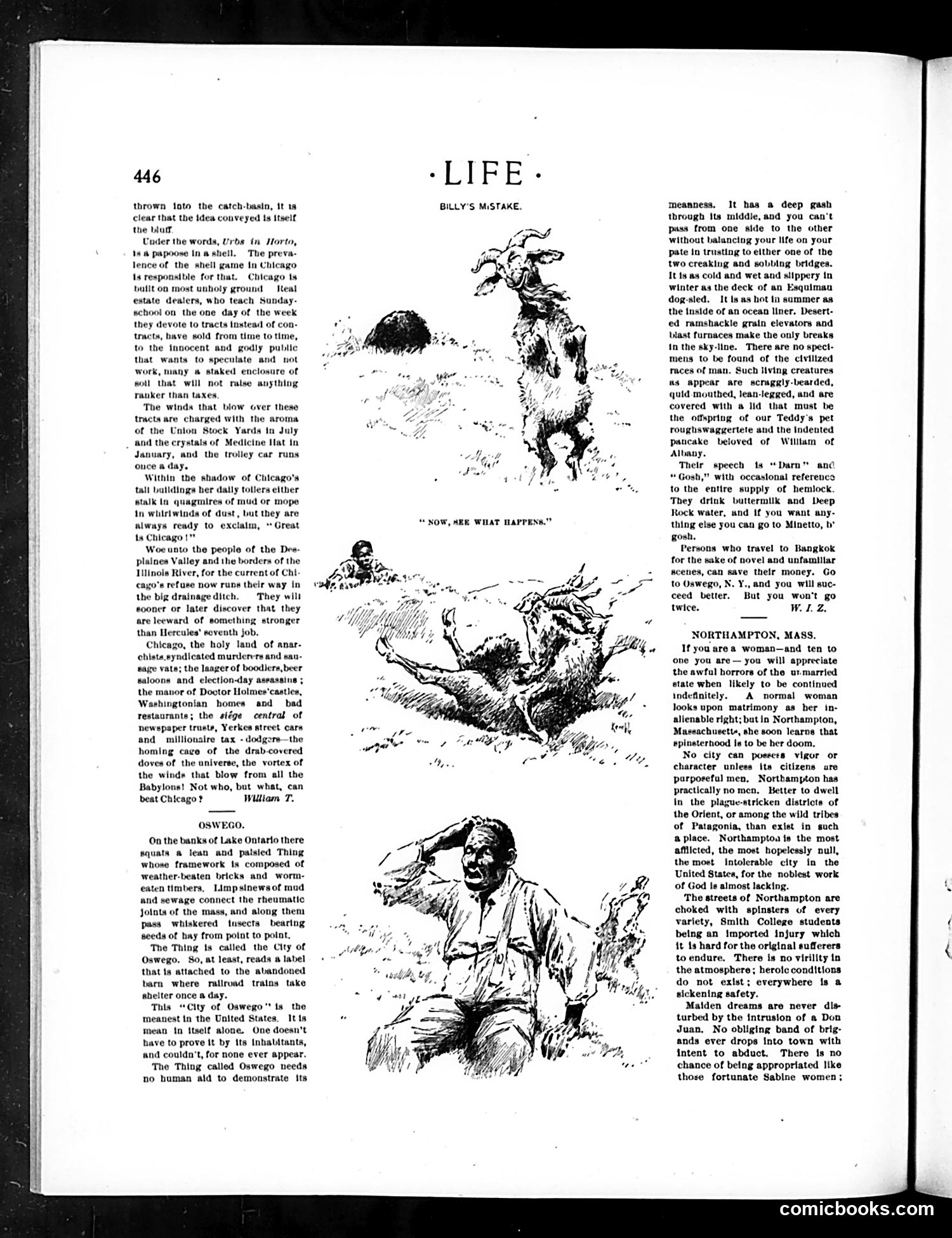
This page from *Life* magazine contains two separate satirical pieces attacking American cities through exaggerated, contemptuous descriptions. **"Billy's Mistake"** (illustrated with sketches) mocks Chicago as a corrupt, polluted cesspool—a "holy land of anarchists" and "murderers," filled with swindlers, corrupt politicians ("boodlers"), and criminals. The text references actual scandals: Dr. H.H. Holmes (a serial killer), corrupt utilities magnate Yerkes, and the city's notorious Union Stock Yards stench. The "shell game" reference alludes to Chicago's reputation for real estate fraud targeting gullible investors. **The Oswego section** savagely ridicules the upstate New York city as literally uninhabitable—physically decrepit, economically dead, climatically brutal, and populated only by crude, inarticulate people. The suggestion that visiting Oswego beats traveling to Bangkok for novelty is purely insulting. Both pieces exemplify *Life*'s satirical voice: savage attacks on American urban dysfunction, corruption, and decay. The tone assumes readers share the author's contempt for these cities' failures.
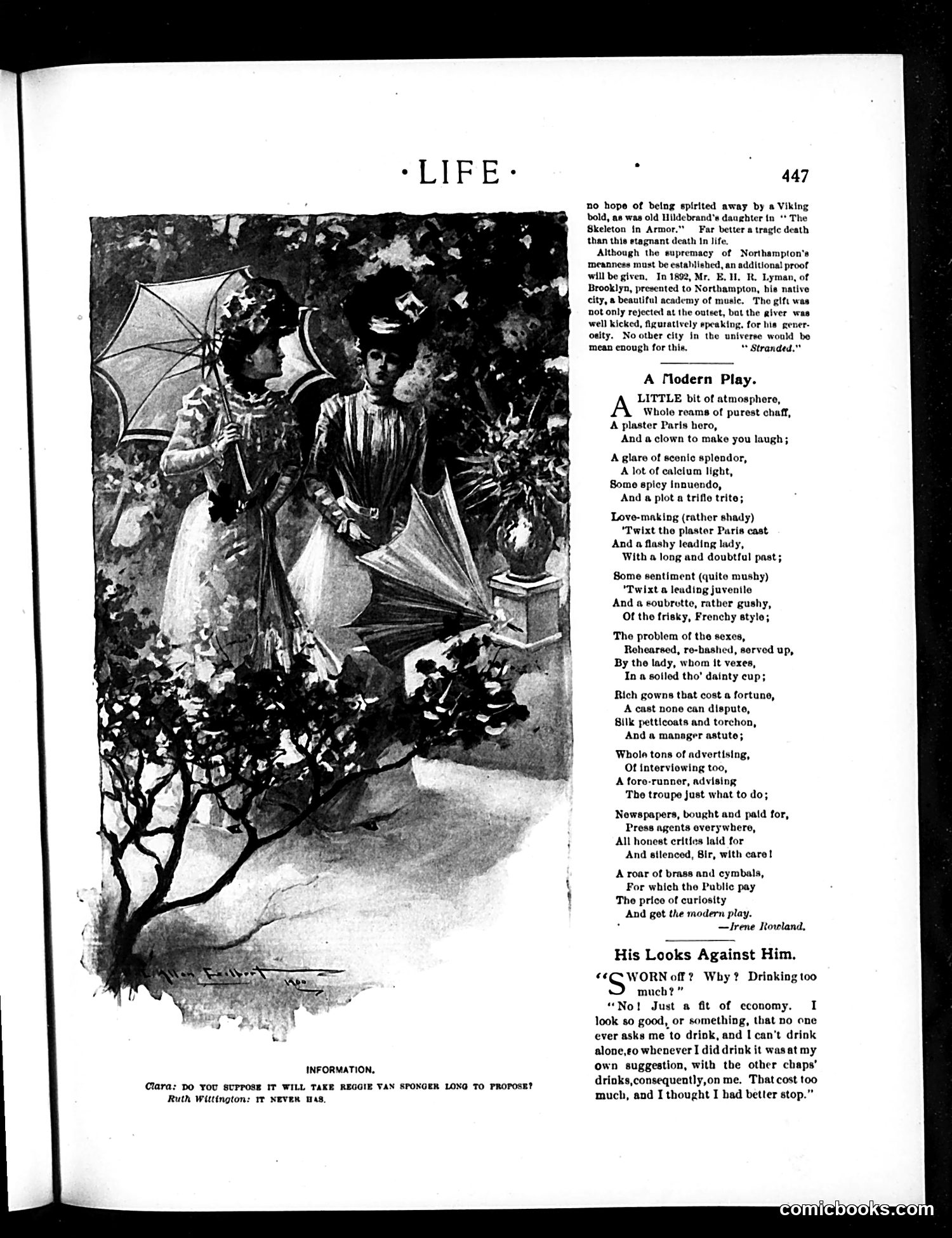
This page contains three satirical pieces typical of early 20th-century American humor magazine Life. **Top illustration and text**: A narrative criticism of Northampton, Massachusetts, presented as exceptionally mean-spirited. The text cites a specific 1892 incident where Brooklyn native E.I.L. Lyman donated a music academy to his hometown—only to have it rejected and be figuratively "kicked" for his generosity. The satire suggests no other city would be so ungracious. **"A Modern Play" poem** (by Irene Rowland): A scathing critique of contemporary theater, cataloging its formulaic clichés—stock characters (plaster Paris hero, flashy leading lady), recycled plots, sensationalism, heavy advertising, and bought press coverage. The satire attacks both theatrical mediocrity and the machinery promoting it. **"His Looks Against Him"**: A brief comic dialogue where a man explains his sobriety results from being too handsome—people assume he doesn't need drinks offered, so he never drinks socially. The joke satirizes vanity and the social awkwardness of masculine appearance working against expected behavior.
This page is primarily **advertising and short humorous anecdotes**, not political cartoons. The main content includes: 1. **"At Scissors at Nulls"** - A poetic anecdote about a bank president during a financial run who calmly lights a cigar with a burning $10 bill to demonstrate confidence, thereby stopping the panic and saving the bank. The story illustrates American confidence and composure during financial crisis. 2. **Walt Whitman anecdote** - A brief story showing the famous poet employed by wealthy patron George Childs to ride streetcars, observe poor conductors without overcoats, and report their sizes so Childs can send them coats anonymously. This portrays genteel charity and dignified mutual respect. 3. **Heavy advertising** - Including whiskey (Wilson, Old Crow Rye, Old Overholt), steel pens (Esterbrook), and cigars (The Brunswick). The satirical tone is gentle, celebrating American values: financial soundness, elite generosity, and honest work. There are no identifiable political figures or sharp social critique.
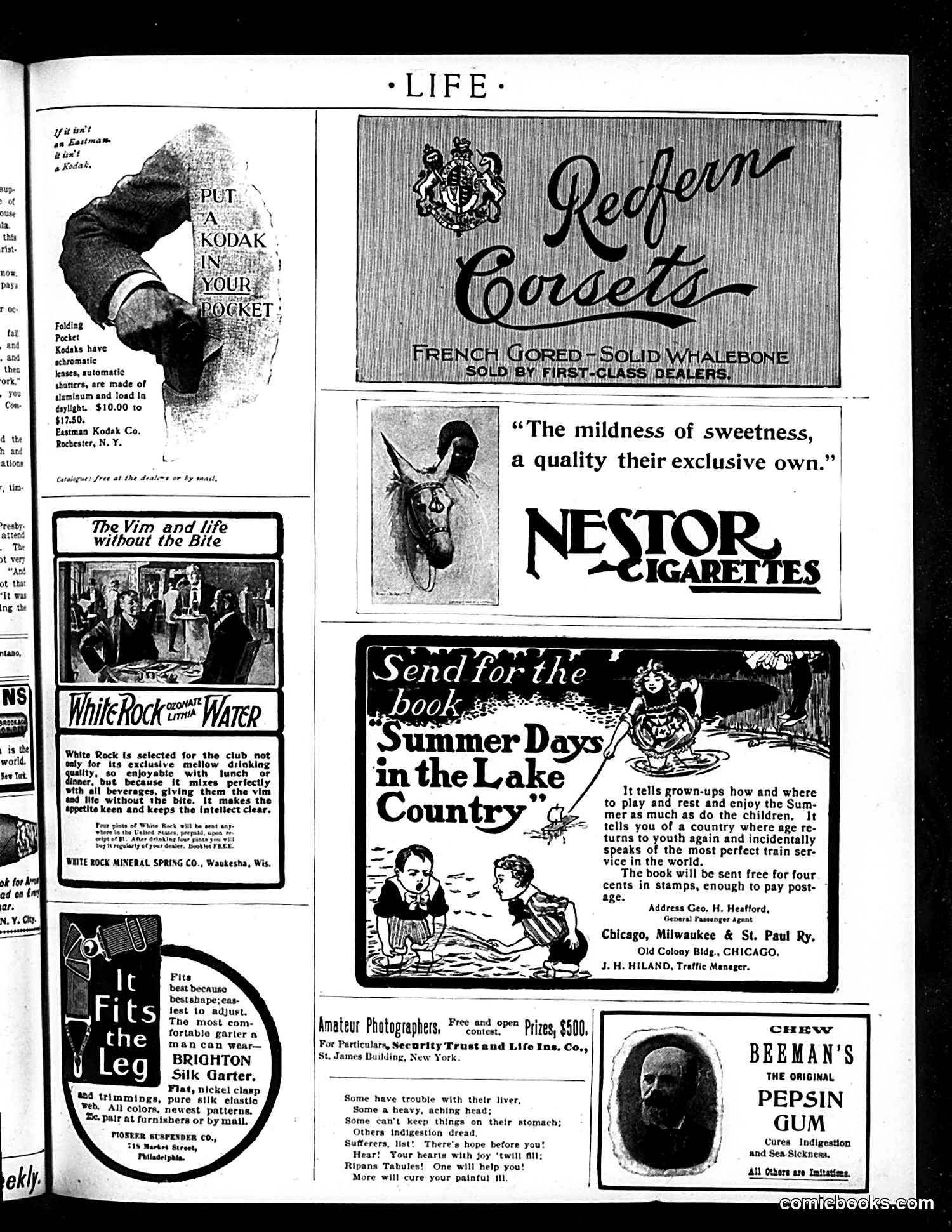
This is primarily an **advertising page** from Life magazine, with minimal editorial content. The page features product advertisements for Kodak folding cameras, White Rock mineral water, Brighton silk garters, Nestor cigarettes, Redfern corsets, a train travel book, Ripans Tabules digestive remedy, Beeman's gum, and a photography contest. The only element resembling editorial content is a small illustration labeled "The Vim and life without the Bite"—appearing to show a social gathering—which seems to be promoting White Rock water's claim that it enhances beverages without harshness. There is **no political satire or cartoon** visible on this page. The "Life" magazine was known for satire, but this particular page is dominated by turn-of-the-century consumer product marketing, reflecting the publication's reliance on advertising revenue.
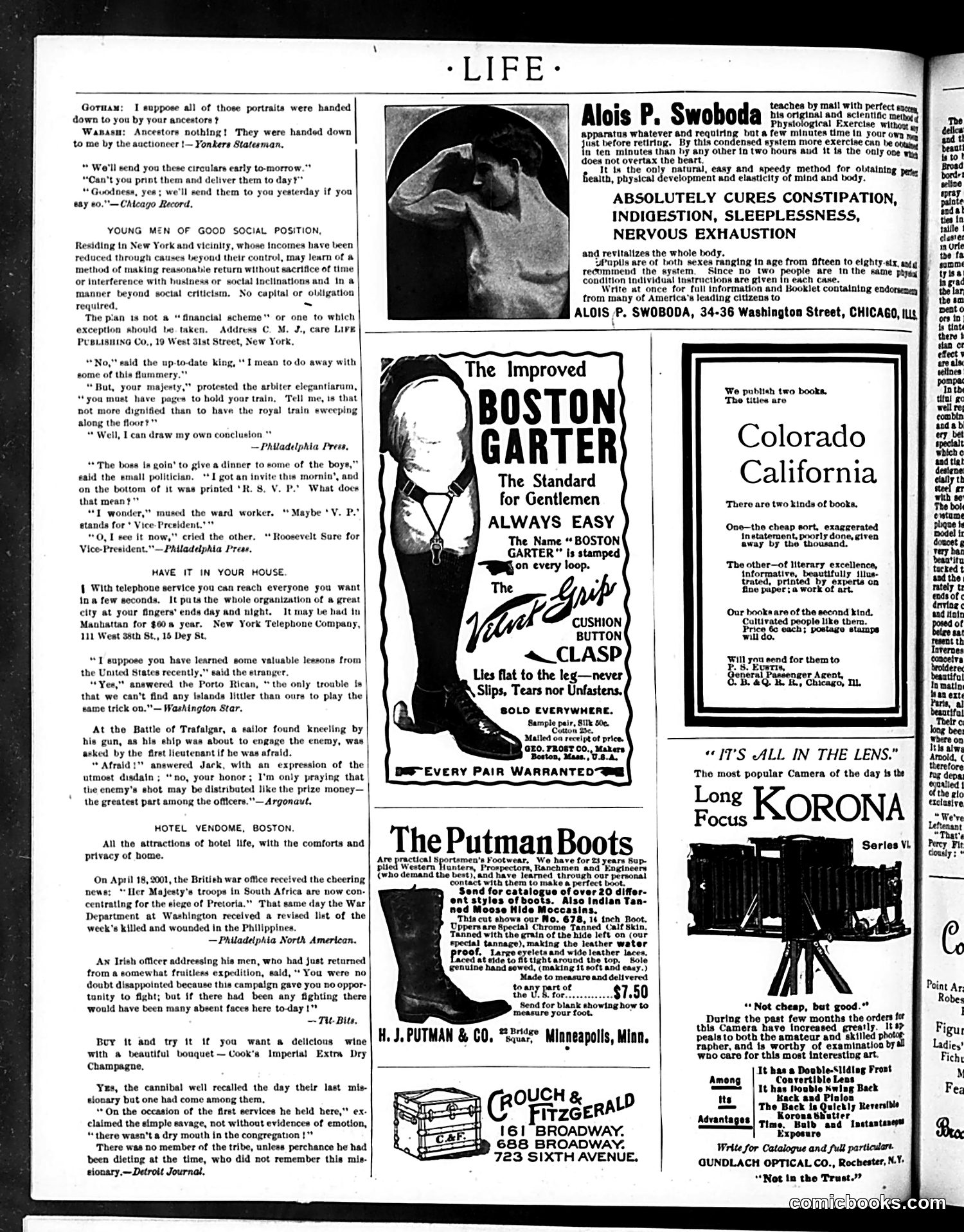
This page is primarily **advertising content** with minimal political satire. The dominant features are product advertisements (Alois P. Swoboda's exercise system, Boston Garter, Putman Boots, Korona camera) interspersed with brief humorous anecdotes. The few cartoon-style jokes present are generic social humor rather than political commentary: - A dialog about auction-purchased portraits (mocking newly wealthy families pretending to old ancestry) - A confusion about "R.S.V.P." misread as "Roosevelt Sure for Vice-President" (lighthearted wordplay, not sharp satire) - Military/naval anecdotes about class differences (officers receiving disproportionate prize money) The page lacks identified caricatures or pointed political figures. Instead, it represents **early 20th-century Life magazine's shift toward commercial content**—humor serves mainly as filler between paid advertisements rather than delivering sustained satirical commentary on current events or public figures.
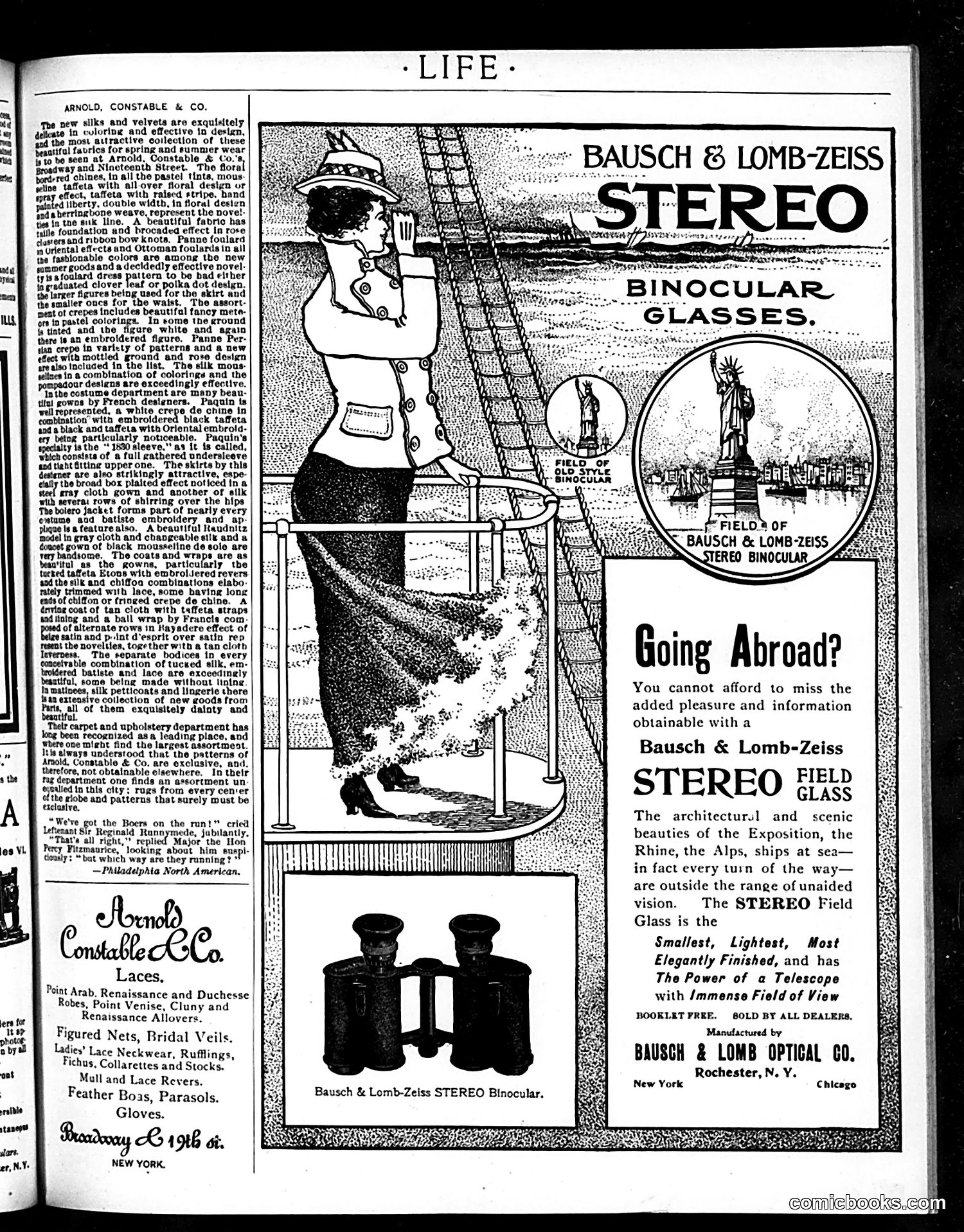
This page is primarily **advertising and fashion editorial**, not political satire. The left column features Arnold, Constable & Co.'s spring/summer fashion collection—silks, velvets, designer gowns from Paquin and other French couturiers, plus carpets and upholstery. The text describes fabrics like "Panne Persian crepe" and "mousseline de sole" with floral and Oriental designs. The right side advertises **Bausch & Lomb-Zeiss Stereo Binoculars**, marketed to travelers ("Going Abroad?") visiting landmarks like the Statue of Liberty. The binoculars are promoted as lightweight, elegant, and telescope-powerful. At the bottom, a brief dialogue fragment mentions "Boers" and military personnel (Lieutenant, Major), likely referencing the **Boer War** (1899-1902), but it's incomplete and unclear in context. **Overall:** This is a typical Life magazine issue mixing high-end advertising with minimal satirical content.
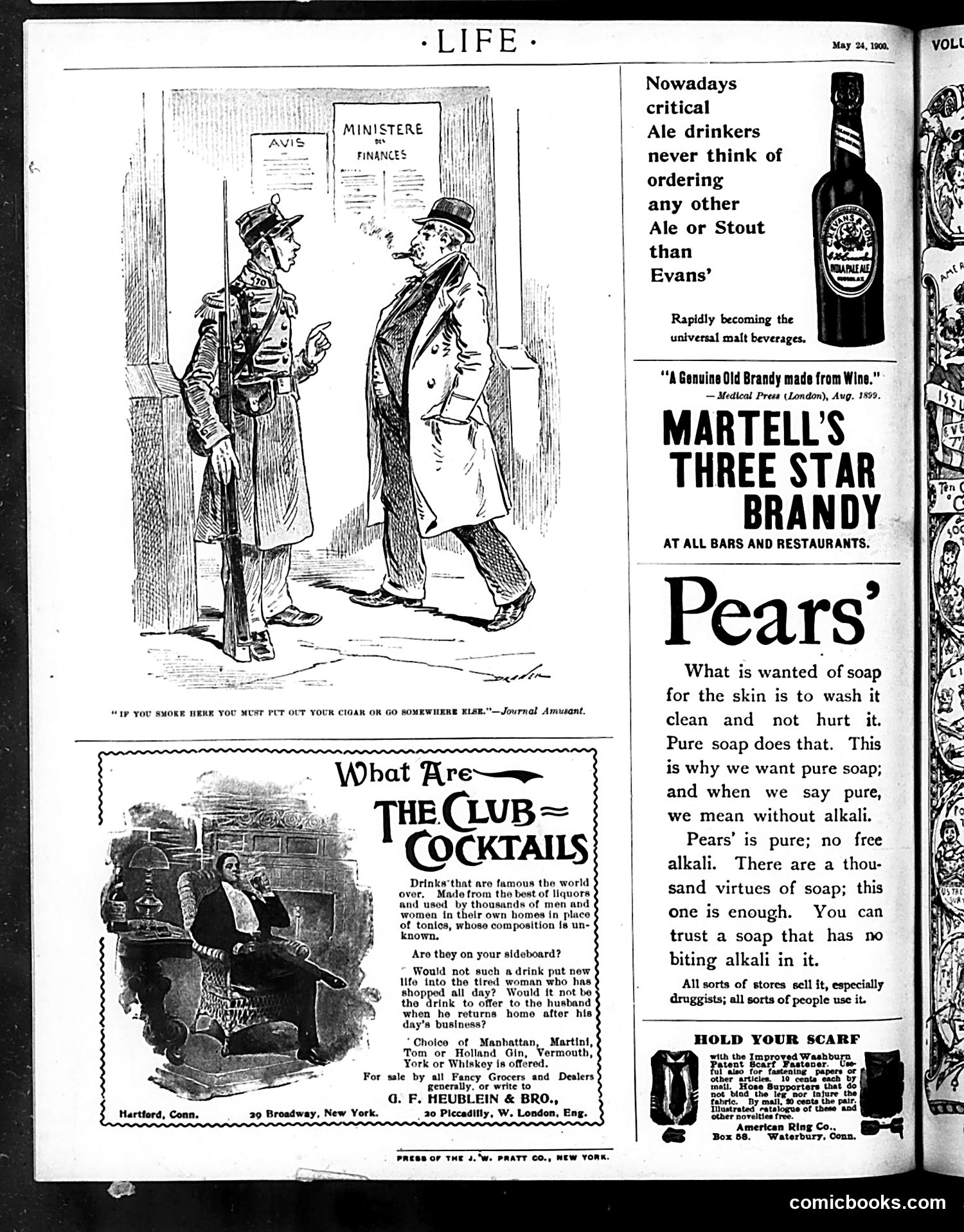
The main cartoon depicts a military officer confronting a civilian near government ministry notices ("AVIS" and "MINISTÈRE DES FINANCES"). The caption quotes *Journal Amusant*: "If you smoke here you must put out your cigar or go somewhere else." **The satire**: This appears to satirize French bureaucratic authority and smoking regulations. The uniformed officer enforces a no-smoking rule at government offices, likely mocking either excessive French military authority or new public health/smoking restrictions being debated in early 1900s France. The humor lies in the formal enforcement of what seems a minor rule. The page is otherwise **advertising-heavy**: Evans' Ale, Martell's Brandy, Pears' Soap, and various other products dominate. A separate section discusses "Club Cocktails" as fashionable home beverages. **Historical context**: This reflects Belle Époque France and Edwardian-era consumer culture, when such magazines blended political satire with commercial messaging to middle/upper-class readers.