
Life, 1900-05-24 · page 6 of 20
Life — May 24, 1900 — page 6: what you’re looking at
What you’re looking at
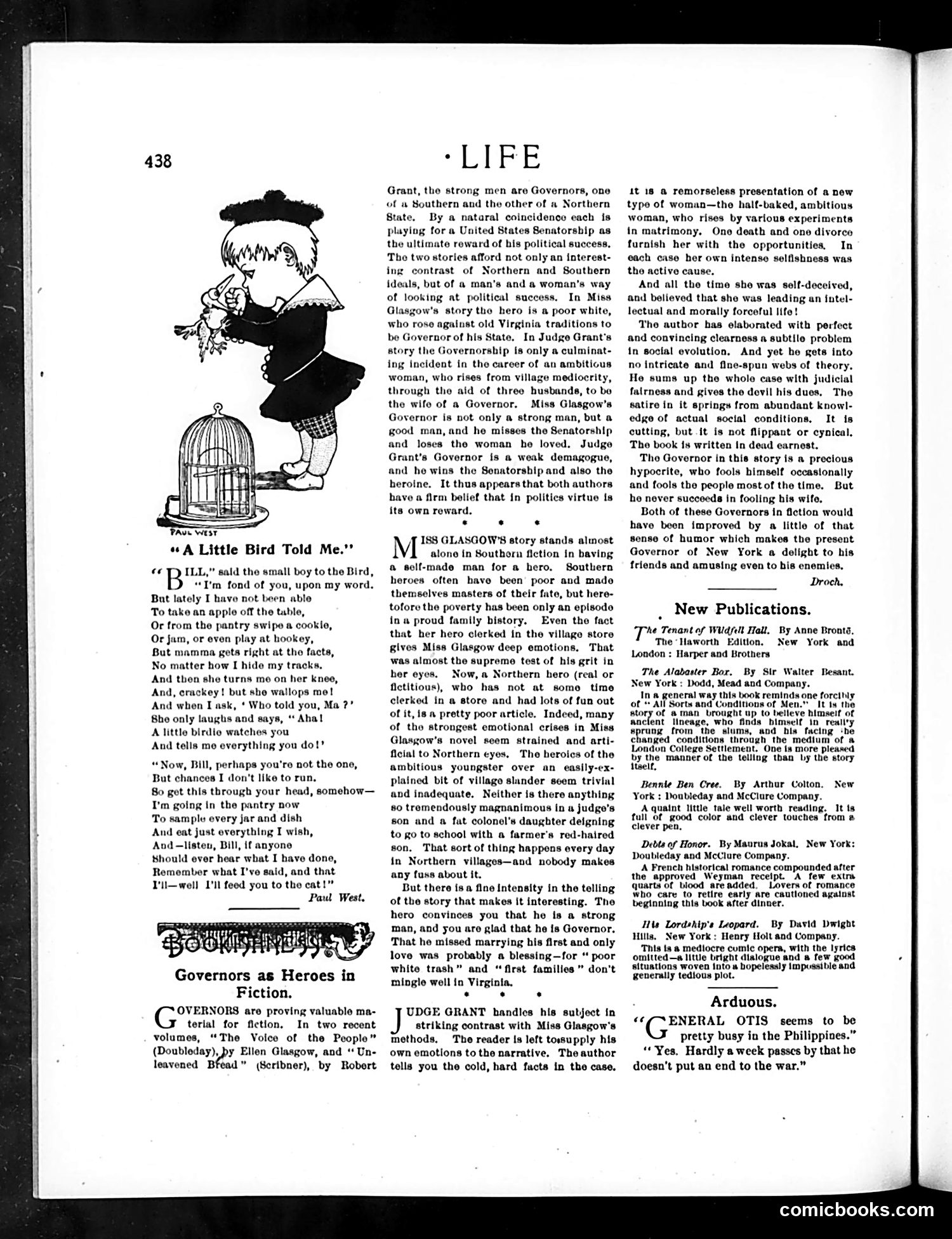
This cartoon depicts a small boy speaking to a caged bird, illustrating a poem about discretion and gossip. The boy warns the bird that although he's told it secrets, he hopes the bird won't repeat them—"who told you, Ma?"—establishing the joke that even inanimate creatures shouldn't be trusted with confidences. The accompanying article discusses two recent novels featuring ambitious politicians seeking governorships: Ellen Glasgow's story about a poor white Virginian and Judge Grant's about a Northern hero. The satire criticizes how these characters manipulate their way to power, missing marriages and genuine connections in pursuit of political success. The overall message critiques the moral compromises required in political ambition.
📄 Transcribed text from this page (OCR, searchable)
Machine-transcribed from the original scan — historical spelling and the odd misread are preserved.
«A Little Bird Told Me.”’ «€ DQ ILL,” sald the small boy to the Bird, I'm fond of you, upon my word, Bat lately I have not been able To take an apple off the table, Or from the pantry swipe a cookie, Or jam, or even play at hookey, But mamma gets right at tho facts, No matter how I hide my tracks. And thon she turns mo on her knee, And, crackey! but sho wallops met And when ask, * Who told you, Ma ?’ Bho only laughs and says, “ Ahal A little birdie watches you And telis mo everything you dot? “Now, Bill, perhaps you'ro not the one, But chances I don't like to run, 8o get this through your head, somehow— I'm going in the pantry now To sample every jar and dish And cat just everything I wish, And listen, Bill, if anyone Should over hear what I havo done, Remember what I've said, and that T'll—well I'll feed you to the cat!” Paul West. Governors as Heroes in Fiction. OVERNORS aro proving valuablo ma- terial for fiction, In two recent volumes, “The Voice of the People” (Doubleday), py Ellen Glasgow, and “Un- leavened Bfead” (Scribner), by Robert ‘LIFE Grant, the strong men are Governors, one of Southern and the other of a Northern State. By a nataral coincidence each is playing for a United States Senatorsbip as the ultimate reward of bis political success, Tho two stories afford not only an interest- ing contrast of Northern and Southern ideals, but of a man’s and a woman's way of looking at political success. In Miss Glasgow's story tho hero is a poor white, who rose against old Virginia traditions to be Governor of his State, In Judge Grant's story the Governorship {s only a culminat- ing incident in tho career of an ambitious woman, who rises from village mediocrity, through the ald of threo husbands, to bo the wife of a Governor. Miss Glasgow’s Governor is not only a strong man, but a good man, and he misses the Senatorship and loses the woman he loved. Judge Grant’s Governor is a weak demagogue, and he wins the Sonatorsbip and also the heroine. It thus appears that both authors have a firm belief that in politics virtue {s its own reward. M 188 GLASGOW'S story stands almost alone in Southorn fiction in baving a eeclf-made man for a hero. Southern heroes often have been poor and made themselves masters of their fate, but here- tofore the poverty has been only an episode ina proud family bistory. Even the fact that her hero clerked in the village store gives Miss Glasgow deep emotions, That was almost the supreme test of his grit in her eyes. Now, a Northern hero (real or fictitious), who has not at some time clerked in a store and had lots of fun out of it, 18 a pretty poor article. Indeed, many of tho strongest emotional crises in Miss Glasgow's novel seem strained and arti- ficial to Northern eyes, The beroics of the ambitious youngster over an easily-ex- plained bit of villago slander seem trivial and inadequate, Neither is there anything 80 tremendously magnanimous in a judge's son and a fat colonel’s daughter deigning to go to school with a farmer's red-haired son, That sort of thing happens every day in Northern villages—and nobody makes any fuss about it. But there is a fine intensity in the telling of the story that makes it interesting. The hero convinces you that he is a strong man, and you aro glad that he is Governor. ‘That he missed marrying his first and only love was probably a blessing—for “ poor white trash” and “first families ” don't mingle well in Virginia. . . . UDGE GRANT handles his subject in striking contrast with Miss Glasgow's imethods. The reader Is left tossupply his own emotions to the narrative, The author tells you the cold, hard facts in the case. it 18 @ remorseless presentation of a new type of woman—tho half-baked, ambitious woman, who rises by various experiments in matrimony, Ono death and one divorce furnish her with the opportunities, In each case her own intense selfishness was the active cause. And all the time sho was self-deceived, and believed that she was leading an intel- lectual and morally forceful life! Tho autbor has elaborated with perfect and convincing clearness a subtile problem in social evolution. And yet he gets into no intricate and fine-spun webs of theory, He sums up the whole case with judicial fairness and gives tho devil his dues, Tho satire in it springs from abundant knowl- edge of actual social conditions, It is cutting, but it is not flippant or cynical. Tho book is written In dead earnest. Tho Governor in thie story 18 a precious hypocrite, who fools himself occasionally and fools the people most of the time. But ho never succeeds in fooling bis wife. Both of these Governors in fiction would havo been improved by a little of that sense of humor which makes the present Governor of New York a delight to his friends and amusing even to his enemies. Droch, New Publications. Tit Tenant of Wudfell Hall, By Anne Bronte. The Haworth Edition, New York and London : Harper and Brothers The Alabaster Bor, By Sir Walter Besant. New York ; Dodd, Mead and Company. In & general way this book reminds one forcitiy of * All Sorts and Conditions of Men.” It is the story of a man Lrought up to belleve himself of ancient Ineage, who finds bimself in reall'y sprung from the slums, and bla facing -be changed conditions through the medium of a London College Settiement. One is more pleased by the manner of the telling than by the story taelf, Bennie Ben Cree. By Arthur Colton. York : Doubleday and McClure Company. A quaint little tale well worth reading. It ts full of good color and clever touches from & clever pen. Debta of Honor. By Maurus Jokal, New York: Doubleday and McClure Company. A French historical romance compounded after the approved Weyman receipt. A few extns quarts of blood are added, Lovers of romance who care to retire early are cautioned against beginning this book after dinner. New Hts Lordship's Leopard. By David Dwight Hills, New York: Henry Holt and Company. ‘This ts a mediocre cumic opera, with the lyrics. omitted—a litue bright dialogue and # few good situations woven {nto a bopelessly Impossible and generally tedious plot. Arduous. NERAL OTIS seems to be pretty busy in the Philippines.” “Yes. Hardly a week passes by that he doesn't put an end to the war.” comicbooks.com