
Life, 1900-05-24 · page 4 of 20
Life — May 24, 1900 — page 4: what you’re looking at
What you’re looking at
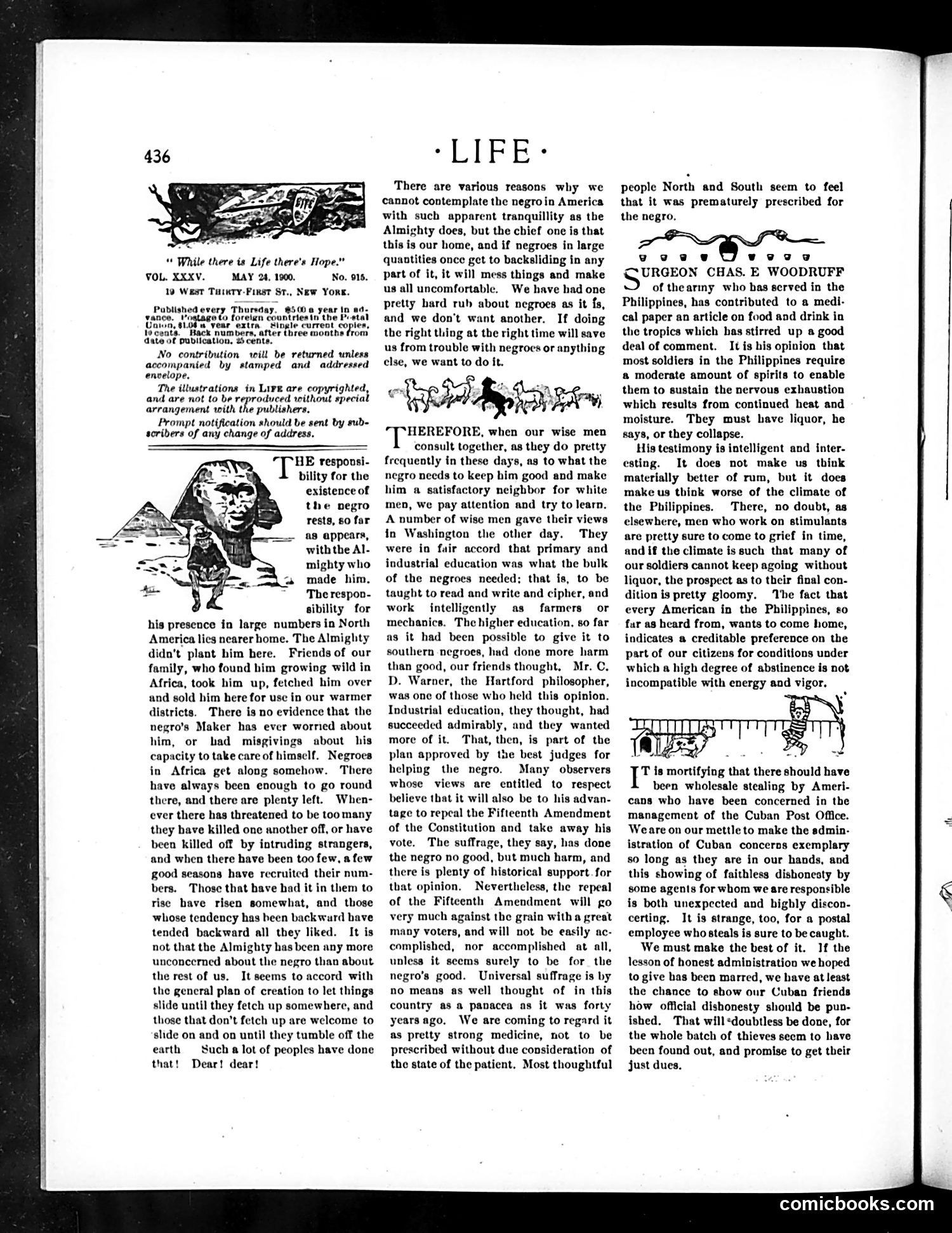
This page contains three distinct editorial cartoons addressing race and labor issues in early 20th-century America. The **left cartoon** depicts a caricatured Black figure, illustrating an article arguing that enslaved African Americans were better off under slavery than in the North, where they faced exploitation and poor conditions. The **top right cartoon** shows figures drinking, accompanying text by "Euroclio" debating whether Philippine soldiers require alcohol to endure tropical hardship—reflecting contemporary debates over colonial administration. The **bottom right cartoon** depicts what appears to be a postal worker, referencing alleged corruption in the Cuban Post Office administration and discussing official dishonesty. All three cartoons employ heavy racial and ethnic caricature typical of early 1900s satirical magazines, presenting viewpoints now recognized as deeply racist and reflecting the era's problematic attitudes toward colonialism and race.
📄 Transcribed text from this page (OCR, searchable)
Machine-transcribed from the original scan — historical spelling and the odd misread are preserved.
“« While there is Life there's Hope.” VOL. XXXV. MAY 24, 1900. No. 915. 19 West Tainry-Fixst St., New YORE, Published every Thurs 85.00 0 year I ¥ 7. A eto foreign countries tn the Pestal Oba vear extra. single current copies, 19 ces Back numbers, after three months from date of publication, 2 cente. No contribution will be returned unless accompanied by stamped and addressed envelope. The illustrations in Lire are copyrighted, and are not to be reproduced without special arrangement with the publishers. Prompt notification should be sent by sub- scribers of any change of address. ‘THE responsi- bility for the existence of the negro rests, 80 far ag appears, with the Al- mighty who made him. The respon- ¢ sibility for his presence in large numbers in North America lies nearer home. The Almighty didn’t plant him here. Friends of our family, who found him growing wild in Africa, took him up, fetched him over and sold him here for use in our warmer districts. There is no evidence that the negro’s Maker has ever worried about him, or had misgivings about his capacity to take care of himsclf. Negroes in Africa get along somehow. There have always been enough to go round there, and there are plenty left. When- ever there has threatened to be toomany they have killed one another off, or have been killed off by intruding strangers, and when there have been too few, afew good seasons have recruited their num- bers. Those that have had it in them to rise have risen somewhat, and those whose tendency has been backward bave tended backward all they liked. It is not that the Almighty has been any more unconcerned about the negro than about the rest of us. It seems to accord with the general plan of creation to let things slide until they fetch up somewhere, and those that don’t fetch up are welcome to slide on and on until they tumble off the earth Such a lot of peoples have done that! Dear! dear! *LIFE - There are various reasons why we cannot contemplate the negroin America with such apparent tranquillity as the Almighty does, but the chief one is that this is our home, and if negroes in large quantities once get to backsliding in any part of it, it will mess things and make us all uncomfortable. We have had one pretty hard rub about negroes as it fs, and we don't want another. If doing the right thing at the right time will save us from trouble with negroes or anything clse, we want to do it, HEREFORE, when our wise men consult together, as they do pretty frequently in these days, as to what the negro needs to keep him good and make him a satisfactory neighbor for white men, We pay attention and try to learn. A number of wise men gave their views in Washington the other day. They were in fair accord that primary and industrial education was what the bulk of the negroes needed; that is, to be taught to read and write and cipher, and work intelligently as farmers or mechanics. The higher education, so far as it had been possible to give it to southern negroes, had done more harm than good, our friends thought, Mr. C. D. Warner, the Hartford philosopher, was one of those who held this opinion. Industrial education, they thought, had succeeded admirably, and they wanted more of it. That, then, is part of the plan approved by the best judges for helping the negro. Many observers whose views are entitled to respect believe that it will also be to his advan- tage to repeal the Fifteenth Amendment of the Constitution and take away his vote. The suffrage, they say, has done the negro no good, but much harm, and there is plenty of historical support. for that opinion. Nevertheless, the repeal of the Fifteenth Amendment will go very much against the grain witha great many voters, and will not be easily ac- complished, nor accomplished at all, unless it seems surely to be for the negro’s good. Universal suffrage is by no means as well thought of in this country as a panacea as it was forty years ago. We are coming to regard it as pretty strong medicine, not to be prescribed without due consideration of the state of the patient. Most thoughtful people North and South seem to feel that it was prematurely prescribed for the negro. URGEON CHAS. E WOODRUFF of thearmy who bas served in the Philippines, has contributed to a medi- cal paper an article on food and drink in the tropics which has stirred up a good deal of comment. It is his opinion that most soldiers in the Philippines require moderate amount of spirits to enable them to sustain the nervous exhaustion which results from continued heat and moisture. They must have liquor, he says, or they collapse. His testimony is intelligent and inter- esting. It does not make us think materially better of rum, but it does make us think worse of the climate of the Philippines. There, no doubt, as elsewhere, men who work on stimulants are pretty sure to come to grief in time, and if the climate is such that many of our soldiers cannot keep agoing without liquor, the prospect as to their final con- dition is pretty gloomy. ‘be fact that every American in the Philippines, so far as heard from, wants to come home, indicates a creditable preference on the part of our citizens for conditions under which a high degree of abstinence is not incompatible with energy and vigor. ‘ . v I" is mortifying that there should have been wholesale stealing by Ameri- cans who have been concerned in the management of the Cuban Post Office. Weare on our mettle to make the sdmin- istration of Cuban concerns exemplary so long as they are in our hands, and this showing of faithless dishonesty by some agents for whom we are responsible is both unexpected and bighly discon- certing. It is strange, too, for a postal employee who steals is sure to be caught. We must make the best of it. If the lesson of honest administration we hoped to give bas been marred, we have at least the chance to show our Cuban friends how official dishonesty should be pun- ished. That will «doubtless be done, for the whole batch of thieves seem to have been found out, and promise to get their just dues, comicbooks.com