
Life, 1900-05-24 · page 12 of 20
Life — May 24, 1900 — page 12: what you’re looking at
What you’re looking at
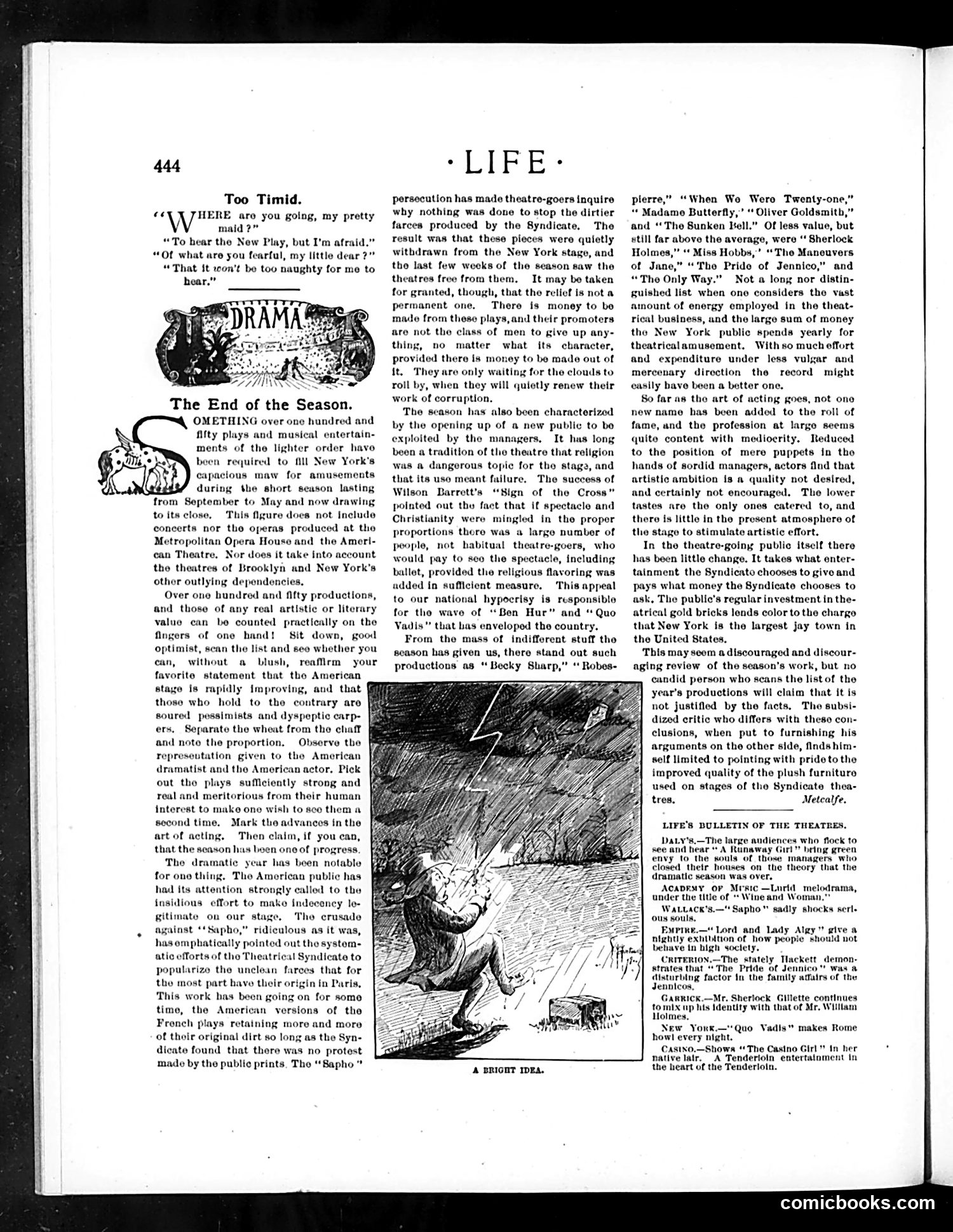
This cartoon depicts a figure (likely representing theater management or the Theatrical Syndicate) struck by lightning labeled "A BRIGHT IDEA." The accompanying article criticizes the Syndicate's monopolistic control of American theater. The text argues that over 150 theatrical productions this season represent progress, yet the Syndicate has created an "insidious effort to monopolize" legitimate theater. The article contrasts American plays (praised as "authentically strong") with French imports the Syndicate favors, suggesting the monopoly prioritizes profit over artistic merit. The lightning bolt is ironic—what appears "bright" to the Syndicate (their business strategies) is actually damaging to American theater's independence and quality.
📄 Transcribed text from this page (OCR, searchable)
Machine-transcribed from the original scan — historical spelling and the odd misread are preserved.
444 Too Timid. “Vy HERE aro you going, my pretty maid ? “To hear the New Play, but I'm afraid “Of what are sou fearful, my little dear 2” “That it won't be too naughty for me to vS ra" The End of the Season. OMETHING over one hundred and fifty plays and musical entertain- ments of the lighter order havo been required to fll New York's capacious maw for amusements during she short season lasting from September to May and now drawing to its close, This figure does not include concerts nor tho operas produced at tho Metropolitan Opera House and the Ameri- can Theatre, Nor does it take into account tho theatres of Brooklyn und New York's other outlying dependencies, Over ono hundred and fifty productions, and those of any real artistic or literary valuo can bo counted practically on the fingers of one hand! Sit down, good optimist, sean the list and seo whether you can, without a blush, reafM™lrm your favorite statement that the American stage is rapidly Improving, and that { those who hold to the contrary are soured pessimists and dyspeptic carp- ers, Separate the wheat from tho chaff and noto the proportion. Observe the representation given to the American dramatist and the Amorican actor. Pick out tho plays suMeciently strong and real and meritorious from thoir human interest to make one wish to seo them a second time, Mark tho advances in the art of acting, Then claim, if you can, that the season has been one of progress. Tho dramatic year has been notable for ono thing, Tho Amorican public has had its attention strongly called to the {nsidious effort to make indecency le gitimate on our stage, ‘Tho crusade against ‘¢Sapho,” ridiculous as it was, has omphatically pointed out the system- atic offorts of tho Theatrical Syndicate to popularize the unclean farces that for the most part have their origin in Paris, This work has been going on for somo timo, the American versions of tho Fronch plays retaining more and moro of thoir original dirt so long as the Syn- dicate found that there was no protest mado by the public prints. The “Bapho *LIFE= persecution has made theatro-goers inquire why nothing was done to stop the dirtier farces produced by the Syndicate. The result was that these pieces were quietly withdrawn from the New York stage, and tho last few weeks of the season saw the theatres free from them. It may be taken for granted, though, that the relief is not a permanent one. There is money to be made from these plays, and their promoters aro not the class of men to give up any- thing, no matter what its character, provided there is money to be made out of it. They aro only waiting for the clouds to roll by, when they will quietly renew their work of corruption, The season has also been characterized by the opening up of a new public to be exploited by the managers, It has long been a tradition of the theatre that religion was a dangerous topic for the staga, and that its uso meant failure. The success of Wilson Barrett’s “Sign of the Cross” pointed out the fact that if spectacle and Christianity were mingled in the proper proportions thore was a large number of poople, not habitual theatre-goers, who would pay to seo the spectacle, including ballet, provided the religious flavoring was added in sufficient measure. This appeal to our national hypocrisy is responsible for tho wave of ‘Ben Hur" and ‘ Quo Vadis” that bas enveloped the country, From the mass of indifferent stuff the season has given us, there stand out such productions as “Becky Sharp,” ‘ Robos- A BRIOT IDEA. plerre,” “When Wo Wero Twenty-one,” “« Madamo Butterfly,” “ Oliver Goldsmith,” and “The Sunken Bell.” Of less value, but still far above the average, were “ Sherlock Holmes,” “ Miss Hobbs,” “Tho Maneuvers of June,” “Tho Pride of Jennico,” and “The Only Way.” Not a long nor distin- guished list when one considers the vast amount of energy employed in the theat- rical business, and the largo sum of money the New York public spends yearly for theatricalamusoment. With so much effort and expenditure under less vulgar and mercenary direction the record might easily bave been a better one. So far as tho art of acting goes, not one new name has been added to the roll of fame, and the profession at largo seems quite content with medioerity. Reduced to the position of mere puppets in tho hands of sordid managers, actors nd that artistic ambition is a quality not desired, and certainly not encouraged. The lower tastes are the only ones catered to, and thero Is little in tho present atmosphere of the stage to stimulate artistic effort, In tho theatre-going public itself there has been little change. It takes what onter- tainment the Syndicato chooses to give and pays what money the Syndicate chooses to ask, The public's regular investment in the- atrical gold bricks lends color to the chargo that New York is the largest jay town in the United States. ‘This may seom a discouraged and discour- aging review of the season's work, but no candid person who scans the list of the year’s productions will claim that it is not justifled by the facts, Tho subsi- dized critic who differs with theso con- clusions, when put to furnishing his arguments on the other side, finds him- self limited to pointing with pride to the improved quality of the plush furnituro used on stages of tho Syndicate thea- tres. Metcalfe, LIFE'S BULLETIN OF THE THEATRES, Daty's.—The large audiences who flock to e and hear A Runaway Girl” bring green envy to the souls of those managers who closed their houses on the theory that the dramatic season was over, ACADEAY OP Mrsic —Lurtd_ melodrama, under the Utle of * Wine and Woman," WALLACK'S.—" Sapho™ sadly shocks serl+ ous souls, Ewrie.— Lord and Lady Algy" give a nightly exhibition of how people should not behave in high soclety, CRITERION.—The stately Tackett demon- strates that “The Pride of Jenico" was a disturbing factor in the family aduirs of the Jennicos, Gannicx.—Mr. Sherlock Gillette continues tomIx up his identity with that of Mr, Wiliam Holmes, New Youx.—"Quo Vadis" makes Rome howl every night. Castxo.—Shows “The Casino Girl in her native lair. A Tendertoln entertatnment In the heart of the Tenderloin. comicbooks.com