
A complete issue · 20 pages · 1900
Life — May 17, 1900
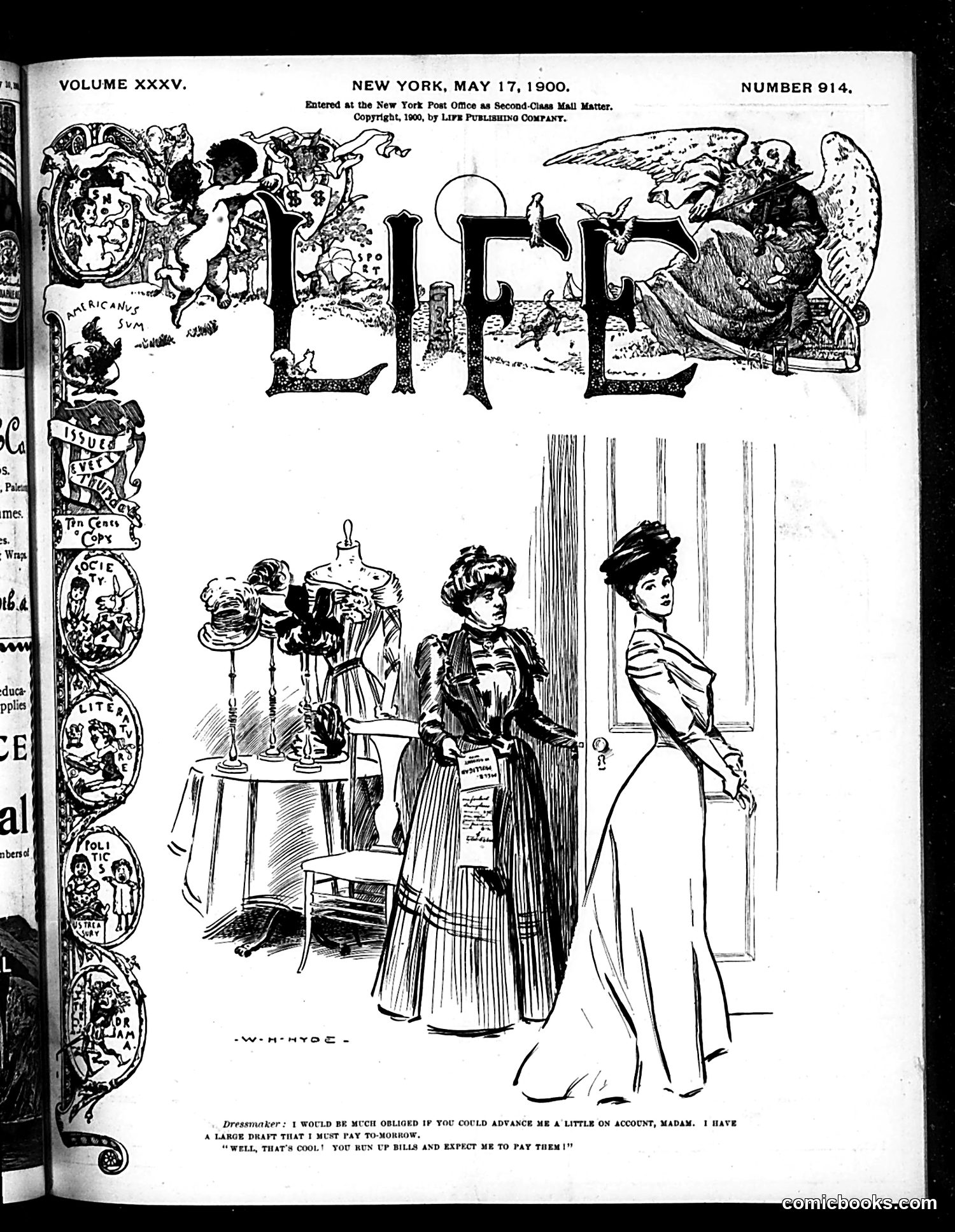
This page features a satirical cartoon about credit and debt in early 1900s society. The illustration shows a well-dressed woman at a fashionable establishment (likely a shop or dressmaker, given the window and furniture). The dressmaker addresses her regarding an outstanding account, saying she would advance credit if the customer could pay part now, as she has a large draft due tomorrow. The woman's haughty response—"Well, that's cool! You run up bills and expect me to pay them!"—satirizes the contradiction of high-society women demanding credit while refusing to settle accounts themselves. It's social satire about hypocrisy regarding financial responsibility among the wealthy elite, where ladies expected unlimited credit without accountability.
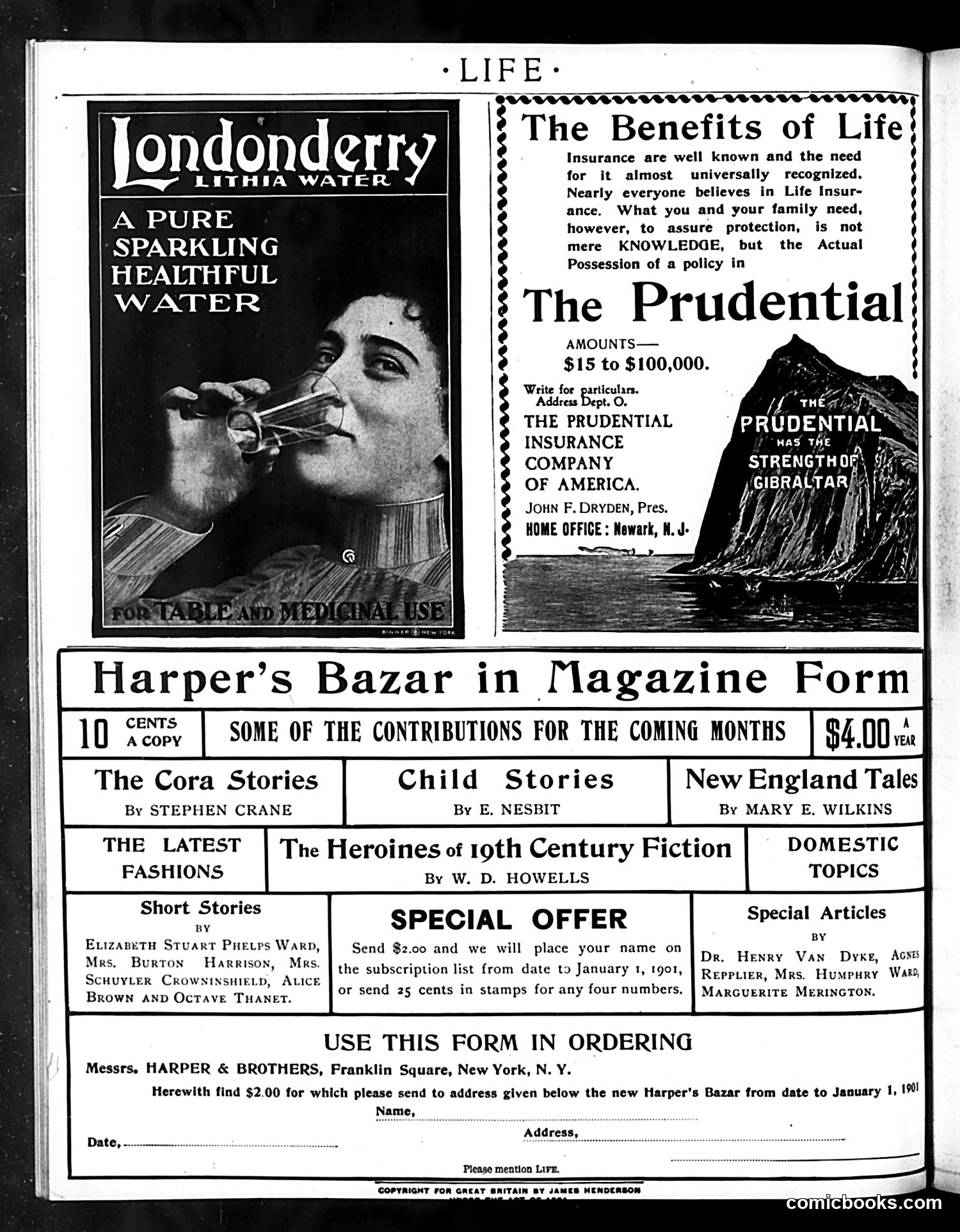
This page is primarily **advertising content**, not editorial satire. It contains two product advertisements and a magazine subscription promotion for Harper's Bazar. The **Londonderry Lithia Water** ad (left) shows a man drinking sparkling water, marketed as "pure" and "healthful" for "table and medicinal use"—typical early 1900s health-drink advertising. The **Prudential Insurance** ad (right) emphasizes life insurance protection, featuring the Rock of Gibraltar as a symbol of strength and stability. It offers policies from $15-$100,000 through The Prudential Insurance Company of America. Below is a **Harper's Bazar subscription offer** promoting upcoming magazine content by authors like Stephen Crane and W.D. Howells, priced at 10 cents per copy or $4 yearly. There is no discernible political cartoon or satire on this page—it's straightforward turn-of-the-century advertising and publishing promotion.
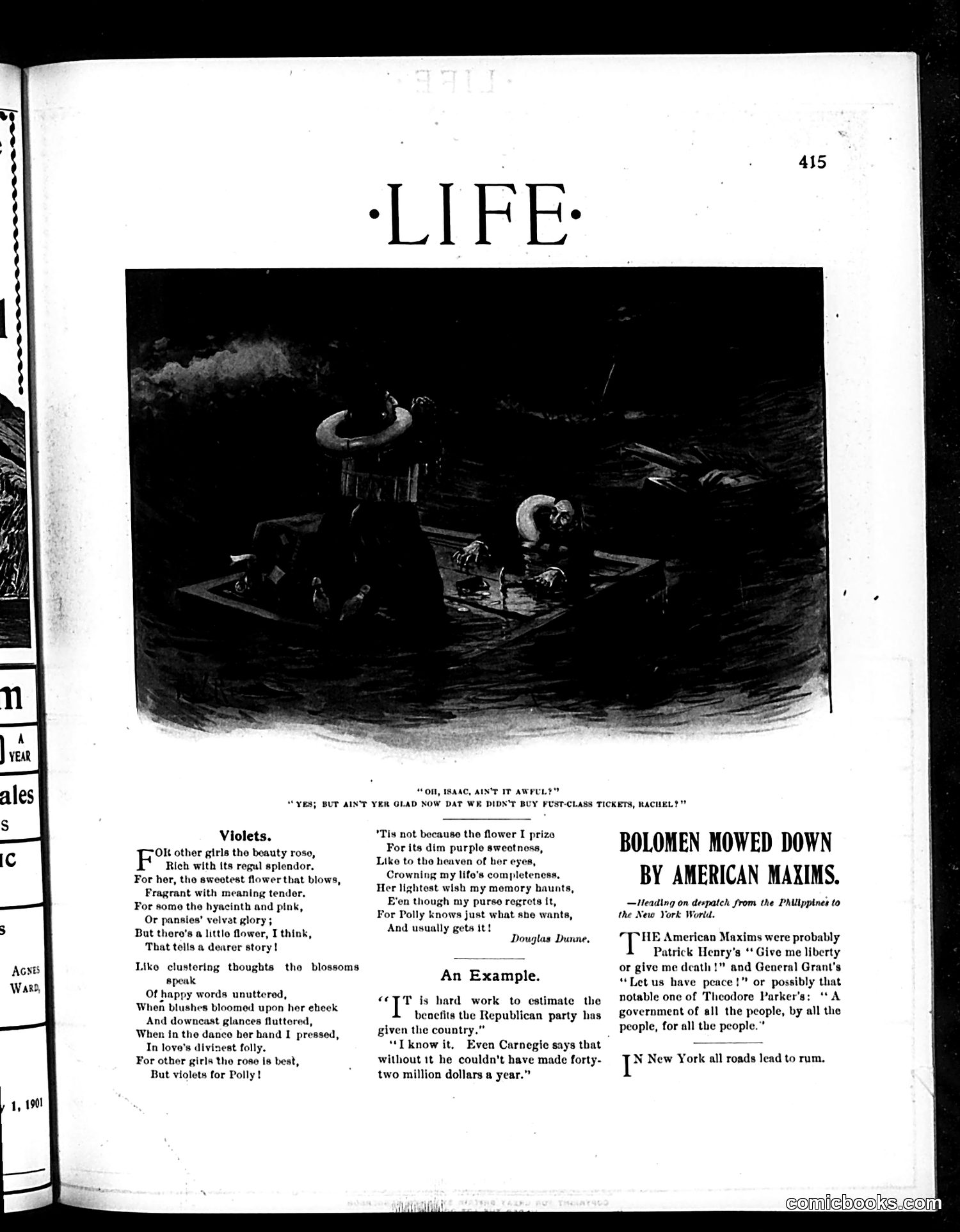
The main cartoon depicts two figures in a boat on dark water, illustrating the headline "Oh, Isaac, ain't it awful!" with a caption about class tickets and Rachel. Below, the article **"BOLOMEN MOWED DOWN BY AMERICAN MAXIMS"** references the Philippines conflict, discussing American military action there. The piece appears to satirize prominent American figures—mentioning Patrick Henry's "Give me liberty or give me death," General Grant's "Let us have peace," and Theodore Parker's statement about government "of all the people, by all the people"—suggesting these lofty ideals contrast sharply with violent military campaigns. The surrounding poetry pieces ("Violets," "An Example") appear to be filler content typical of Life's satirical format, though their connection to the political content is unclear.
This page contains two main editorial sections praising **Francis Gilbert Atwood**, who died April 30th in Jamaica Plain, Massachusetts. The text celebrates him as a valued contributor to Life magazine, noting his wit, humor, and thoughtful commentary on politics and current events. The second section discusses **Captain Chadwick** and his embarrassing exposure in newspapers regarding sentiment leaks—apparently his confidential letters were published, causing him public humiliation. The editors note he's now subject to the Statute of Limitations but suggest his suffering has been undeserved. The page also includes a brief item about Harvard University inviting Cuban schoolteachers to visit for six weeks of instruction, funded by the War Department. The two small illustrations appear decorative rather than satirical caricatures.
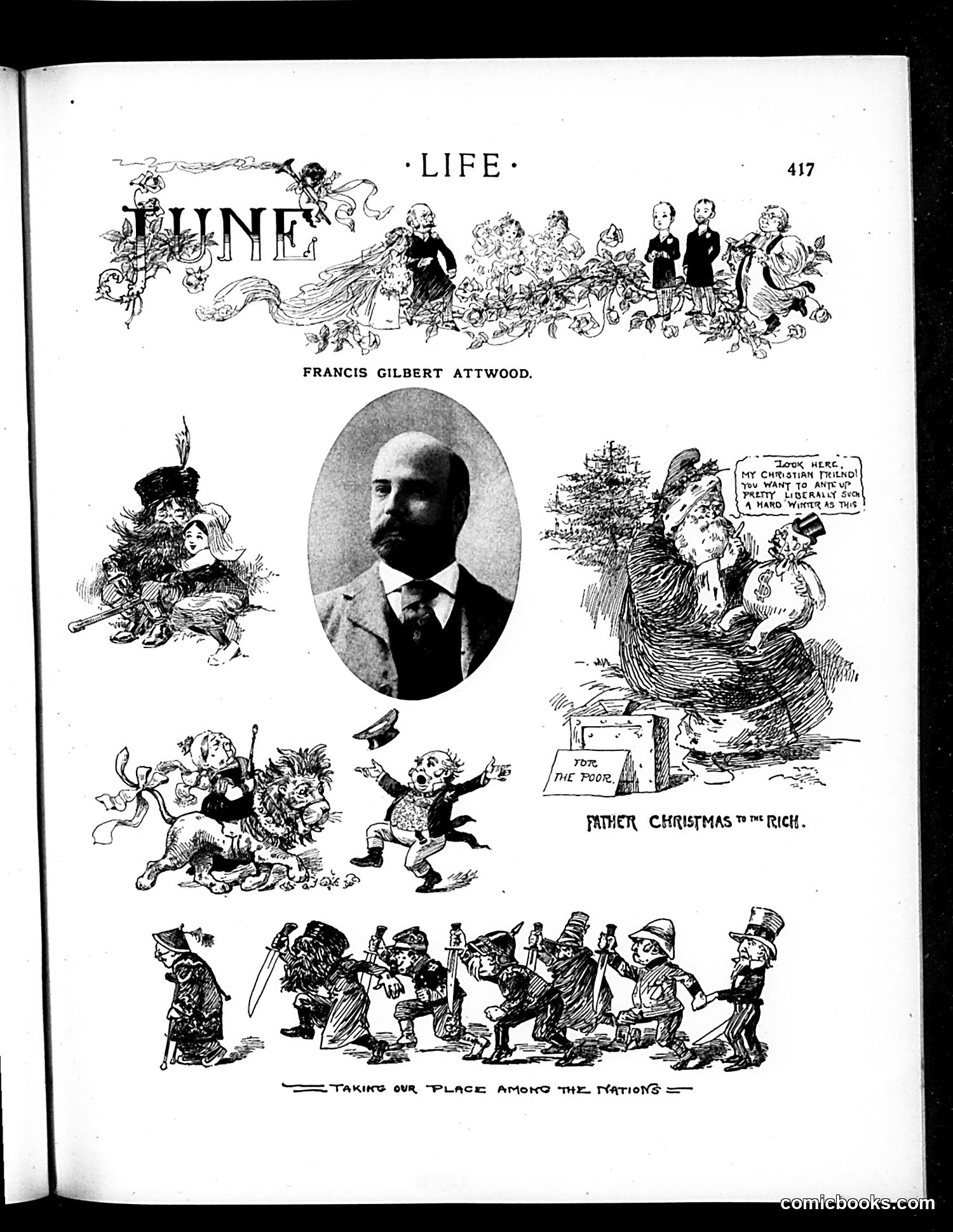
This page celebrates illustrator **Francis Gilbert Attwood** through his own cartoons. The central photograph shows Attwood himself, surrounded by examples of his satirical work. The cartoons depict characteristic Attwood themes: whimsical depictions of wealth inequality ("Father Christmas to the Rich"), mischievous children, and social commentary. One sketch shows figures labeled "For the Poor," contrasting charitable treatment of rich versus poor during Christmas season—a common Progressive Era critique. The bottom cartoon, "Taking Our Place Among the Nations," appears to reference international diplomacy, likely contemporary to the magazine's publication. Attwood's style—detailed cross-hatching, exaggerated character types, and social commentary—exemplifies Life magazine's satirical approach to early 20th-century American politics and society.
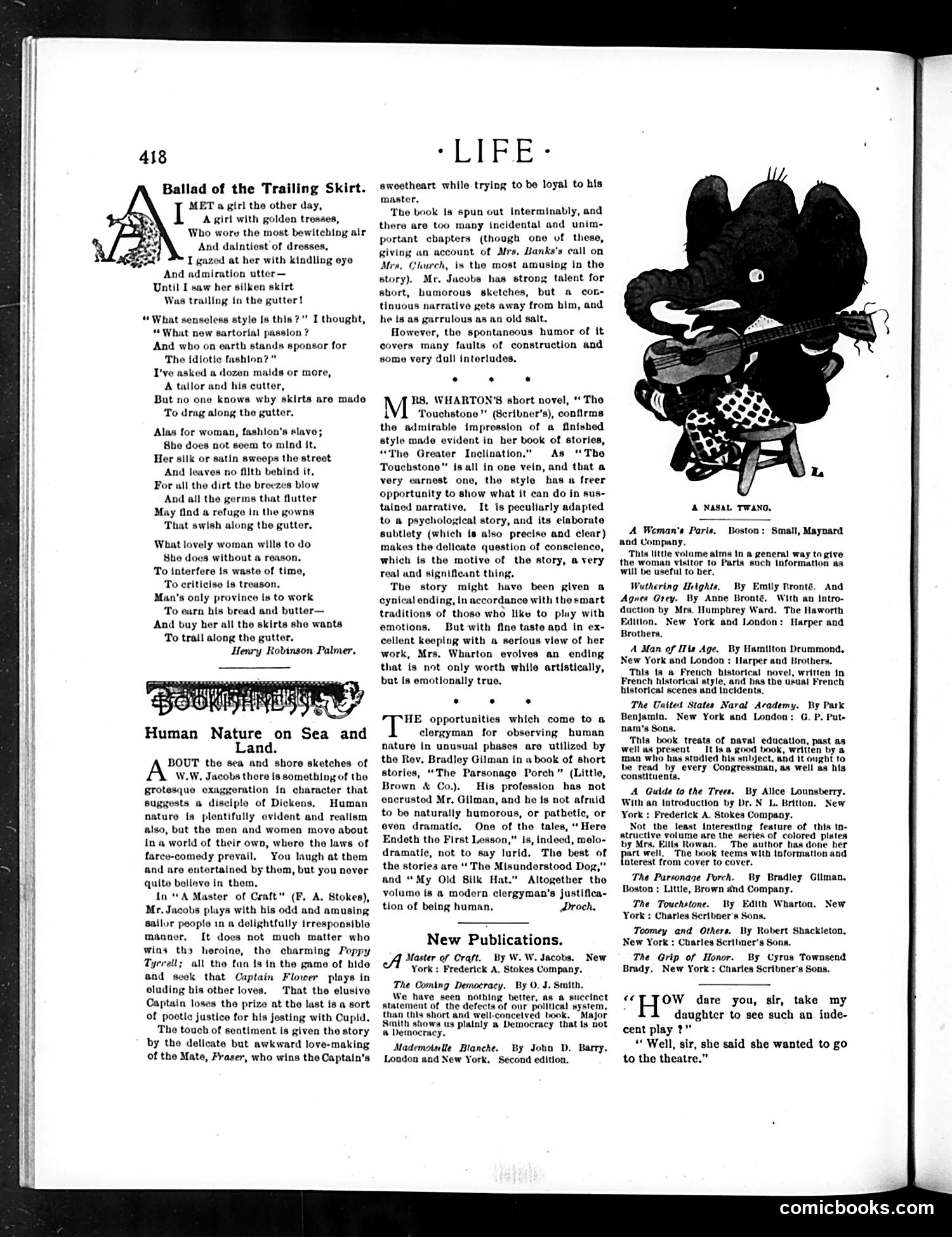
This page contains **literary reviews and book advertisements** rather than political cartoons. The main illustration titled "A Naval Twang" shows a figure seated in a chair—likely a humorous genre sketch unrelated to politics. The page reviews several books including *The Touchstone* by Mrs. Wharton and *The Parsonage Porch*. There's also a section on "Human Nature on Sea and Land" discussing W.W. Jacobs's sketches. At the bottom, a small dialogue snippet begins: "How dare you, sir, take my daughter to see such an indecent play?" with the response "Well, sir, she said she wanted to go to the theatre." This appears to be **social satire about theater-going and propriety rather than political commentary**—typical of Life magazine's lighter cultural criticism.
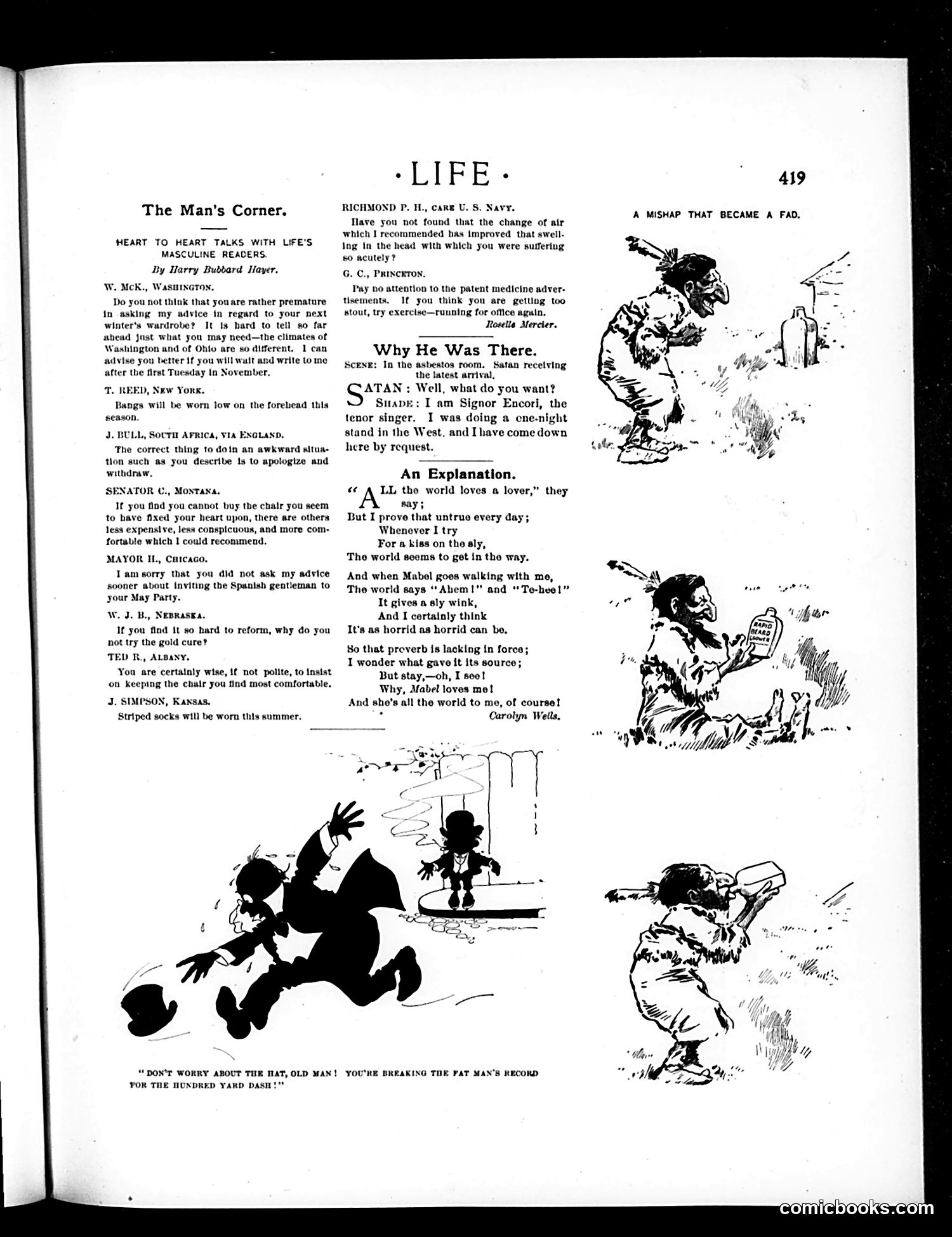
This page from *Life* magazine (page 419) contains "The Man's Corner," a letters column offering advice to male readers on relationships and social matters. The cartoons appear to illustrate humorous domestic and social scenarios. One cartoon shows a man breaking a speed record while running, with the caption "DON'T WORRY ABOUT THE HAT, OLD MAN! YOU'RE BREAKING THE FAT MAN'S RECORD FOR THE HUNDRED YARD DASH!" This mocks overweight men's athletic abilities—a common early 20th-century satirical trope. Other illustrated content includes a poem titled "An Explanation" by Carolyn Wells about a lover named Mabel and social courtship dynamics, with accompanying comic illustrations depicting romantic/social interactions. The overall tone reflects period humor about gender relations, physical appearance, and courtship customs typical of early American satirical magazines.
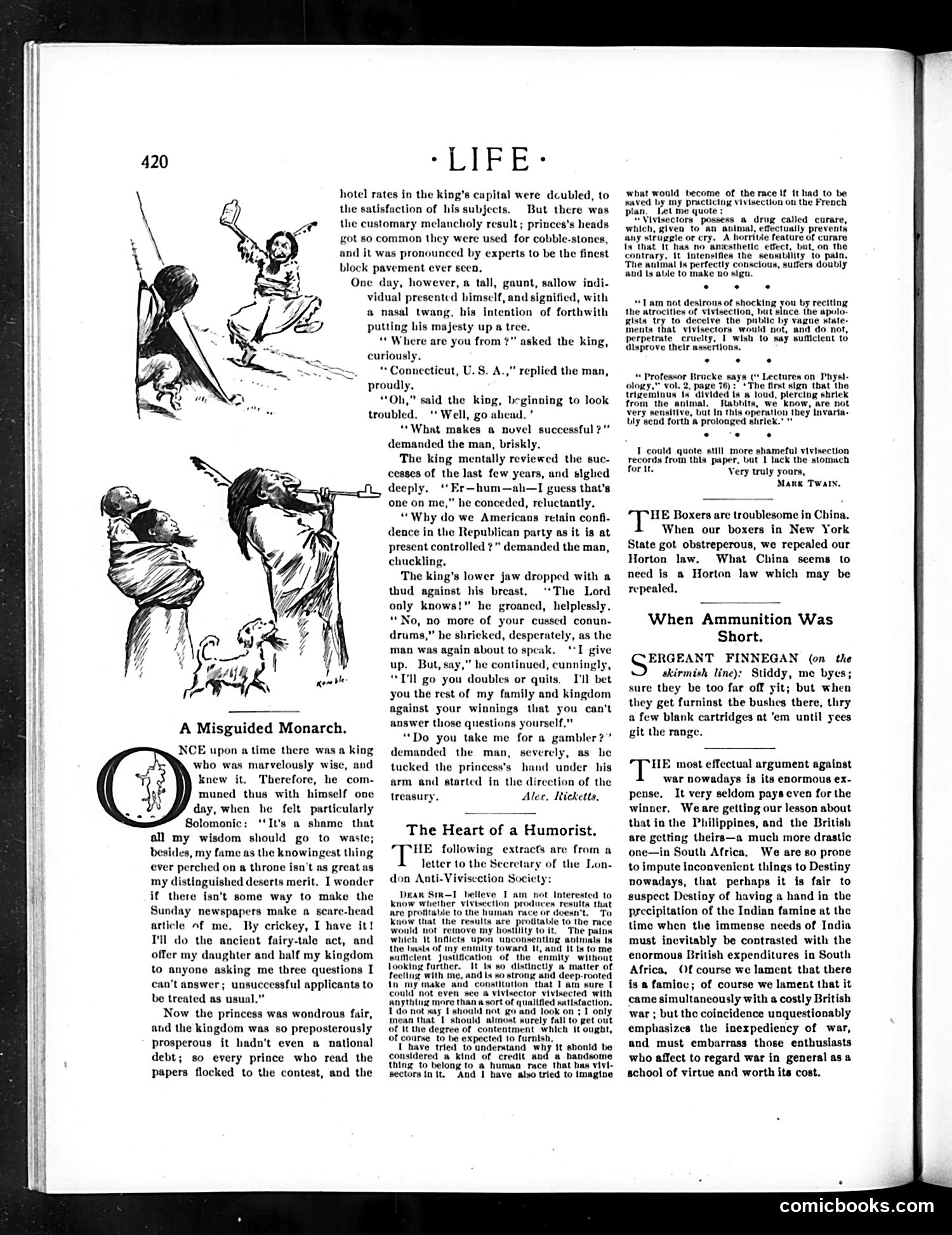
This cartoon satirizes an unnamed king who is foolishly seeking advice about governing from an American man claiming to be from Connecticut. The joke hinges on the king's gullibility: despite being "marvelously wise," he consults this apparent commoner about Republican politics and American confidence. The satire targets two things: first, the absurdity of monarchs taking political guidance from ordinary foreigners; second, a critique of American boosterism—the man's confident, somewhat cocky assertions about American superiority and Republican governance. The accompanying illustrations show the physical comedy of their interaction, with the king appearing increasingly troubled by the American's presumptuous answers to his questions about successful governance and maintaining power.
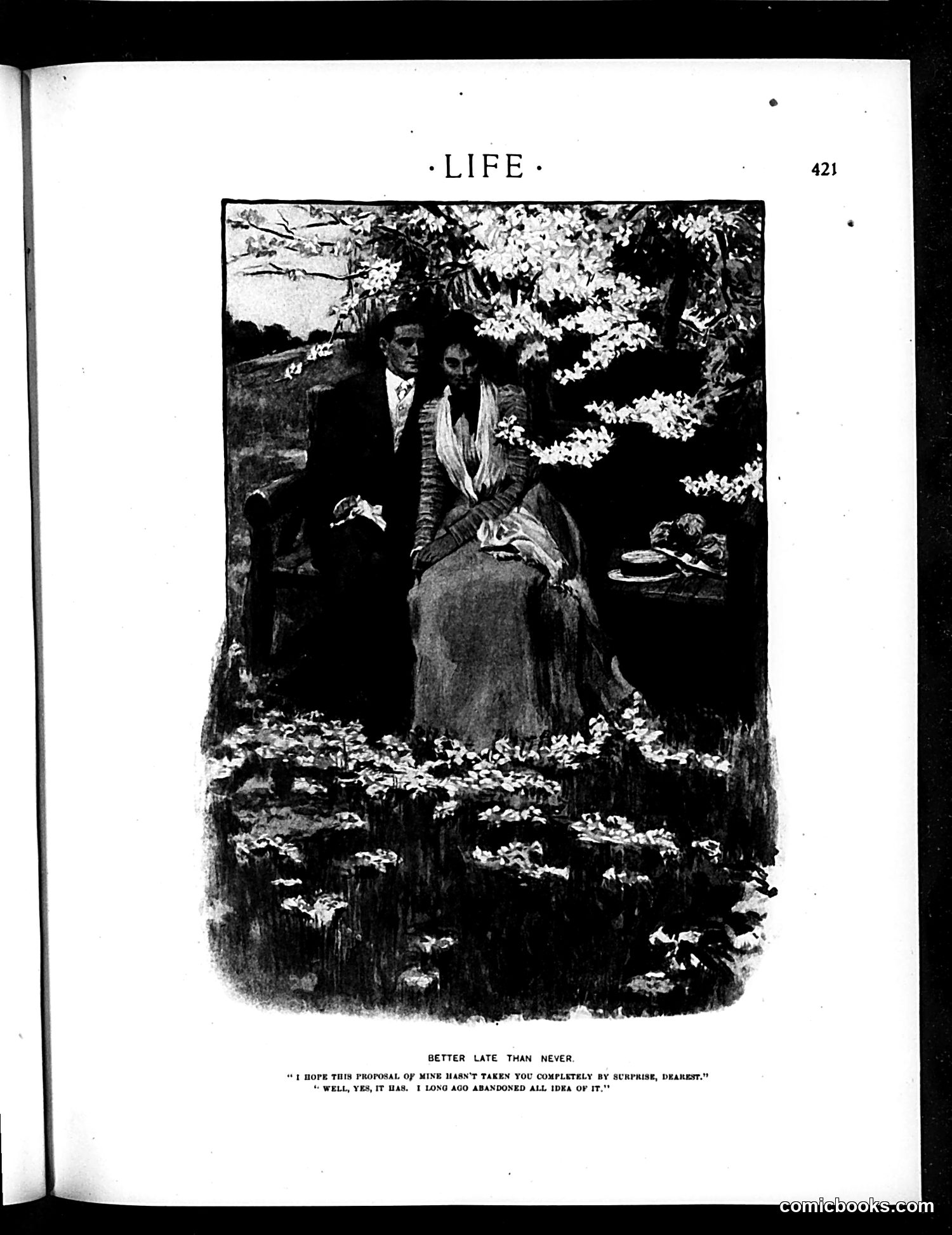
This illustration depicts a romantic garden scene with two figures beneath flowering trees. The caption quotes dialogue: "I hope this proposal of mine hasn't taken you completely by surprise, dearest." The woman responds: "Well, yes, it has. I long ago abandoned all idea of it." The satire concerns a marriage proposal arriving after an unexpectedly long courtship. The man appears to be finally proposing, but the woman's reply suggests she'd given up hope years earlier—implying either his extreme hesitation or her patience wearing thin. The joke plays on Victorian-era courtship conventions, where delayed proposals could indicate indecision, financial uncertainty, or lack of genuine commitment. The ironic title suggests belated action is still preferable to none, though the woman's reaction indicates otherwise.
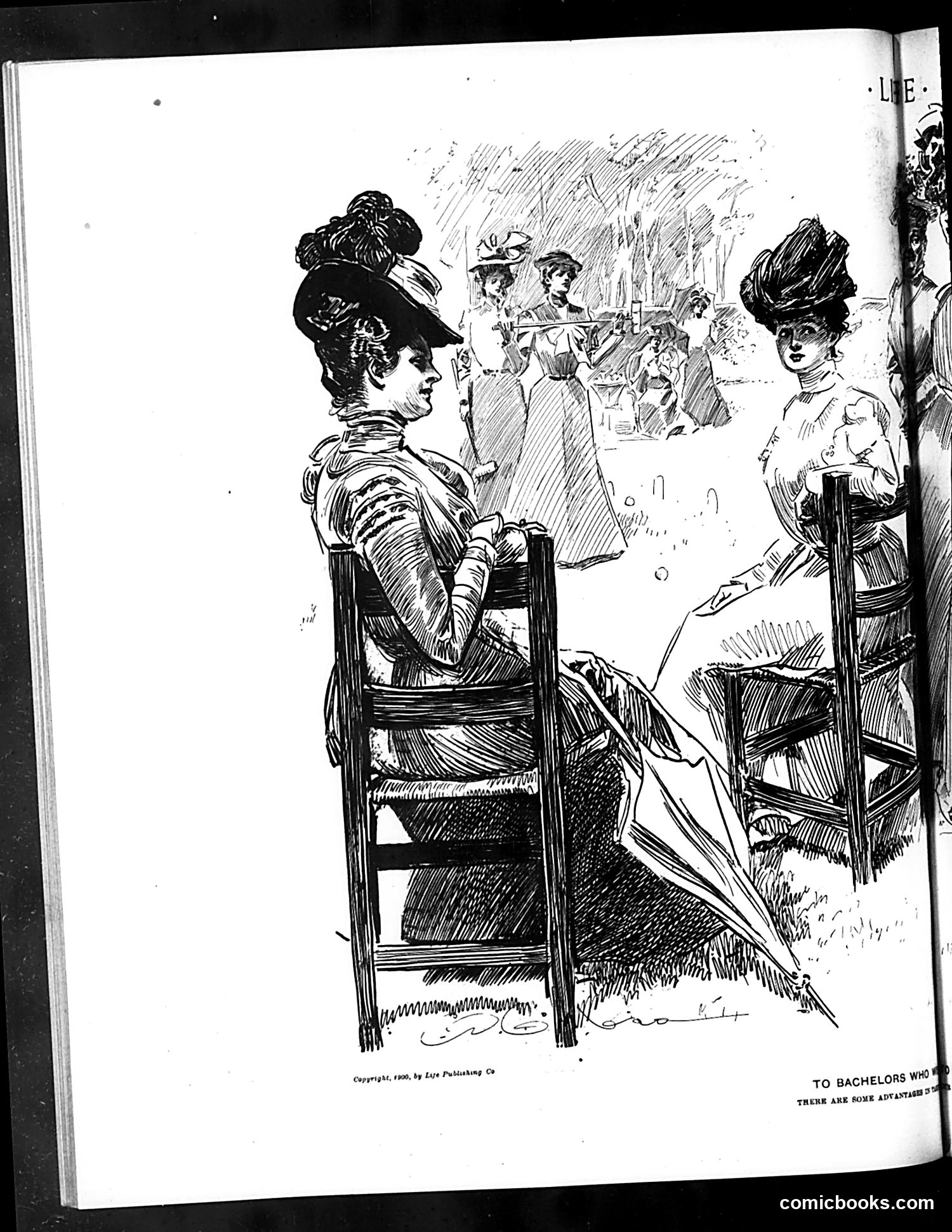
This is a satirical illustration from *Life* magazine (copyright 1908, Life Publishing Co.). It depicts fashionable women in Edwardian-era dress and elaborate hairstyles, seated and socializing at what appears to be a social gathering or event. The partial caption visible at bottom right reads "TO BACHELORS WHO..." (text cut off), suggesting the cartoon comments on marriage or courtship dynamics. The women's exaggerated postures, ornate clothing, and towering hairstyles—typical of Gibson Girl aesthetics—appear meant as gentle mockery of high society's affectations and superficiality. The exact satirical point remains unclear without the complete caption, but likely concerns bachelor attitudes toward eligible women or the absurdities of turn-of-the-century social conventions.
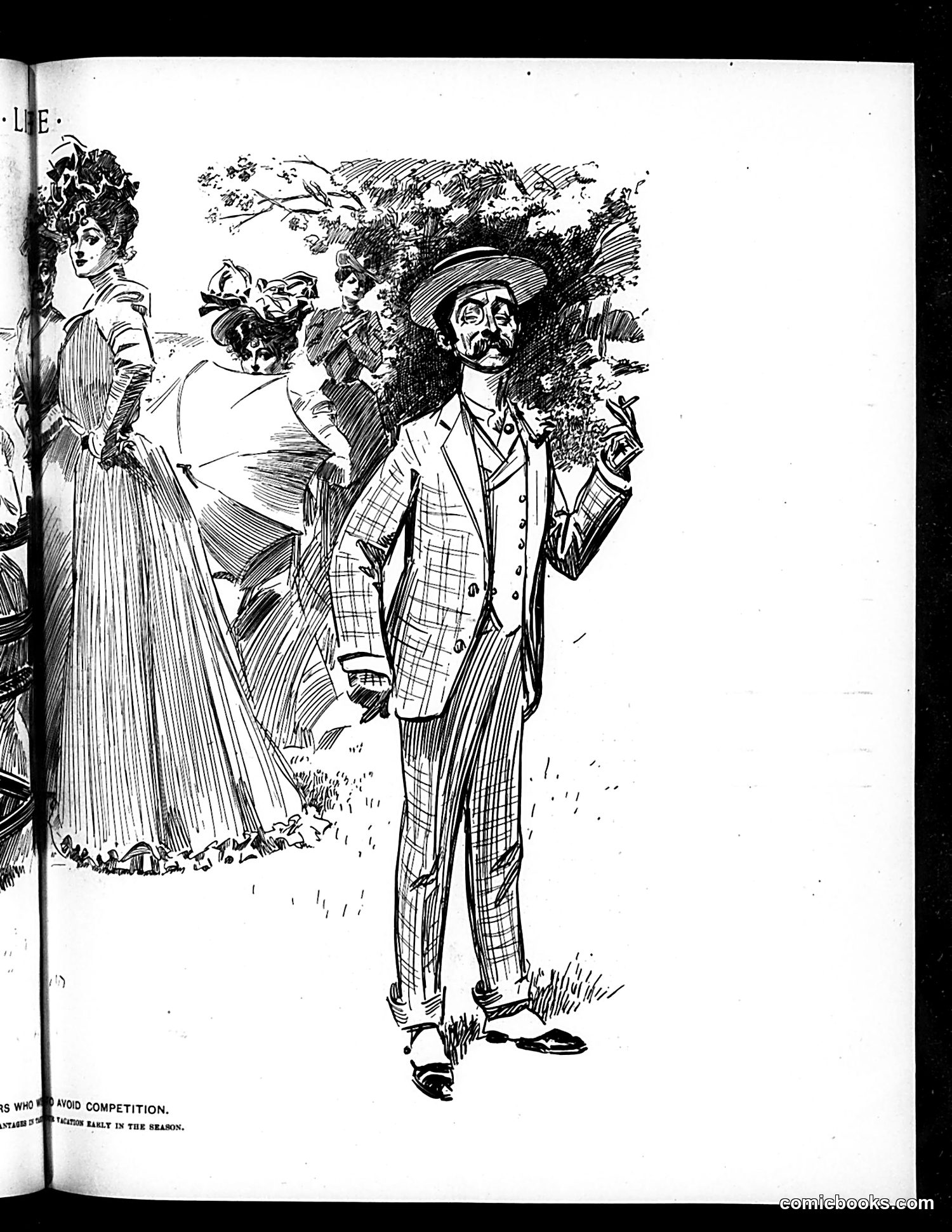
This appears to be a satirical illustration from Life magazine depicting a social scene. The central figure is a gaunt, older man in a plaid suit with an exaggerated facial expression, standing prominently in the foreground. Behind him are fashionably dressed women and other figures in what seems to be an outdoor garden setting. The partially visible caption mentions avoiding "competition" and references something about "fashion early in the season," suggesting social commentary about competitive behavior in high society or fashion circles. The caricature style—particularly the sharp features and the man's distinctive appearance—indicates this is likely satirizing a specific public figure or social type of the Edwardian era, but **I cannot identify who specifically** without additional context or clearer caption text.
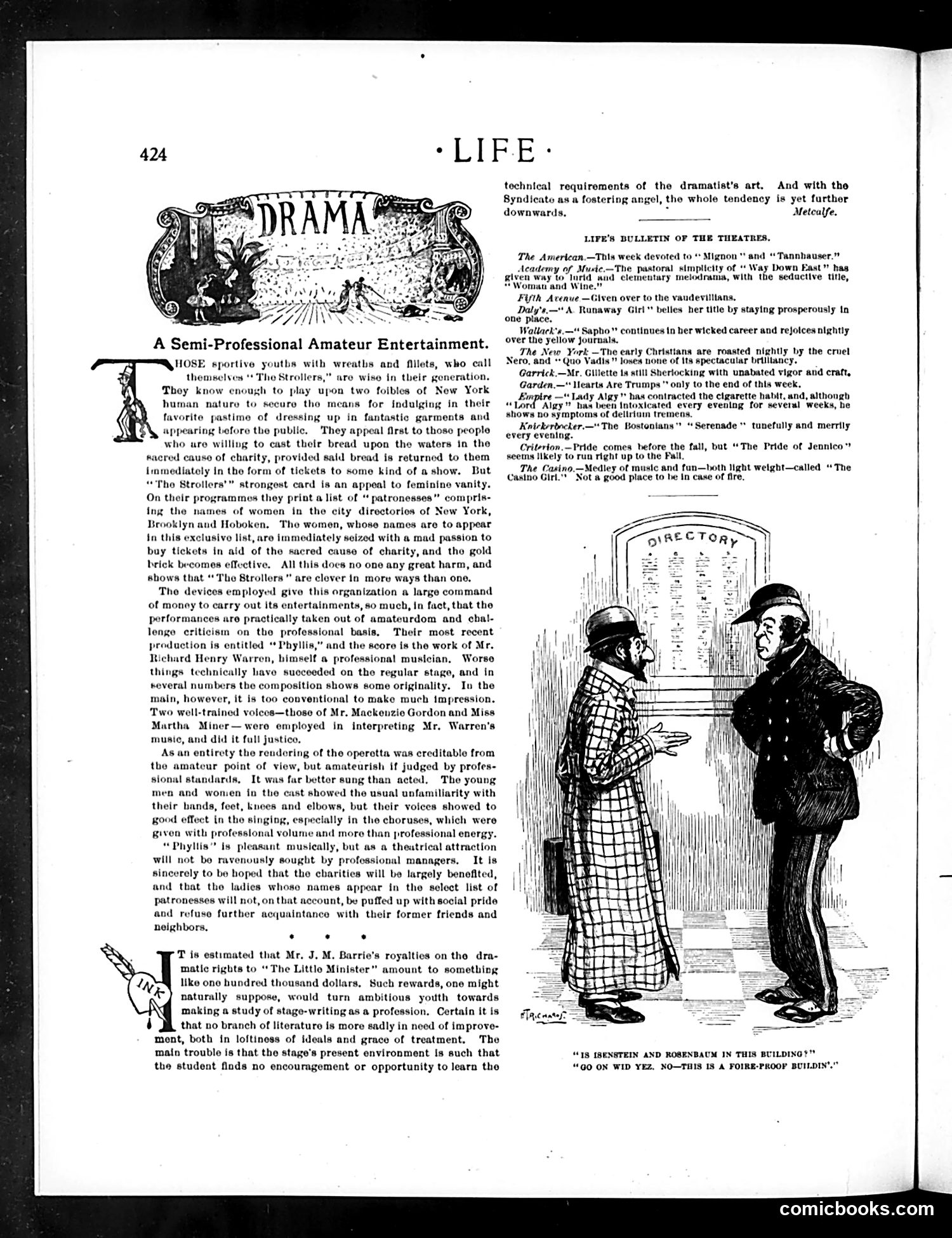
This page discusses amateur theatrical productions by wealthy New York society women organizing charity performances. The main article, "A Semi-Professional Amateur Entertainment," critiques these "Strollers"—society ladies who perform in plays to raise funds for charitable causes. The cartoon depicts two men at a theater directory board. One man asks the other: "Is Bernstein and Rosenbaum in this building?" The response: "Go on wid yez. No—this is a fire-proof buildin'." This joke relies on an ethnic stereotype, suggesting that Jewish businessmen (Bernstein and Rosenbaum are Jewish names) would be associated with fire hazards or dishonest dealings—a common antisemitic trope of the era. The humor depends on degrading stereotypes now recognized as offensive.
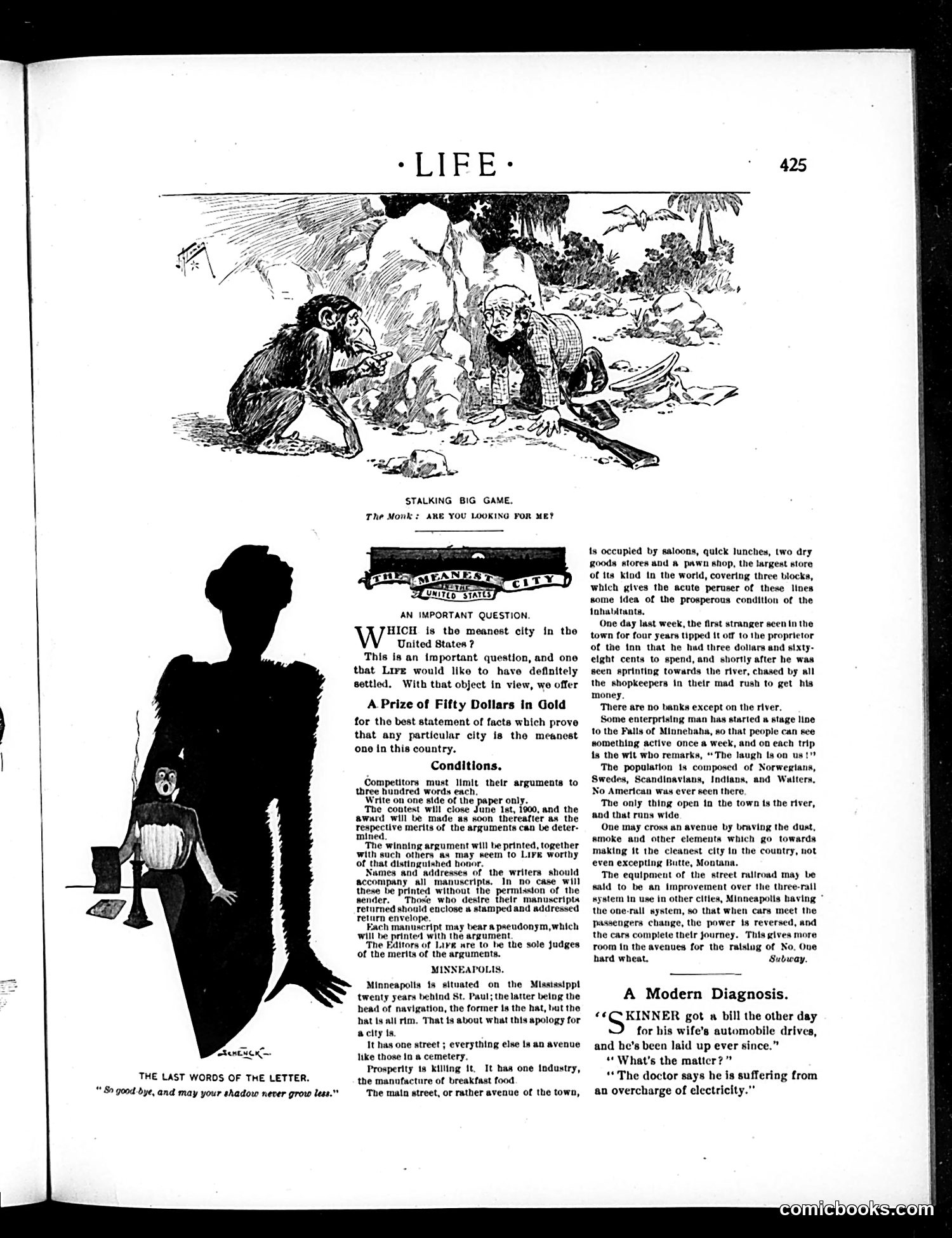
This page contains two satirical pieces from Life magazine (circa 1900): **Top cartoon ("Stalking Big Game"):** A man and a monkey confront each other in a wilderness setting. The caption quotes the man asking "ARE YOU LOOKING FOR ME?" This appears to be a commentary on human-animal similarities or possibly a reference to Darwinian evolution debates of the era—a common satirical theme in early 1900s American humor. **Main content:** Life announces a contest offering $50 in gold for the best argument proving which U.S. city is "the meanest" (cheapest/most miserly). The example submission viciously satirizes Minneapolis, mocking its poverty, limited commercial activity, Scandinavian immigrant population, and poor infrastructure. The joke relies on regional stereotypes and class-based humor typical of the period. **Bottom item ("A Modern Diagnosis"):** A brief humorous exchange where a man is hospitalized after receiving an auto repair bill—the doctor diagnoses "overcharge of electricity," punning on both the car's electrical systems and the financial shock. The page reflects turn-of-century American satirical sensibilities: regional mockery, immigrant stereotyping, and wordplay-based humor.
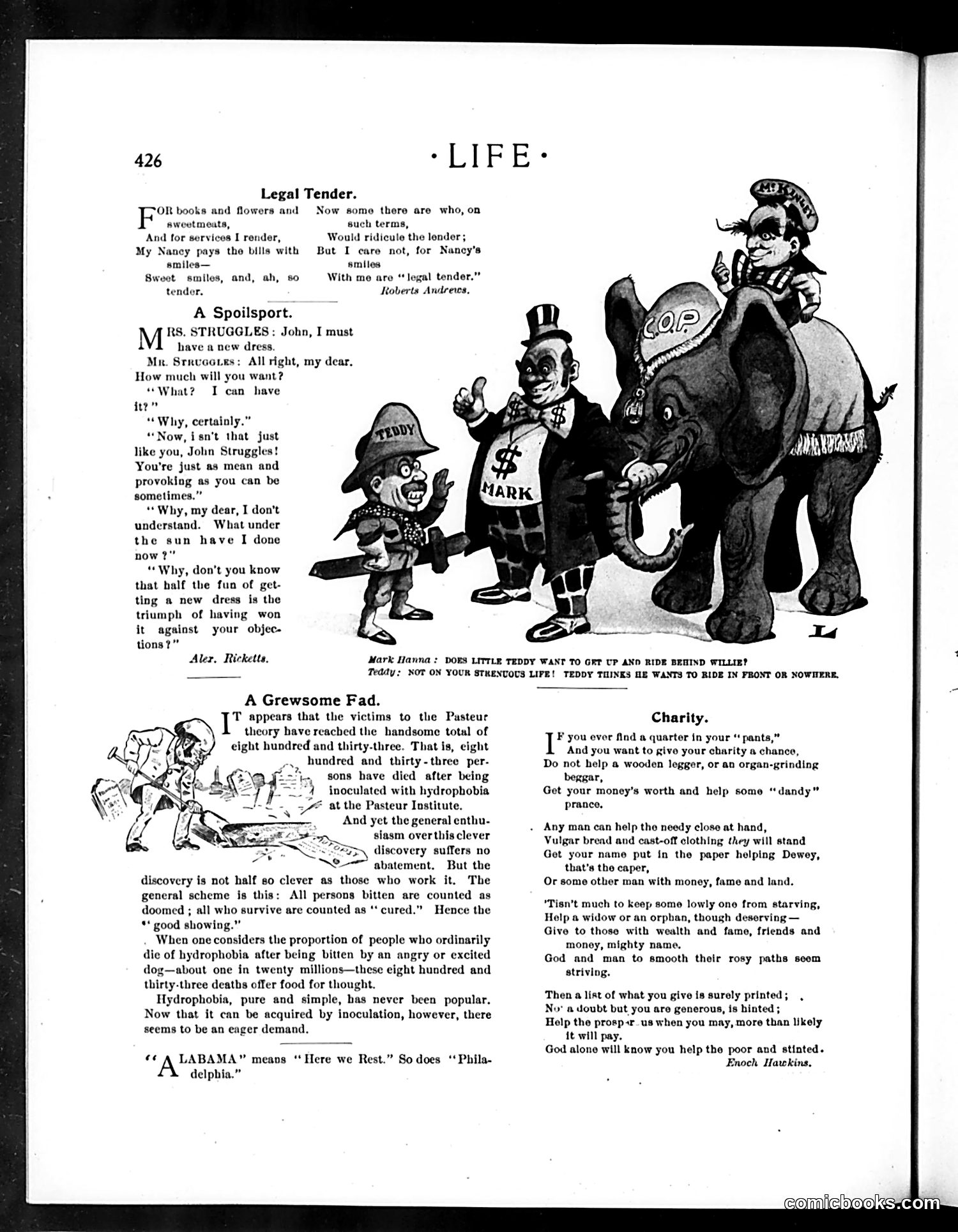
**"A Spoilsport"** satirizes marital dynamics: Mrs. Struggles wants a new dress, but when her husband immediately agrees, she's furious—she wanted the *triumph of winning an argument*, not easy consent. The joke mocks how some spouses derive satisfaction from conflict rather than getting what they claim to want. **The Mark Hanna cartoon** depicts political tension circa Theodore Roosevelt's presidency. Hanna (Republican kingmaker) offers "Little Teddy" a ride behind "Willie" (likely McKinley or another establishment figure), but Roosevelt refuses—he wants to lead ("ride in front"), not follow. This reflects Roosevelt's ambitious, aggressive political style and his desire for power rather than subordinate positions. **"A Grewsome Fad"** critiques the Pasteur rabies vaccine's reputation. Though presented as miraculous, the piece notes 833 deaths after inoculation and questions whether the cure itself kills more people than natural hydrophobia would. It satirizes blind faith in medical progress and the rhetorical trick of counting all bitten patients as "doomed" so survivors appear "cured."
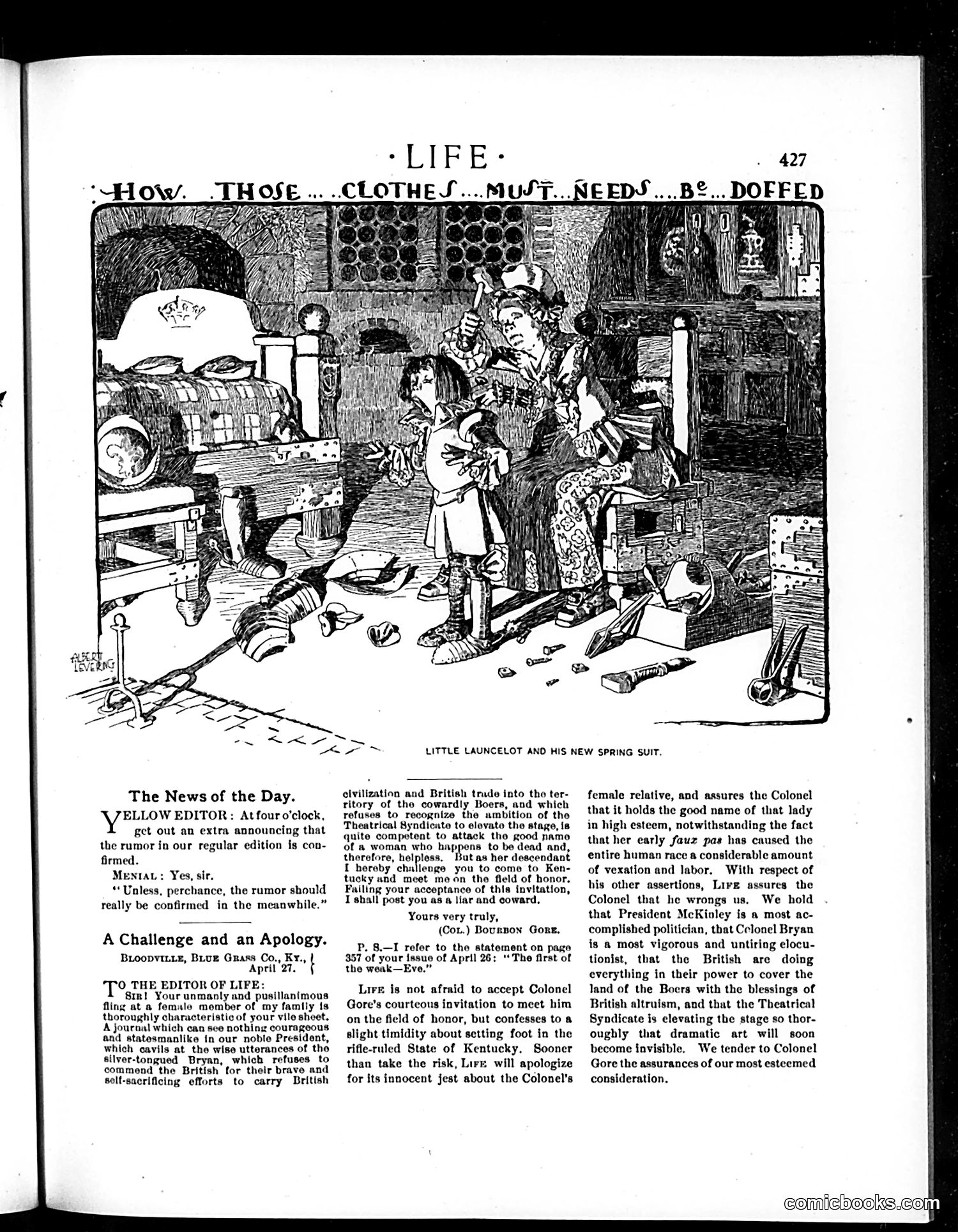
This page contains two satirical pieces from *Life* magazine (circa 1900): **"The News of the Day"** is a brief joke about journalistic sensationalism: an editor instructs his assistant to publish an "extra" announcing a rumor as confirmed—unless the rumor proves false in the meantime. It mocks newspapers' eagerness to print unverified stories. **"A Challenge and an Apology"** is more pointed satire. Colonel Bourbon Gore demands a duel with *Life*'s editor over a dead female relative's "faux pas" (likely an affair or scandal). Gore also attacks *Life* for criticizing President McKinley, William Jennings Bryan, and the British conduct in the Boer War. *Life*'s response drips with sarcasm: it apologizes while simultaneously insulting the woman ("early faux pas"), mocking Gore's Kentucky pride, and—most pointedly—praising all three targets Gore defended, but with obviously false flattery ("dramatic art will soon become invisible"). The satire suggests *Life* actually opposes these positions but strategically retreats. The cartoon above depicts children in Victorian dress, likely illustrating innocent youth contrasted with adult moral corruption.
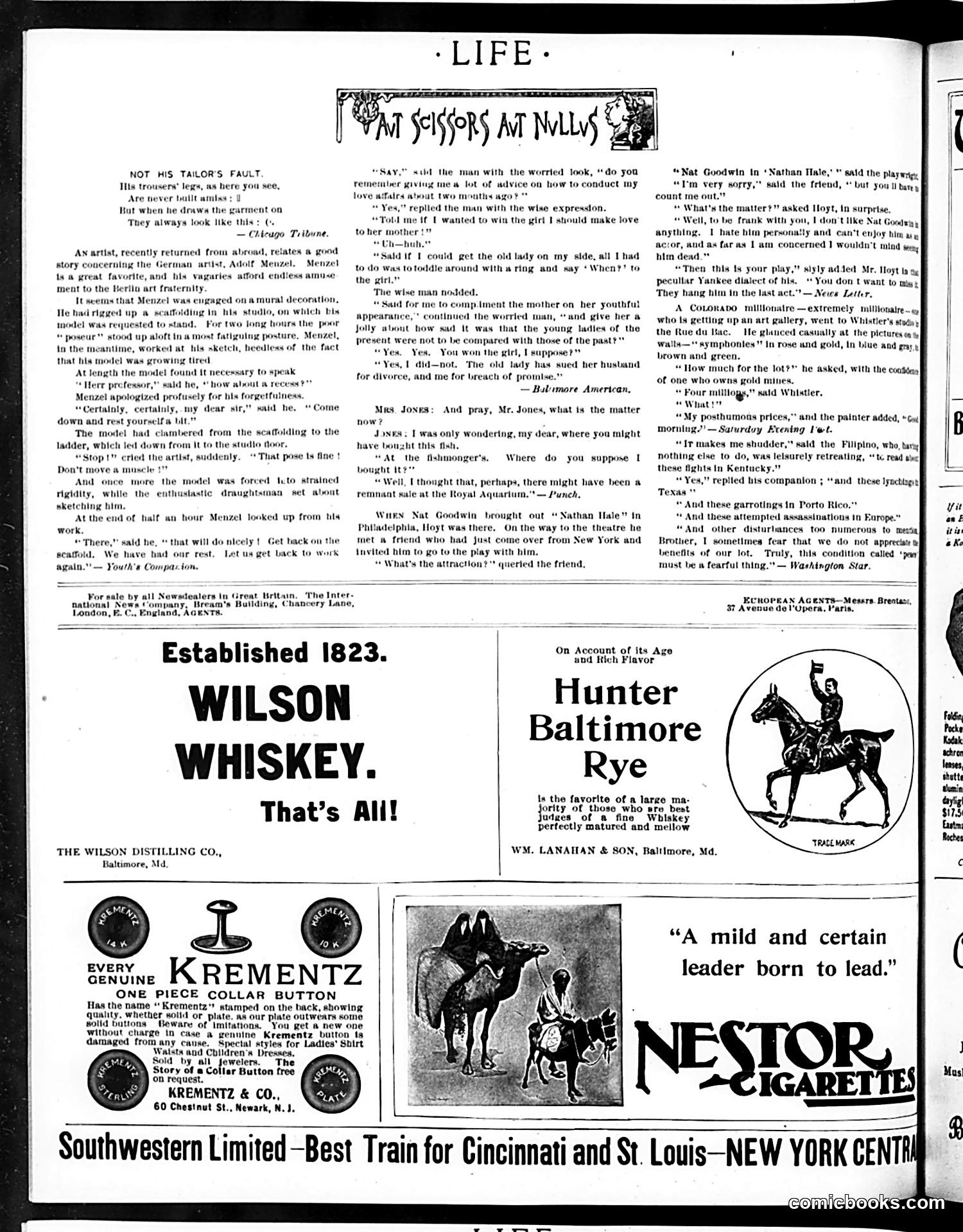
This page contains several satirical vignettes typical of Life magazine's humor: **"Nat Scissors at Nully's"** appears to be the main cartoon, featuring anecdotes about romantic advice and theater gossip. References include actor **Nat Goodwin** performing in "Nathan Hale" and comedian **DeWolf Hoyt**, depicted as exchanging witty remarks about courtship tactics and theatrical rivalry. One sketch mocks an overly-dedicated artist (appears to be referencing **Menzel**, a noted painter) who demands his model maintain an exhausting pose for hours, then desperately asks him not to move when finally repositioning. Another features a **Colorado billionaire** dismissing **Whistler's** artwork prices as overinflated—satirizing wealthy nouveaux riches and artistic pretension. The page also includes period advertisements (Wilson Whiskey, Krementz collar buttons, Nestor Cigarettes), typical of Life's mixed editorial-advertising format. The overall tone mocks social climbers, artistic pretension, and romantic foolishness—standard Life magazine targets.
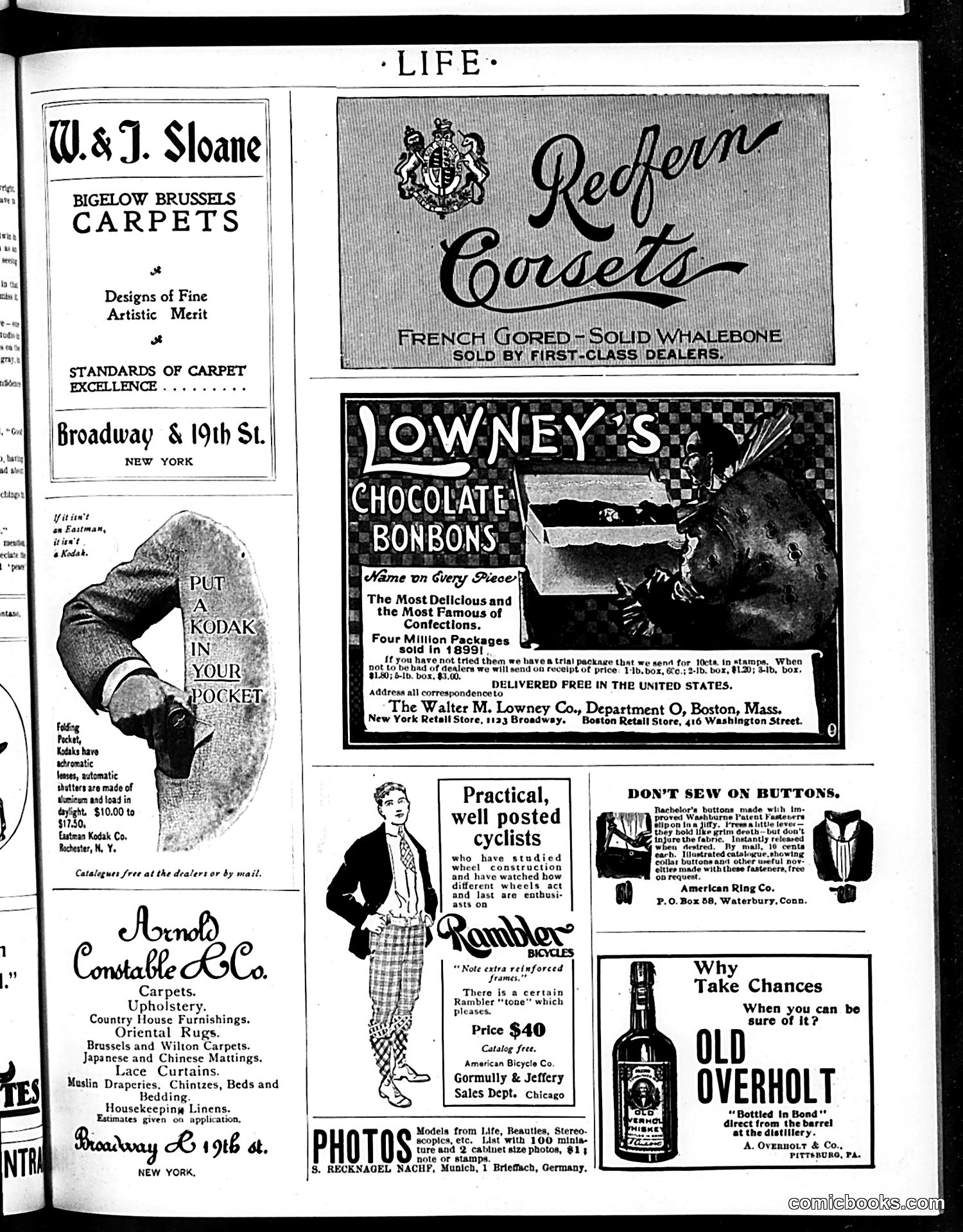
This is primarily a **advertising page**, not a satirical cartoon page. It contains multiple product advertisements typical of early 1900s American magazines: **Notable ads include:** - **W. & J. Sloane** (carpets) and **Arnold Constable & Co.** (furnishings) — upscale home goods - **Lowney's Chocolate Bonbons** — emphasizing popularity ("Four Million Packages sold in 1899") - **Rambler Bicycles** — targeting "well posted cyclists" with a $40 price point - **Kodak cameras** — promoting portable photography - **Old Overholt whiskey** — "Bottled in Bond" (a guarantee of authenticity/quality) - **American Ring Co.** — sewing fasteners The page reflects **turn-of-century American consumer culture**: photography technology, cycling popularity, mail-order shopping, and branded luxury goods. The ads target middle-to-upper-class readers with disposable income. There is **no political satire** visible — this is straightforward commercial advertising from Life's revenue-generating content.
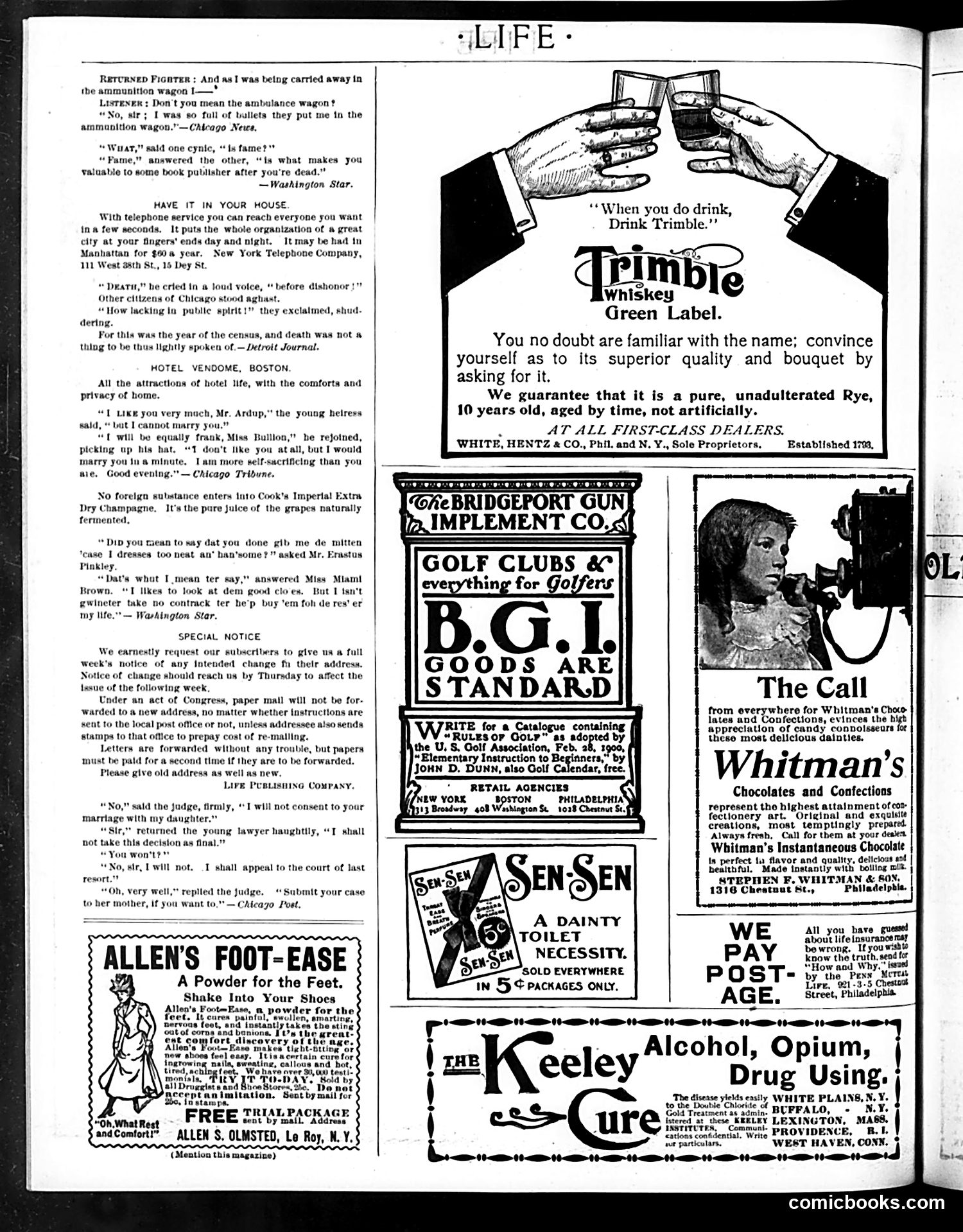
This page from *Life* magazine is primarily **advertising and humorous anecdotes**, not political cartooning. The content reflects early 20th-century American commercial culture and social attitudes. **Notable elements:** The **jokes and quips** mock contemporary concerns: a returned soldier's overabundance of bullets, Chicago's indifference to death during census year, a gold-digger romance, and class anxiety about clothing and propriety. These are light satirical observations on urban life and social pretension. **Advertisements dominate**: Trimble Whiskey, B.G.I. golf equipment, Whitman's Chocolates, Allen's Foot-Ease powder, and "The Keeley Cure" for alcohol/drug addiction. The Keeley Cure ad is notable—it reflects contemporary anxiety about substance abuse as a treatable medical condition. **The satire is gentle**: rather than sharp political critique, these are humorous observations on marriage, courtship, wealth-seeking, and social climbing. The page captures *Life*'s role as a satirical humor magazine targeting middle-class readers with witty commentary on their own society.
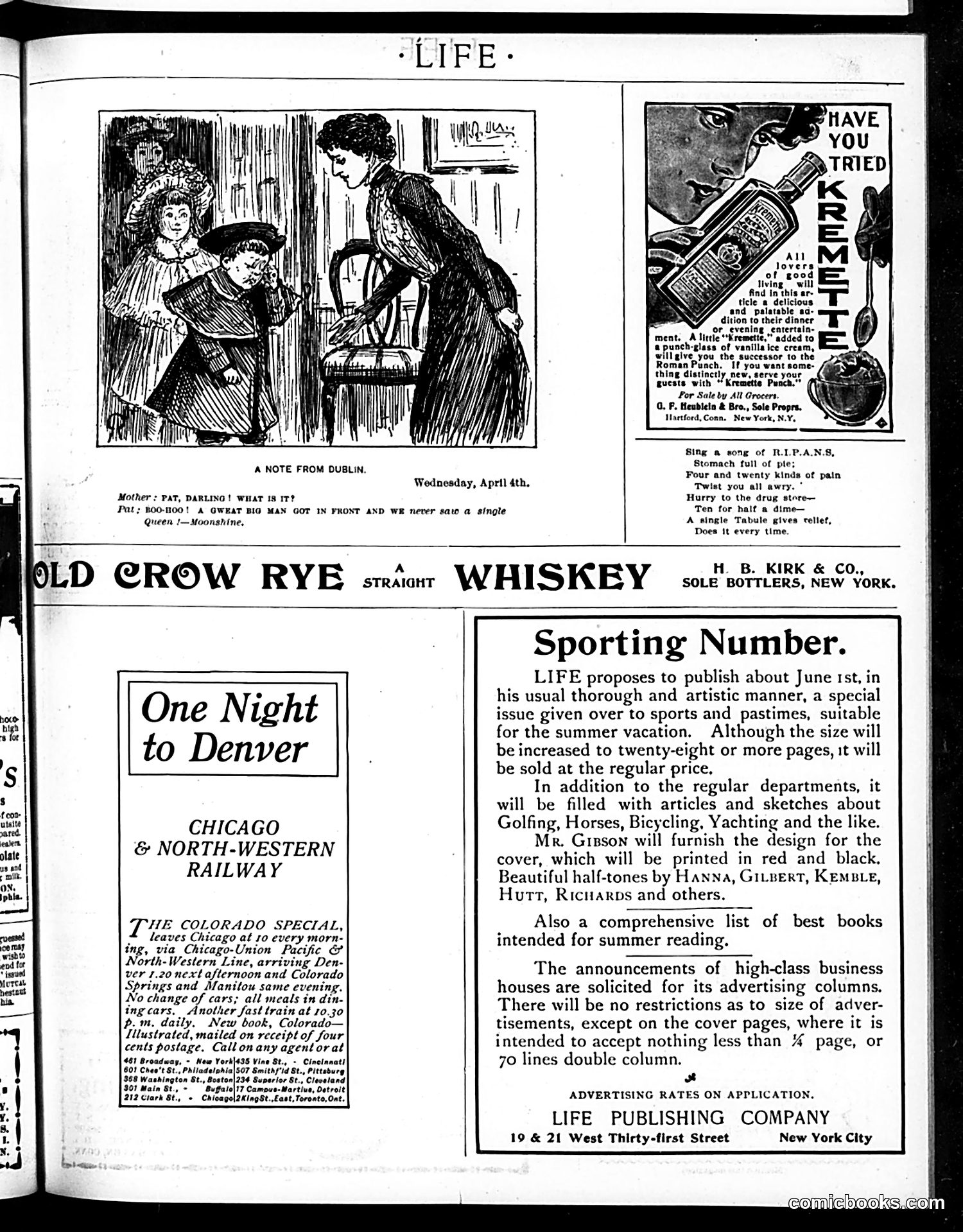
**The Main Cartoon ("A Note from Dublin"):** This depicts an Irish mother and child at a theatrical performance. The mother asks what's wrong with "Pat"; he responds that "a great big man got in front" and they "never sat a single" (word, or line of sight). This is a sight-gag about theater-going frustration—someone blocking the view—but with an Irish dialect punch line referencing "Moonshine" (likely illicit whiskey). The humor relies on Irish immigrant stereotypes common to early 1900s American satire. **Right Panel Advertisement:** A "Kremette Punch" drink ad and a Ripans Tabules stomach remedy ad (common patent medicine of the era), presented as satirical song lyrics about digestive distress and quick relief. **Bottom Content:** Mostly advertisements and announcements—Old Crow Whiskey, Chicago & North-Western Railway's "Colorado Special," and Life Publishing Company's announcement of an upcoming sports-focused issue. The page is primarily **advertising-driven content** with one ethnic-stereotype sight gag.
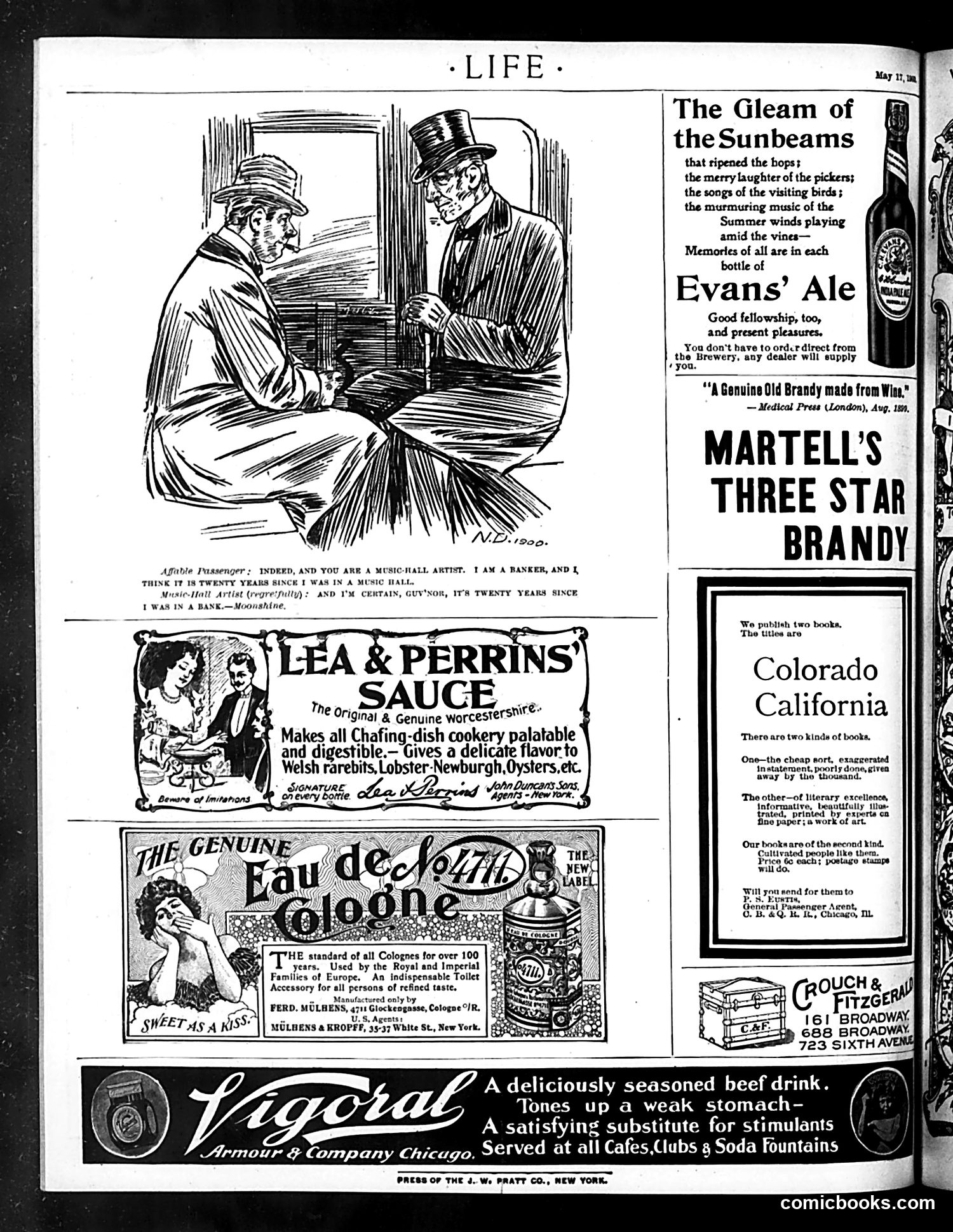
**The Main Cartoon:** The single illustrated cartoon depicts two men in conversation—a well-dressed banker and a shabby music-hall performer. The joke relies on ironic role reversal: the banker boasts he hasn't visited a music hall in twenty years, while the performer sadly admits he hasn't worked in a bank for twenty years. The implication is that the entertainer has fallen into poverty and desperation, forced to take any available work (including banking), while the banker has abandoned lowbrow entertainment—suggesting class anxiety and economic displacement during uncertain times. **The Rest:** The page is primarily **advertisements** for luxury consumer goods: Evans' Ale, Martell's Brandy, Lea & Perrins Sauce, Feu de Cologne, Vigoral beef drink, and travel books. These ads suggest the magazine's affluent readership and the era's focus on refined leisure and consumption.