
Life, 1900-05-17 · page 6 of 20
Life — May 17, 1900 — page 6: what you’re looking at
What you’re looking at
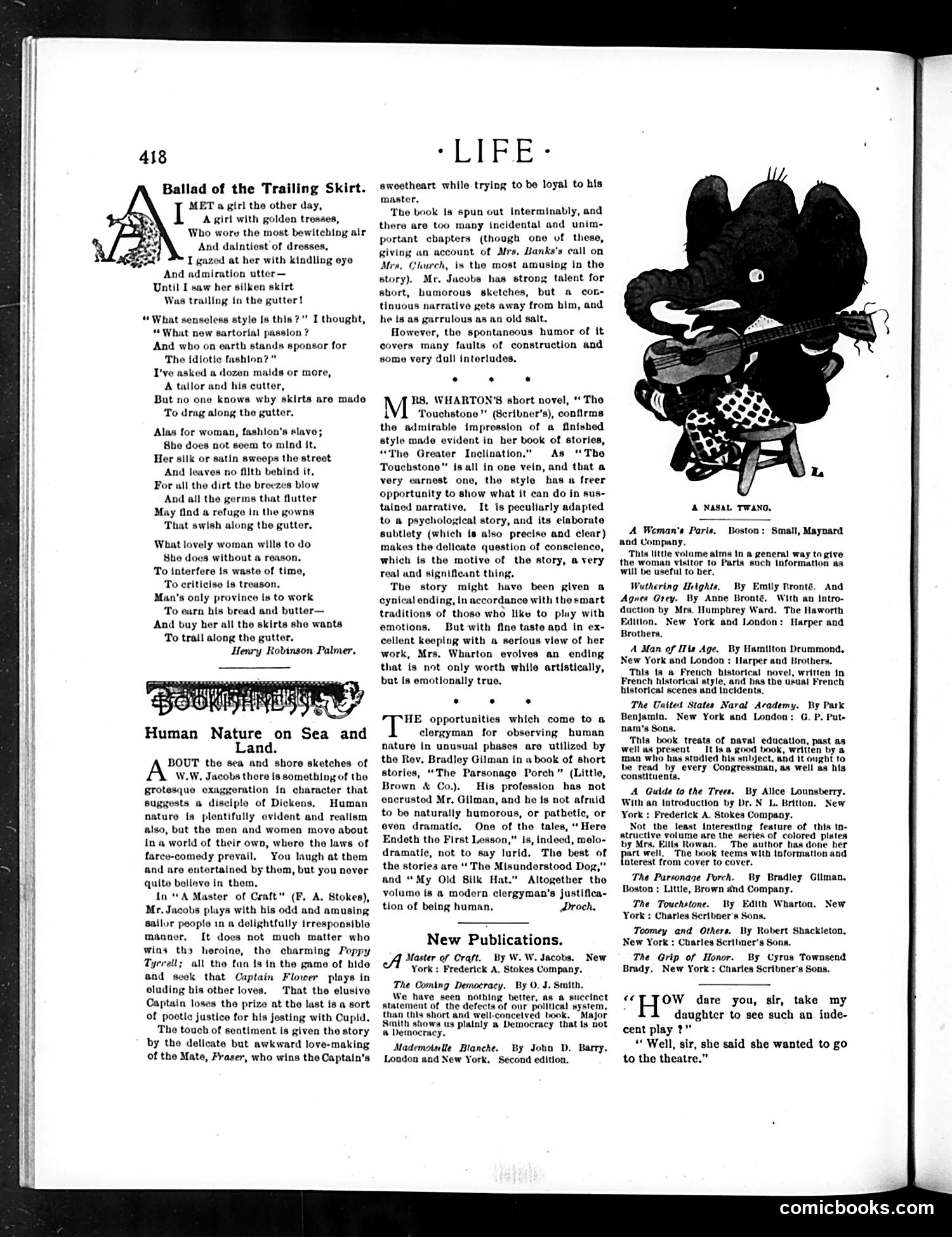
This page contains **literary reviews and book advertisements** rather than political cartoons. The main illustration titled "A Naval Twang" shows a figure seated in a chair—likely a humorous genre sketch unrelated to politics. The page reviews several books including *The Touchstone* by Mrs. Wharton and *The Parsonage Porch*. There's also a section on "Human Nature on Sea and Land" discussing W.W. Jacobs's sketches. At the bottom, a small dialogue snippet begins: "How dare you, sir, take my daughter to see such an indecent play?" with the response "Well, sir, she said she wanted to go to the theatre." This appears to be **social satire about theater-going and propriety rather than political commentary**—typical of Life magazine's lighter cultural criticism.
📄 Transcribed text from this page (OCR, searchable)
Machine-transcribed from the original scan — historical spelling and the odd misread are preserved.
418 Ballad of the Trailing Skirt. MET a girl tho other day, A girl with golden tresses, ay Who wore the most bewitching air of And daintiest of dresses. eget I gazed at her with kindling eye And admiration utter— Until I saw her silken skirt Was trailing in the gutter! “What senseless style is this?” I thought, “What new sartorial passion ? And who on earth stands sponsor for Tho Idiotic fushton?” I’ve asked a dozen maids or more, A tallor and his cutter, But no one knows why skirts are mado To drag along the gutter. Alas for woman, fashion’s slavo; She does not seem to mind it, Her silk or satin sweops the street And leaves no filth behind it, For ull the dirt the breezes blow And all the germs that flutter May find a refugo In the gowns That swish along the gutter, What lovely woman wills to do She does without a reason, To interfere is waste of time, To criticise {8 treason, Man's only province is to work To earn bis bread and butter— And buy her all the skirts she wants To trail along tho gutter. Henry Robinson Palmer. Human Nature on Sea and Land. BOUT the sea and shoro sketches of W.W. Jacobs thore is something of tho grotesque exaggeration in character that suggests a disciple of Dickens. Human nature {s plentifully evident and realism also, but the men and women move about in a world of their own, whero tho laws of farce-comedy provail. You laugh at them and aro entertained by them, but you nover quite believe in them. In “A Master of Craft” (F, A. Stokes), Mr. Jacobs plays with bis odd and amusing sailor people in a delightfully irresponsiblo manner, [t does not much matter who wins tho heroine, tho charming Poppy Tyrrell; all the fun ts in the game of hide and seck that Captain Flower plays in eluding his other loves. That the elusive Captain loses tho prize at tho last is a sort of pootle justice for his jesting with Cupid. The touch of sentiment is given the story by tho delicate but awkward love-making of the Mate, Fraser, who wins tho Captain's «LIB « sweetheart while trying to be loyal to his master, ‘The book Is spun out interminably, and there are too many incidental and unim- portant chapters (though one vf these, giving an account of Mfrs, Banks's call on Mra, Church, is the most amusing in the story). Mr, Jacobs has strong talent for short, humorous sketches, but a con- tinuous narrative gets away from bim, and he {s a8 garrulous as an old salt. However, the spontaneous humor of It covers many faults of construction and some very dull interludes, . . . RS, WHARTON’S short novel, “ Tho ‘ Touchstone” (Scribner's), confirms the admirable impreasion of a finished style made evident in ber book of stories, “The Greater Inclination.” As “Tho Touchstono” is all in one vein, and that a very earnest one, the style has a freer opportunity to show what it can do in sus- tained narrative, It is peculiarly adapted to @ psychological story, and its elaborate subtlety (which is also precise and clear) makes the delicate question of conscience, which {8 the motive of the story, a very real und significant thing. The story might have been given a cynical ending, in accordance with the smart traditions of those who like to pluy with emotions. But with fine taste and in ex- cellent keeping with a serious view of her work, Mrs, Wharton evolves an ending that is not only worth while artistically, but is emotionally true, HE opportunities which come to a clergyman for observing human nature in unusual phases aro utilized by the Rev. Bradley Gilman in a book of short stories, “The Parsonago Porch” (Little, Brown & Co). His profession has not encrusted Mr, Gilman, and he is not afraid to be naturally humorous, or pathetic, or oven dramatic, One of tho tales, “Hero Endeth tho First Lesson,” is, indeed, melo- dramatic, not to say lurid. The best of tho stories are The Misunderstood Dog,” and “My Old Silk Hat.” Altogether tho volumo is a modern clergyman’s justifica- tion of being human. Proch, New Publications. AA Master of Craft. By W.W. Jacobs. New York : Frederick A. Stokes Company. The Coming Democracy. By 0. J. Smith. We have seen nothing better, as a succinct statement of the defects of our polltical system, than this short and well-concelved book. Major Smith shows us plainly a Democracy that Is not @ Democracy. Mademaslle Blanche. By John D. Barry. London and New York, Second edition, A NASAL TWANG, A Woman's Paris, Boston: Small, Maynard ‘and Company, Thia little volume alms In a general way togive the woman visitor to Paris such information as will be useful to her, Wuthering Heights, By Emlly Dronté. And Aguee Orey. By Anne Bronté. With an intro duction by Mra. Humphrey Ward. The Haworth Edition, New York and London: Harper and Brothers, A Man of His Age. By Hamilton Drummond, New York and London : Harper and brothers. This is a French historical novel, written in French historical atyle, and has the usual French historical scenes and tncidents. The United States Naral Academy. By Park Benjamin. New York and London: G. P. Put- nam’s Sons. ‘This book treats of naval education, past as well as present It 1s a good book, written by a man who has studied his subject, and it ought to be read by every Congressman, as well as his constituents, A Guide to the Trees. By Allce Lounsberry. With an Introduction by Dr. NL. Britton, New York : Frederick A. Stokes Company. Not the least Interesting feature of this in- structive volume are the series of colored plates by Mra. Ells Rowan. The author has done her rt well. The book teems with toformation and nterest from cover to cover. The Partonage Porch. By Bradley Gilman, Boston : Lite, Brown and Company. The Touchstone. By Edith Wharton, New York : Charles Scribner's Sons. Toomey and Others. By Robert Shackleton, New York : Charles Scribner's Sons. The Grip of Honor. By Cyrus Townsend Brady. New York : Charles Scribner's Sons. ccs OW dare you, sir, take my daughter to see such an. inde- cent play ?”” “ Well, sir, she said she wanted to go to the theatre.” comicbooks.com