
Life, 1900-05-17 · page 12 of 20
Life — May 17, 1900 — page 12: what you’re looking at
What you’re looking at
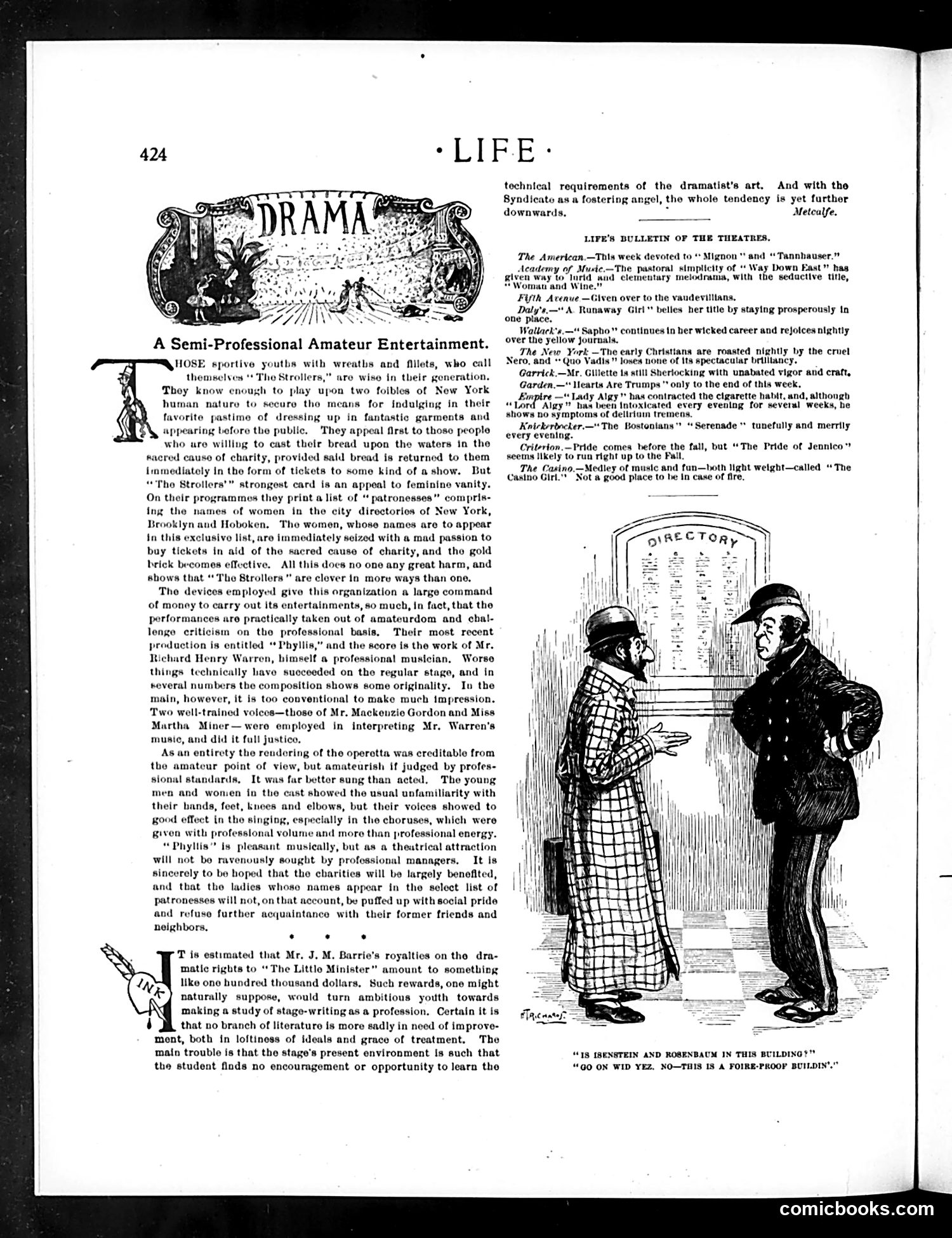
This page discusses amateur theatrical productions by wealthy New York society women organizing charity performances. The main article, "A Semi-Professional Amateur Entertainment," critiques these "Strollers"—society ladies who perform in plays to raise funds for charitable causes. The cartoon depicts two men at a theater directory board. One man asks the other: "Is Bernstein and Rosenbaum in this building?" The response: "Go on wid yez. No—this is a fire-proof buildin'." This joke relies on an ethnic stereotype, suggesting that Jewish businessmen (Bernstein and Rosenbaum are Jewish names) would be associated with fire hazards or dishonest dealings—a common antisemitic trope of the era. The humor depends on degrading stereotypes now recognized as offensive.
📄 Transcribed text from this page (OCR, searchable)
Machine-transcribed from the original scan — historical spelling and the odd misread are preserved.
A Semi-Professional Amateur Entertainment. HOSE sportive youths with wreaths and fillets, who call themselves "* Tho Strollers,” are wise in their generation, Thoy know enough to play upon two foibles of New York human nature to secure tho means for indulging in their favorite pastime of dressing up in fantastic garments and appearing before the public, They appeal first to those people who ure willing to cast their bread upon the waters in the sacred cause of charity, provided sald bread is returned to them immediately In tho form of tickets to some kind of a show. But “Tho Strotlers’” strongest card is an appeal to feminine vanity. On their programmos they print a list of “ patronesses” compris- ing the names of women in the city directorios of New York, Brooklyn aud Hoboken, Tho women, whose names are to appear in this exclusive list, are immediately seized with a mad passion to buy tickets in aid of the sacred cause of charity, and tho gold brick becomes effective. All this does no one any great harm, and shows that “Tho Btrollers" are clover 1n more ways than one, Tho devices employed give this organization a large command of monoy to carry out its entertainments, so much, In fact, that the performances are practically taken out of amateurdom and cbal- lenge criticism on tho professional basis, Their most recent production is entitled “Phyllis,” and the score is the work of Mr. Richard Henry Warren, himself a professional musician, Worse things technically have succeeded on the regular stage, and in several numbers the composition shows some originality. Iv the main, however, it is too conventional to make much tmpression. Two well-trained voicos—those of Mr. Mackenzie Gordon and Miss Martha Miner—wero employed in interpreting Mr. Warren's music, and did it full justice, As an entirety the rendoring of the operotta was creditable from the amateur point of view, but amateurish if judged by profes- sional standards, It was far better sung than acted, The young men and wonen in the cast showed the usual unfamiliarity with their bands, feet, knees and elbows, but their voices showed to good effect in the singing, especially in the choruses, which were given with professional volume and more than professional energy. “Phyllis” is pleasant musically, but as a theatrical attraction will not bo ravenously sought by professional managers. It is sincerely to be hoped that the charities will be largely benefited, and that tho ladies whoso names appear in the select list of patronesses will not, on that account, be puffed up with social pride and refuse further acquaintance with their former friends and neighbors, T is estimated that Mr. J, M. Barrie's royalties on tho dra- matie rights to “The Little Minister” amount to something like ono hundred thousand dollars, Such rewards, one might naturally suppose, would turn ambitious youth towards making a study of stage-writing as a profession. Certain it is ‘4 that no branch of literaturo is more sadly in need of improve- ment, both in loftiness of ideals and grace of treatment. The main trouble is that the stage’s present environment Is such that the student finds no encouragement or opportunity to learn the *LIFE- technical requirements of the dramatist's art, And with tho Syndicate as a fostering angel, the whole tendency is yet furthor downwards, i Metcalfe. LIPE'S BULLETIN OF THE THEATRES. The American.—This week devoted to“ Mignon * and “Tannhauser.” Academy of Music.—The pastoral simplicity of * Way Down East” has ven way to lurid and clementary melodrama, with the seductive title, oman and Wine." FYth Avenue —Given over to the vaudevilitans, Daly's,—" A. Teunaway Giri" belies her title by staying prosperously in one piace, Wattack's.—" Sapho continues in her wicked career and rejotces nightly over the yellow Journals, The New York —The early Christiana are roasted nightly by the cruel Nero, and * Quo Vadis" loses none of its spectacular brilllancy. Garrick.—Mr. Gillette 1s still Shertocking with unabated vigor and craft, Garden.—“ Mearts Are Trumps" only to the end of thts week, Empire —*“Lady Algy " has contracted the clearette hablt. and, althongh “Lord Algy” bas been Intoxicated every evening for several weeks, he shows no symptoms of delirium tremens. Koirkeroncker.—""The Bostonians” ‘Serenade ™ tunefully and merrily every evening. Critvrion.—Pride comes before the fall, but “The Pride of Jennico”? seems Ilkely to run right up to the Full, The Casino.—Medley of music and fun—both light welght—called “The Casino Girl." Not a good place to be in case of fire. oO RECTORS) ert HI I Hh | HA Hi Ain NA iui “(18 IBENSTEIN AND ROSENBAUM IN THIS BUILDING?" “G0 ON WID YEZ, NO—THIS 18 A FOIRE-PROOP BUILDIN’.” comicbooks.com