
A complete issue · 20 pages · 1900
Life — January 18, 1900
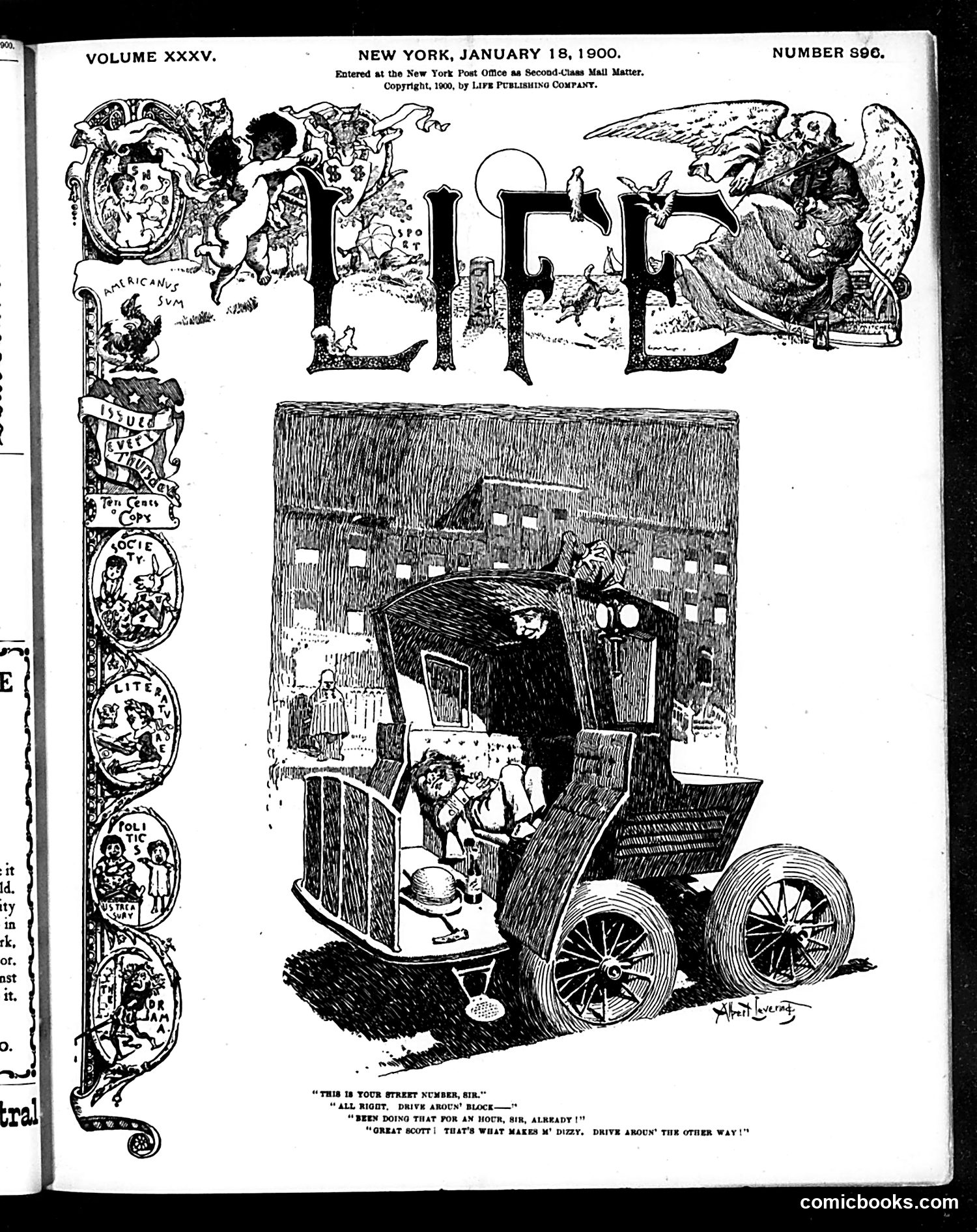
This page features a satirical cartoon about automobile traffic congestion in early 1900s New York City. The main illustration depicts a crowded street scene with an automobile attempting to navigate among pedestrians and buildings, with umbrellas held up, suggesting rainy weather. The dialogue captions reference "your street number" and "drive around," with characters expressing frustration about the vehicle blocking traffic—one saying "been doing that for an hour, sir" and another responding "that's what makes m' dizzy, drive about the other way!" The satire mocks the chaos caused by early automobiles in crowded urban streets, presenting the new technology as an obstacle creating confusion rather than convenience. The ornamental border with seasonal vignettes suggests this is a regular magazine feature.
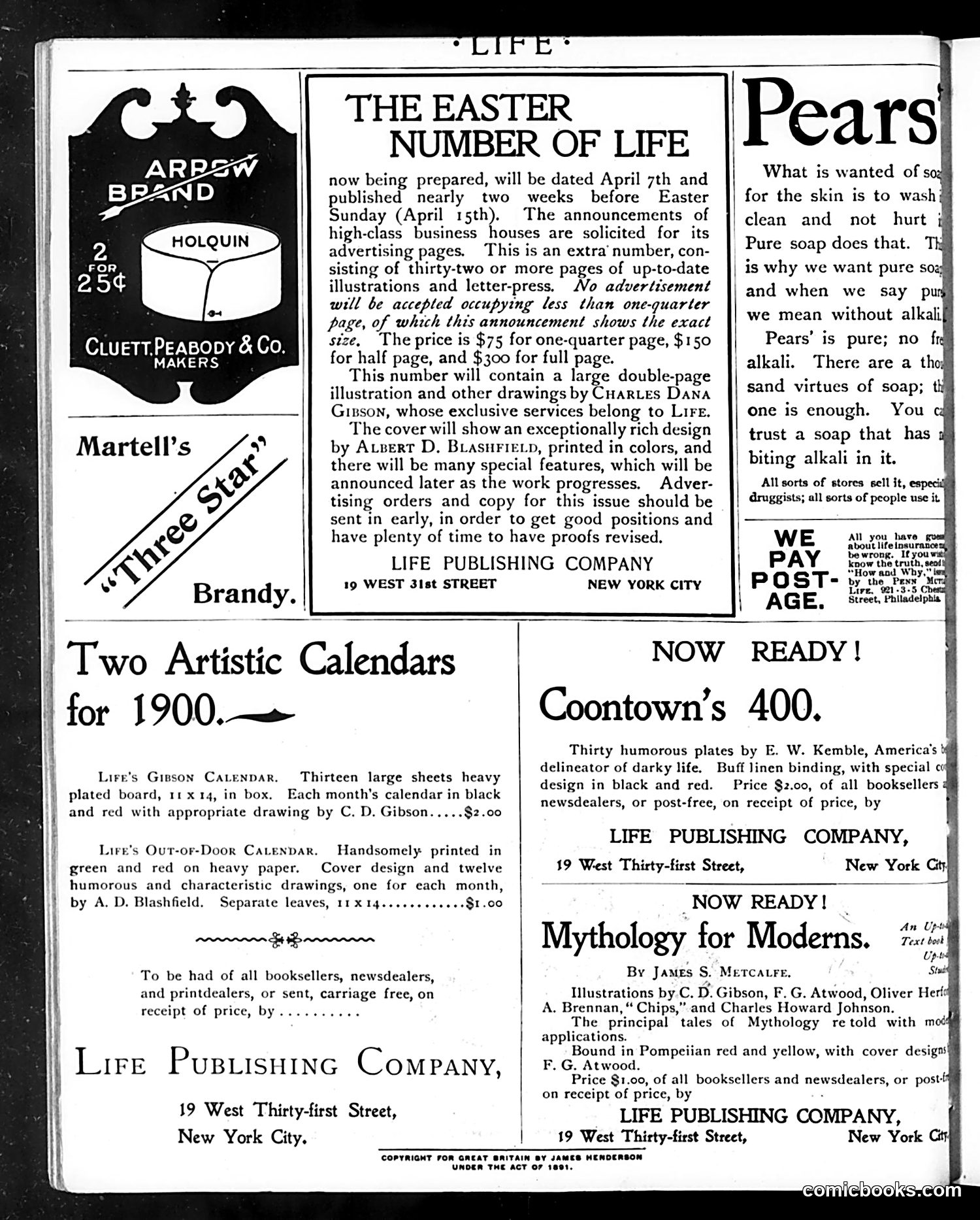
This page is primarily **advertising and publisher announcements** rather than political satire or comics. The main content includes: 1. **Life Publishing Company announcements** for upcoming books and calendars 2. **Product advertisements** (Arrow Brand holquin, Martell's Brandy, Pears' soap) 3. **Promotional notices** for *Life's* Easter issue, two artistic calendars for 1900, and three new publications: *Coontown's 400*, *Mythology for Moderns*, and others The page reflects turn-of-the-century commercial publishing culture. The racist title "*Coontown's 400*" reflects the deeply offensive racial attitudes of the 1890s-1900s era. There is **no identifiable political cartoon or satire** on this particular page—it's a commercial advertisement section showcasing Life Publishing Company's products and services.
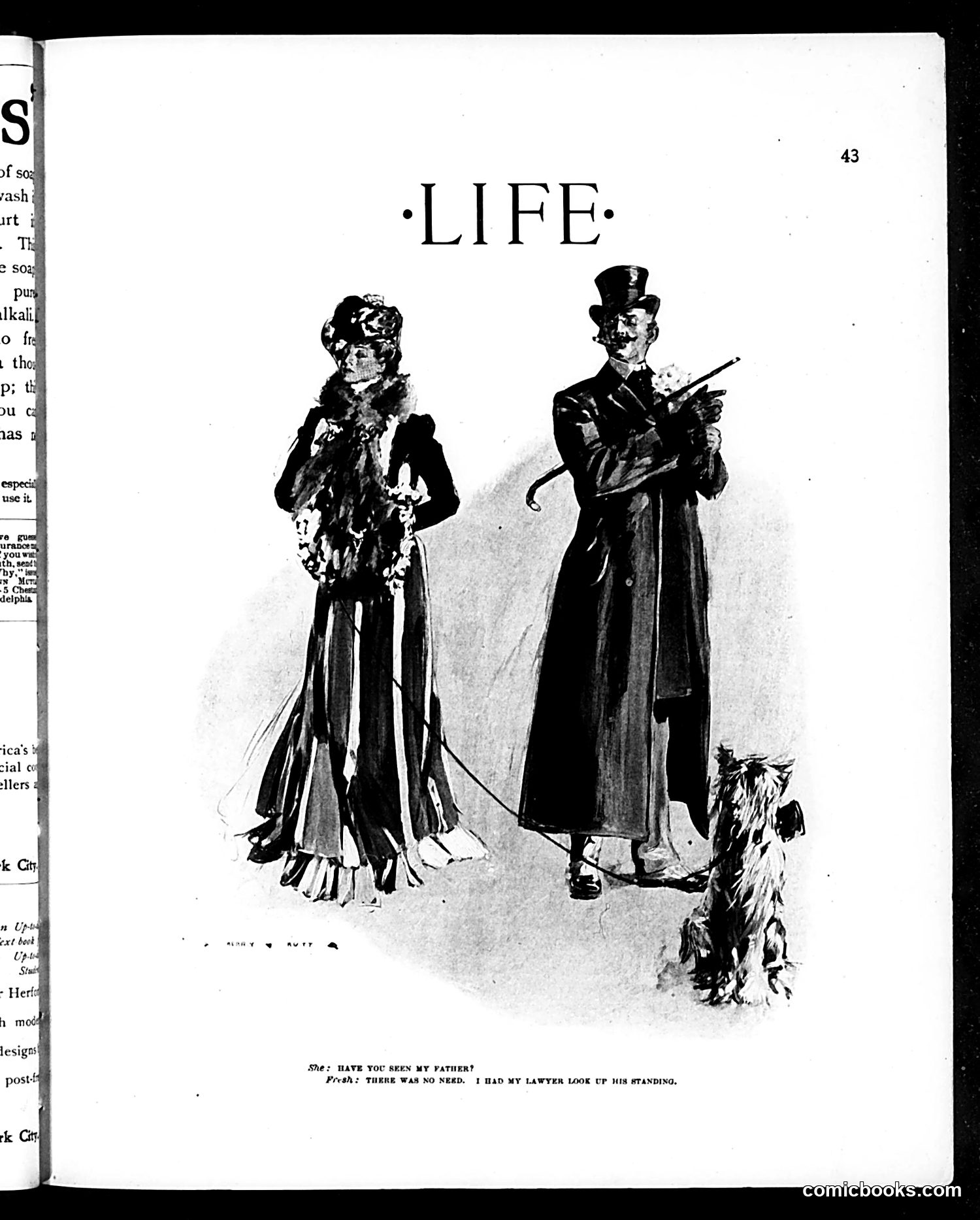
This satirical illustration shows two elegantly dressed figures from the early 20th century with a small dog. The caption reads: "She: HAVE YOU BEEN MY FATHER? / French: THERE WAS NO NEED. I HAD MY LAWYER LOOK UP HIS STANDING." The humor targets the legal and financial aspects of courtship and marriage among the wealthy. The woman asks if the man has been her father's lawyer or representative (checking his credentials), but he responds that his own lawyer already investigated the man's financial "standing"—meaning his wealth and social status. This satirizes how marriage among the upper classes was often a financial transaction where lawyers vetted potential partners' economic worth rather than romantic or familial connections being primary concerns.
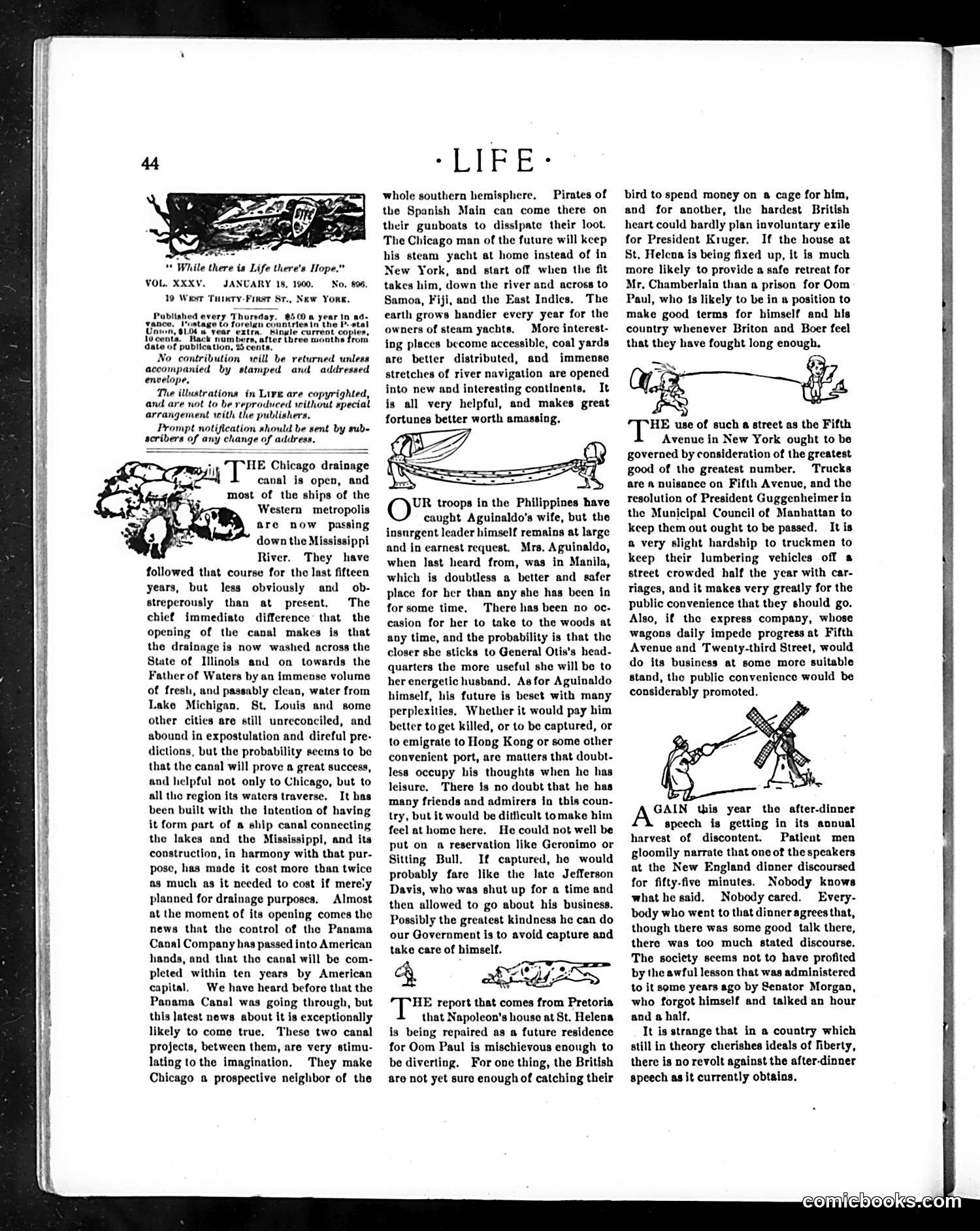
This page contains three separate satirical items: 1. **Chicago Drainage Canal**: Text discusses the opening of Chicago's drainage canal, praising it as beneficial infrastructure that will help multiple cities and regions. 2. **Philippine Insurgency**: Commentary on Aguinaldo's wife being captured by U.S. troops. The satire questions whether Aguinaldo would be better off captured, killed, or emigrating—treating his predicament with dark humor about colonial conflict. 3. **Fifth Avenue Street Nuisance**: Criticism of commercial traffic (lumber wagons, express company vehicles) congesting New York's Fifth Avenue. The satire mocks the inconvenience to wealthy residents while advocating for municipal regulation to protect the street's prestige. 4. **After-Dinner Speech Restraint**: A brief satirical note about Americans' polite tolerance of tedious after-dinner speeches, contrasting this with claimed ideals of liberty.
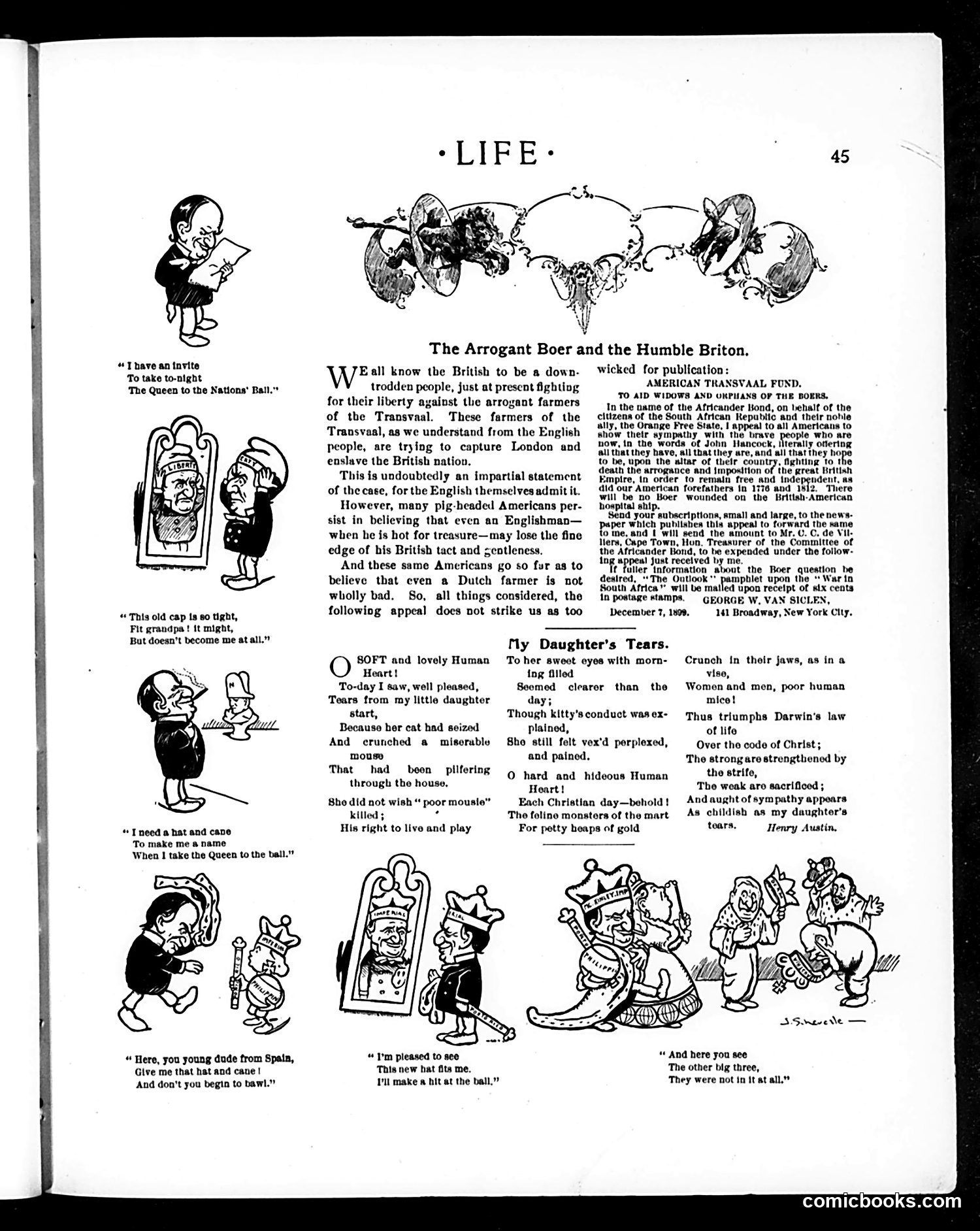
This page satirizes early 20th-century British-American tensions. "The Arrogant Boer and the Humble Briton" references the Boer War (1899-1902), mocking British claims of moral superiority while fighting Afrikaner farmers. The accompanying appeal solicits American donations for Boer refugees, apparently for publication in an "Afrikander" newspaper. The cartoons mock Americans seeking British approval—particularly new money ("dudes") aspiring to British respectability by adopting upper-class affectations like canes and hats. The captions satirize this social climbing. "Fly Daughter's Tears" and "Soft and Lovely Human Heart" are sentimental poems about children and compassion, possibly ironic counterpoints to the hardened imperial politics discussed above. The overall page presents satirical commentary on class pretension, imperial hypocrisy, and transatlantic social dynamics of the Edwardian era.
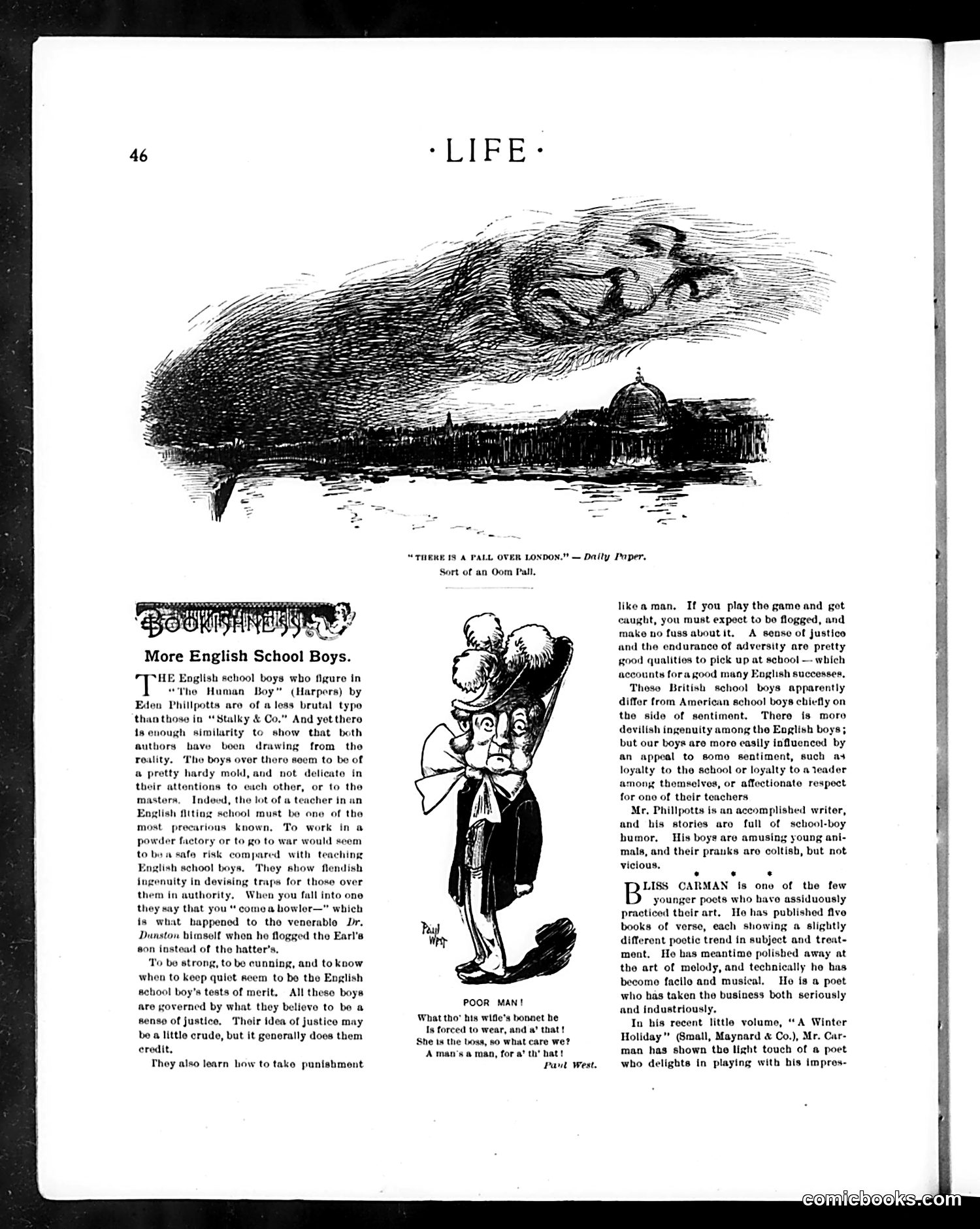
This page satirizes English school boys through a caricatured figure labeled "Poor Man!" The cartoon depicts a stern, thin schoolmaster or headmaster carrying a cane—the symbol of corporal punishment in British schools. The accompanying text explains that English schoolboys endure harsher discipline than American counterparts, showing "devilish ingenuity" in resisting authority. The joke plays on the contrast between the boys' cleverness and their vulnerability to punishment. The caption references a wife's bonnet and "a man's a man, for a' that"—likely quoting Scottish poet Robert Burns to mock the schoolmaster's authority over boys, ironically suggesting even strict discipline cannot diminish their essential humanity or spirit.
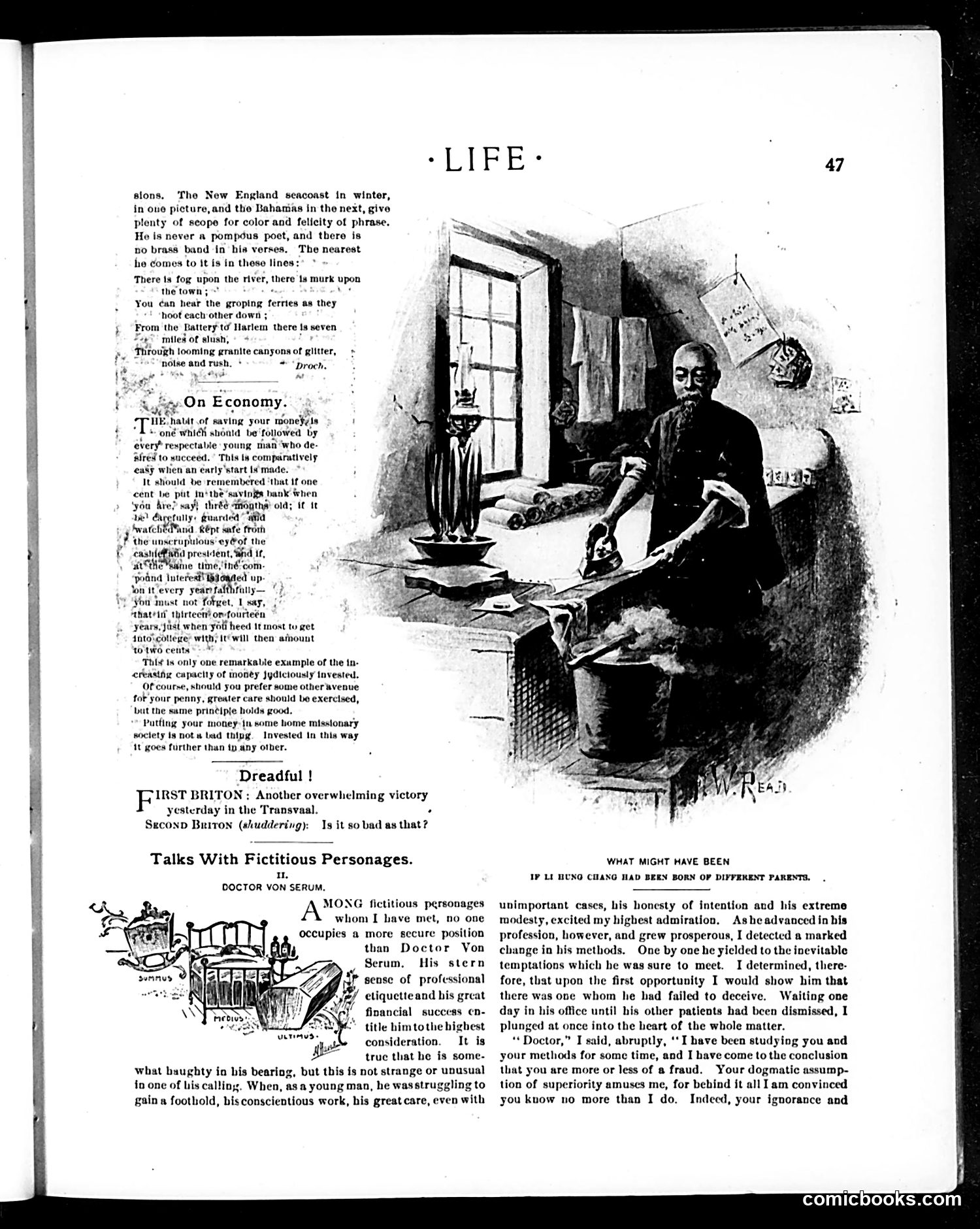
The main illustration depicts a scene titled "What Might Have Been If Li Hung Chang Had Been Born of Different Parents." Li Hung Chang was a prominent Chinese diplomat and statesman. The cartoon shows him as a Western-style office worker or businessman at a desk, wearing Western clothing and a hat, surrounded by Western furnishings and papers. The satire appears to mock the idea of cultural assimilation—suggesting that if this important Chinese figure had been raised in Western society instead, he would be merely an ordinary clerk or functionary rather than a significant statesman. It plays on late-19th-century assumptions about Western superiority while simultaneously mocking Western ordinariness, implying that even "Western" training couldn't make someone truly exceptional.
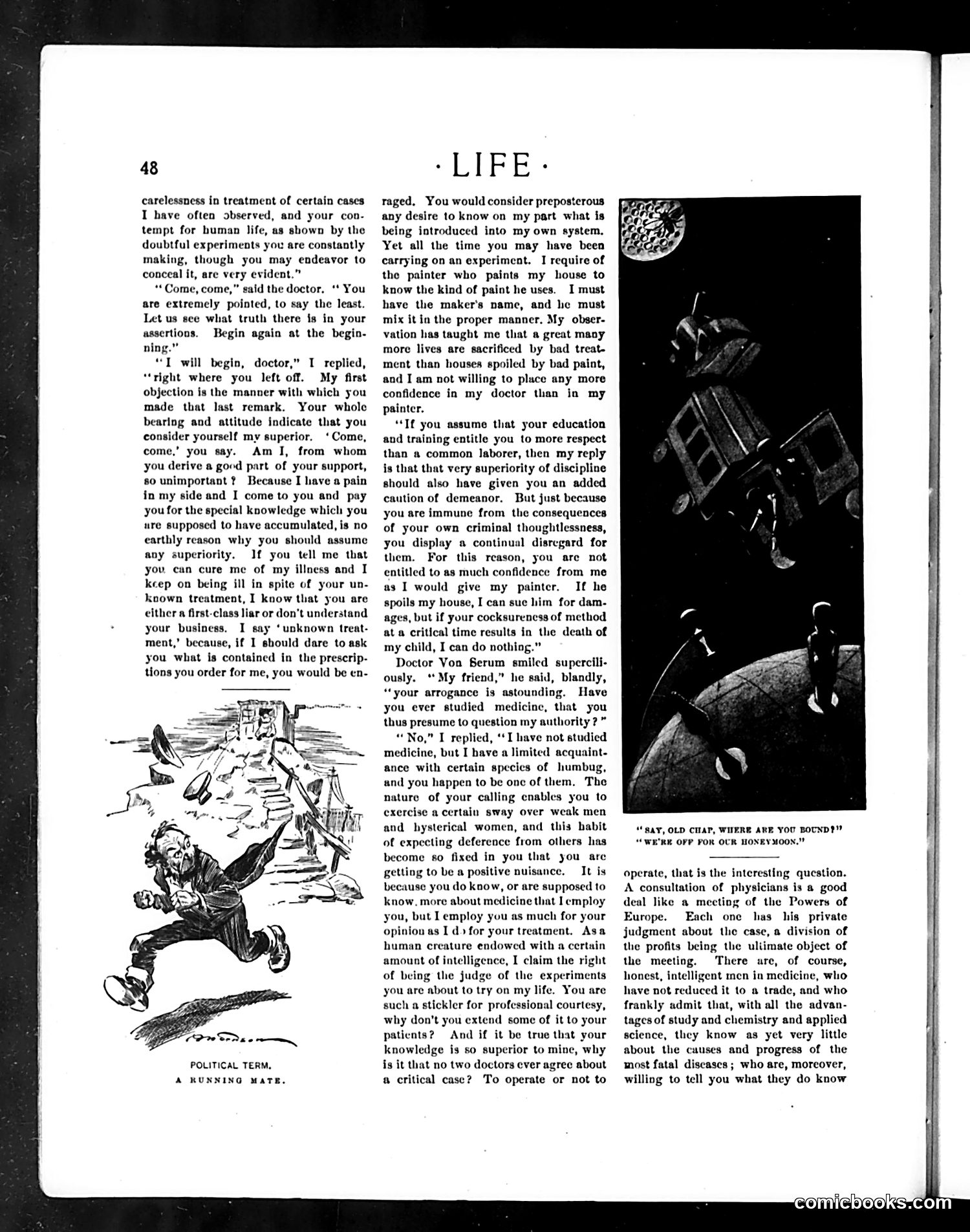
This page contains two satirical illustrations accompanying a dialogue between a patient and "Doctor Von Serum." **The larger cartoon** (bottom left) shows a chaotic scene labeled "A RUNNING MATE," depicting what appears to be a political candidate or figure in disarray, surrounded by scattered objects and confusion—likely satirizing political partnerships or campaign chaos. **The upper right illustration** shows figures in what appears to be a honeymoon scenario, captioned "SAY, OLD CHAP, WHERE ARE YOU BOUND?" / "WE'RE OFF FOR OUR HONEYMOON." The accompanying text is a heated debate between a doctor and patient about medical authority, competence, and treatment methods. The satire criticizes doctors who claim superiority while disagreeing with colleagues, suggesting arrogance undermines their credibility. The political cartoon references remain unclear without additional historical context about specific 1890s-1900s figures or events.
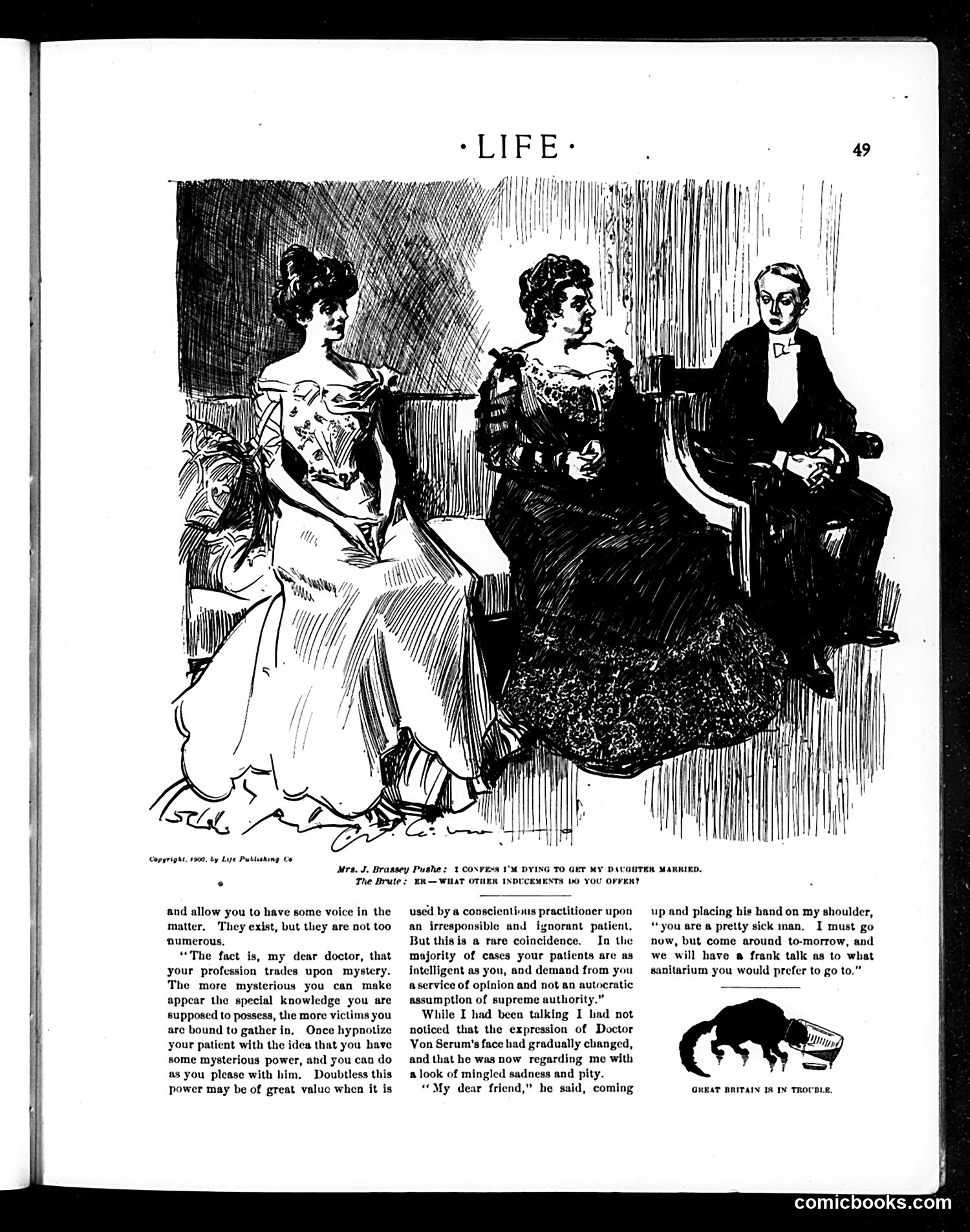
The main illustration shows a domestic scene with three figures—a woman in an elegant white gown, a middle-aged woman in dark clothing, and a man in formal attire. The caption reads: "Mrs. J. Breezy Parke: I confess I'm dying to get my daughter married. The Brisk Er—What other inducements do you offer?" This is a satirical commentary on marriage arrangement practices among wealthy families. The humor targets the transactional nature of high-society matchmaking, where mothers essentially negotiate their daughters' marriages as business deals, offering "inducements" like dowries or family connections rather than romantic compatibility. The cartoon critiques the commodification of women and the mercenary attitudes of the period's marriage market among the upper classes.
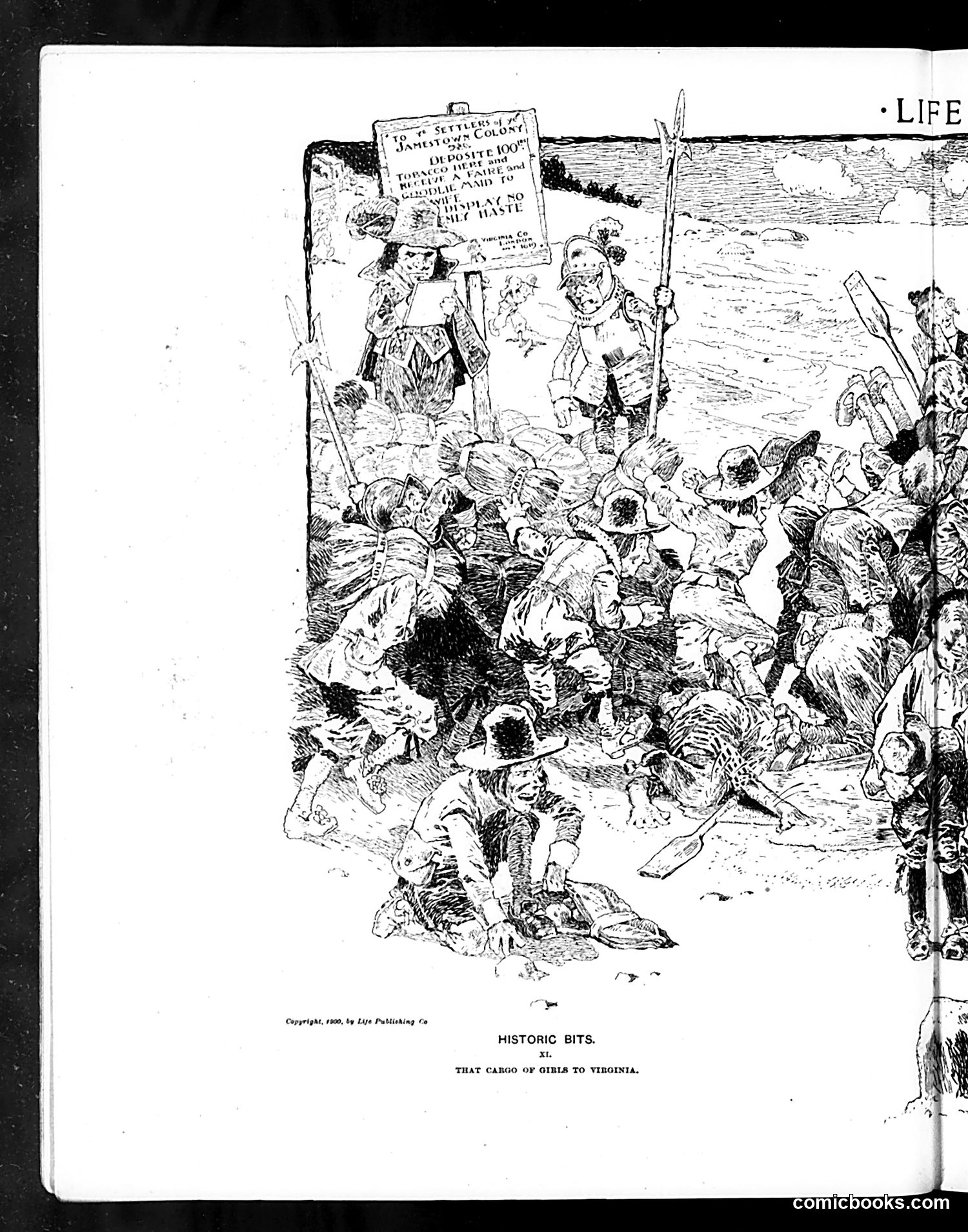
This satirical cartoon from Life magazine depicts a historical event—likely referencing the early colonial period when shiploads of women were sent from England to Virginia to establish families in the settlement. The sign held by the two figures appears to advertise or announce details of this "cargo." The cartoon satirizes this practice by depicting the women as literal cargo being transported and distributed, treating human settlement as a commercial transaction. The chaotic scene with numerous figures suggests disorder or the crude nature of this colonial enterprise. The satire critiques both the commodification of women and the somewhat absurd, rough-and-tumble approach to establishing colonial settlements. The humor derives from depicting a serious historical matter in exaggerated, darkly comic terms typical of Life magazine's editorial cartooning style.
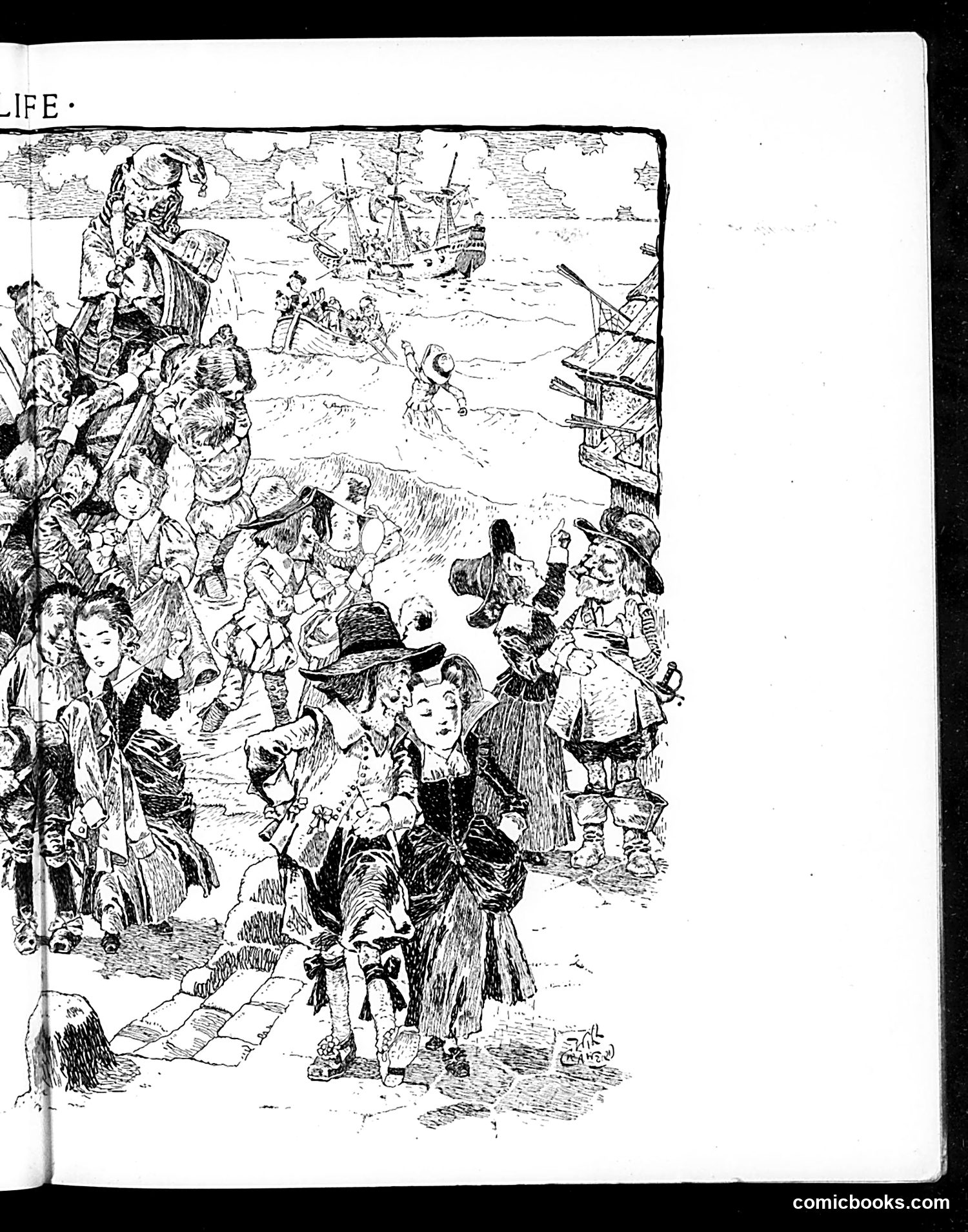
This page from *Life* magazine shows a crowded seaside scene with numerous figures in period dress (appearing to be late 19th or early 20th century). The composition depicts what seems to be a busy beach or port with ships visible in the background, suggesting a scene of emigration or immigration. The gathering includes well-dressed passengers, families with children, and various characters in distinctive clothing and hats. The satirical intent likely comments on immigration, social class differences, or the chaos of mass travel during this era. However, without legible OCR text or visible caption, the specific political or social target remains unclear. The crowded, somewhat chaotic composition suggests commentary on overcrowding, social mixing, or contemporary immigration debates—common *Life* magazine themes of the period.
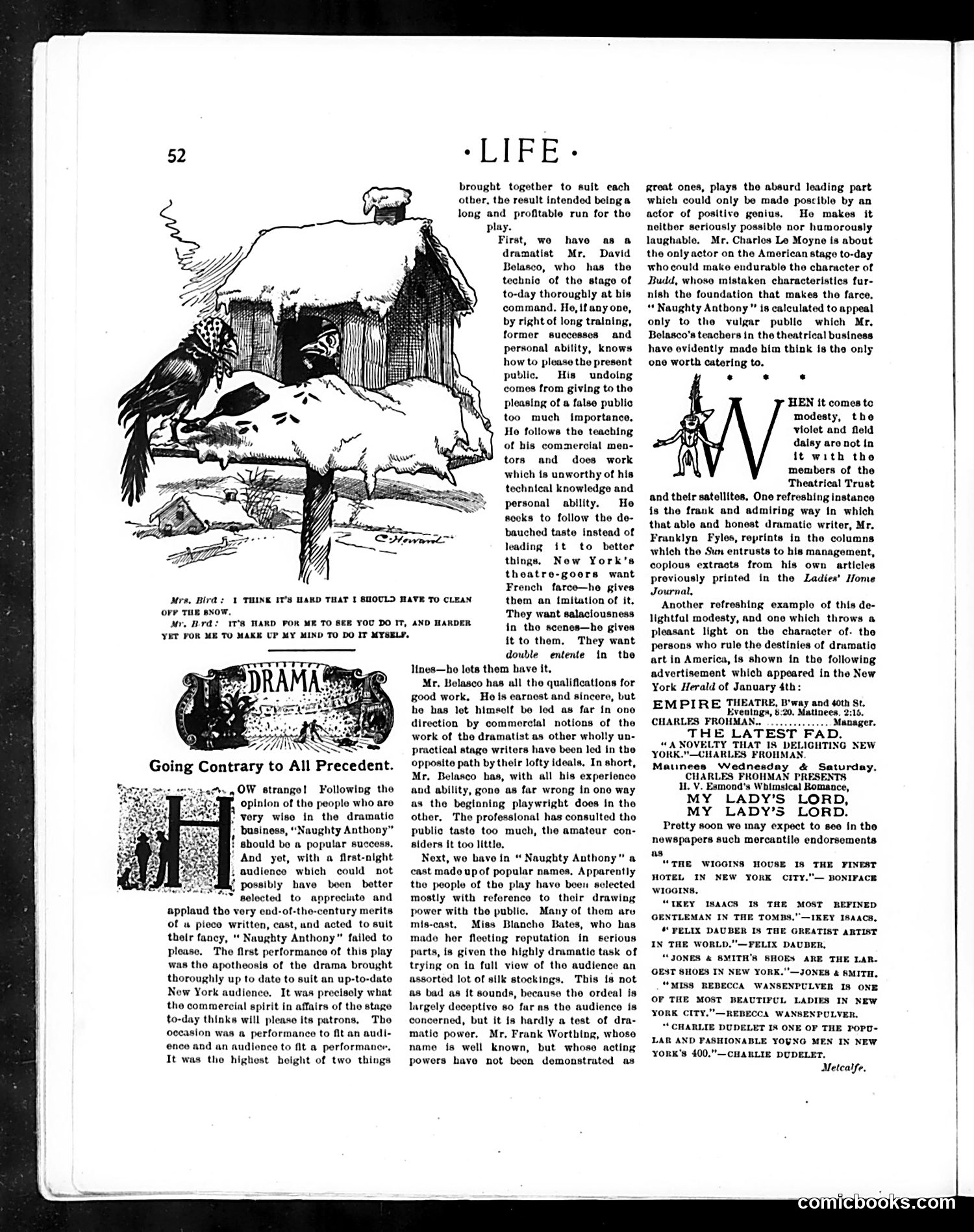
This cartoon depicts a domestic dispute about household cleanliness. A woman (Mrs. Bird) complains to her husband that "it's hard that I should have to clean up the bird" while he argues "it's hard for me to see you do it, and harder yet for me to make it my duty send to myself." The humor relies on a gender-role conflict typical of early 20th-century satire: the husband resists sharing domestic labor while the wife bears the burden of housework. The bird serves as a metaphor for life's messy complications that one spouse (typically the wife) is expected to manage alone. The surrounding text discusses theatrical productions, making this likely part of Life magazine's arts and social commentary section.
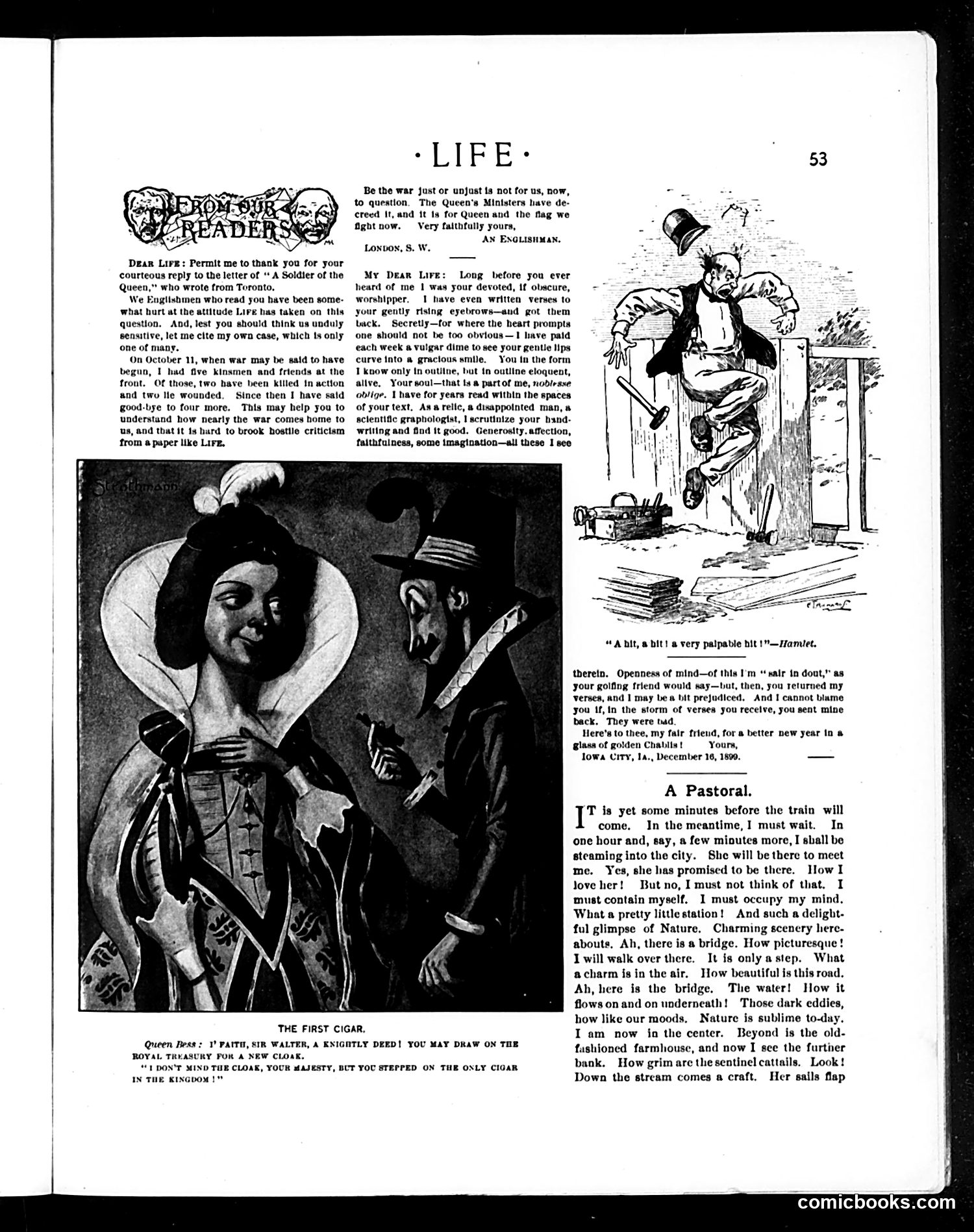
This page contains reader letters and literary content rather than political cartoons. The letters address **Life's editorial stance on the Boer War** (1899-1902). An English correspondent expresses hurt that Life has criticized Britain's war effort, citing personal sacrifice—five relatives at the front, two killed, two wounded. Life's response affirms the magazine's right to critique even as the war proceeds. **"The First Cigar"** is a historical cartoon depicting **Queen Elizabeth I granting Sir Walter Raleigh permission to draw on the royal treasury** for a new cloak, with the caption joking that he stepped on "the only cigar in the kingdom"—an anachronistic humor device, since tobacco was a New World novelty Raleigh famously introduced to England. **"A Pastoral"** is sentimental romantic fiction about a man waiting at a train station to meet his beloved, using nature imagery to reflect his emotional state. The page reflects *Life's* dual identity: satirical political commentary alongside literary and romantic content.
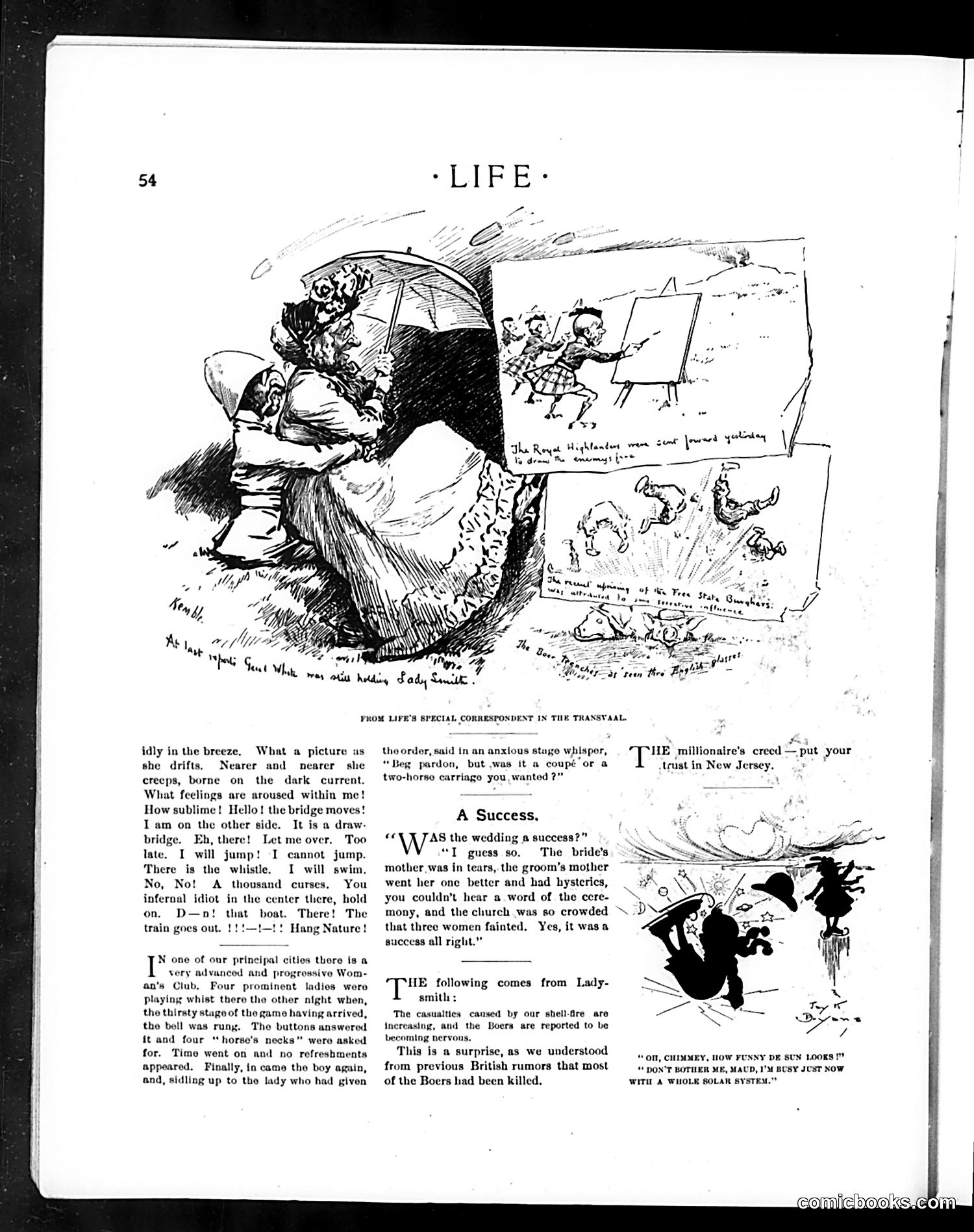
This page from Life magazine contains several satirical pieces mocking various social situations and, notably, the Boer War (likely 1899-1902). **The main cartoon** at top depicts Life's correspondent in the Transvaal (South Africa) experiencing comedic frustration—a drawbridge closes, separating him from his destination, creating physical slapstick humor about war correspondence. **"A Success"** jokes about a chaotic wedding where emotional excess (tears, hysterics, fainting) paradoxically signals success. **The most pointed satire** appears in the "Lady-smith" section, which mocks British war claims. It notes the Boers are "becoming nervous" from British shelling—then sarcastically undercuts this by quoting "previous British rumors that most of the Boers had been killed." This ridicules inflated British military reporting and propaganda about Boer casualties, suggesting the British had already claimed victory through exaggerated claims. **Minor jokes** include a Woman's Club anecdote about a confused waiter mishearing "horse's necks" (a drink) as a carriage request, and a quip about trusting New Jersey.
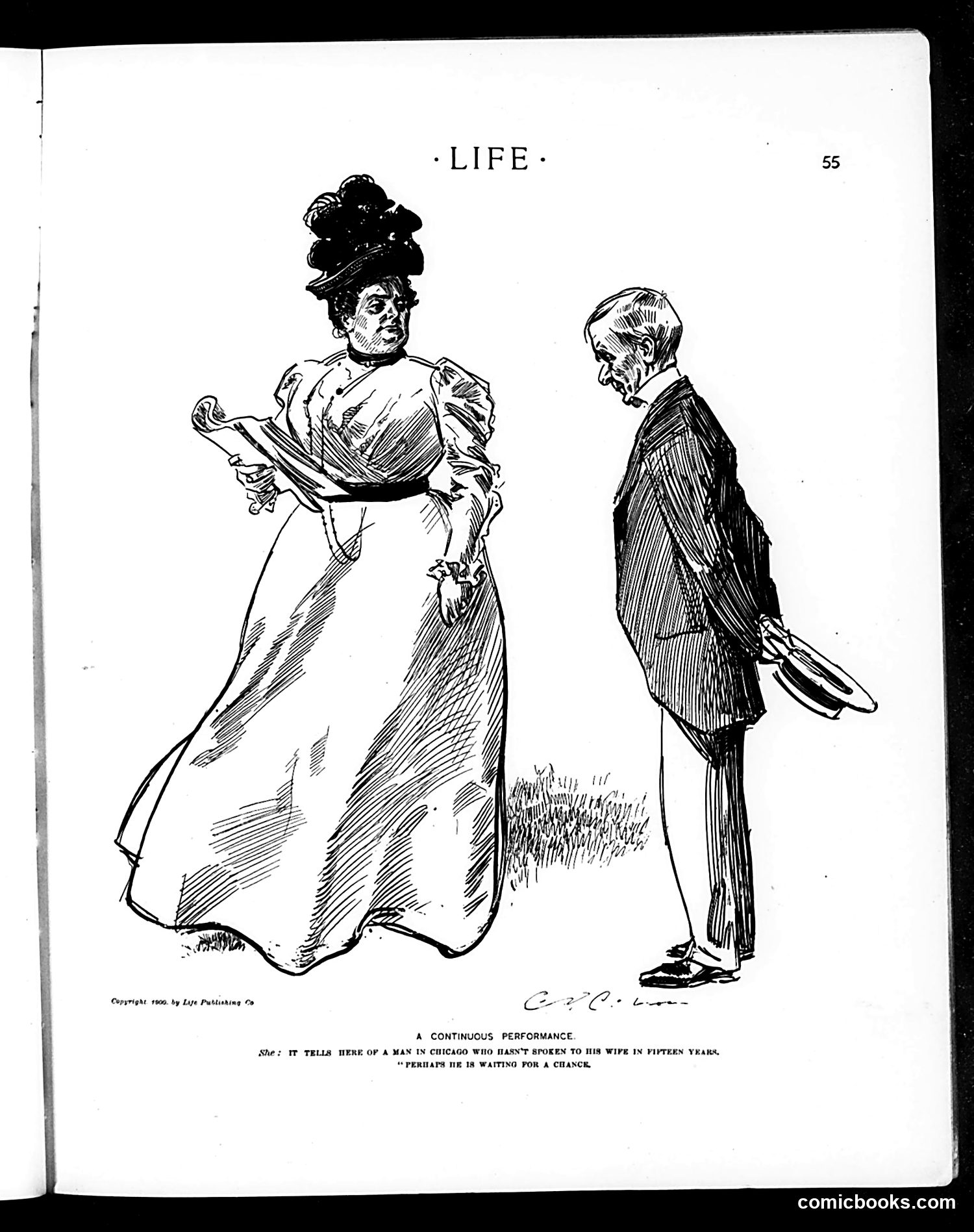
This early Life magazine cartoon satirizes marital infidelity. The caption states: "It tells here of a man in Chicago who hasn't spoken to his wife in fifteen years. 'Perhaps he is waiting for a chance.'" The scene depicts a fashionably dressed woman (left) confronting a thin, older man (right) who appears to be leaving or avoiding her. The woman holds what appears to be a riding crop or similar object—possibly suggesting she's assertive or aggressive in the relationship. The joke's premise is that prolonged silence in a marriage—presented as a "continuous performance"—occurs because the husband is waiting for an opportunity to speak, implying the wife dominates conversation or the relationship is irreparably broken. It's a commentary on marital discord and gender dynamics in early 20th-century relationships.
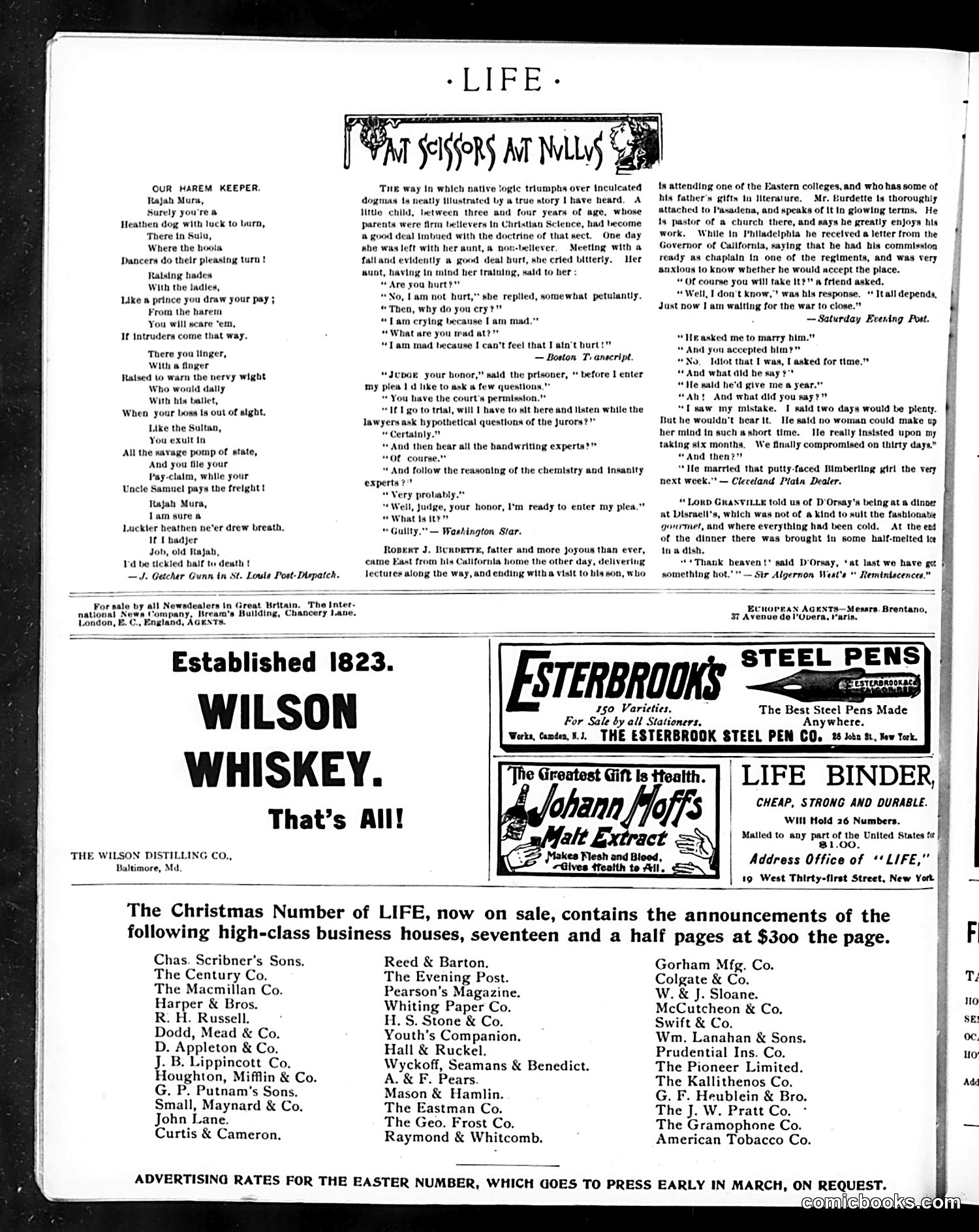
This page is primarily **advertising and filler content** for *Life* magazine, with several short humorous pieces rather than a cohesive political cartoon. The main content includes: 1. **"Our Harem Keeper"** — A poem mocking "Rajah Mura," likely a reference to colonial-era stereotypes of Filipino or Pacific Islander rulers under American control. The satire suggests Uncle Sam exploits these figures while they enjoy privileges ("drawing pay"). 2. **Christian Science anecdote** — A child's logical contradiction: she denies being hurt (per Christian Science doctrine) while crying from anger, mocking the sect's denial of physical reality. 3. **Courtroom joke** — A defendant realizes guilty plea is wise before enduring cross-examination, poking fun at legal proceedings. 4. **Robert Burdette piece** — Notes the California pastor/lecturer declining a chaplaincy commission to wait for war's end—unclear which conflict is referenced. 5. **Marriage anecdote** — Woman's miscalculation during engagement negotiation. The page reflects early 1900s American satirical humor: sometimes racist (colonial attitudes), sometimes social commentary on religion and law.
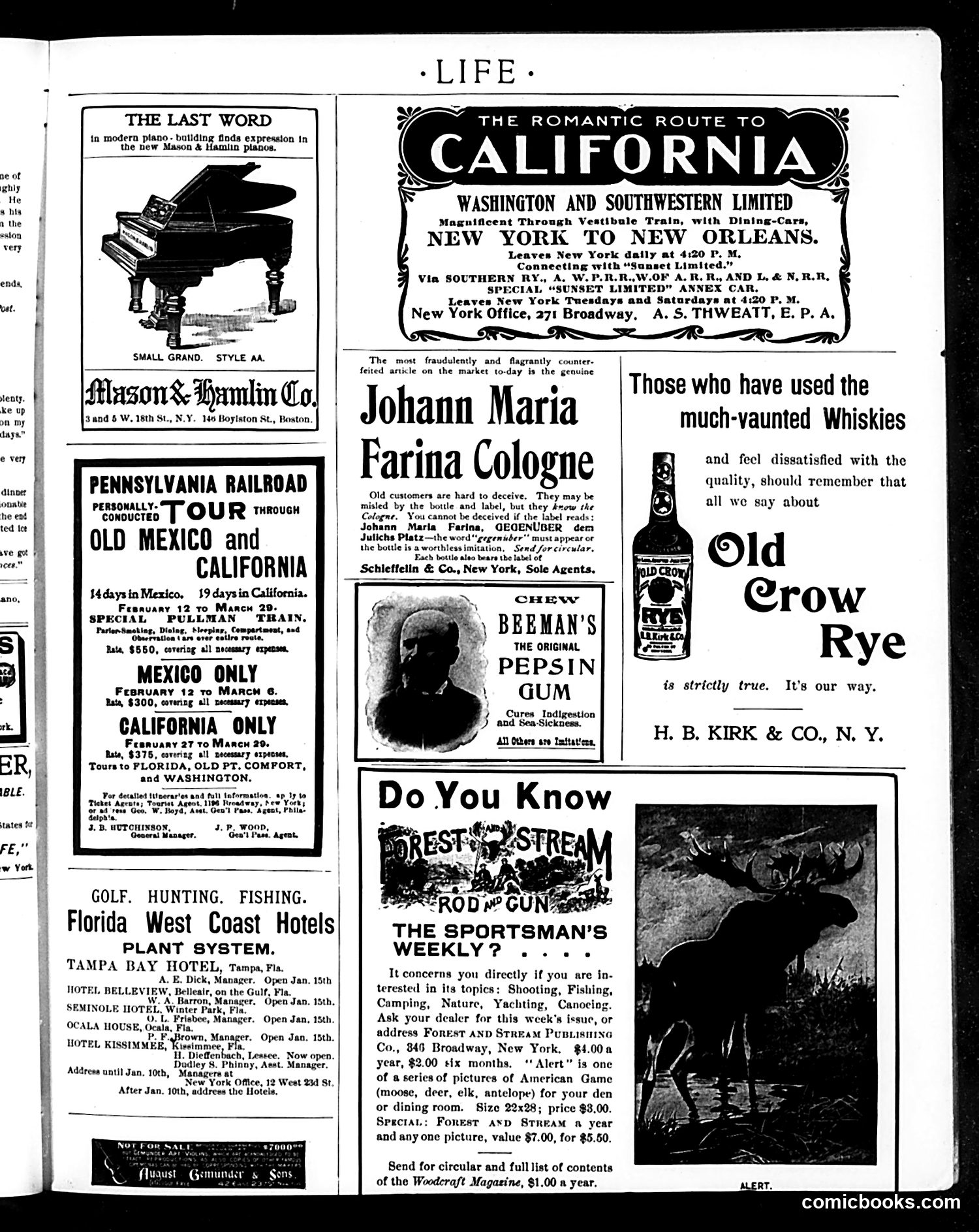
This page contains **no political cartoons or satirical content**—it is primarily a **advertisements section** from an early 20th-century issue of Life magazine. The ads promote: - **Travel**: Pennsylvania Railroad tours to Mexico and California; luxury train services to New Orleans - **Hotels**: Florida resort properties (Tampa Bay Hotel, Belleview) - **Consumer goods**: Mason & Hamlin pianos, Johann Maria Farina cologne, Beeman's pepsin gum, Old Crow rye whiskey - **Publications**: Forest and Stream (a sportsman's weekly magazine featuring hunting/fishing content and wildlife prints) The single illustrated element—a silhouetted moose or elk labeled "ALERT"—is promotional imagery for Forest and Stream's wildlife picture series, not satire. The page reflects early-1900s American consumer culture, emphasizing leisure travel, luxury goods, and outdoor recreation for affluent readers. No political commentary or satirical intent is evident.
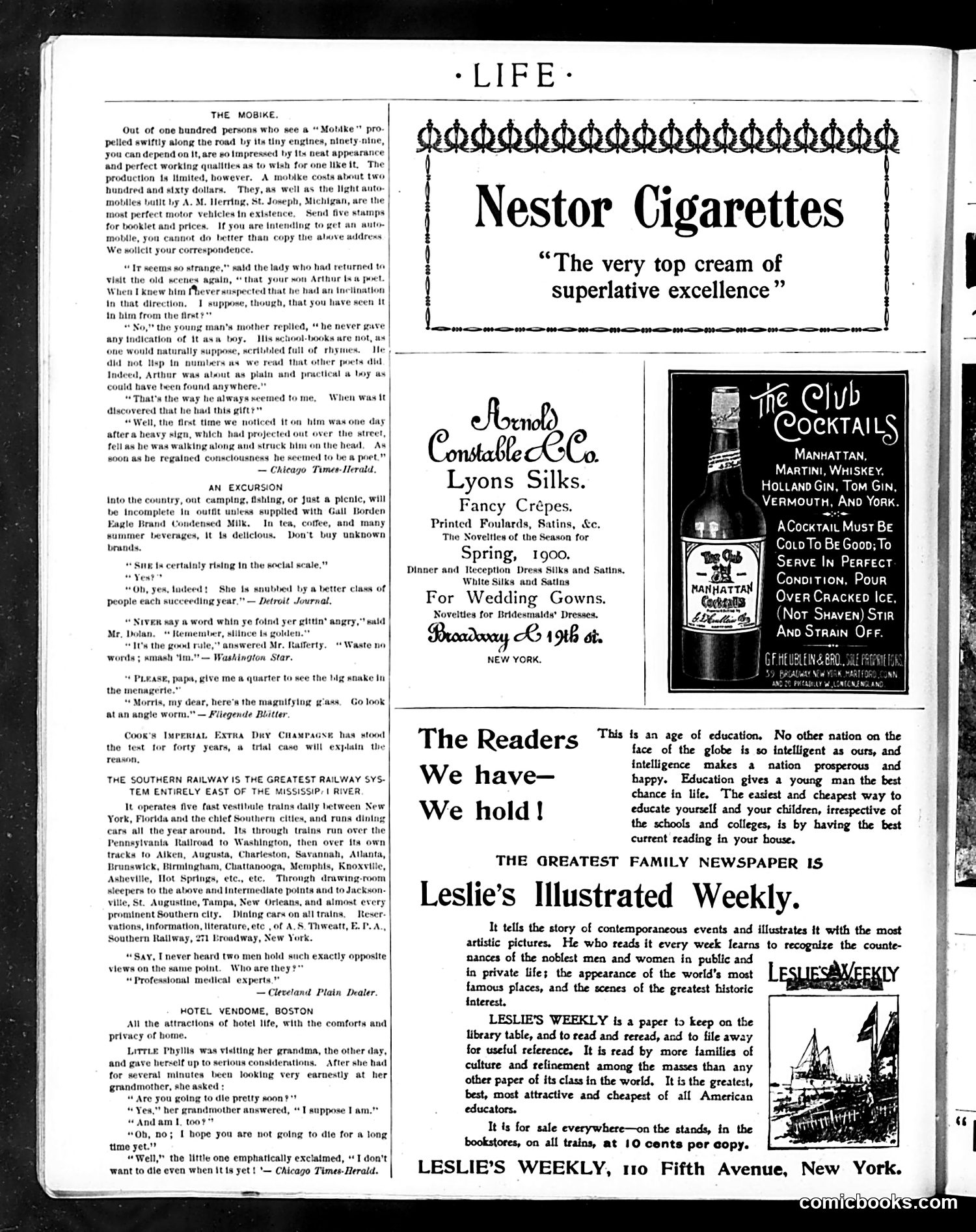
This page is primarily **advertising and filler content**, not political satire or editorial cartooning. The main advertisements feature consumer products (Nestor Cigarettes, Arnold Constable silks, The Club cocktails, Leslie's Illustrated Weekly) typical of early 1900s magazines. The text contains **humor pieces and jokes** rather than political cartoons: - A story about a young man who became a poet only after hitting his head - Jokes about social climbing, silence being golden, and medical experts disagreeing - Anecdotes featuring Irish-accented characters (typical period stereotyping) The only substantive editorial content is an **advertisement for Leslie's Weekly**, promoting it as "the greatest family newspaper" for education and current events. There are **no political cartoons, caricatures of public figures, or satirical commentary** visible on this page. It represents a typical early-1900s magazine layout mixing product advertising with light humor and lifestyle content.
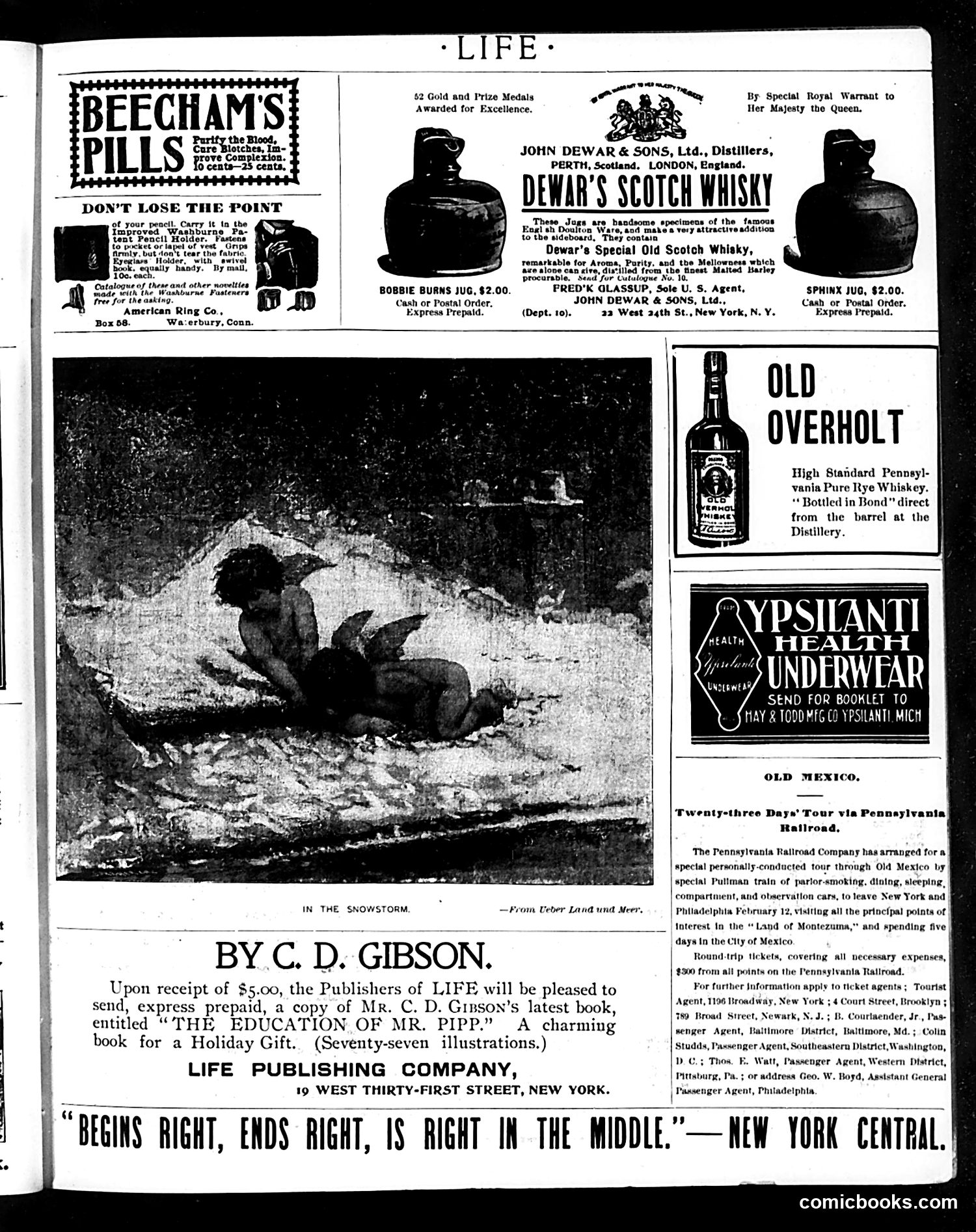
This page is primarily **advertisements** with one editorial illustration. The main cartoon—"In the Snowstorm"—appears to depict a person struggling in harsh winter weather, lying prone in snow with what look like logs or debris nearby. The image credit reads "From Ueber Land und Meer" (a German publication), suggesting it's a reproduced illustration about survival or hardship in extreme conditions. Below the image, the page advertises Gibson's new book, *"The Education of Mr. Pipp,"* for five dollars. Gibson was a celebrated American illustrator and cartoonist known for satirical social commentary. The surrounding ads promote liquor (Dewar's Scotch, Old Overholt whiskey), patent medicines, underwear, and a Pennsylvania Railroad tour to Mexico—typical turn-of-century magazine advertising. The page's actual satirical content is minimal; it functions mainly as a promotional vehicle.
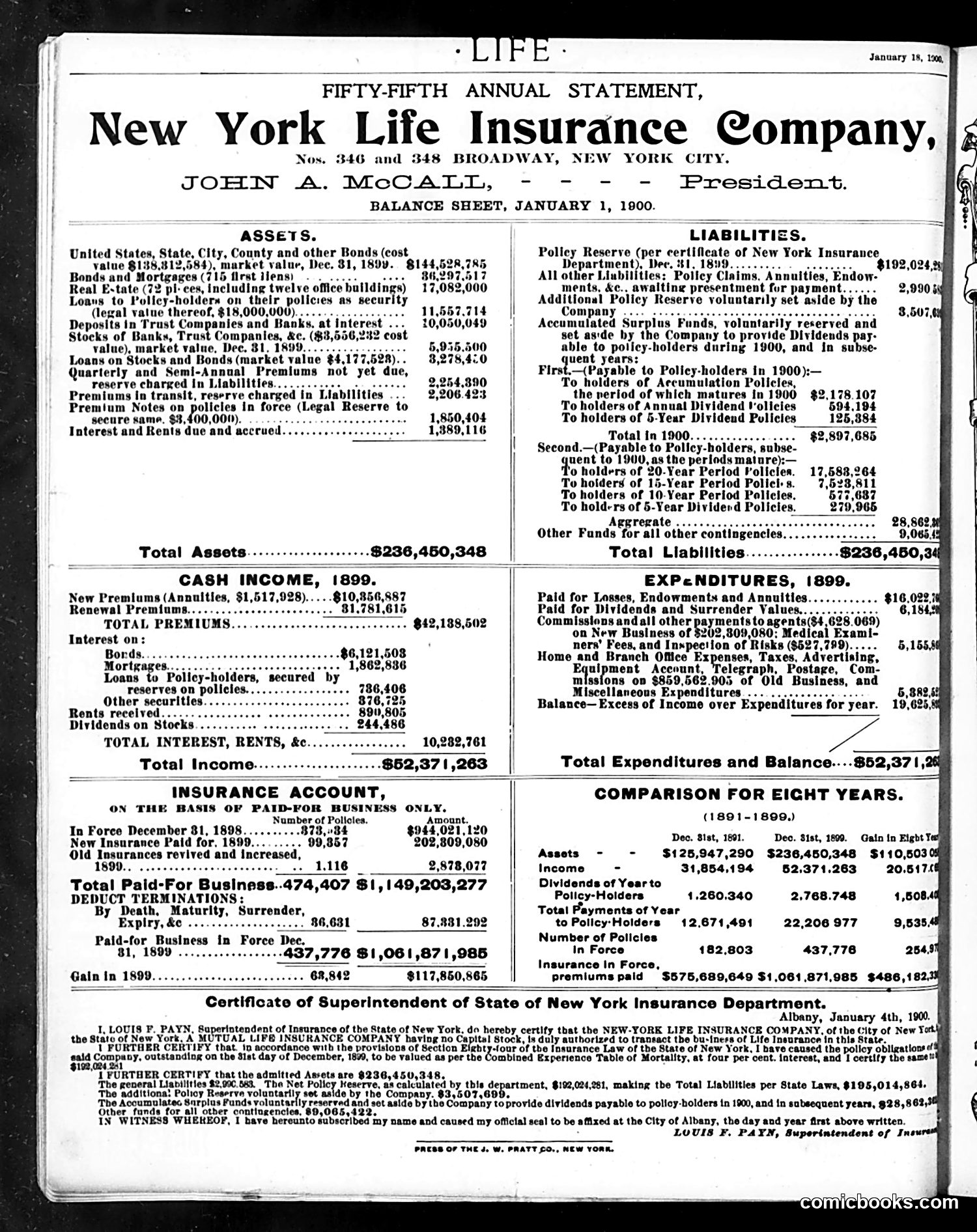
This page is the **financial statement** of the New York Life Insurance Company, dated January 1, 1900—not satirical content. *Life* magazine (founded 1883) regularly published such documents alongside humor and cartoons. The page shows the company's balance sheet, listing assets of $236.4 million, liabilities, cash income and expenditures for 1899, and insurance in force. President John A. McCall signed it. A certification from Louis F. Payn, New York's Superintendent of Insurance, appears at bottom. This represents routine corporate reporting in a major publication of the era—there are no political figures, caricatures, or satirical commentary visible. It's a historical financial record demonstrating the scale of American life insurance at the turn of the 20th century.