
Life, 1900-01-18 · page 4 of 20
Life — January 18, 1900 — page 4: what you’re looking at
What you’re looking at
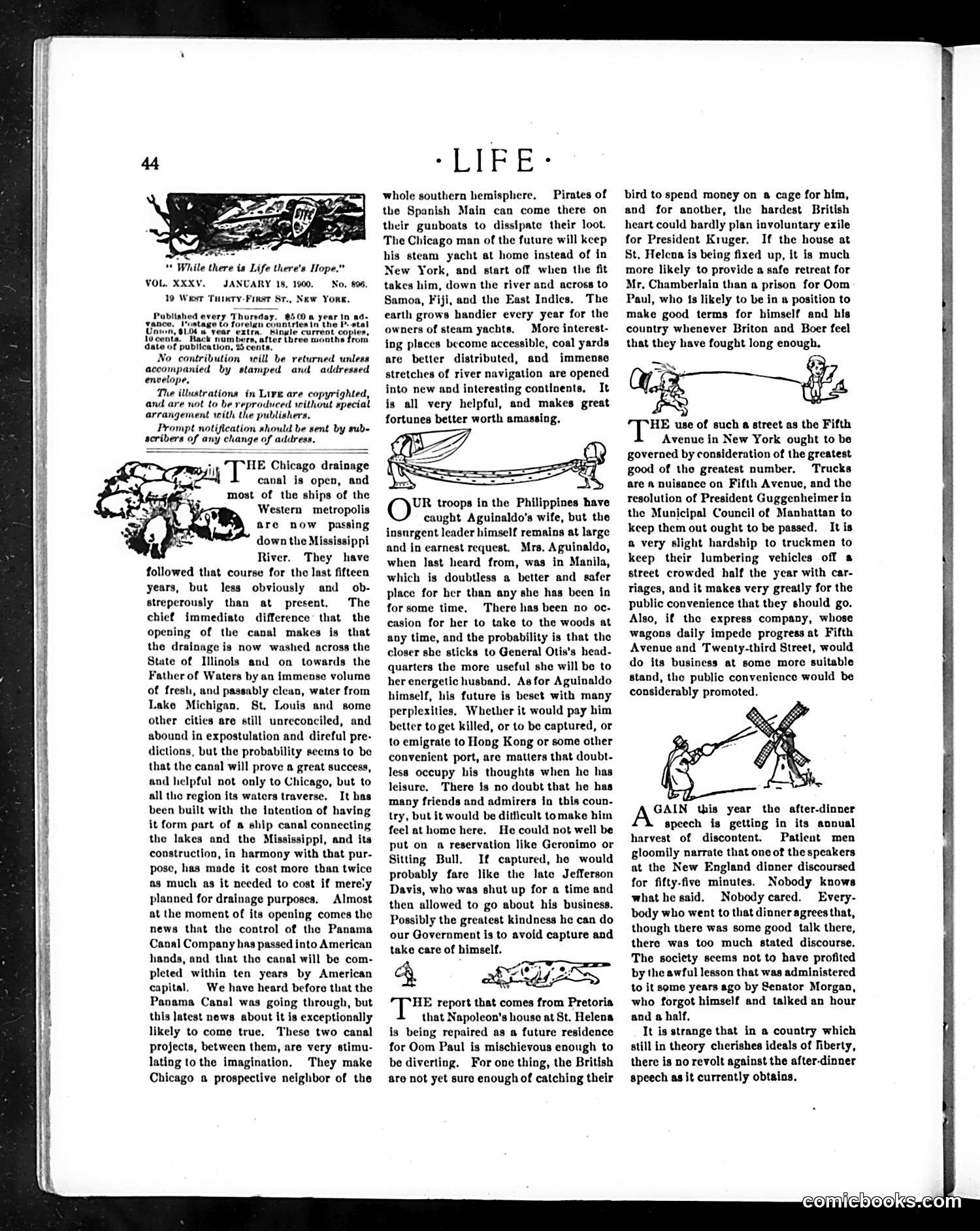
This page contains three separate satirical items: 1. **Chicago Drainage Canal**: Text discusses the opening of Chicago's drainage canal, praising it as beneficial infrastructure that will help multiple cities and regions. 2. **Philippine Insurgency**: Commentary on Aguinaldo's wife being captured by U.S. troops. The satire questions whether Aguinaldo would be better off captured, killed, or emigrating—treating his predicament with dark humor about colonial conflict. 3. **Fifth Avenue Street Nuisance**: Criticism of commercial traffic (lumber wagons, express company vehicles) congesting New York's Fifth Avenue. The satire mocks the inconvenience to wealthy residents while advocating for municipal regulation to protect the street's prestige. 4. **After-Dinner Speech Restraint**: A brief satirical note about Americans' polite tolerance of tedious after-dinner speeches, contrasting this with claimed ideals of liberty.
📄 Transcribed text from this page (OCR, searchable)
Machine-transcribed from the original scan — historical spelling and the odd misread are preserved.
Sebtireqenres-vomene rn =e Pa er a oe ee a “ While there ia Life there's Hop VOL. XXXV. JANUARY 18, 1900, 19 West Tutery- First . New Yori Published every Thurs 500 a year in vance, uatage to foreign countries tn the | (0a year eaten. hinge current coples, Tack numbers, after three wonthe from ‘Of publication, 35 cents. No contribution will be returned unless accompanied by stamped and addressed envelope. The illustrations in Live are copyrighted, and are not to be reproduced without speciat arrangement with the publishers, Prompt notification should be sent by sub- scribers of any change of address. HE Chicago drainage canal is open, and most of the ships of the Western metropolis are now passing down the Mississippi River. They have followed that course for the last fifteen years, but less obviously and ob- streperously than at present. The chief immediate difference that the opening of the canal makes is that the drainage is now washed across the State of Illinois and on towards the Father of Waters by an immense volume of fresh, and passably clean, water from Lake Michigan. St. Louis and some other cities are still unreconciled, and abound in expostulation and direful pre- dictions, but the probability seems to be that the canal will prove a great success, and helpful not only to Chicago, but to all the region its waters traverse. It has been built with the intention of having it form part of a ship canal connecting the lakes and the Mississippi, and its construction, in harmony with that pur- pose, has made it cost more than twice as much as it needed to cost if merely planned for drainage purposes. Almost at the moment of its opening comes the news that the control of the Panama Canal Company has passed into American hands, and that the canal will be com- pleted within ten years by American capital. We have heard before that the Panama Canal was going through, but this latest news about it is exceptionally likely to come true. These two canal projects, between them, are very stimu- lating to the imagination, They make Chicago a prospective neighbor of the whole southern hemisphere. Pirates of the Spanish Main can come there on their gunboats to dissipate their loot. The Chicago man of the future will keep his steam yacht at home instead of in New York, and start off when the fit takes him, down the river and across to Samoa, Fiji, and the East Indies. The earth grows handier every year for the owners of steam yachts, More interest- ing places become accessible, coal yards are better distributed, and immense stretches of river navigation are opened into new and interesting continents, It is all very helpful, and makes great fortunes better worth amassing, UR troops in the Philippines have caught Aguinaldo’s wife, but the insurgent leader himself remains at large and in earnest request. Mrs, Aguinaldo, when last heard from, was in Manila, which is doubtless a better and safer place for her than any she has been in for some time. There has been no oc. casion for her to take to the woods at any time, and the probability is that the closer she sticks to General Otis's head- quarters the more useful she will be to her energetic husband, As for Aguinaldo himself, his future is besct with many perplexities, Whether it would pay him better to get killed, or to be captured, or to emigrate to Hong Kong or some other convenient port, are matters that doubt- less occupy his thoughts when he has leisure. There is no doubt that he has many friends and admirers in this coun- try, but it would be ditficult tomake him feel at home here, He could not well be put on a reservation like Geronimo or Sitting Bull. If captured, he would probably fare like the late Jefferson Davis, who was shut up for a time and then allowed to go about his business. Possibly the greatest kindness he can do our Government is to avoid capture and take care of himself. a T= report that comes from Pretoria that Napoleon's house at St. Helena is being repaired as a future residence for Oom Paul is mischievous enough to be diverting. For one thing, the British are not yet sure enough of catching their bird to spend money on a cage for him, and for another, the hardest British heart could hardly plan involuntary exile for President Kruger. If the house at St. Helena is being fixed up, it is much more likely to provide a safe retreat for Mr, Chamberlain than a prison for Oom Paul, who {s likely to be in a position to make good terms for himself and his country whenever Briton and Boer feel that they have fought long enough, = CW. HE use of such a street as the Fifth Avenue in New York ought to be governed by consideration of the greatest good of the greatest number. Trucks are a nuisance on Fifth Avenue, and the resolution of President Guggenheimer in the Municipal Council of Manhattan to keep them out ought to be passed, It is a very slight hardship to truckmen to keep their lumbering vehicles off a street crowded half the year with car- riages, and it makes very greatly for the public convenience that they should go. Also, if the express company, whose wagons daily impede progress at Fifth Avenue and Twenty-third Street, would do its business at some more suitable stand, the public convenience would be considerably promoted. GAIN this year the after-dinner speech is getting in its annual harvest of discontent. Patient men gloomily narrate that one of the speakers at the New England dinner discoursed for fifty-five minutes. Nobody knows what he said. Nobody cared. Every- body who went to that dinner agrees that, though there was some good talk there, there was too much stated discourse. The society scems not to have profited by the awful lesson that was administered to it some years ago by Senator Morgan, who forgot himself and talked an hour and a half, It is strange that in a country which still in theory cherishes ideals of Fiberty, there is no revolt against the after-dinner speech as it currently obtains.