
A complete issue · 20 pages · 1900
Life — January 4, 1900
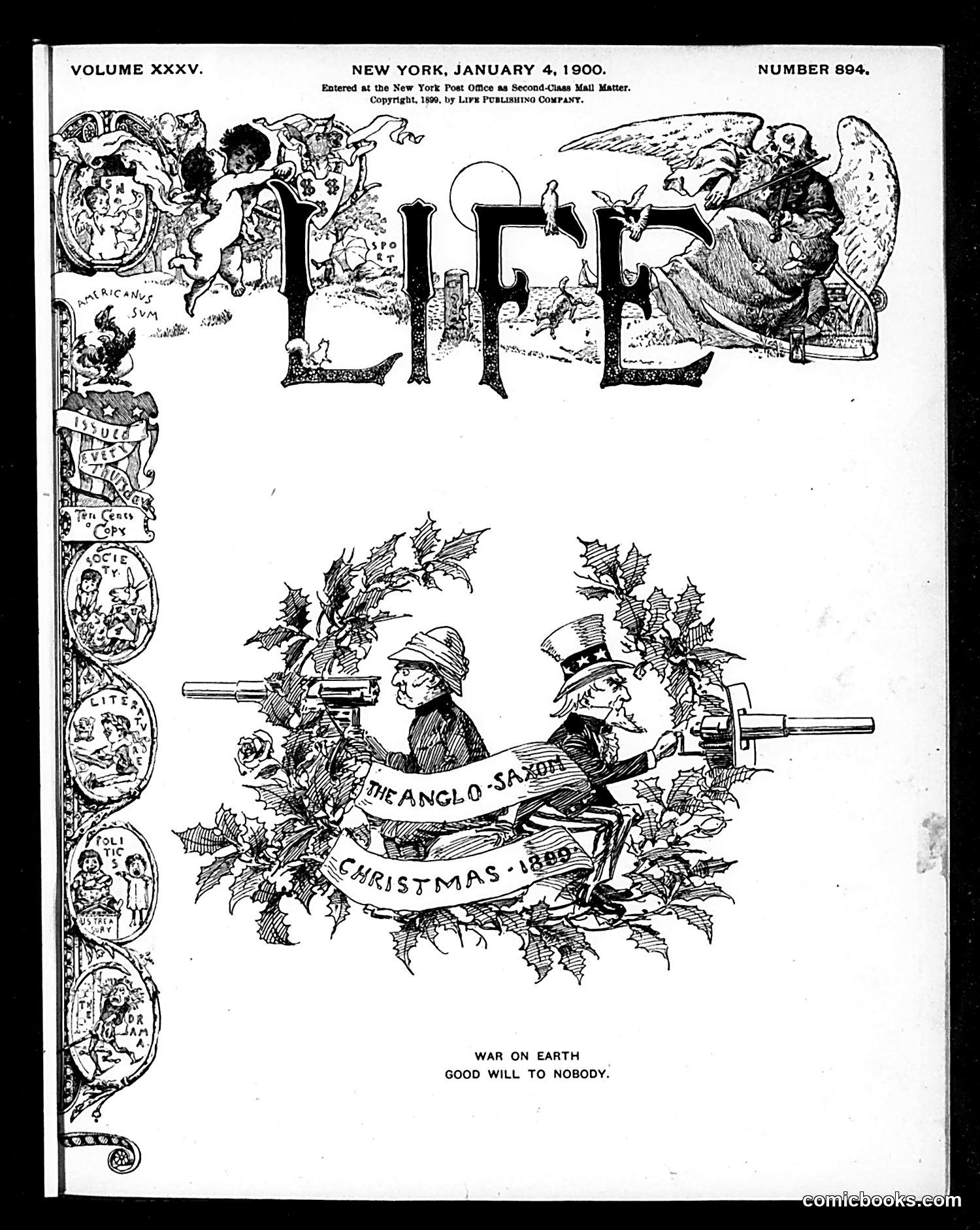
This is the New Year's issue of *Life*, a satirical weekly. The main cartoon depicts the Boer War (the Anglo-Saxon conflict labeled on the ribbons), shown as skeletal figures armed with telescopes engaged in combat amid holly sprigs—a dark Christmas joke. The caption "War on Earth / Good Will to Nobody" inverts the traditional Christmas message of peace and goodwill, sarcastically commenting on the ongoing brutality of the conflict in South Africa. The left border contains small decorative vignettes typical of *Life*'s elaborate design. The page emphasizes the irony of celebrating Christmas while nations wage war, a pointed criticism of contemporary geopolitical violence presented through the magazine's characteristic blend of festive imagery and biting social commentary.
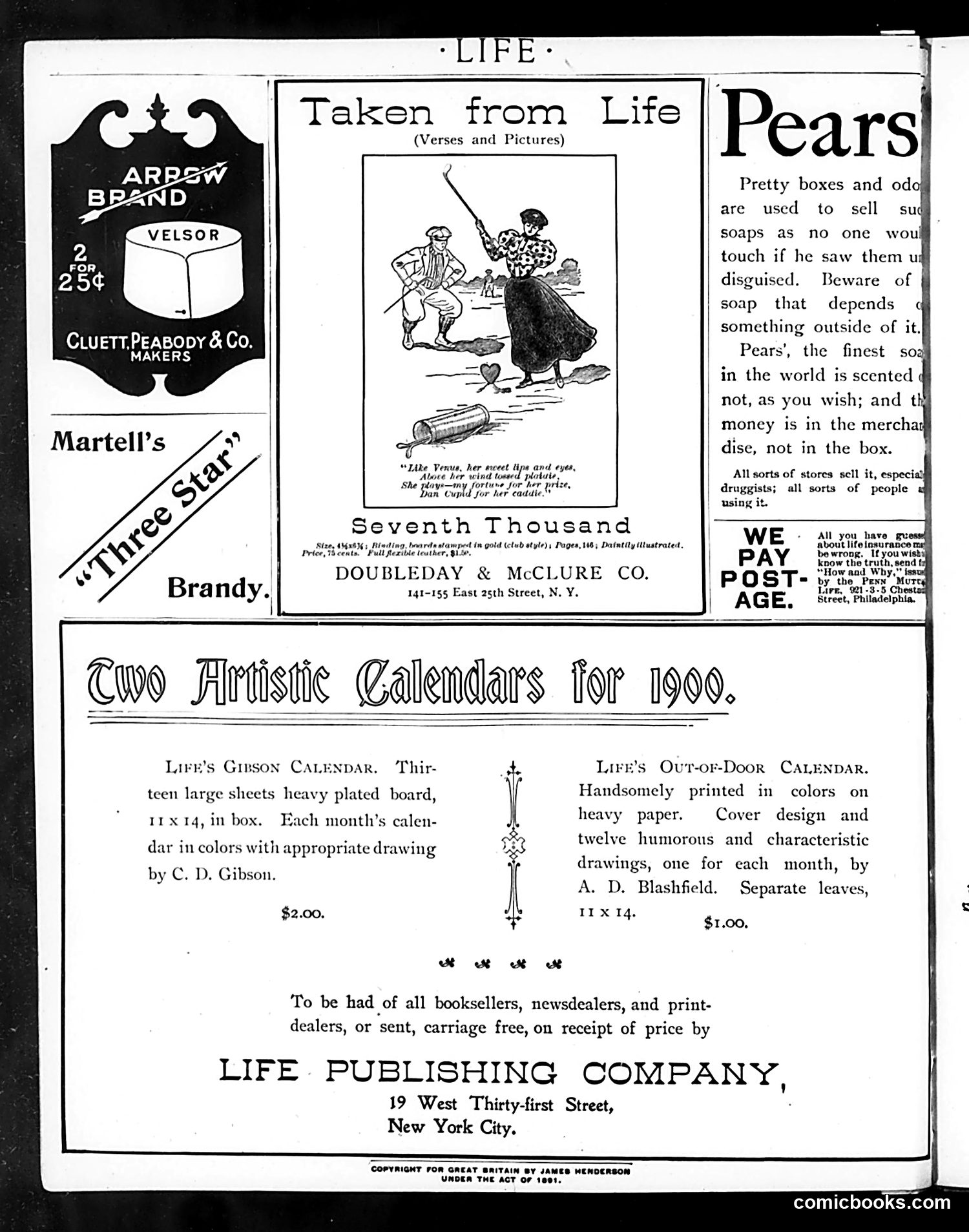
This page is primarily **advertising** for Life Publishing Company's products, with one cartoon in the center titled "Seventh Thousand." The cartoon depicts a woman striking a man with what appears to be a stick or cane while a child watches. The accompanying verse (partially legible) suggests a domestic dispute scenario, likely playing on period humor about marital discord or the "battle of the sexes" — common satirical themes in early 1900s magazines. The cartoon's "Seventh Thousand" caption likely indicates this was a popular or recurring image. The surrounding advertisements for soaps ("Pears"), brandy, and collars represent typical Life magazine monetization rather than editorial content. Without clearer verse text, the specific satirical point remains unclear, though it appears to mock domestic relationships typical of the era's humor.
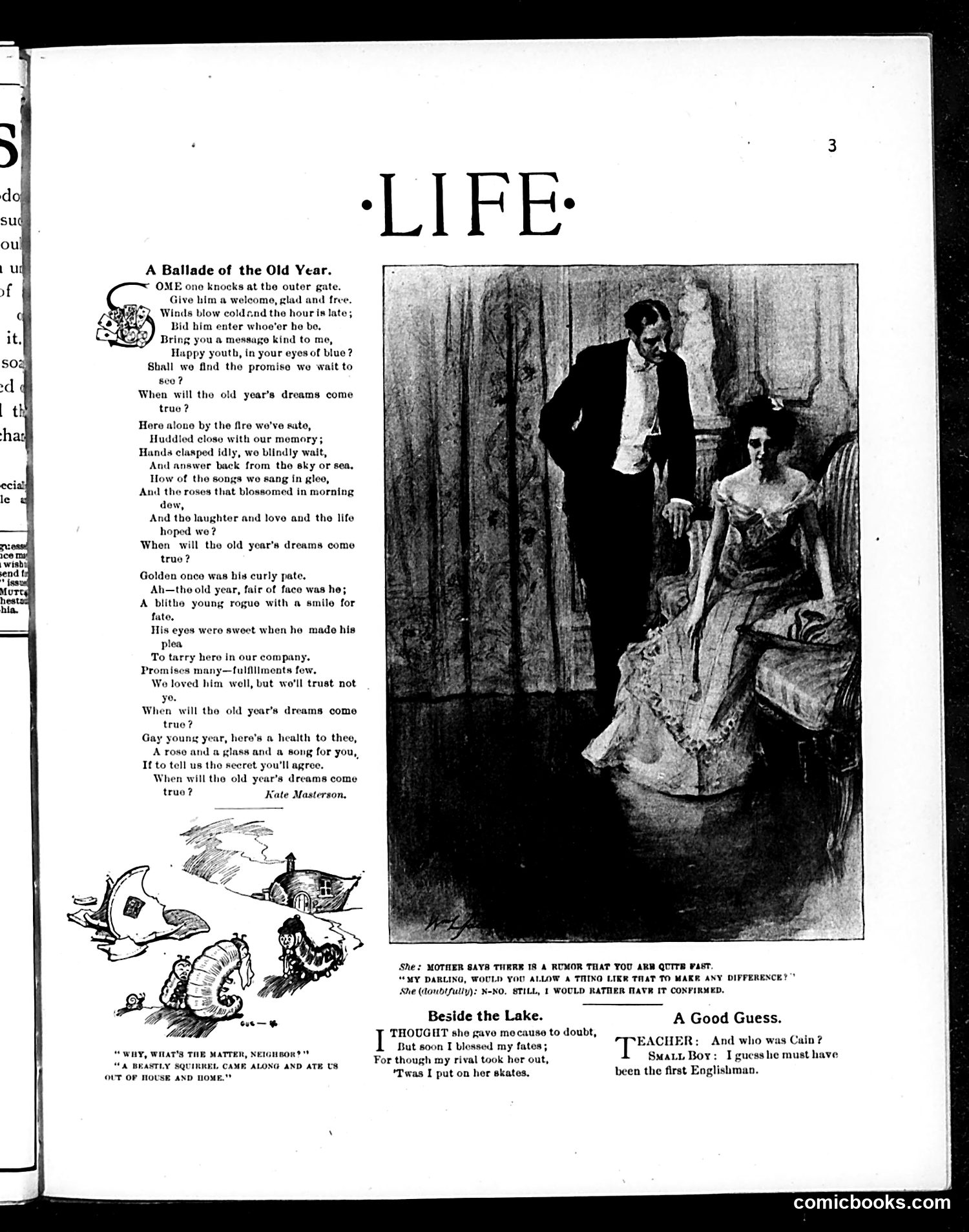
This page contains three distinct pieces: **"A Ballad of the Old Year"** by Kate Masterson: A nostalgic poem reflecting on the passing year, addressing themes of youth, dreams, and hope for the coming year. The verse asks repeatedly "When will the old year's dreams come true?" **Main illustration**: Shows a man and woman in what appears to be an intimate or romantic moment, captioned with dialogue about making a difference in a relationship. **Two brief humor items**: "Beside the Lake" depicts a skating mishap with romantic complications. "A Good Guess" is a simple joke where a teacher asks who Cain was, and a student guesses "the first Englishman"—a mild jab at English national pride or stereotypes. The page reflects typical early-20th-century Life magazine content: sentimental verse, romantic illustration, and gentle social humor rather than sharp political satire.
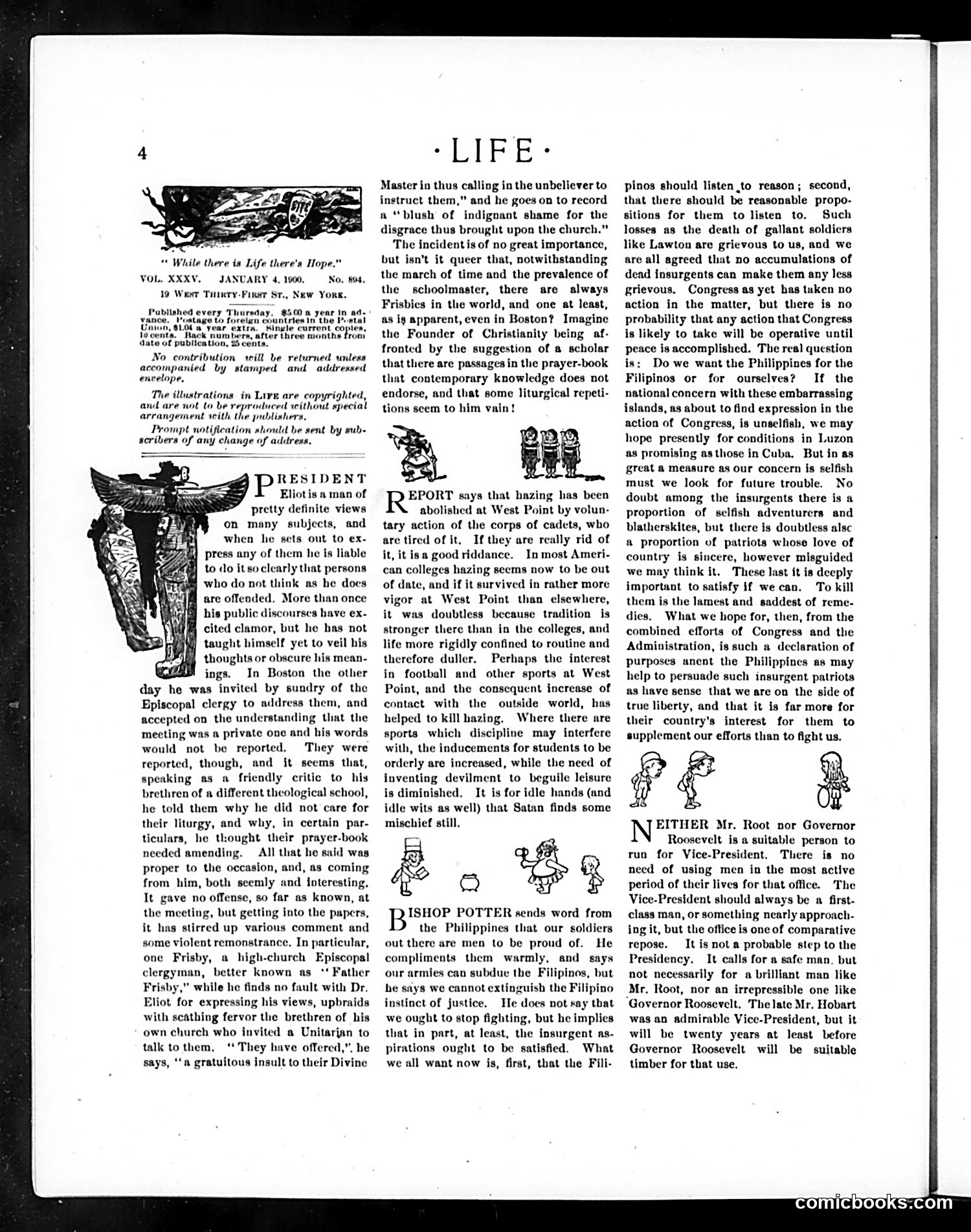
This page contains editorial commentary rather than cartoons. The main illustrated elements are decorative mastheads and small vignettes of figures engaged in various activities. The text discusses several topics: President Roosevelt's views on candor in public discourse; hazing abolition at West Point; and Episcopal clergy addressing theological matters. A section critiques the fitness of certain figures for Vice-President, specifically stating neither Mr. Root nor Governor Roosevelt is suitable, arguing the office requires an active first-class man, though these individuals might eventually qualify. The piece reflects turn-of-the-century debates about military discipline, presidential succession, and clerical authority—topics of immediate political concern in 1900.
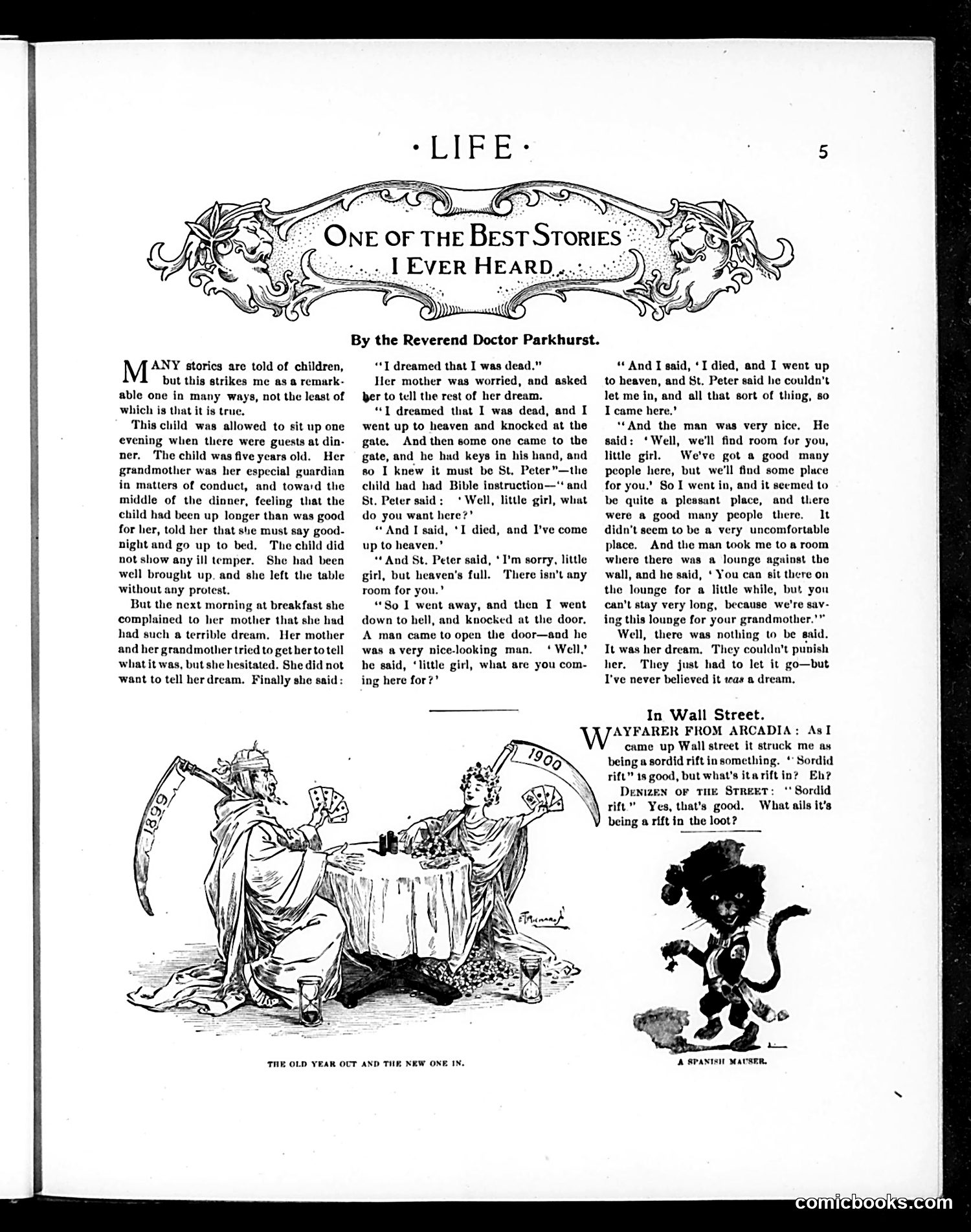
This page contains two distinct pieces: 1. **"One of the Best Stories I Ever Heard"** by Reverend Doctor Parkhurst: A lengthy anecdote about a child's dream of heaven and hell, presented as moral instruction. The story emphasizes Christian virtue and warns against punishment in the afterlife. 2. **"In Wall Street"** (lower right): A brief satirical dialogue between a "Waypaper from Arcadia" and a "Denizen of the Street" discussing "solid rift" in the loot—likely mocking Wall Street financial corruption or fraud using wordplay. 3. **Illustrations**: Include a classical allegory (Old Year/New Year transition) and a caricature labeled "A Spanish Mauzer," though the specific satirical target remains unclear without additional context.
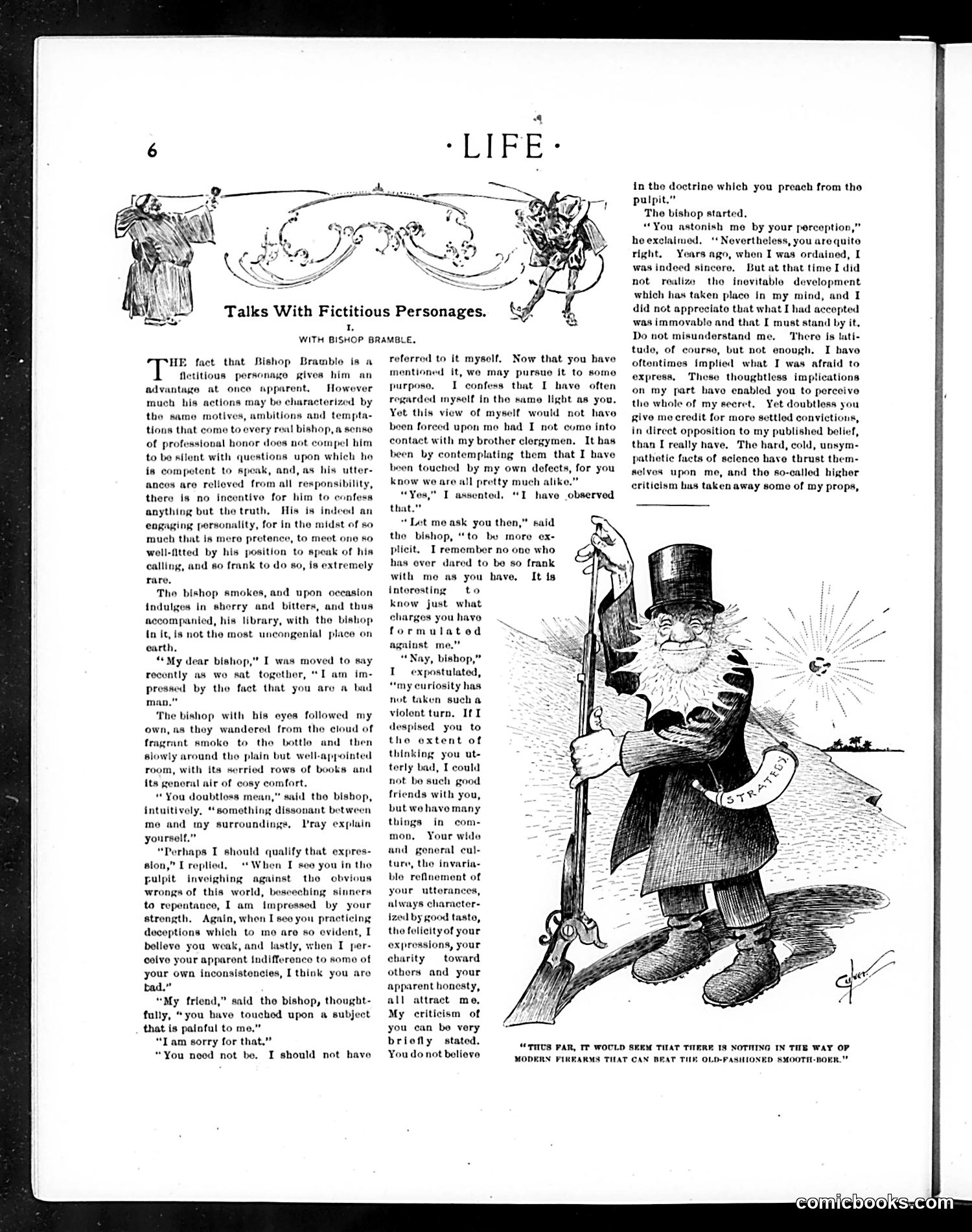
This page features a dialogue between the author and a Bishop, discussing the Bishop's criticism of the author's published work. The Bishop accuses the author of lacking sincerity and attacking established religion. The author responds by defending his integrity and explaining his deceptions stem from honest intellectual convictions, not malice. The cartoon illustration shows a figure (likely representing the author or a clergyman) holding a rifle or musket, with the caption: "Thus far, it would seem that there is nothing in the way of modern firearms that can beat the old-fashioned smooth-bore." The satire appears to critique religious authority's response to modern intellectual criticism, contrasting spiritual "weapons" with literal ones.
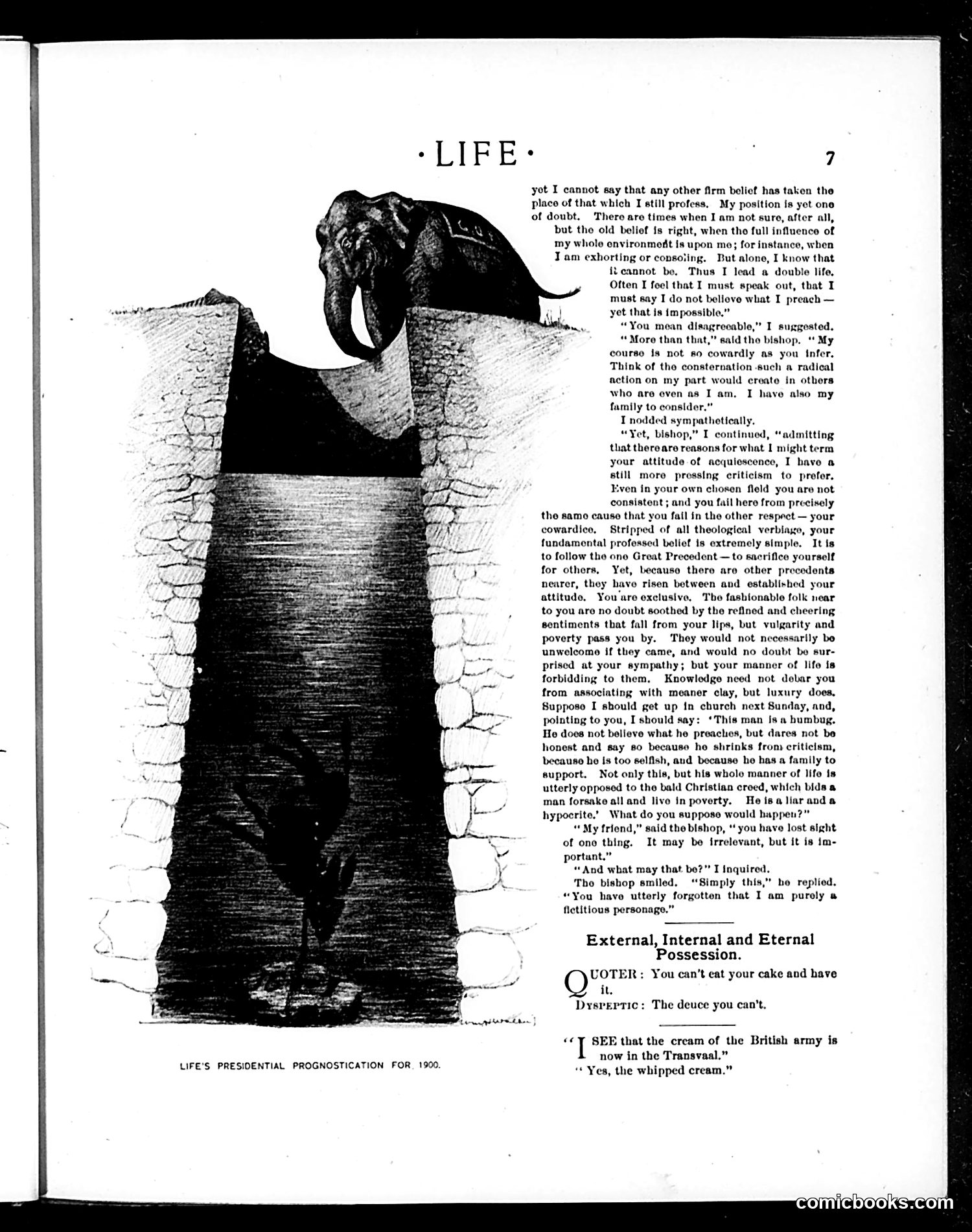
The main illustration, captioned "Life's Presidential Prognostication for 1900," depicts an elephant balanced precariously on a tower of stacked blocks. The elephant likely represents the Republican Party (the GOP mascot), suggesting uncertainty about the coming 1900 presidential election. The accompanying text is a debate between an unnamed speaker and a bishop about Christian belief and hypocrisy. The bishop is criticized for preaching poverty while living comfortably—a satire on religious hypocrisy. Below is a brief joke section titled "External, Internal and Eternal Possession" mocking the Boer War ("whipped cream"), likely referencing British military struggles in South Africa. The page blends political prophecy with social/religious commentary typical of Life's satirical format.
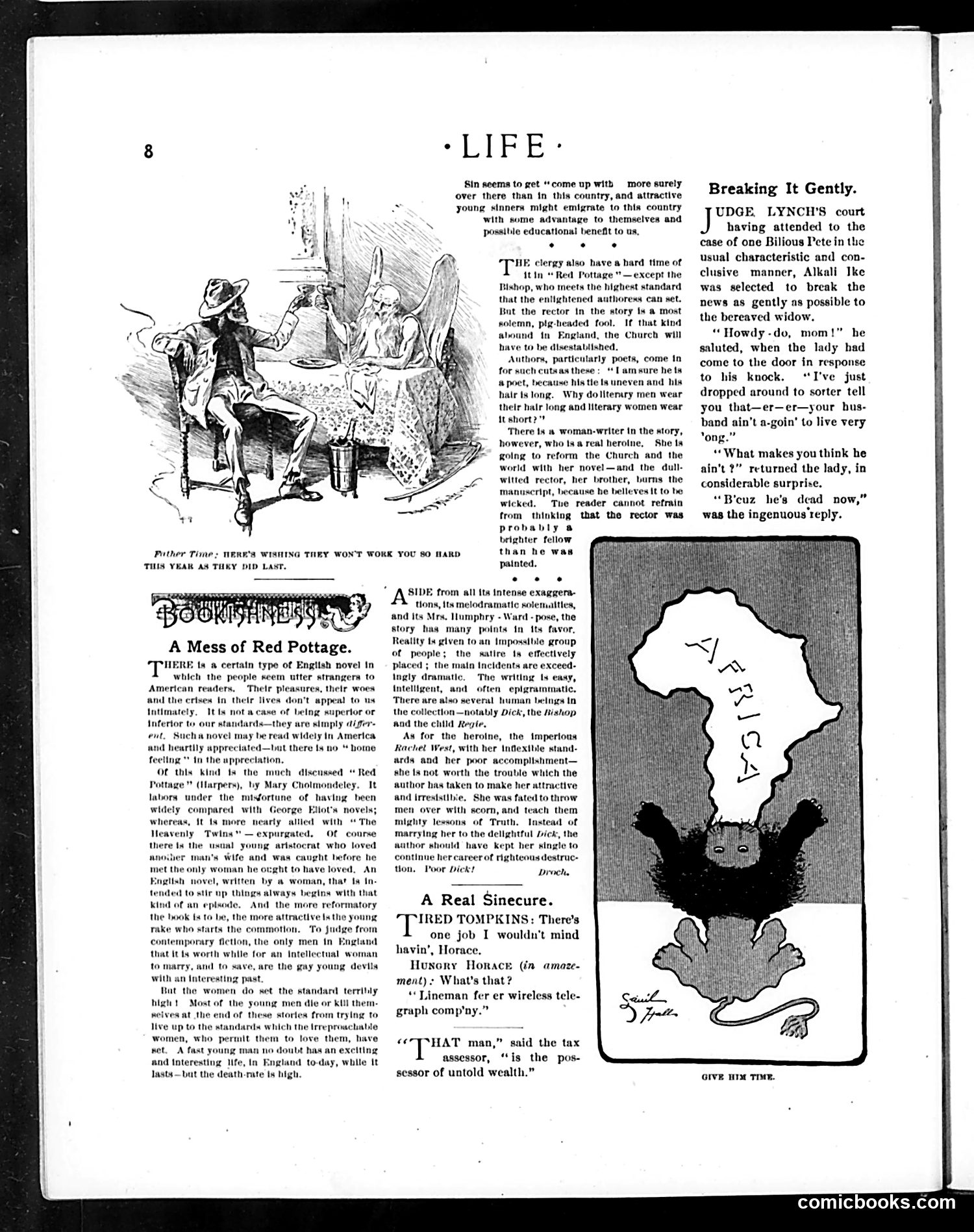
This page contains literary criticism and satirical commentary on contemporary novels. The main cartoon (top left) illustrates "A Mess of Red Pottage," criticizing a novel about English society where aristocratic characters interact with American readers. The reviewer notes the work is melodramatic but competently written, though faults the heroine's characterization. The "Breaking It Gently" cartoon (top right) depicts Judge Lynch's court, satirizing how widows might receive inheritance news—a genteel social commentary on manners and delicate situations. "A Real Sincerely" (bottom) is a brief joke about a job in a wireless telegraph company, playing on the phrase "sincere" and contemporary technology references. The page demonstrates Life's dual role as both literary critic and social satirist.
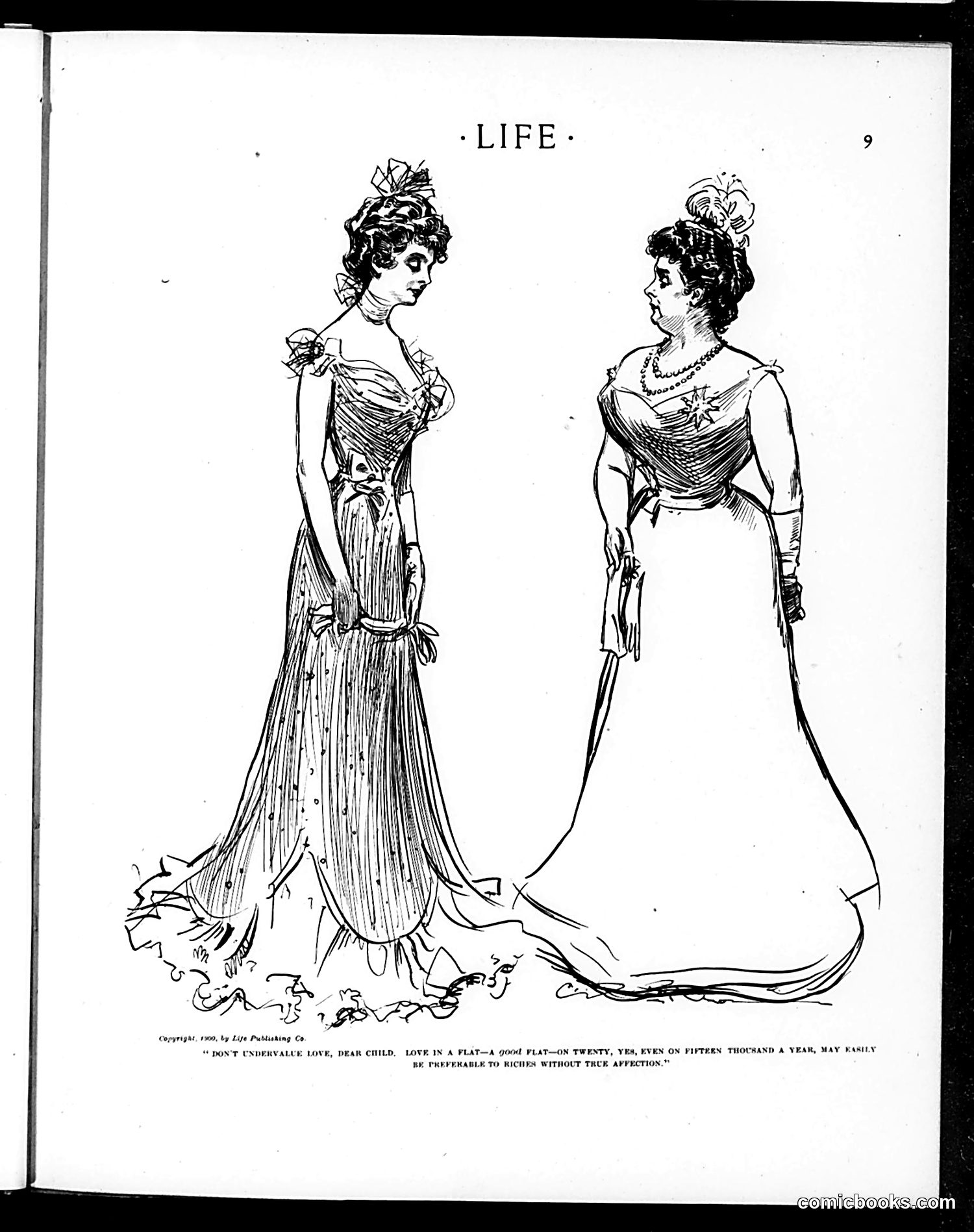
This page from *Life* magazine presents an illustration of two elegantly dressed women in Edwardian-era gowns with elaborate hairstyles and trains. The caption below quotes advice about love and marriage: "Don't undervalue love, dear child. Love in a flat—a good flat—on twenty, yes, even on fifteen thousand a year, may hardly be preferable to riches without true affection." The satire mocks upper-class women's materialistic priorities regarding marriage. Rather than valuing genuine affection, the women are portrayed as calculating the minimum financial requirements for romance—specifically focusing on apartment quality and annual income thresholds. The illustration's emphasis on their fashionable appearance and the quoted dialogue together suggest social commentary on how wealthy women equated romantic compatibility with economic security and luxury living standards. This reflects early 1900s anxieties about marriage as a financial transaction.
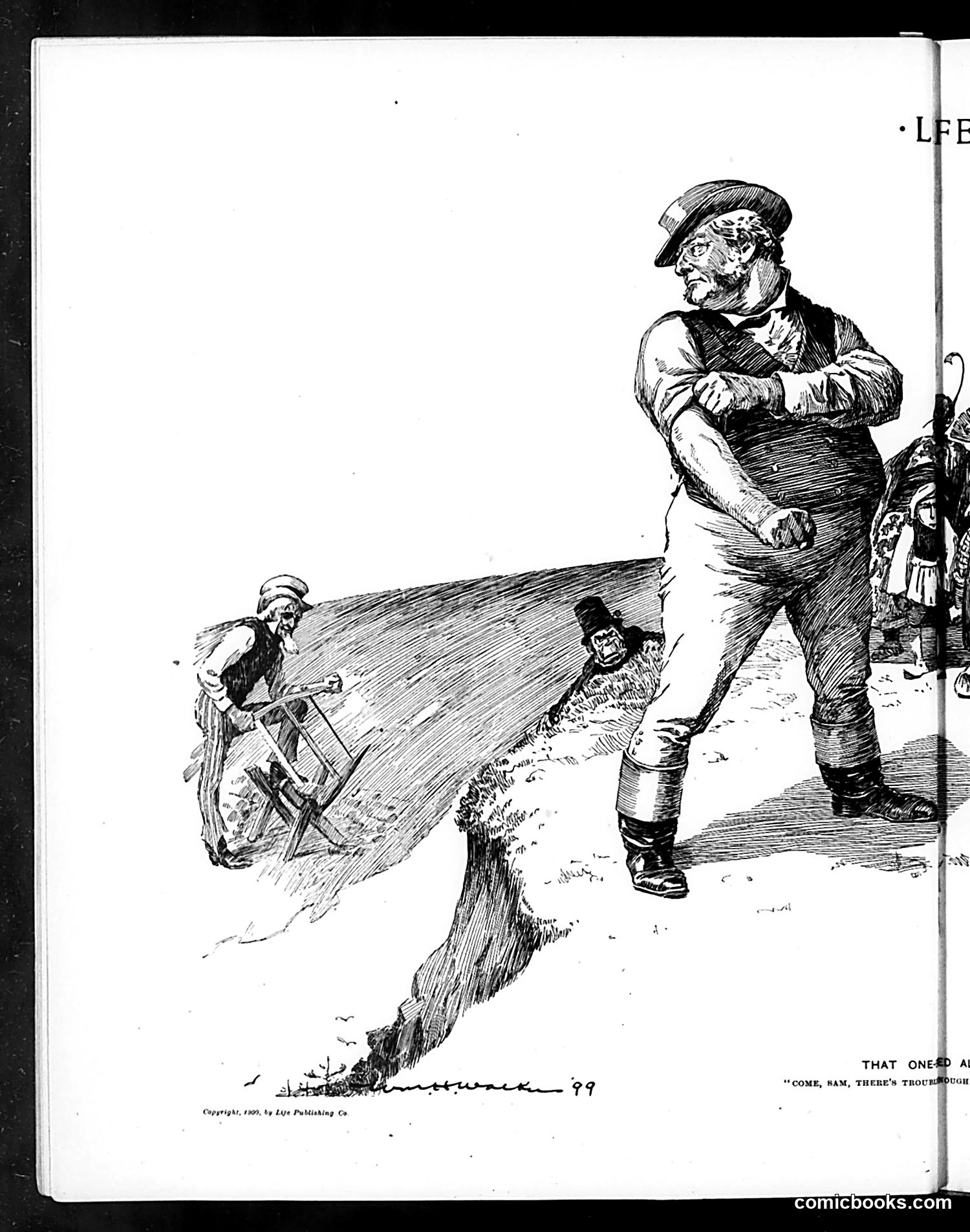
This is a satirical cartoon from Life magazine (copyright 1909, by the visible attribution). The image shows a large, well-fed man in working-class attire confronting a smaller, desperate-looking figure pulling a heavily laden cart or wagon. The caption reads: "COME, SAM, THERE'S TROUBLE ENOUGH" (partially visible). The satire appears to address class conflict and labor conditions in early 20th-century America. The portly figure likely represents a wealthy employer or capitalist, while the struggling laborer represents the working poor. The cartoon critiques the disparity between classes and suggests that the wealthy man is callously dismissing or minimizing workers' legitimate grievances and difficult circumstances. The specific "trouble" referenced remains unclear from the visible text, but the visual contrast powerfully illustrates economic inequality.
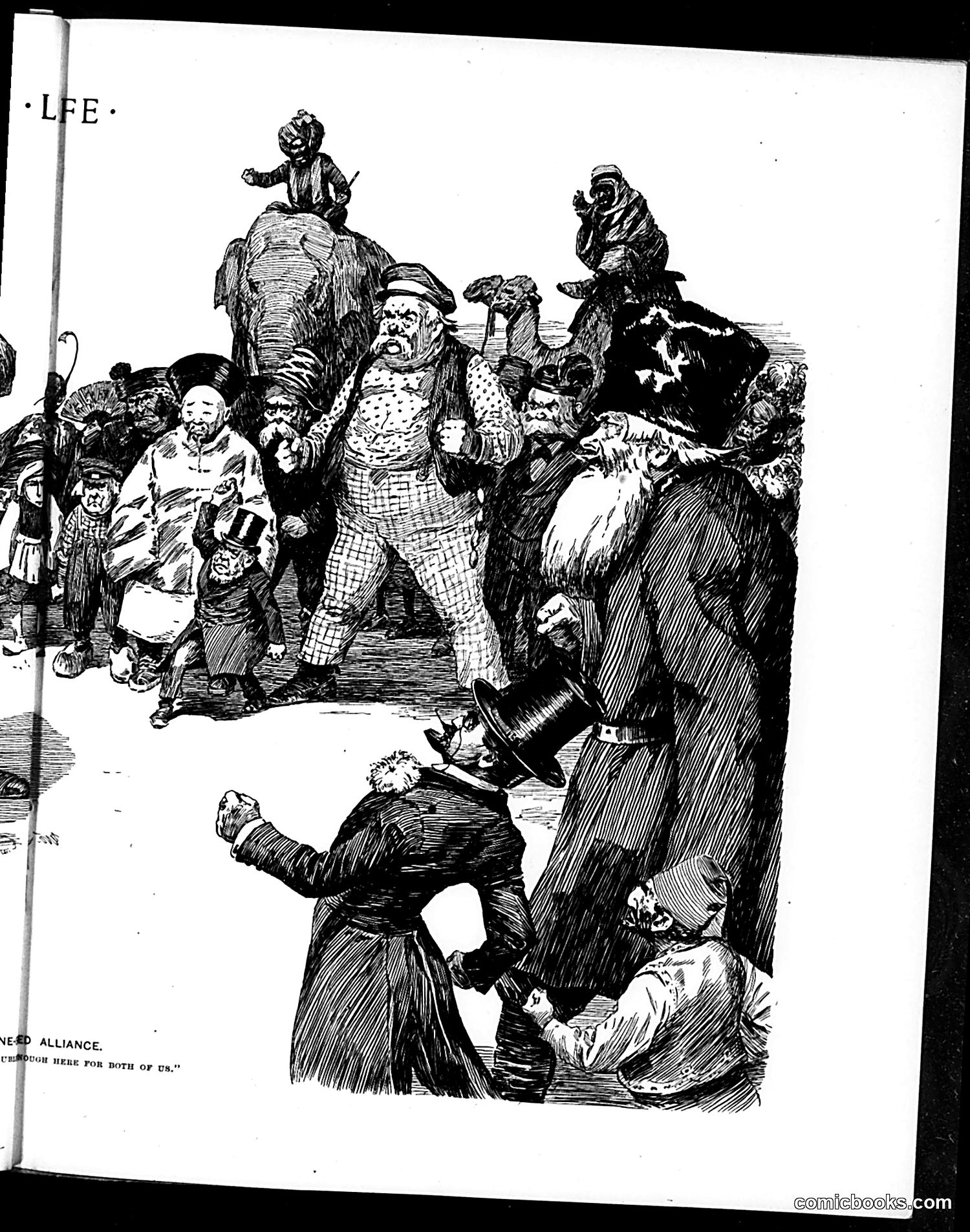
This is a satirical illustration from *Life* magazine depicting what appears to be a political alliance or negotiation scene. The central figure is a large man in checkered clothing, surrounded by various caricatured characters of different ethnicities and social classes—including what appear to be laborers, immigrants, and political figures. The partially visible text references "NEED ALLIANCE" and mentions something about "FREEDOM HERE FOR BOTH OF US," suggesting commentary on political coalition-building, likely around labor, immigration, or civil rights issues. The style of caricature—exaggerated facial features and ethnic stereotyping—is typical of 19th-century political satire. Without the complete caption or date, the specific political event referenced remains unclear, though it appears to critique opportunistic political alliances formed across class or ethnic lines.
This page reviews a theatrical production comparing two opposing character types: a refined "lady" (associated with Maxine Elliott and N.C. Goodwin's sophisticated performances) versus a "cowboy" character. The critic notes these are "radically opposites" in the play. The review critiques Mr. Clyde Fitch's attempt to unite these contrasting personas on stage. The satirical point appears to be that combining such incompatible character archetypes—refined Eastern femininity versus rough Western masculinity—creates an awkward dramatic mismatch, despite the actors' talents. The critic suggests the play's premise itself is fundamentally flawed as theatrical literature.
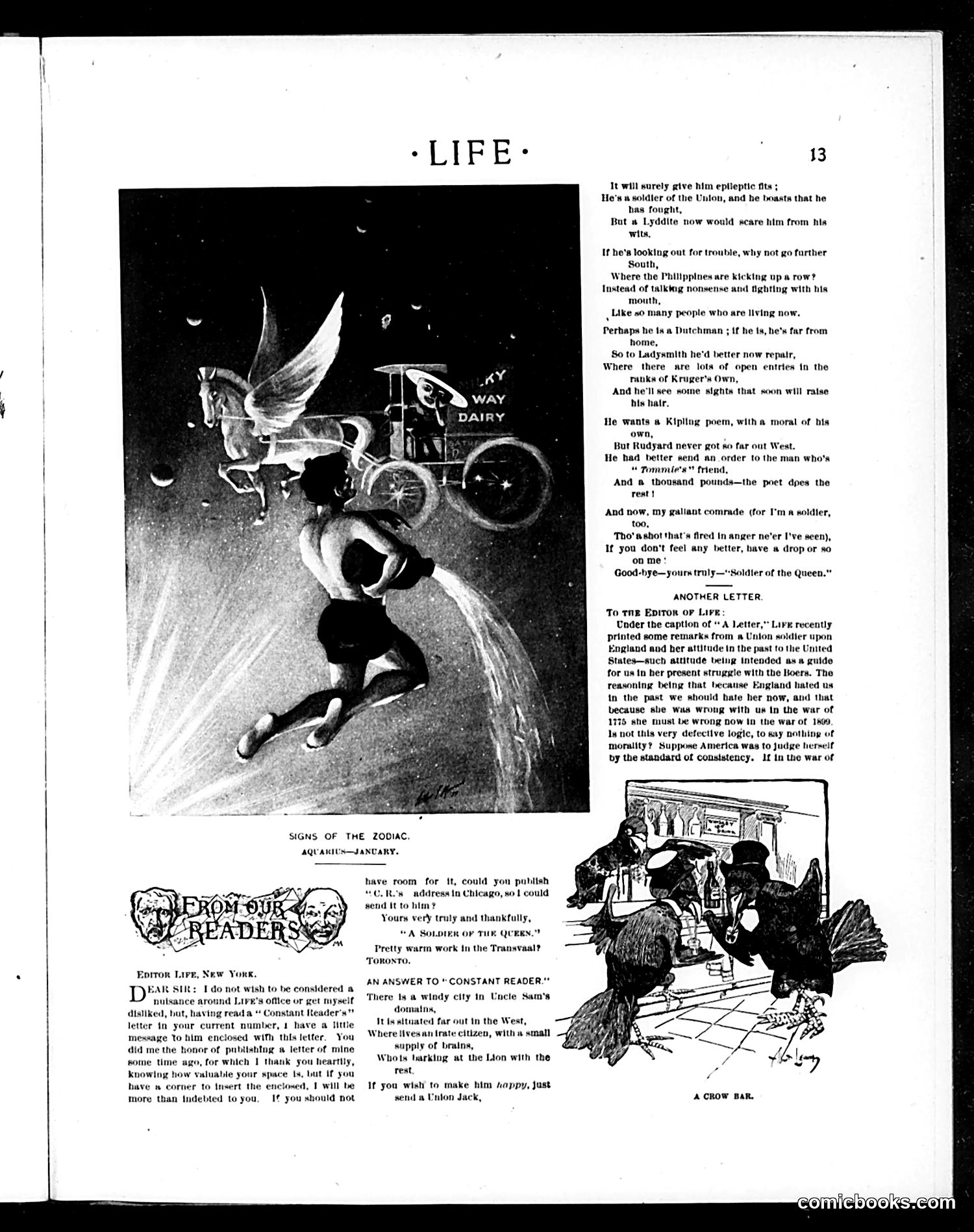
This page contains reader letters and editorial commentary addressing the Boer War. The prominent cartoon depicts **Britannia (winged female figure) riding a milk cart labeled "Way Dairy,"** likely satirizing British imperial commerce during the conflict. The letters debate England's past hostility toward America (referencing the 1775 Revolution) versus current sympathy during the Boer War. One writer defends supporting Britain despite historical grievances, while another critiques this "defective logic." References include: - **Ladysmith** (besieged British garrison in South Africa) - **Kruger** (Boer leader Paul Kruger) - **Lyddite** (explosive ammunition, humorously suggested to frighten a "Dutchman"—a Boer) - **Philippines** (ongoing American colonial conflict, used as counterargument) - **Rudyard Kipling** (celebrated war poet) The satire explores American ambivalence about supporting Britain—traditionally a rival—against the Boers, while America itself pursued imperial expansion. The "Crow Bar" illustration (lower right) remains unclear without caption context.
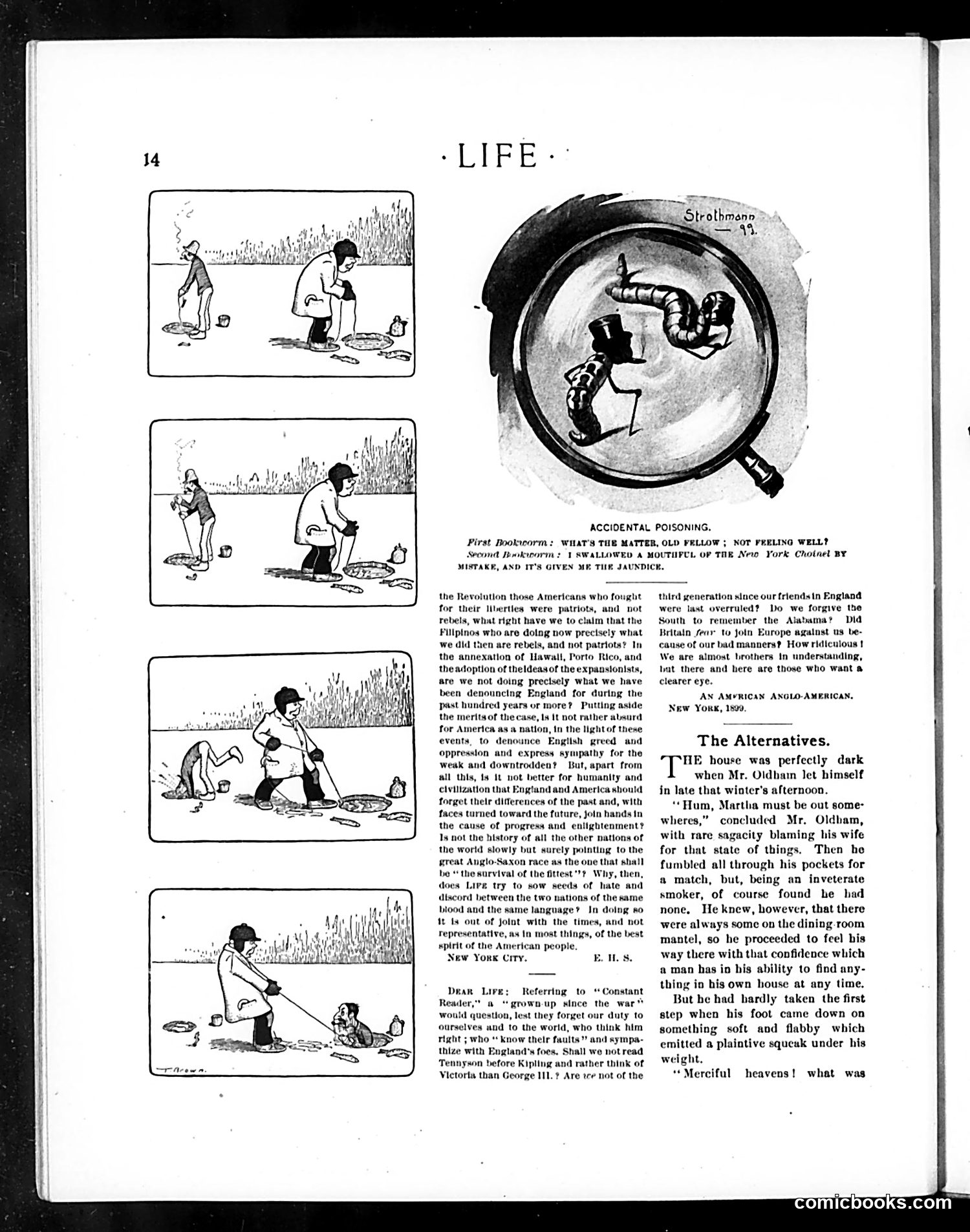
## The Bookworm Cartoon The top cartoon depicts two "bookworms" (literal worms inside books). One complains he swallowed "a mouthful of the New York *Chronicle*" and it gave him jaundice. This is political satire mocking a specific newspaper—likely the *New York Chronicle*—as poisonous or sickening. The joke relies on the reader's familiarity with that publication's editorial stance or reputation. ## The Debate Section Below are letters debating American imperialism circa 1899. One writer criticizes America's hypocrisy: we fought England for independence, yet now condemn Filipinos doing the same as "rebels." He questions why America annexes Hawaii and Puerto Rico while denouncing British imperialism. A responding letter defends Anglo-Saxon unity and progress. This reflects real 1899 debates over the Spanish-American War and Philippine-American War—dividing Americans on whether imperial expansion contradicted founding ideals. ## "The Alternatives" The bottom story fragment appears unrelated domestic fiction about Mr. Oldham searching for matches in darkness.
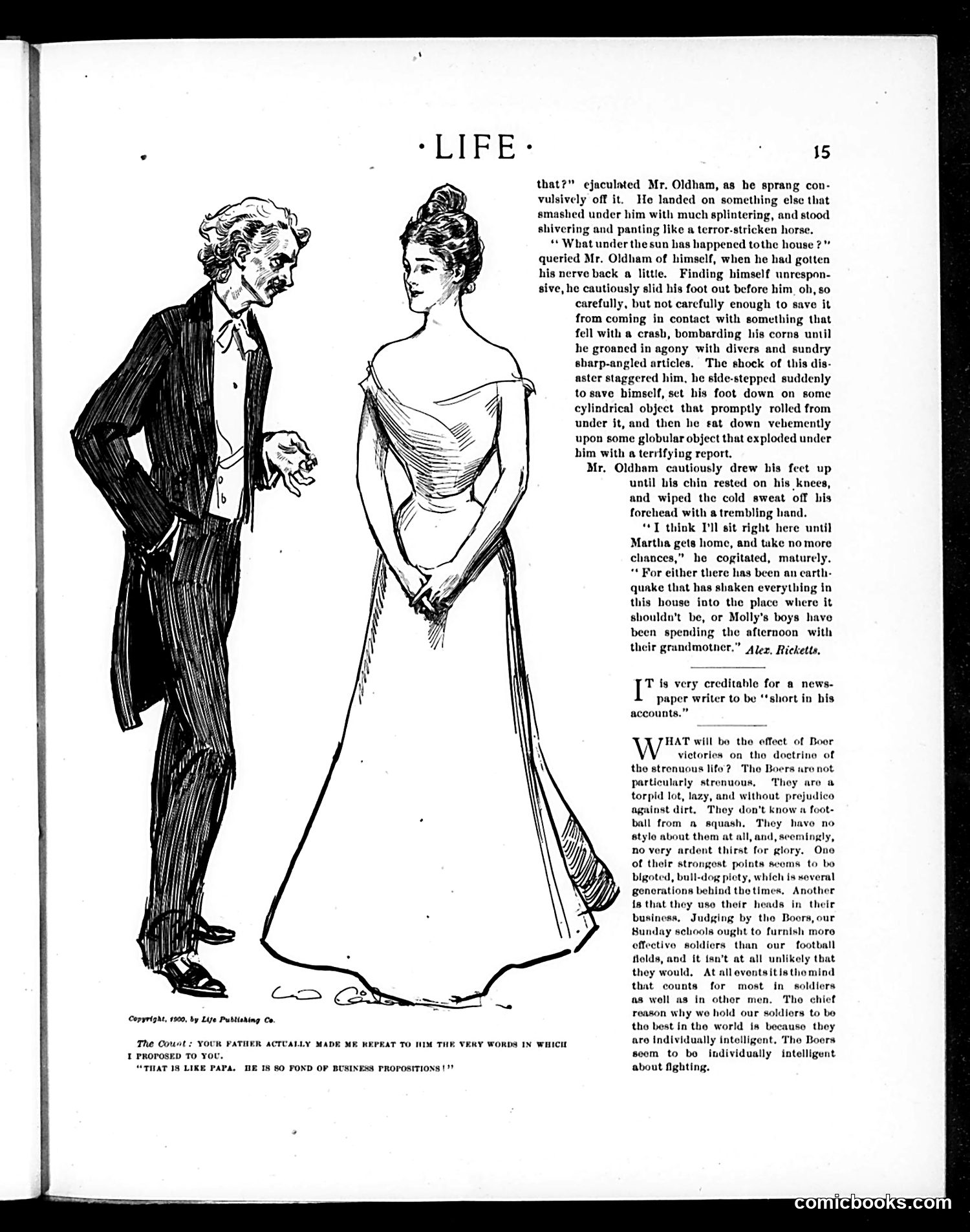
This page contains two distinct satirical pieces: **The Main Cartoon** depicts a gentleman (Mr. Oldham) and a woman in an elegant dress. The caption reveals a domestic comedy: the woman's father made her repeat the exact marriage proposal words back to him—treating the proposal as a "business proposition." The satire mocks the commercialization of romance and the intrusion of paternal business thinking into courtship. **The Oldham Story** (text on right) humorously describes Mr. Oldham returning home to chaos—stepping on broken objects, toys, and debris. The punchline reveals "Molly's boys" (grandchildren) have visited, not an earthquake. The satire gently mocks domestic disorder caused by children's visits. **The Boer War Commentary** (bottom) discusses the Second Boer War (1899-1902), contrasting the lazy, "torpid" Boers with American "strenuous life" ideology. The author argues the Boers succeed through intelligence, not vigor—implying American education should emphasize brains over athletics. All three pieces employ satire on contemporary social values: commercialism in marriage, family chaos, and martial philosophy.
This page contains primarily **advertisements and filler content** rather than political cartoons. The main text is a humorous anecdote attributed to Chauncey Depew (a prominent Republican politician of the era), where three schoolboys representing different political parties—Republican, Prohibitionist, and Democrat—compete for a woodchuck. The Democrat wins by honestly admitting he simply wants the woodchuck, not ideological principles. **The satire's point**: It mocks American political rhetoric as empty posturing. All parties make grand claims about their principles, but the Democrat's naked self-interest is portrayed as more honest—a subtle jab at politicians' actual motivations versus their public speeches. The page also includes humorous anecdotes about frontier life in North Carolina and Native American negotiations, but these appear to be filler content rather than coordinated political commentary. The advertisements (Wilson Whiskey, Life Binder, Johann Hoff's Malt Extract) dominate the lower portion.
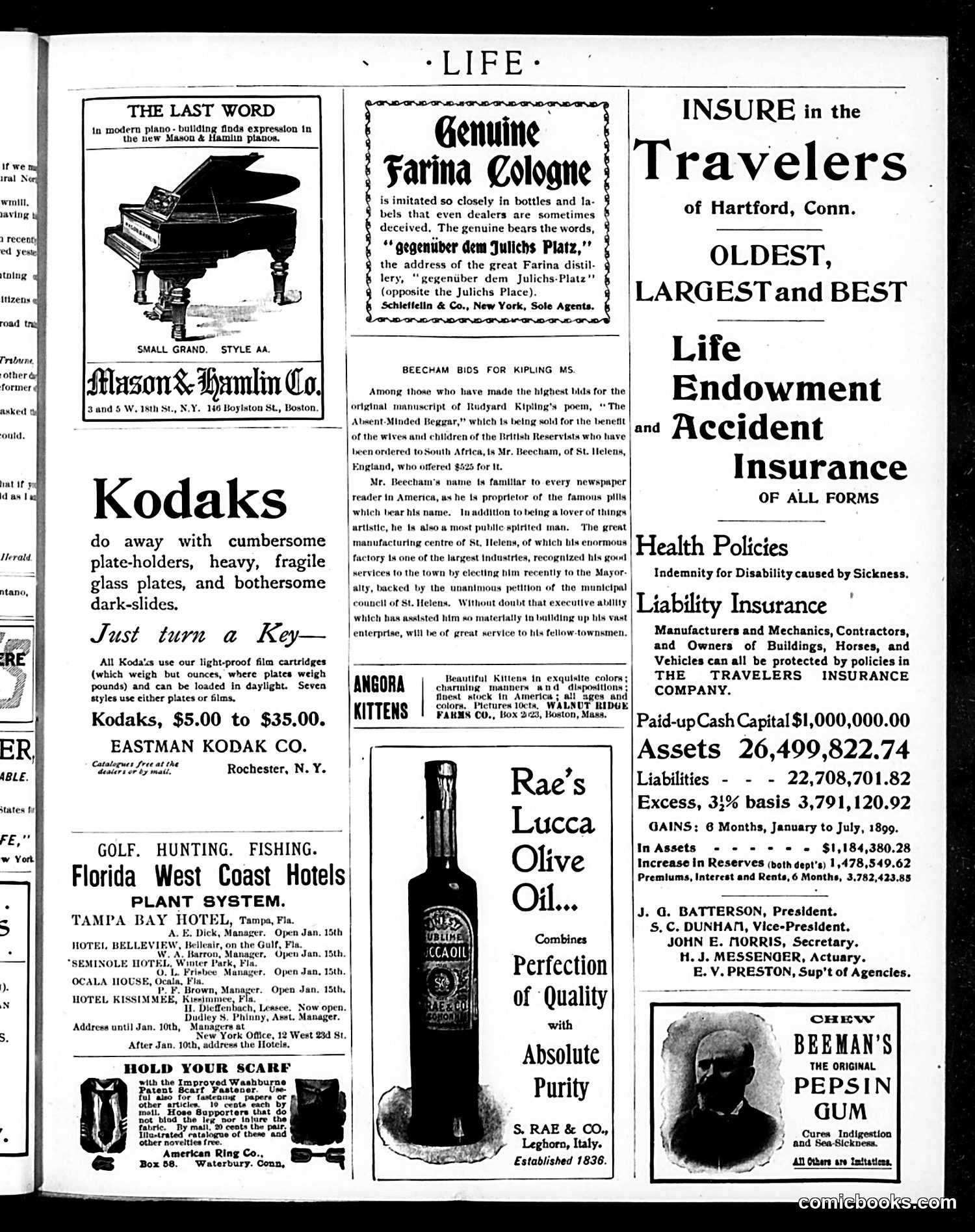
This is primarily an **advertising page**, not editorial or satirical content. The dominant feature is a large advertisement for **Kodak cameras**, which promises ease-of-use by eliminating cumbersome glass plates—a revolutionary advancement in consumer photography at the time. Notable advertising content includes: - **Beecham's bid for Kipling manuscript**: A news item about Thomas Beecham, proprietor of Beecham's Pills (a popular patent medicine), purchasing Rudyard Kipling's manuscript of "The Absent-Minded Beggar" (a poem supporting British soldiers in the Boer War). The item credits Beecham as both an art lover and capable businessman, recently elected mayor of St. Helens. - Other ads promote **Travelers Insurance** (Hartford), **Farina Cologne**, Kodaks, Florida hotels, and novelty items like scarf fasteners. No political satire is evident; this appears to be a standard mixed advertising and light news page from Life magazine circa 1899.
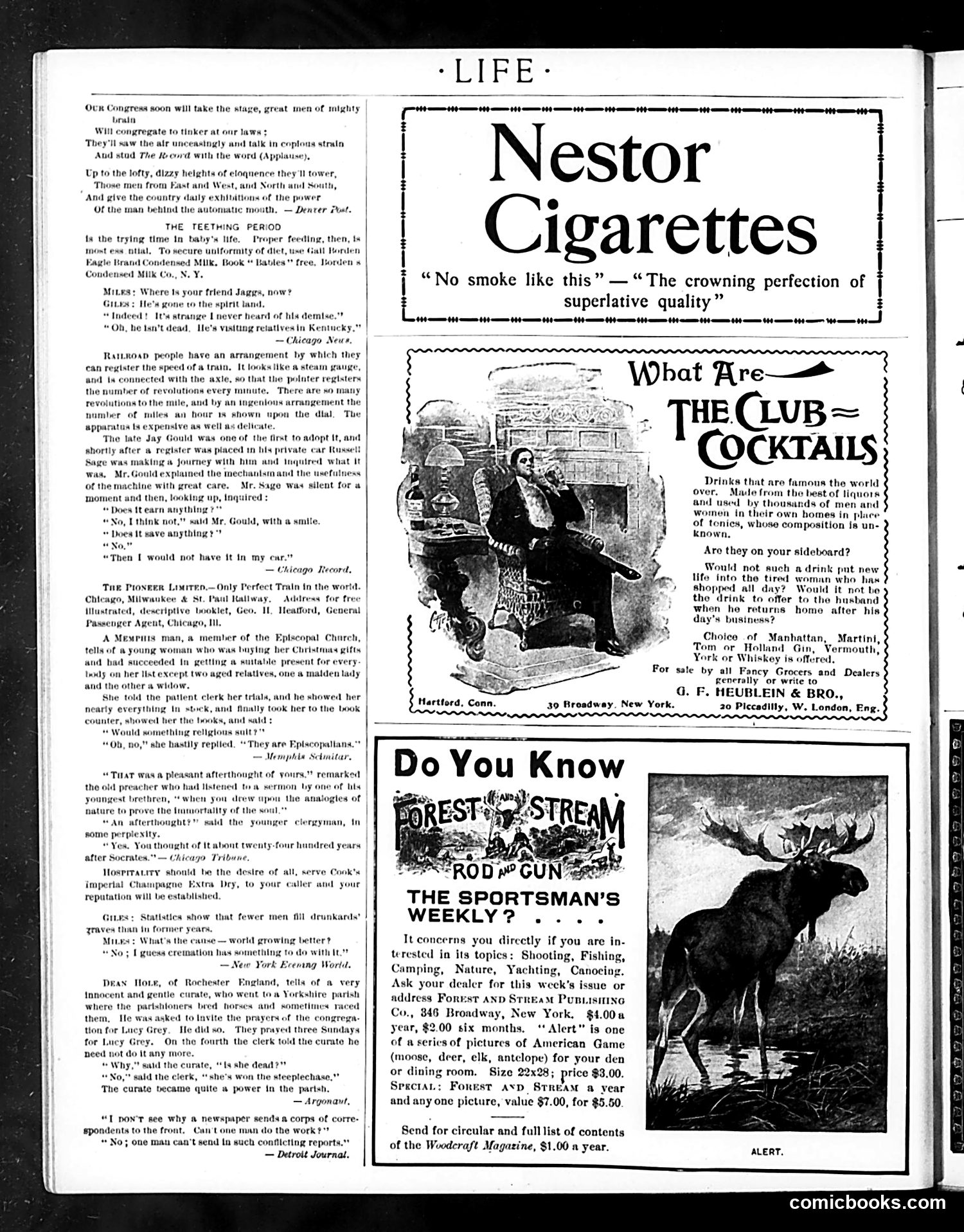
This page contains several **short humorous anecdotes** typical of Life's satirical style, plus **advertisements**. The main text items are jokes about: - **Congress** taking office and making grand speeches - A **teething baby** and milk brands - **Jay Gould** (the wealthy railroad magnate) with a speed-measuring device in his private train car—the humor being that despite Gould's pride in this expensive technology, his companion Russell Sage dismisses it as useless - Various other brief comedic stories about clergy, Christmas shopping, and cremation The **advertisements** promote: - **Nestor Cigarettes** ("No smoke like this") - **Club Cocktails** (Heublein brand mixers) - **Forest and Stream** magazine for sportsmen The satire targets **wealthy industrialists' materialism** (Gould's gadgetry) and includes **gentle religious humor**. The page reflects early 20th-century concerns: consumer products, leisure activities for the affluent, and conventional piety. There are **no political cartoons** on this page—it's primarily text-based humor and advertising.
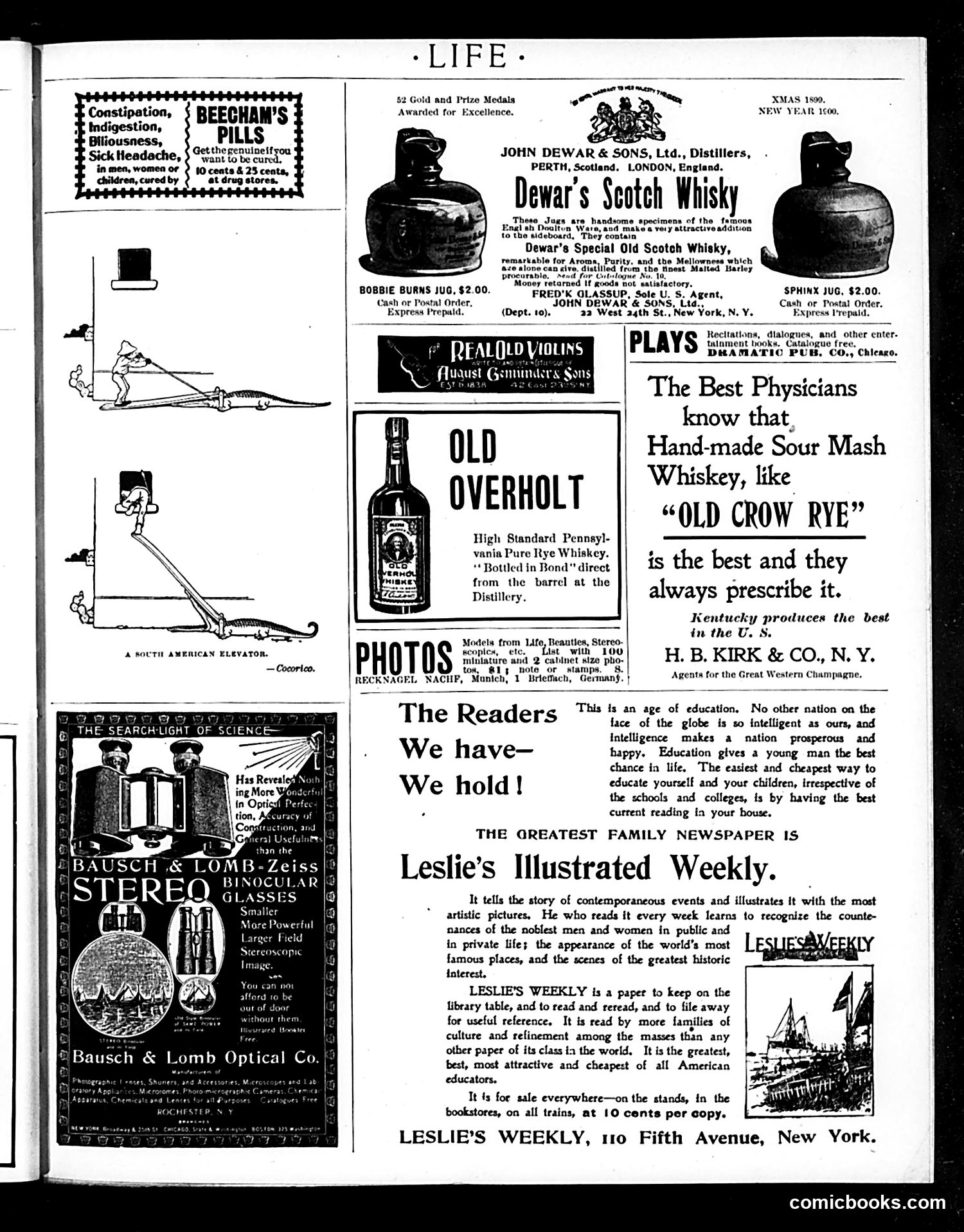
This is primarily an **advertising page** rather than editorial content. The cartoons are minimal—just two small satirical sketches on the left showing a "South American Elevator" (a person being stretched between two figures, likely mocking exaggerated claims about exercise equipment). The page is dominated by **period advertisements** for: - **Patent medicines** (Beecham's Pills for digestive complaints) - **Whiskey brands** marketed with medical authority ("The Best Physicians know that... Old Crow Rye... is the best") - **Optical equipment** (Bausch & Lomb stereo glasses) - **Leslie's Illustrated Weekly** (competing publication) The **social context**: This reflects late-1890s America when whiskey was openly advertised as medicine, patent medicines were unregulated, and magazines competed fiercely for readers by claiming educational superiority. The modest elevator cartoon is a throwaway joke, with the page's real "message" being commercial rather than satirical.
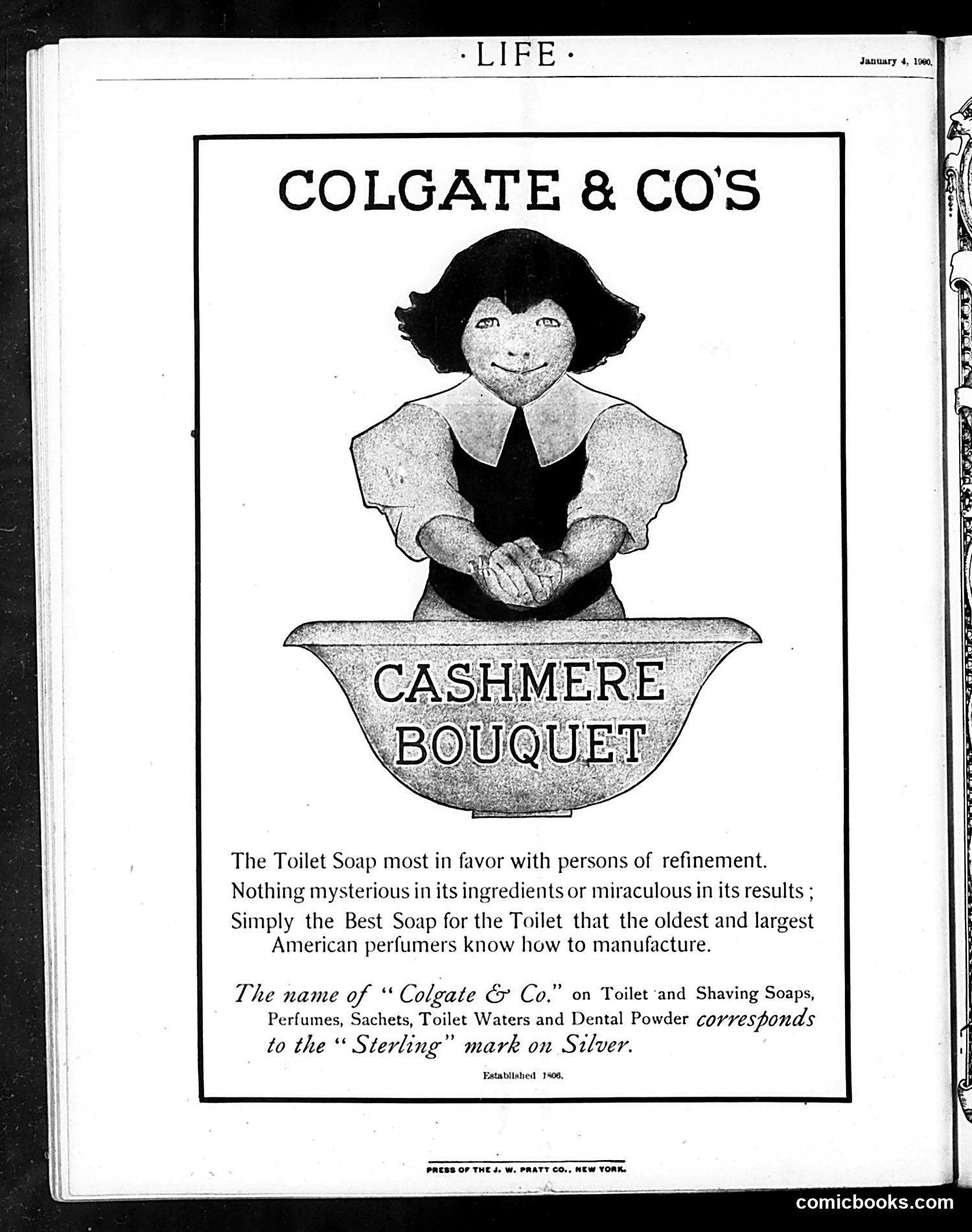
This is a **product advertisement**, not political satire. It appears in *Life* magazine (January 4, 1906) promoting Colgate & Co.'s "Cashmere Bouquet" toilet soap. The illustration shows a cheerful, round-faced woman in early 1900s dress, positioned above the product name as a mascot or brand representative. The ad targets wealthy consumers by emphasizing "refinement" and quality manufacturing by "the oldest and largest American perfumers." The key marketing claim compares the Colgate brand name to a "Sterling" mark on silver—suggesting the brand guarantees quality and authenticity. The ad stresses there's nothing mysterious or miraculous about the soap; it simply represents honest craftsmanship and established reputation. This is straightforward commercial messaging typical of early 20th-century magazine advertising, not satirical commentary.