
Life, 1900-01-04 · page 4 of 20
Life — January 4, 1900 — page 4: what you’re looking at
What you’re looking at
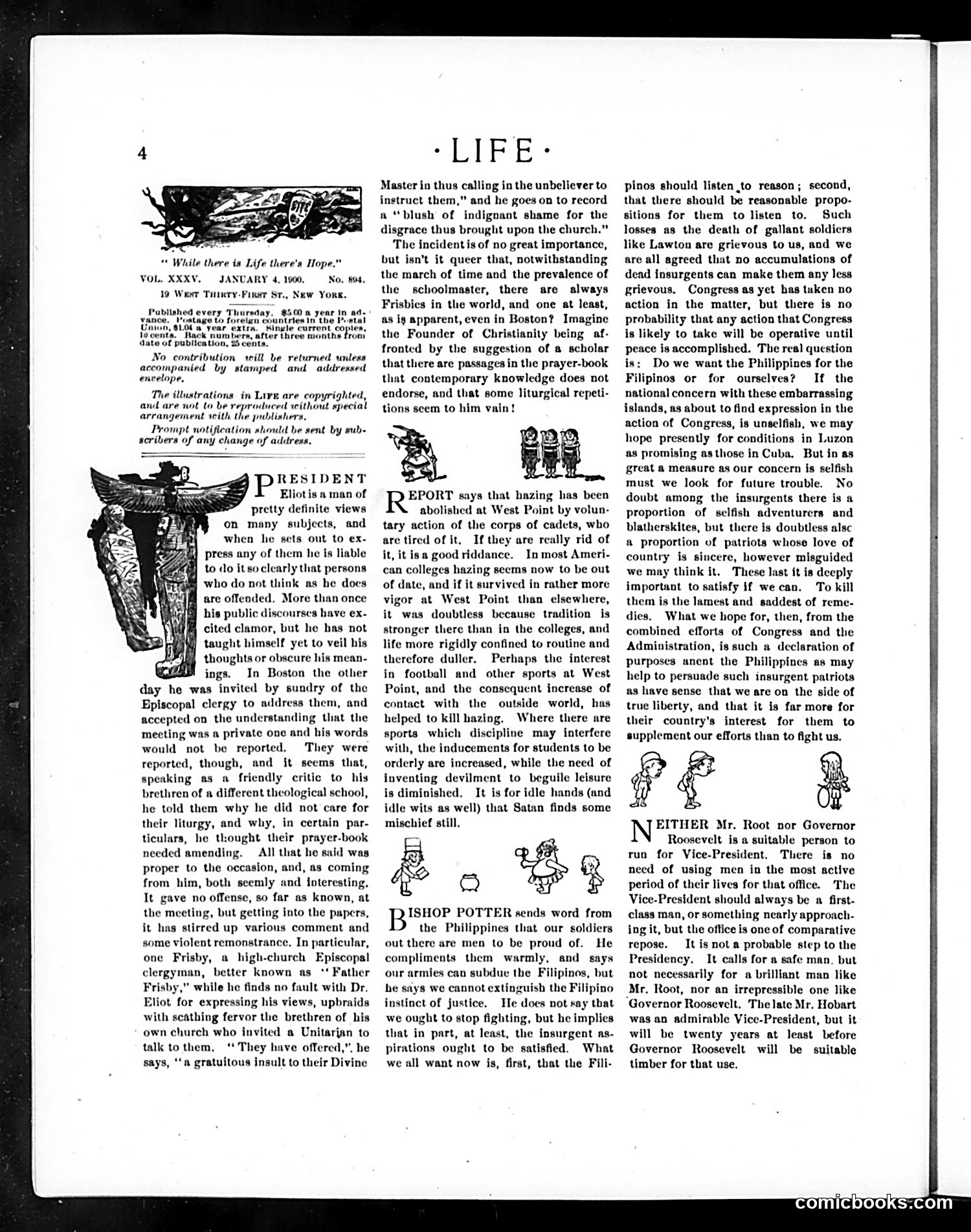
This page contains editorial commentary rather than cartoons. The main illustrated elements are decorative mastheads and small vignettes of figures engaged in various activities. The text discusses several topics: President Roosevelt's views on candor in public discourse; hazing abolition at West Point; and Episcopal clergy addressing theological matters. A section critiques the fitness of certain figures for Vice-President, specifically stating neither Mr. Root nor Governor Roosevelt is suitable, arguing the office requires an active first-class man, though these individuals might eventually qualify. The piece reflects turn-of-the-century debates about military discipline, presidential succession, and clerical authority—topics of immediate political concern in 1900.
📄 Transcribed text from this page (OCR, searchable)
Machine-transcribed from the original scan — historical spelling and the odd misread are preserved.
While here is Life there's Hope.” VOL. XXXV. JANUARY 4, 1900, 19 West Tiery-Finst St., New Yor«, Published every Thursday. $5.00 9 year I vatage to forelgn countries in the I Year extra. Single curront cop ack humbers. after three months ron Sate of publication, 33 cent No contribution will be returned unless accompanied by stamped and addressed envelope, The illustrations in Live are copyrighted, anil are not to be reproduced without special arrangement with the publishers, Prompt notification should be sent by sub- scribera of any change of address, RESIDENT Eliotis a man of pretty definite views on many subjects, and when he sets out to ex- } press any of them he is liable } to do itsoclearly that persons who do not think as he docs are offended. More than once his public discourses have ex- cited clamor, but he has not H taught himself yet to veil bis thoughts or obscure his mean- ings. In Boston the other day he was invited by sundry of the Episcopal clergy to address them, and accepted on the understanding that the meeting was a private one and his words would not be reported. They were reported, though, and it seems that, spenking as a friendly critic to his brethren of a different theological school, he told them why he did not care for their liturgy, and why, in certain par- ticulars, he thought their prayer-book needed amending. All that he said was proper to the occasion, and, as coming from him, both seemly and interesting. It gave no offense, so far as known, at the meeting, but getting into the papers, it has stirred up various comment and some violent remonstrance. In particular, one Frisby, a high-church Episcopal clergyman, better known as ** Father Frisby,” while he finds no fault with Dr. Eliot for expressing his views, upbraids with scathing fervor the brethren of his own church who invited a Unitarian to talk tothem, ‘ They have offered,” he says, ‘‘a gratuitous insult to their Divine LIFE Master in thus calling in the unbeliever to instruct them,” and he goes on to record a “blush of indignant shame for the disgrace thus brought upon the church.” The incidentis of no great importance, but isn’t it queer that, notwithstanding the march of time and the prevalence of the schoolmaster, there are always Frisbies in the world, and one at least, as ig apparent, even in Boston? Imagine the Founder of Christianity being af- fronted by the suggestion of 8 scholar that there are passages in the prayer-book that contemporary knowledge does not endorse, and that some liturgical repeti- tions seem to him vain! ‘Ss fi EPORT says that hazing has been abolished at West Point by volun- tary action of the corps of cadets, who are tired of it, If they are really rid of it, it isa good riddance. In most Ameri- can colleges hazing secms now to be out of date, and if it survived in rather more vigor at West Point than elsewhere, it was doubtless because tradition is stronger there than in the colleges, and life more rigidly confined to routine and therefore duller, Perhaps the interest in football and other sports at West Point, and the consequent increase of contact with the outside world, has helped to kill hazing. Where there are sports which discipline may interfere with, the inducements for students to be orderly are increased, while the need of inventing devilment to beguile leisure is diminished. It is for idle hands (and idle wits as well) that Satan finds some mischief still. Bo By ISHOP POTTER sends word from the Philippines that our soldiers out there are men to be proud of. He compliments them warmly, and says our armies can subdue the Filipinos, but he says we cannot extinguish the Filipino instinct of justice. He does not say that we ought to stop fighting, but he implies that in part, at least, the insurgent as- pirations ought to be satisfied. What we all want now is, first, that the Fili- Mr. Root, pinos should listen to reason; second, that there should be reasonable propo- sitions for them to listen to, Such losses as the death of gallant soldiers like Lawton are grievous to us, and we are all agreed that no accumulations of dead insurgents can make them any less grievous. Congress as yet has taken no action in the matter, but there is no probability that any action that Congress is likely to take will be operative until peace is accomplished. The real question is: Do we want the Philippines for the Filipinos or for ourselves? If the national concern with these embarrassing islands, as about to find expression in the action of Congress, is unselfish, we may hope presently for conditions in Luzon as promising as those in Cuba, But in as great @ measure as our concern js selfish must we look for future trouble. No doubt among the insurgents there is a proportion of selfish adventurers and blatherskites, but there is doubtless alsc a proportion of patriots whose love of country is sincere, however misguided we may think it. These last it is deeply important to satisfy if wecan. To kill them is the lamest and saddest of reme- dies. What we hope for, then, from the combined efforts of Congress and the Administration, is such a declaration of purposes anent the Philippines as may help to persuade such insurgent patriots as have sense that we are on the side of true liberty, and that it is far more for their country’s interest for them to supplement our efforts than to fight us. EITHER Mr. Root nor Governor Roosevelt is a suitable person to run for Vice-President. There is no necd of using men in the most active period of their lives for that office. The Vice-President should always be a first- class man, or something nearly approach- ing it, but the office is one of comparative repose. It isnot a probable step to the Presidency, It calls for a safe man, but not necessarily for a brilliant man like nor an irrepressible one like Governor Roosevelt. The late Mr. Hobart was an admirable Vice-President, but it will be twenty years at least before Governor Roosevelt will be suitable timber for that use,