
Life, 1900-01-04 · page 6 of 20
Life — January 4, 1900 — page 6: what you’re looking at
What you’re looking at
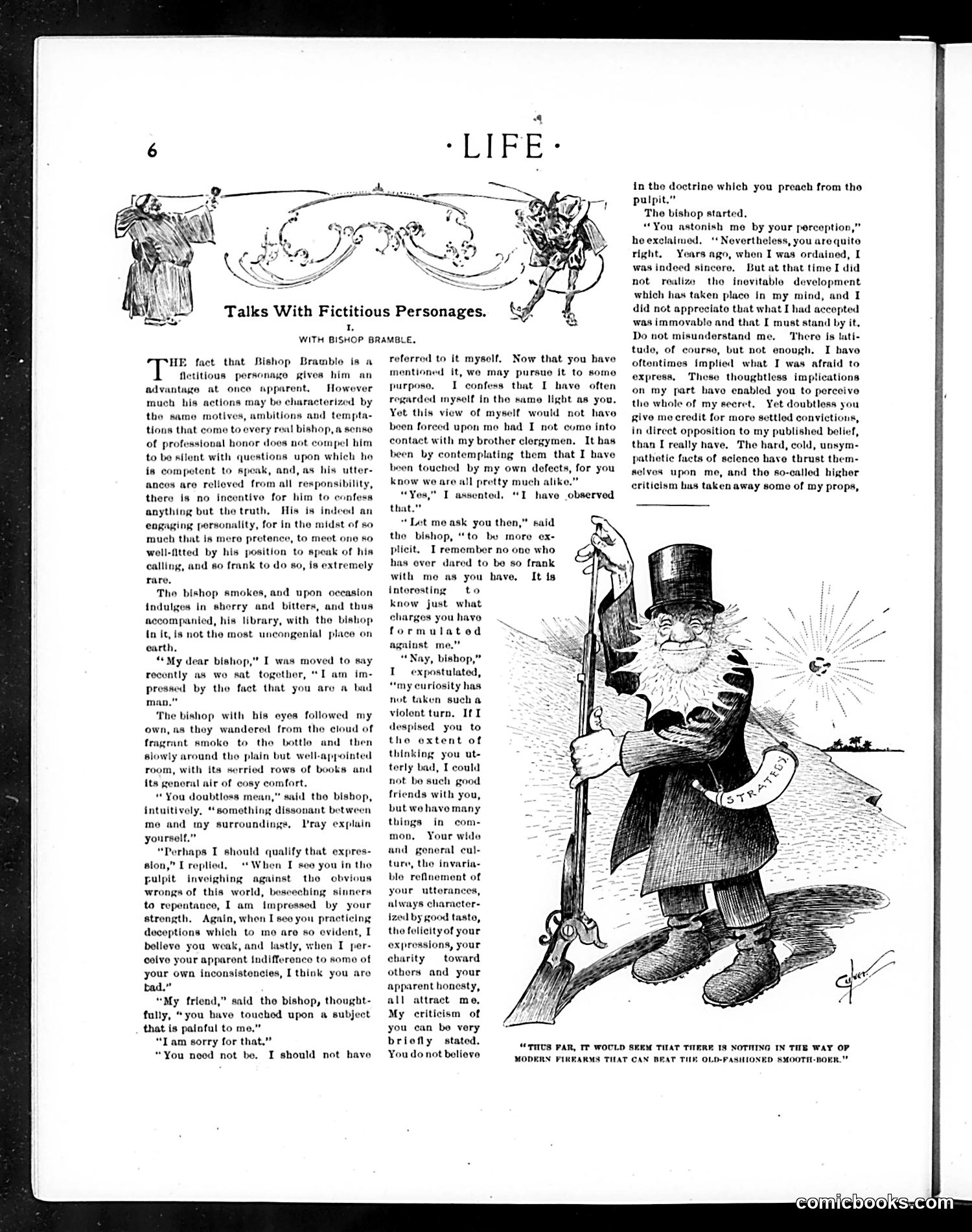
This page features a dialogue between the author and a Bishop, discussing the Bishop's criticism of the author's published work. The Bishop accuses the author of lacking sincerity and attacking established religion. The author responds by defending his integrity and explaining his deceptions stem from honest intellectual convictions, not malice. The cartoon illustration shows a figure (likely representing the author or a clergyman) holding a rifle or musket, with the caption: "Thus far, it would seem that there is nothing in the way of modern firearms that can beat the old-fashioned smooth-bore." The satire appears to critique religious authority's response to modern intellectual criticism, contrasting spiritual "weapons" with literal ones.
📄 Transcribed text from this page (OCR, searchable)
Machine-transcribed from the original scan — historical spelling and the odd misread are preserved.
Talks With Fictitious Personages. 1. WITH BISHOP BRAMBLE, HE fact that Bishop Bramblo is a fictitious personage givea him an advantage at once apparent, However much his actions may be characterized by tho samo motives, ambitions and tempta- tions that come to every real bishop, a sense of professional honor does not compel him to bo silent with questions upon which ho ia competent to speak, and, as his utter- ancos aro relieved from all responsibility, there is no incentive for him to confess anything but the truth, His is indeed an engaging personality, for in the midst of so much that is mero pretence, to meet one so woll-fitted by his position to speak of his calling, and 80 frank to do so, is extremely rare. Tho bishop smokes, and upon occasion indulges in shorry and bitters, and thus accompanied, his library, with the bishop {n it, is not the most uncongenial place on earth, “My dear bishop,” I was moved to say rocently as wo sat togethor, “Tam im- pressed by tho fact that you are a bad man.” The bishop with bis oyes followed my own, a8 they wandered from the cloud of fragrant smoke to tho bottle and then slowly around tho plain but well-appointed room, with its serried rows of books and its genoral air of cosy comfort. You doubtless mean,” said tho bishop, intuitively, “something dissonant between mo and my surroundings, Pray explain yourself.” “Perhaps I should qualify that expres- sion,” replied, “When I seo you in the Pulpit inveighing against the obvious wrongs of this world, beseeching sinners to repentance, I am tmpressed by your strongth, Again, whon I seo you practicing deceptions which to mo aro so evident, I believe you weak, and lastly, when I per- coivo your apparent Indifference to somo of your own inconsistencies, I think you are “My friend,” said tho bishop, thought- fully, “you have touched upon a subject that is painful to me.” “Tam sorry for that.” “You need not be. I should not havo referred to it mysolf, Now that you have montioned it, we may pursue it to some purpose, I confess that I have often regarded myself in the same light as you. Yet this view of myself would not havo been forced upon mo had I not como into contact with my brother clergymen. It has been by contemplating them that I have been touched by my own defects, for you know we are all pretty much alike. os," T assented, “I have observed ~ Lot me ask you then, the bishop, “to be more ex- plicit, I remember no one who has over dared to be so frank with mo as you have, It is intorosting to know just what charges you havo formulated against me.” “Nay, bishop,” I expostulated, “my curiosity has not taken such a violent turn, If I despised you to tho oxtent of thinking you ut- terly bad, I could not be such good. friends with you, but wehavomany things in com- mon, Your wide and goneral cul- ture, the invaria- ble refinement of your utterances, always character- ized by good tasto, tho folicity of your expressions, your charity toward othors and your apparent honesty, all attract’ me, My criticism of you can be very briefly stated. You do not believe in tho doctrine which you preach from tho pulpit.” The bishop started, “You astonish mo by your perception,” heexclaimed. ‘Nevertheless, you arequito right. Years ago, when I was ordained, I was indeed sincere, But at that time I did not realize tho inevitable development which has taken placo in my mind, and I did not appreciato that what I had accepted was immovable and that I must stand by it. Do not misunderstand me. ‘There is lati- tudo, of course, but not enough, I havo oftentimes implied what I was afraid to express, These thoughtless imptications on my part bavo enabled you to perceive tho whole of my secret. Yet doubtless you give me credit for more settled convictions, in direct opposition to my published belief, than I really have. The hard, cold, unsym- pathetic facts of scienco have thrust them- selvos upon mo, and tho so-called highor criticism bus taken away some of my props, “THUS PAR, IP WOULD SEEM THAT THERE 18 NOTHING IN THE WAY OP MODERN PIRRARMS THAT CAN BRAT OLD-PASILIONRD SMOOTIT-BOER.””