
Life, 1900-01-04 · page 12 of 20
Life — January 4, 1900 — page 12: what you’re looking at
What you’re looking at
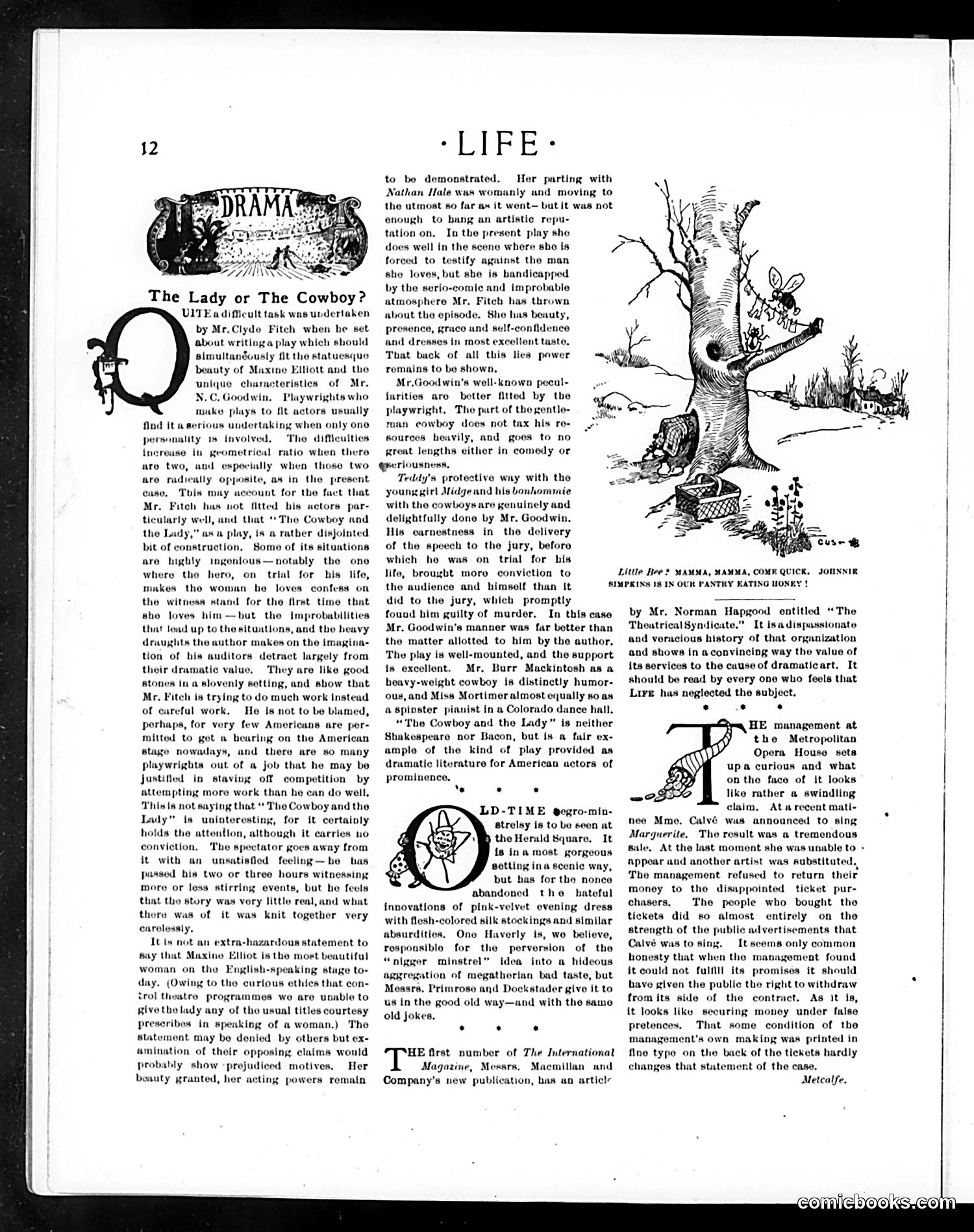
This page reviews a theatrical production comparing two opposing character types: a refined "lady" (associated with Maxine Elliott and N.C. Goodwin's sophisticated performances) versus a "cowboy" character. The critic notes these are "radically opposites" in the play. The review critiques Mr. Clyde Fitch's attempt to unite these contrasting personas on stage. The satirical point appears to be that combining such incompatible character archetypes—refined Eastern femininity versus rough Western masculinity—creates an awkward dramatic mismatch, despite the actors' talents. The critic suggests the play's premise itself is fundamentally flawed as theatrical literature.
📄 Transcribed text from this page (OCR, searchable)
Machine-transcribed from the original scan — historical spelling and the odd misread are preserved.
UITE a dificult task was undertaken by Mr.Clyde Fitch when be set about writing a play which should Bimultandously fit the statuesque beauty of Muxtne Elliott and the unique characteristics of Mr. N.C. Goodwin. Playwrights who muke plays to fit actors usually find it a serious undertaking when only ono personality 1s involved. The dificulties increase in geometrical ratio when there are two, und especially when those two are radically opposite, as in the present case, This may account for the fact that Mr. Fiteh has ors par- ticularly well, and that The Cowboy and the Lady,” us a play, is a rather disjointed bit of construction. Some of its situations are highly ingenious—notably the ono where the hero, on trial for his life, makes the woman he loves confess on the witness stand for the first time that sho loves him—but the Improbabilities that lead up to the situations, and the heavy draughts the author makes on the imagina- tion of his auditors detract largely from their dramatic value. They are like good stones in a slovenly setting, and show that Mr. Fitch is trying to do much work instead of careful work, He is not to be blamed, perhaps, for very few Americans are per- mitted to get a bearing on the American stage nowadays, and there are so many playwrights out of a job that he may be Justified in staving off competition by attempting more work than he can do well, ‘Thists not saying that * The Cowboy and the Lady” is uninteresting, for it certainly holds the attention, although it carries no conviction, The spectator goes away from it with an unsatisfed feeling—he bas passed bis two or three hours witnessing more or less stirring events, but be feels that the story was very little real,and what thors was of it was knit together very carelessly. It ts not an extra-hazardous statement to Say that Maxine Elliot is the most beautiful woman on the English-speaking stuge to- day. (Owing to tho curious ethics that con- trol theatre programmes wo are unable to give tho lady any of tho usual titles courtesy prescribes in speaking of a woman.) Tho statement may be denied by others but ex- amination of their opposing claims would Probably show “prejudiced motives. Her beauty granted, her acting powers remain qeeriousness, ‘LIPE: to be demonstrated. Her parting with Nathan Hale was womanly and moving to the utmost 80 far as it went— but it was not enough to bang an artistic repu- tation on, In the present play sho does well in the scene where sho is forced to testify against the man sho loves, but sbe is bandicapped by the serio-comic and improbable atmosphere Mr. Fiteb has thrown about the episode. Sho hus beauty, presence, graco und self-confidence and dresses in most excellent taste, That buck of all this lies power romains to be shown, Mr.Goodwin’s well-knowo pecul- furities aro better fitted by the playwright. Tho part of thogentlo- man cowboy does not tax his ro- sources heavily, and goes to no great lengths either in comedy or Teddy's protective way with tho young girl Midge and his bonhommie with the cowboys are genuinely and delightfully done by Mr, Goodwin, His earnestness in the delivery of the speech to the jury, before which he was on trial for bis life, brought more conviction to the audience and himself than It did to the jury, which promptly fouad him guilty of murder. In this caso Mr, Goodwin's manner was far better than the matter allotted to him by the author, ‘Thy play is well-mounted, and the support is excellent. Mr, Burr Mackintosh as a heavy-weight cowboy is distinctly humor- ous, and Miss Mortimer almost equally 0 as a spinster pianist in a Colorado dance hall, “The Cowboy and the Lady” is neither Shakespeare nor Bacon, but is a fair ex- amplo of the kind of play provided as dramatic literature for American actors of prominence, ‘ . . LD-TIME @egro-min- strelsy is to be seen at b the Heruld Square, It fs ina most gorgeous gotting ina scenic way, but bas for tho nonco abandoned the hateful Innovations of pink-velvet evening dress with flesh-colored silk stockings and similar absurdities, Ono Haverly is, wo believe, responsible for the perversion of the “nigger minstrel” {dea into a hideous aggregation of megatherian bad taste, but Messra, Primrose and Dockstader give it to us in the good old way—and with the samo old jokes. HE first number of The International Magazine, Messrs, Macmillan and Company’s new publication, has un article Little Bee $ MAMMA, MAMMA, COME QUICK, JONNNIR SIMPRINS 18 IN OUI PANTRY EATING MONEY by Mr. Norman Hapgood entitled “The ‘Theatrical Syndicate.” It isadispassionate and voracious history of that organization and shows in aconvincing way the value of its services to the cause of dramaticart. It should be read by every one who feels that Lire has neglected the subject. . . . HE management at the Metropolitan Opera House sets upa curious and what on the faco of it looks = like rather a swindling claim, At arecent mati- nee Mme. Culvé wus announced to sing Marguerite, Tho result was a tremendous Bale, At the last moment she was unable to + Appear and another artist was substituted, ‘The management refused to return their money to tho disappointed ticket pur- chasers, The people who bought tho tickets did so almost entirely on tho strength of the public advertisements that Calvé was to sing. It seems only common honesty that when the management found it could not fulfill its promises it should have given the public the right to withdraw from its side of the contract, As it is, it looks liky securing money under false pretences. That some condition of the management's own making was printed in fine typo on the back of the tickets hardly changes that statement of the case. Metcalfe.