
A complete issue · 20 pages · 1899
Life — December 14, 1899
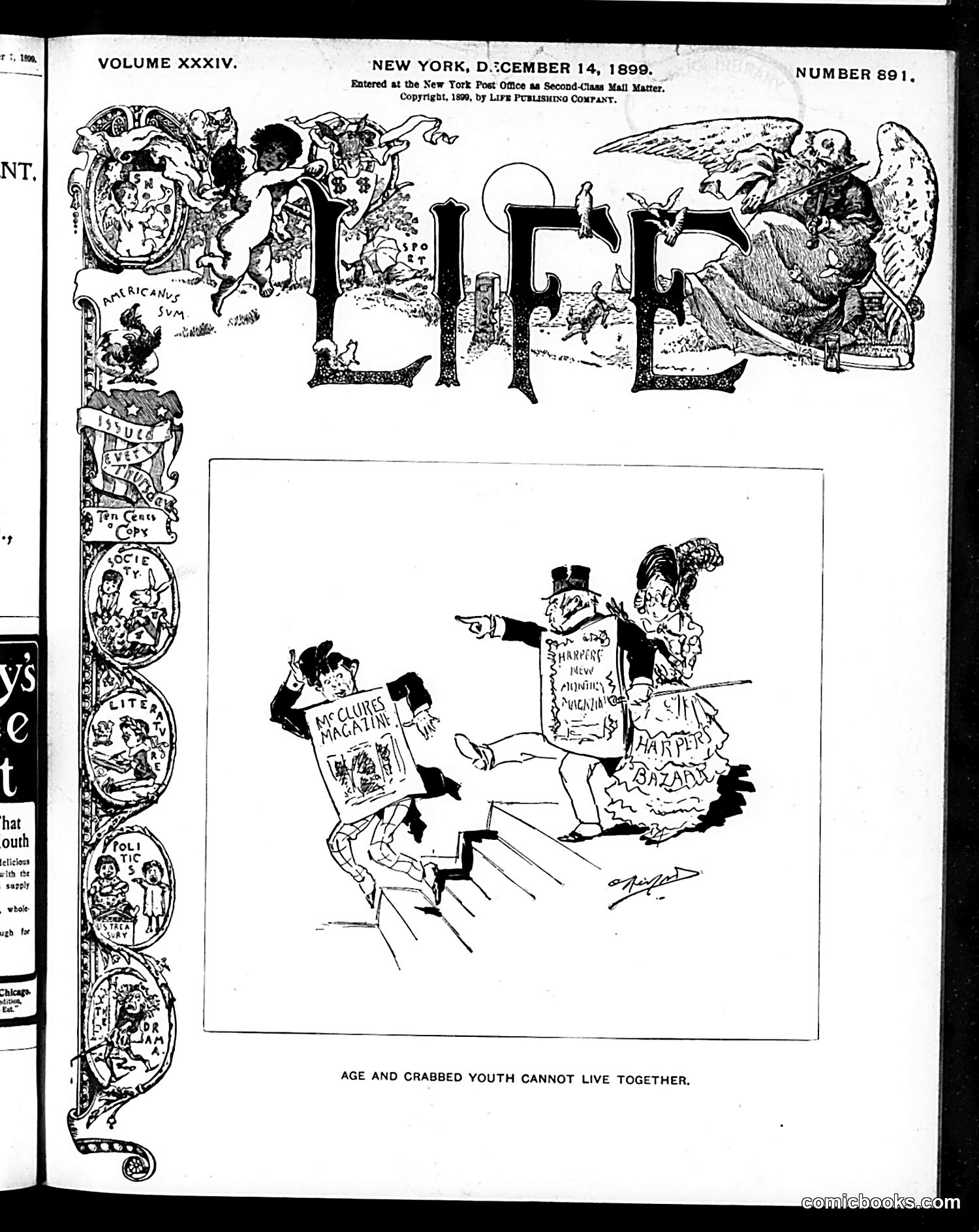
The main cartoon depicts three caricatured figures in conflict, labeled with publication names: "McClure's Magazine," "Harper's New Monthly," and "Harper's Bazar." They appear to be fighting or struggling with each other on a slanted surface. The caption reads: "Age and Crabbed Youth Cannot Live Together." This is satirizing rivalry between competing American magazines in the late 1890s. The cartoon suggests tension between established older publications (likely Harper's, which dated to mid-century) and newer competitors like McClure's Magazine (founded 1893), which pioneered cheaper, more sensational content. The satire mocks their inability to coexist peacefully in the crowded magazine market of the era.
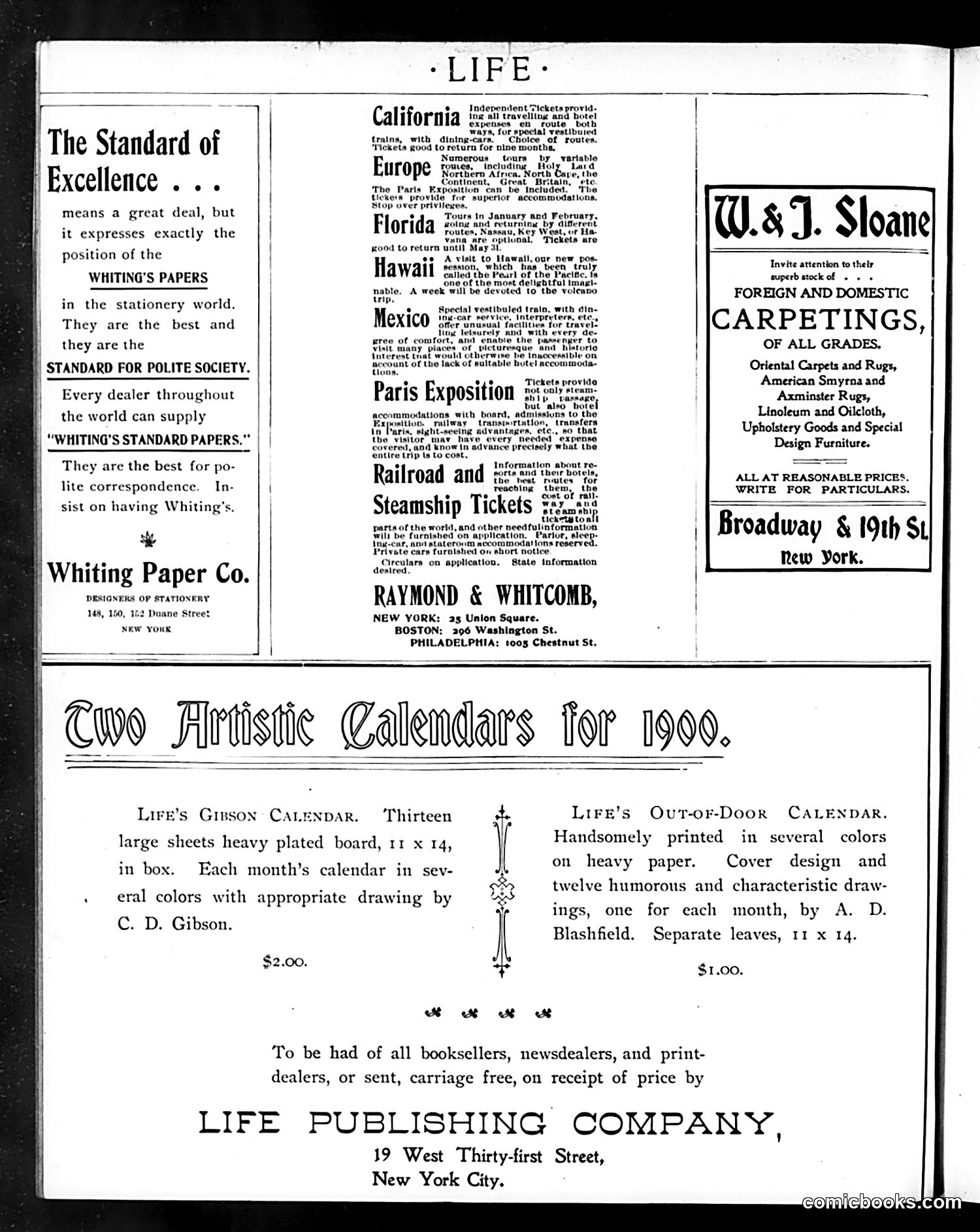
This page is primarily **advertising**, not satire or political commentary. It contains: 1. **Whiting Paper Co.** advertisement emphasizing their stationery's quality as "the standard for polite society" 2. **Travel advertisements** from Raymond & Whitcomb listing destinations (California, Europe, Florida, Hawaii, Mexico, Paris Exposition, railroad/steamship tickets) 3. **W. & J. Sloane** carpet and upholstery advertisement 4. **Life Publishing Company** promoting two artistic calendars for 1900—one by C.D. Gibson ($2.00) and one by A.D. Blashfield ($1.00), with decorative illustrations The page reflects turn-of-the-century consumer culture and Life magazine's business model of combining editorial content with advertisements targeting affluent readers interested in travel, fine goods, and art.
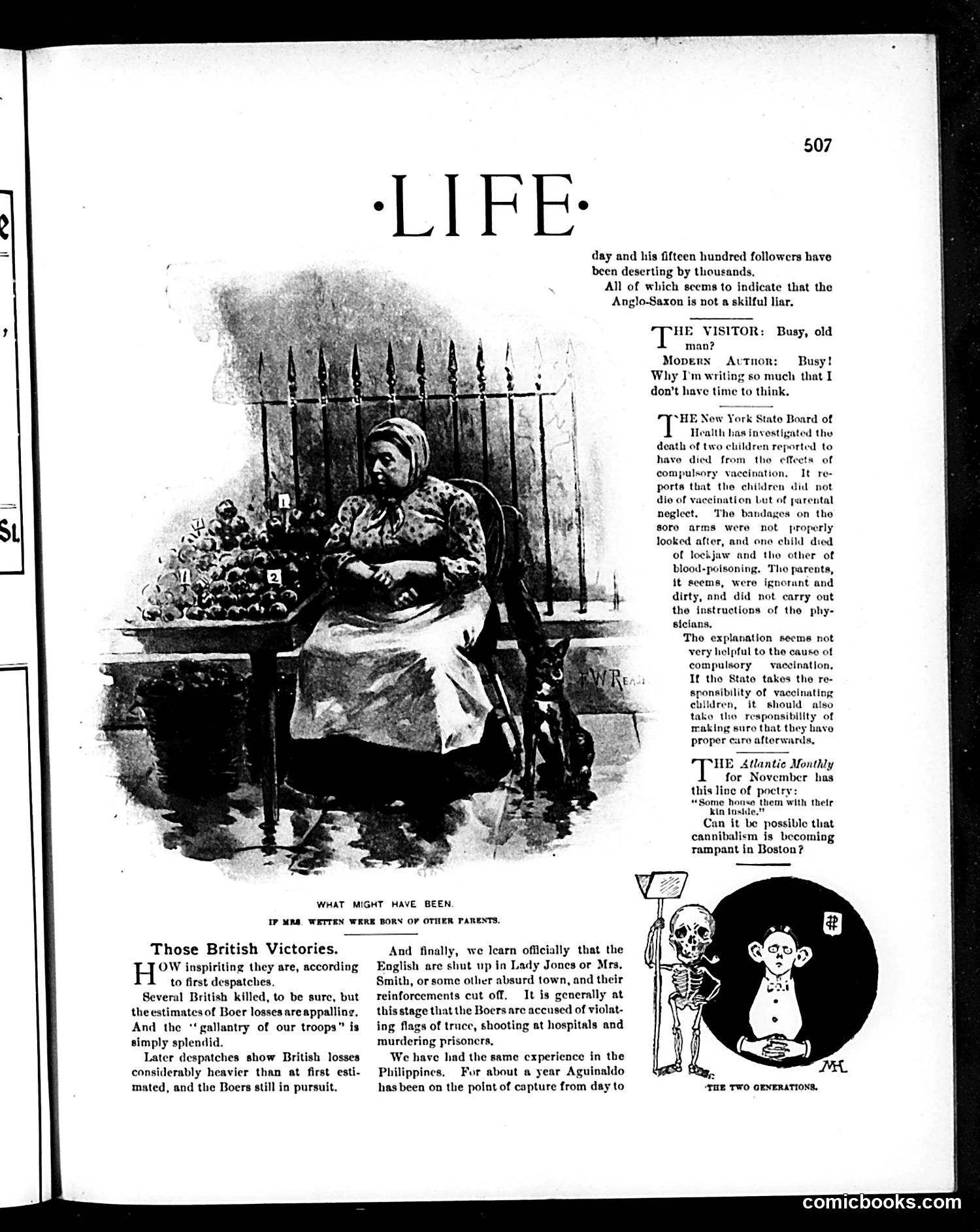
**Main Illustration:** Shows an elderly woman (likely a caregiver or nurse) sitting beside an iron fence with a young child, captioned "What Might Have Been - If Mrs. Werthen Were Born of Other Parents." **Political Context:** The page discusses the Boer War, referencing British military losses and accusations against the English regarding treatment of prisoners and hospital attacks. There's also commentary on vaccination deaths investigated by the New York State Board of Health, where two children reportedly died despite vaccination. **The Satire:** The cartoon appears to critique either British imperial conduct during the Boer War or parental responsibility in vaccination cases—the caption suggests examining how circumstances of birth/parentage shape moral outcomes. A smaller cartoon titled "The Two Generators" shows skeletal and living figures, likely symbolizing death and life. The page blends political criticism with social commentary on public health and parental duty.
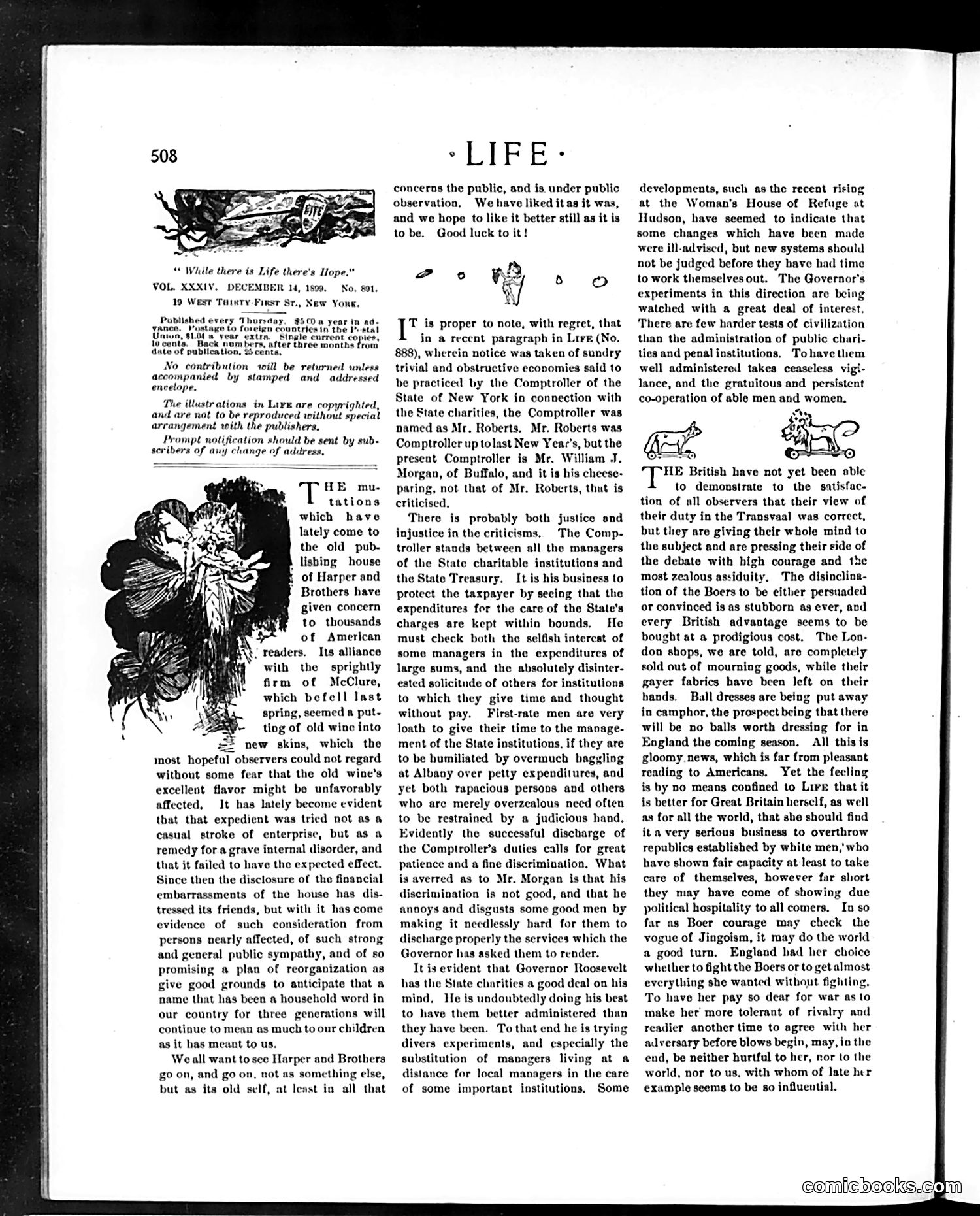
The page contains editorial commentary on New York State's charitable institutions administration, specifically criticizing Mr. Roberts (the previous Comptroller) for what the text describes as "sundry trivial and obstructive economies." The new Comptroller, William J. Morgan of Buffalo, is praised for his fairness in overseeing public charities. The left side features an illustrated floral vignette labeled "While there is Life there's Hope"—a decorative element typical of the era, not a political cartoon. The text argues that efficient charity administration requires balancing fiscal responsibility with humane treatment, and that the Comptroller's role is properly scrutinizing institutional expenditures to protect taxpayers while ensuring adequate care for the State's dependent populations.
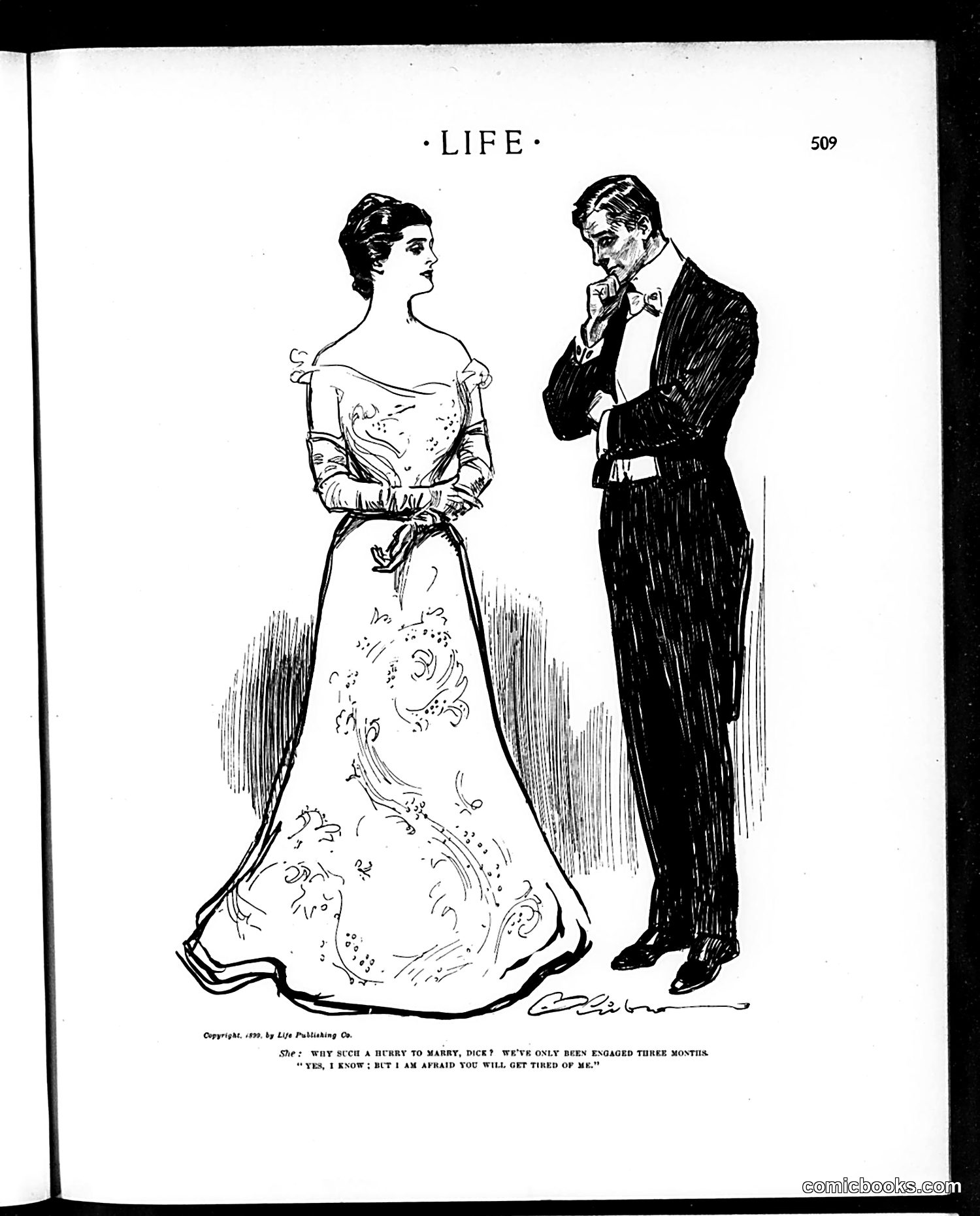
This is a satirical cartoon about marriage from *Life* magazine (copyright 1909, per the visible text). The illustration shows a well-dressed couple in formal evening wear having a conversation. The caption reads: "Why such a hurry to marry, Dick? We've only been engaged three months." The woman's response: "Yes, I know; but I am afraid you will get tired of me." **The satire:** This is social commentary on courtship and marriage expectations. The joke ironically reverses typical gender roles—usually men were portrayed as reluctant about commitment, but here the woman expresses insecurity about holding the man's interest. It mocks both the brief courtship period and the woman's anxiety that romantic enthusiasm will fade after marriage, reflecting early 20th-century attitudes about relationships and gender dynamics.
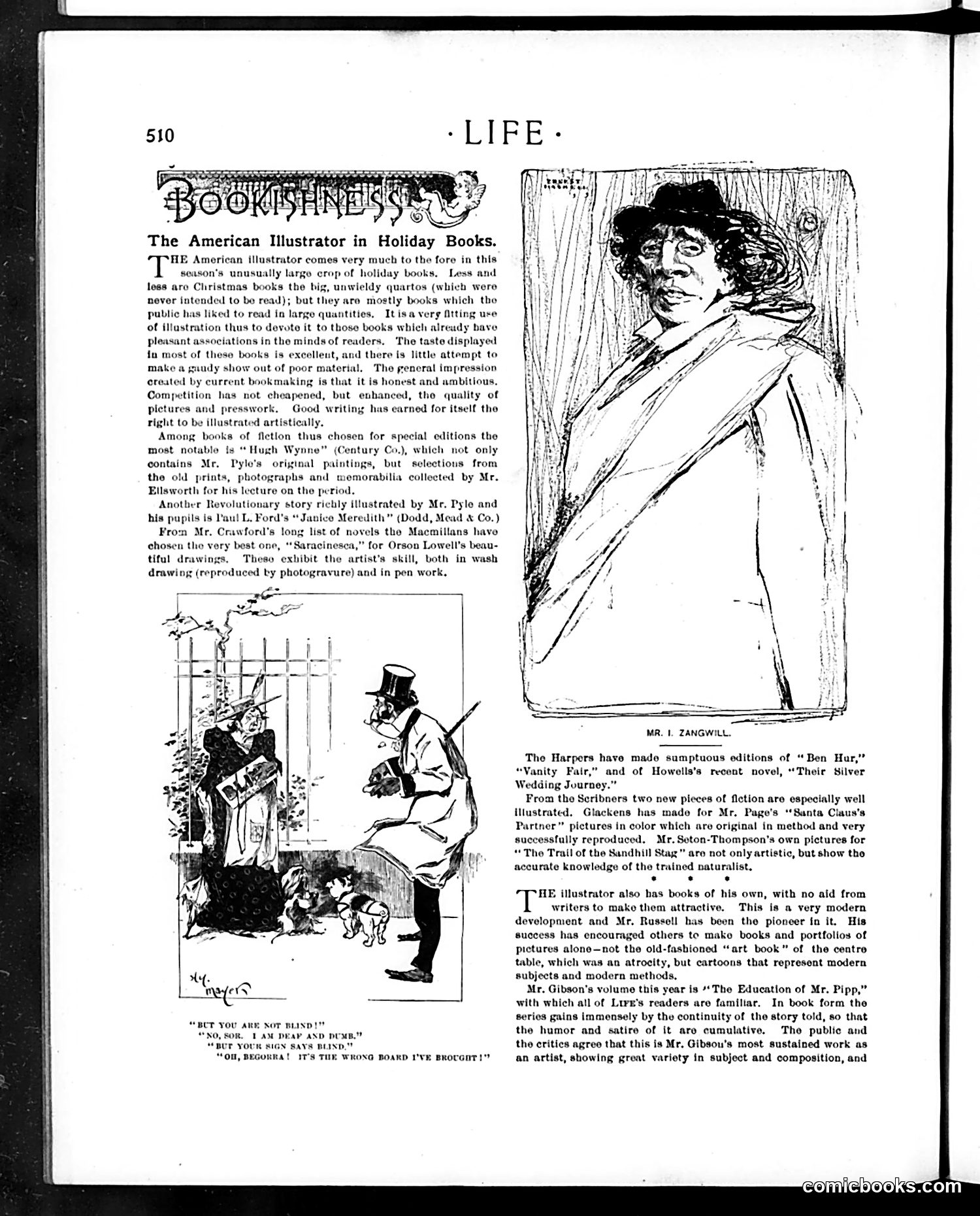
This page discusses American illustrators in holiday books rather than political cartoons. The main cartoon (bottom left) appears to be a humorous domestic scene showing two figures and a dog near a fence, with dialogue about blindness and "the wrong board." The specific satirical meaning is unclear without additional context, though it seems to mock someone's poor judgment or perception. The portrait labeled "MR. I. ZANGWILL" (right side) is a sketch of what appears to be a literary figure. The text praises various American illustrators and their work on fiction and holiday editions, highlighting artists like Pyle, Gibson, and others who contributed to book illustration during this period.
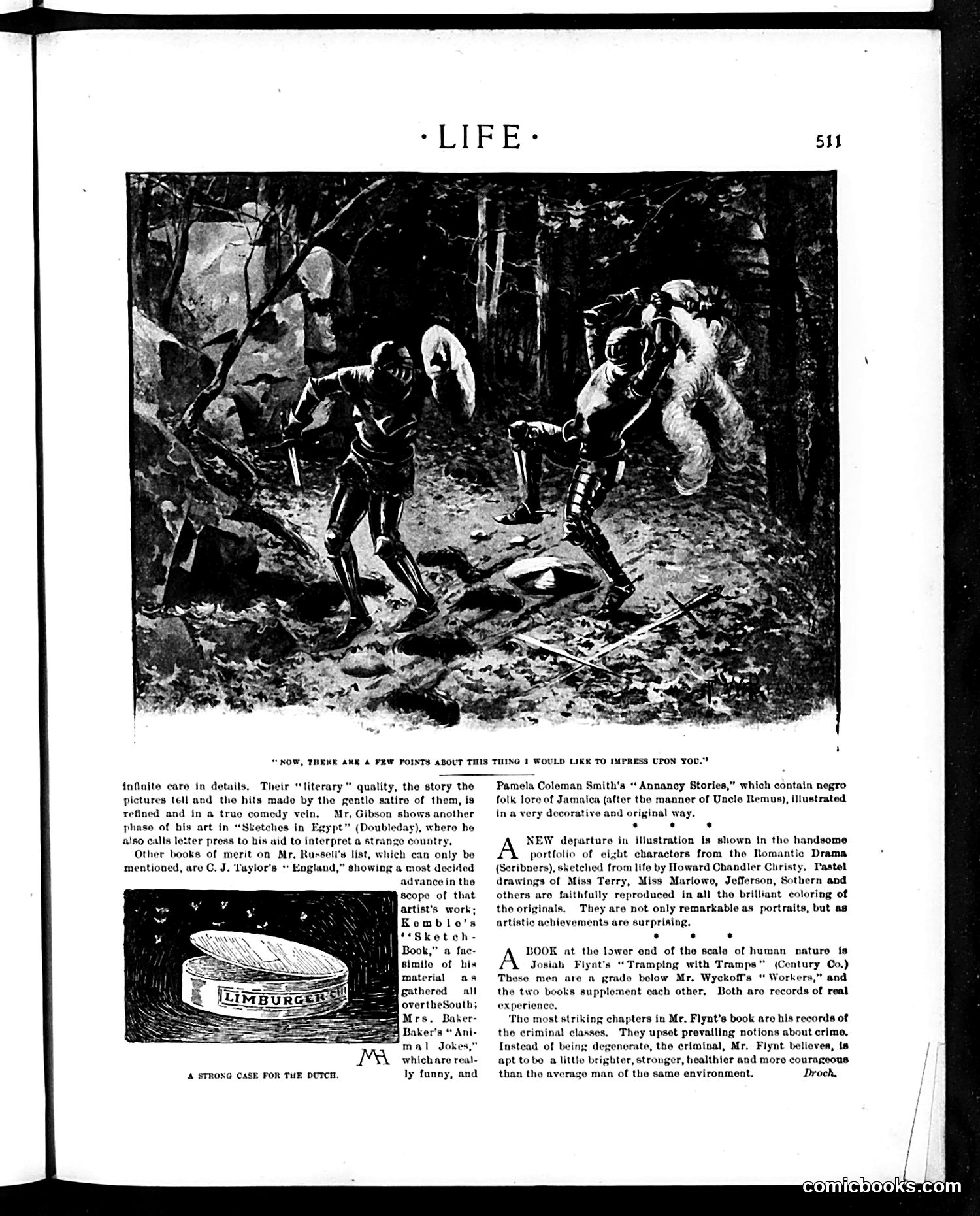
This page discusses book illustrations and literary adaptations. The main image shows what appears to be a theatrical or film scene with costumed figures in a forest setting, illustrating a story adaptation. The text praises Howard Chandler Christy's illustrations for characters from "Innocent Drama" (Scribners), noting they're "not only remarkable as portraits, but as artistic achievements are surprising." Below, there's discussion of Josiah Flynt's "Tramping with Tramps," compared favorably to Wyckoff's "Workers." The commentary suggests Flynt's criminal case studies portray criminals as "brighter, stronger, healthier and more courageous than the average man of the same environment"—suggesting a sociological perspective challenging stereotypes about criminality. The page primarily reviews illustrated books and their artistic merit rather than offering political satire.
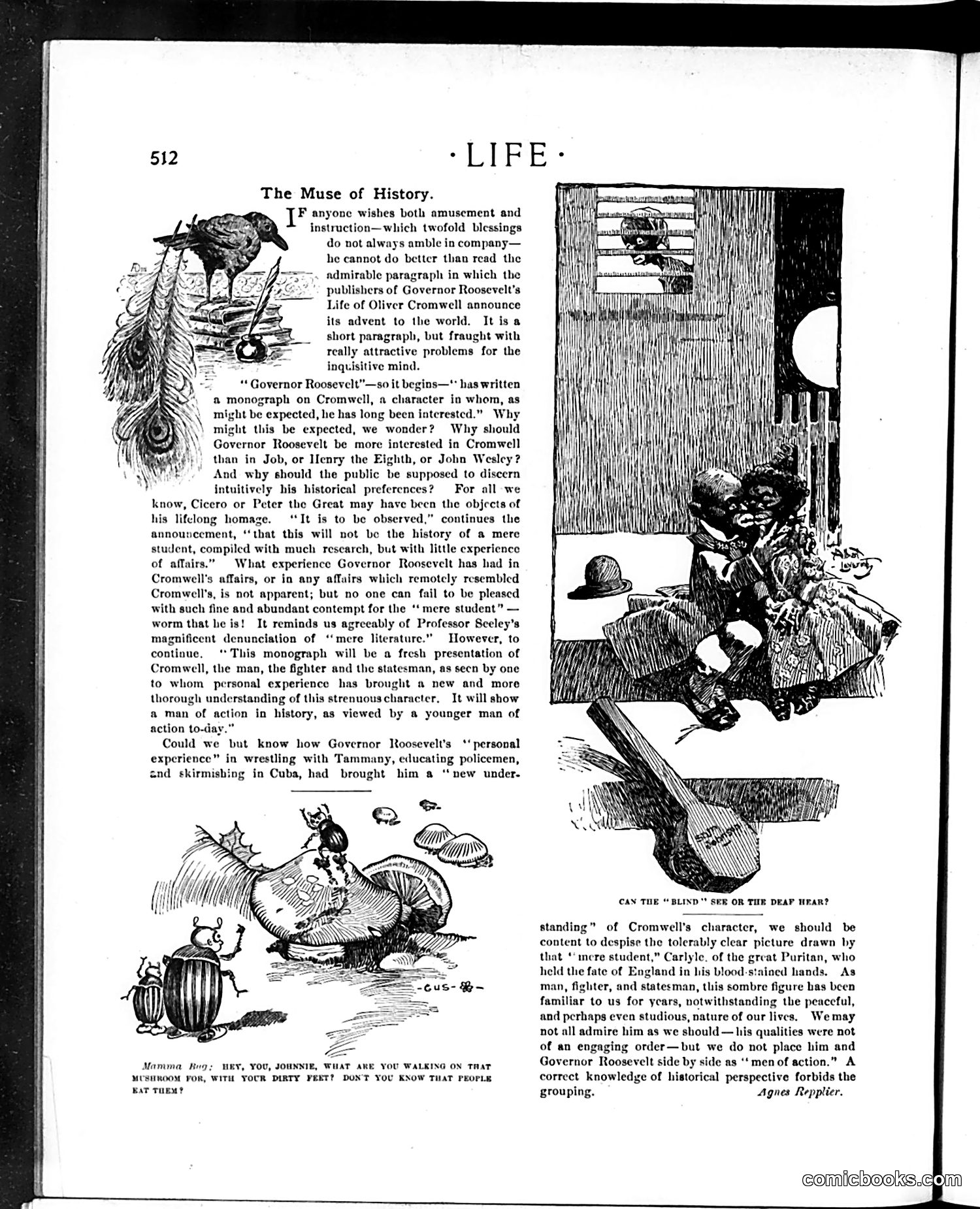
This page critiques Governor Roosevelt's planned monograph on Oliver Cromwell. The article questions why Roosevelt would write about Cromwell rather than figures like Job or John Wesley, suggesting his choice reflects questionable historical preferences. The cartoons mock Roosevelt's claim of "personal experience" informing his work. The lower illustration shows figures in what appears to be muddy or chaotic circumstances, captioned "Mamma Bug: Hey, you, Johnnie, what are you walking on that mushroom for, with your dirty feet? Don't you know that people eat those?"—a crude joke implying Roosevelt lacks the refined perspective needed for serious historical scholarship. The satire suggests Roosevelt's rough, action-oriented persona unfits him for scholarly work.
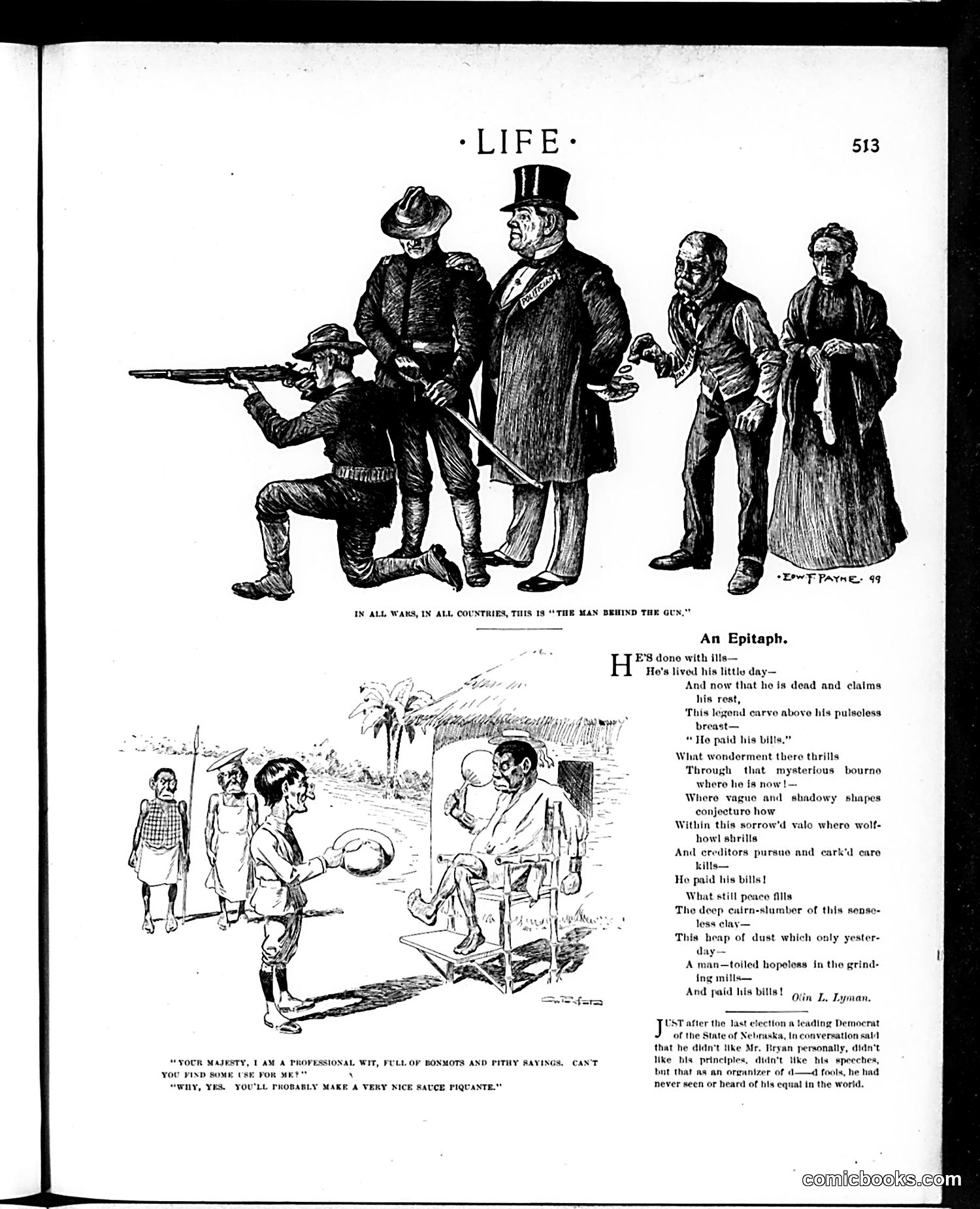
This page from *Life* magazine contains two satirical cartoons about war and politics. The **top cartoon** depicts "the man behind the gun"—showing a wealthy, top-hatted gentleman (likely representing political/military leadership or wealthy interests) directing a soldier firing a rifle, while other officials observe. The satire suggests that ordinary soldiers are mere tools of powerful elites who profit from war while avoiding danger themselves. The **bottom cartoon** appears to reference military recruitment or conscription, with the caption mentioning "professional soldiers" and "honors and pity." The dialogue about making "a very nice sauce piquante" suggests soldiers' lives are treated as expendable commodities by those in power. Both cartoons critique how war exploits ordinary people for elite interests—a common theme in *Life*'s anti-war and anti-establishment satire.
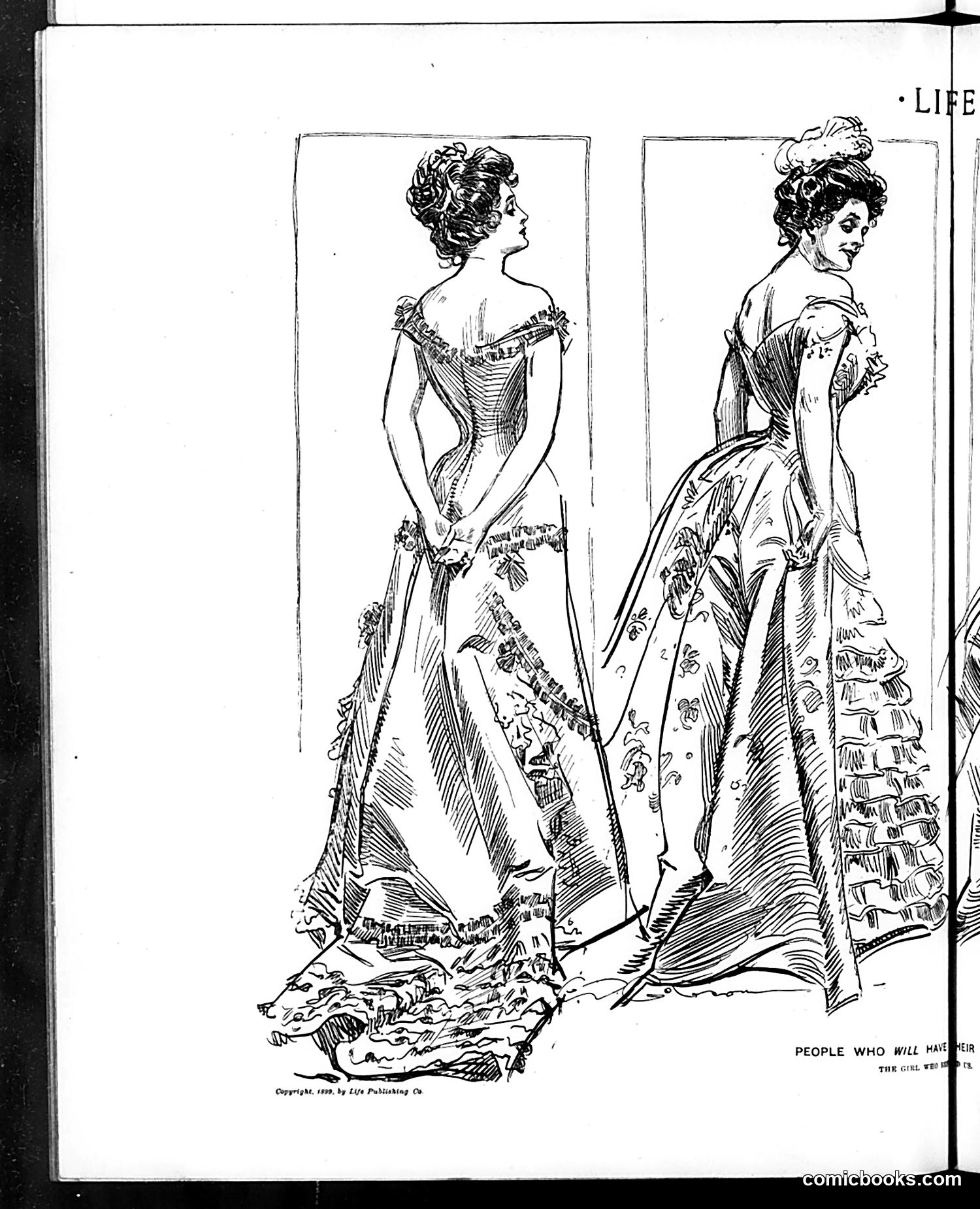
This page displays fashion illustration rather than political satire. It shows two women in elaborate Edwardian-era evening gowns, drawn in a detailed ink-sketch style. Both figures feature the period's characteristic Gibson Girl silhouette with upswept hair, corseted waists, and ornate embellishments. The left figure wears an off-shoulder gown with decorative elements on the skirt. The right figure displays a more elaborate train with intricate ruching or pleating details. Both garments feature the lavish, formal styling typical of wealthy women's attire from approximately the 1900s-1910s. The page header reads "LIFE" and includes text referencing "PEOPLE WHO WILL HAVE THEIR" and "THE GIRL YES-YES," though the complete caption is cut off, making the specific satirical intent unclear from visible text alone.
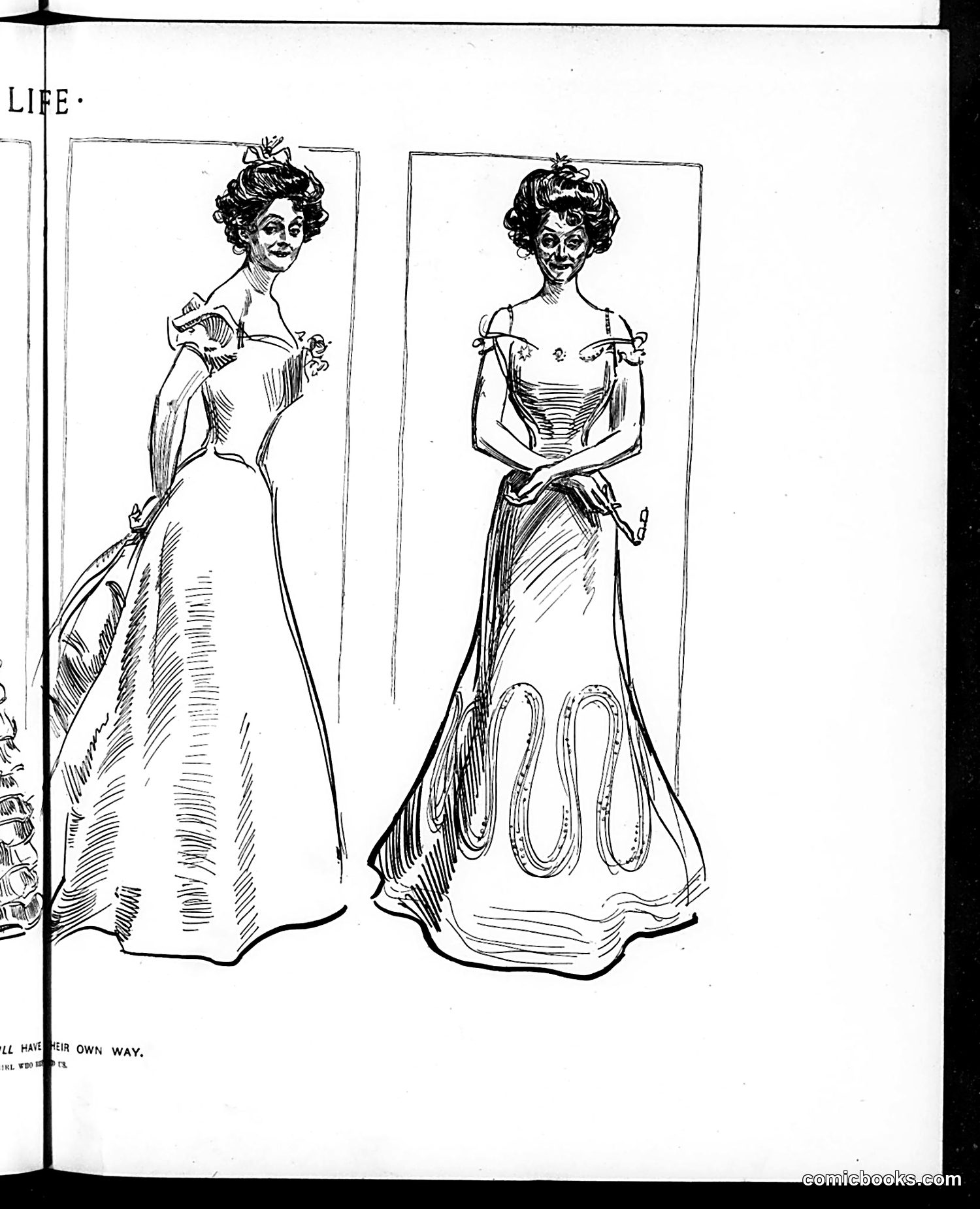
This page from *Life* magazine shows fashion illustrations of two elegantly dressed women in elaborate gowns, positioned under the heading "LIFE." The left figure holds playing cards and wears an ornate gown with dramatic draping. The right figure wears a corseted dress with decorative circular patterns on the skirt. The partial visible text at bottom appears to reference "their own way," suggesting this is satirical commentary on women's fashion or behavior. Given *Life*'s satirical nature, these illustrations likely mock contemporary women's fashion trends or social pretensions of the era—possibly critiquing the excessive ornamentation and impracticality of fashionable dress, or satirizing wealthy women's leisure activities. The specific social commentary remains unclear without the complete caption text.
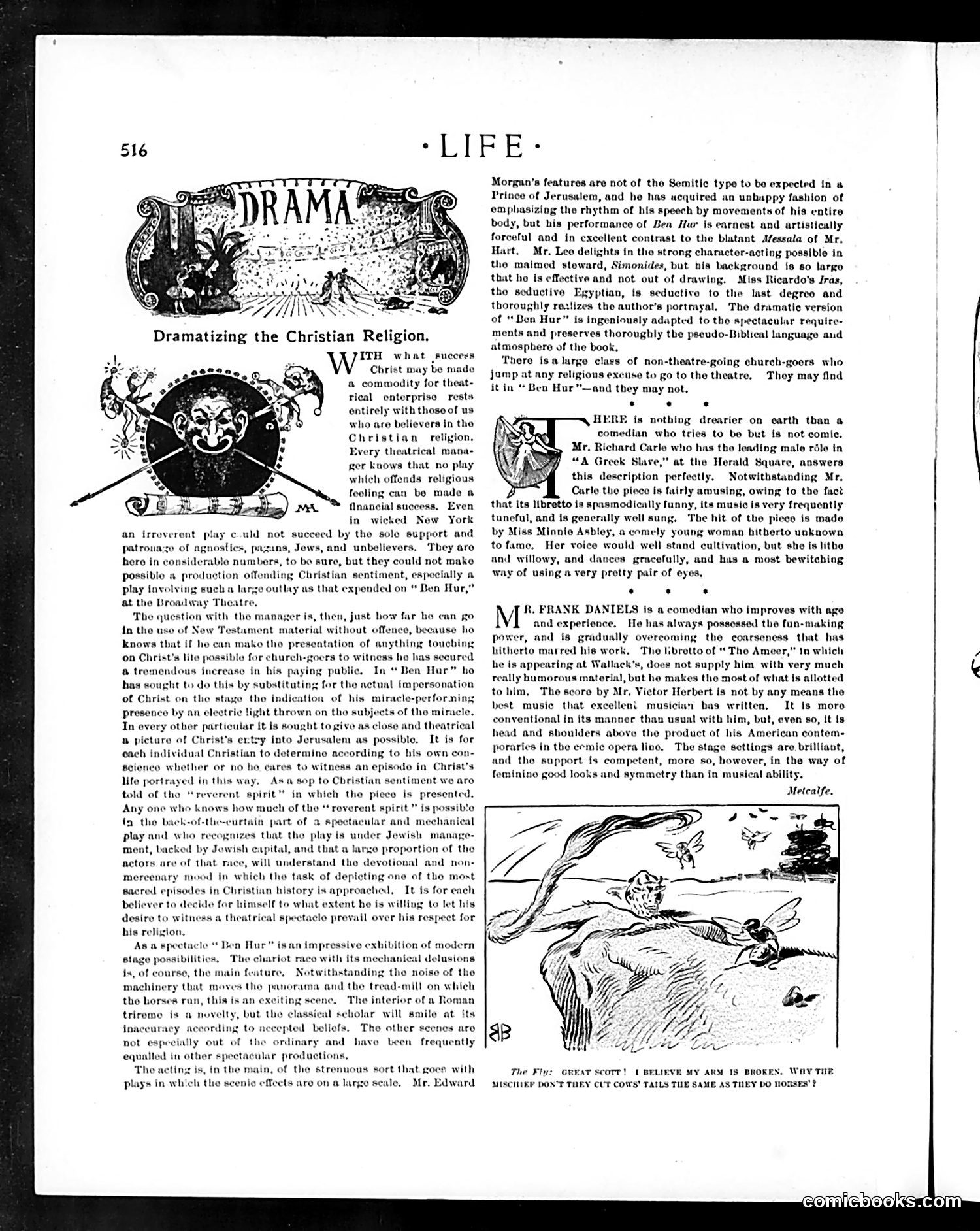
This page discusses theatrical dramatizations of Christian religious themes, particularly critiquing a play called "Ben Hur" on Broadway. The article argues that while religious sentiment can succeed in theater, managers must be cautious about how far they go in depicting Christ or sacred moments on stage. The accompanying illustration shows a reclining figure (likely representing a classical or biblical character) in a sketched landscape. The caption quotes "The Fitz" making a humorous comment about a cow's broken arm versus horse tails—apparently mocking the play's theatrical staging choices. The text praises various actors' performances while expressing concern that dramatizing religious content risks trivializing sacred subjects, even as spectacles like Ben Hur achieve commercial success.
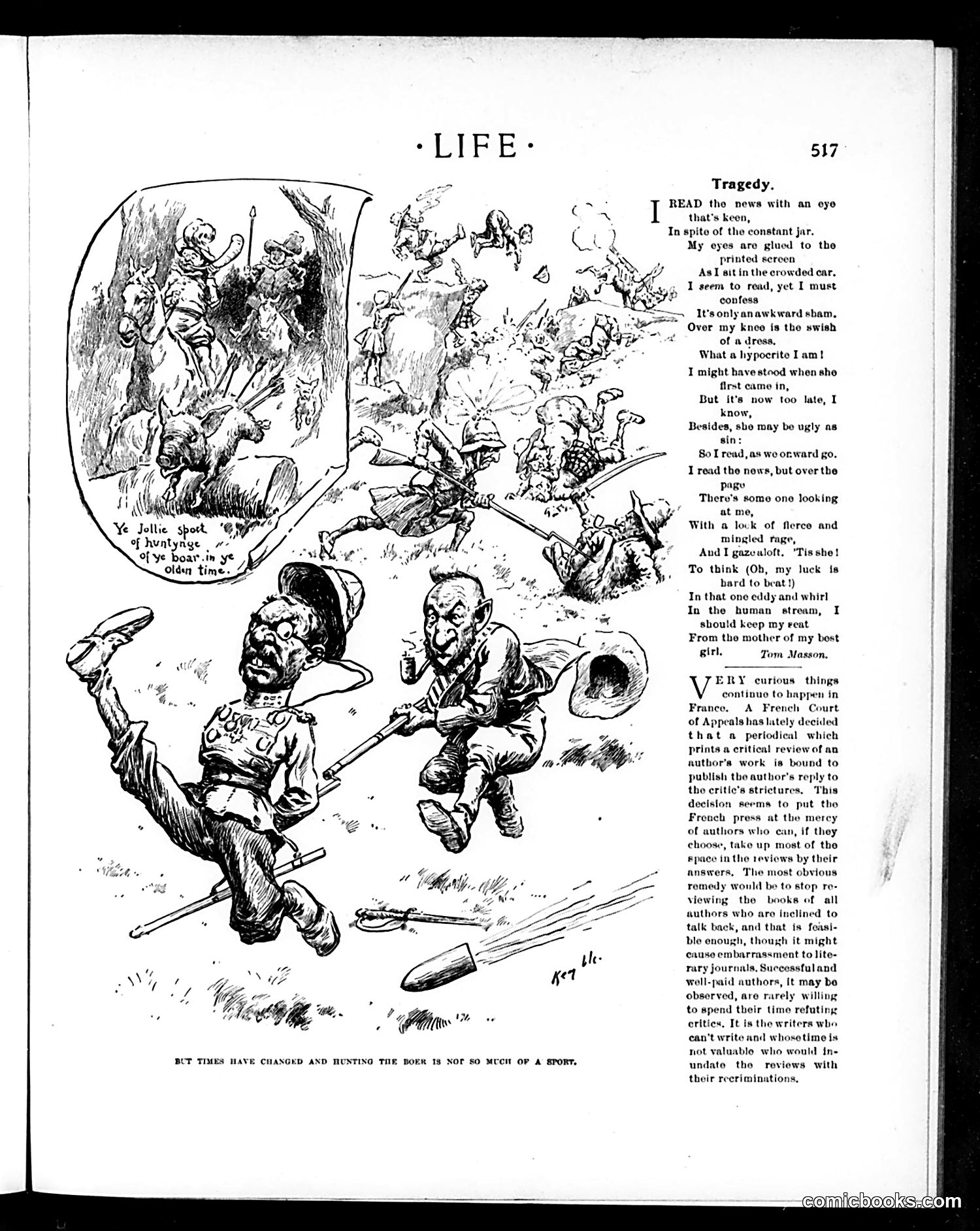
The left cartoon depicts a chaotic medieval hunting scene in a bubble, contrasted with two modern figures below engaged in slapstick combat. The caption "BUT TIMES HAVE CHANGED AND HUNTING THE BOER IS NOT SO MUCH OF A SPORT" references the Second Boer War (1899-1902), when British forces fought Dutch settlers in South Africa. The satire suggests that while nobles once hunted for sport and glory, modern warfare against the Boers has become messy, undignified, and unglamorous—no longer the romantic adventure depicted in historical imagery. The cartoonist mocks the contrast between idealized past conflicts and the brutal reality of contemporary colonial warfare. The right-side poem, "Tragedy," humorously depicts a modern commuter reading news in a crowded streetcar while avoiding eye contact with a woman—only to awkwardly discover she's his girlfriend's mother, creating social embarrassment.
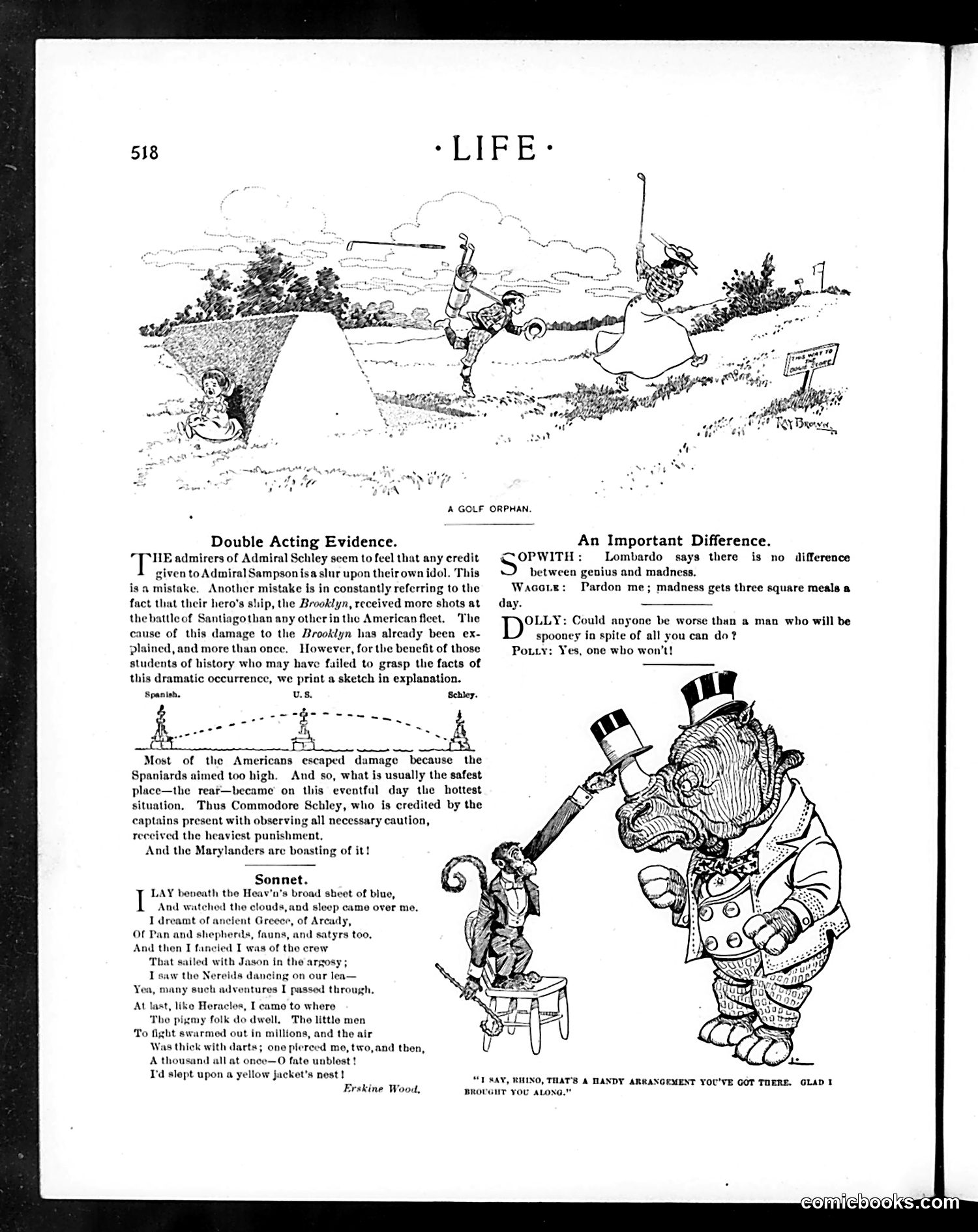
This page contains several unrelated satirical pieces typical of Life's format: **Top cartoon ("A Golf Orphan"):** Shows a small child abandoned on a golf course—a visual pun suggesting golf's popularity has made children neglected "orphans" while parents pursue the sport. **"Double Acting Evidence":** Debates credit for the Spanish-American War naval victory at Santiago between Admiral Schley and Admiral Sampson. The sketch explains why the Brooklyn received more damage: Spanish gunners aimed high, making the rear (normally safest) the hottest position. The satire mocks Schley's admirers for crediting him while dismissing Sampson's role, and jokes that Maryland soldiers boast about their ship's punishment as if it were an achievement. **"An Important Difference":** A brief joke distinguishing genius from madness—the latter gets three meals daily (implying institutionalization). **"Sonnet":** A humorous poem about classical dreams ending when the narrator falls asleep on a yellow jacket's nest, combining epic pretension with slapstick reality. **Bottom cartoon:** A rhinoceros and companion, likely another standalone joke about usefulness.
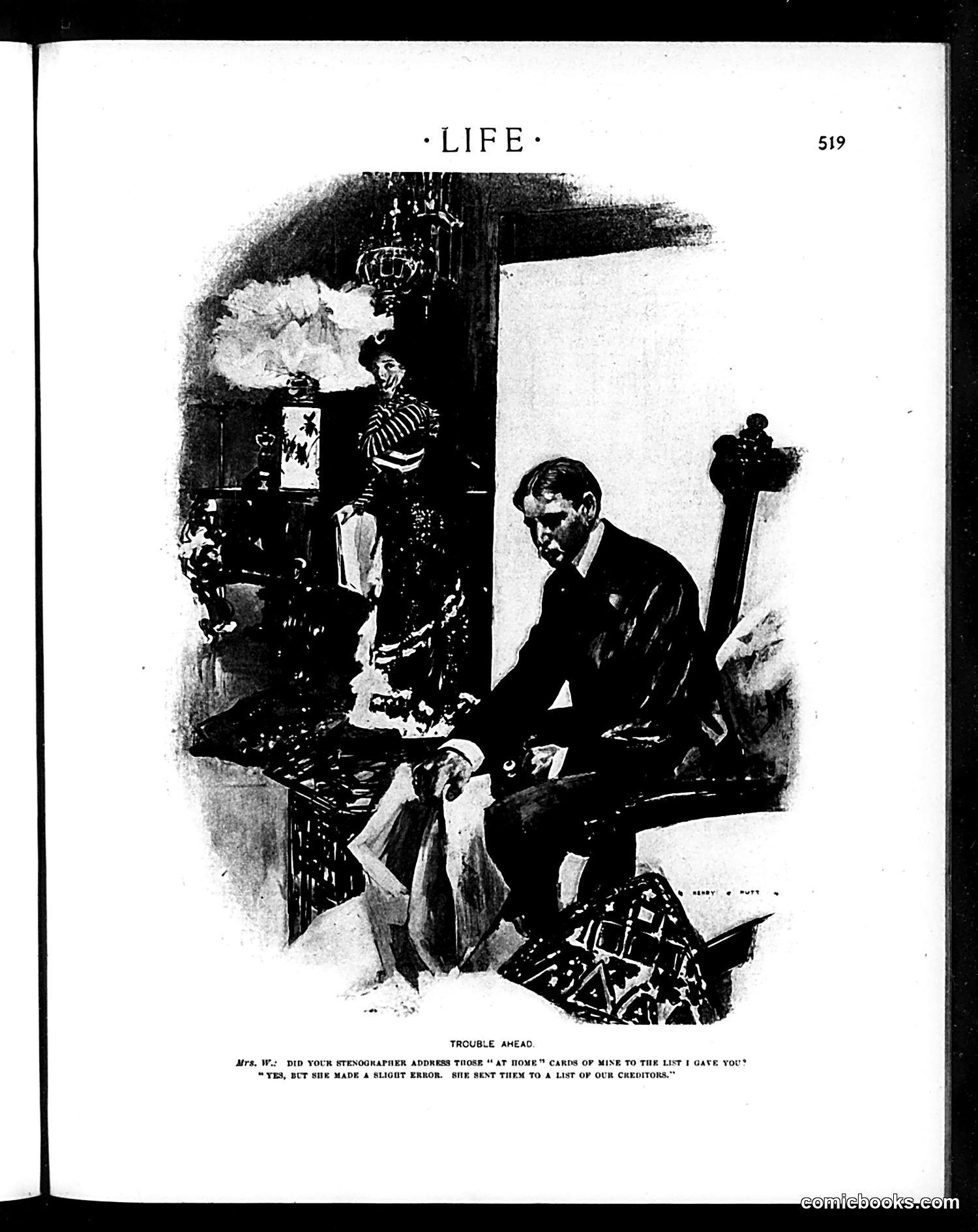
This cartoon depicts a businessman confronting his stenographer about a clerical error. He had instructed her to send "at home" cards (social invitation cards) to a specific guest list, but she mistakenly sent them to the company's creditors instead. The humor relies on the embarrassment this would cause: inviting people you owe money to your home party is socially mortifying and potentially awkward. The cartoon satirizes both the incompetence of office staff and the broader anxiety about financial obligations during what appears to be an economically uncertain period (likely early 20th century, given Life's era and the formal business setting depicted). The joke plays on the gap between professional pretense and financial reality.
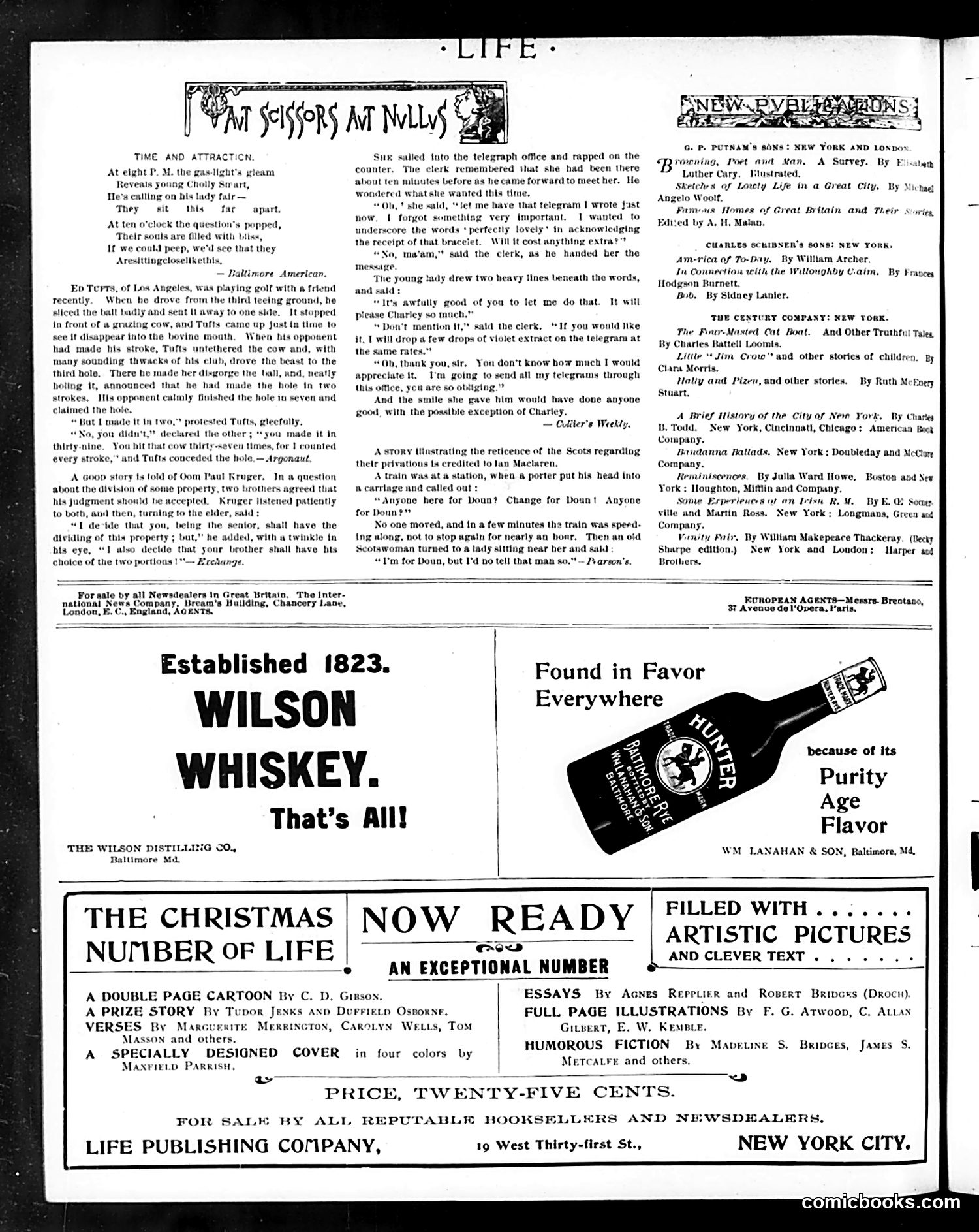
This page is primarily **advertising and book announcements** with several short humorous anecdotes scattered throughout. The main illustrated content appears to be a series of **comedic vignettes about courtship and social situations**: 1. "Time and Attraction" depicts a young couple's progressive closeness during an evening visit—a gentle satire on Victorian courtship propriety and changing physical distances as the night progresses. 2. Other brief stories mock pretension and social awkwardness: a woman obsessing over telegram punctuation, a golfer's absurd claim about hitting a cow instead of a golf ball, and Scottish reticence about personal matters. The satire is **light and domestic**, targeting everyday social conventions rather than politics. The humor relies on exaggeration of minor social anxieties—proper etiquette, competitive boasting, emotional restraint—reflecting upper-middle-class concerns of the era. The page concludes with advertisements for Wilson Whiskey and the Christmas issue of *Life* itself, priced at twenty-five cents.
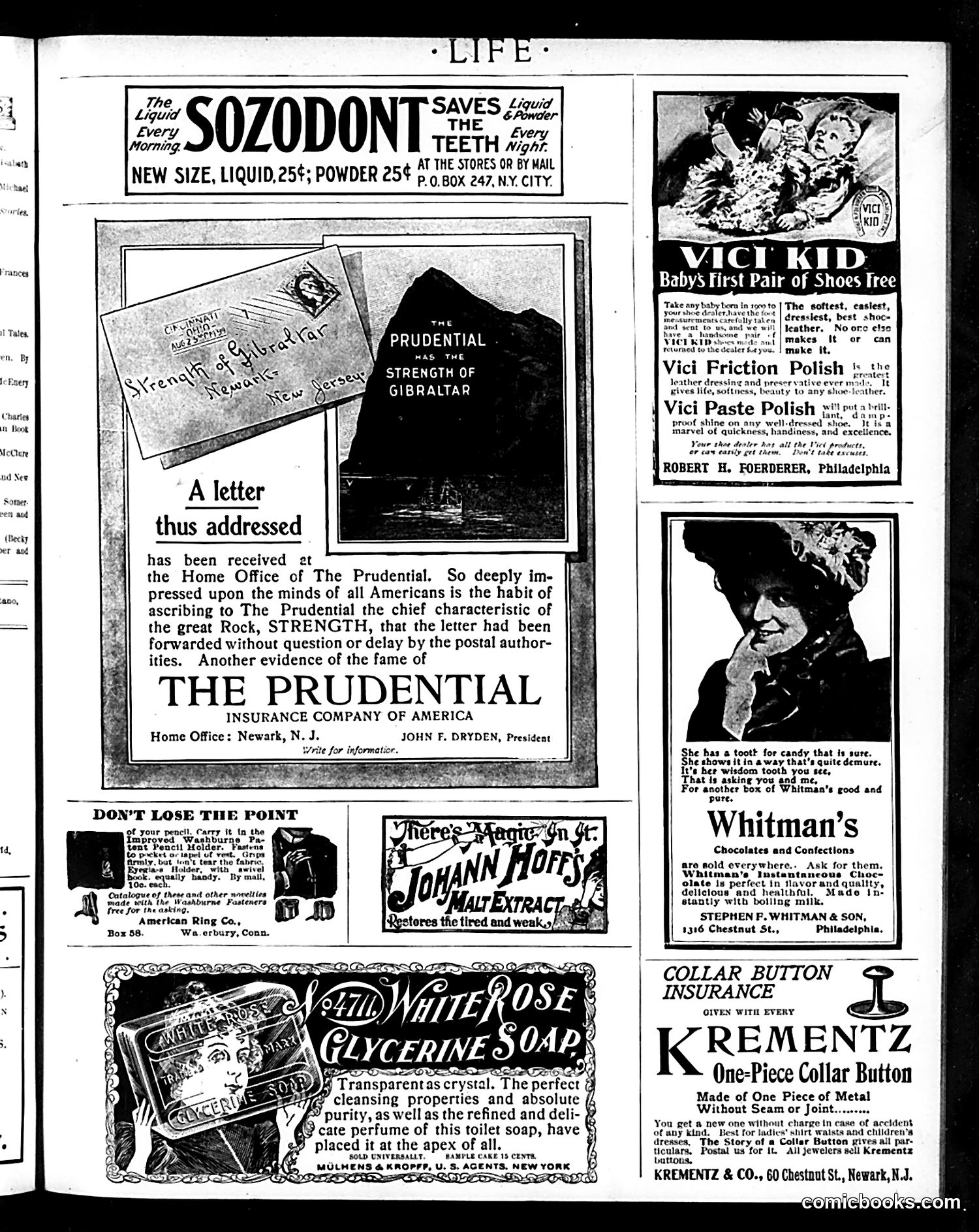
This page is primarily **advertising**, not political satire. However, the main content—a Prudential Insurance advertisement—uses a clever conceit worth explaining for modern readers. The ad depicts a letter addressed simply to "The Prudential" at Gibraltar, yet it was delivered successfully to Prudential's Home Office in Newark, New Jersey. The joke plays on the insurance company's famous slogan associating itself with **"the strength of Gibraltar"** (the Rock of Gibraltar, a symbol of immovable strength). The satire is gentle: Americans have so thoroughly internalized Prudential's brand identity with Gibraltar that postal workers automatically forwarded the misdirected letter without question—as if "The Prudential" were as universally recognized and stable as the actual Rock of Gibraltar. It's meta-advertising: the ad itself becomes evidence of the brand's cultural dominance. The surrounding ads (Sozodont toothpaste, Whitman's chocolates, shoe polish) are period product advertisements with no satirical content.
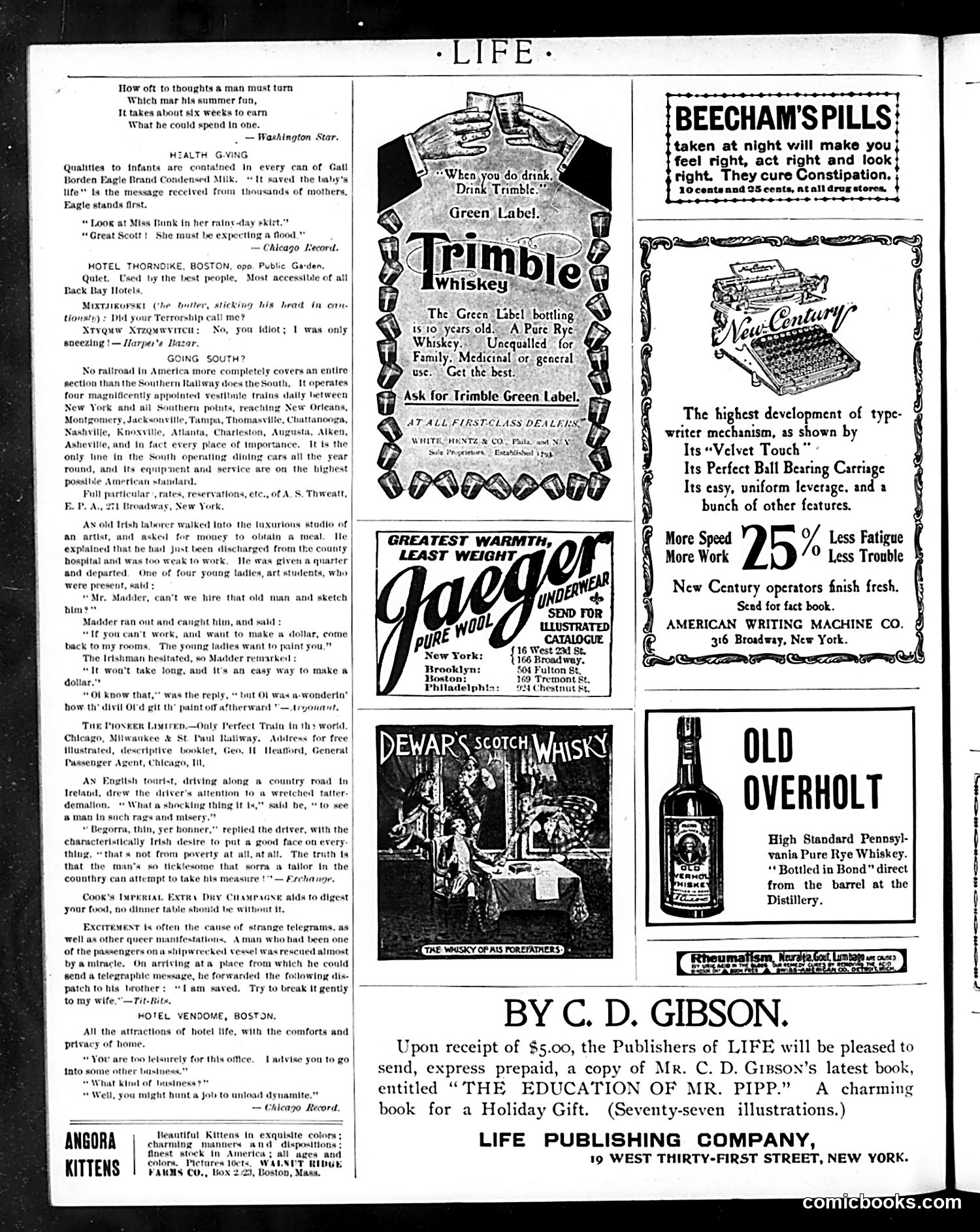
This page is primarily **advertising with some light humor pieces**, typical of early 1900s Life magazine format. The main content consists of brief anecdotes and jokes interspersed with product advertisements. Notable humor includes: - An Irish laborer story playing on ethnic stereotypes (the "stage Irishman" was a common caricature of the era) - A taxi driver's quip about a poorly-dressed man, where the punchline relies on the driver's exaggerated Irish brogue and class commentary - A shipwreck survivor's darkly comic telegram **The advertisements reveal period assumptions**: Beecham's Pills for constipation, Trimble Whiskey marketed for "medicinal" use (common during this pre-Prohibition era), and Old Overholt whiskey all appear prominently. The New Century typewriter emphasizes modern technology. There are **no political cartoons** on this page—Life here functions as a humor and advertising vehicle rather than political satire. The jokes rely on then-familiar stereotypes (Irish workers, class distinctions) that were standard entertainment conventions of the time.
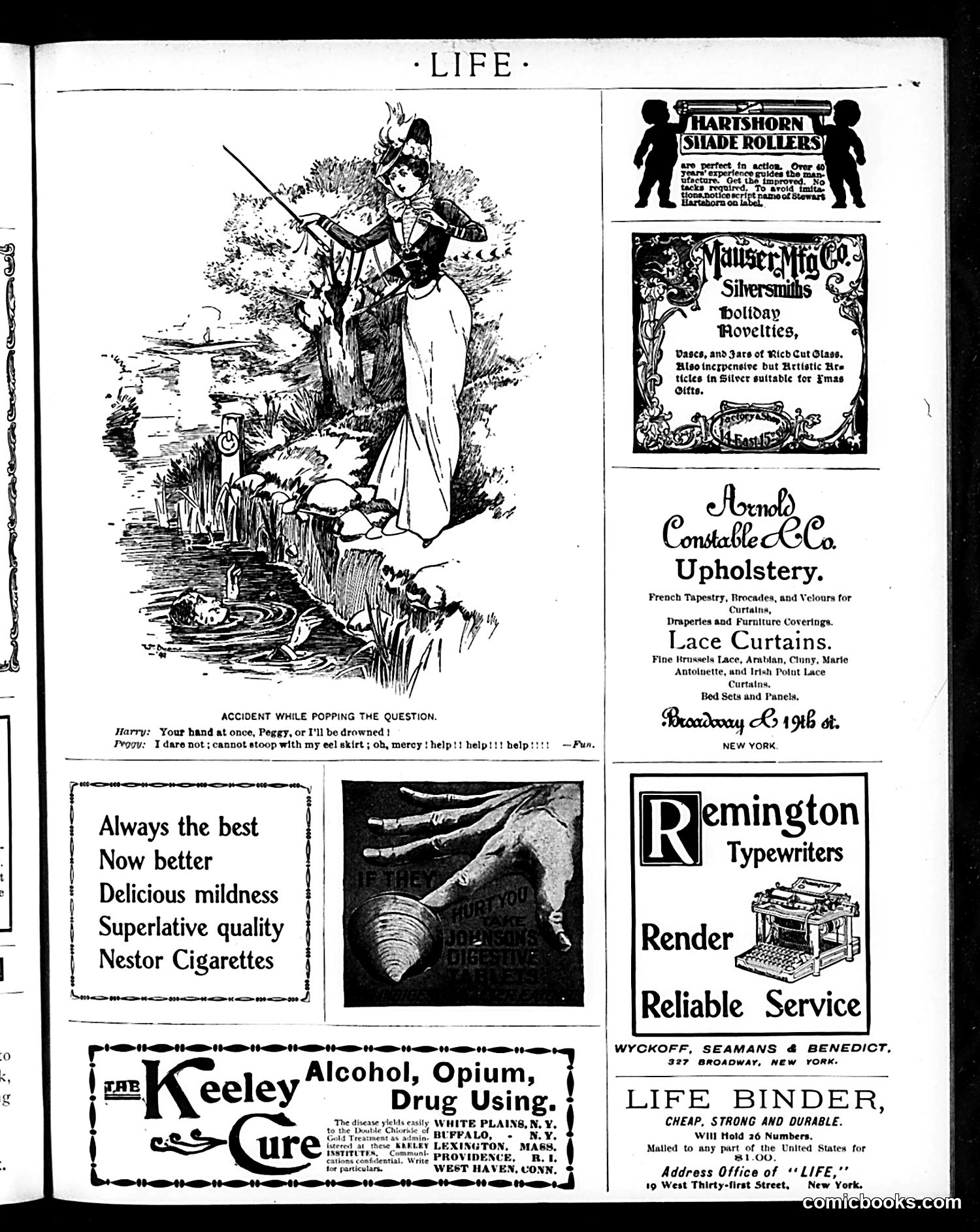
This cartoon satirizes the fashion constraints of early 1900s women's clothing. A man proposes to his girlfriend "Peggy" while they're near water, but she cannot help him because her restrictive "eel skirt" (a fitted, tubular skirt style) prevents her from bending or moving freely. She cries for help as he faces drowning, unable to assist due to her garment's design. The joke mocks both the impracticality of women's fashionable dress—which literally endangered wearers—and the gender dynamics where a woman's appearance took priority over her ability to help in emergencies. It's social commentary on how fashion victimized women by severely limiting their mobility and agency, presented here as absurdly humorous tragedy. The page is primarily advertisements for period products (cigarettes, typewriters, upholstery services).
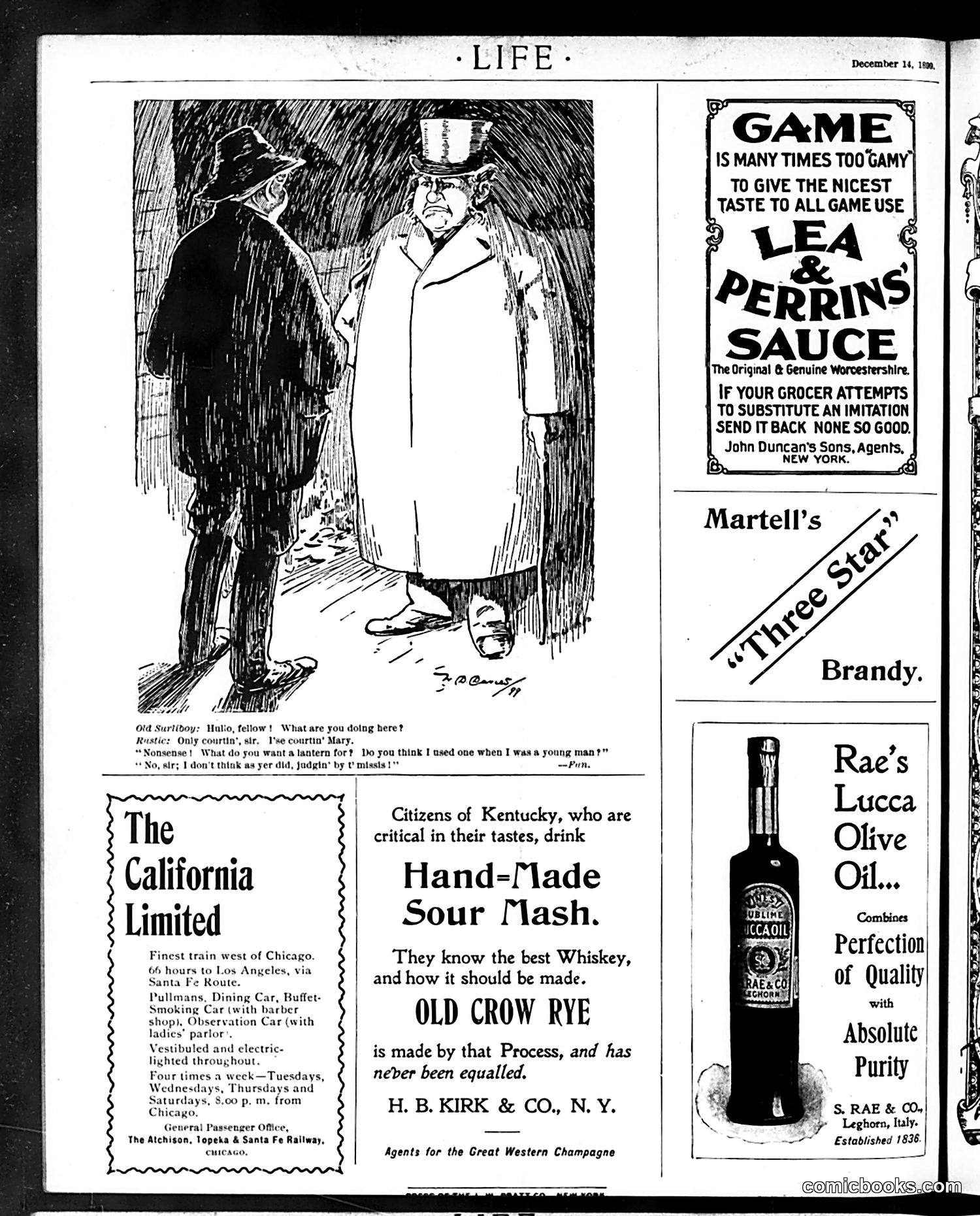
This page is primarily **advertising**, with one small cartoon at top. The cartoon depicts an **old man confronting a young suitor courting a woman named Mary**. The suitor carries a lantern; the old man dismisses it as unnecessary, claiming he never needed one when courting. The suitor's reply—"I don't think as yer did, Judgin' by t' missls"—suggests the old man's past conquests were questionable or improper (the term implies indiscretion). The joke relies on **generational mockery**: the older man is embarrassed by the implication that his courting lacked propriety, while the younger generation practices more cautious, respectable courtship. The remainder of the page consists of period advertisements for luxury goods: **Lea & Perrins sauce, train service, whiskey, brandy, and olive oil**—targeting affluent readers. These ads reflect early-20th-century consumer culture and class distinctions.