
Life, 1899-12-14 · page 12 of 20
Life — December 14, 1899 — page 12: what you’re looking at
What you’re looking at
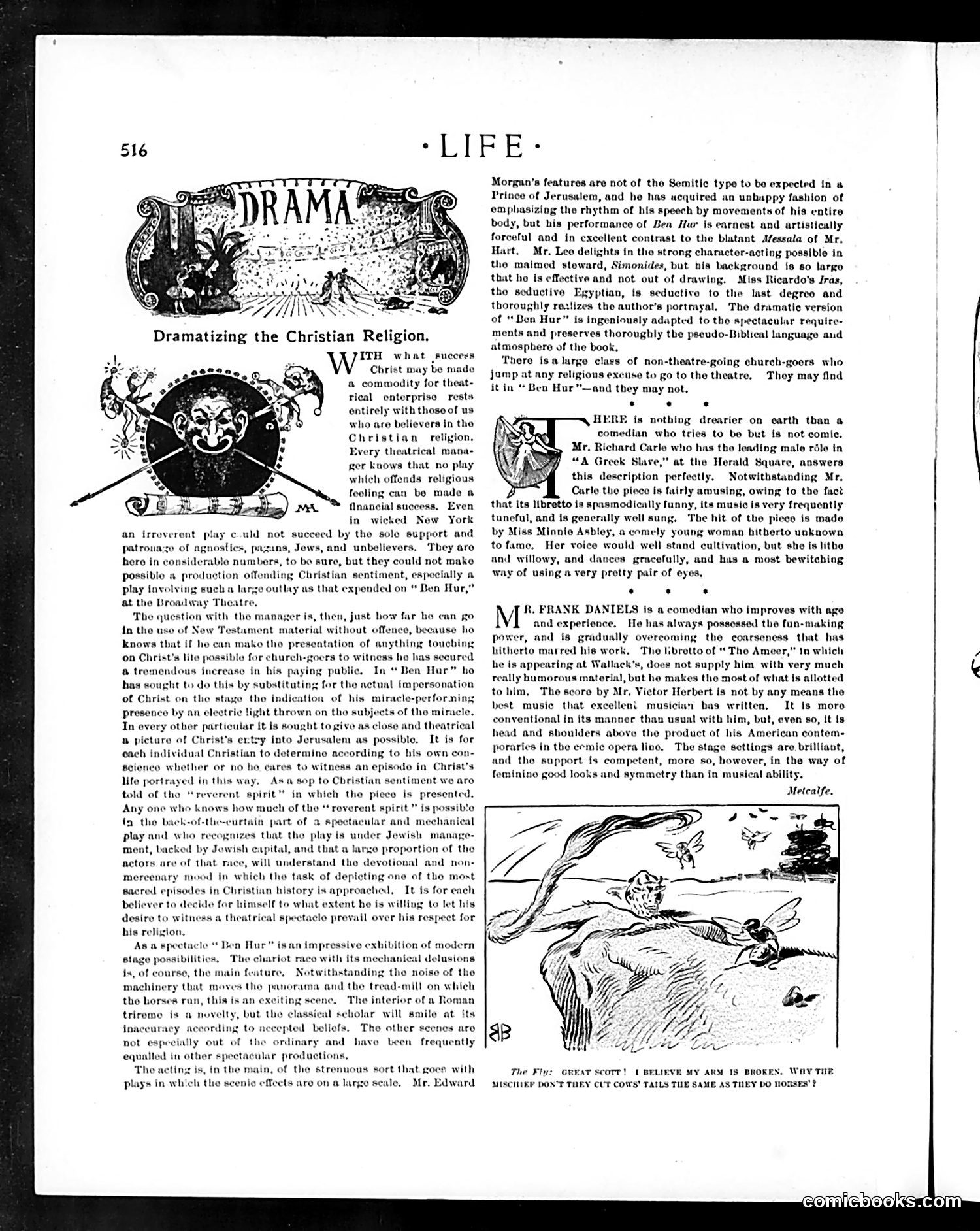
This page discusses theatrical dramatizations of Christian religious themes, particularly critiquing a play called "Ben Hur" on Broadway. The article argues that while religious sentiment can succeed in theater, managers must be cautious about how far they go in depicting Christ or sacred moments on stage. The accompanying illustration shows a reclining figure (likely representing a classical or biblical character) in a sketched landscape. The caption quotes "The Fitz" making a humorous comment about a cow's broken arm versus horse tails—apparently mocking the play's theatrical staging choices. The text praises various actors' performances while expressing concern that dramatizing religious content risks trivializing sacred subjects, even as spectacles like Ben Hur achieve commercial success.
📄 Transcribed text from this page (OCR, searchable)
Machine-transcribed from the original scan — historical spelling and the odd misread are preserved.
Dramatizing the Christian Religion. ITH what success Christ may be mado & commodity for theat- rical_ onterpriso rests entirely with thoso of us who are believers in the Christian religion, Every theatrical mana- ger knows that no play which offends religious fecling can be made a Mnancial success. Even in wicked New York an irreverent play c-uld not succeed by the sole support and patronaze of agnostics, pagans, Jews, and unbelievers. They aro hero in considerable numbers, to be sure, but they could not make possible a production offending Christian sentiment, especially a play favolving such a largo outlay as that expended on “ Ben Hur, at the Broadway Theatre. The question with tho manager is, then, just bow far bo can go in the use of New Testament material without offence, because I knows that if he can make tho presentation of anything touchi on Christ's lite possible for church-gocrs to witness ho has secu: ‘f tromendous increaso in his paying public. In“ Ben Hue” ho has sought to do this by substituting for the actual impersonation of Christ on the stage the indication of his miracle-perforning presenco by an electric light thrown on tho subjects of the miracle, In every other particular it is sought to give as close and theatrical & picture of Christ's extry Into Jerusalem as possible. It is for each individual Christian to determine according to his own con- scionco whether or no ho cares to witness an episode in Christ's Lin this way, Asa sop to Christian sentiment we aro oe nt spirit” in which the piece is presented. knows how much of the “reverent spirit” is possibio ek-of-the-curtain part of a spectacular and mechanical 1 who nizes that the play is under Jewish manage- acked by Jowish capital, and that a large proportion of the v of that mee, will understand the devotional and non- nood in which the task of depicting one of the most sacred episodes in Christian history is approached, It {s for each believer to decide for himself to what extent he is willing to let his desiro to witness a theatrical spectacle prevail over his respect for his religion. As a spectacle * stage possibilities ia, of course, the main feature, machinery that moves tho pu the horses run, this is an exe trireme is a novelty, but the ¢ life portray told of tho Any one w fa tho ti play i ment, actors 0 mereenar Ben Hur” isan impressive exhibition of modern The chariot race with its mechanteal delusions Notwithstanding the noise of the rama and the tread-mill on which ing seene, The interior of a Roman sical scholar will smile at its pted beliefs, Tho other scenes aro not especially out of the ordinary and have Leen frequently other spectacular productions, is, in the main, of the strenuous sort that goes with Mr. Edward inaceu cording to nee ney a equalled i ‘The actin plays in which the scenic effects are on a large scale, » LIFE « Morgan's features are not of the Semitic type to be expected In a Prince of Jerusalem, and he has acquired an unbappy fashion of emphasizing the rhythm of his speech by movements of his entire body, but bis performance of Ben Hur is earnest and artistically forceful and in excellent contrast to the blatant Afessala of Mr. Hart. Mr. Leo delights in tho strong character-acting possible in tho maimed steward, Simonides, but bis background is so largo that ho is effective and not out of drawing. Miss Ricardo’s Jras, tho seductive Egyptian, 1s seductive to the last degree and thoroughly rextizes the author's portrayal, The dramatic version of “Ben Hur” is ingeniously adapted to the spectacular require- ments and preserves thoroughly the pseudo-Biblical language aud atmosphero of the book. Thero isalarge class of non-theatre-going church-goors who jump at any religious excuse to go to the theatre. They may find it in * Ben Hur”"—and they may not, . ° . HERE is nothing drearier on earth than a comedian who tries to be but is not comic. Mr. Richard Carle who has the leading male réle in “A Greek Slave,” at the Herald Square, answers this description perfectly. Notwithstanding Mr. 3 Carle the piece Is fairly amusing, owing to the fact that its Ibretto is spasmodically funny, its music is very frequently tuneful, and {s generally well sung. The hit of the piece is made by Miss Minnie Asbley, a comely young woman hitherto unknown tofame. Her voice would well stand cultivation, but sho is litho and willowy, and dances gracefully, and has a most bewitching way of using a very protty pair of eyes, R. FRANK DANIELS is a comedian who improves with ago and experionce. Ho has always possessed the fun-making power, and is gradually overcoming tho coarseness that has hitherto marred his work, The libretto of * Tho Ameer,” In which he is appearing at Wallack’s, does not supply him with very much really humorous material, bat he makes the most of what is allotted to him, The scoro by Mr. Victor Herbert is not by any means tho Dest music that excellent musician bas written. It {8 moro conventional in its manner than usual with him, but, even so, it {s head and shoulders above tho product of his American contem- poraries in the cemic opera lino, The stago settings aro. brilliant, and tho support Is competent, moro so, howover, in the way of feminine good looks and symmetry than in musical ability. Metcalfe, I BELIEVE MY ARM 18 BROKEN. Way THE MISCHIEY DON'T THEY CUT COWS' TAILS TUE SAME AS THEY DO ORSES'? The Flu: GR¥AT scott!