
Life, 1899-12-14 · page 8 of 20
Life — December 14, 1899 — page 8: what you’re looking at
What you’re looking at
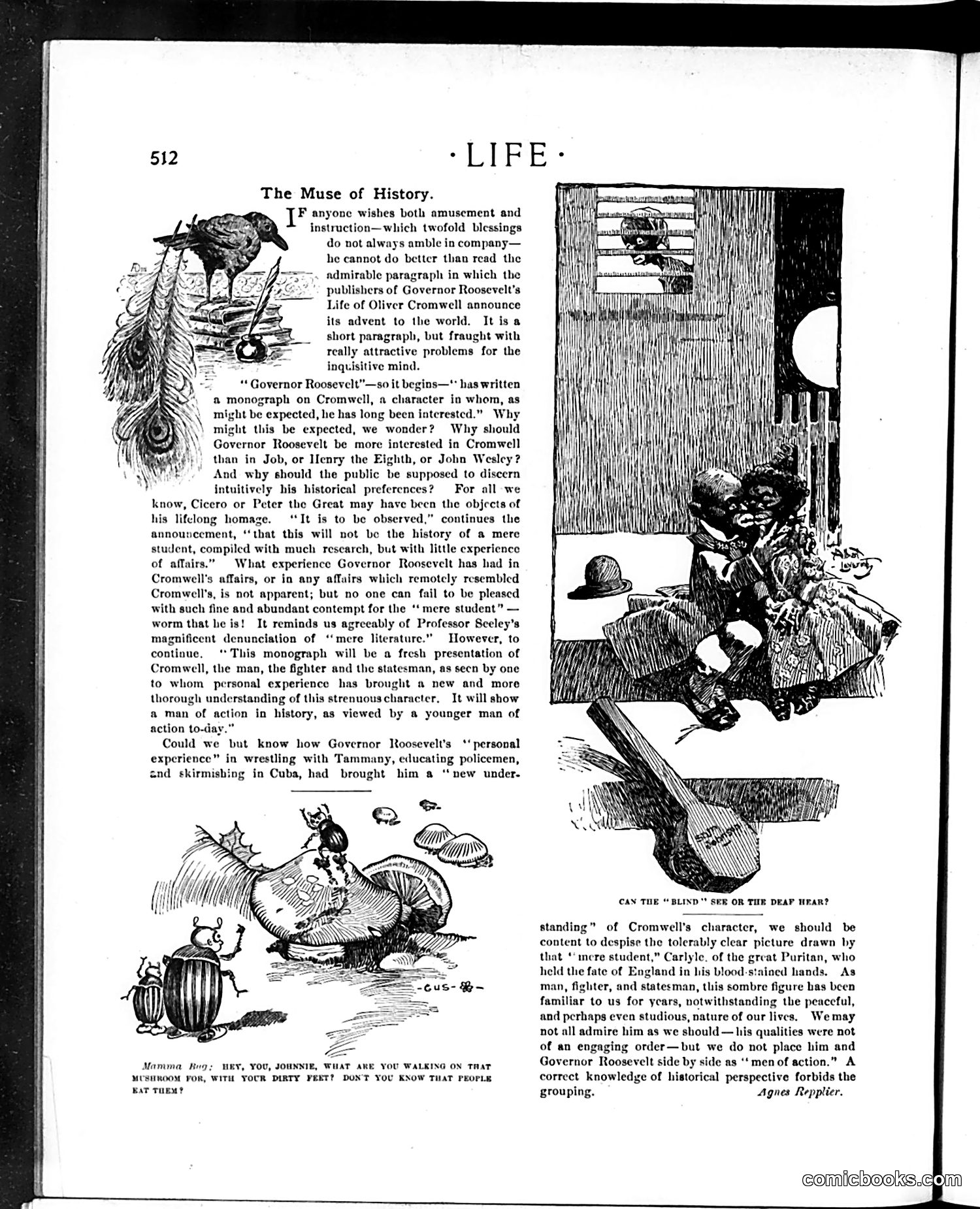
This page critiques Governor Roosevelt's planned monograph on Oliver Cromwell. The article questions why Roosevelt would write about Cromwell rather than figures like Job or John Wesley, suggesting his choice reflects questionable historical preferences. The cartoons mock Roosevelt's claim of "personal experience" informing his work. The lower illustration shows figures in what appears to be muddy or chaotic circumstances, captioned "Mamma Bug: Hey, you, Johnnie, what are you walking on that mushroom for, with your dirty feet? Don't you know that people eat those?"—a crude joke implying Roosevelt lacks the refined perspective needed for serious historical scholarship. The satire suggests Roosevelt's rough, action-oriented persona unfits him for scholarly work.
📄 Transcribed text from this page (OCR, searchable)
Machine-transcribed from the original scan — historical spelling and the odd misread are preserved.
«LIFE - The Muse of History. IF anyone wishes both amusement and instruction—which twofold blessings do not always amble in company— he cannot do better than read the admirable paragraph in which the publishers of Governor Roosevelt's Life of Oliver Cromwell announce its advent to the world, It is a short paragraph, but fraught with really attractive problems for the : inquisitive mind. - “ Governor Roosevelt”—so it begins—"* has written a monograph on Cromwell, a character in whom, as might be expected, he has long been interested.” Why might this be expected, we wonder? Why should Governor Roosevelt be more interested in Cromwell than in Job, or Henry the Eighth, or John Wesley? And why should the public be supposed to discern intuitively his historical preferences? For all we know, Cicero or Peter the Great may have been the objects of his lifelong homage. “It is to be observed,” continues the announcement, ‘that this will not be the history of a mere student, compiled with much research, but with little experience of affairs.” What experience Governor Roosevelt has had in Cromwell's affairs, or in any affairs which remotely resembled Cromwell's, is not apparent; but no one can fail to be pleased with such fine and abundant contempt for the ‘‘ mere student” worm that he is! It reminds us agreeably of Professor Sceley’s magnificent denunciation of ‘mere literature.” However, to continue, ‘This monograph will be a fresh presentation of Cromwell, the man, the fighter and the statesman, as secn by one to whom personal experience has brought a new and more thorough understanding of this strenuous character, It will show a man of action in history, as viewed by a younger man of action to-day.” Could we but know how Governor Roosevelt’s ‘personal experience” in wrestling with Tammany, educating policemen, snd skirmishing in Cuba, had brought him a ‘new under. Mamma Rng; Wey, YOU, JOUNNIE, WHAT AE YOU WALKING ON THaT MUSHMOOM VOR, WITH YOCR DIRTY FEET? DON'T YOU KNOW THAT reorLE Bat THES? ™ Mi CAN THE “ BLIN OR THR DEAF HRAR? standing” of Cromwell's character, we should be content to despise the tolerably clear picture drawn by that “incre student,” Carlyle. of the great Puritan, who held the fate of England in his blood-stained hands. As man, fighter, and statesman, this sombre figure bas been familiar to us for years, notwithstanding the peaceful, and perhaps even studious, nature of our lives. Wemay not all admire him as we should —his qualities were not of an engaging order—but we do not place him and Governor Roosevelt side by side as ‘‘ men of action.” A correct knowledge of historical perspective forbids the grouping. Agnes Repplier. comichooks.com