
A complete issue · 20 pages · 1899
Life — December 7, 1899
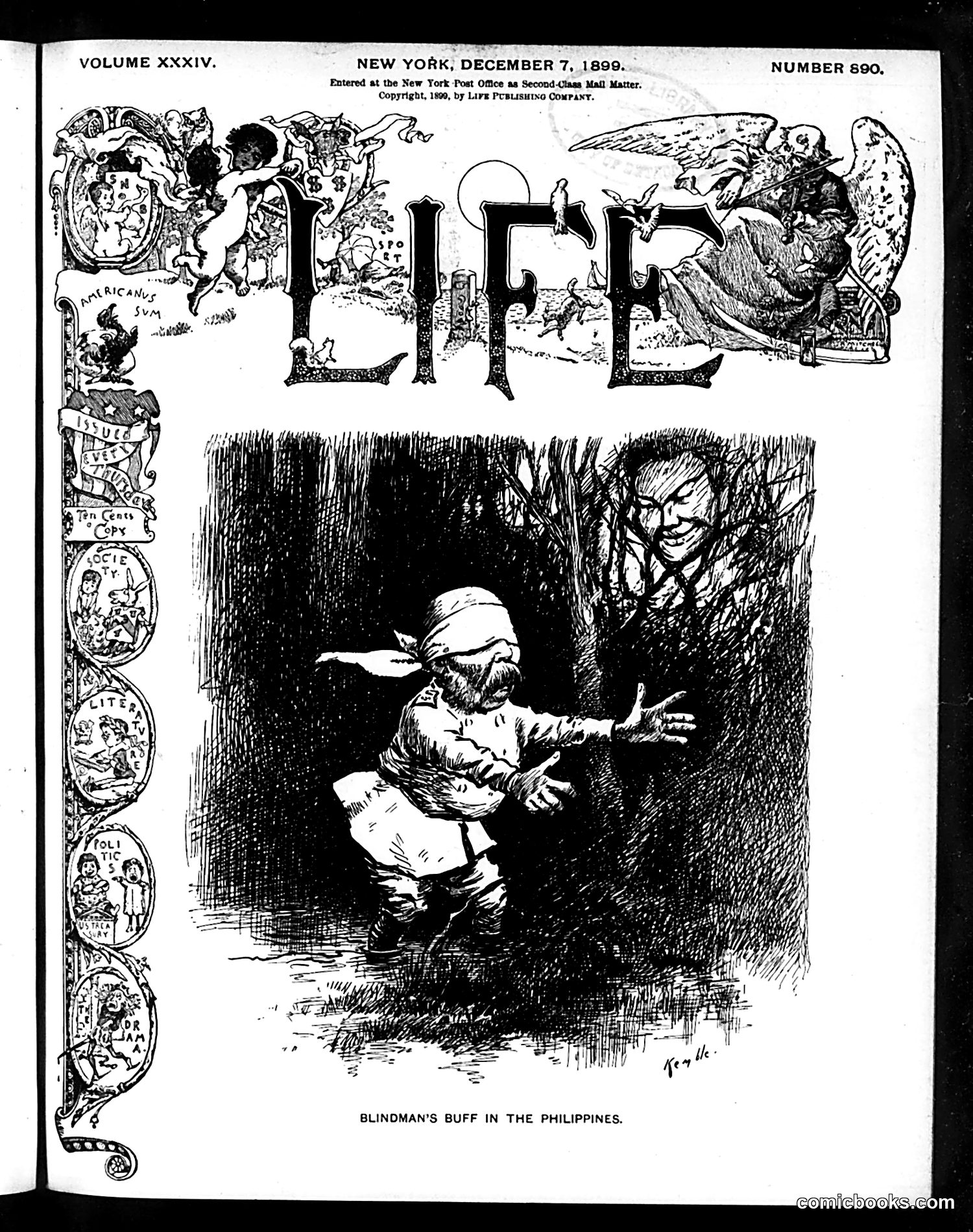
This *Life* magazine page from December 7, 1899, contains a political cartoon titled "Blindman's Buff in the Philippines." The illustration depicts a blindfolded figure stumbling in darkness, apparently unable to see or navigate obstacles. The cartoon satirizes American military operations in the Philippines during the Spanish-American War and subsequent Philippine-American War (1899-1902). The "blindman's buff" metaphor suggests U.S. forces were operating without clear strategy or visibility into the conflict's complexities. The blindfold represents American policymakers' alleged inability to comprehend or effectively manage the Philippine situation. This reflects contemporary American anxieties about imperial overreach and the challenges of colonial occupation, popular debate topics in *Life's* satirical commentary.
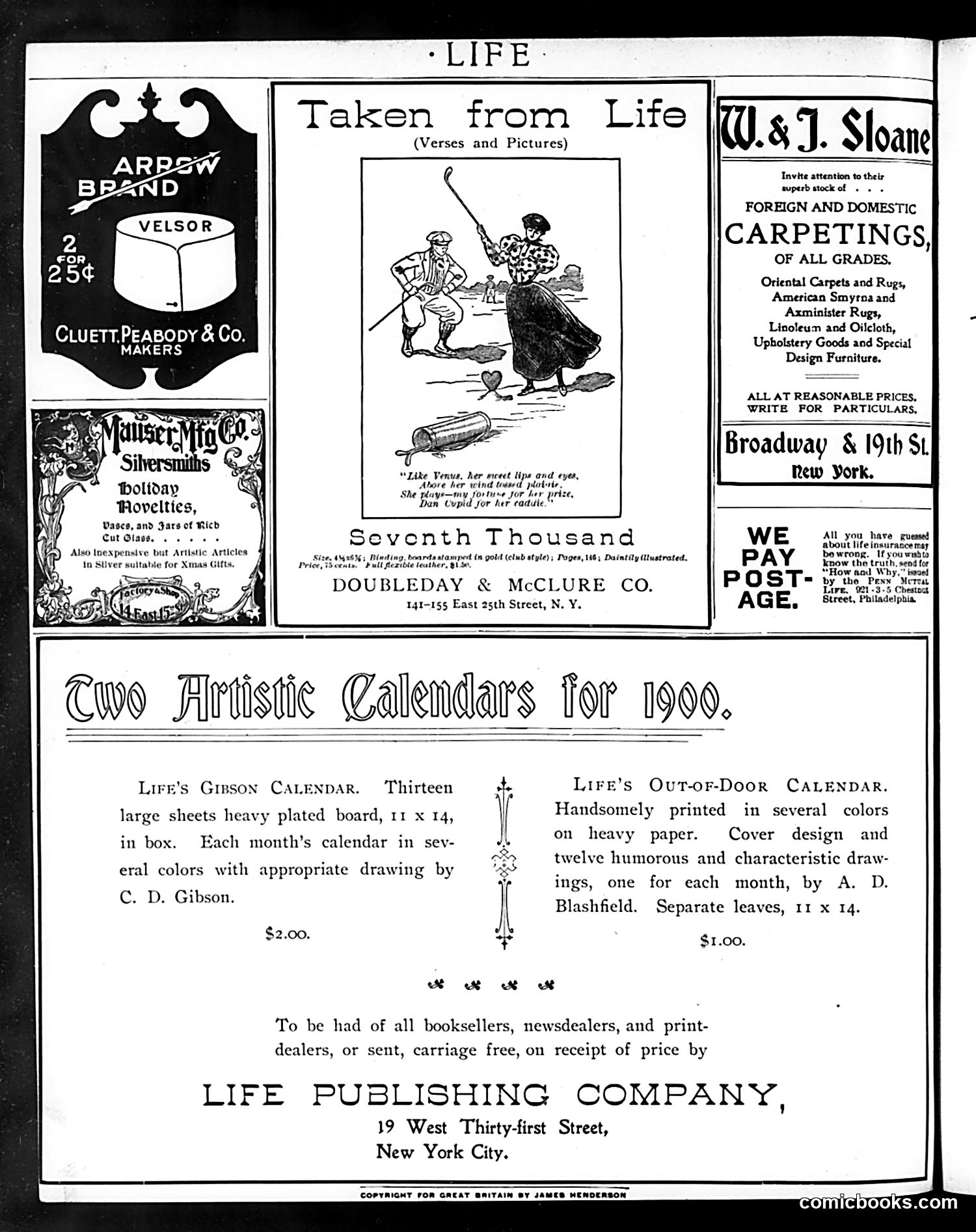
This page is primarily **advertising and product promotion** rather than political satire. The central cartoon, titled "Taken from Life (Verses and Pictures)," depicts a domestic scene with two figures and a small cherub or cupid at the bottom. Based on the visible text fragment mentioning "wind-tossed plumes" and "fortune," this appears to be a lighthearted commentary on **courtship or romantic relations**, likely satirizing Victorian-era dating customs or female vanity regarding fashion and appearance. The surrounding advertisements (carpets, silver goods, calendars) and the overall page layout reflect Life magazine's dual purpose: combining satirical humor with commercial content. Without clearer text visibility, the specific social critique remains somewhat unclear, though the romantic theme was common Life subject matter circa 1900.
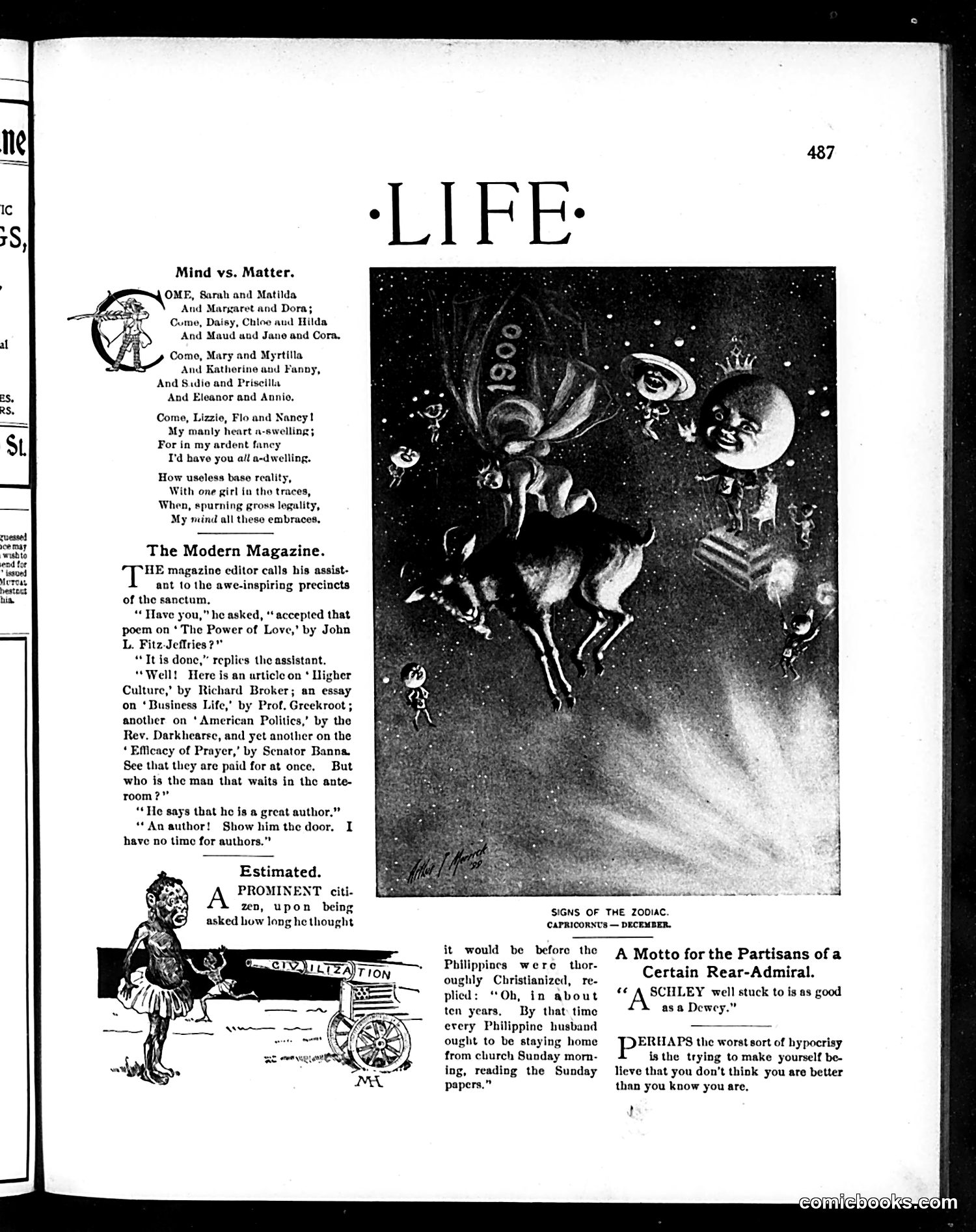
**"Signs of the Zodiac: Capricornus — December"** The main illustration depicts an astrological fantasy scene with a goat-headed creature (Capricornus) surrounded by cherubs, celestial bodies, and 1900 marked on a horn. This appears to be a satirical millennial commentary on the approaching year 1900, playing with zodiac superstitions and fin-de-siècle anxieties about the new century. The accompanying text sections include humorous commentary on magazine editors and authors, and a piece titled "Estimated" about Philippine Christianization—suggesting American colonial attitudes toward the Philippines (then a recent U.S. acquisition after the Spanish-American War). The page primarily satirizes contemporary American social pretensions, editorial practices, and imperial attitudes through witty commentary rather than sharp political critique.
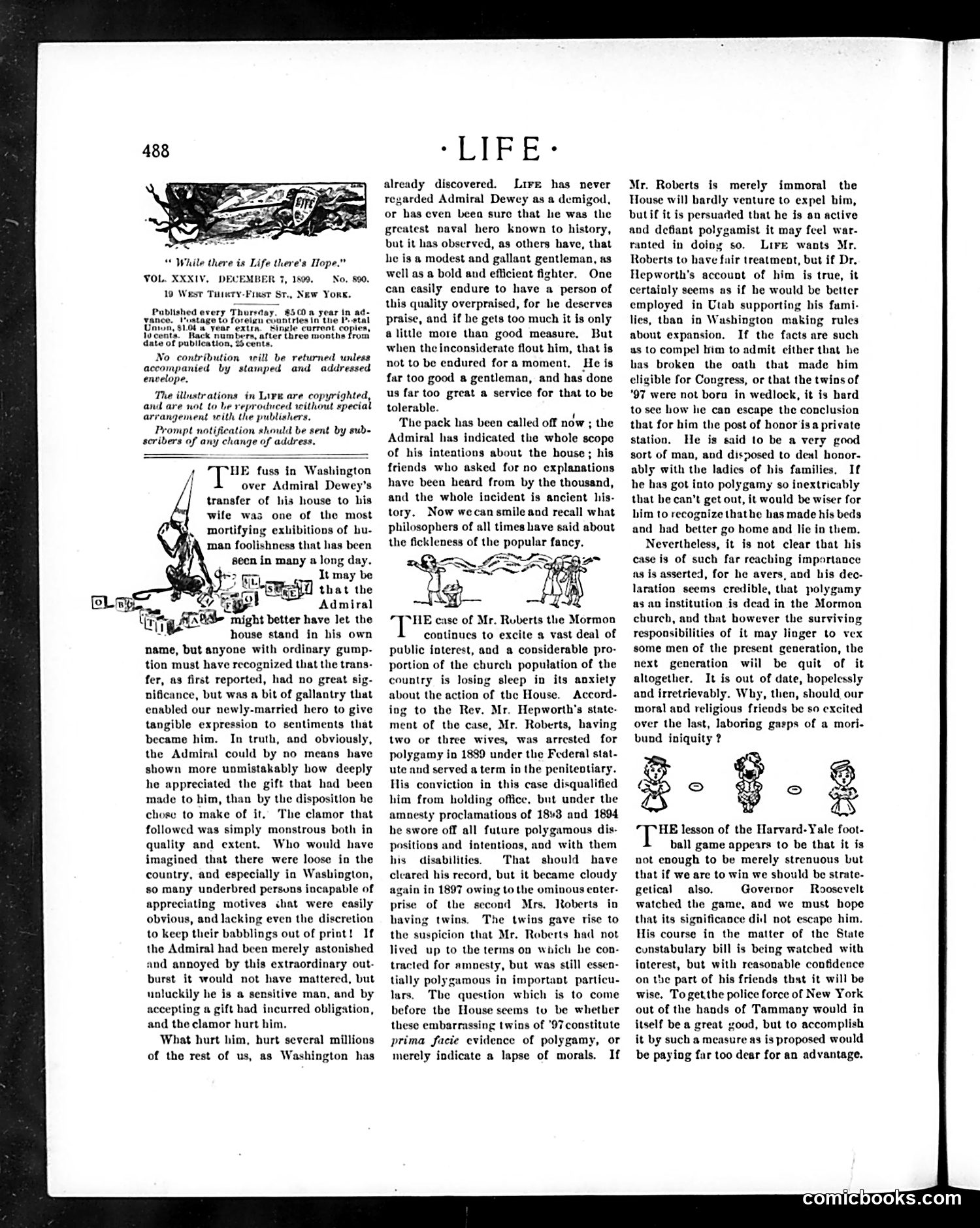
This page discusses Admiral Dewey and a controversy involving Mr. Roberts, a Mormon who practiced polygamy. The left cartoon appears to show someone being battered or attacked, illustrating the "fuss in Washington over Admiral Dewey's transfer." The text critiques both figures: Dewey receives praise as a naval hero but is described as receiving excessive public attention; Roberts, having married multiple wives and served prison time for polygamy in 1893, remains controversial. The article questions whether his case warrants such continued public interest. The piece also references a Harvard-Yale football game and a proposed New York police measure. The overall tone suggests satirizing how Washington handles celebrity figures and moral scandals while ordinary citizens' concerns are overlooked.
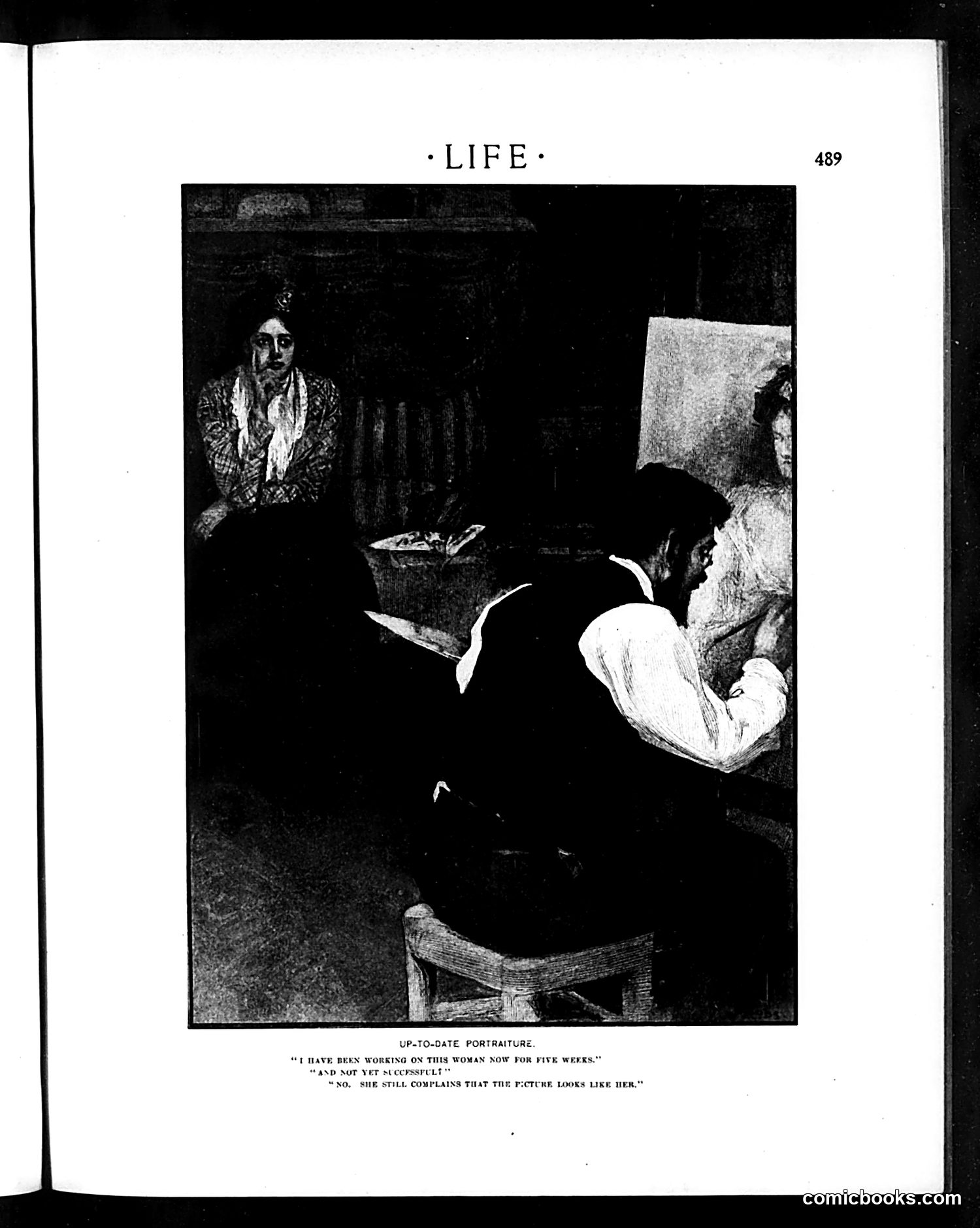
This page appears to be from Life magazine's satirical section titled "Up-to-Date Portraiture." The caption reads: "I have been working on this woman now for five weeks." "And not yet succeeded?" "No, she still complains that the picture looks like her." The cartoon depicts an artist (left) showing a portrait to a seated woman (right), with another figure observing. The joke is a classic commentary on vanity and unflattering portraiture: despite weeks of work, the subject remains dissatisfied because the realistic portrait apparently reveals unflattering truths about her appearance. The humor lies in the tension between artistic accuracy and the subject's desire for flattery—a timeless satire on vanity and the gap between self-perception and reality.
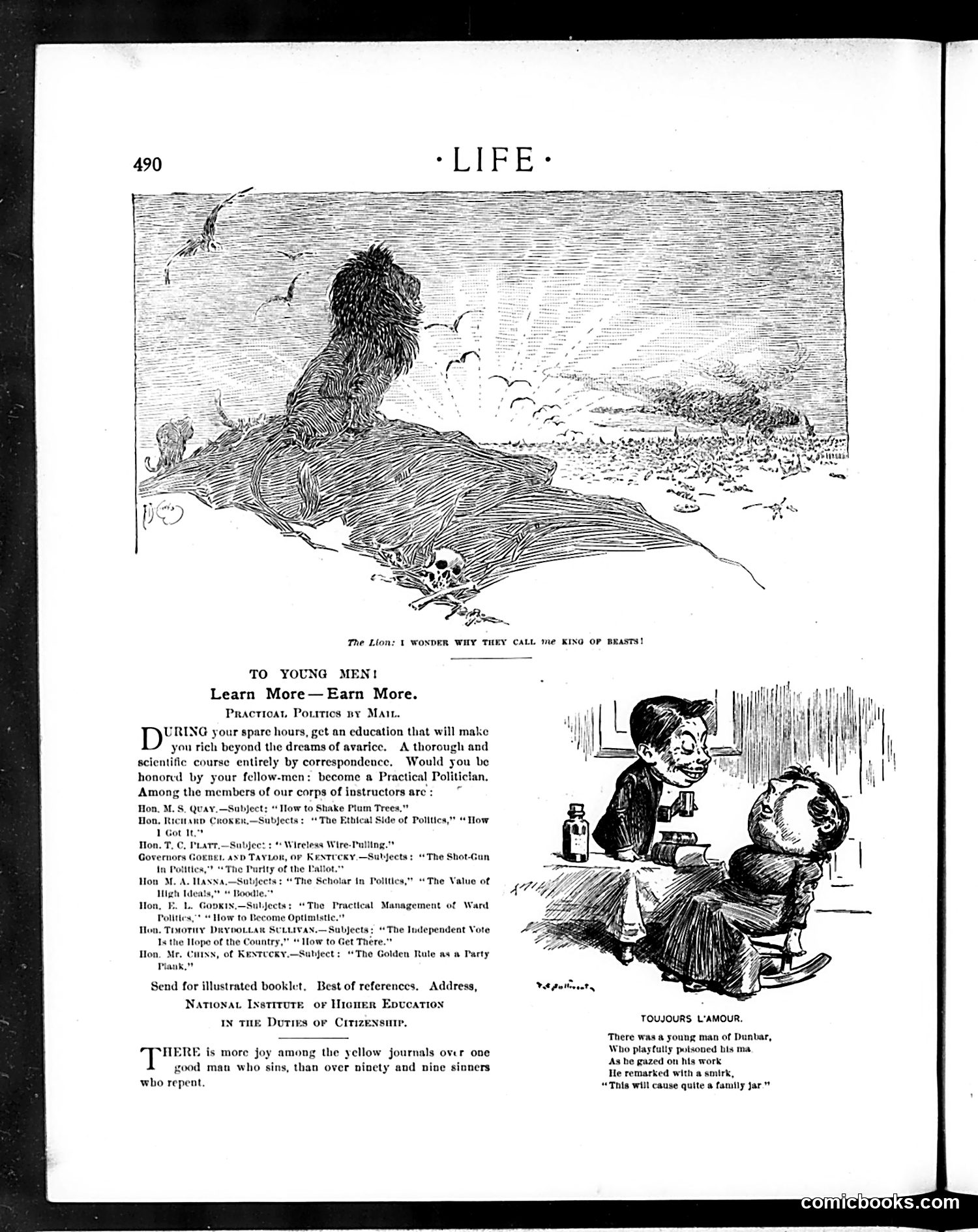
**The Lion Cartoon:** The top illustration shows a dead lion with a skull beneath it, captioned "The Lion: I wonder why they call me king of beasts!" This appears to be satirical commentary on diminished authority or respect—suggesting that despite traditional claims to superiority, the lion (possibly representing a political figure or institution) has lost actual power or influence. **The Political Education Advertisement:** The main text promotes a correspondence course in "Practical Politics" taught by various named instructors including politicians. This satirizes the commercialization of political education and the notion that one can learn "practical politics" through mail correspondence—mocking both the politicians involved and the gullible public. **"Toujours L'Amour" Poem:** A brief humorous verse about a young man from Dunfar poisoning his mother, with a darkly comic punchline about family consequences.
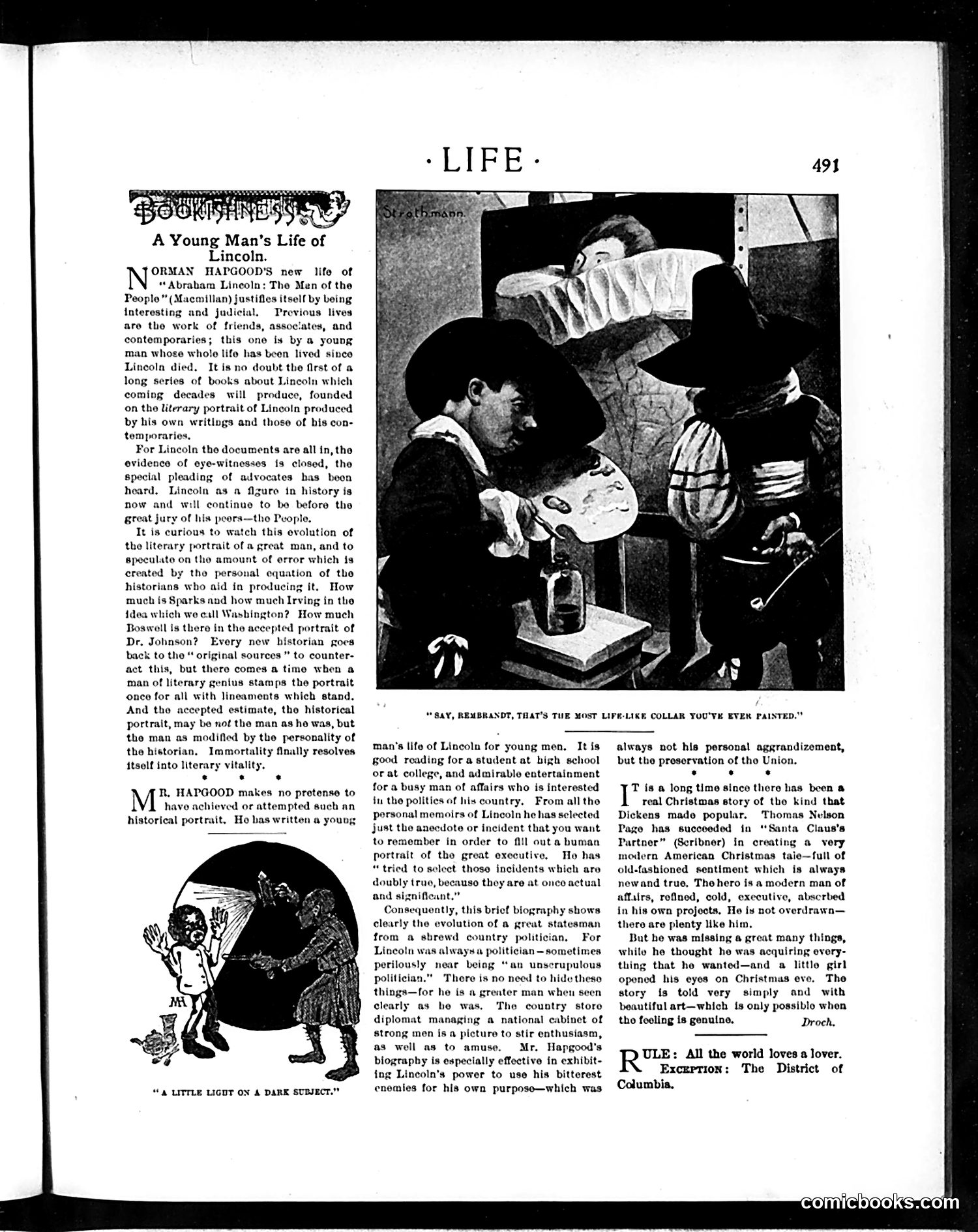
This page reviews Norman Hapgood's biography "A Young Man's Life of Lincoln." The top photograph shows two men examining what appears to be a historical document or artifact, with the caption "Say, Rembrandt, that's the most life-like collar you've ever painted." The lower cartoon, titled "A Little Light on a Dark Subject," depicts two figures in period dress examining something, likely satirizing historical interpretation itself. The review discusses how Hapgood's work differs from previous Lincoln biographies by focusing on personal anecdotes and contemporary accounts rather than established historical narratives. The text notes this approach reveals how historians' interpretations shape the "literary portrait" of historical figures, modifying facts through their own perspectives—a commentary on historiography and biographical bias.
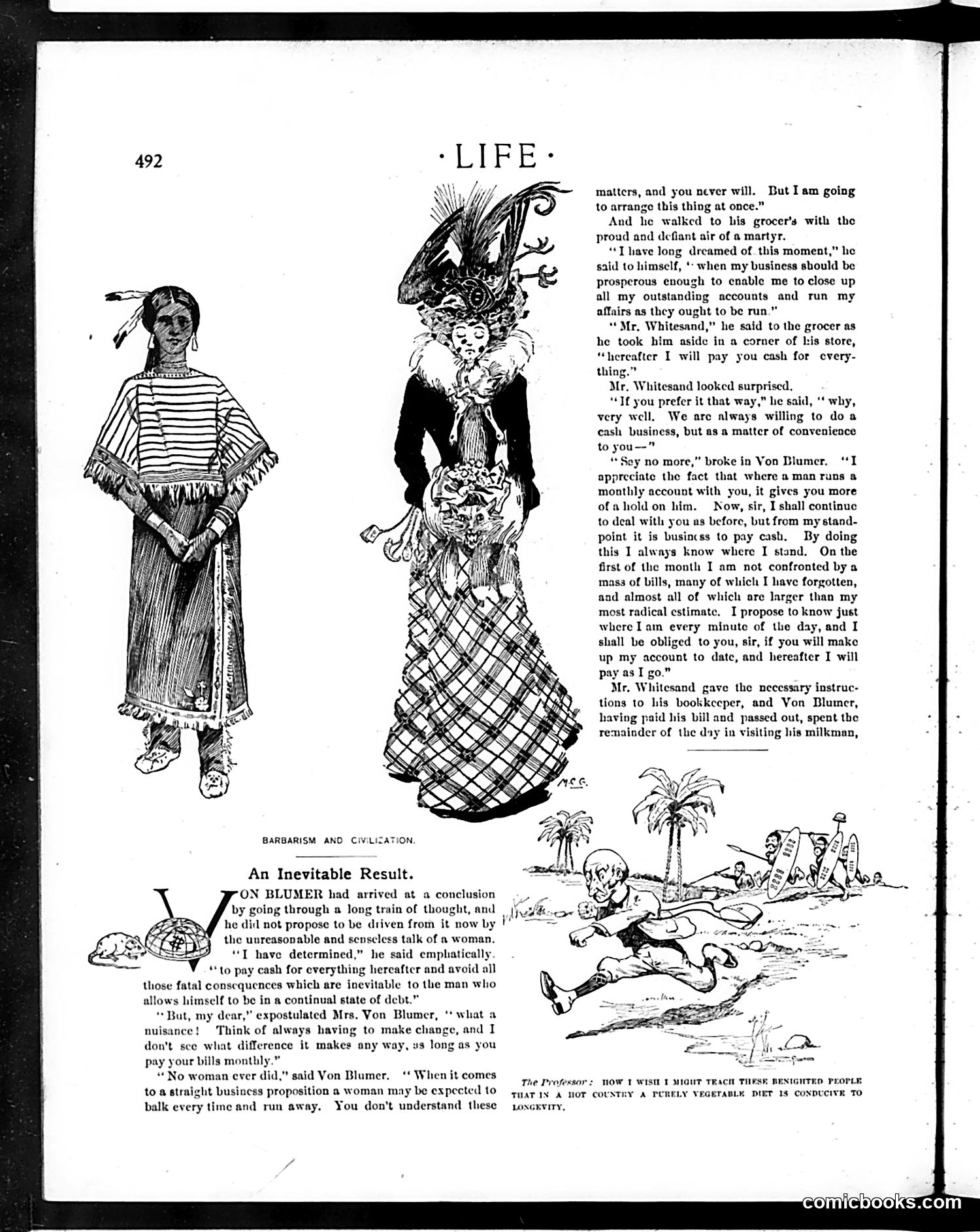
This page satirizes Von Blumer, a businessman determined to pay cash for everything to avoid debt. His wife objects that this approach is impractical and will damage their social standing. Von Blumer remains adamant, insisting cash transactions provide financial clarity and control. The top illustration contrasts two figures—likely representing "barbarism" (left, in simple striped clothing) and "civilization" (right, elaborately dressed). The satire suggests Von Blumer's cash-only philosophy is absurdly primitive for modern society, which operates on credit systems. The bottom cartoon shows Von Blumer crawling through a desert, implying his stubborn refusal to use credit isolates him completely from civilized commercial life—an "inevitable result" of his outdated financial principles.
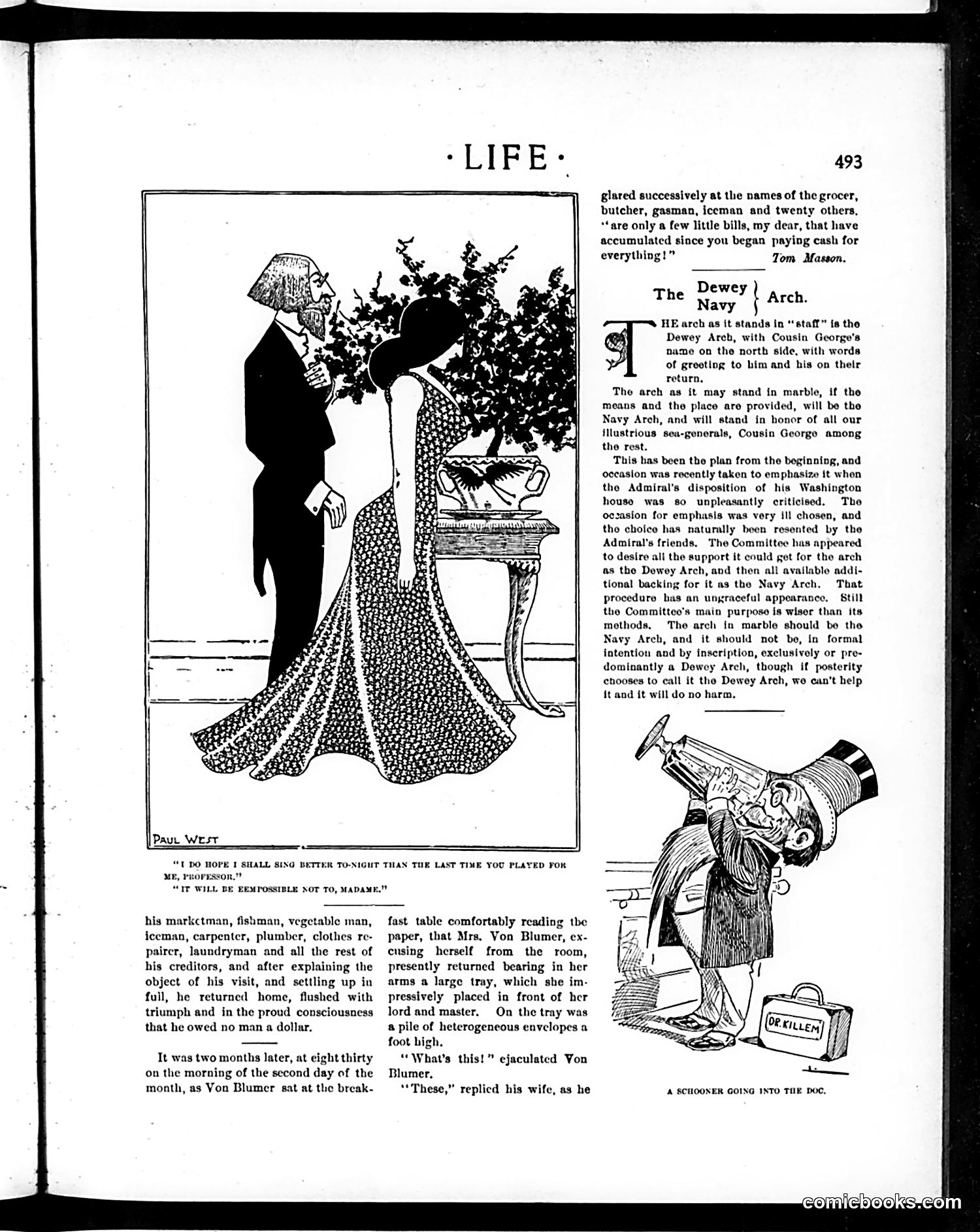
The main illustration by Paul West depicts a fashionable woman in an elaborate patterned gown arranging flowers, with the caption "I do hope I shall look better to-night than the last time you played for me, Professor" and a response "It will be impossible not to, Madame." This is a society satire about vanity and appearance. The woman's concern that the "Professor" (likely a musician or performer) might somehow affect her looks suggests anxiety about social presentation among the wealthy. The article "The Dewey Navy Arch" discusses a proposed memorial arch to honor Admiral George Dewey and naval heroes, debating whether it should be called the "Dewey Arch" or "Navy Arch." The lower cartoon showing "A Schooner Going Into the Dock" appears to be a separate humorous illustration, though its specific meaning is unclear from the visible text.
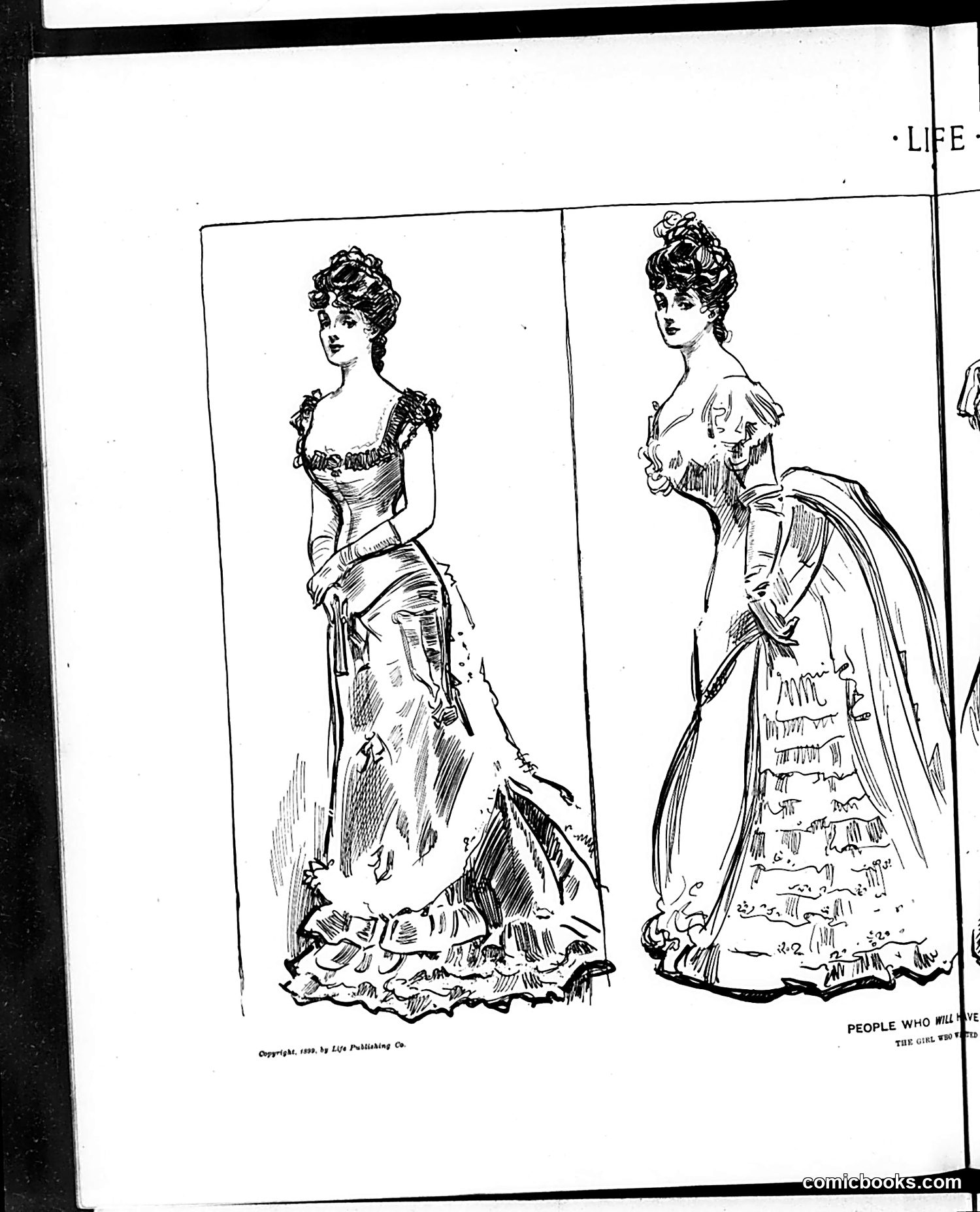
This page from *Life* magazine shows two pen-and-ink fashion illustrations of elaborately dressed women in what appears to be early 1900s attire, featuring corseted waists, ornate sleeves, and dramatic trailing skirts with decorative details. The copyright reads "1899 by Life Publishing Co." The partial text visible at bottom right suggests this relates to "people who will have" and "the girl who" (text cut off). Without the complete caption or article text, the specific satirical point is unclear. However, *Life* frequently mocked women's fashion during this era—particularly the impracticality of tight corseting and excessive ornamentation. This likely satirizes contemporary fashion trends or the type of woman who followed them, though the exact social or political target cannot be determined from the visible image alone.
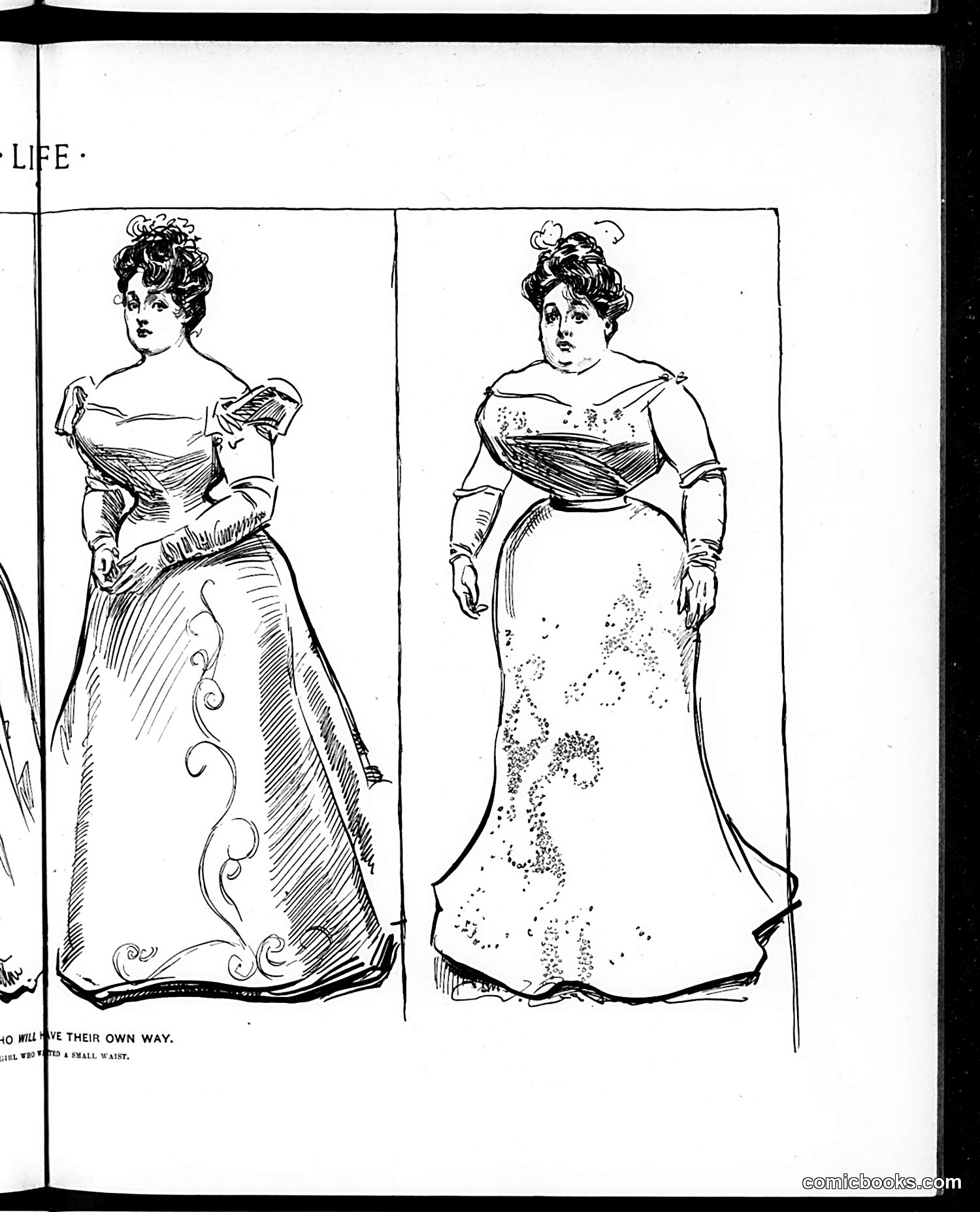
This page from *Life* magazine appears to satirize women's fashion and body types of the early 1900s (the "Gibson Girl" era). It contrasts two female figures: the left shows an idealized, slender woman in an elegant gown with decorative hem details; the right depicts a fuller-figured woman in similar formal dress with embellished skirt. The partial visible text references "their own way" and "a small waist," suggesting the cartoon critiques contemporary fashion obsessions—particularly the era's extreme corseting and the cultural pressure to achieve an impossibly tiny waist regardless of natural body type. The satire likely mocks both the fashion industry's unrealistic standards and society's fixation on conforming diverse body shapes to a single idealized silhouette.
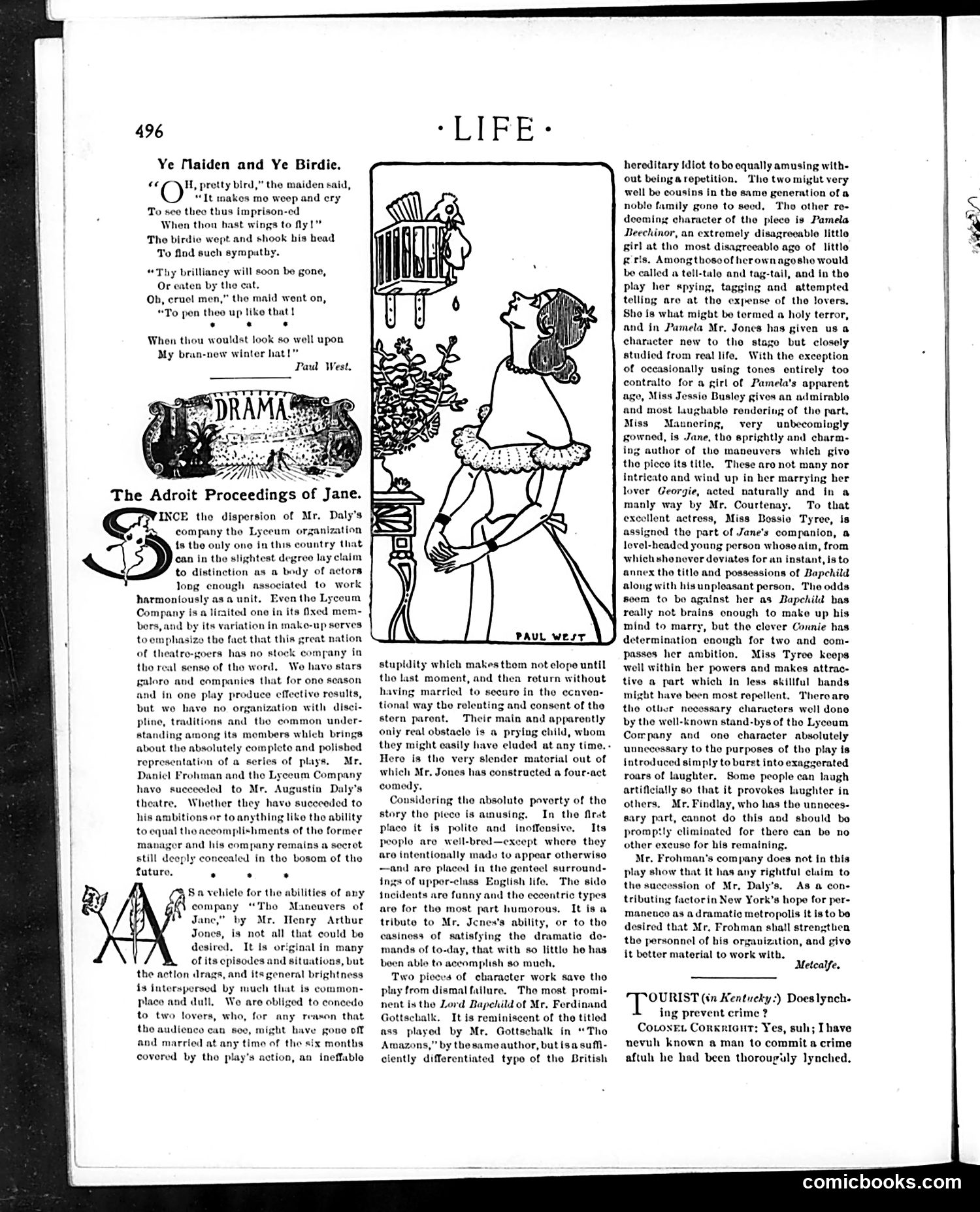
This page contains a poem by Paul West titled "Ye Maiden and Ye Birdie," accompanied by an illustration showing a young woman in period dress interacting with a bird in a cage. The poem humorously depicts the woman's sympathy for the caged bird, using archaic language ("Ye," "Thou"). Below is a section titled "The Adroit Proceedings of Jane," which reviews theatrical productions. The text discusses various plays, including critiques of performances and character portrayals. The reviews mention specific actors and productions of the era, evaluating dramatic quality and performances. The page appears to be a mix of poetry, theatrical criticism, and entertainment commentary typical of Life magazine's satirical content.
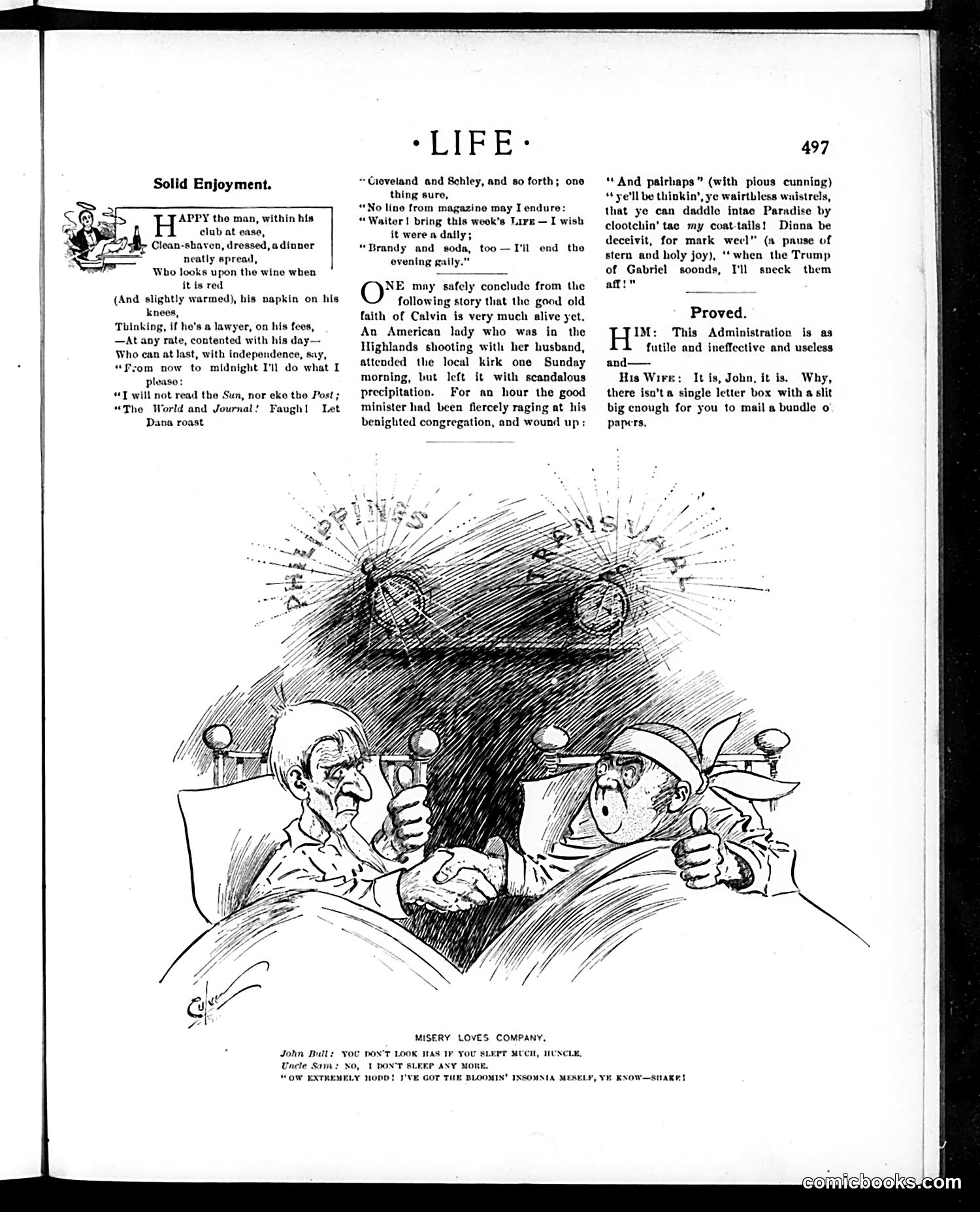
**Top Section ("Solid Enjoyment"):** A satirical poem celebrating a man's evening freedom at his club, specifically his resolve to avoid newspapers—the *Sun*, *Post*, *World*, and *Journal*. He orders Life magazine instead, preferring it as daily reading. This is self-promotional satire by the magazine itself, mocking the sensationalism and heaviness of daily newspapers while positioning Life as superior entertainment. **Bottom Cartoon ("Misery Loves Company"):** depicts "John Bull" (Britain, personified) and "Uncle Sam" (America) commiserating about insomnia. Both appear exhausted, suggesting both nations face similar political troubles. The context suggests this references shared anxieties—likely imperial or diplomatic concerns of the period—where both nations find grim comfort in mutual suffering. **Middle Story:** A humorous anecdote about Scottish Presbyterian hellfire preaching, satirizing stern Calvinist clergy and their threats of damnation. The page overall reflects American magazine humor: self-promotion, international commentary, and religious satire.
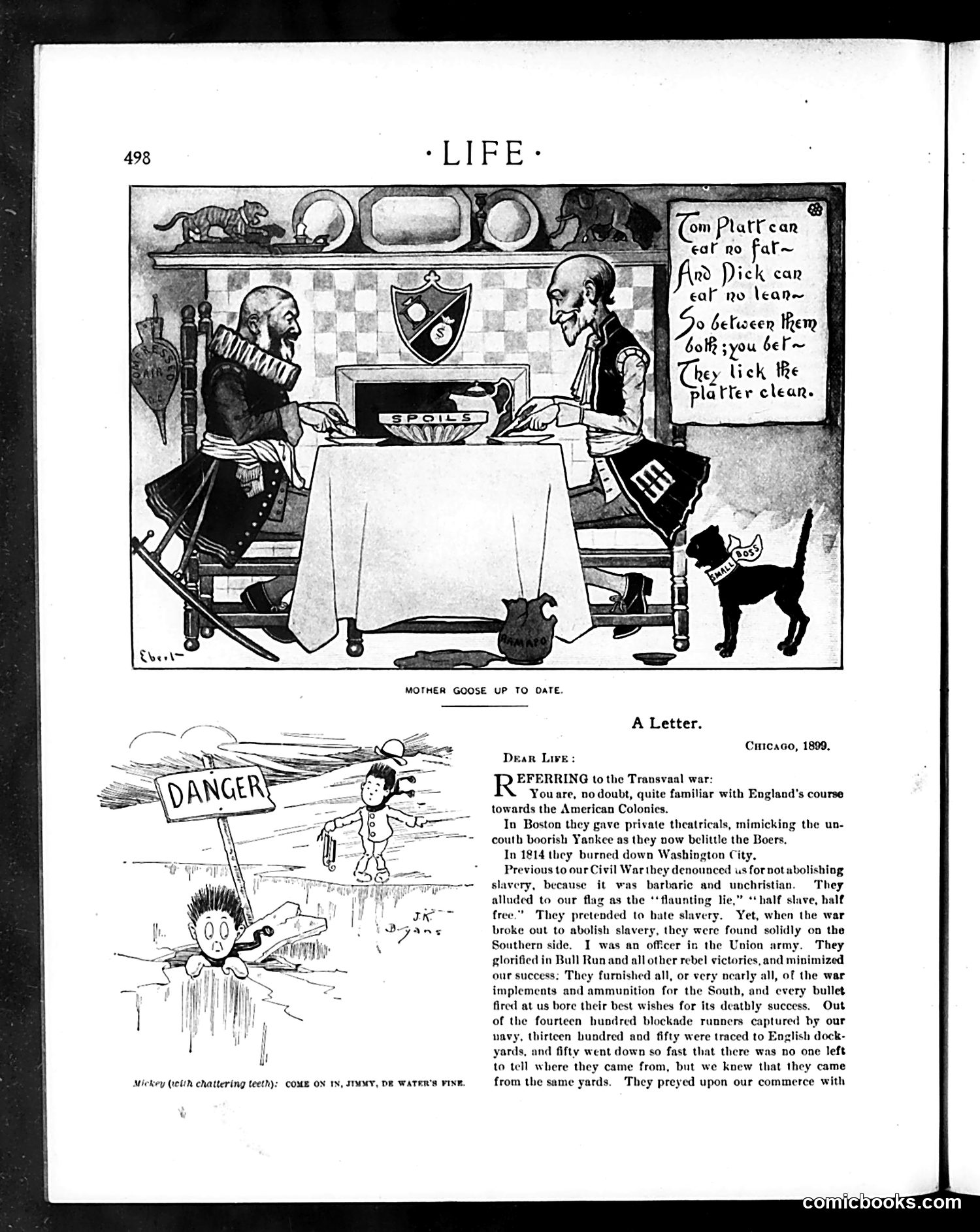
**Top Cartoon ("Mother Goose Up to Date"):** Two elaborately dressed gentlemen dining together recite a nursery rhyme variant about eating without fat or lean—apparently mocking diplomatic pretense or suggesting both nations engage in hypocritical self-interest while claiming moral superiority. **Bottom Content:** A letter from Chicago (1899) critiques British hypocrisy regarding the Boer War. The writer argues England historically condemned American slavery while secretly supporting the Confederacy during the Civil War—supplying munitions and blockade runners to the South. The letter accuses Britain of preying on American commerce while publicly claiming moral authority. **Context:** This reflects late-19th-century American resentment of British conduct during the American Civil War, when Britain maintained official neutrality while materially aiding the Confederacy. The Boer War (1899-1902) gave Americans opportunity to critique British imperialism and hypocrisy—turning tables on the nation that once lectured them about morality.
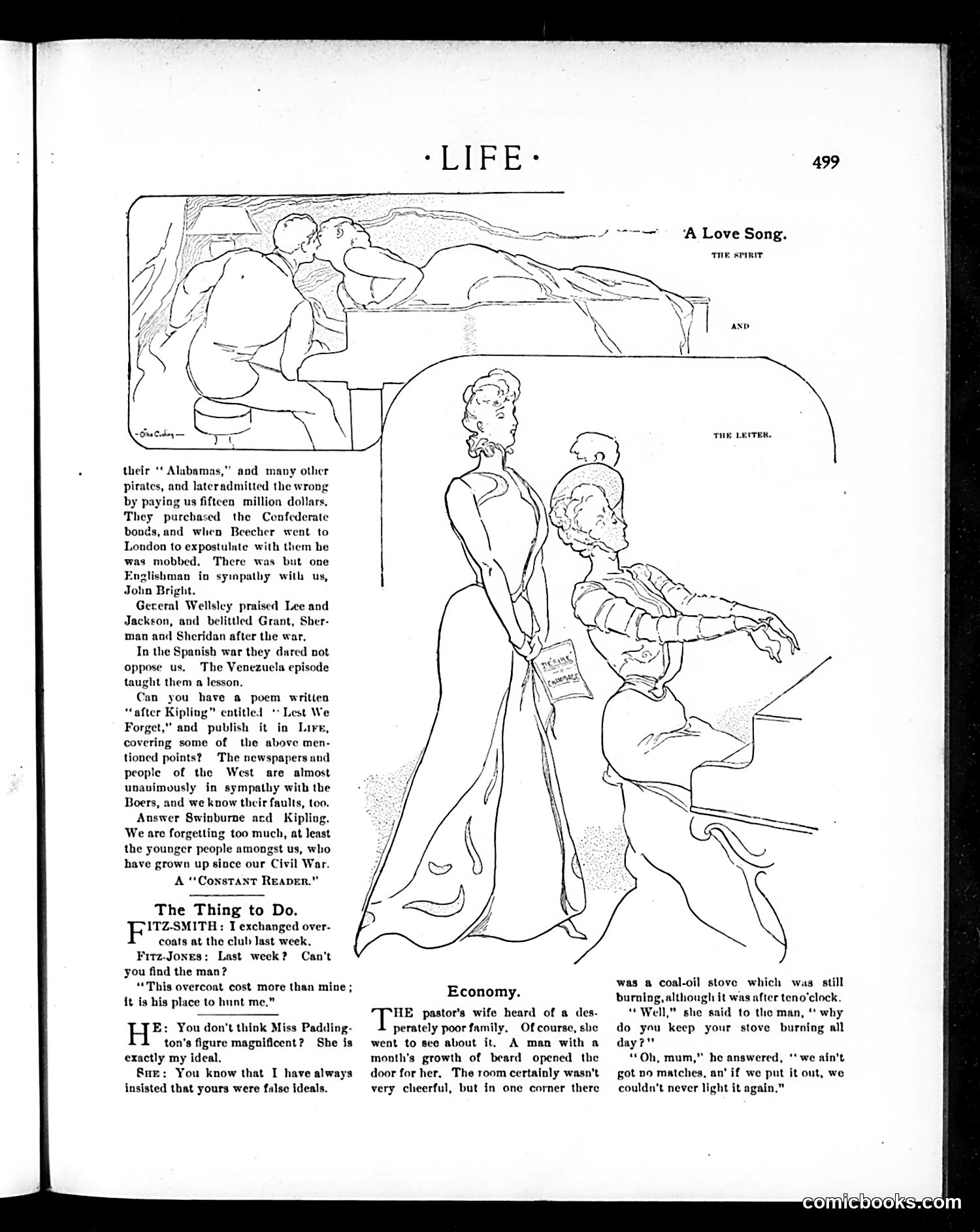
This page contains several brief humorous sketches typical of *Life* magazine's satirical style. **"The Thing to Do"** mocks upper-class social hypocrisy: Fitz-Smith exchanges overcoats at a club, then expects the owner to retrieve his inferior coat—assuming the richer man will naturally chase down the poorer one's property. The second exchange satirizes aesthetic pretension, with one character claiming Miss Paddington's figure is their "ideal" while their companion points out they've always held false standards. **"Economy"** offers situational humor about poverty: a desperately poor family keeps their coal stove burning continuously because they lack matches to relight it if extinguished. The joke exposes the catch-22 of poverty—they waste fuel to avoid the impossibility of relighting it. The upper illustrations appear decorative rather than editorial cartoons, depicting romantic or domestic scenes in the magazine's characteristic line-drawing style. The page reflects *Life*'s focus on social class commentary and everyday absurdities.
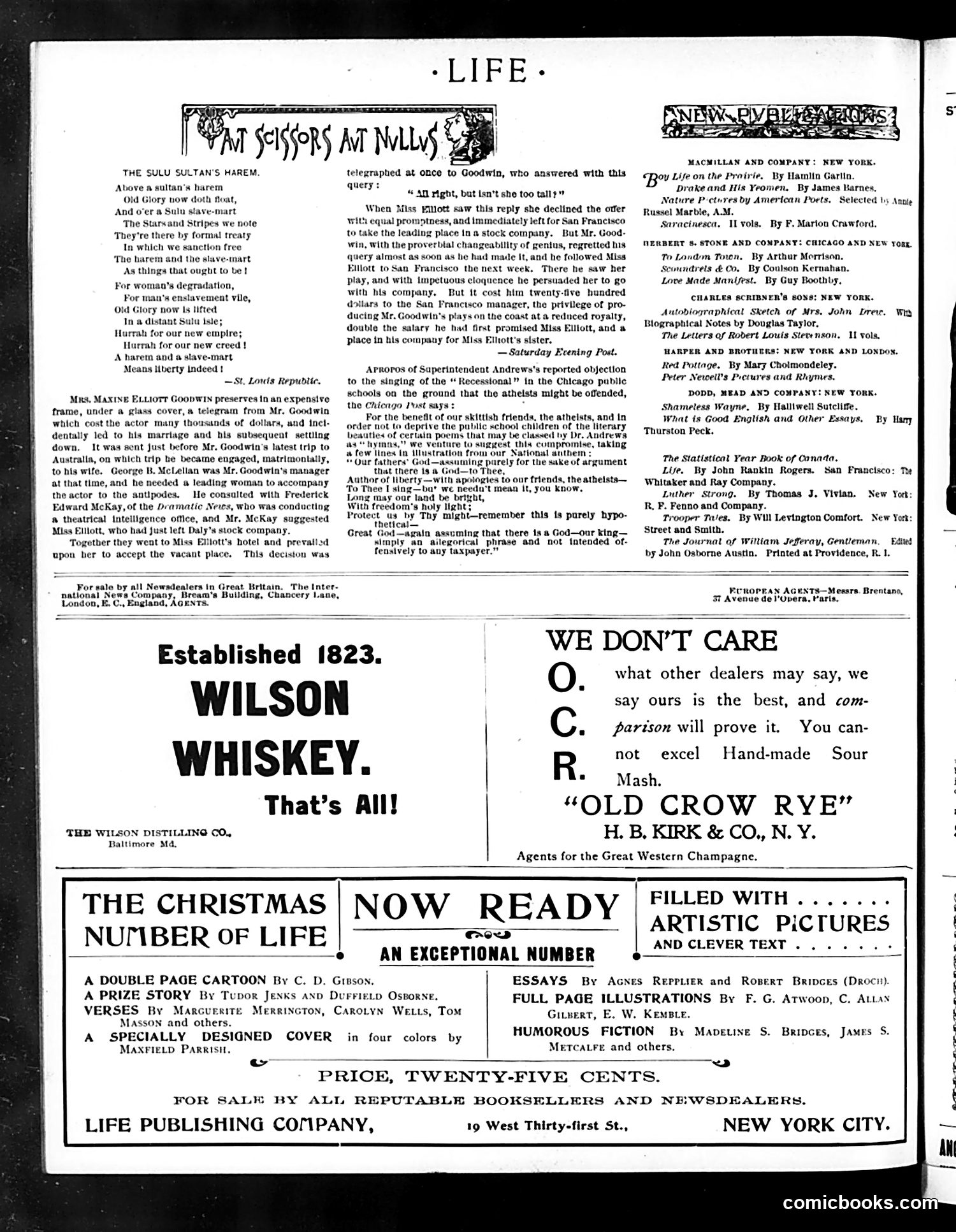
This page is primarily advertisements and book announcements from *Life* magazine's back matter—not political cartoons. The only satirical content is a reprinted poem, "The Sulu Sultan's Harem" (from the *St. Louis Republic*), which criticizes American imperial expansion. It's a scathing critique: the poem sarcastically celebrates the American flag floating over a foreign harem and slave market, mocking U.S. foreign policy that effectively tolerates these practices in conquered territories. The refrain "Means liberty indeed!" is heavy-handed irony—condemning American imperialism as hypocritical to its stated values. This likely references early 1900s U.S. involvement in the Philippines (Sulu region), where American military governance coexisted with local institutions many Americans found morally troubling. The satire attacks both the contradiction between American democratic ideals and imperial practice, and the indifference of American officials to human rights abuses abroad.
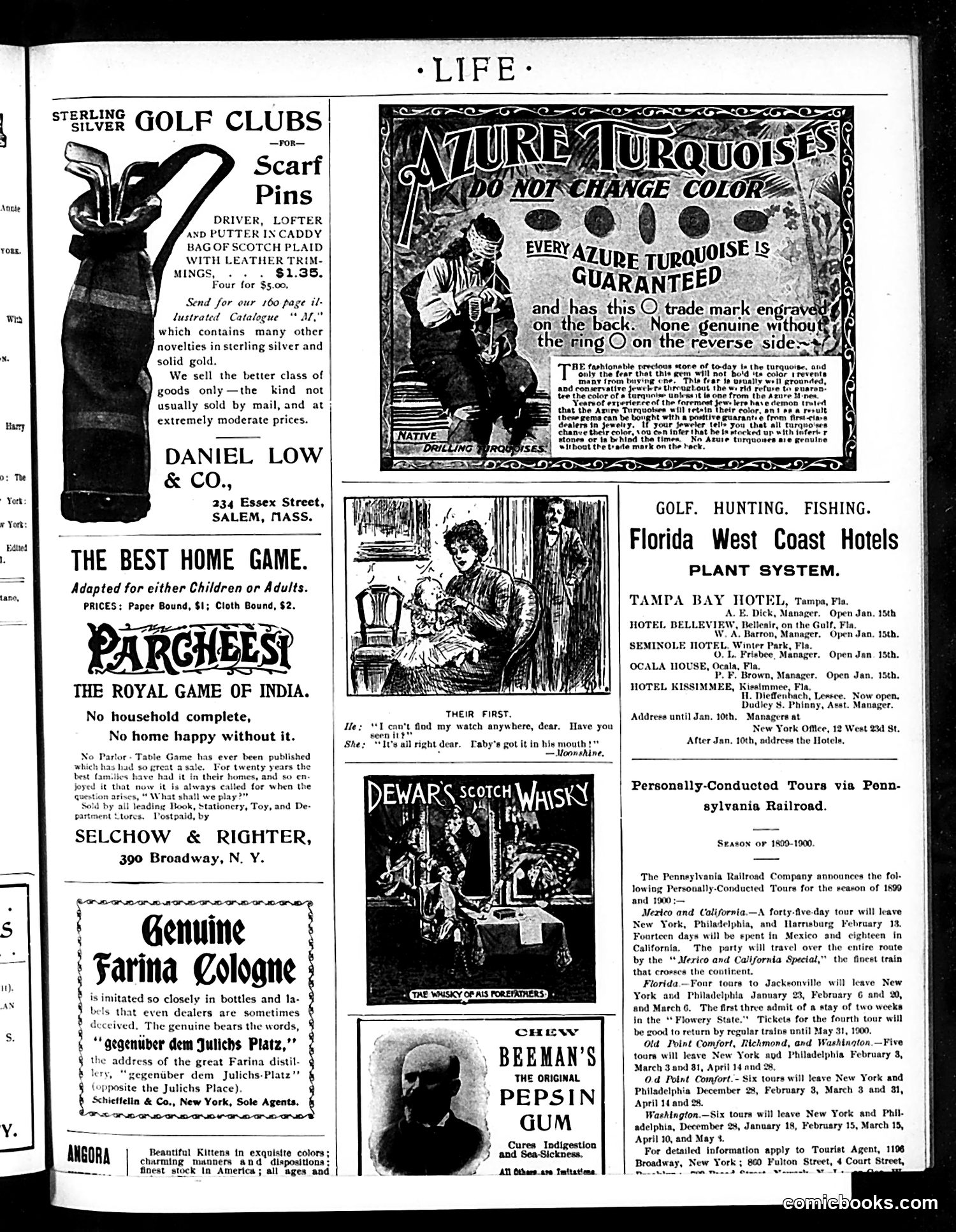
This page is primarily **advertising**, not satirical content. It consists of commercial advertisements and announcements from circa 1899-1900. The one **cartoon** present is small and titled "Their First" (lower center): it shows a domestic scene where a wife asks her husband if he's seen his watch. He replies that the baby has it in his mouth. The joke is a gentle domestic humor about infants putting objects in their mouths—a common sight gag of the era. The page otherwise advertises: - Sterling silver golf clubs and accessories - Parlor board games (Parcheesi) - Cologne and perfume - Turquoise jewelry (with authenticity guarantees) - Beeman's Pepsin Gum - Dewar's Scotch Whisky - Florida resort hotels - Pennsylvania Railroad tours to Mexico, California, and Florida There is no political satire or social commentary on this page—it is a straightforward commercial publication typical of Life magazine's advertising revenue model in this period.
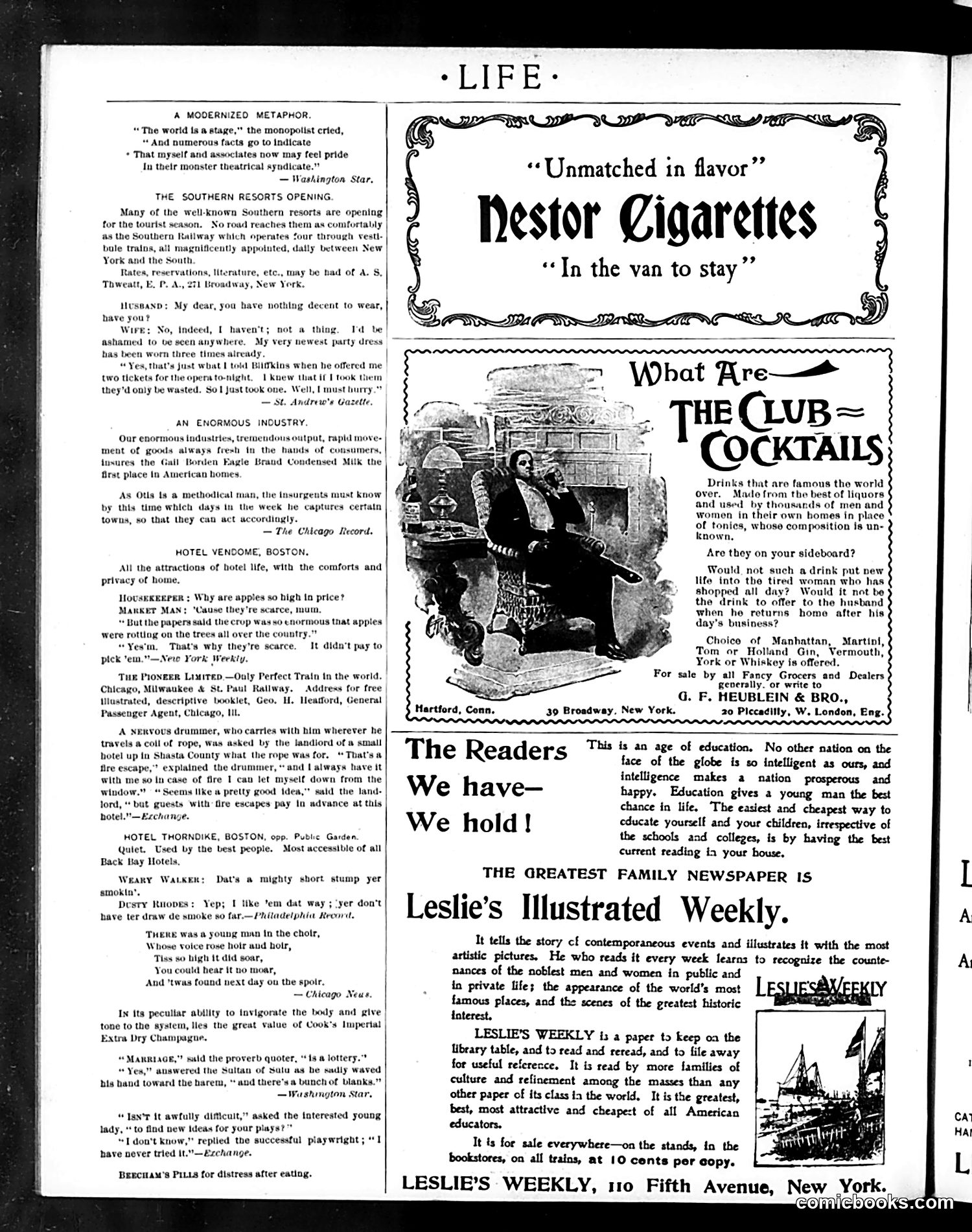
This page is primarily **advertising and light humor pieces** rather than political cartoons. The opening metaphor compares the world to a theatrical stage, with a monopolist claiming pride in his "monster theatrical syndicate"—likely satirizing the consolidation of business power during the Gilded Age/early 20th century. The page contains several brief comedic anecdotes: a hosiery joke about wasteful orchids, a drummer's fire-escape rope, an apple-shortage paradox (crop destroyed so unprofitable to pick), and a harem joke about marriage as "lottery with blanks." The visual cartoon shows what appears to be **a theatrical or social scene with multiple figures**, though specific identities aren't clear from the image quality. The majority of the page features **advertisements** for Nestor Cigarettes, Club Cocktails, Leslie's Illustrated Weekly, and various hotels and transportation services. This reflects the magazine's revenue model. The "Modernized Metaphor" heading suggests contemporary critiques of monopoly capitalism, but lacks specific political figures or events to pinpoint.
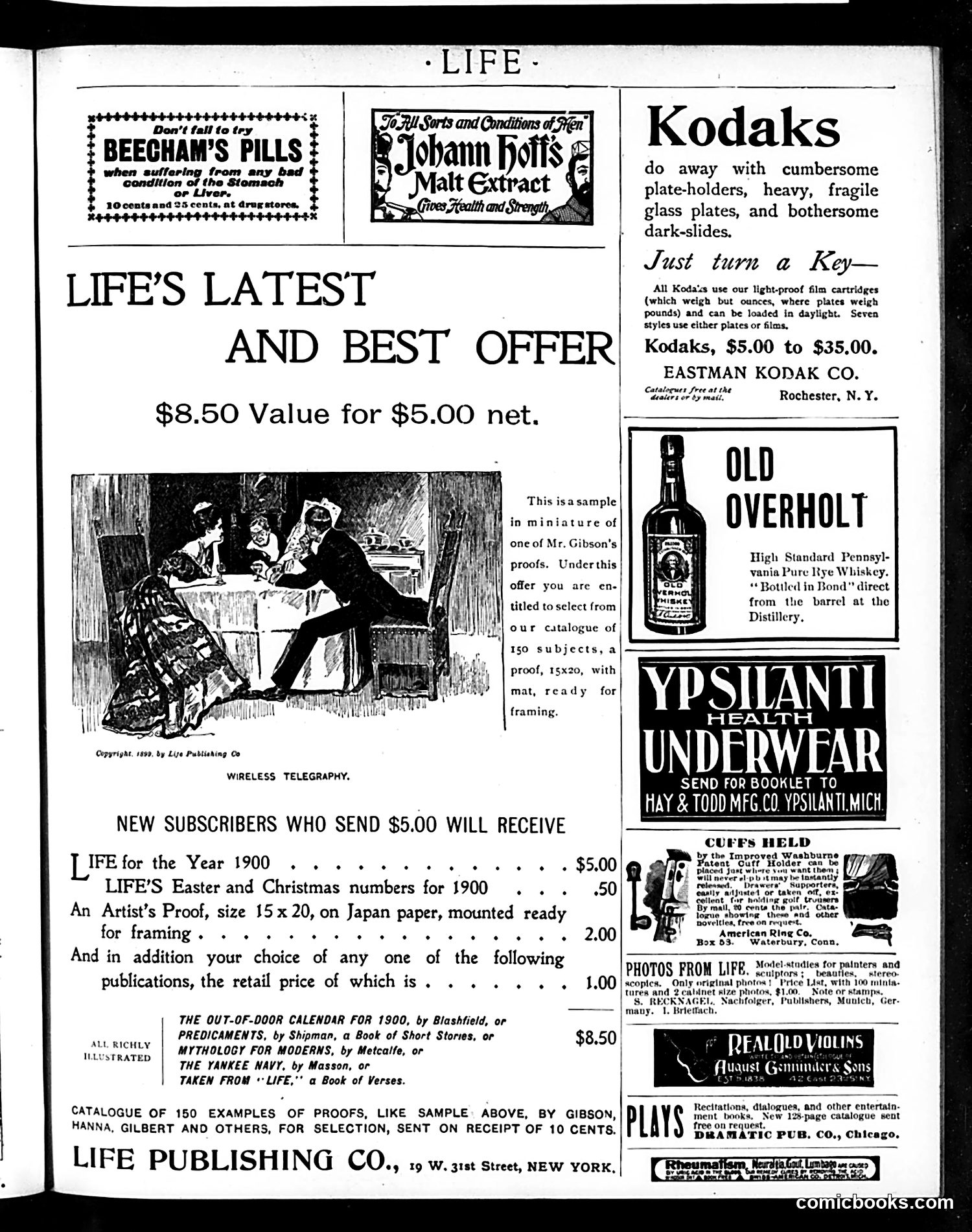
This page is primarily **advertising**, not political satire. The main content shows a subscription offer to *Life* magazine for 1900. The central image—credited to Gibson (likely Charles Dana Gibson, creator of the "Gibson Girl")—depicts Victorian-era figures at a dinner table and is labeled "Wireless Telegraphy." This appears to be visual humor about silent dinner companions—a social observation joke about people dining together without conversation, presented as "wireless telegraphy" (a new technology of 1899-1900). The surrounding ads showcase period products: Kodak cameras (emphasizing convenience), Beecham's Pills, malt extract, whiskey, underwear, and golf equipment. The subscription offer itself—$8.50 value for $5.00—is the page's primary message, bundling a year of *Life* with art prints and books. This is essentially a turn-of-the-century magazine promotion page with vintage advertising.
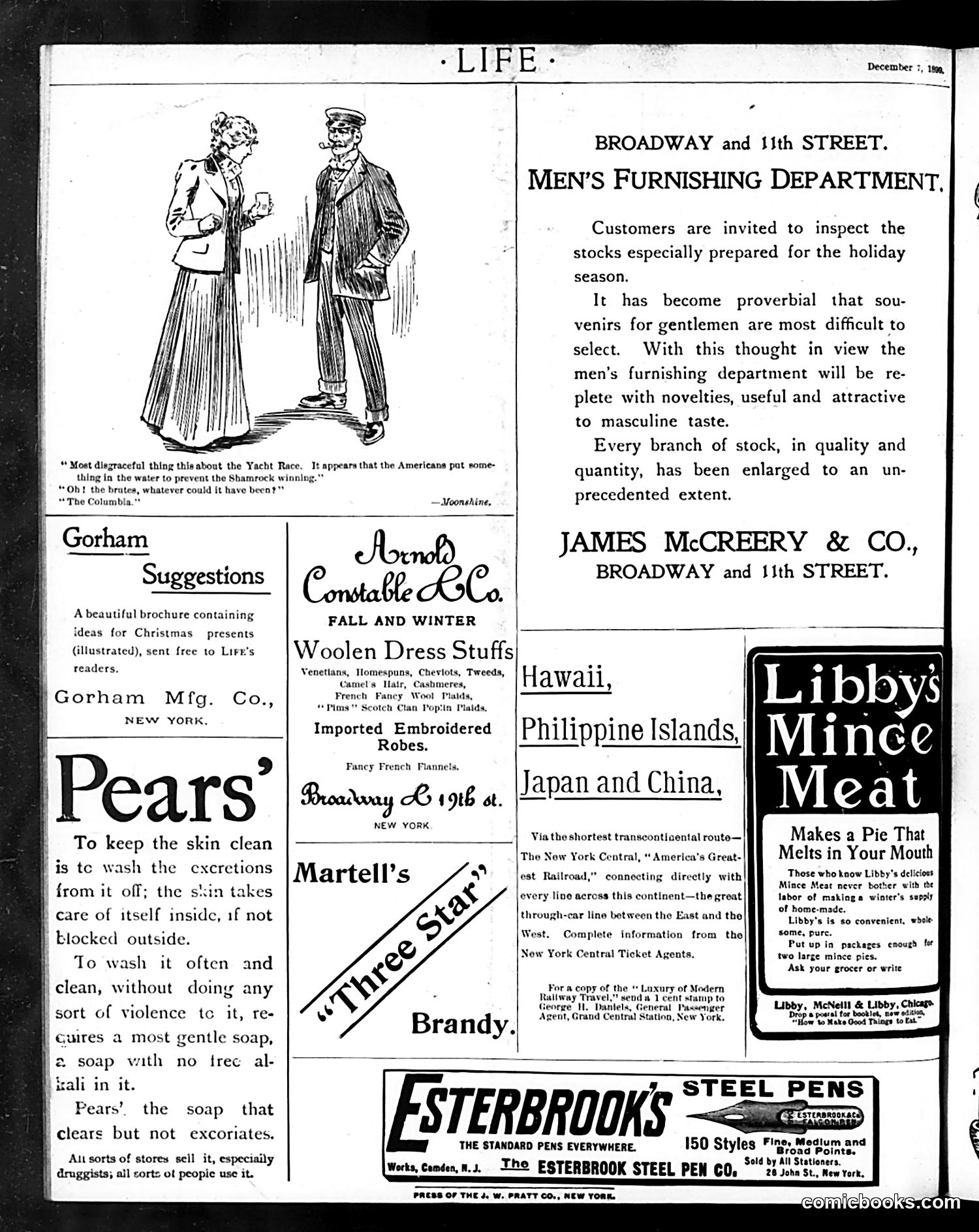
The cartoon depicts a conversation between two figures—apparently a woman and a man in formal attire—discussing the America's Cup yacht race. The joke turns on a witty insult: when the woman asks what "the Americans put in the water to prevent the Shamrock winning," the man's answer is "The Columbia"—meaning the American yacht itself was the obstacle to Ireland's Shamrock winning. This references America's Cup yacht racing competitions between American and British (or Irish) vessels. The humor relies on mock-outrage at American sportsmanship, with the woman treating this as scandalous interference, while the punchline reframes it as simple competitive superiority: the American boat itself prevented an Irish victory through legitimate racing. The page is otherwise filled with period advertisements for department stores, soaps, and luxury goods—typical of Life's commercial content.