
Life, 1899-12-07 · page 7 of 20
Life — December 7, 1899 — page 7: what you’re looking at
What you’re looking at
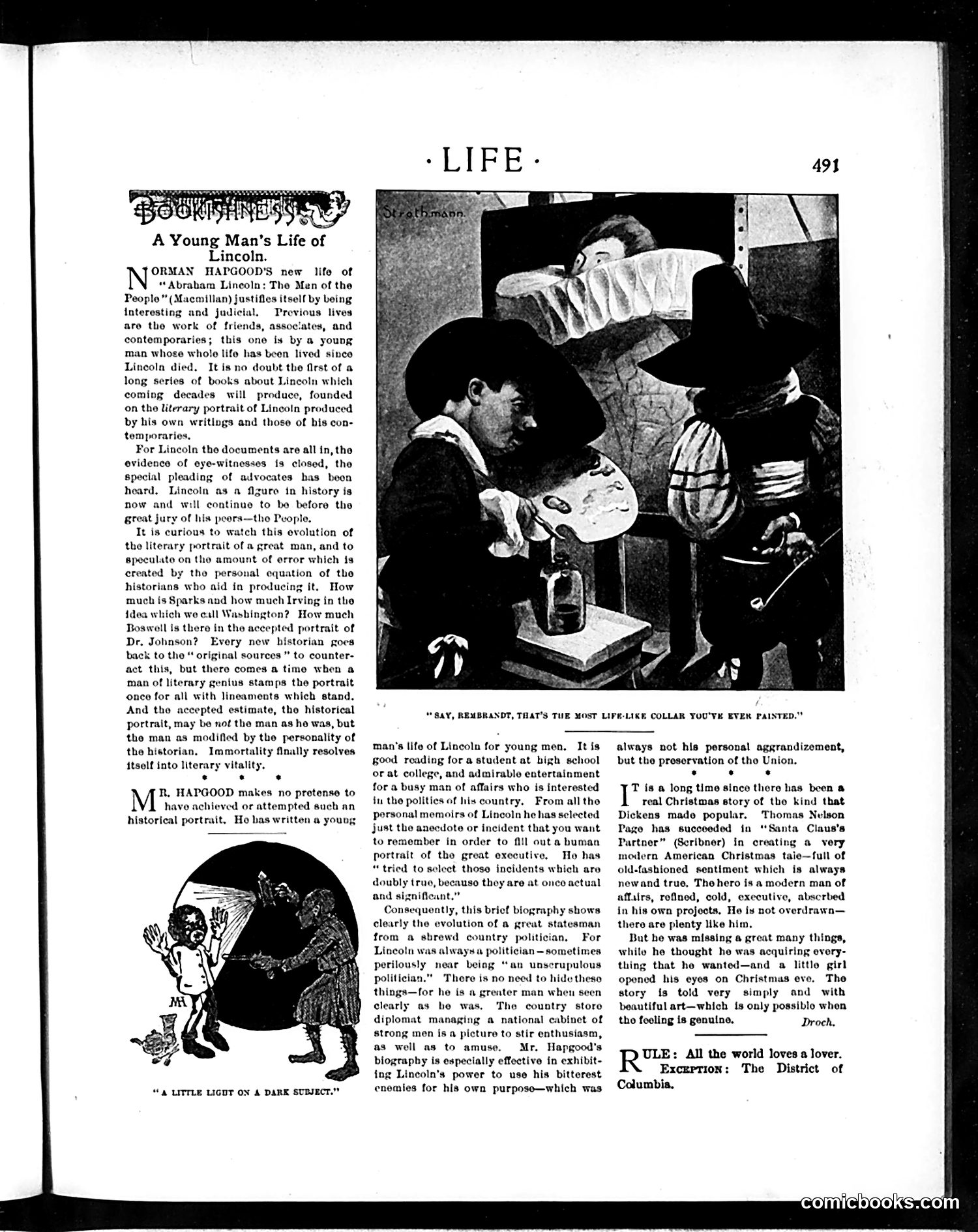
This page reviews Norman Hapgood's biography "A Young Man's Life of Lincoln." The top photograph shows two men examining what appears to be a historical document or artifact, with the caption "Say, Rembrandt, that's the most life-like collar you've ever painted." The lower cartoon, titled "A Little Light on a Dark Subject," depicts two figures in period dress examining something, likely satirizing historical interpretation itself. The review discusses how Hapgood's work differs from previous Lincoln biographies by focusing on personal anecdotes and contemporary accounts rather than established historical narratives. The text notes this approach reveals how historians' interpretations shape the "literary portrait" of historical figures, modifying facts through their own perspectives—a commentary on historiography and biographical bias.
📄 Transcribed text from this page (OCR, searchable)
Machine-transcribed from the original scan — historical spelling and the odd misread are preserved.
A Young Man’s Life of Lincoln. ORMAN HAPGOOD'S new life of “Abraham Lincoln: The Men of the Peoplo” (Macmillan) justifies itself by being interesting and judicial, Previous lives aro the work of friends, associates, and contemporaries; this one is by a young man whose whole life has been lived since Lincoln died, It is no doubt the first of a long series of books about Lincoln which coming decades will produce, founded on tho literary portrait of Lincoln produced by his own writings and those of bis con- temporaries, For Lincoln the documents are all in, tho evidence of eye-witnesses {8 closed, the special pleading of advocates has been heard, Lincoln as a figuro in history is now and will continue to be before tho great jury of his peors—the People, It is curious to watch this evolution of the literary portrait of a great man, and to speculate on the amount of error which 1s created by the personal equation of the historians who aid ia producing it, How much is Sparks and how much Irving in the idea which we call Washington? How much Boswell is thero in the accepted portrait of Dr. Johnson? Every new historian goes back to the “ original sources " to counter- act this, but there comes a time when a man of literary genius stamps tho portrait once for all with lineaments which stand. And tho accepted estimate, tho historical portrait, may be not the man as he was, but tho man as modifled by the personality of the historian, Immortality Nnally resolves itself into literary vitality, * . . R. HAPGOOD makes no pretense to have achieved or attempted such an historical portrait, Ho has written a young “a LITTLE LIGDT ON 4 DARK SUBJECT." “SAY, REMBRANDT, THAT'S TUE MOST LIPE-LIKE COLLAR YOU'VE EVEK PAINTED." man’s life of Lincoln for young men. It is good reading for a student at bigh school or at college, and admirable entertainment for a busy man of affairs who is interested in the politics of his country. From all tho personal memoirs of Lincoln he has selected just the anecdote or incident that you want to remember in order to fill outa buman portrait of tho great executive. Ho has “ tried to select those incidents which aro doubly true, becauso thoy are at onco actual and significant.” Consequently, this brief biography shows clearly the evolution of a great statesman from a sbrewd country politician, For Lincotn was always politician — sometimes perilously near being “an unscrupulous politician.” There is no need to hide theso things—for he is a greater man when seen clearly as be was. The country store diplomat managing a national cabinet of strong men isa picture to stir enthusiasm, as well as to amuse. Mr. Hapgood’s biography is especially effective in exhibit- ing Lincoln's power to uso his bitterest enemies for his own purposo—which was always not his personal aggrandizement, but the prosorvation of tho Union. . . * T is a long timo since thoro has been a real Christmas story of tho kind that Dickens mado popular, Thomas Nelson Pago has succoeded in “Santa Claus's Partner” (Scribner) in creating a very modern Amorican Christmas taie—full of old-fashioned sentiment which is always newand true, Tho hero is a modern man of affairs, roflned, cold, executive, abscrbed in his own projects, Ho is not overdrawa— thero are plenty like him. But he was missing @ great many things, while ho thought he was acquiring overy- thing that he wanted—and a little girl oponed his eyes on Christmas eve. Tho story {s told vory simply and with beautiful art—which 1s only possiblo whon tho fooling is genulno. Droch. ULE: All the world loves a lover. Exception: The District of Columbia,