
Life, 1899-12-07 · page 15 of 20
Life — December 7, 1899 — page 15: what you’re looking at
What you’re looking at
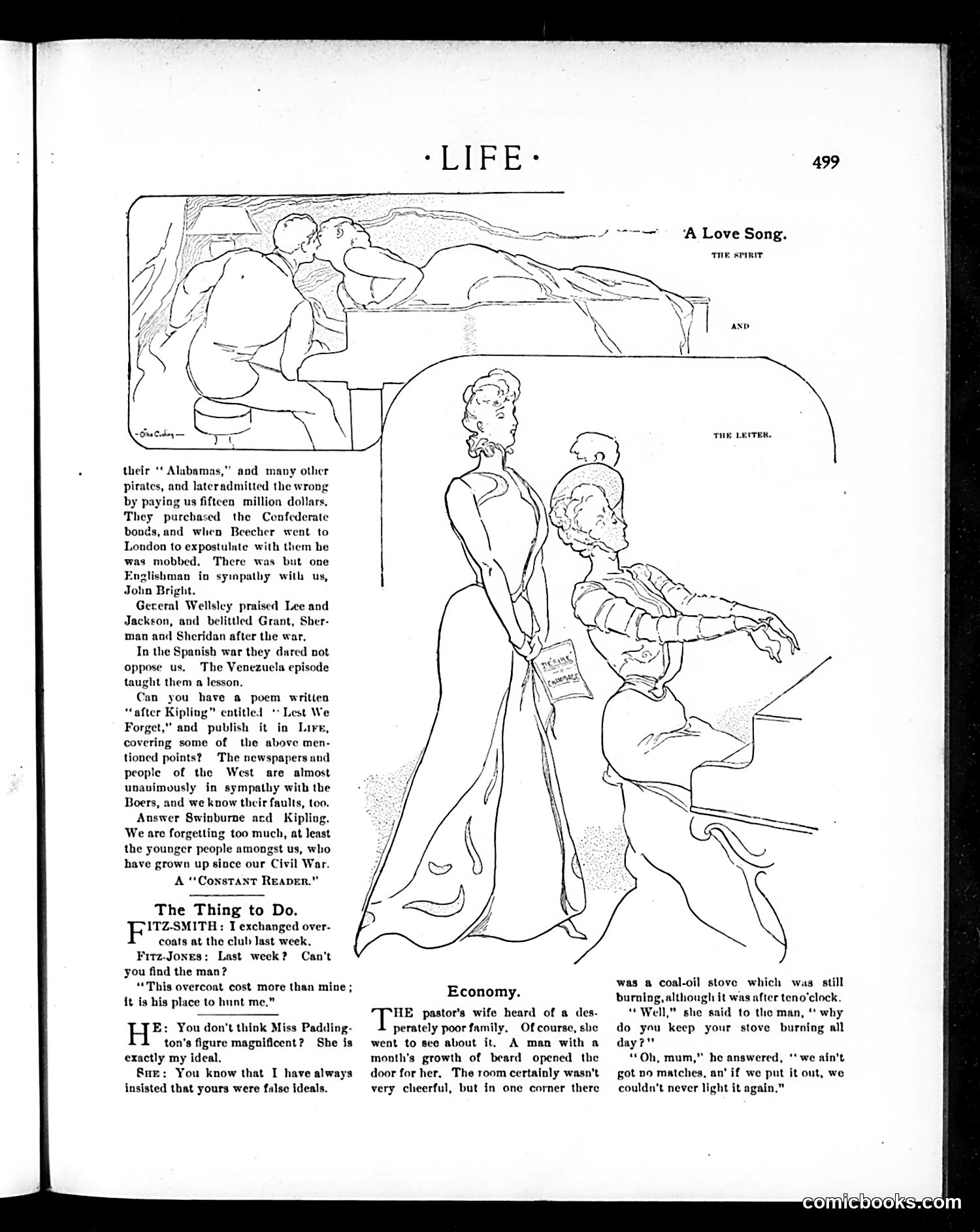
This page contains several brief humorous sketches typical of *Life* magazine's satirical style. **"The Thing to Do"** mocks upper-class social hypocrisy: Fitz-Smith exchanges overcoats at a club, then expects the owner to retrieve his inferior coat—assuming the richer man will naturally chase down the poorer one's property. The second exchange satirizes aesthetic pretension, with one character claiming Miss Paddington's figure is their "ideal" while their companion points out they've always held false standards. **"Economy"** offers situational humor about poverty: a desperately poor family keeps their coal stove burning continuously because they lack matches to relight it if extinguished. The joke exposes the catch-22 of poverty—they waste fuel to avoid the impossibility of relighting it. The upper illustrations appear decorative rather than editorial cartoons, depicting romantic or domestic scenes in the magazine's characteristic line-drawing style. The page reflects *Life*'s focus on social class commentary and everyday absurdities.
📄 Transcribed text from this page (OCR, searchable)
Machine-transcribed from the original scan — historical spelling and the odd misread are preserved.
their ‘‘ Alabamas,” and many other pirates, and lateradmitted the wrong by paying us fifteen million dollars. They purchased the Confederate bonds, and when Beecher went to London to expostulate with them he was mobbed. There was but one Englishman in syinpathy with us, John Bright. Gereral Wellsley praised Lee and Jackson, and belittled Grant, Sher- man and Sheridan after the war, In the Spanish war they dared not oppose us. The Venezuela episode taught them a lesson. Can you have a poem written “after Kipling” entitled ** Lest We Forget,” and publish it in Lire, covering some of the above men- tioned points? The newspapers and people of the West are almost unavimously in sympathy with the Boers, and we know their faults, too. Auswer Swinburne acd Kipling. We are forgetting too much, at least the younger people amongst us, who have grown up since our Civil War. A “Constant Reaper.” The Thing to Do. ITZ-SMITH: I exchanged over- coats at the club last week. Fitz-Jones: Last week? Can't you find the man? “This overcoat cost more than mine ; it is his place to hunt me.” E: You don't think Miss Padding- ton’s figure magnificent? She is exactly my ideal. Sue: You know that I have always insisted that yours were false ideals. ‘A Love Song. Te sri Economy. HE pastor's wife heard of a des. perately poor family, Ofcourse, she went to see about it. A man with a month's growth of beard opened the door for her, The room certainly wasn't very cheerful, but fn one corner there THE LEITER, was a coal-oil stove which was. still burning, although it was after teno’clock. “Well,” she said to the man, “ why do you keep your stove burning all day?” ‘©Oh, mum,” he answered, ‘‘ we ain't got no matches, an’ if we put it out, we couldn't never light it again.”