
Life, 1899-12-07 · page 4 of 20
Life — December 7, 1899 — page 4: what you’re looking at
What you’re looking at
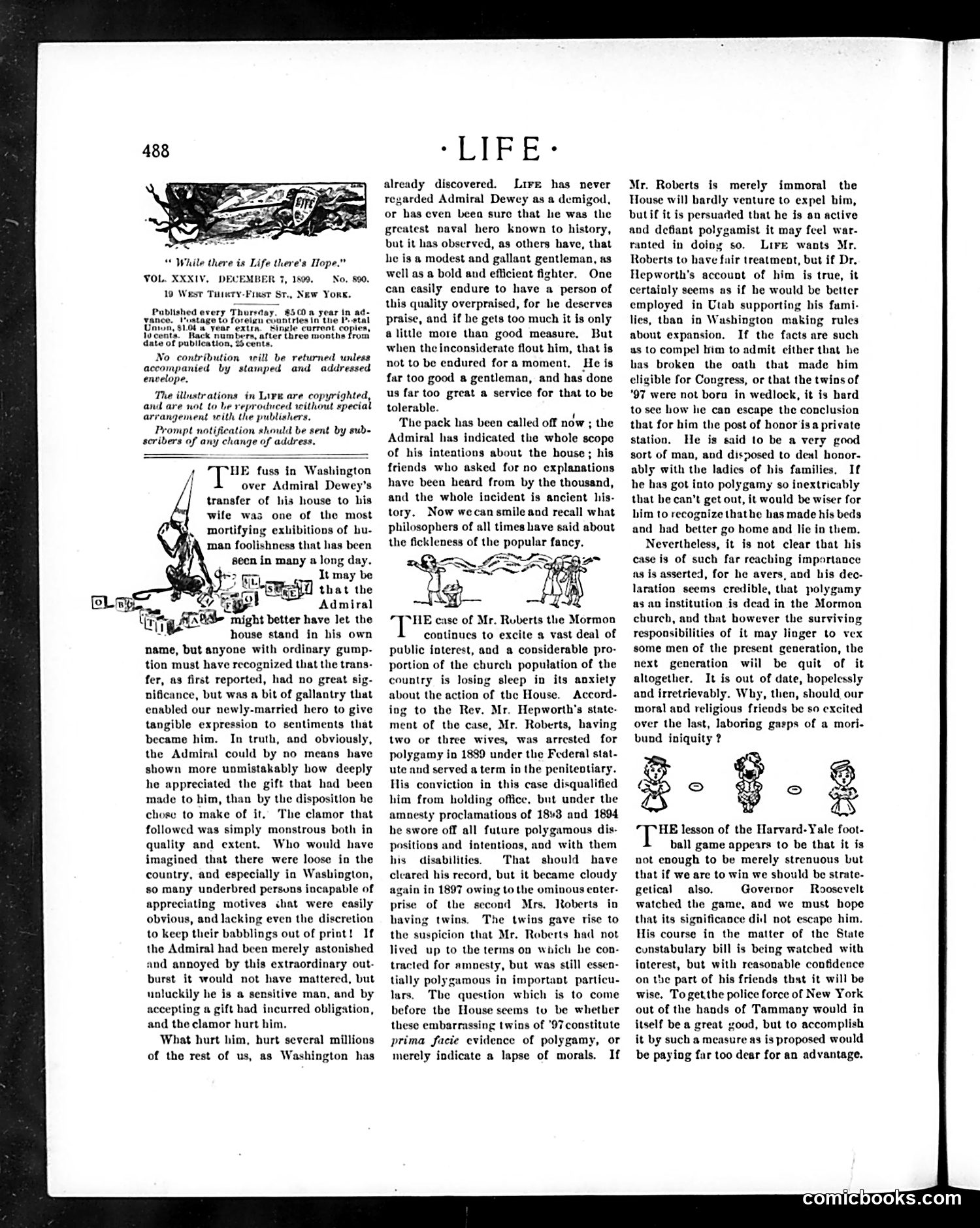
This page discusses Admiral Dewey and a controversy involving Mr. Roberts, a Mormon who practiced polygamy. The left cartoon appears to show someone being battered or attacked, illustrating the "fuss in Washington over Admiral Dewey's transfer." The text critiques both figures: Dewey receives praise as a naval hero but is described as receiving excessive public attention; Roberts, having married multiple wives and served prison time for polygamy in 1893, remains controversial. The article questions whether his case warrants such continued public interest. The piece also references a Harvard-Yale football game and a proposed New York police measure. The overall tone suggests satirizing how Washington handles celebrity figures and moral scandals while ordinary citizens' concerns are overlooked.
📄 Transcribed text from this page (OCR, searchable)
Machine-transcribed from the original scan — historical spelling and the odd misread are preserved.
VOL. XXXIV, DECEMBER 7, 1899. 19 West Tutery. bilshed every Thureaoy., ratage to forelay ‘a Year exttn. single cures ack numbers, after three months from Oke of ‘publiosticns Scents, No contribution will be returned unless accompanied by stamped and addressed envelope. The itlustrations in Lure are copyrighted, and are not to be reproduced without speciat arrangement with the publishers. Prompt notification should be sent by subs scribers of any change of address. HE fuss in Washington over Admiral Dewey’s transfer of lis house to his wile was one of the most mortifying exhibitions of hu- man foolishness that has been seen ae many a long day. It may be Stlswesa that the Admiral ia a better have let the house stand in his own name, but anyone with ordinary gump- tion must have recognized that the trans- fer, a3 first reported, had no great sig- nificance, but was a bit of gallantry that enabled our newly-married hero to give tangible expression to sentiments that became him. In truth, and obviously, the Admiral could by no means have shown more unmistakably how deeply he appreciated the gift that had been made to him, than by the disposition he chose to make of it. The clamor that followed was simply monstrous both in quality and extent. Who would have imagined that there were loose in the country, and especially in Washington, so many underbred persuns incapable of appreciating motives chat were easily obvious, and lacking even the discretion to keep their babblings out of print! If the Admiral had been merely astonished and annoyed by this extraordinary out- burst it would not have mattered, but unluckily he is a sensitive man, and by accepting a gift had incurred obligation, and the clamor hurt him. What hurt him, hurt several millions of the rest of us, as Washington has LIFE already discovered. Lire has never regarded Admiral Dewey as a demigod, or has cven been sure that he was the greatest naval hero known to history, but it has observed, as others have, that he is a modest and gallant gentleman, as well as a bold and efficient fighter, One can easily endure to have a person of this quality overpraised, for he deserves praise, and if he gets too much it is only alittle more than good measure, But when the inconsiderate flout him, that is not to be endured fora moment. He is far too good a gentleman, and has done us far too great a service for that to be tolerable. ' The pack has been called off now ; the Admiral has indicated the whole scope of his inteations about the house ; his friends who asked for no explanations have been heard from by the thousand, and the whole incident is ancient his- tory. Now wecan smile and recall what philosophers of all times have said about the fickleness of the popular fancy. Ay MEF SE er <9 — T2 case of Mr. Ruberts the Mormon continues to excite a vast deal of public interest, and a considerable pro- portion of the church population of the country is losing sleep in its anxiety about the action of thc House. Accord- ing to the Rev. Mr. Hepworth’s state- ment of the case, Mr. Roberts, having two or three wives, was arrested for polygamy in 1889 under the Federal stat- ute and served a term in the penitentiary. His conviction in this case disqualified him from holding office, but under the amnesty proclamations of 1843 and 1894 he swore off all future polygamous dis- positions and intentions, and with them his disabilities. © That should have cleared his record, but it became cloudy again in 1897 owing to the ominous enter- prise of the second Mrs, Roberts in having twins. The twins gave rise to the suspicion that Mr. Roberts had not lived up to the terms on which he con- tracted for amnesty, but was still essen- tially polygamous in important particu- lars, The question which is to come before the House seems tu be whether these embarrassing twins of ‘97constitute prima facie evidence of polygamy, or merely indicate a lapse of morals. If Mr. Roberts is merely immoral the House will bardly venture to expel bim, butif it is persuaded that he is an active and defiant polygamist it may feel war- ranted in doing so. Lire wants Mr. Roberts to have fair treatment, but if Dr. Hepworth’s account of him is true, it certainly seems as if he would be better employed in Utab supporting his fami- lies, than in Washington making rules about expansion. If the facts are such as to compel lim to admit either that he bas broken the oath that made him eligible for Congress, or that the twins of ‘97 were not bora in wedlock, it is hard to see how he can escape the conclusion that for him the post of honor isa private station. He is said to be a very good sort of man, and disposed to deal honor- ably with the ladics of his families, If he has got into polygamy so inextricably that he can’t get out, it would be wiser for him to recognize thathe has made his beds and had better go home and lic in them. Nevertheless, it is not clear that his case is of such far reaching importance as is asserted, for he avers, and his dec- laration seems credible, that polygamy as an institution is dead in the Mormon church, aud that however the surviving responsibilities of it may linger to vex some men of the present generation, the next generation wiil be quit of it altogether. It is out of date, hopelessly and irretrievably. Why, then, should our moral and religious friends be so excited over the last, laboring gasps of a mori- bund iniquity ? HE lesson of the Harvard-Yale foot- ball game appears to be that it is not enough to be merely strenuous but that if we are to win we should be strate- getical also. Governor Roosevelt watched the game, and we must bope that its significance dil not escape him. His course in the matter of the State constabulary bill is being watched with interest, but with reasonable confidence on the part of his friends that it will be wise. To getthe police force of New York out of the hands of Tammany would in itself be a great youd, but to accomplish it by such a measure as is proposed would be paying far too dear for an advantage. comicbooks.com