
A complete issue · 20 pages · 1899
Life — November 23, 1899
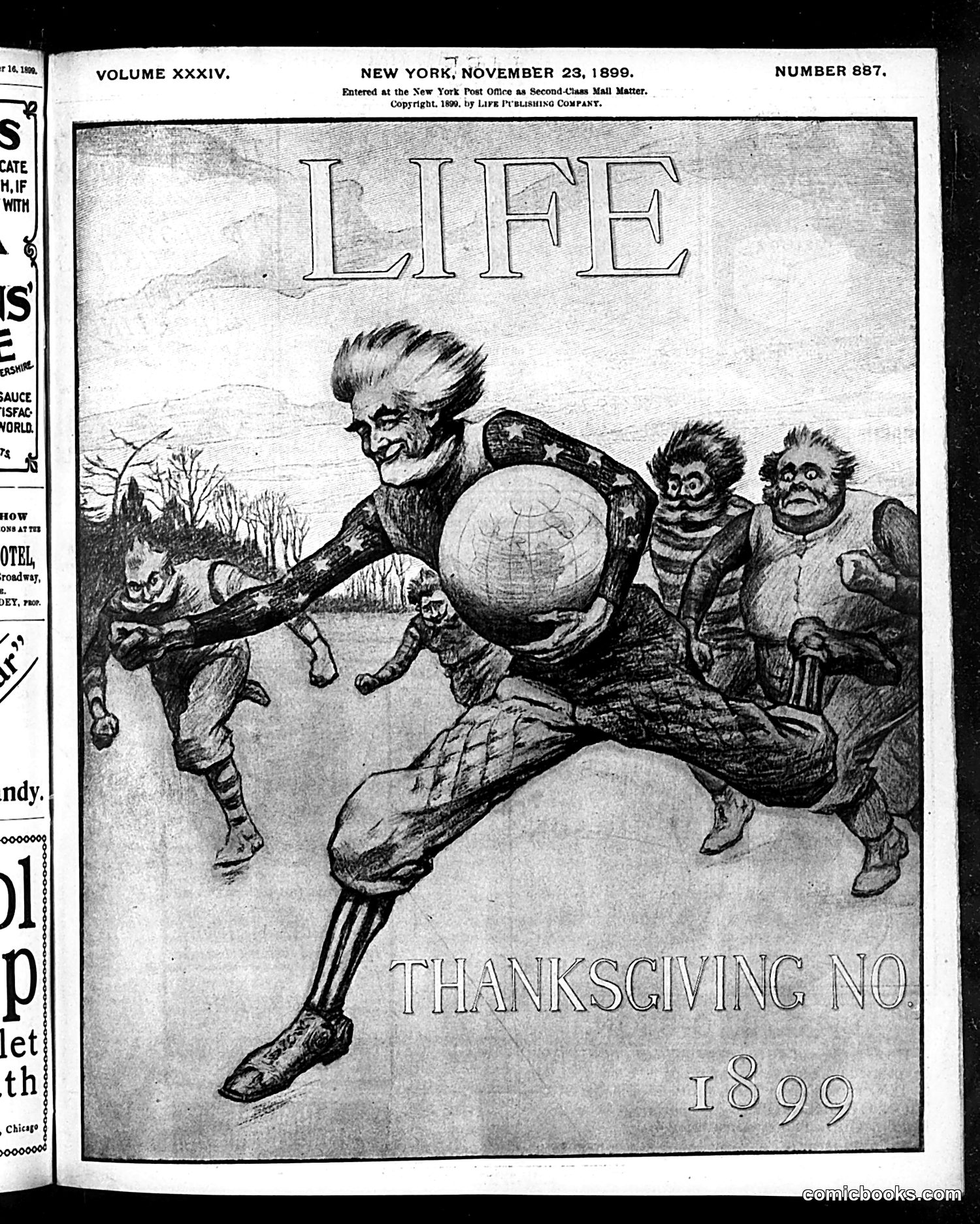
This Thanksgiving issue cover features a grotesque caricatured figure juggling a globe while surrounded by smaller demon-like creatures. The exaggerated facial features and wild hair suggest this represents a specific political figure, likely a world leader or powerful politician of the era, though the identity isn't explicitly stated on this page. The satire appears to comment on imperial ambitions or global power-playing around 1899—a period of intense American and European colonialism. The juggling of the world, combined with the demonic attendants, suggests commentary on reckless or dangerous manipulation of international affairs. The "Thanksgiving No. 1899" subtitle indicates this is satirical commentary on what the magazine considered laughable or concerning about contemporary geopolitics.
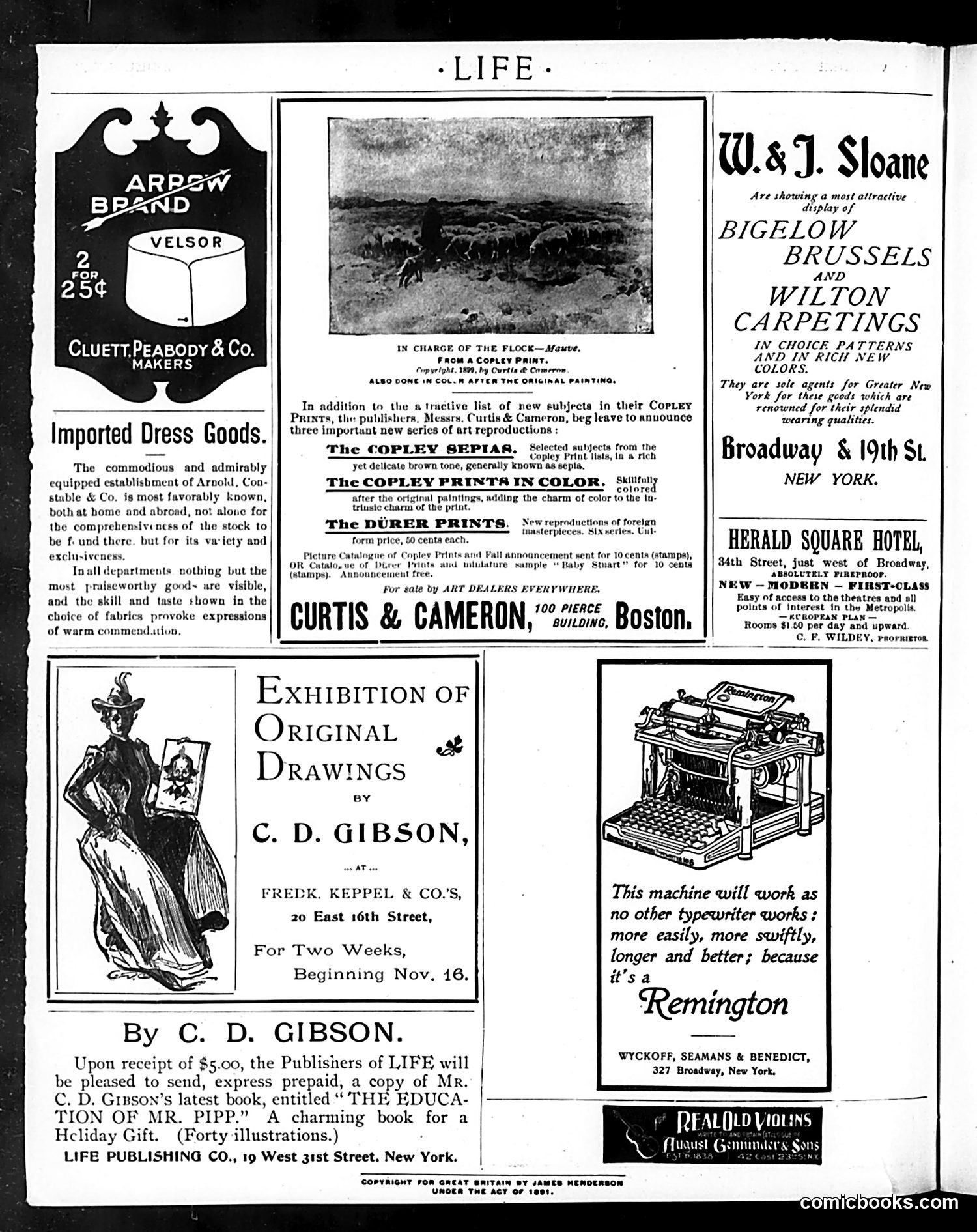
This page is primarily **advertising**, not satire or political commentary. It contains several period ads (circa 1890s-early 1900s): - **Arrow Brand Velsor collars** (Cluett, Peabody & Co.) - **Arnold, Constable & Co.** imported dress goods - **Copley Prints** and **Durer Prints** (art reproductions) - **Curtis & Cameron** art dealer in Boston - **Exhibition of Original Drawings by C.D. Gibson** (the famous Gibson Girl illustrator) - **W. & J. Sloane** carpeting on Broadway - **Herald Square Hotel** advertisement - **Remington typewriter** - **Real Old Violins** (bottom) The central image shows "In Charge of the Flock—Harvest" from a Copley Print. There is **no political cartoon or satire** on this page—it's a straightforward advertising section from Life magazine's commercial pages.
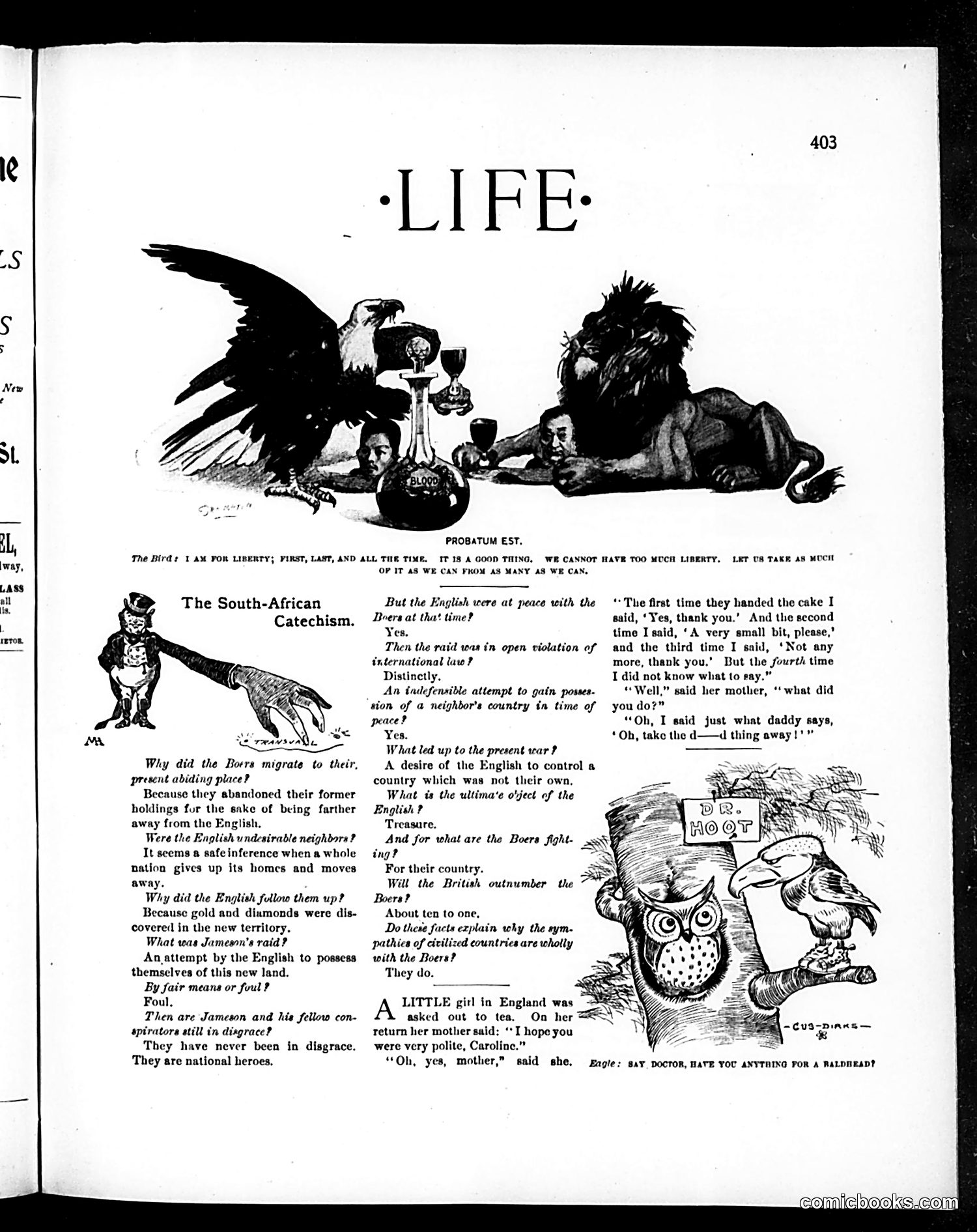
The top illustration satirizes imperial power dynamics, depicting an eagle (representing America) and a lion (Britain) toasting over a goblet, with smaller figures below—likely representing colonized peoples or rival nations. "The South-African Catechism" is a satirical Q&A mocking British justifications for the Boer War. It ridicules claims that British intervention was benevolent, revealing the actual motives: controlling territory and resources ("a desire of the English to control a country"). The catechism format parodies religious instruction, suggesting the war's justifications were hollow propaganda. The lower right cartoon shows an owl reading "Life" magazine, commenting on a doctor's lack of baldness remedies—typical period advertising satire. The tea anecdote illustrates social propriety versus reality.
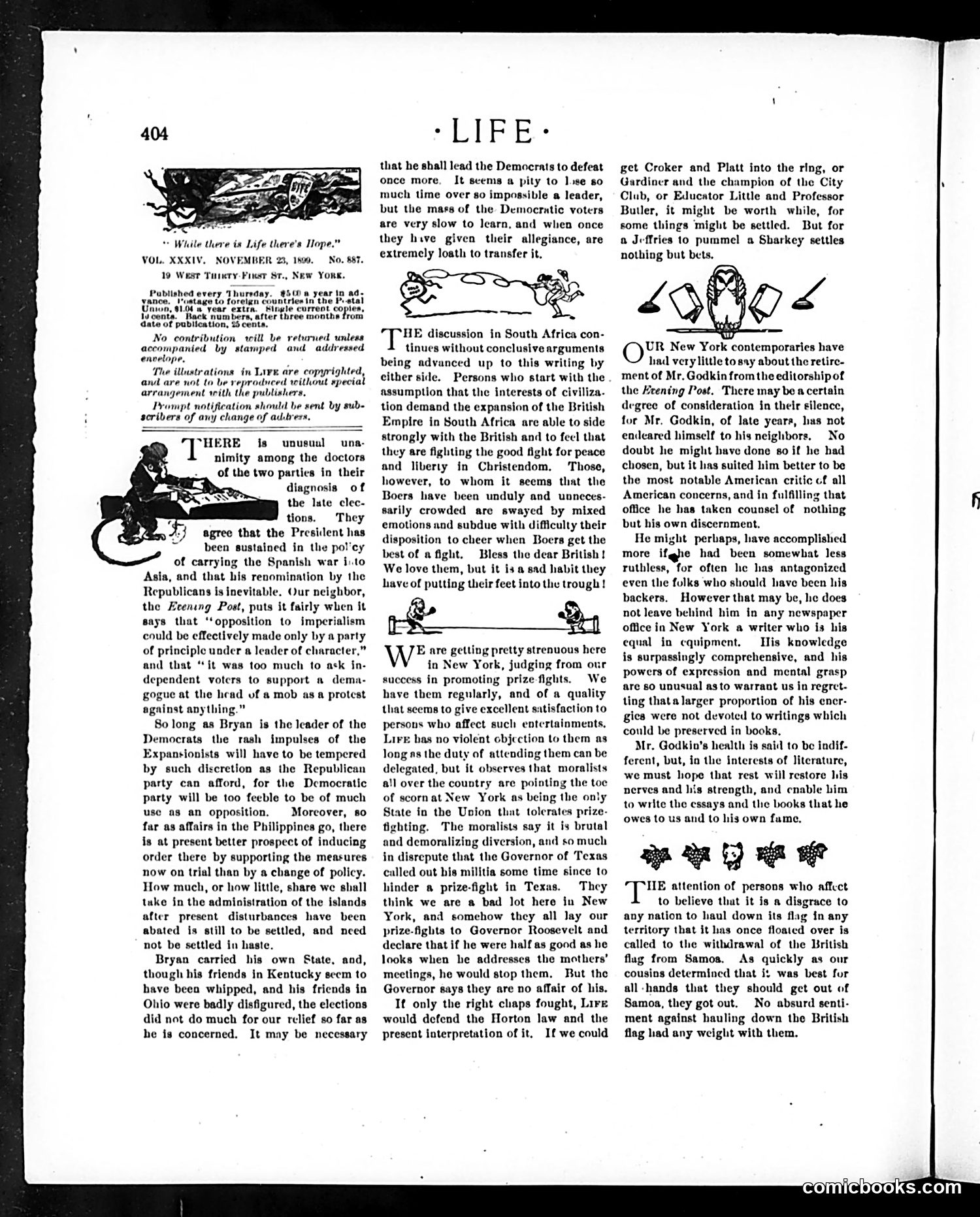
The page contains editorial commentary on American politics and international affairs rather than a single unified cartoon. Key points: **Political Context:** Discussion of South African conflicts and British Imperial interests; Democratic Party leadership struggles; criticism of prize-fighting regulations and the Governor of Texas. **The Small Cartoons:** Appear to satirize political hypocrisy—one shows figures discussing "opposition to imperialism" while another depicts prize-fight promotion debates. **Main Target:** American moralizers who criticize prize-fighting while ignoring imperial expansion and other ethical inconsistencies. The text mocks New York's "righteousness" about prize-fights while defending expansionism elsewhere. The satire critiques selective moral outrage and political double-standards of the era.
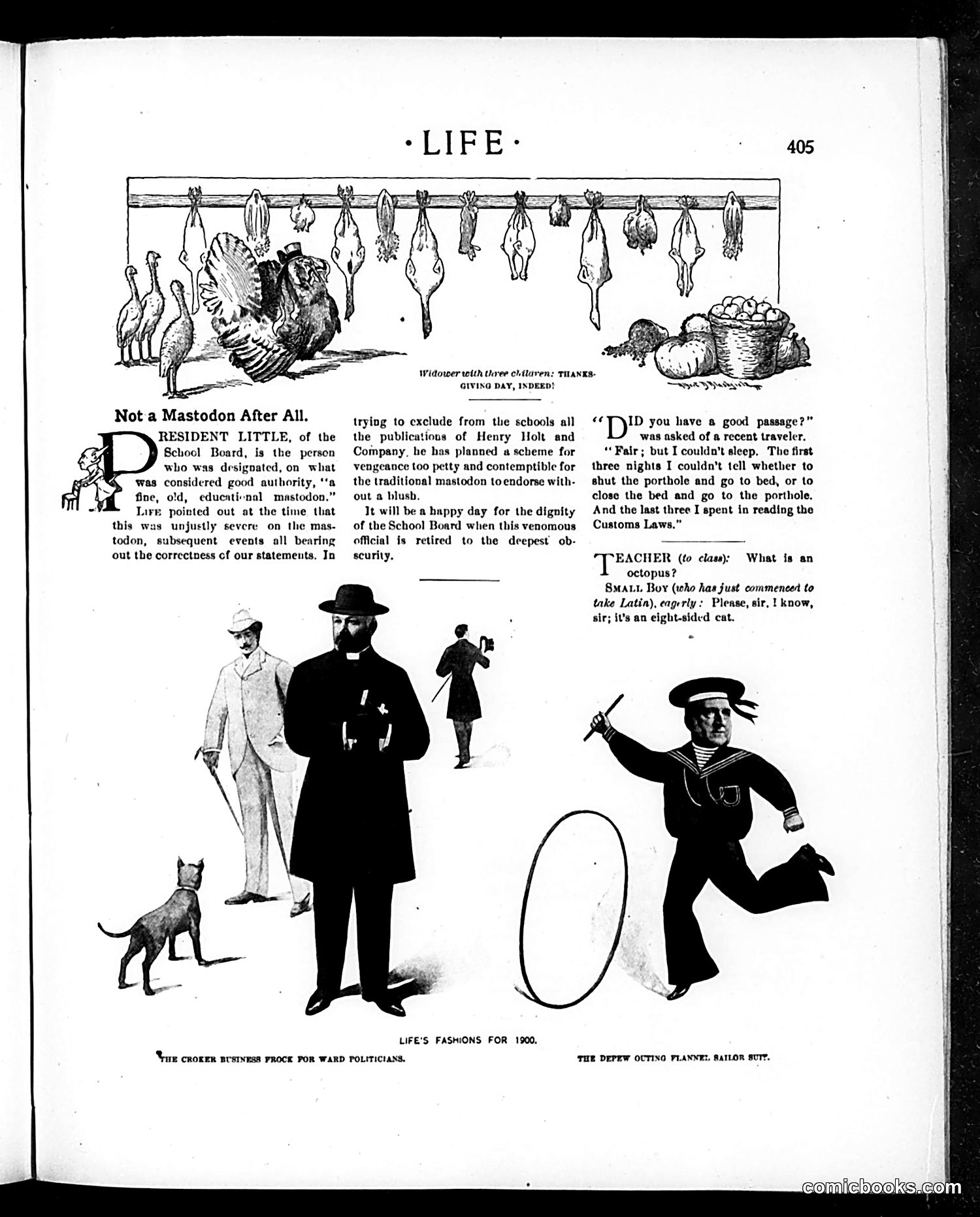
This page contains two distinct pieces of satire from circa 1900: **"Not a Mastodon After All"** mocks a School Board resident whose attempt to exclude Henry Holt Company publications from schools backfired—making him look foolish rather than authoritative. **"Life's Fashions for 1900"** presents two fashion mockeries: the top caption references "the choker business price for ward politicians" (suggesting corrupt officials adopt restrictive neckwear), while the bottom shows "the duffly octino flannel: sailor suit"—a sailor in an exaggerated octagonal or circle-shaped outfit. The sailor illustration satirizes impractical fashion trends affecting even naval uniforms. Both pieces use visual absurdity to critique institutional and sartorial pretension of the era.
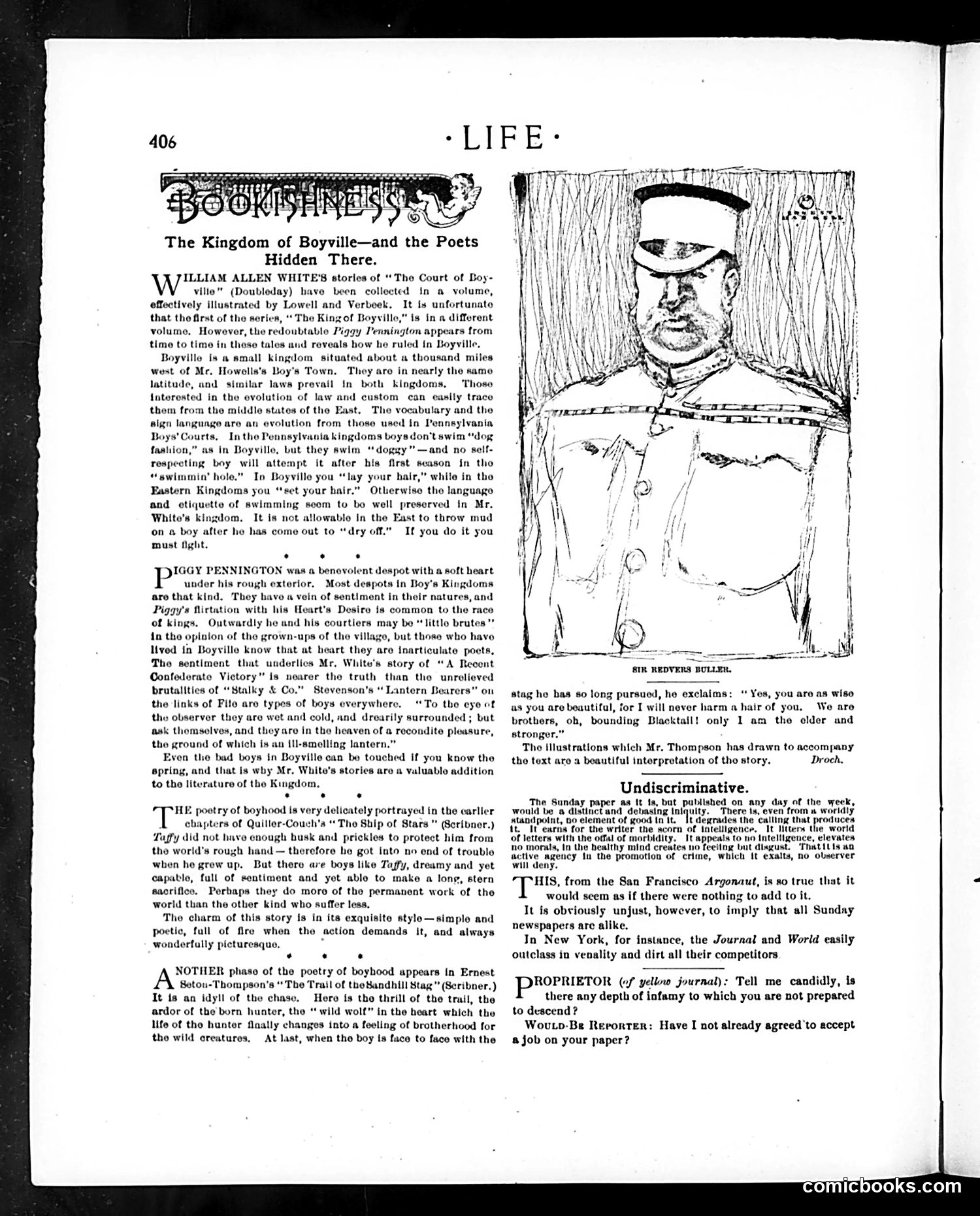
This page discusses William Dean Howells' "Boy's Town" stories, comparing the fictional "Kingdom of Boyville" to real boyhood experiences. The illustration shows a uniformed official (identified as "SIR ARTHUR SULLIVAN" in the caption), though the connection between the portrait and the text isn't immediately clear from this page alone. The page includes literary criticism praising boyhood poetry by Ernest Seton-Thompson and others, celebrating how these works capture authentic childhood experience and sentiment. The brief "Undiscriminative" section mocks the San Francisco *Argonaut* newspaper, while the final joke satirizes a journalist's interview—poking fun at incompetent reporting. This appears primarily as cultural/literary commentary rather than political satire.
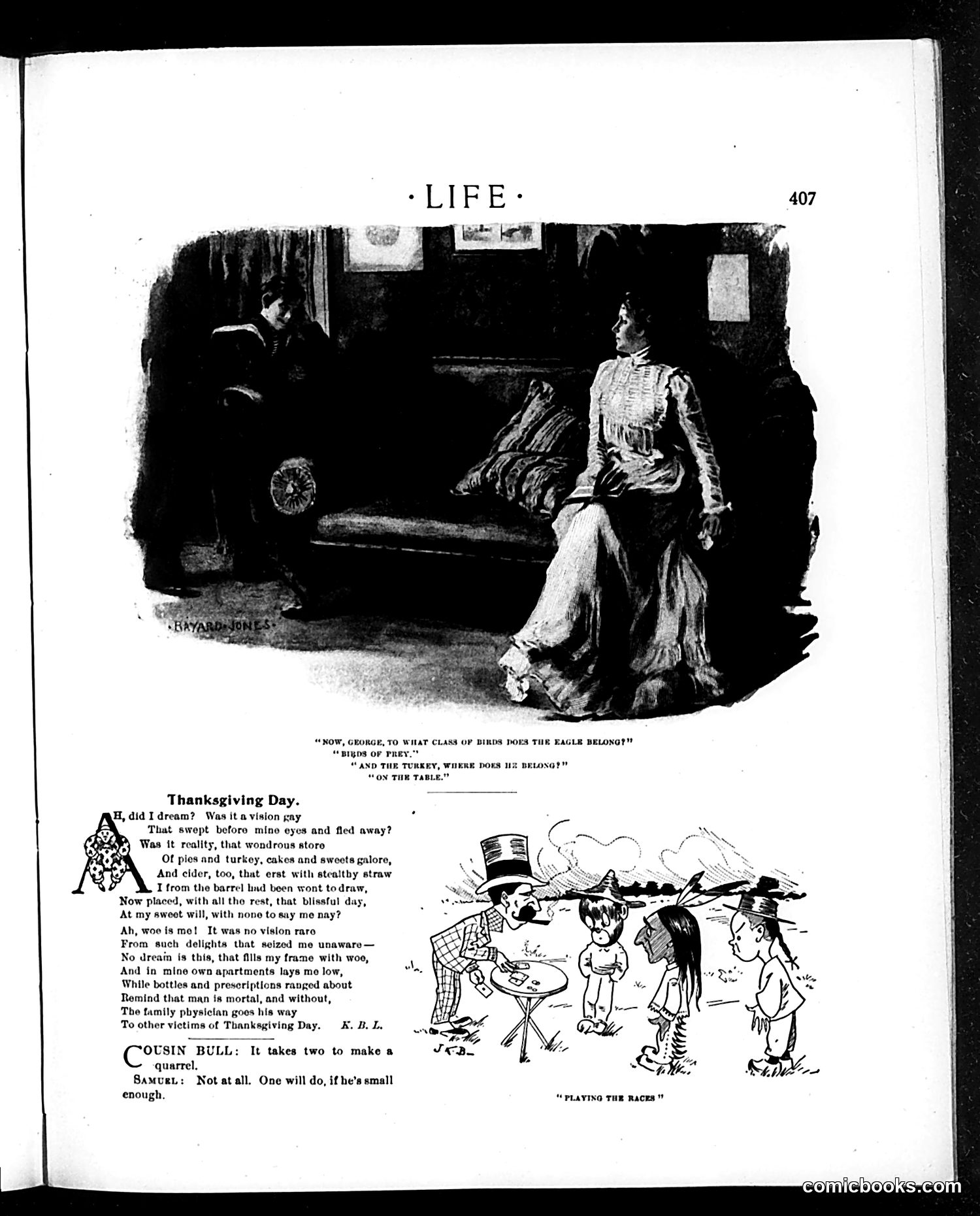
**Top Illustration (by Bayard Jones):** A domestic scene showing a woman sitting on a sofa confronting a man near a doorway. The caption quotes dialogue about classifying birds—likely a coded reference to social categorization or marital tension disguised as innocent conversation. The satirical point appears to be about concealed relationship conflict beneath polite domestic interaction. **"Thanksgiving Day" Poem:** A nostalgic poem contrasting idealized Thanksgiving memories with modern domestic reality, suggesting contemporary family life fails to match traditional expectations. **"Cousin Bull" Joke & "Playing the Races" Cartoon:** A brief humorous exchange about quarrels, paired with an illustration of children playing with toy horses—likely satirizing American fascination with horse racing and gambling culture.
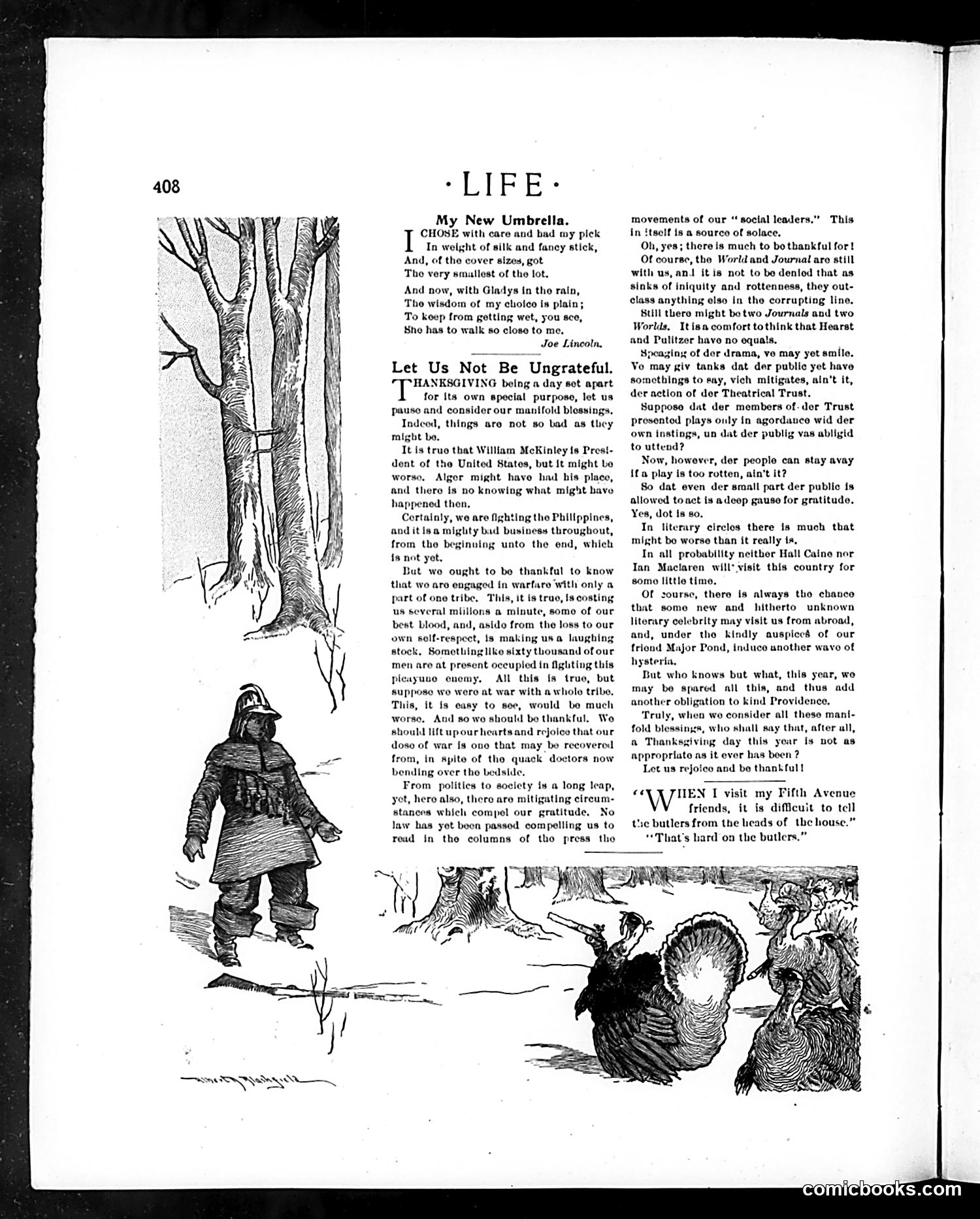
This page from *Life* magazine contains two main elements: **"My New Umbrella"** (top): A humorous poem by Joe Lincoln about choosing an umbrella, with an illustration of tree branches. This appears to be light verse, not political satire. **"Let Us Not Be Ungrateful"** (main article): A Thanksgiving editorial addressing American gratitude despite contemporary challenges. It references President William McKinley, the Philippine-American War ("fighting the Philippines"), and mentions figures like Algernon Alger and Hall Caine. The piece argues Americans should be thankful despite military casualties and political turmoil. **Bottom cartoon**: Shows a figure (possibly a butler or servant, based on the context about Fifth Avenue servants) in conversation with others, illustrating the quoted joke about servants' gossip. The overall tone is patriotic but gently satirical about American complacency and class dynamics.
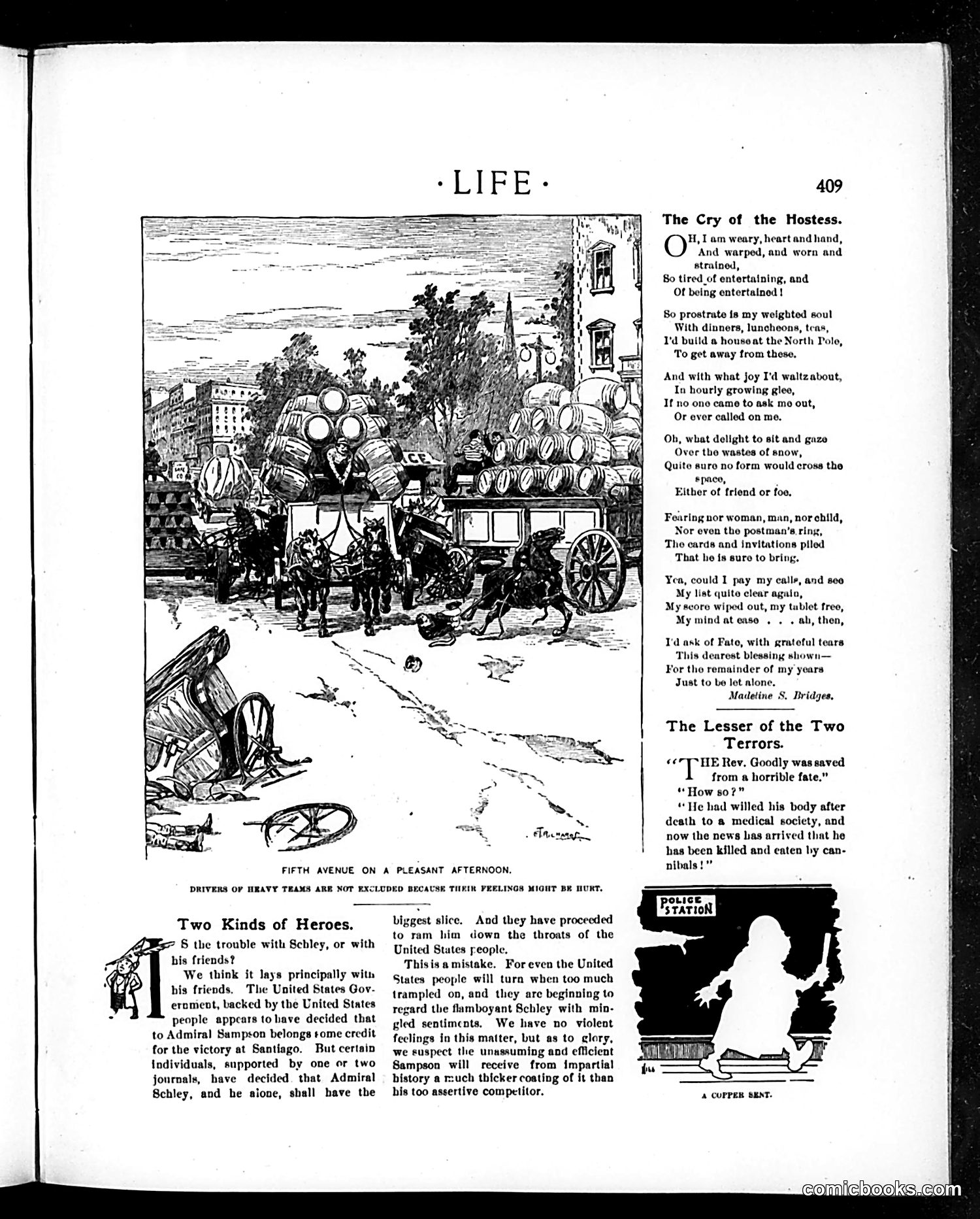
The main illustration depicts "Fifth Avenue on a Pleasant Afternoon" with overturned delivery wagons and chaos—satirizing wealthy New York society's disruption by heavy traffic. The caption notes that drivers of heavy trucks are "not excluded because their feelings might be hurt," suggesting ironic commentary on traffic dangers affecting the wealthy neighborhood. Below, "Two Kinds of Heroes" discusses Admiral Sampson versus Schley regarding credit for the Spanish-American War victory at Santiago. The text indicates debate over which officer deserves recognition, with some journals supporting Schley while others back Sampson. This reflects genuine historical controversy about naval command during the 1898 conflict. "The Lesser of Two Terrors" mentions Reverend Goodly and cannibals, though details remain unclear from visible text.
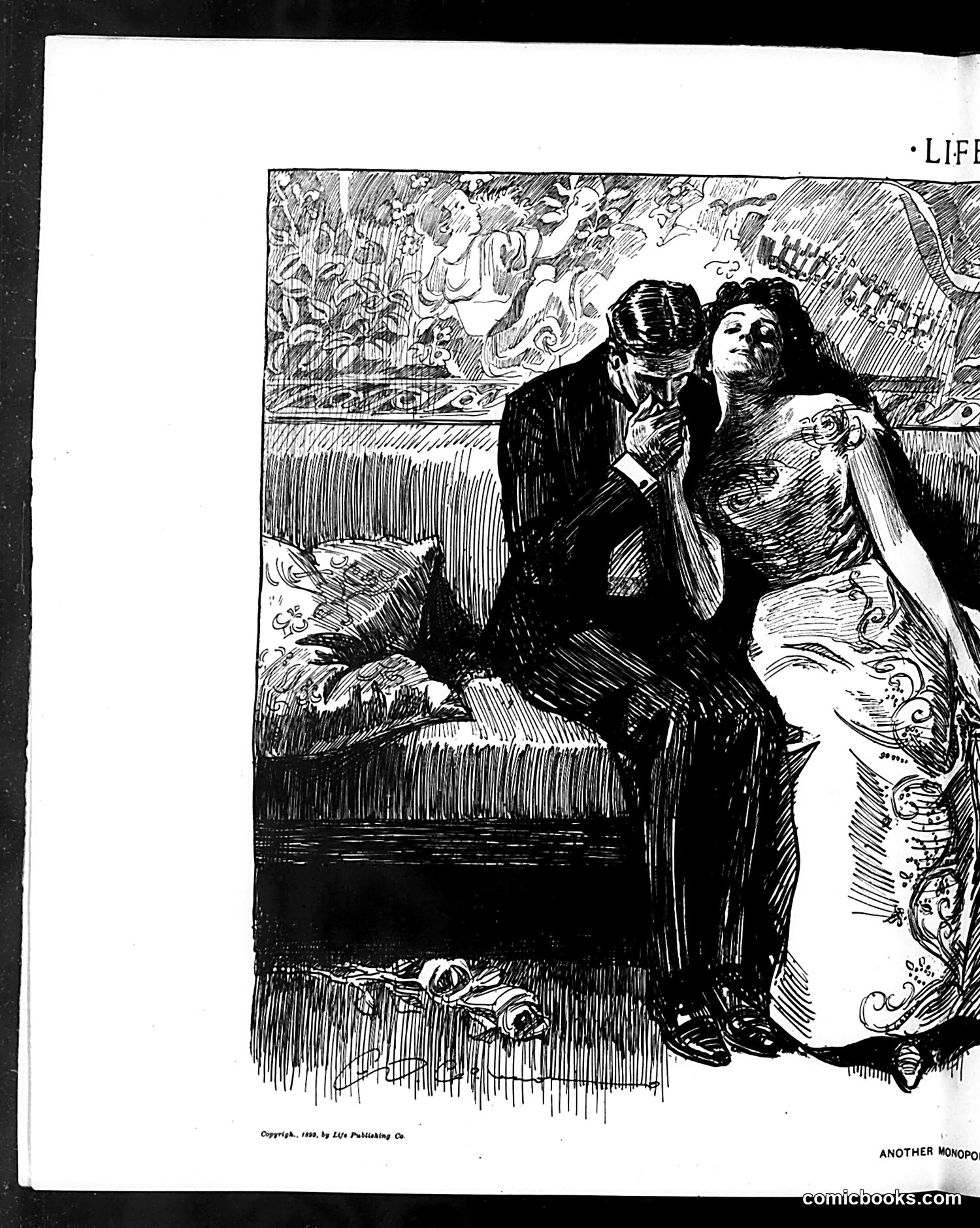
This is a satirical illustration from *Life* magazine (copyright 1908, per the visible text). The cartoon depicts a romantic or intimate scene between a man in formal attire and a woman in an elegant dress, positioned near what appears to be a bed or couch with decorative furnishings visible in the background. The title "ANOTHER MONOPOLY" (visible at bottom) suggests social satire, likely commenting on wealth concentration or exclusive control—themes *Life* frequently satirized during the Progressive Era. The domestic setting and the figures' positioning imply commentary on marriage, romance, or relationships as a form of monopoly or exclusive possession. Without additional context identifying the specific individuals or referencing accompanying article text, the precise satirical target remains unclear, though the critique appears directed at contemporary social attitudes toward romantic relationships or wealth consolidation.
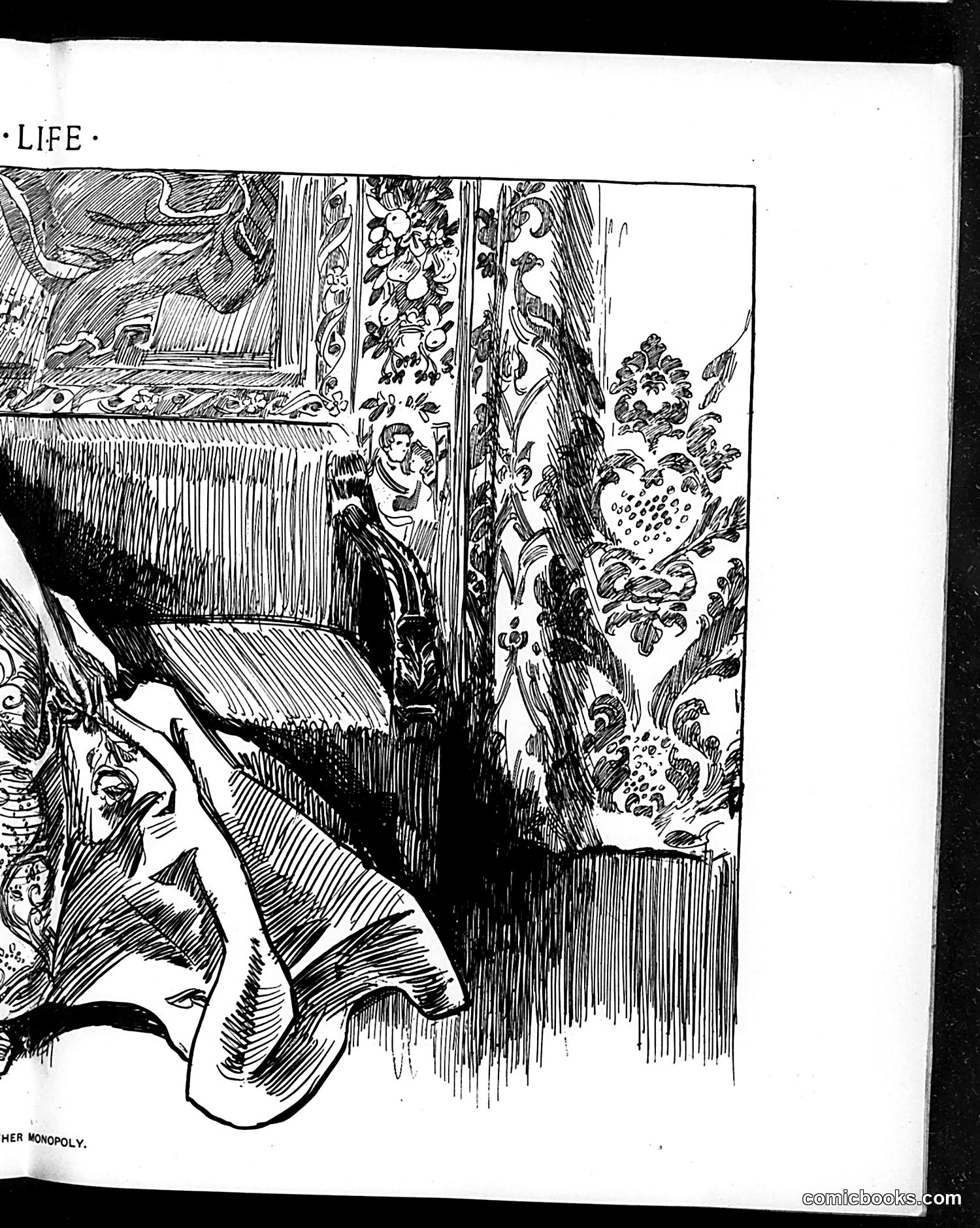
This is a **Life magazine satirical illustration** titled "HER MONOPOLY" (visible at bottom left). The cartoon depicts a woman in an ornate interior—wearing a patterned dress—reclining or resting while surrounded by elaborate decorative elements including floral wallpaper and ornamental details. The satire appears to critique **women's control or dominance within domestic/household spaces**—the "monopoly" on the home. The luxurious setting and the woman's leisured pose suggest commentary on either female domesticity, wealth, or marital dynamics, likely from the **early 20th century** when Life regularly published satirical commentary on gender roles and social conventions. Without additional context or captions visible, the exact target of the satire remains somewhat unclear, though it clearly addresses women's social position or domestic authority.
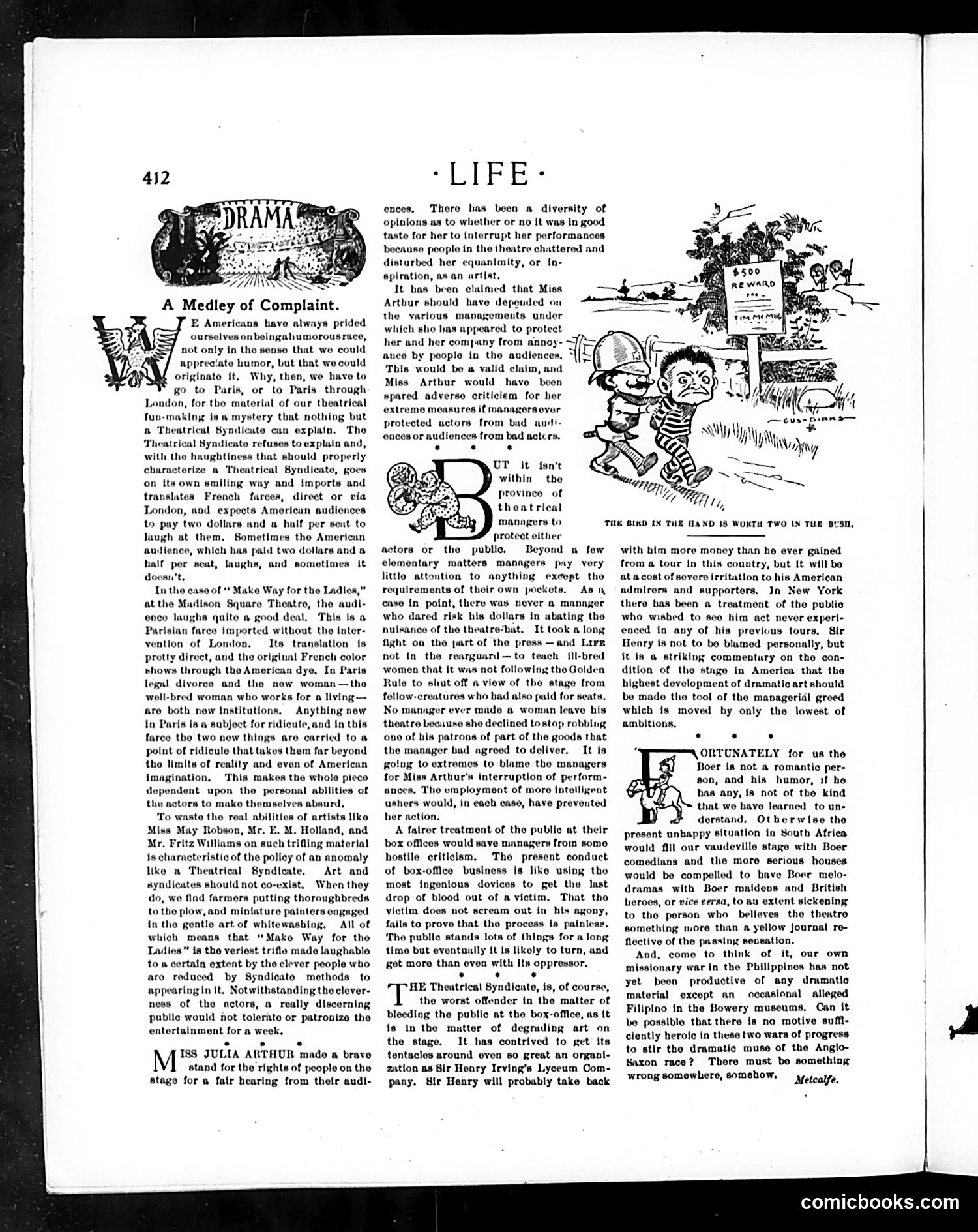
This page critiques theatrical management practices and Miss Julia Arthur's public disputes. The main article "A Medley of Complaint" addresses tensions between actors and theater managers over artistic control and fair treatment. The cartoon titled "The Bird in the Hand is Worth Two in the Bush" (right side) depicts what appears to be theatrical managers or promoters chasing after performers, visually expressing the text's complaint that managers exploit actors for profit while limiting their creative freedom. The satirical point: theater managers prioritize box-office revenue over artistic merit, mistreat actors, and use contractual control to silence criticism. The author advocates for better protections for performers and critiques the Theatrical Syndicate's monopolistic practices. The tone suggests Life magazine sided with actors against exploitative management.
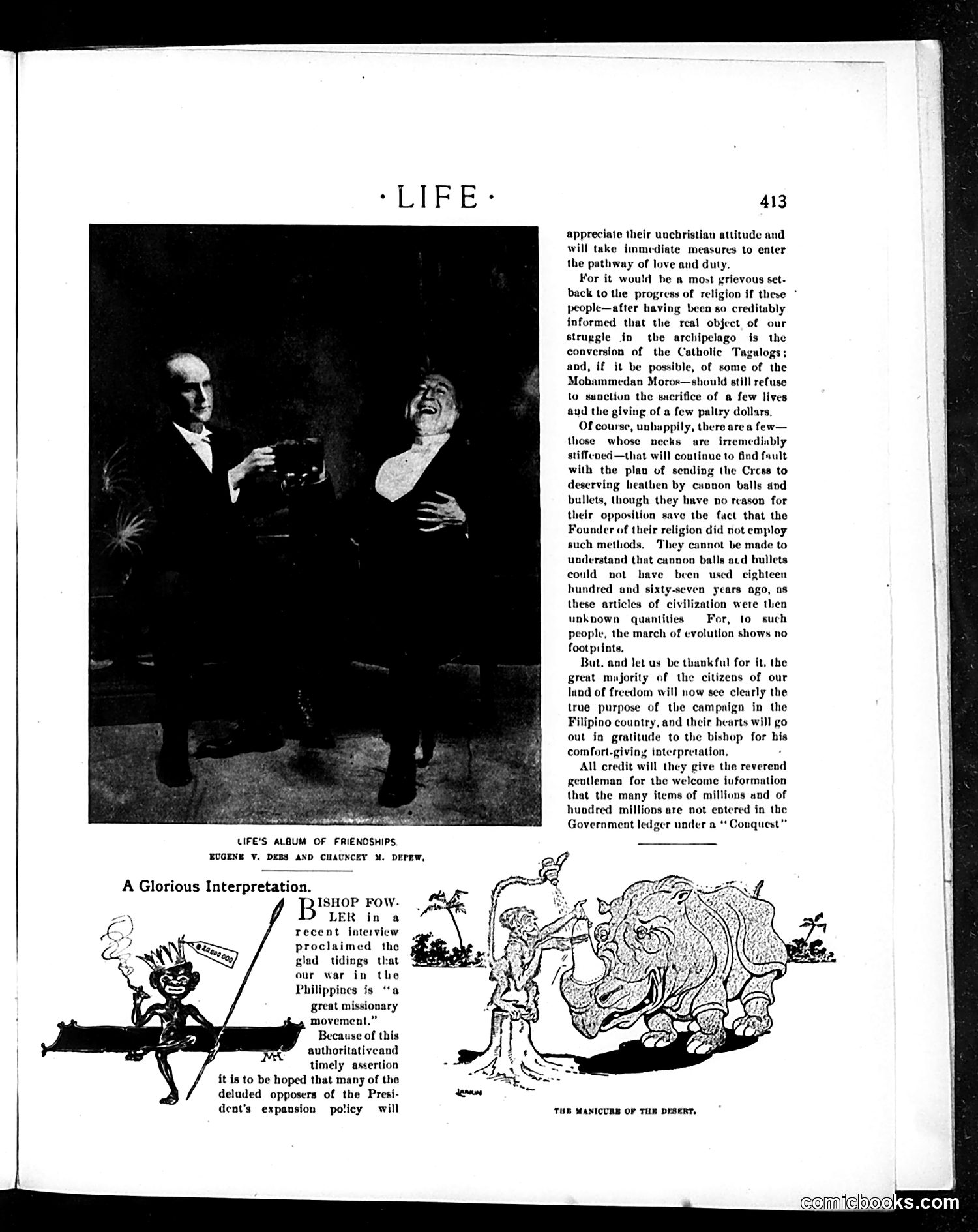
This page satirizes Bishop Fowler's claim that the Philippine-American War is a "great missionary movement." The text is heavily sarcastic, pretending to celebrate the bishop's interpretation while actually mocking it. The satire targets those who justify military conquest as Christian expansion. Life ridicules the logic that: - Cannon fire and bullets are acceptable methods of "conversion" - The Founder of Christianity didn't use such methods (obvious irony) - Americans should ignore the war's cost in lives and money because it's framed as religious duty The cartoon titled "The Manicure of the Desert" (bottom right) appears to satirize the beautification or "civilizing" of colonial territories through military force. The top photo caption "Life's Album of Friendships" names Eugene V. Debs (Socialist politician/labor leader) and Chauncey M. Depew (Republican railroad magnate)—unlikely allies—perhaps suggesting the war united strange political bedfellows. The overall message: Life exposes religious hypocrisy masking imperial ambitions in the Philippines.
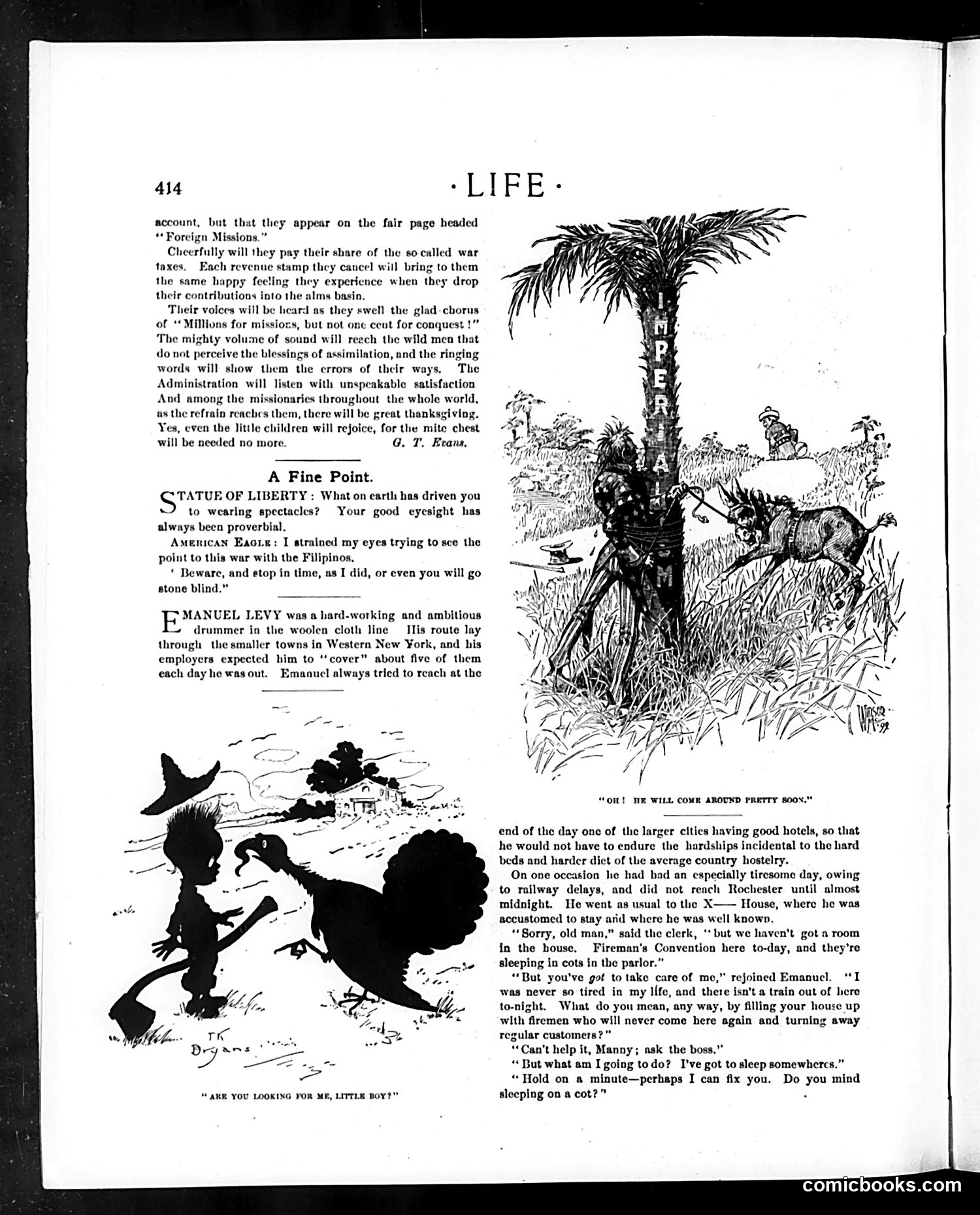
This page contains political satire about American imperialism in the Philippines. The main cartoon depicts the Statue of Liberty wearing spectacles, having "strained her eyes trying to see the point to this war with the Filipinos." The American Eagle warns her she'll go "stone blind" if she doesn't stop—satirizing the contradiction between America's professed democratic ideals and its military expansion in the Philippines. The preceding text mocks wealthy Americans who donate to foreign missionaries while opposing spending on domestic conquest, sarcastically suggesting this hypocrisy will bring "great thanksgiving" worldwide. The lower story about Manuel Levy, a traveling salesman, appears unrelated—a humorous anecdote about finding hotel accommodations during a firemen's convention. The overall page critiques American foreign policy inconsistency: exporting Christianity and "civilization" abroad while pursuing military imperialism that contradicts stated values.
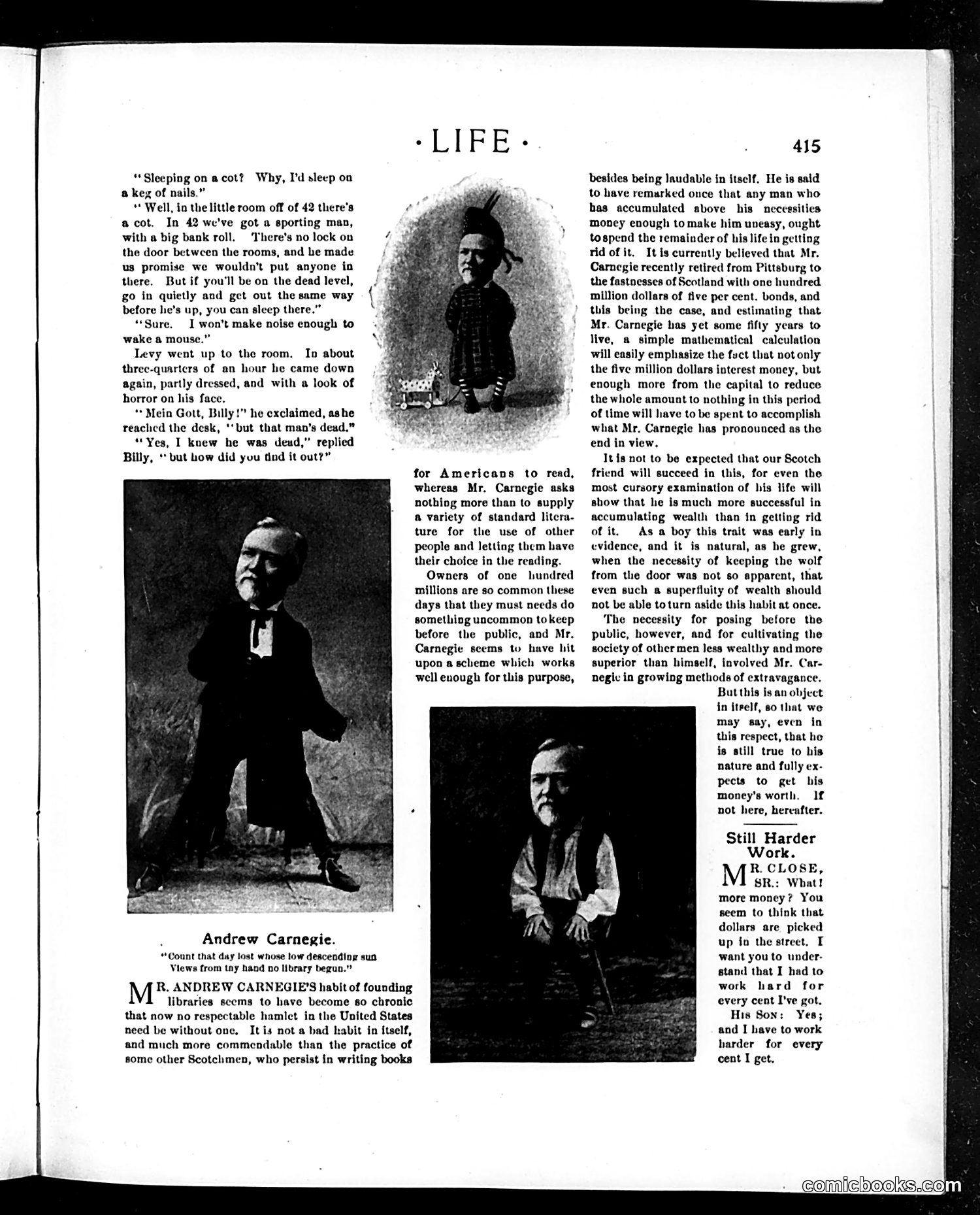
This page satirizes **Andrew Carnegie**, the Scottish-American steel magnate and philanthropist. The accompanying photographs show Carnegie as the subject. The satire targets Carnegie's famous library-building campaign. The piece mocks the contradiction between his stated philosophy—that wealthy men should spend excess money to avoid discomfort—and his actual behavior: he retired to Scotland with $100 million in bonds while claiming to give it away. The author sarcastically calculates that even with fifty years to live, Carnegie couldn't spend his wealth fast enough to match his own principles. The satire also hints at hypocrisy: Carnegie poses as a philanthropist for public standing while remaining fundamentally driven by the accumulation instinct that made him rich. The brief dialogue about sleeping on a cot and the "Still Harder Work" exchange use humor to critique wealthy men's self-justification and their children's inherited entitlement.
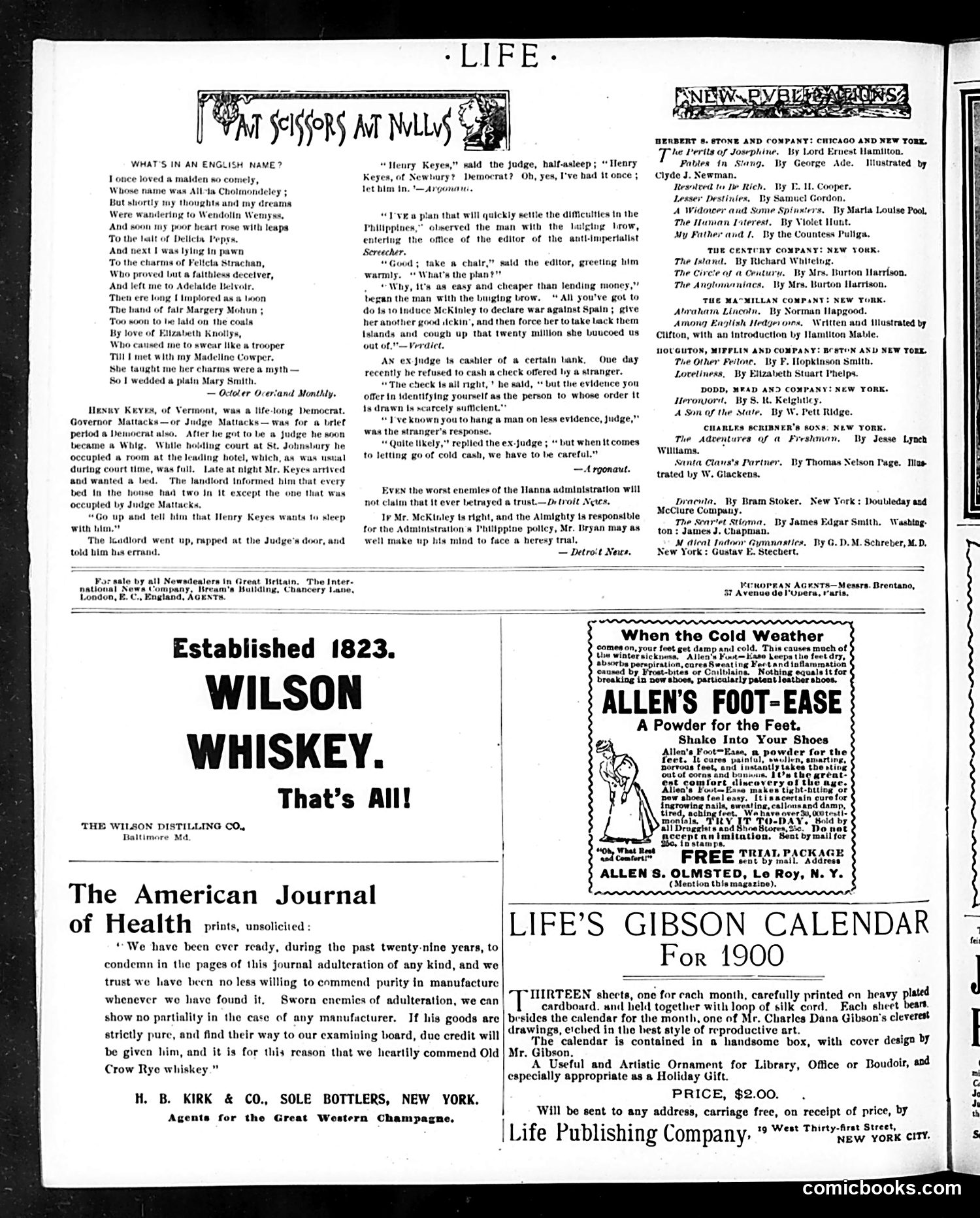
This page contains **multiple short humorous anecdotes** rather than political cartoons. The main satirical pieces target: 1. **"At Scissors at Mills"** — A poem mocking pretentious English surnames (Cholmondeley, Wemyss, etc.), suggesting English naming conventions are absurdly complicated compared to plain "Mary Smith." 2. **The Henry Keyes anecdote** — A Democrat politician requests lodging from a former political rival (now a Judge) who had switched to the Whig party, creating ironic awkwardness. 3. **The Philippines plan** — A satirical jab at anti-imperialist newspaper editors, mocking those who advocated military intervention against Spain to "settle" Philippine issues. 4. **The ex-Judge cashier** — A witty retort about judicial severity: a stranger notes the judge hanged men on less evidence than required to cash a check. The page primarily advertises **Wilson Whiskey, Allen's Foot-Ease, and Life's Gibson Calendar**. These are typical advertisements and book announcements for an 1899-1900 publication.
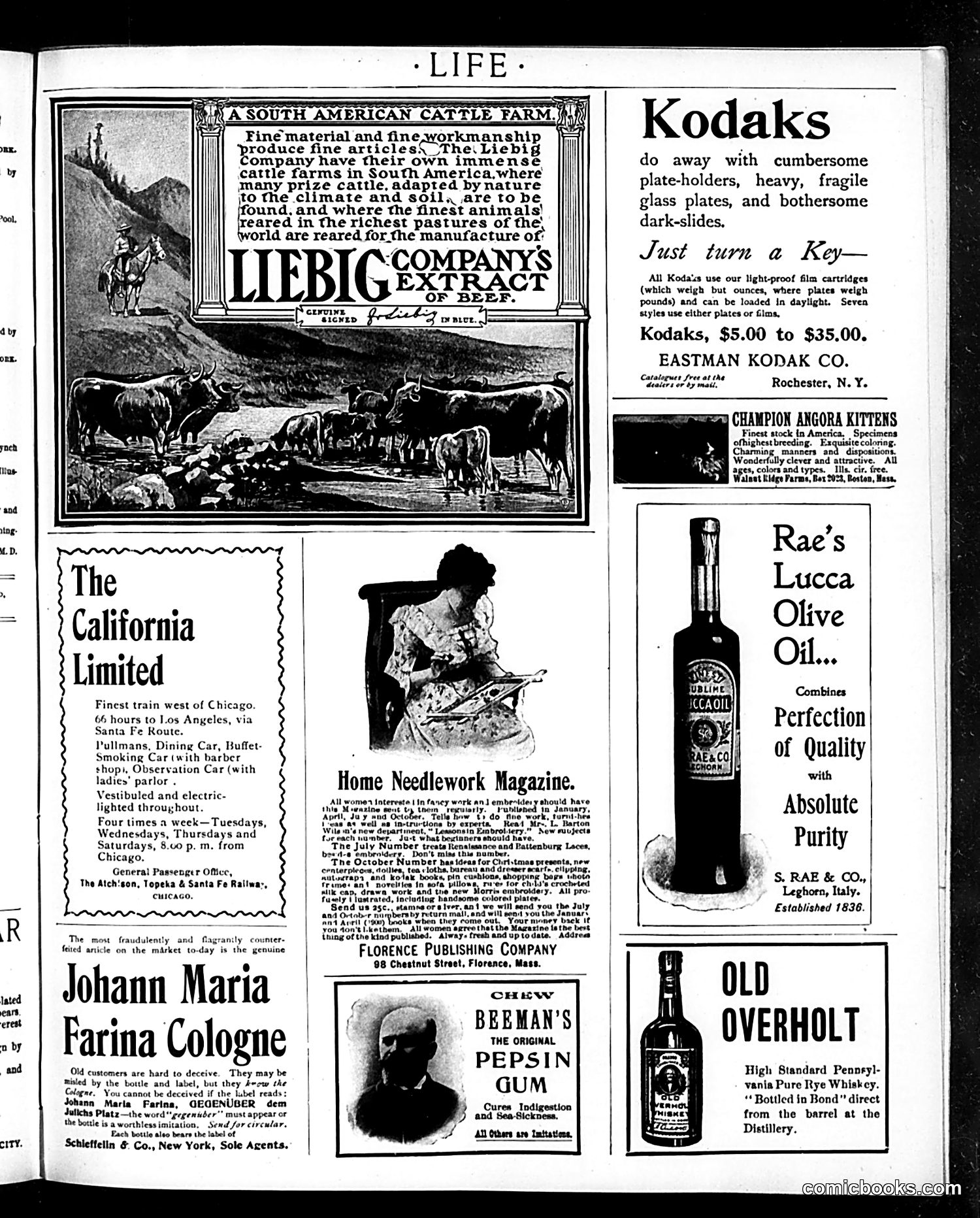
This page is primarily **advertising**, not political satire. It contains roughly a dozen product advertisements typical of early 20th-century magazines. The only non-advertising content is a large illustration for **Liebig Company's Extract of Beef** depicting South American cattle ranching. The image shows a gaucho herding cattle in mountainous terrain—a romanticized scene meant to emphasize the product's origin in premium South American livestock. The text claims Liebig's cattle farms produce superior beef extract because animals thrive naturally in South America's climate and pastures. The remaining page space features consumer goods ads: Kodak cameras, cologne, train service, needlework magazines, gum, kittens, olive oil, and whiskey. These reflect the affluent readership Life targeted. There is **no political cartoon or satire present** on this page. The Johann Maria Farina Cologne advertisement does warn against counterfeits, but this is commercial rather than satirical messaging.
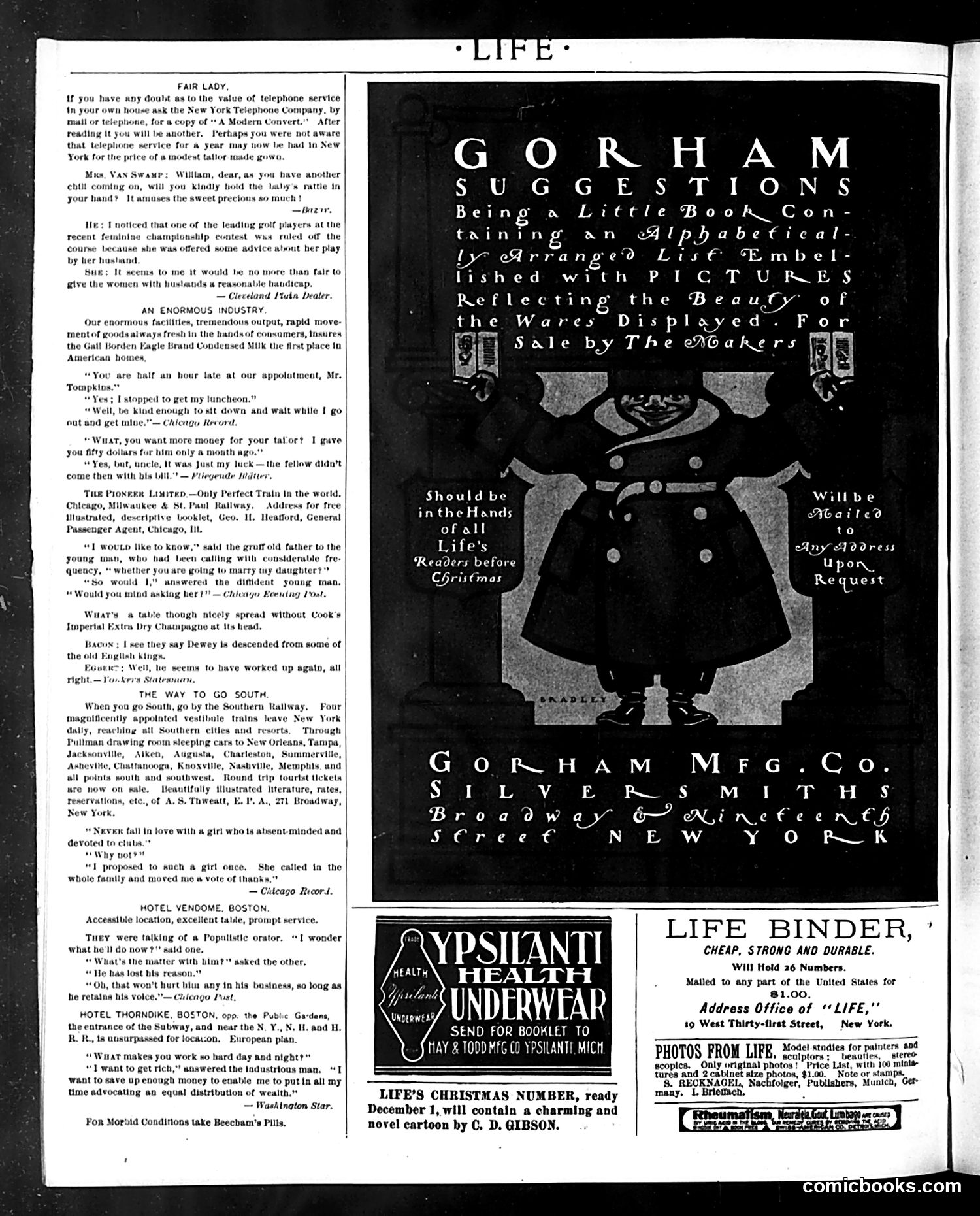
This page is primarily **advertising and miscellaneous content** rather than political cartoons. It consists of: 1. **Short humorous anecdotes** in the left column—brief satirical jokes about everyday life (golf handicaps, tailors, lunch breaks, proposals). These poke gentle fun at social conventions and human behavior rather than political figures. 2. **Large advertisement** (right side) for **Gorham Manufacturing Company's "Suggestions" book**—a mail-order catalog of decorative wares displayed on the cover. 3. **Multiple hotel and travel advertisements** (Southern Railway, Hotel Vendome, Hotel Thorndike) promoting leisure destinations. 4. **Product advertisements** for items like Ypsilanti Underwear and Life's Binder. The humor reflects **turn-of-the-century American middle-class anxieties**: marital dynamics, wealth inequality, modernization (telephones), and social ambition. There are no identifiable political cartoons or caricatured public figures on this page—it's primarily a commercial publication mixing light satire with advertising.
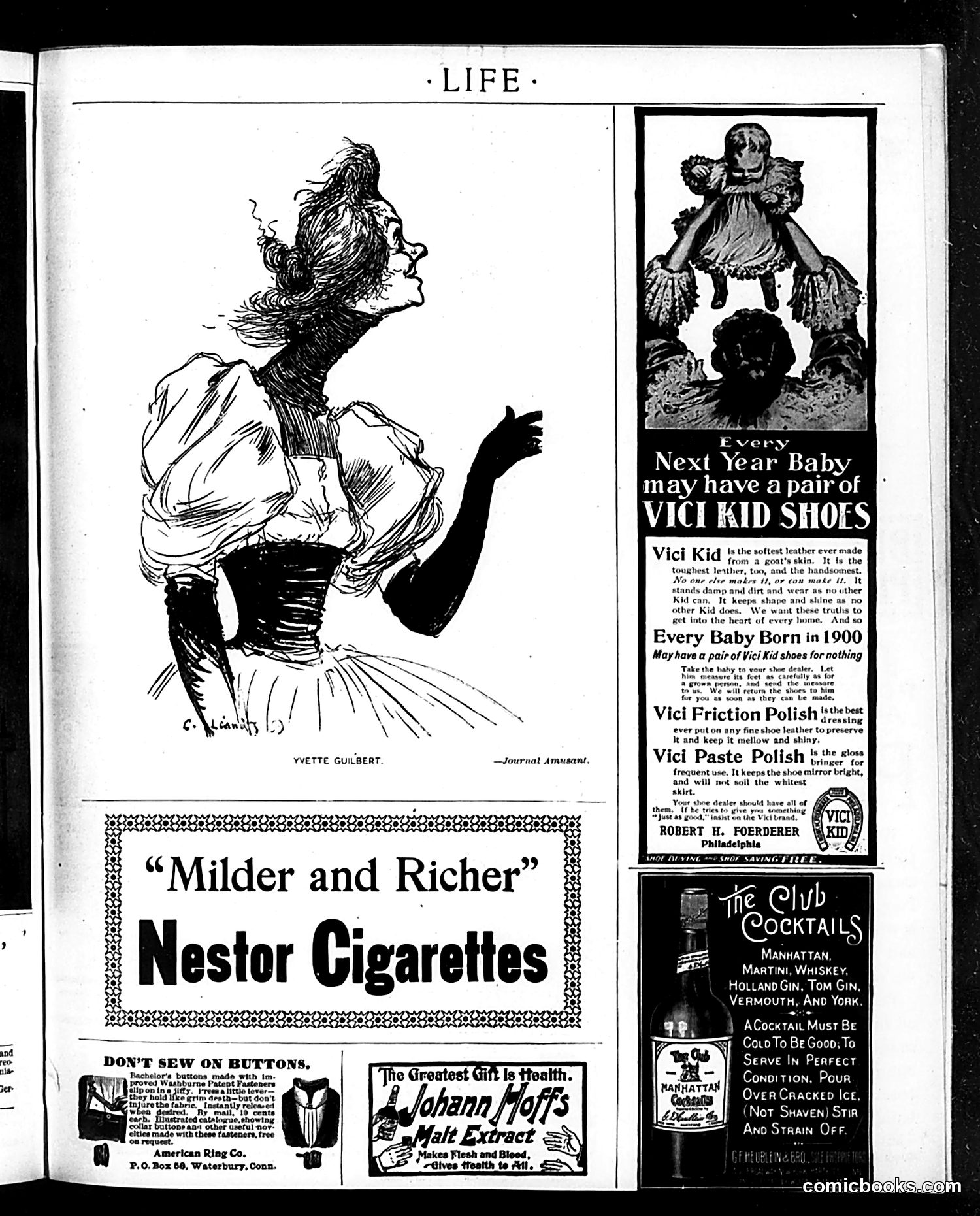
This is primarily an **advertising page** from Life magazine, circa 1900 (based on "Every Baby Born in 1900" reference). The top features a sketch of **Yvette Guilbert**, a famous French cabaret singer, credited to *Journal Amusant*, suggesting Life reprinted international satirical artwork. The page is dominated by commercial advertisements: Nestor Cigarettes ("Milder and Richer"), Vici Kid Shoes (leather products for babies), Johann Hoff's Malt Extract (a health tonic), button fasteners, and cocktail recipes. The only satirical element is the **Guilbert sketch itself**—a caricature exaggerating her distinctive features and theatrical posture, likely mocking her performance style or persona that was well-known to American readers of the era. The remaining content reflects turn-of-the-century consumer culture: medicinal tonics marketed as cure-alls, luxury goods, and cocktail culture targeting affluent readers.
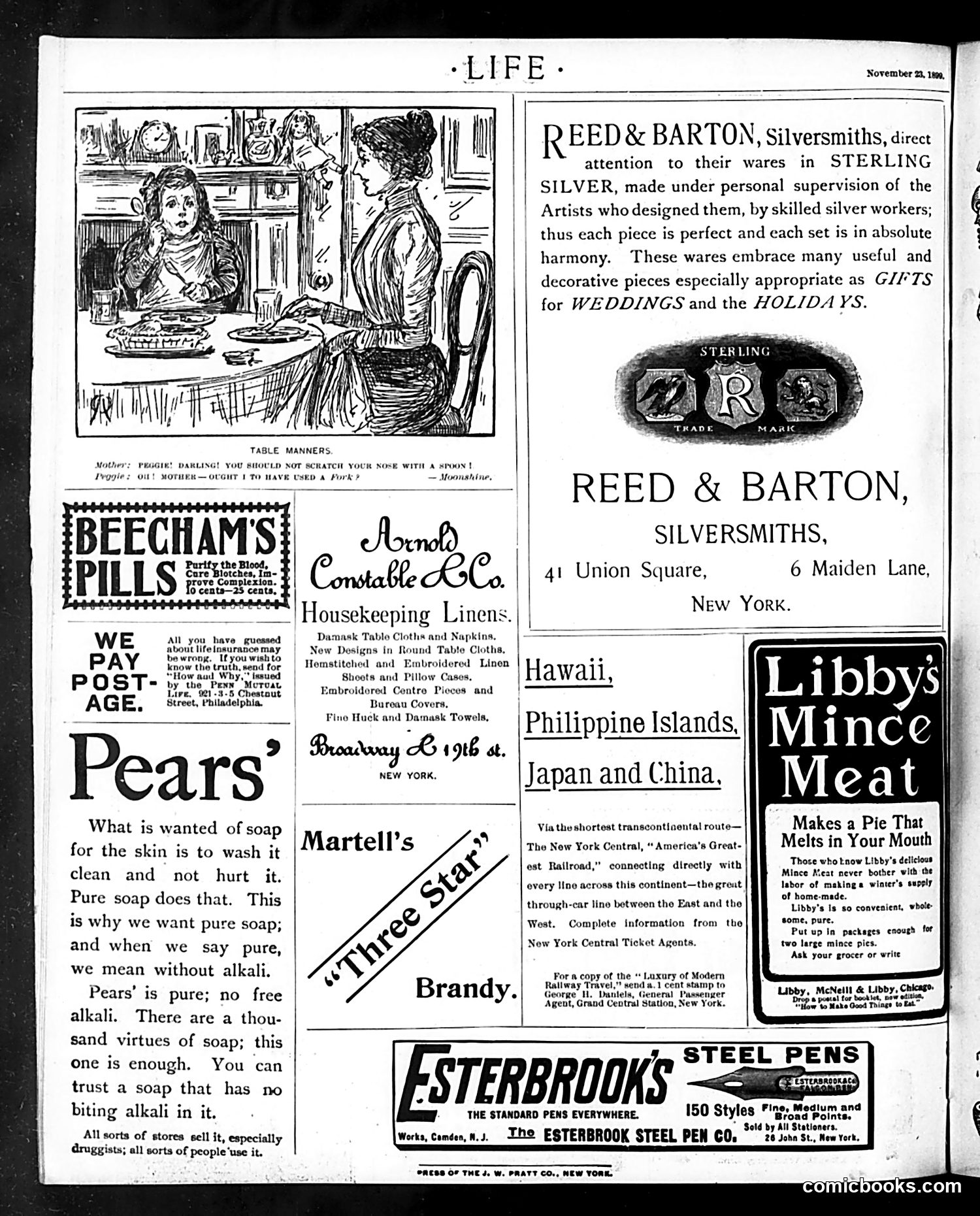
This page is primarily **advertising with one satirical cartoon**. The small cartoon titled "TABLE MANNERS" depicts a dining scene where a mother corrects her child's etiquette—the child has scratched their nose with a spoon rather than a fork. The mother's exasperated comment ("You should not scratch your nose with a spoon!") and the child's bewildered response ("ought I to have used a Fork?") satirizes overly rigid Victorian table-manner rules and their absurd application. The joke mocks the era's obsession with precise etiquette: the distinction between spoon and fork is presented as trivially pedantic when the real problem is using any eating utensil for personal grooming. The satire targets upper-class pretension about "proper" behavior. The remainder consists of period advertisements for luxury goods (Reed & Barton silver, housekeeping linens), medicines (Beecham's Pills), soap, insurance, and food products—typical of *Life* magazine's commercial content in the 1880s.