
Life, 1899-11-23 · page 12 of 20
Life — November 23, 1899 — page 12: what you’re looking at
What you’re looking at
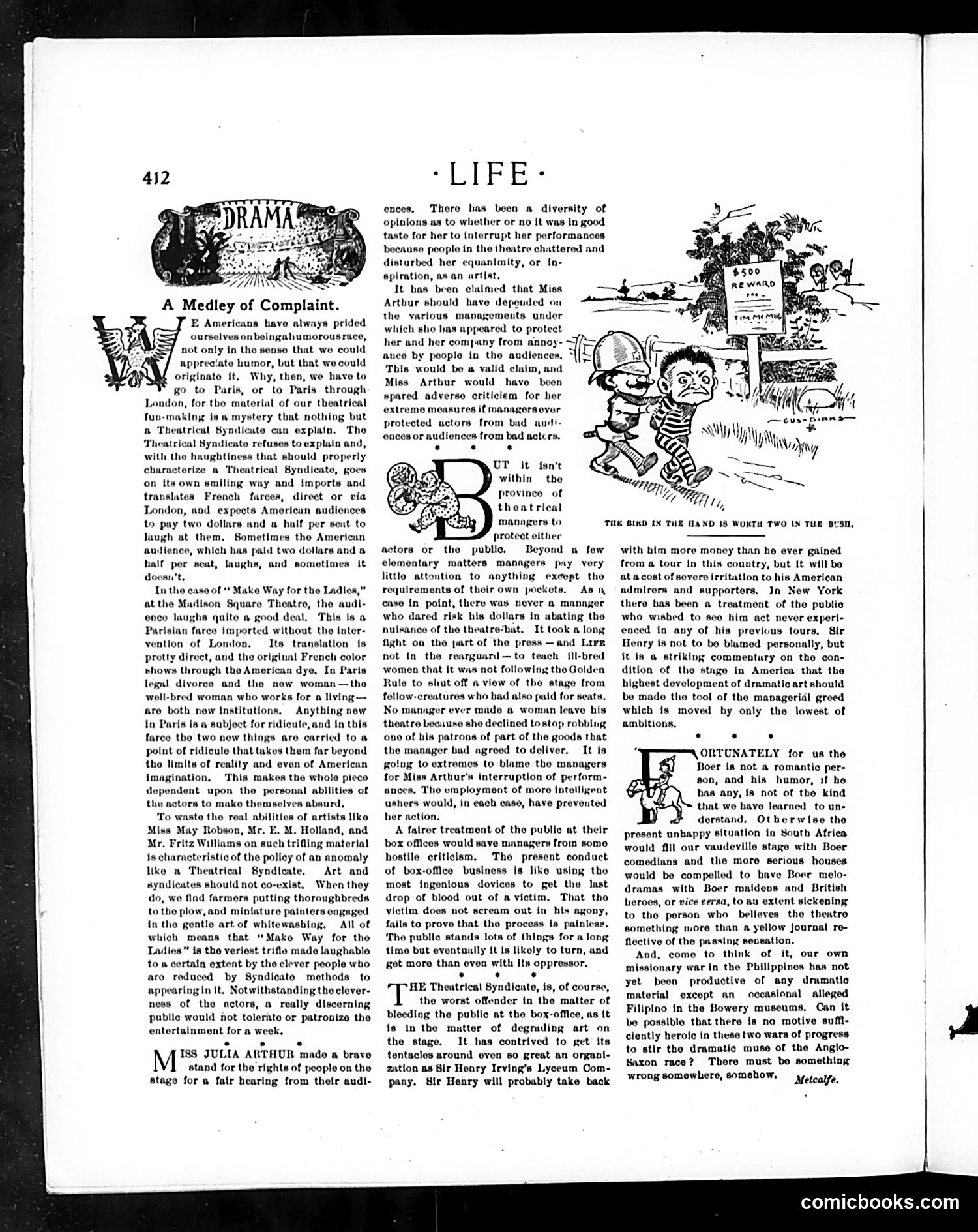
This page critiques theatrical management practices and Miss Julia Arthur's public disputes. The main article "A Medley of Complaint" addresses tensions between actors and theater managers over artistic control and fair treatment. The cartoon titled "The Bird in the Hand is Worth Two in the Bush" (right side) depicts what appears to be theatrical managers or promoters chasing after performers, visually expressing the text's complaint that managers exploit actors for profit while limiting their creative freedom. The satirical point: theater managers prioritize box-office revenue over artistic merit, mistreat actors, and use contractual control to silence criticism. The author advocates for better protections for performers and critiques the Theatrical Syndicate's monopolistic practices. The tone suggests Life magazine sided with actors against exploitative management.
📄 Transcribed text from this page (OCR, searchable)
Machine-transcribed from the original scan — historical spelling and the odd misread are preserved.
E Americans have always prided ourselves on beingahumorousrace, not only in the sense that we could appreciate Lumor, but that we could originato It, Why, then, we have to go to Paris, or to Paris through London, for the material of our theatrical fun-making isa mystery that nothing but @ Theatrical Syndicate can explain, Tho Theatrical Syndicate refuses to explain and, with the haugbtiness that sbould properly characterize a Theatrical Byndicate, goes on its own smiling way and imports and translates. French farces, direct or via London, and expects American audiences to pay two dollars and a half per seut to laugh at them. Sometimes the American audience, which has paid two dollars and a half por seat, laughs, and sometimes it doesn't, In tho caso of “ Make Way for tho Ladios," at the Mudison Square Theatro, the audi- ence laughs quite a good deal, This is a Parisian farce imported without tho inter- vention of London, Its translation is protty direct, and the original French color shows through the American dye, In Paris legul divorco and the new wotan—tho well-bred woman who works for a living— aro both now Institutions, Anything new In Paris is a subject for ridicule, and in this farco tho two now things aro carried to a point of ridicule that takes them far beyond tho limits of reality and even of American imagination, ‘This makes the whole pieco dependent upon the personal abilities of the actors to make themselves absurd, To waste tho real abilities of artists Ike Miss May Robson, Mr. E. M. Holland, and Mr. Fritz Williams on such trifling material is characteristic of the policy of an anomaly like @ Theatrical Syndicate, Art and syndicates should not co-exist, When they do, we find farmers putting thoroughbreds tothe plow, and miniature painters enguged in the gentle art of whitewashing, All of which means that “Make Way for the Ladies” is tho veriost triflo made laughablo to w certain extent by tho clever people who aro reduced by Syndicate methods to appearing in tt, Notwithstanding tho clever- ness of the actors, a really discerning publle would hot tolerate or patronize tho entertainment for a week. * «6 6 188 JULIA ARTHUR mado a bravo stand for tho rights of people on the stago for a falr hearing from their audt- ‘LIFE ences, Thoro has been a diversity of opinions as to whether or no it was In good taste for her to interrupt her performances because people in the theatre chattored and disturbed her equanimity, or in- spiration, ax an artist. It has been claimed that Miss Arthur should have depeuded the various managements under which sho has appeared to protect her and her company from annoy- ~ ance by people in the audiences, * This would be # valid claim, and Miss Arthur would have beon spared adverso criticiem for her extreme measures if managersever protected actors from bad nudi- onces or audiences from bad actcrs. * . * UT it tan't within tho province of theatrical managers to protect either actors or the public. Beyond a few clomentary matters managers pay very little attontion to anything excopt tho requirements of their own pockets, As caso in point, there was never a manager who dared risk bis dollars in abating tho nuisance of the theatre-but, It took a long fight on the part of the press —and Lire not {n the rearguard —to teach ill-bred women that it was not following the Golden Rule to shut off a view of the stage from follow-creatures who had also paid for seats, No manager ever mado @ woman leavo his theatre becuse she declined to stop robbing ono of bis patrons of part of the goods tbat the manager bad ugroed to deliver. It is golng to extremes to blame the managers for Miss Arthur's interruption of perform- ances, Tho employment of more intelligent ushers would, in each case, have prevented her action, A fairer treatment of tho public at their box offices would save managers from somo hostile criticism, Tho present conduct of box-office business is like using the most ingenious dovices to got tho last drop of blood out of a victim. That tho victim does not scream out in hls agony, fails to prove that tho process 1s painless. ‘Tho public stands lots of things for a long timo but eventuully {t 18 likoly to turn, and get more than even with Its oppressor. * . oe HE Theatrical Syndicate, is, of course, the worst offender in the matter of bleeding the public at the box-office, as It fs in the mutter of degrading art on the stage, It has contrived to get its tentacles around even 60 great an organl- zation as Bir Henry Irving’s Lyceum Com- pany, Sir Henry will probably take back —Cus- pian Nyy TUE BIMD IN TUL HAND 18 WORTH TWO LN THE sY’st, with bim more money than be ever gained from a tour In this country, but It will bo at acost of severe irritation to his American admirors and supportors. In New York there bas been a treatment of the public who wished to seo him act never expert- enced in any of his previous tours. Sir Henry ts not to bo blamed personally, but it is @ striking commentury on the con- dition of the stage in America that tho highest development of dramatic art should be made the tool of the managoridl groed which is moved by only tho lowest of ambitions, ° . . ORTUNATELY for us tho Boer is not a romantic per- gon, and his humor, if ho bas any, is not of the kind that we bave learned to un- derstand. Otherwise tho present unhappy situation in South Africa would fill our vaudeville stage with Boer comedians and the more serious houses would be compelled to bave Boer melo- dramas with Boer maidevs and British heroes, or vice versa, to au extent sickening to the person who belleves the theatro something more than a yellow journal ro- flective of the passing sensation, And, come to think of it, our own missionary war in the Philippines has not yet been productive of any dramatio material except an occasional alleged Filiplno in the Bowery museums. Can it be possible that there is no motive suffl- clently heroic in these two wars of progress to stir the dramatic muse of the Anglo- Saxon race? There must be something wrong somewhere, somehow. — yreroalye, comicbooks.com