
Life, 1899-11-23 · page 15 of 20
Life — November 23, 1899 — page 15: what you’re looking at
What you’re looking at
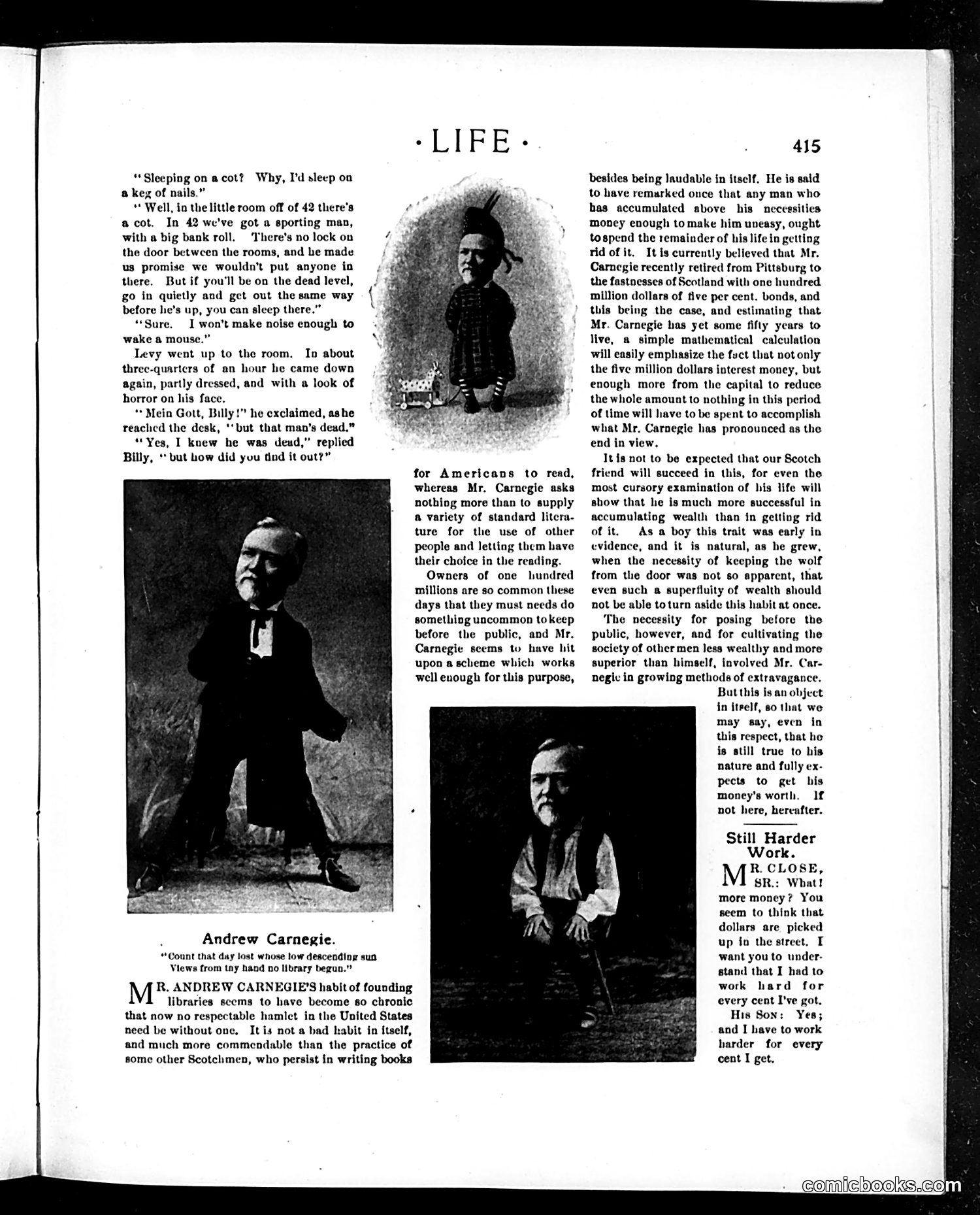
This page satirizes **Andrew Carnegie**, the Scottish-American steel magnate and philanthropist. The accompanying photographs show Carnegie as the subject. The satire targets Carnegie's famous library-building campaign. The piece mocks the contradiction between his stated philosophy—that wealthy men should spend excess money to avoid discomfort—and his actual behavior: he retired to Scotland with $100 million in bonds while claiming to give it away. The author sarcastically calculates that even with fifty years to live, Carnegie couldn't spend his wealth fast enough to match his own principles. The satire also hints at hypocrisy: Carnegie poses as a philanthropist for public standing while remaining fundamentally driven by the accumulation instinct that made him rich. The brief dialogue about sleeping on a cot and the "Still Harder Work" exchange use humor to critique wealthy men's self-justification and their children's inherited entitlement.
📄 Transcribed text from this page (OCR, searchable)
Machine-transcribed from the original scan — historical spelling and the odd misread are preserved.
“Sleeping on acot? Why, I'd sleep on a keg of nails.” ** Well, in the little room off of 42 there's acot. In 42 we've got a sporting man, with a big bank roll. ‘There's no lock on the door betwcen the rooms, and he made us promise we wouldn’t put anyone in there. But if you'll be on the dead level, go in quietly and get out the same way before he's up, you can sleep there.” “Sure. I won't make noise enough to wake a mouse.” Levy went up to the room. In about three-quarters of an hour he came down again, partly dressed, and with a look of horror on his face. “Mein Gott, Billy!” he exclaimed, ashe reached the desk, ‘‘but that man’s dead.” “Yes, I knew he was dead,” replied Billy, * but bow did you tind it out?” Andrew Carnegie. “Count that day lost whose low descending sun Views from thy hand no brary begun.” R, ANDREW CARNEGIE’S habit of founding libraries scems to have become so chronic that now no respectable hamlet in the United States need be without onc, It is not a bad habit in itself, and much more commendable than the practice of some other Scotchmen, who persist in writing books for Americans to read, whereas Mr. Carnegie asks nothing more than to supply a variety of standard litera- ture for the use of other people and letting them have their choice in the reading. Owners of one hundred millions are so common these days that they must needs do something uncommon tokeep before the public, and Mr. Carnegie scems to have hit upon ascheme which works well enough for this purpose, 45 besides being laudable in itself, He is said to have remarked once that any man who has accumulated above his necessities money enough to make him uneasy, ought tospend the remainder of his life in getting rid of it. It is currently believed that Mr. Carnegie recently retired from Pittsburg to the fastnesses of Scotland with one hundred million dollars of five per cent. bonds, and this being the case, and estimating that Mr. Carnegie has yet some fifty years to live, a simple mathematical calculation will easily emphasize the fuct that not only the five million dollars interest money, but enough more from the capital to reduce the whole amount to nothing in this period of time will have to be spent to accomplish what Mr, Carnegie has pronounced as the end in view. It is not to be expected that our Scotch friend will succeed in this, for even the most cursory examination of his life will show that he is much more successful in accumulatiog wealth than in getting rid of it. As a boy this trait was early in evidence, and it is natural, as he grew, when the necessity of keeping the wolf from the door was not so apparent, that even such a superfluity of wealth should not be able toturn aside this habit at once. ‘The necessity for posing before the public, however, and for cultivating the society of other men less wealthy and more superior than himself, involved Mr. Car- negic in growing methods of extravagance. But this is an object in itself, a0 that we may say, even in this respect, that ho is still true to his nature and fully ex- pects to get his money's worth. If not here, hereafter. Still Harder Work. R. CLOSE, SR.: What! more money? You seem to think that dollars are picked up in the street, I want you to under- stand that I had to work hard for every cent I’ve got. His Son: Yes; and I have to work harder for every cent I get. comichooks.coun)