
Life, 1899-11-23 · page 6 of 20
Life — November 23, 1899 — page 6: what you’re looking at
What you’re looking at
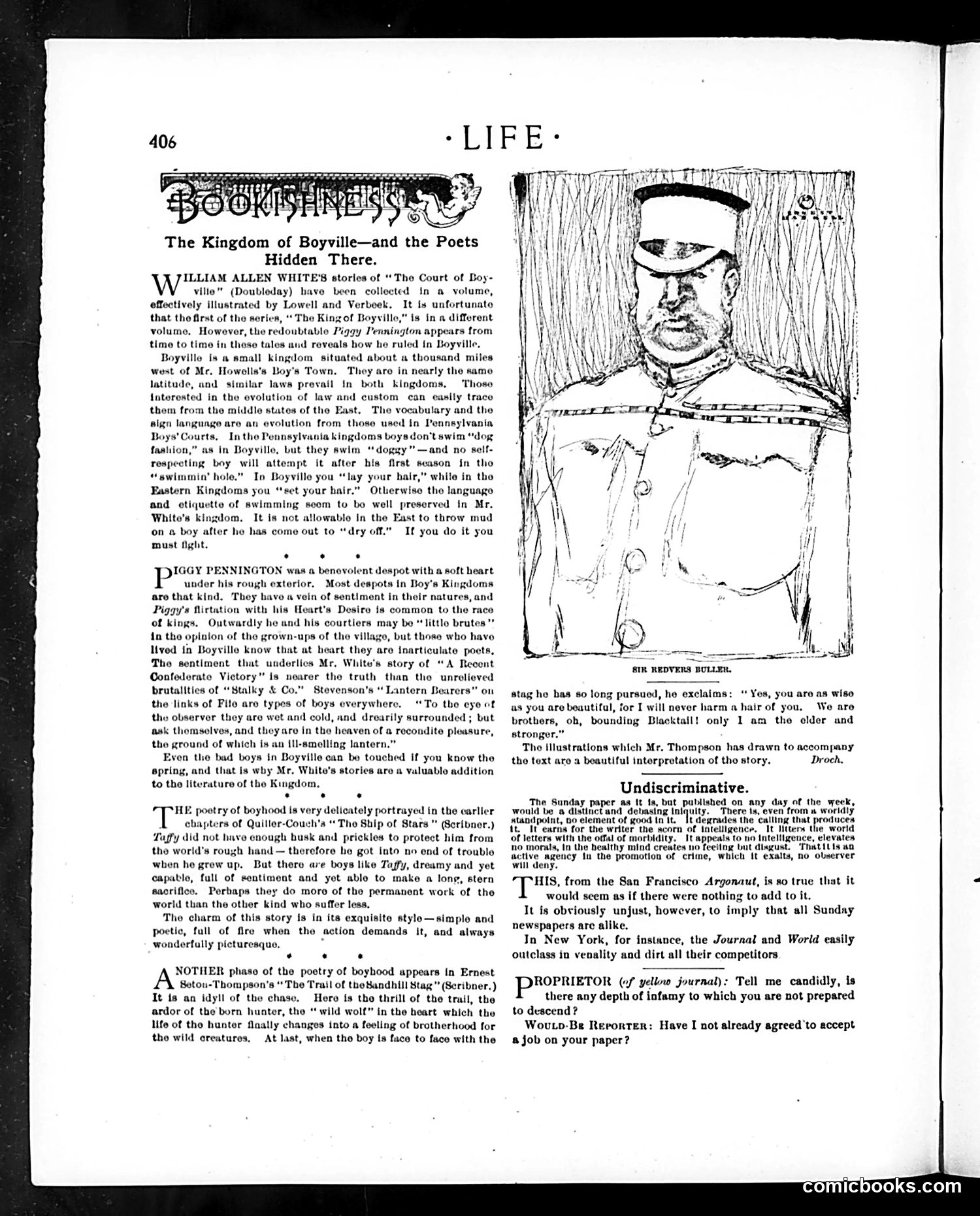
This page discusses William Dean Howells' "Boy's Town" stories, comparing the fictional "Kingdom of Boyville" to real boyhood experiences. The illustration shows a uniformed official (identified as "SIR ARTHUR SULLIVAN" in the caption), though the connection between the portrait and the text isn't immediately clear from this page alone. The page includes literary criticism praising boyhood poetry by Ernest Seton-Thompson and others, celebrating how these works capture authentic childhood experience and sentiment. The brief "Undiscriminative" section mocks the San Francisco *Argonaut* newspaper, while the final joke satirizes a journalist's interview—poking fun at incompetent reporting. This appears primarily as cultural/literary commentary rather than political satire.
📄 Transcribed text from this page (OCR, searchable)
Machine-transcribed from the original scan — historical spelling and the odd misread are preserved.
The Kingdom of Boyville—and the Poets Hidden There. ILLIAM ALLEN WHITE'S stories of “Tho Court of Boy- ville” (Doubleday) have been collected in a volume, effectively illustrated by Lowell and Verbeek. It 1s unfortunate that tho first of the series, “The Kingof Boyvillo,” is in a different volume, Howover, the redoubtable Piggy Pennington appears trom timo to timo in those tales aud reveals how he ruled in Boyville. Boyville is a small kingdom situated about a thousand miles west of Mr, Howolls’s Boy's Town, They aro in nearly the samo latitude, and similar laws prevail in both kingdoms, ‘Those {uterested in the evolution of law and custom can easily trace thom from the middle states of the East, The vocabulary and the sign language are an evolution from those used in Pennsylvania Boys’ Courts, In tho Pennsylvania kingdoms boys don't swim “dog fashion,” as in Boyville, but they swim “doggy” —and no self- respecting boy will attempt it after his first season in tho “swimmin’ hole.” To Boyvillo you “lay your hair,” while in the Eastern Kingdoms you “set your hair.” Otherwiso the languago and etiquette of swimming seom to bo well preserved in Mr, White's kingdom, It is not allowable In the East to throw mud on a boy after he has come out to “dry If you do it you must fight. . . . P IGGY PENNINGTON was a benovolent despot with a soft heart under his rough exterior, Most despots in Boy's Kingdoms are that kind. They bave a vein of sentiment in their natures, and Piggy's Nirtation with his Heart’s Desiro is common to the race of kings, Outwardly he and his courtiers may bo “little brutes” in tho opinion of the grown-ups of the village, but those who havo lived in Boyville know that at heart they are inarticulate poets, Tho sentiment that underlies Mr, White's story of “A Recent Confederate Victory” is nearer tho truth than the unrolieved bratalities of “Stalky & Co.” Stevenson's ntern Bearers” on the links of Fito aro types of boys everywhere. “To the eye of the observer they are wet and cold, and drearily surrounded; but ask thomselves, and they are in the heaven of a recondite pleasure, the ground of which is an {ll-smolling lantern.” Even the bad boys in Boyville can be touched if you know the spring, and that is why Mr, White's stories aro a valuable addition to tho literature of the Kingdom, . . . HE pootry of boyhood is very delicately portrayed in the carller chapters of Quiller-Couch'a “Tho Ship of Stats” (Scribnor.) Taffy did not have enough husk and prickles to protect him from tho world’s rough hand — therefore ho got into no end of trouble when he grew up. But thero are boys like Taffy, dreamy and yet capatlo, full of sentiment and yet ablo to make a lone, stern sacrifice, Perbaps they do moro of tho permanent work of the world than the other kind who suffer less, Tho charm of this story fs in its exquisite stylo—simplo and poetic, full of fire when the action demands it, and always wonderfully picturesque. o oe . NOTHER phaso of the poetry of boyhood appears in Ernest Setou-Thompson's “The Trail of the Sandhill Stag” (Seribner.) It {8 an idyll of the chase. Hero {s tho thrill of the trail, the ardor of the born hunter, the “ wild wolf” in the heart which the Ufo of tho hunter flaally changes into a feeling of brotherhood for tho wild creatures, At last, when tho boy is face to face with the ———— SIR REDVERS BULLER, stag ho has so long pursued, ho exclaims: “ Yes, you aro as wiso as you are beautiful, for I will never harm a hair of you. We aro brothers, ob, bounding Blacktall! only 1 am the older and stronger.” Tho illustrations which Mr, Thompson has drawn to accompany tho toxt aro a beautiful intorprotation of tho story. Droch. Undiscriminative. The Sunday paper as it ta. but published on any day of the week would be & distinctand debasing tnlqulty. There ts. even from a w standpoint, o0 element of good in it. It degrades the calling that scocuoee tt It earns for the writer the scorn of Intelligence. It Itters the world of letters with the offal of morbidity. It appeals to no intelligence, elevates no morals, in the healthy mind creates no feeling but diagust. Thatitts ao save agency tu the promotion of crime, which it exalts, no observer will deny. HIS, from the San Francisco Argonaut, is so true that it would seem as if there were nothing to add to it. It is obviously unjust, however, to imply that all Sunday newspapers are alike. In New York, for instance, the Journal and World easily outclass in venality and dirt all their competitors ROPRIETOR (of yellow journal): Tell me candidly, is there any depth of infamy to which you are not prepared to descend? Wouto-Be Rerorter: Have I not already agreed'to accept 8 job on your paper? comicbooks.com