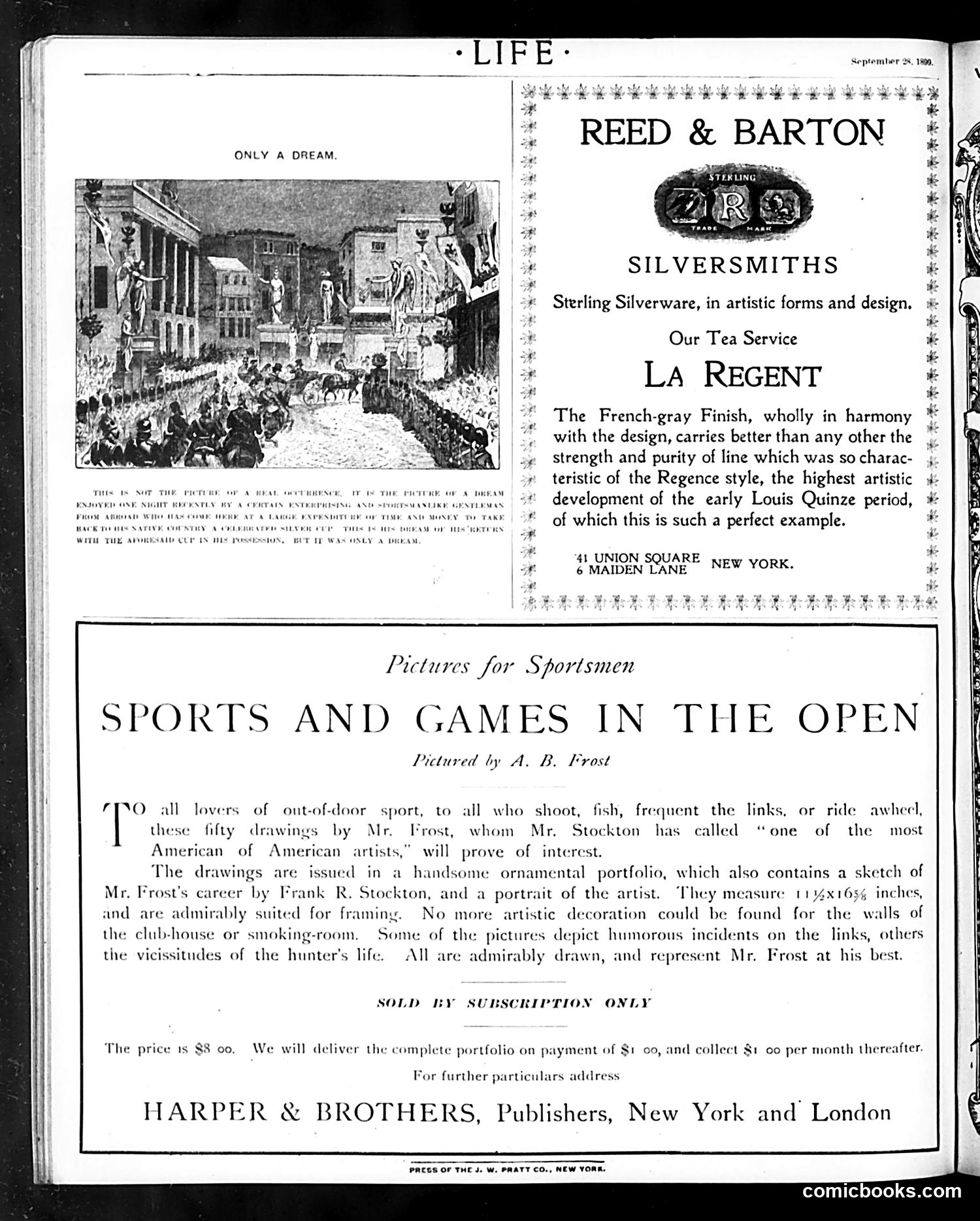
A complete issue · 20 pages · 1899
Life — September 28, 1899
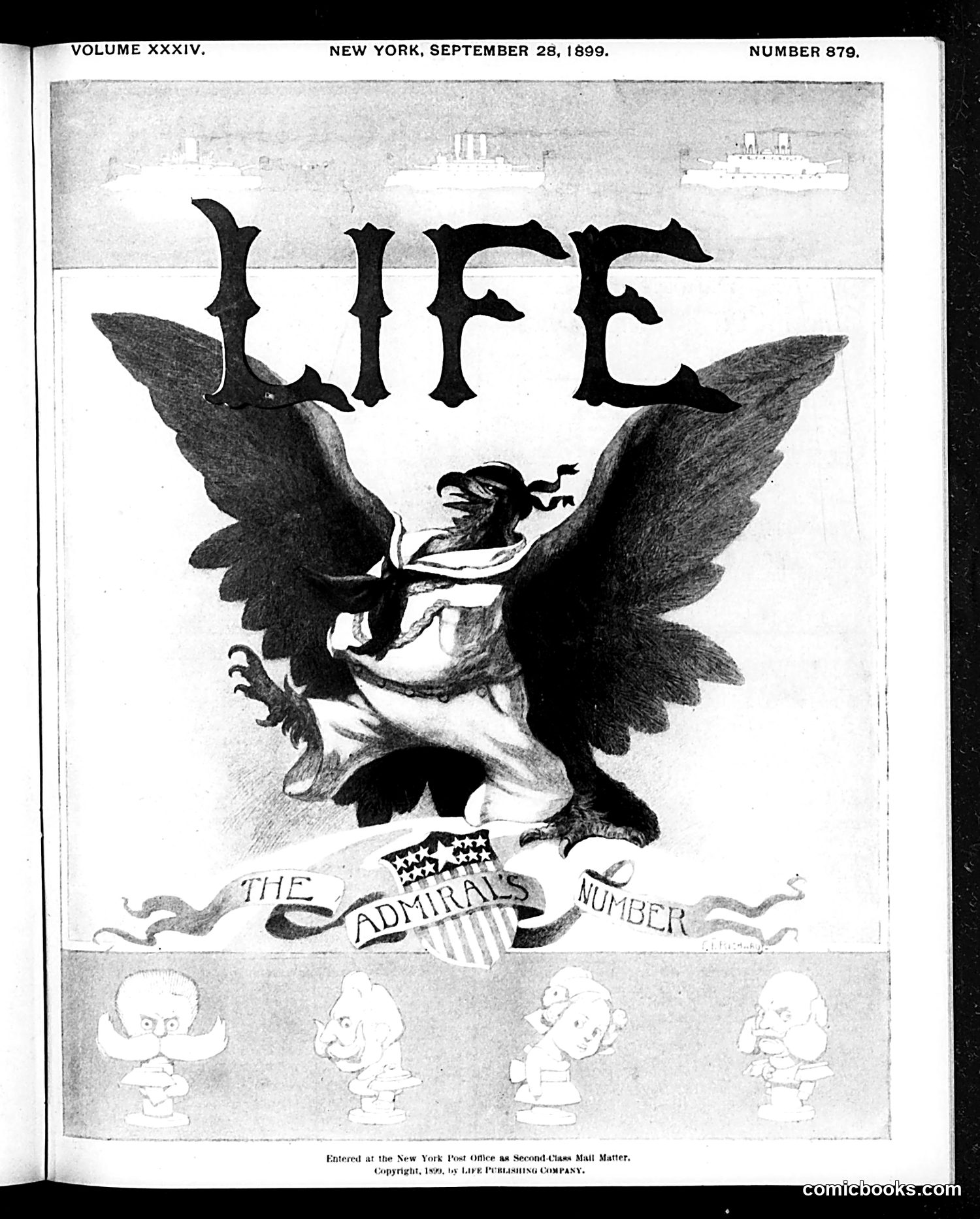
This is the cover of *Life* magazine's "The Admirals' Number," featuring an eagle (the Great Seal of the United States) prominently displayed. The cover celebrates American naval power, with warships illustrated at the top. The four caricatured heads at the bottom appear to be portraits of notable American admirals from this era, though specific identities aren't clearly labeled in the visible text. This issue was likely published during or shortly after the Spanish-American War (1898), when American naval victories—particularly Admiral Dewey's triumph at Manila Bay—elevated the U.S. Navy's prestige internationally. The patriotic imagery and focus on admirals reflects American imperial expansion and growing naval dominance at the turn of the twentieth century.
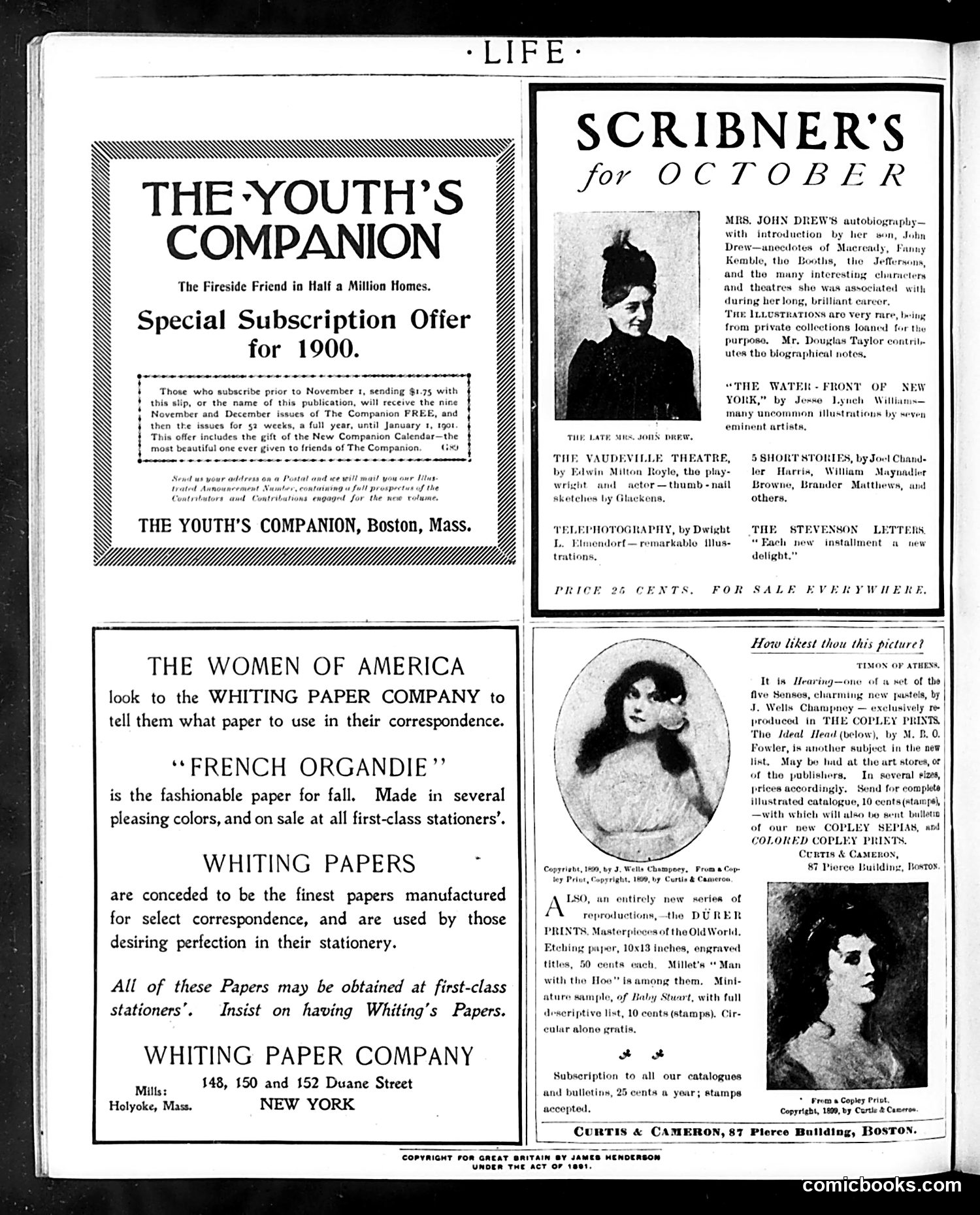
This page is primarily **advertising**, not satirical content. It contains four advertisements: 1. **The Youth's Companion** - a subscription offer for a family magazine 2. **Whiting Paper Company** - promoting "French Organdie" stationery as fashionable for fall correspondence 3. **Scribner's for October** - advertising the magazine's October issue, featuring Mrs. John Drew's autobiography and various literary/artistic content 4. **Curtis & Cameron** - promoting Burée prints and a new series called "Hoeing" featuring what appear to be portrait illustrations The page shows typical turn-of-the-century (1900) advertisements targeting middle and upper-class readers, particularly women, emphasizing refinement, correspondence, and cultural pursuits. There is no political satire or cartoon humor present—this is a commercial page designed to generate revenue for *Life* magazine.
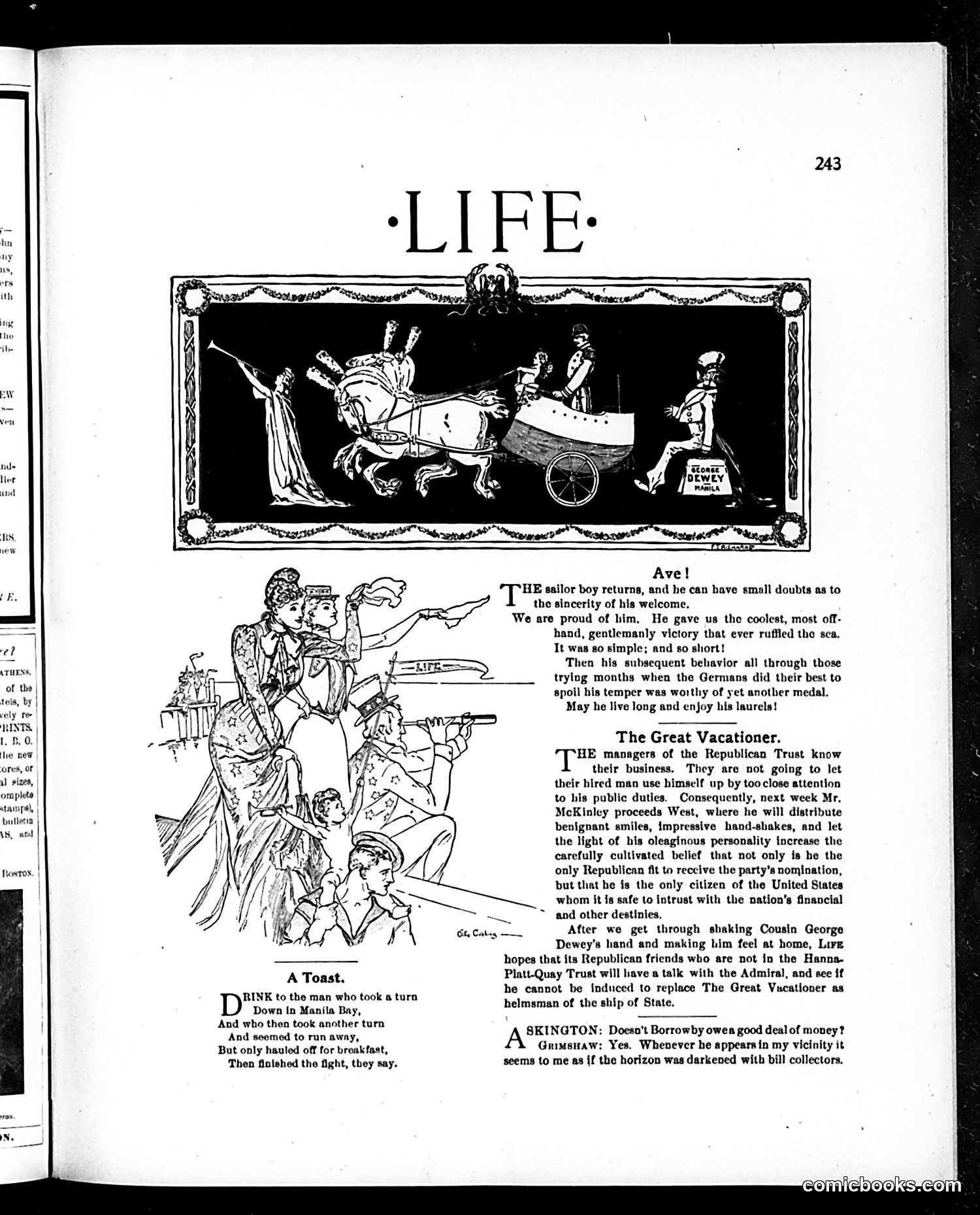
This page contains political satire from the WWI era, likely 1918-1919 based on references to recent German military defeat and post-war politics. **"Ave!" section**: Praises a returning sailor for his naval victory, then pivots to criticize Republican efforts to undermine Democratic leadership—likely targeting the GOP's attempt to deny credit for the war effort. **"The Great Vacationer"**: Mocks a Republican figure (appears to be William McKinley or similar GOP leader) for planning to distribute patronage positions while avoiding serious governance. The text criticizes him as unfit for leadership. **"A Toast"**: Brief verse celebrating a naval victory in Manila Bay (likely referencing the Spanish-American War). The bottom dialogue between "Skington" and "Grimshaw" jokes about debt collection, seemingly unrelated political humor. Overall: Post-war partisan attacks on Republican competence and integrity.
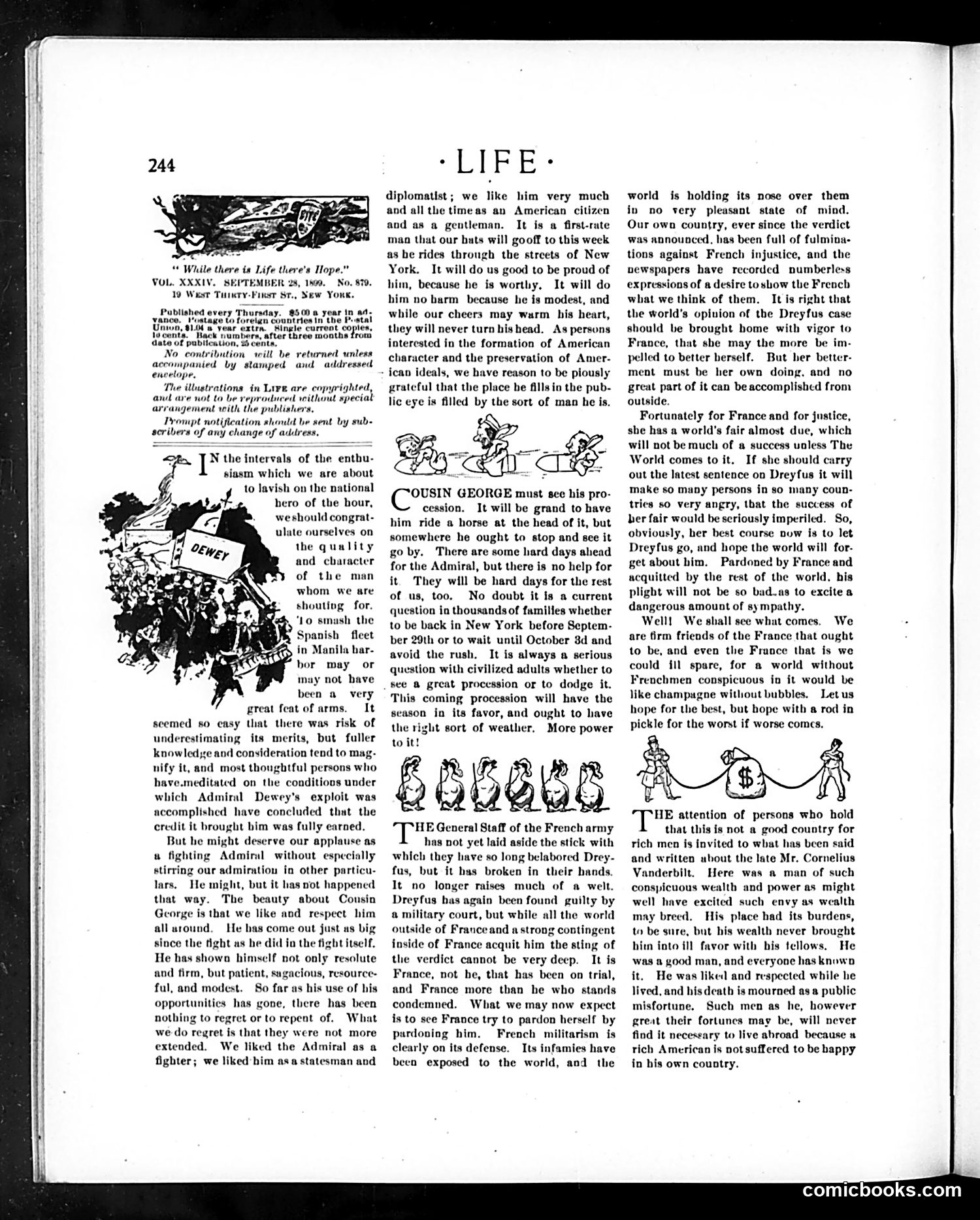
This page discusses **Cousin George** and his military commission, likely referring to a prominent political figure of the era. The text expresses hope he'll "see his profession" and ride at the head of a military unit, suggesting debate over his appropriate role. The left cartoon depicts **Denver** (labeled on a map/caricature) in relation to what appears to be Admiral Dewey's reputation and military accomplishments. The satire seems to question whether Dewey's merits are being underestimated or properly recognized. The right illustration shows figures holding a rope with dollar signs, satirizing wealthy individuals—possibly the Vanderbilts, mentioned by name—and their expectation that wealth excuses them from civic duty or patriotic service. The overall tone criticizes privilege and questions proper conduct during this period.
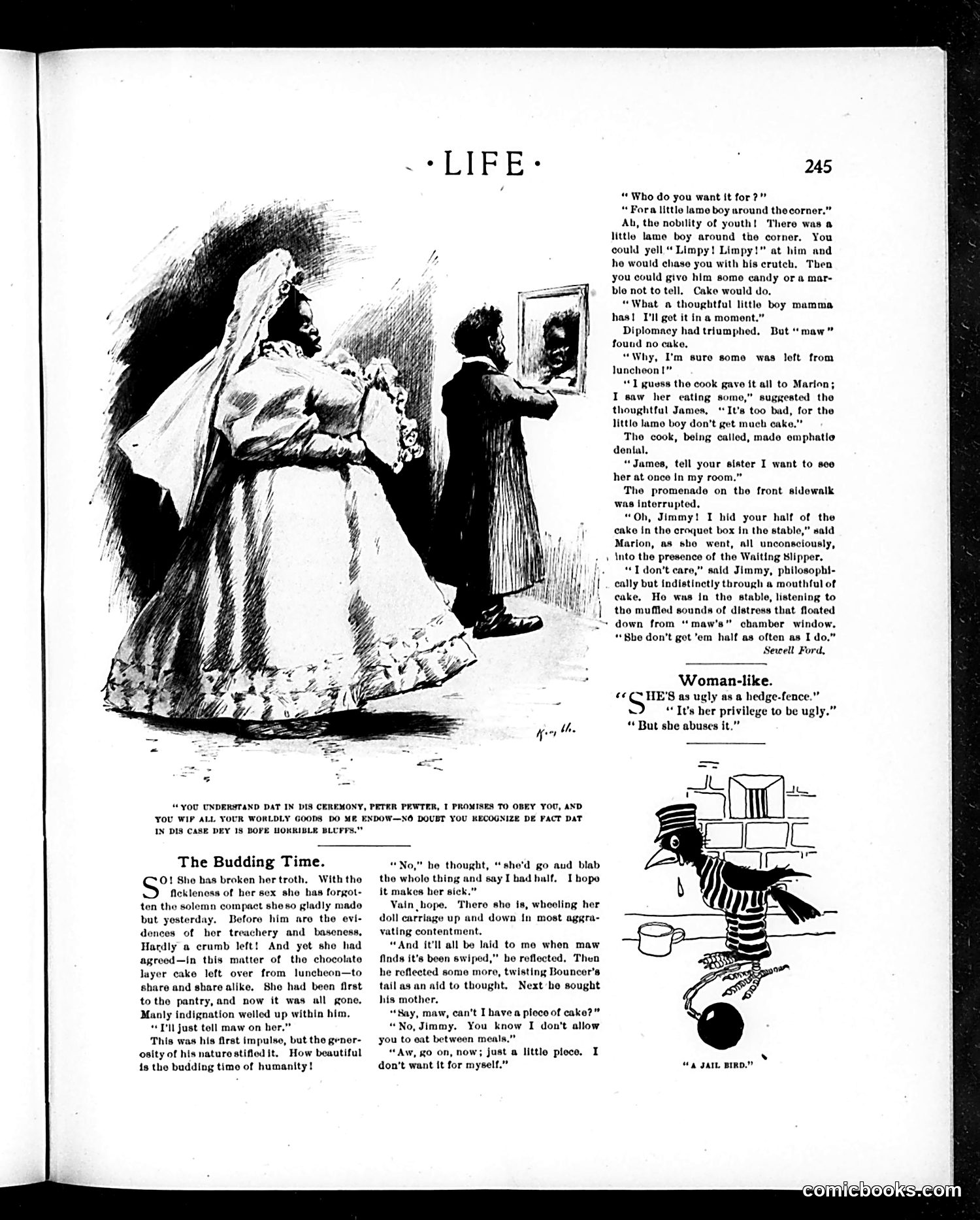
**Top Illustration**: Shows a domestic scene where a woman in a wedding dress confronts a man about a missing cake. The dialogue reveals a quarrel over a chocolate layer cake—the woman accuses the man of eating it, he blames the cook Marion, who claims it was given to a "little lame boy." The satire mocks marital disputes and domestic absurdities, with the "budding time of humanity" referring to newlyweds' petty conflicts. **"Woman-like" Section**: A brief philosophical quote sardonically contrasting women's beauty with their tendency to "abuse it." **"A Jail Bird" Illustration**: Shows a figure in striped clothing next to books and a cup, likely depicting prison life or confinement—though the specific reference is unclear. The page emphasizes domestic humor and social commentary typical of early 20th-century American satire.
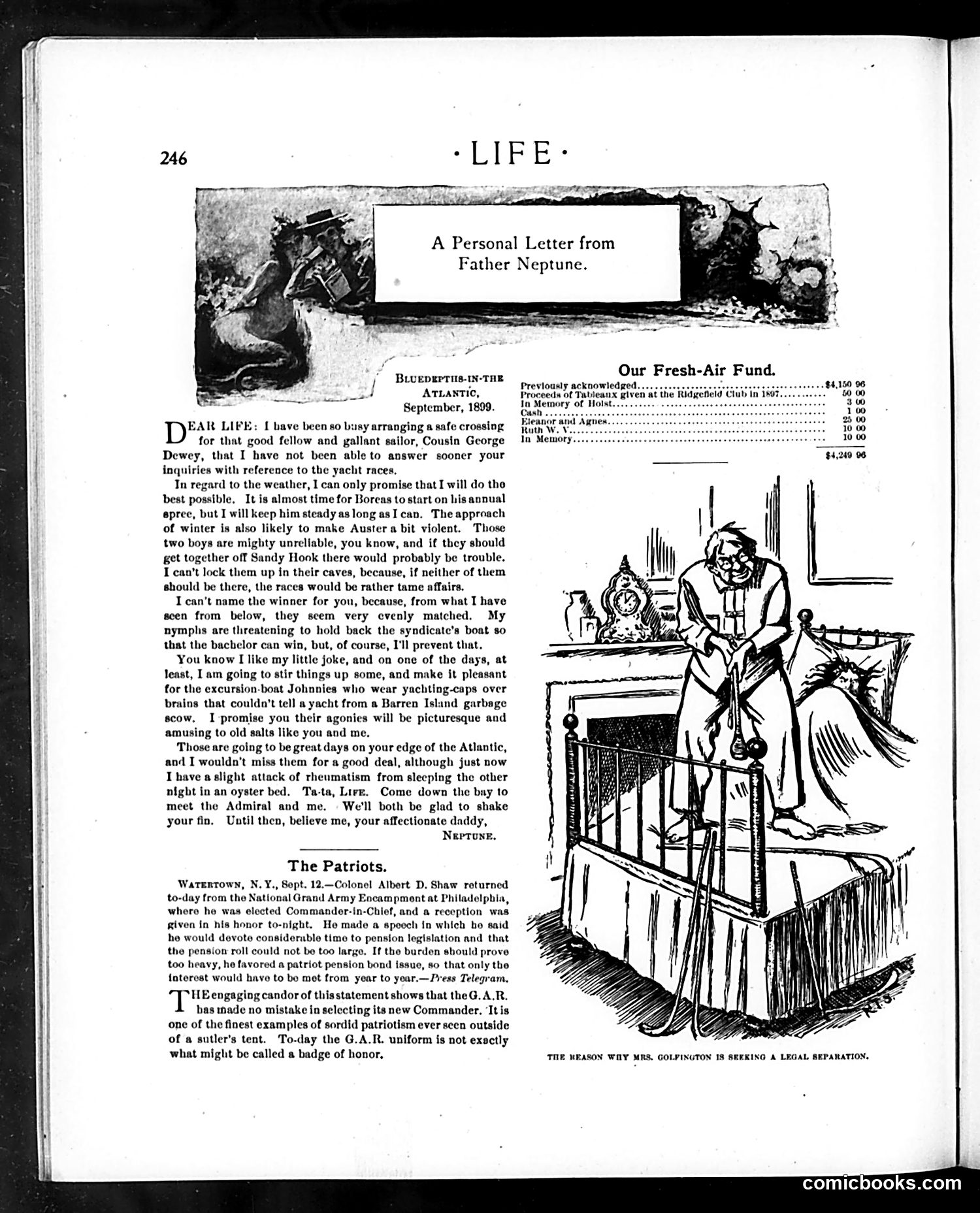
The page contains "A Personal Letter from Father Neptune," a satirical piece where the Roman god of the sea addresses "Dear Life" magazine. Neptune humorously complains about managing boat traffic and dangerous weather conditions on the Atlantic, mentioning two unreliable boys (likely referring to competing yacht racers) at Sandy Hook. The accompanying cartoon depicts Neptune as an older bearded man sitting with what appears to be a young boy, illustrating the paternal relationship established in the letter's conceit. Below this is "The Patriots," discussing Colonel Albert D. Shaw's election as Commander-in-Chief of the Grand Army of the Encampment, praising his patriotism and the G.A.R. uniform's honor. The satire uses Neptune as a personified voice to gently mock maritime activities and competitive sailing culture of the era.
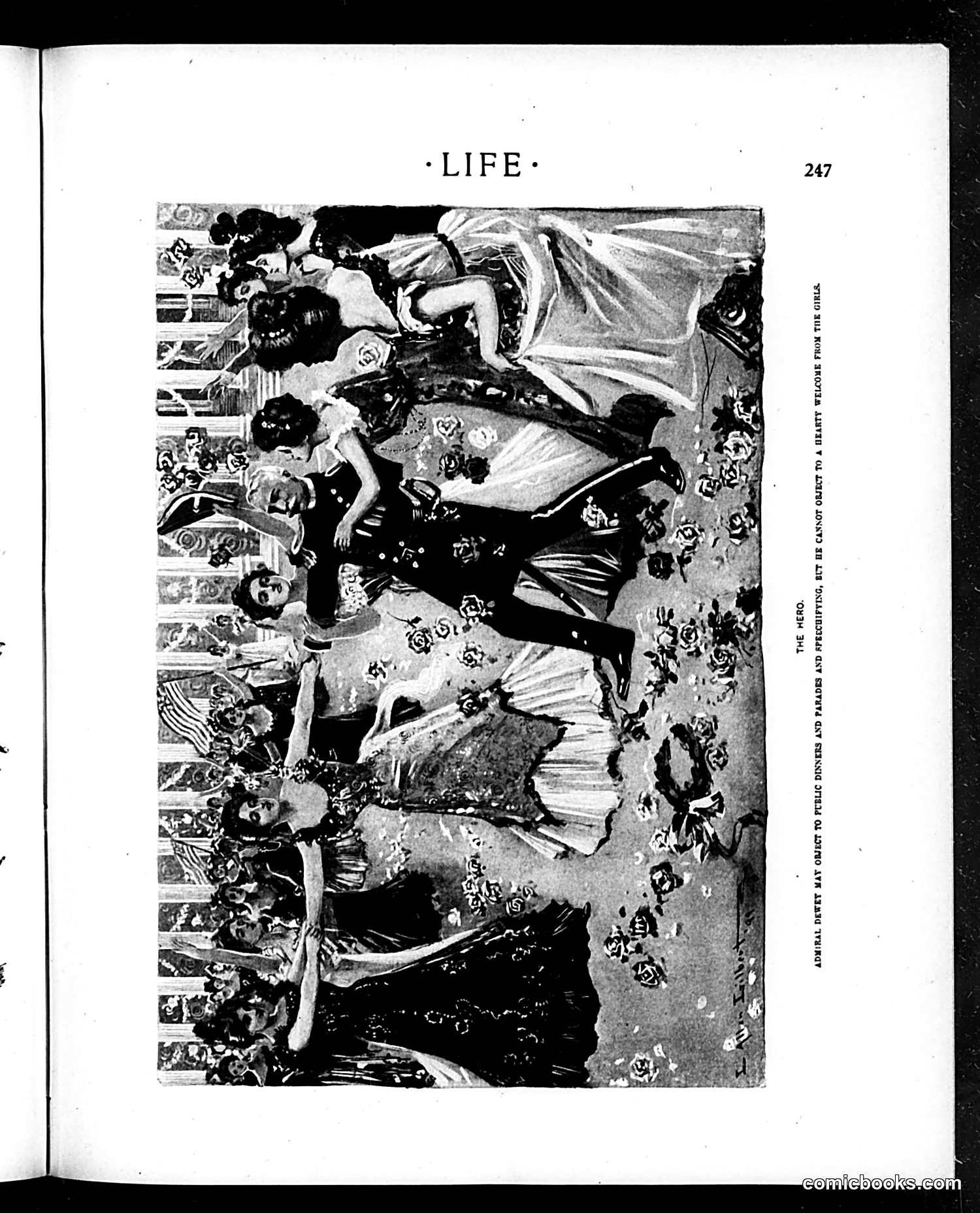
This page from *Life* magazine (page 247) contains a black-and-white illustration that appears to be rotated 90 degrees. The image shows multiple figures in what seems to be a social gathering or party scene, with people in formal and semi-formal dress arranged on a decorative floral-patterned surface or carpet. The caption at right references "aerial liberty" and appears to comment on propriety or social behavior, though the exact wording is partially unclear in the OCR. Without clearer visibility of specific caricatured features or the complete caption text, I cannot definitively identify the particular figures or political/social commentary intended. The satirical intent appears social rather than strictly political, likely mocking contemporary manners or social conventions of the era in which this was published.
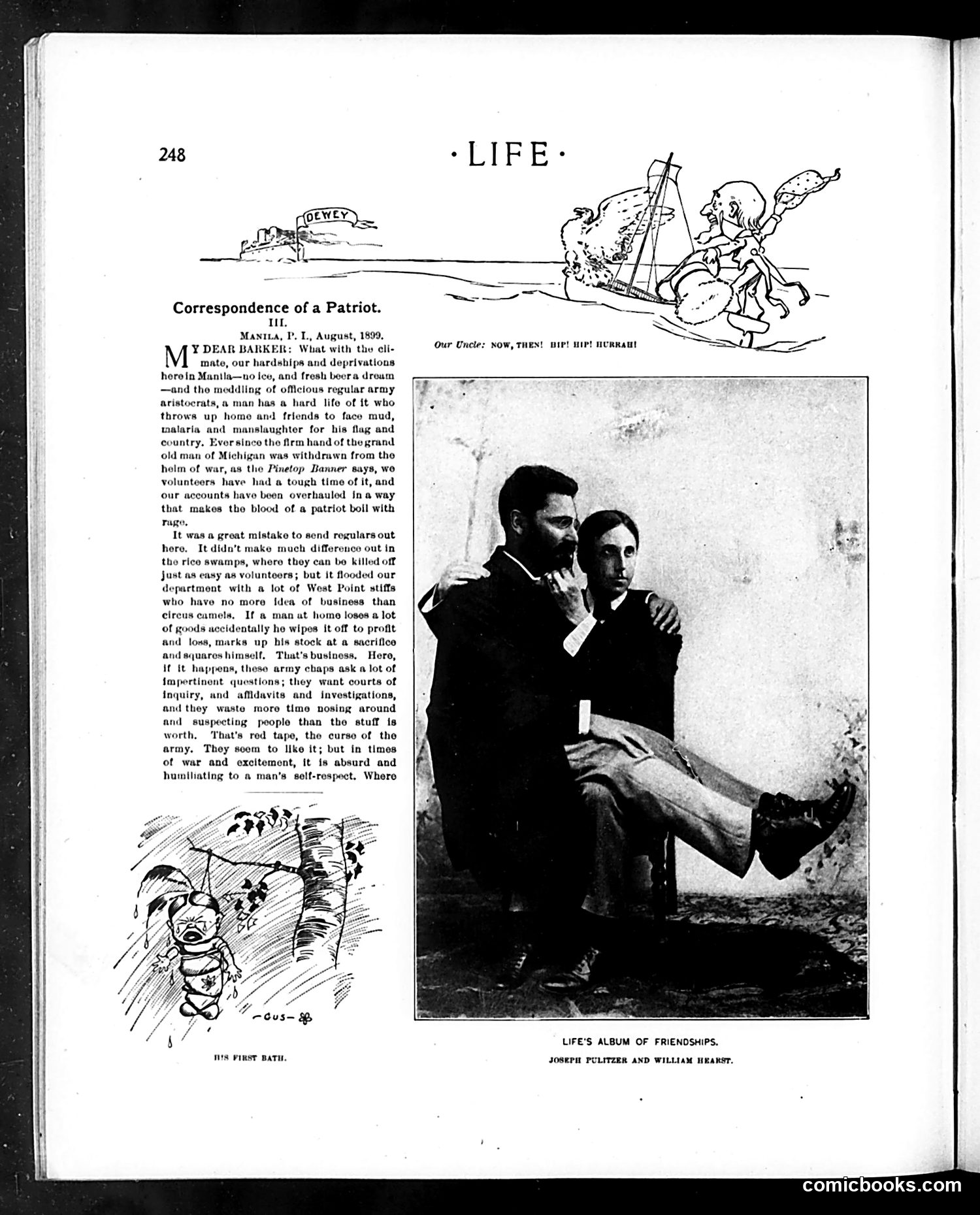
This page features "Correspondence of a Patriot III," a letter dated Manila, August 1899, criticizing military management during the Philippine-American War. The author complains that army officers conduct excessive inquiries and investigations rather than decisive action, wasting time "suspecting people" instead of fighting. The accompanying photograph shows two men identified as "Joseph Pulitzer and William Hearst"—the competing newspaper magnates whose rivalry defined American journalism of this era. The small cartoons illustrate the letter's themes satirically. The overall piece mocks what the author views as bureaucratic incompetence and red tape during wartime, contrasting this with the urgency combat demands. The inclusion of Pulitzer and Hearst likely references their newspapers' coverage of the Philippines conflict.
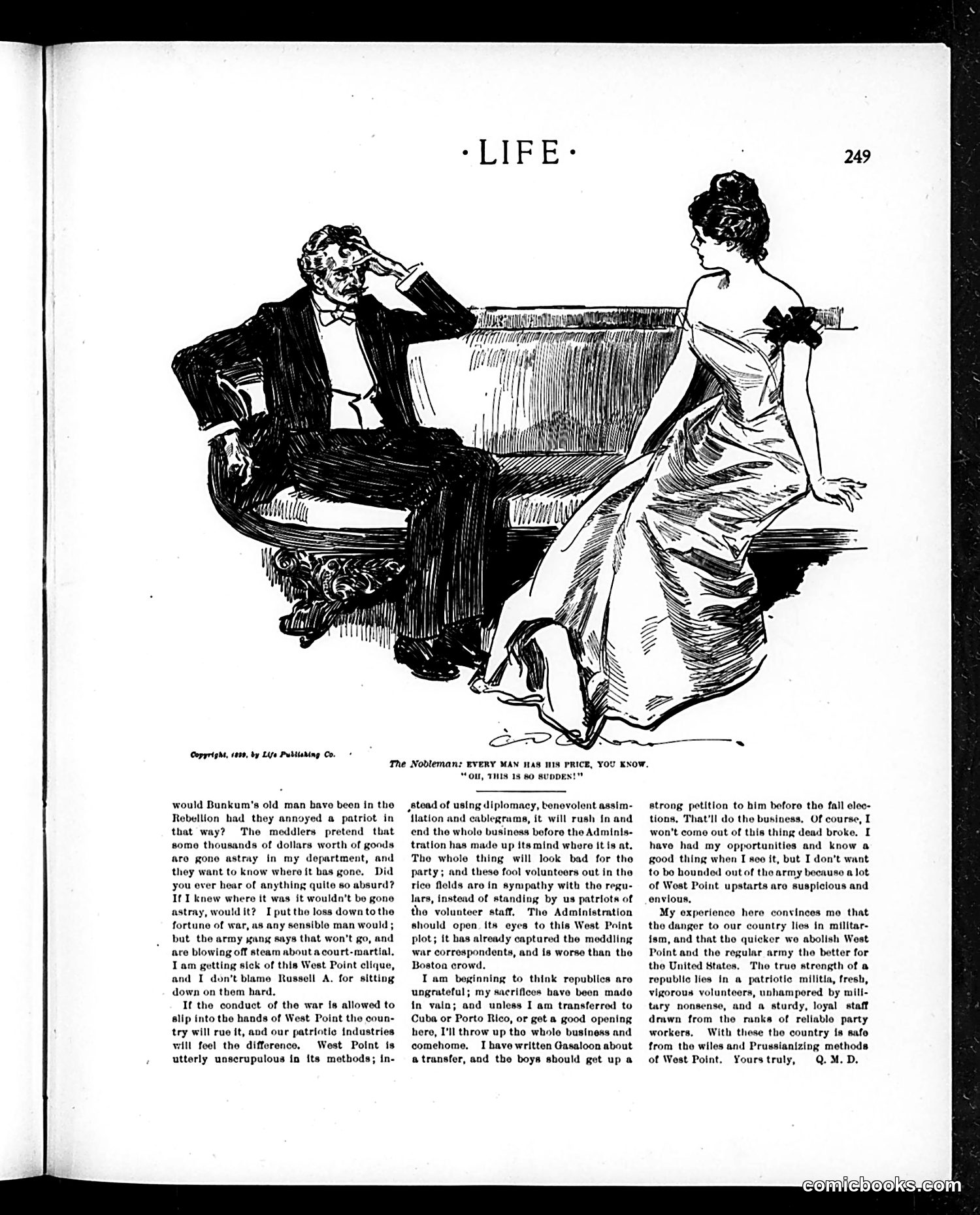
**The Cartoon:** The illustration titled "The Nobleman: EVERY MAN HAS HIS PRICE. YOU KNOW. 'OH, THIS IS NO RUDENESS!'" depicts a well-dressed man in formal attire conversing with an elegantly dressed woman on a sofa. The cartoon satirizes social hypocrisy and class pretension—the "nobleman" claims superiority while the caption suggests his civility is merely transactional ("every man has his price"). **The Article:** The accompanying text discusses West Point military academy, expressing concern about political interference in military institutions. The author criticizes proposals to transfer West Point's control, arguing this threatens institutional independence and patriotic military integrity. The piece advocates protecting the military from political manipulation and diplomatic interference. **Overall Theme:** The page combines visual satire about aristocratic pretense with serious political commentary on institutional independence and military governance.
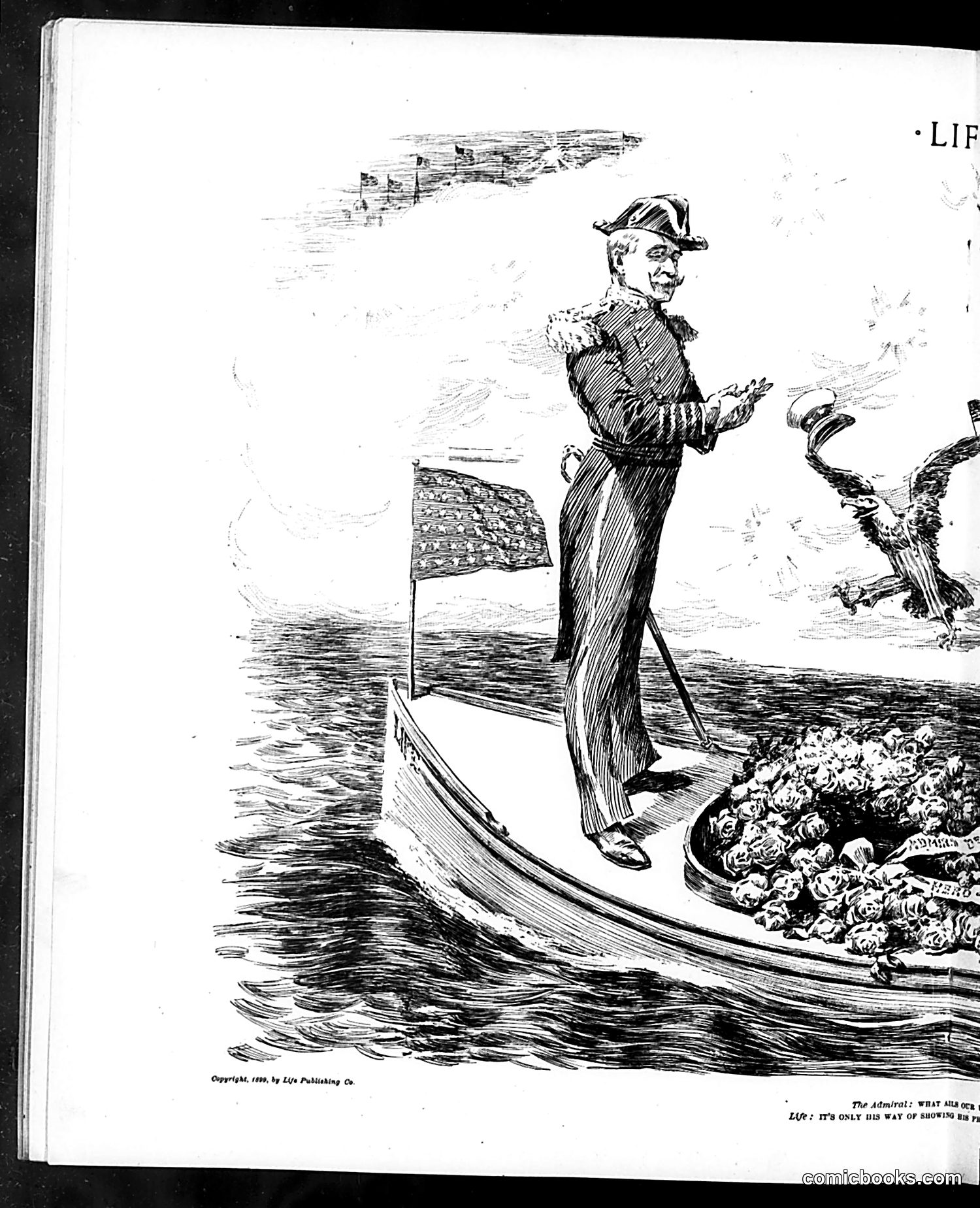
This is a political cartoon featuring a tall, thin military officer standing in a boat. The figure wears a bicorn hat and formal military dress with epaulettes, characteristic of early 20th-century naval or military leadership. He gestures expressively while standing near a flag, with what appears to be a pile of skulls or casualties on the right side of the image. The caption at bottom reads: "The Admiral: 'WHY ALL THESE... / LIFE: 'IT'S ONLY HIS WAY OF SHOWING HIS...'" The satire appears to criticize a military leader's indifference to casualties or deaths resulting from their command decisions. The skulls symbolize the human cost of warfare, while the admiral's casual gesture suggests he dismisses or minimizes this loss. The incomplete caption suggests the admiral makes excuses for the bloodshed. Without the full date or caption visible, the specific conflict remains unclear.
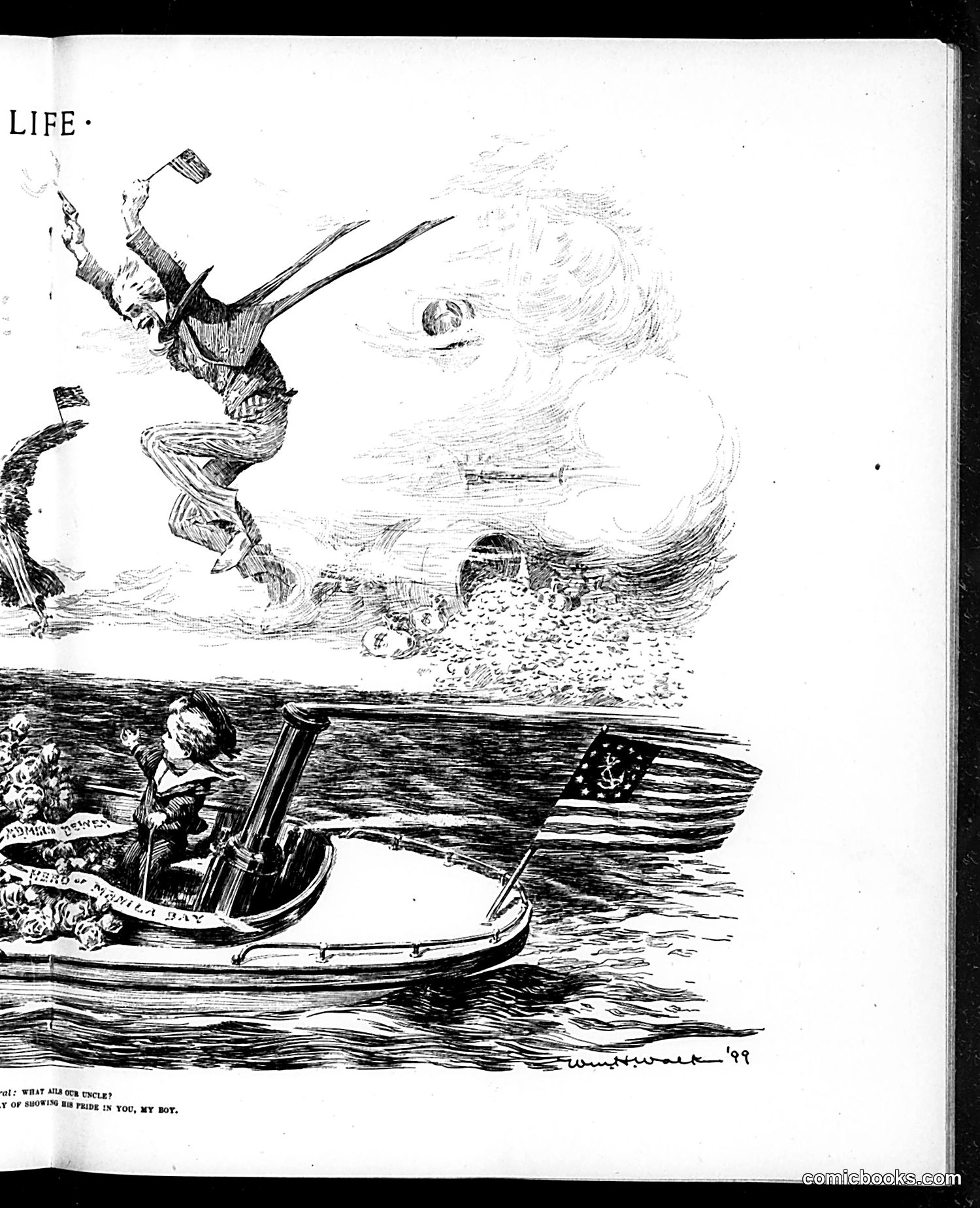
This page from *Life* magazine features a political cartoon titled "LIFE" at the top. The illustration shows a dramatic scene: a figure in period costume (appearing to be Uncle Sam or similar patriotic character) leaps energetically from a boat marked with a skull-and-crossbones flag, arms raised triumphantly. Below, a child in a boat watches this display. The partially visible caption at the bottom reads something like "...WHAT AIM HE UNCLE?..." and "...Y OF SHOWING HIS PRIDE IN YOU, MY BOY." The cartoon appears to satirize American patriotism or military enthusiasm being displayed for younger generations, possibly critiquing how adults showcase nationalist pride to children. The skull-and-crossbones flag suggests piracy or questionable moral implications of this patriotic display. The exact historical context remains unclear without the complete caption or date.
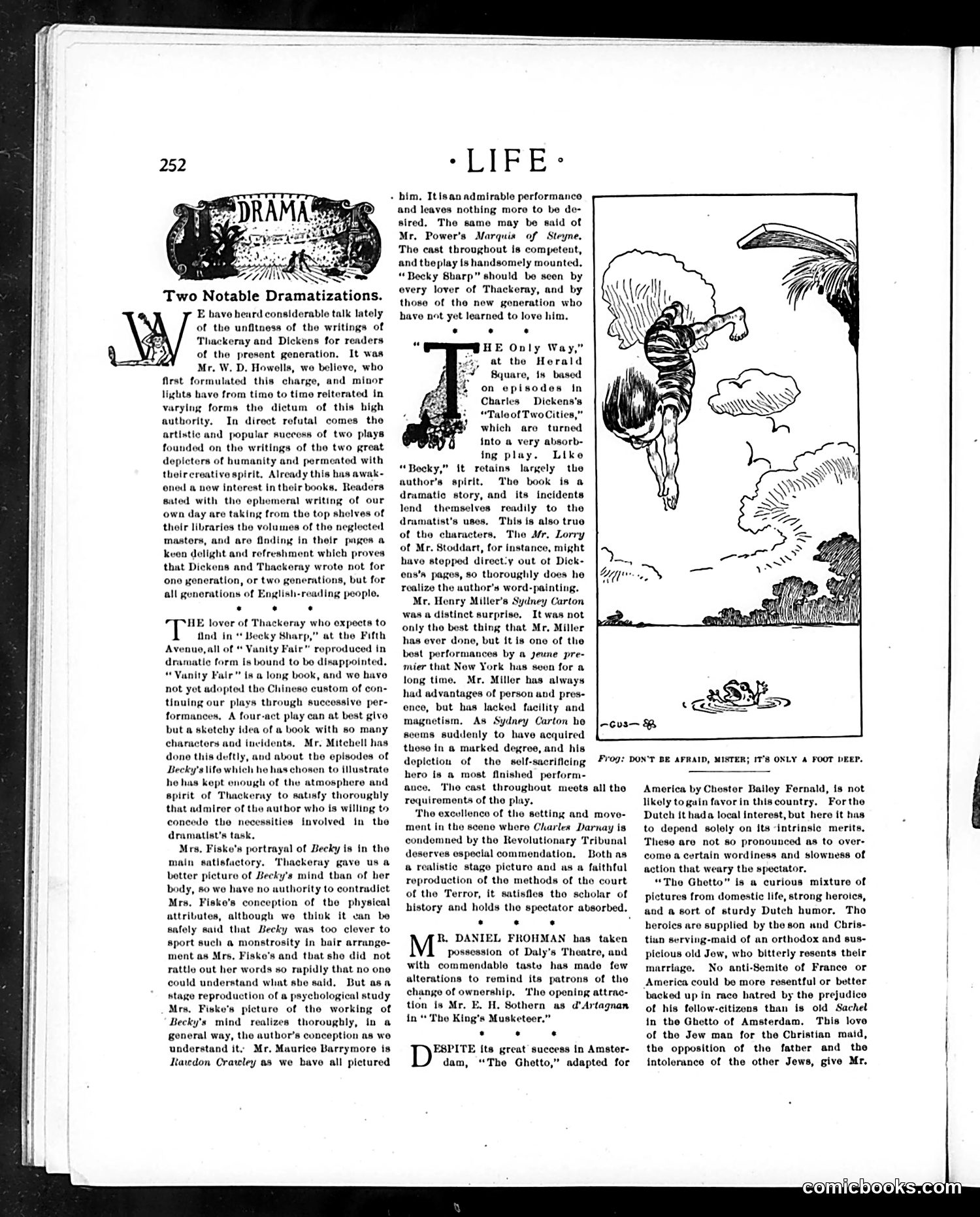
This page contains theater criticism rather than political cartoons. The main illustration shows a figure in period costume falling or tumbling downward—likely satirizing a dramatic performance. The text discusses dramatic adaptations of works by Dickens and Thackeray. Critics evaluate recent stage productions, including "The Only Way" (based on Dickens's "A Tale of Two Cities") and "Becky Sharp" (from Thackeray). The reviews critique theatrical quality and cast performances. One section discusses Mr. Daniel Frohman's management of Daly's Theatre and adaptations of various literary works. The tone is caustic, suggesting these dramatizations often disappoint compared to the original novels. The illustration's caption, "DON'T BE AFRAID, MISTER; IT'S ONLY A FOOT DEEP," appears to mock the shallow theatrical adaptations being reviewed.
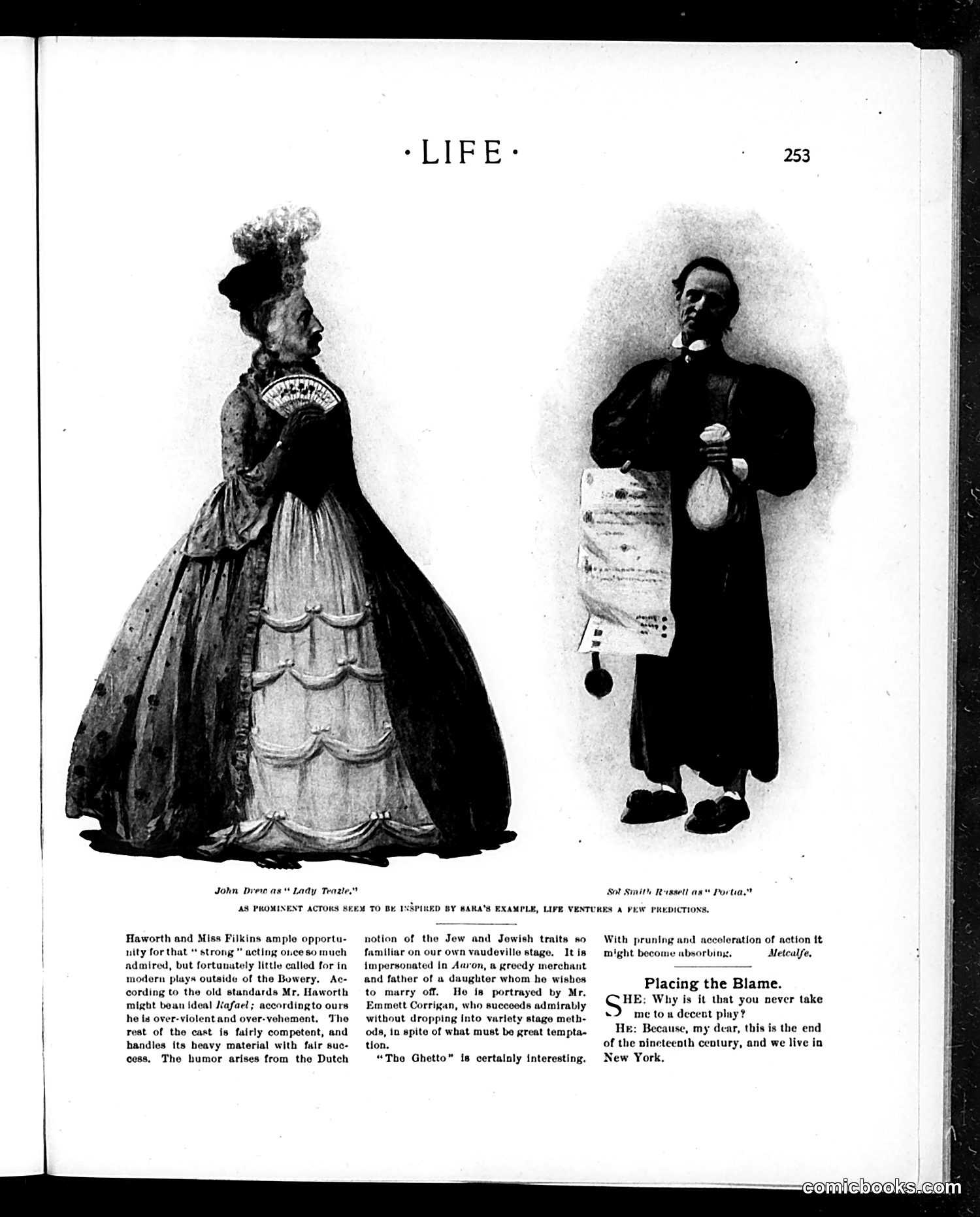
This page reviews theatrical productions featuring prominent actors John Drew and Sol Smith Russell. The satirical element appears in the caption's subtitle, which claims Life is making "predictions" based on "Bara's example"—likely referencing Theda Bara, a silent-film actress known for sexually provocative "vamp" roles. The two illustrated figures represent these actors in their current roles. The accompanying dialogue at bottom—"Placing the Blame"—is a short comic sketch where a husband deflects his wife's complaint about never attending decent theater by blaming New York's theatrical landscape at century's end. The satire critiques both the quality of contemporary theater and the social dynamics of theatergoing. The reference to "the Bowery" and "vaudeville" indicates concern that serious theater is degrading toward lower-class entertainment forms, while the husband's deflection suggests marital tension over leisure and culture.
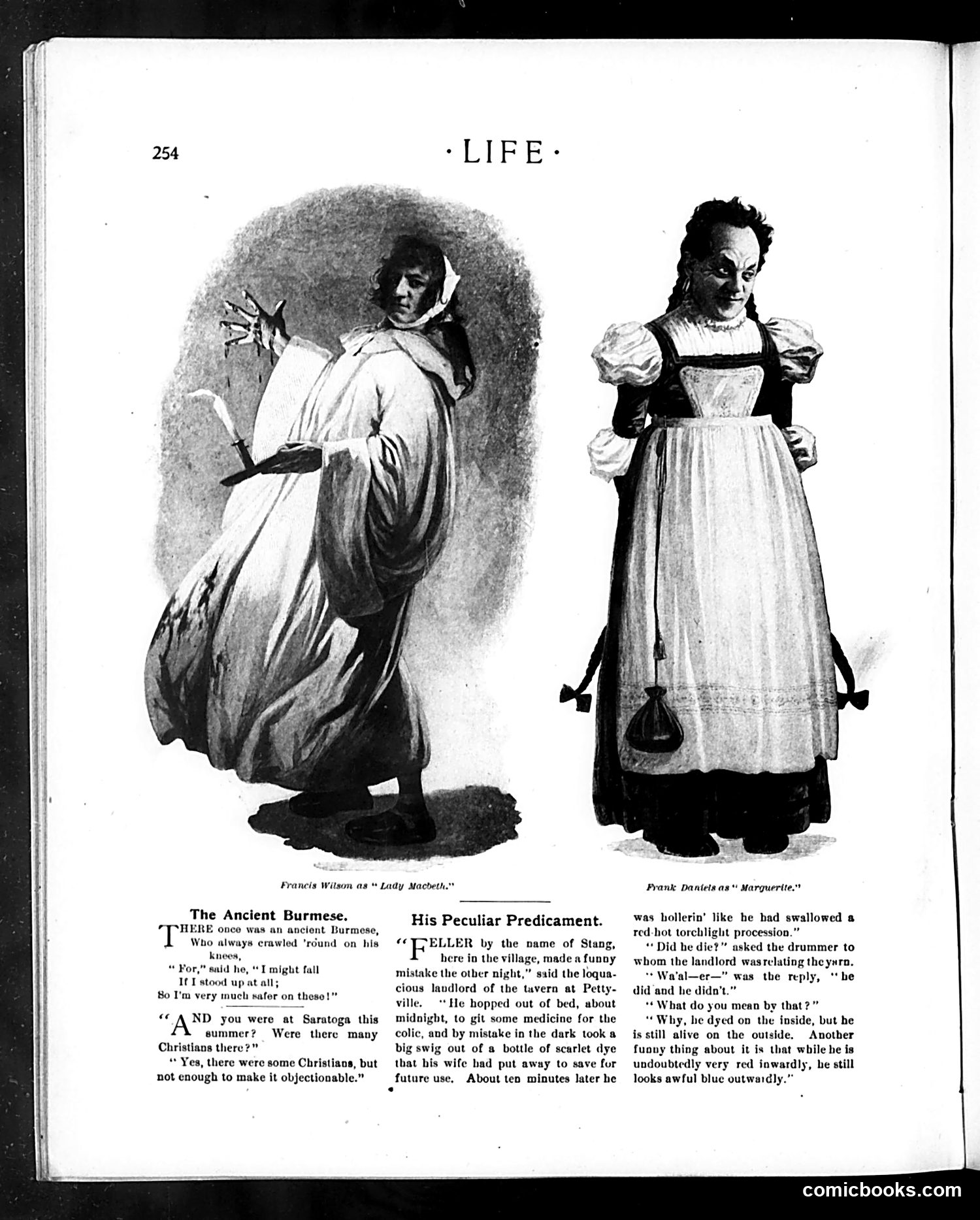
This page from *Life* magazine contains theatrical illustrations and three separate humorous anecdotes targeting social pretension and human folly. The top shows actors Francis Wilson (as Lady Macbeth) and Frank Daniels (as Marguerite), likely referencing contemporary theater productions. Below are three satirical jokes: 1. **"The Ancient Burmese"** mocks colonial-era stereotypes about non-Western peoples, depicting someone crawling to avoid falling—absurdist humor playing on period attitudes. 2. **Saratoga Christians** satirizes wealthy American resort culture, suggesting summer guests were predominantly non-Christian or immoral ("not enough to make it objectionable"). 3. **"His Peculiar Predicament"** is a rural dialect humor piece about a tavern keeper who accidentally drinks scarlet dye instead of medicine, resulting in a pun: he "dyed on the inside" (colored internally) while remaining blue (sad) outwardly. The page reflects *Life*'s satirical approach to social commentary through theatrical references, cultural stereotyping, and wordplay humor typical of late 19th/early 20th-century American comedy.
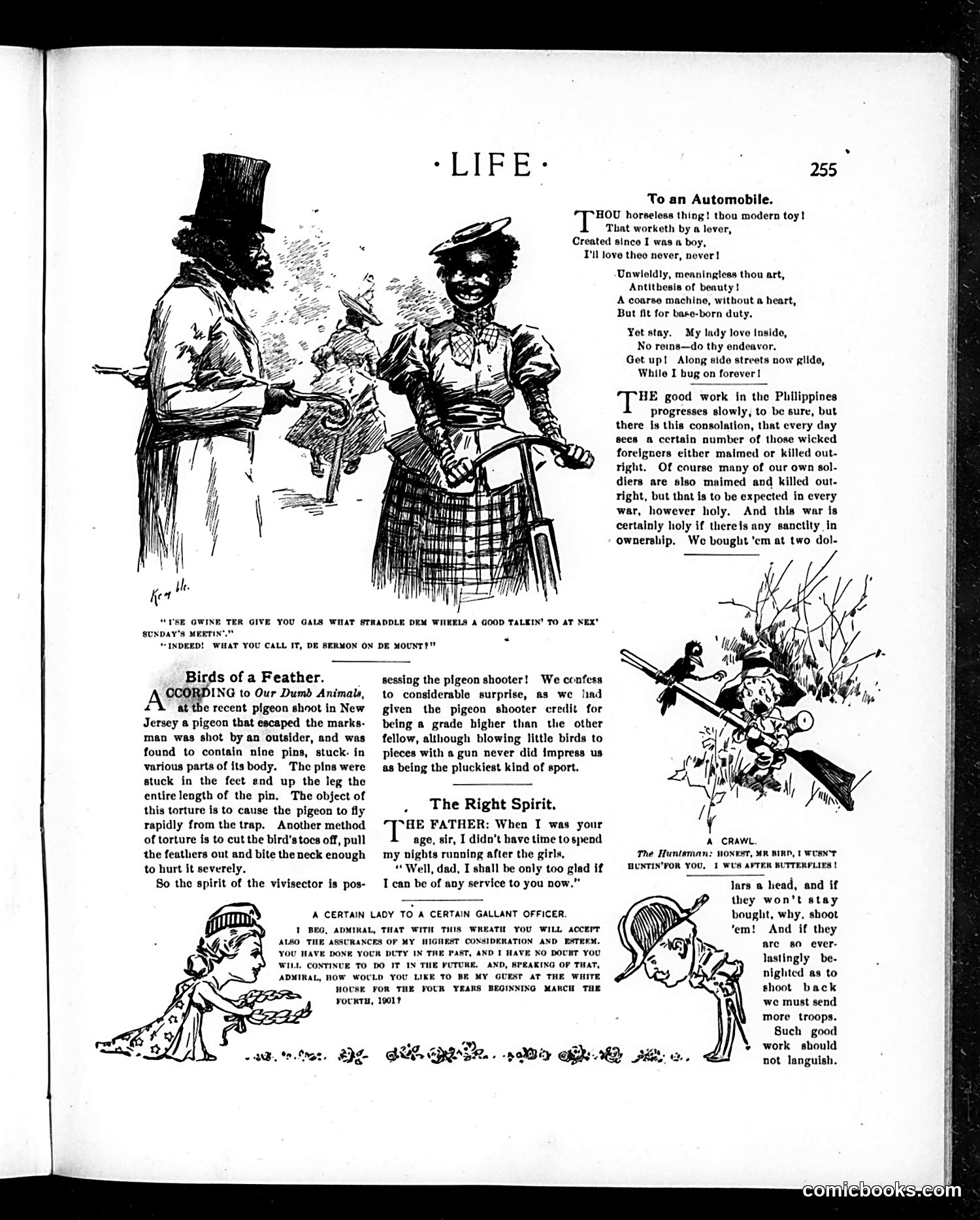
This page contains several satirical pieces critiquing American society circa 1900-1901: **"Birds of a Feather"** condemns the cruel treatment of pigeons at shooting competitions, comparing hunters' brutality to vivisectionists' practices. The satire suggests that those who torture animals for sport are morally equivalent to scientific experimenters. **"To an Automobile"** is a humorous poem mocking the new automobile technology as an ugly, heartless machine—yet admitting its practical utility. **"The Right Spirit"** satirizes American imperialism in the Philippines. The father-son dialogue about duty and the lady's invitation referencing "March the Fourth, 1901" (Theodore Roosevelt's inauguration) critique American colonial expansion. The final passage brutally mocks U.S. military policy: Americans bought the Philippines and will shoot Filipinos who resist, treating imperial conquest as a commercial transaction. The satire exposes the hypocrisy of calling colonial warfare "holy."
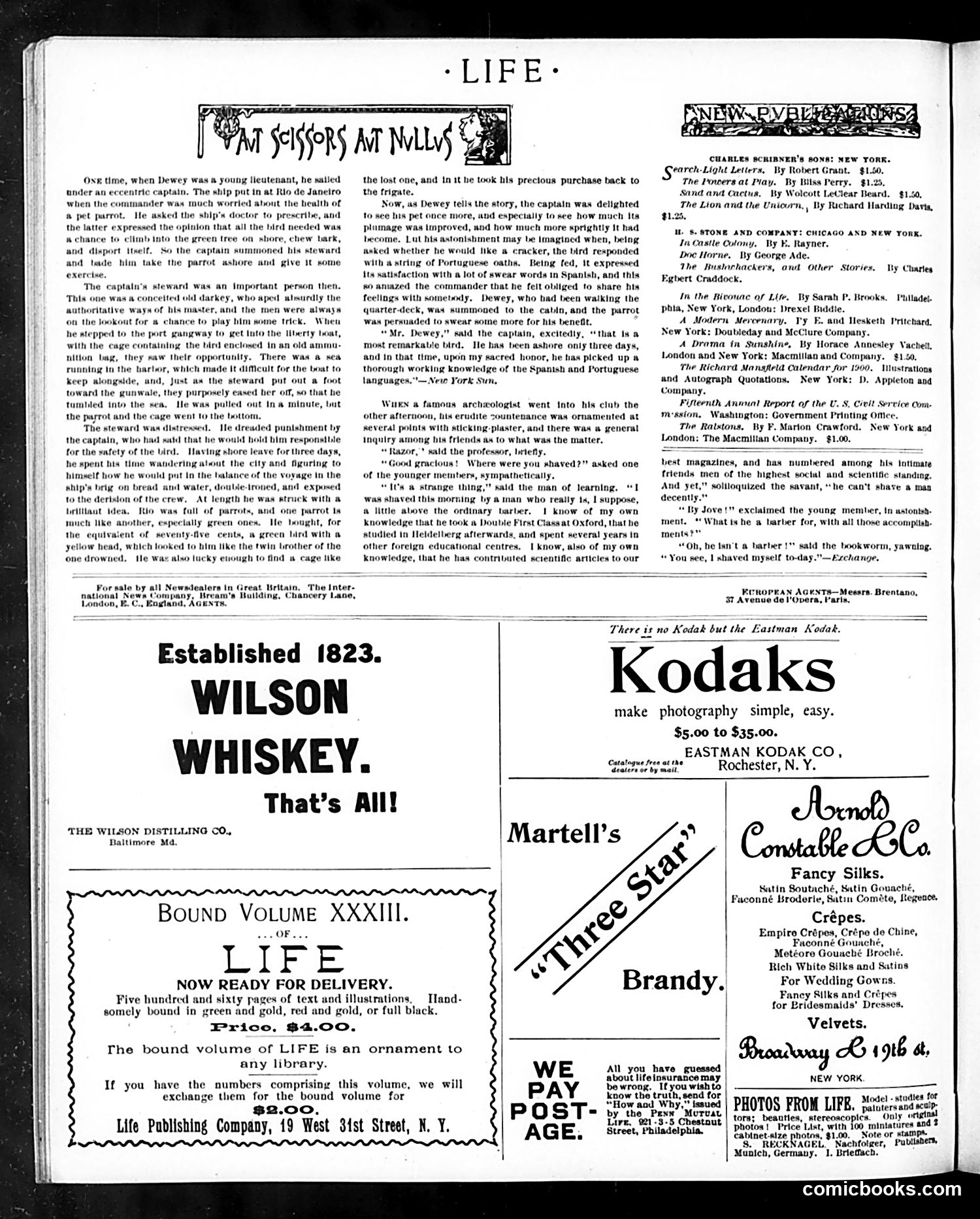
This page contains a humorous anecdote about Admiral Dewey (the famous naval commander) and a parrot. The story mocks both human vanity and the notion of environmental improvement. When Dewey's steward accidentally loses the captain's prized parrot overboard in Rio de Janeiro, he replaces it with an identical-looking bird purchased ashore. The captain is delighted—until the replacement parrot begins squawking in Portuguese and Spanish oaths. The captain marvels that the bird "picked up" these languages in merely three days ashore, demonstrating remarkable linguistic ability. The joke satirizes the captain's gullibility and absurd reasoning. A lower-quality parrot didn't magically become refined through shore leave; it was simply a different bird that already knew sailor's curses. A second brief anecdote about a learned barber appears below, using similar humor about educated men in humble professions. The page is primarily advertising (whiskey, cameras, silk, brandy), typical for Life magazine of this era.
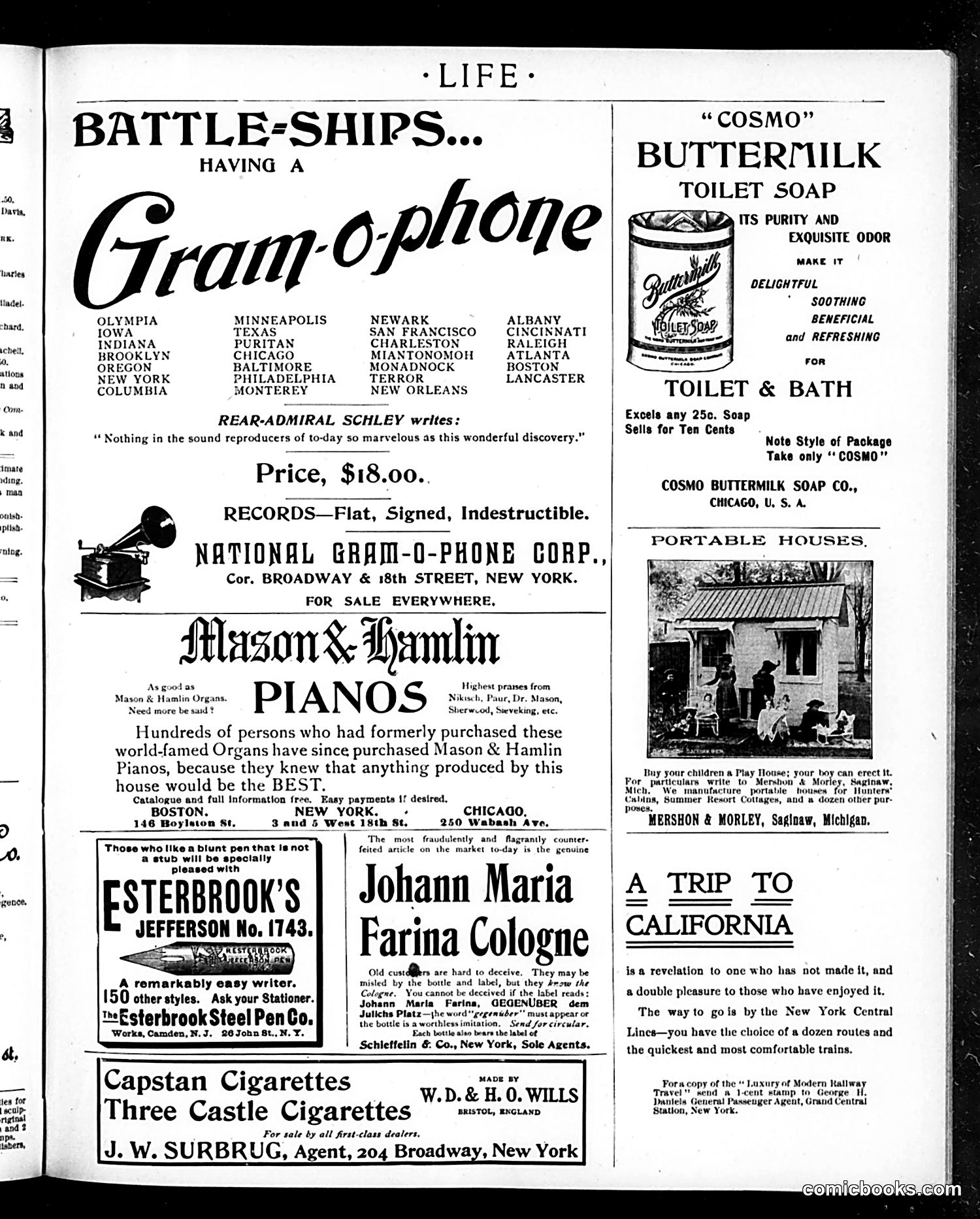
This page is primarily **advertisements**, not satirical editorial content. However, the lead ad is notable: **"Battle-Ships Having a Gramophone"** features Rear-Admiral Schley endorsing the National Gram-O-Phone ($18.00). Schley was a prominent Spanish-American War naval commander (1898), making his celebrity endorsement timely and credible for selling early sound-recording technology. The ad lists U.S. Navy ships' names, implying these vessels used the gramophone—a marketing strategy linking cutting-edge consumer technology to military prestige and modernity. The remaining ads promote pianos, specialty soaps, pens, cologne, portable play houses, cigarettes, and California rail travel—typical turn-of-century luxury goods and services. **Context for modern readers:** This reflects the early 1900s when celebrity military endorsements and brand-name authentication (like the "genuine" Farina Cologne warning against counterfeits) were persuasive advertising tactics.
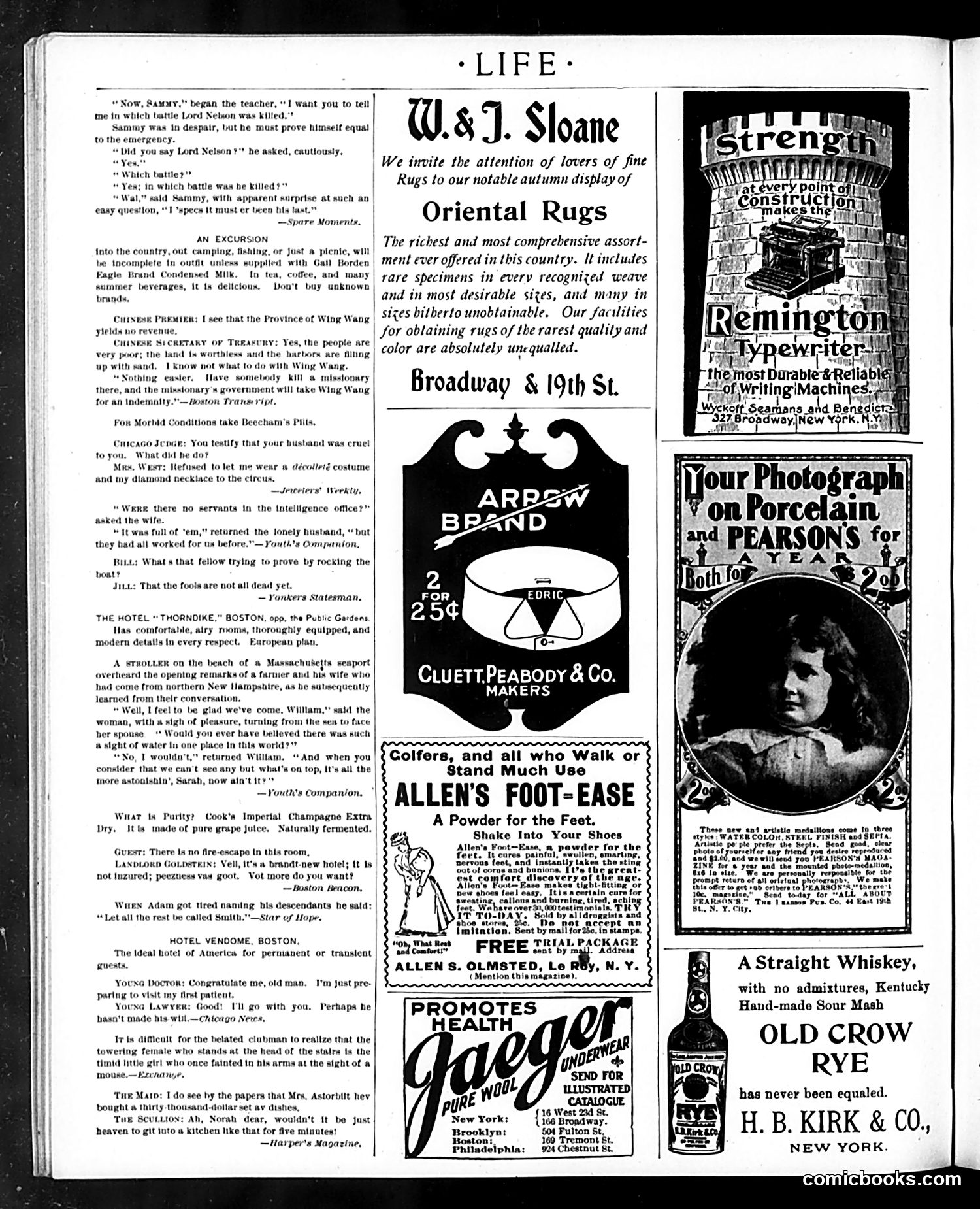
This page is primarily **advertising and humor snippets**, not a political cartoon. The bulk consists of short jokes and product advertisements typical of early 20th-century Life magazine. The jokes reflect period attitudes: one mocks a student's ignorance of history (Lord Nelson); another stereotypes Chinese officials as corrupt; several portray women as extravagant or illogical. A particularly class-conscious joke depicts a working-class immigrant hotel owner indifferent to safety regulations. The advertisements—for Oriental rugs, typewriters, foot powder, whiskey, and photograph services—target affluent readers. Notable is the casual racism in stereotyped Chinese dialect ("Vot more do you vant?") representing both immigrants and foreign officials. **Context we'd miss:** The "Chinese" jokes reference real contemporary anxieties about Chinese immigration and Western imperial interests in China. The humor assumes reader familiarity with these tensions as comedy fodder. Overall, this is a **snapshot of Edwardian-era popular attitudes**, not sophisticated satire—what passed for genteel humor among privileged American audiences.
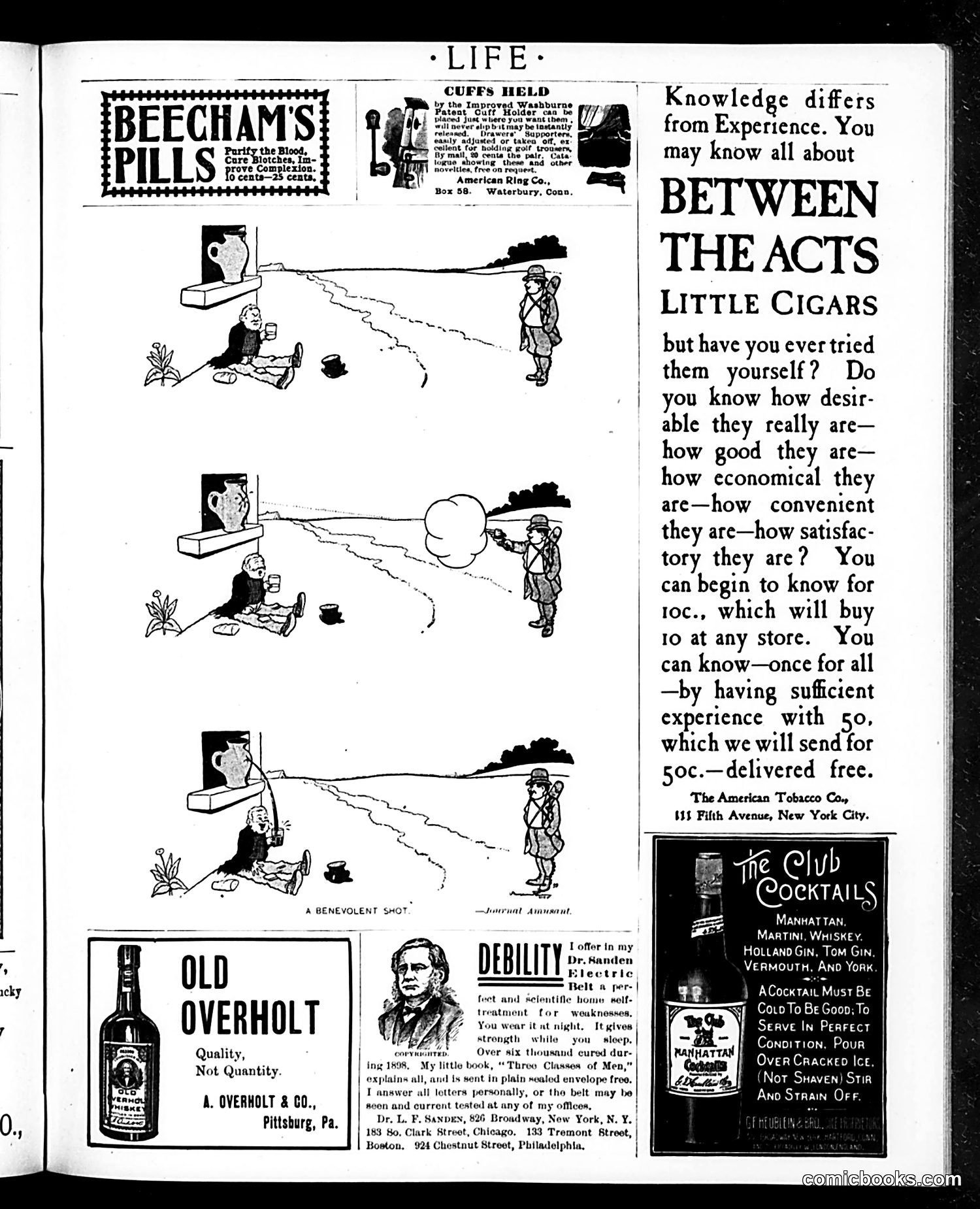
This page is primarily **advertising**, not editorial satire. The main cartoon—titled "A Benevolent Shot"—shows a three-panel sequence of a man receiving increasingly larger injections or doses from a figure on the right, depicting the escalating effects of treatment or consumption. The ads reveal period concerns: Beecham's Pills promised blood purification; Dr. Sanden's "Electric Belt" claimed to cure male weakness through nighttime wear; Old Overholt whiskey emphasized "quality"; and Between the Acts Little Cigars invited consumer experience ("knowledge differs from experience"). The cartoon likely mocks either medical quackery or excessive consumption—the "benevolent" framing is ironic, as the growing balloon suggests the recipient is being inflated or harmed. Without attribution or caption beyond "A Benevolent Shot," the precise target remains unclear, though it appears to critique either dubious remedies or indulgence sold to the gullible.