
Life, 1899-09-28 · page 4 of 20
Life — September 28, 1899 — page 4: what you’re looking at
What you’re looking at
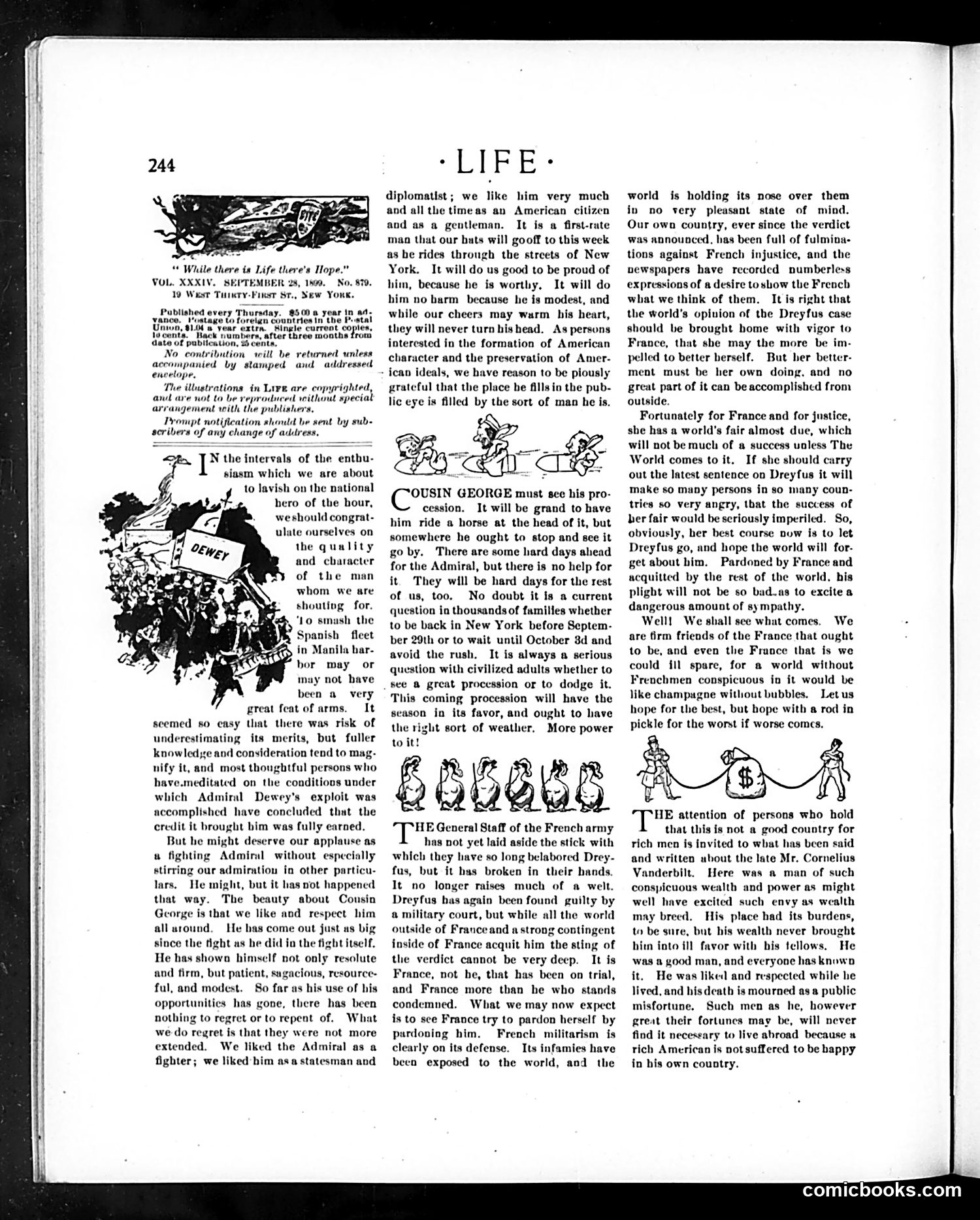
This page discusses **Cousin George** and his military commission, likely referring to a prominent political figure of the era. The text expresses hope he'll "see his profession" and ride at the head of a military unit, suggesting debate over his appropriate role. The left cartoon depicts **Denver** (labeled on a map/caricature) in relation to what appears to be Admiral Dewey's reputation and military accomplishments. The satire seems to question whether Dewey's merits are being underestimated or properly recognized. The right illustration shows figures holding a rope with dollar signs, satirizing wealthy individuals—possibly the Vanderbilts, mentioned by name—and their expectation that wealth excuses them from civic duty or patriotic service. The overall tone criticizes privilege and questions proper conduct during this period.
📄 Transcribed text from this page (OCR, searchable)
Machine-transcribed from the original scan — historical spelling and the odd misread are preserved.
“* While there is Life Here's Hope.” VOL. XXXIV. SEPTEMBER 28, 1800, No. 879. . Sew Youn, 19 West Turury-Finst 8 ‘ublished every Hostage U 7 U 4 a year extri current cop locent’s. “Back numbers, after three months from date of publication, % cents, contribution will be returned unless The illustrations in Live are copyrighted, awl are not to be reproduced without special arrangement with the publisher Trompt notification should be sent by sub- scribers of any change of address, c | eae intervals of the enthu- siasm which we are about to lavish on the national hero of the hour, weshould congrat- ulate ourselves on the quality and character of the man whom we are shouting for. ‘Lo smash the Spanish fleet in Manila bar- bor may or may not have , been a very great feat of arms. It seemed 80 casy that there was risk of underestimating its merits, but fuller knowledye and consideration tend to mag- nify it, and most thoughtful persons who have.meditated on the conditions under which Admiral Dewey's exploit was accomplished have concluded that the credit it brought bim was fully earned. But he might deserve our applause as a fighting Admiral without especially stirring our admiration in other particu- lars. He might, but it has not happened that way. The beauty about Cousin Gcorge is that we like and respect him all uround, He bas come out just as big since the Aight as he did in the fight itself. He has shown himself not only resolute and firm, but patient, sugacious, resource- ful, and modest. So far as his use of his opportunities has gone, there has been nothing to regret or to repent of. What we do regret is that they were not more extended. We liked the Admiral as a fighter; we liked: him asa statesman and -LIFE: diplomatist; we like him very much and all the timeas an American citizen and as a gentleman. It is a first-rate man that our bats will gooff to this week as he rides through the streets of New York. It will do us good to be proud of him, because he is worthy, It will do him no barm because he is modest, and while our cheers may warm his heart, they will never turn bis bead. As persons interested in the formation of American character and the preservation of Amer- - ican ideals, we have reason to be piously grateful that the place he fillsin the pub- lic eye is filled by the sort of man he is. OUSIN GEORGE must sce his pro- cession. It will be grand to have him ride a horse at the head of it, but somewhere he ought to stop and see it go by. There are some hard days ahead for the Admiral, but there is no help for it. They will be hard days for the rest of us, too, No doubt it is a current question in thousandsof families whether to be back in New York before Septem- ber 29th or to wait until October 8d and avoid the rush. It is always a serious question with civilized adults whether to _ See & great procession or to dodge it. This coming procession will have the season in its favor, and ought to have the right sort of weather. More power to it! 660886 THE General Staff of the French army has not yet laid aside the stick with which they have so long belabored Drey- fus, but it bas broken in their hands. It no longer raises much of a welt. Dreyfus has again been found guilty by a military court, but while all the world outside of France and a strong contingent inside of France acquit him the sting of the verdict cannot be very deep. It is France, not he, that has been on trial, and France more than be who stands condemned. What we may now expect is to see France try to pardon herself by pardoning him. French militarism is clearly on its defense. Its infamies have been exposed to the world, and the world is holding its nose over them in no very pleasant state of mind. Our own country, ever since the verdict was announced, has been full of fulmina- tions against French injustice, and the newspapers have recorded numberless expressions of a desire to show the Frencb what we think of them. It is right that the world’s opiuion of the Dreyfus case should be brought home with vigor to France, that she may the more be im- pelled to better herself. But her better- ment must be her own doing. and no great part of it can be accomplished from outside. Fortunately for France and for justice, she has a world’s fair almost due, which will not be much of a success uoless The World comes to it. If she should carry out the latest sentence on Dreyfus it will make so many persons in so many coun- tries so very angry, that the success of her fair would be seriously imperiled. So, obviously, ber best course now is to let Dreyfus go, and hope the world will for- get about him. Pardoned by France and acquitted by the rest of the world, bis plight will not be so bad_as to excite a dangerous amount of sympathy. Well! We shall see what comes. We are firm friends of the France that ought to be, and even the France that is we could ill spare, for a world without Frenchmen conspicuous in it would be like champagne without bubbles. Let us hope for the best, but hope with a rod in pickle for the worst if worse comcs. HE attention of persons who hold that this is not a good country for rich men is invited to what has been said and written ubout the late Mr. Cornelius Vanderbilt. Here was a man of such conspicuous wealth and power as might well have excited such envy as wealth may breed. His place had its burdens, to be sure, but his wealth never brought hit into ill favor with bis tellows. He ‘was a good man, and everyone has known, it, He was liked and respected while he lived, and his death is mourned asa public misfortune. Such men as he, however great their fortunes mag be, will never find it necessary to live abroad because a rich American is not suffered to be happy in his own country. comicbooks.com