
Life, 1899-09-28 · page 12 of 20
Life — September 28, 1899 — page 12: what you’re looking at
What you’re looking at
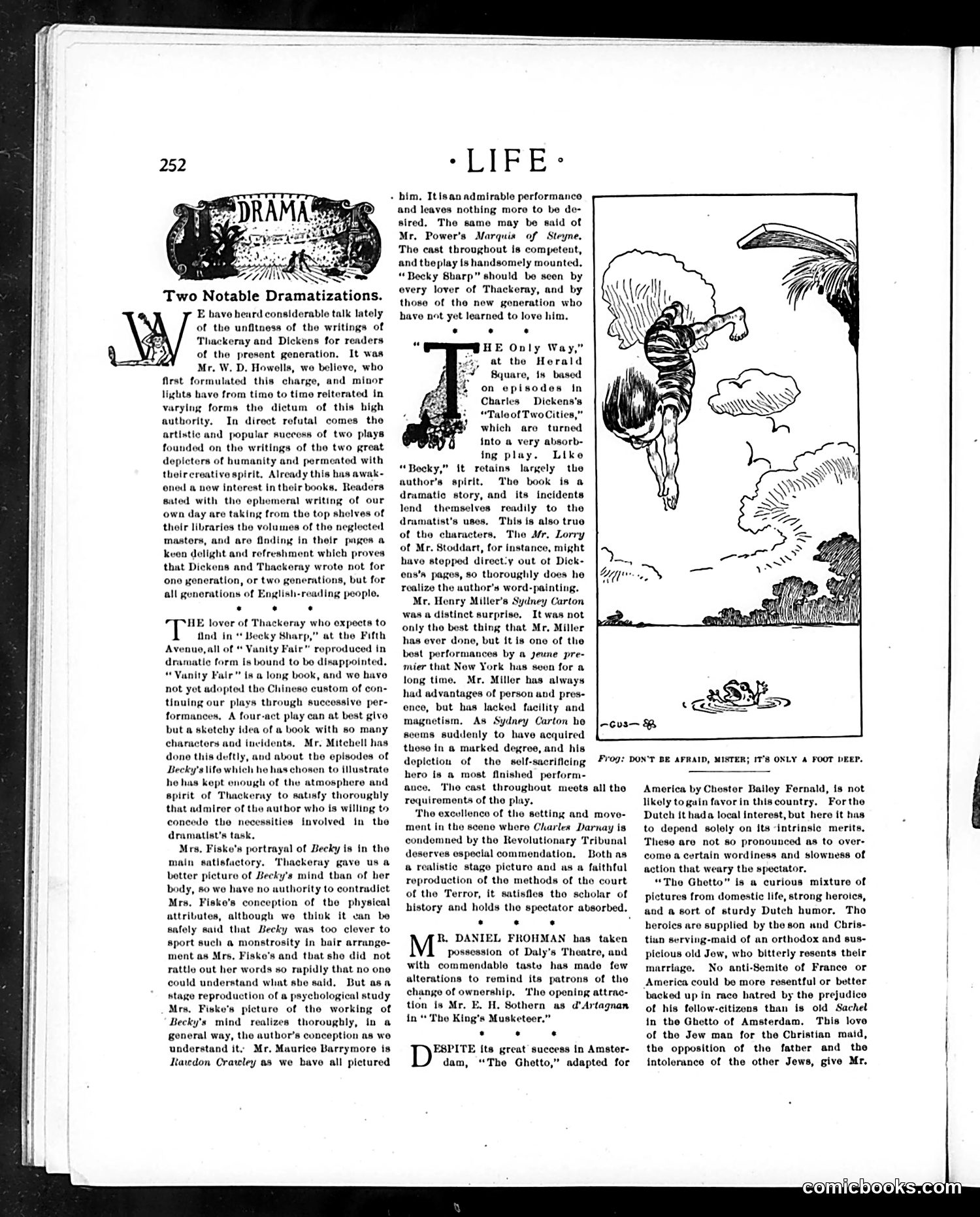
This page contains theater criticism rather than political cartoons. The main illustration shows a figure in period costume falling or tumbling downward—likely satirizing a dramatic performance. The text discusses dramatic adaptations of works by Dickens and Thackeray. Critics evaluate recent stage productions, including "The Only Way" (based on Dickens's "A Tale of Two Cities") and "Becky Sharp" (from Thackeray). The reviews critique theatrical quality and cast performances. One section discusses Mr. Daniel Frohman's management of Daly's Theatre and adaptations of various literary works. The tone is caustic, suggesting these dramatizations often disappoint compared to the original novels. The illustration's caption, "DON'T BE AFRAID, MISTER; IT'S ONLY A FOOT DEEP," appears to mock the shallow theatrical adaptations being reviewed.
📄 Transcribed text from this page (OCR, searchable)
Machine-transcribed from the original scan — historical spelling and the odd misread are preserved.
Two Notable Dramatizations. E bave heurd considerable talk lately of the unfitness of the writings of Thackeray and Dickens for readers of the present generation. It was Mr. W. D. Howells, we believe, who first formulated this charge, and minor lights have from time to time reiterated in varying forms tho dictum of this bigh authority. In direct refutal comes the artistic and popular success of two plays founded on the writings of the two great depicters of humanity and permeated with theircreative spirit. Already this has awak- oned a new interest in their books, Readers sated with the ephemeral writing of our own day are taking from the top shelves of their libraries the volumes of the neglected mastors, and are finding in their pages a keen delight and refreshment which proves that Dickons and Thackeray wrote not for ono generation, or two generations, but for all generations of English-reading people, . . . HE lover of Thackeray who oxpects to find in “Becky Sharp,” at the Fifth Avenue,all of * Vanity Fair” reproduced in dramatic form is bound to be disappointed, “Vanity Fair” is a long book, and we have not yet adopted the Chinese custom of con- tinuing our plays through successive per- formances, A four-act play can at best give but a sketeby idea of a book with 80 many charactors aod incidents. Mr, Mitchell has done this deftly, and about the episodes of Becky's lite which he has chosen to illustrate he has kept enough of the atmosphere and spirit of Thackeray to satisfy thoroughly that admirer of the author who is willing to concede the necessities Involved in the dramatist’s task, Mrs, Fiske's portrayal of Becky is in the main satisfactory. Thackeray gave us a better picture of Becky's mind than of her body, 80 we have no authority to contradict Mrs, Fiske’s conception of the physical attributes, although wo think it van be safely said that Becky was too clever to sport such @ monstrosity in hair arrange- ment as Mrs, Fiske's and that sho did not rattle out her words so rupidly that no one could understand what sbe said, But asa stage reproduction of a psychological study Mrs, Fiske’s picture of the working of Becky's mind realizes thoroughly, in a general way, the author's conception as we understand it, Mr, Maurice Barrymore is Rawdon Crawley as we bave all pictured «LIFE = - him, Itisan admirable performanco and leaves nothing moro to be de- sired. The same may be said of Mr. Power's Marquis of Steyne. Tho cast throughout is competent, and theplay 1s handsomely mounted. “Becky Sharp” should be seen by every lover of Thackeray, and by those of the new goneration who have not yet learned to love him. oe HE Only Way,” at the Herald Square, 18 based on episodes In Charles Dickens's “Taleof TwoCities,' which aro turned into a very absorb- ing play. Like “Becky,” it retains largely the author's spirit, The book is a dramatic story, and its incidents lend themselves readily to the dramatist’s uses. This is also true of tho characters, The Afr, Lorry of Mr. Stoddart, for instance, might havo stepped direct:y out of Dick- ens’a pages, 80 thoroughly does he realize the author's word-painting. Mr, Henry Miller’s Sydney Carton was a distinct surprise, It was not only tho best thing that Mr. Miller has ever done, but it is one of the best performances by a jeune pre- mier that Now York has seen for a long time. Mr. Miller has always had advantages of person and pres- ence, but has lacked facility and magnetism, As Sydney Carton ho seems suddenly to have acquired these in a murked degree, and his depiction of the self-sacrificing hero is a most finished perform- auce, Tho cast throughout meets all tho requirements of the play. ‘The excvllence of the setting and moyo- ment in the scene whore Charles Darnay is condemned by tho Revolutionary Tribunal deserves especial commendation, Both as a realistic stage picturo and as a faithful reproduction of the methods of the court of the Terror, it satisfies tho scholar of history and holds the spectator absorbed. o 8 6 R, DANIEL FROHMAN has taken possession of Daly's Theatro, and with commendable taste has made few alterations to remind its patrons of the change of ownership, ‘Tho opening attrac- tion is Mr. E. H. Sothern as d'Artagnan in “ Tho King’s Musketeer.” 6 . D== {ts great success In Amster- dam, “Tho Ghetto,” adapted for Frog: DON'T DE AFRAID, MISTER; 1T°8 ONLY 4 FOOT DEEP. America by Chestor Bailey Fernald, {8 not likely to gain favor in this country, For the Dutch it hada local interest, but here it has to depend solely on its intrinsic merits, These are not 80 pronounced as to over- come a certain wordiness and slowness of action that weary the spectator, “Tho Ghetto” is a curious mixture of pictures from domestic life, strong heroics, and a sort of sturdy Dutch humor. Tho heroics are supplied by the son und Chris- tiun serving-maid of an orthodox and sus- pictous old Jow, who bitterly resents their marriage. No anti-Semite of France or America could be more resentful or better backed up in raco hatred by the prejudice of his fellow-citizens than is old Sachet in the Ghetto of Amsterdam. This lovo of the Jew man for the Christian maid, the opposition of the father and the intolerance of the other Jews, give Mr.