
A complete issue · 20 pages · 1899
Life — August 3, 1899
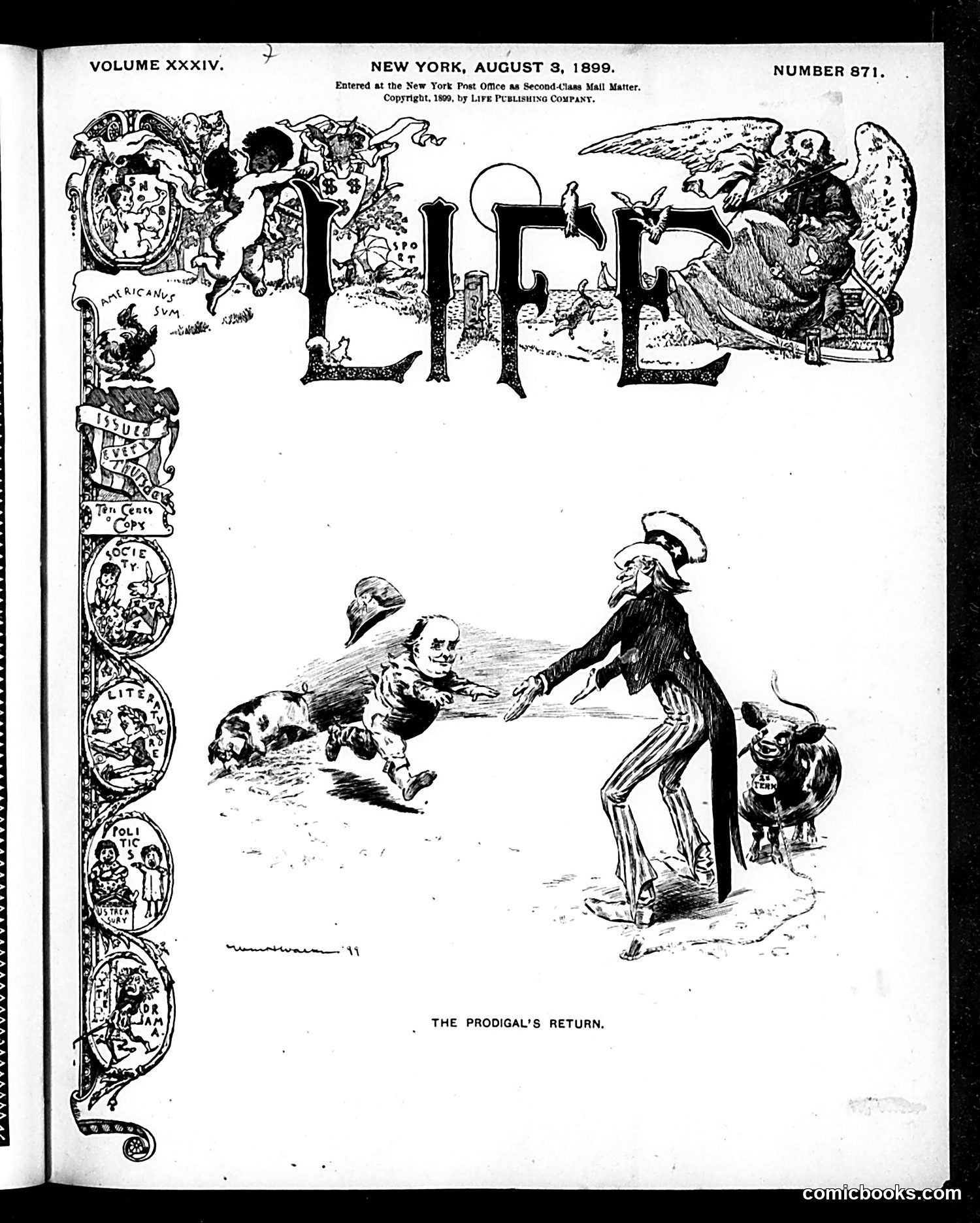
This cartoon illustrates the biblical parable of the prodigal son. A tall, skeletal figure in striped patriotic clothing (Uncle Sam) welcomes back a young boy, while two smaller figures (appearing to represent other nations or powers) flank the scene. The cartoon likely references American imperial politics of 1899—specifically territorial expansion or the return of American interests/influence somewhere abroad. The "prodigal's return" suggests a wayward party coming back into the fold. The stylized patriotic dress and the composition echo contemporary debates about America's growing global involvement during the Spanish-American War period and subsequent imperial acquisitions. Without clearer historical markers, the specific reference remains uncertain, though it clearly concerns American foreign policy and national identity circa 1899.
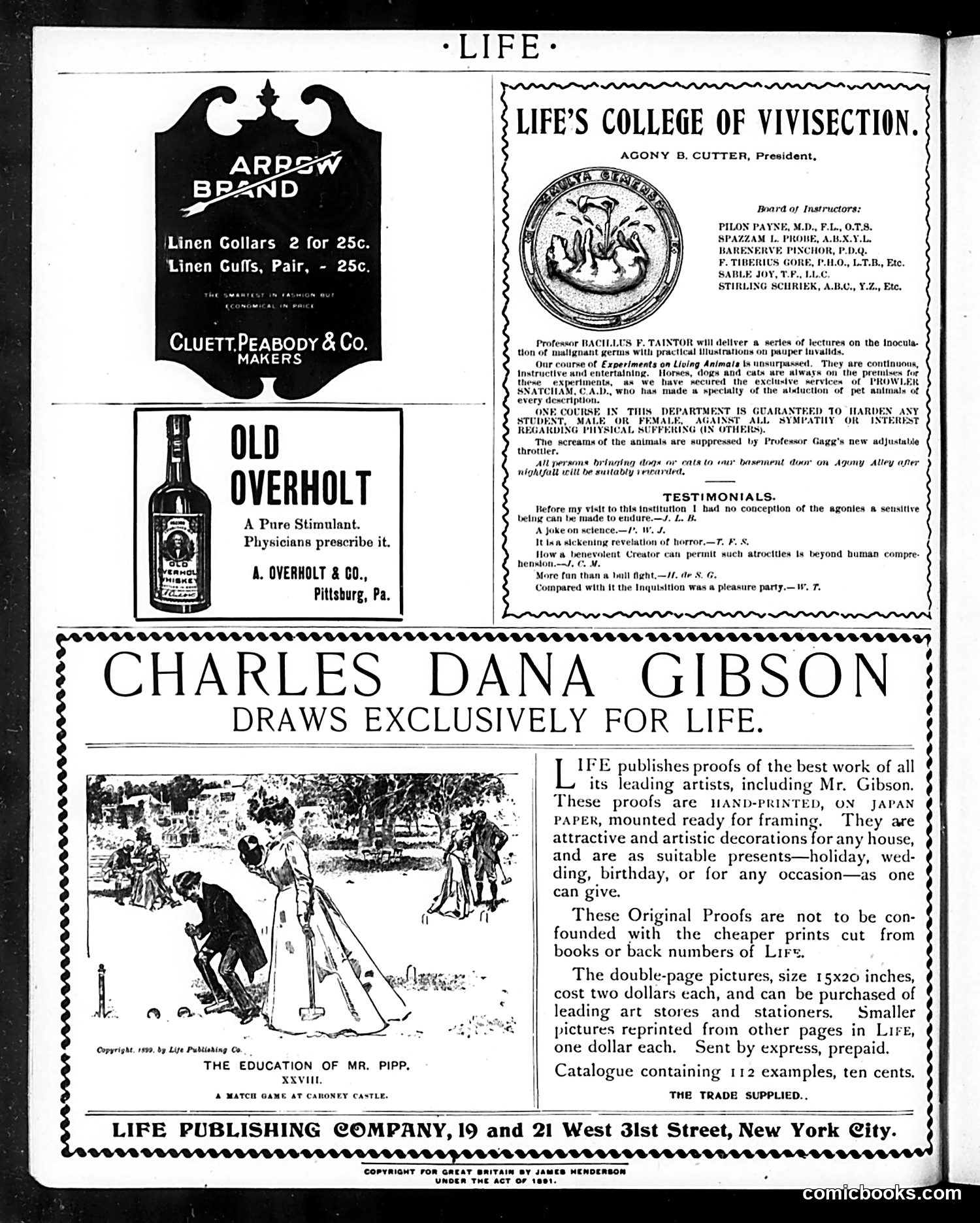
This page is primarily **advertising and promotional content** rather than political satire. It contains: 1. **Arrow Brand collar/cuff advertisement** (top left) 2. **Old Overholt whiskey ad** (bottom left) - marketed as "a pure stimulant" prescribed by physicians 3. **Life's College of Vivisection** (top right) - a humorous advertisement for lectures on animal dissection by Professor Bacilles F. Taintor, featuring testimonials about the educational value 4. **Charles Dana Gibson feature** (center/bottom) - promoting his exclusive artwork available as mounted proofs for sale through Life Publishing Company The vivisection college appears to be **satirical humor** about contemporary scientific education, though the exact joke is unclear without additional context. The page otherwise functions as a vehicle for monetizing Life magazine's brand through merchandise and advertising.
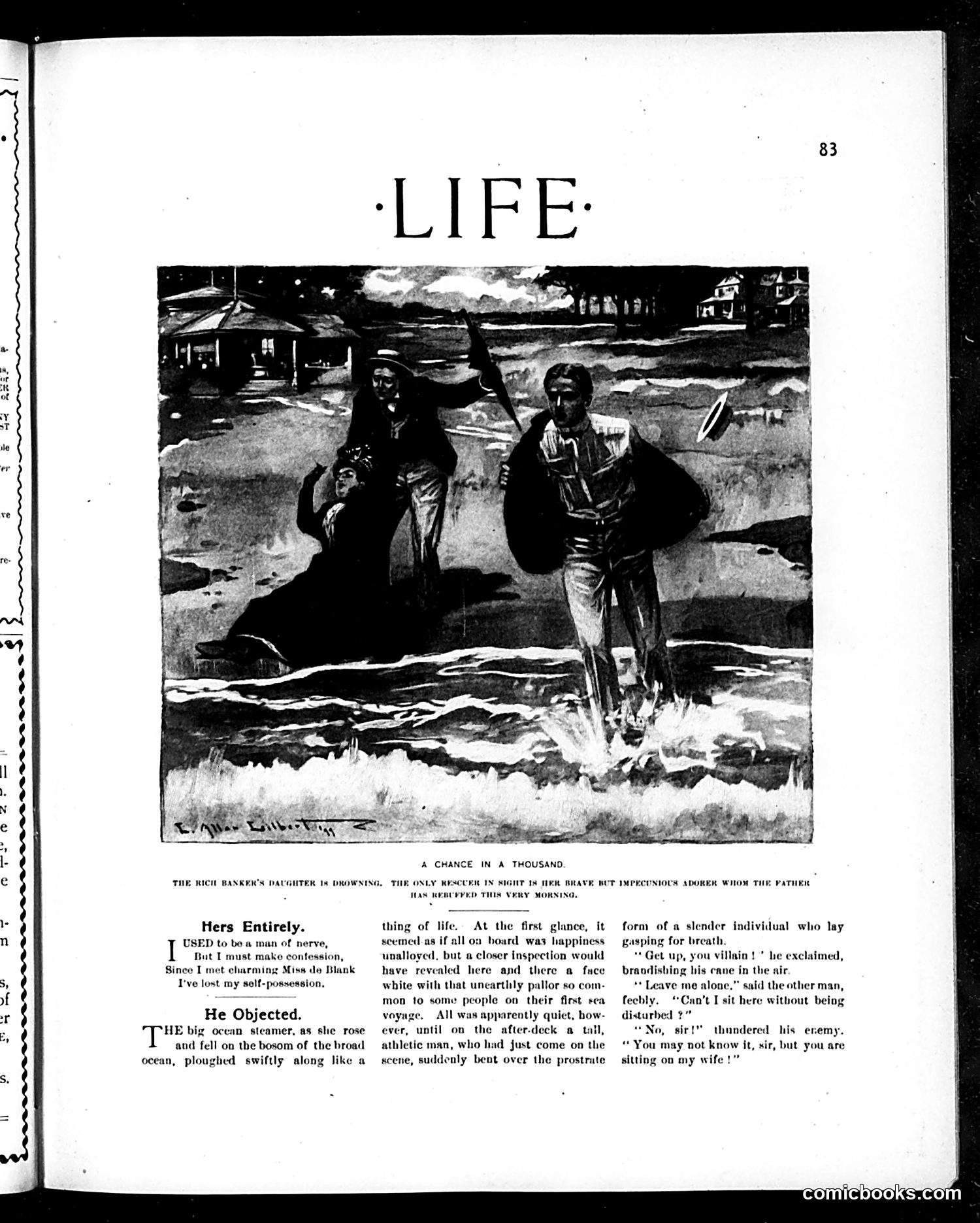
**Image & Caption:** "A Chance in a Thousand" depicts a dramatic rescue at sea. A wealthy banker's daughter is drowning while a brave but "impecunious" (poor) man rescues her—visible in the illustration as figures in rough ocean waves with buildings on shore. **The Story:** The accompanying text presents a romantic narrative conflict. A poor man saves a rich woman's life, but class barriers prevent their union. The dialogue reveals the social commentary: the rescued woman's father acknowledges the rescuer's heroism but cannot accept him as a son-in-law because of his poverty ("You may not know it, sir, but you are sitting on my wife!"). **Satire:** This mocks rigid class distinctions in Gilded Age America, where even life-saving sacrifice couldn't overcome social hierarchy and wealth-based marriage expectations.
This page contains **no political cartoons**—it's primarily satirical editorial commentary in text form. The main piece discusses **General Alger**, apparently Secretary of War, criticizing his fitness for office. The text suggests Alger was forced into an unsuitable administrative role and should have sought a different position to vindicate his record. The author argues the President, Secretary, and others should be "thankful" Alger didn't pursue legal action. A secondary article discusses **Mr. Archie H. Brower of South Dakota**, concerning a missing-link attraction at his tent show—debating whether the specimen was a monkey or human. The satire mocks the incident and questions the authorities' judgment. The third piece addresses **Philippine censorship** of newspaper correspondents, criticizing information suppression from voters as contrary to American democratic interests.
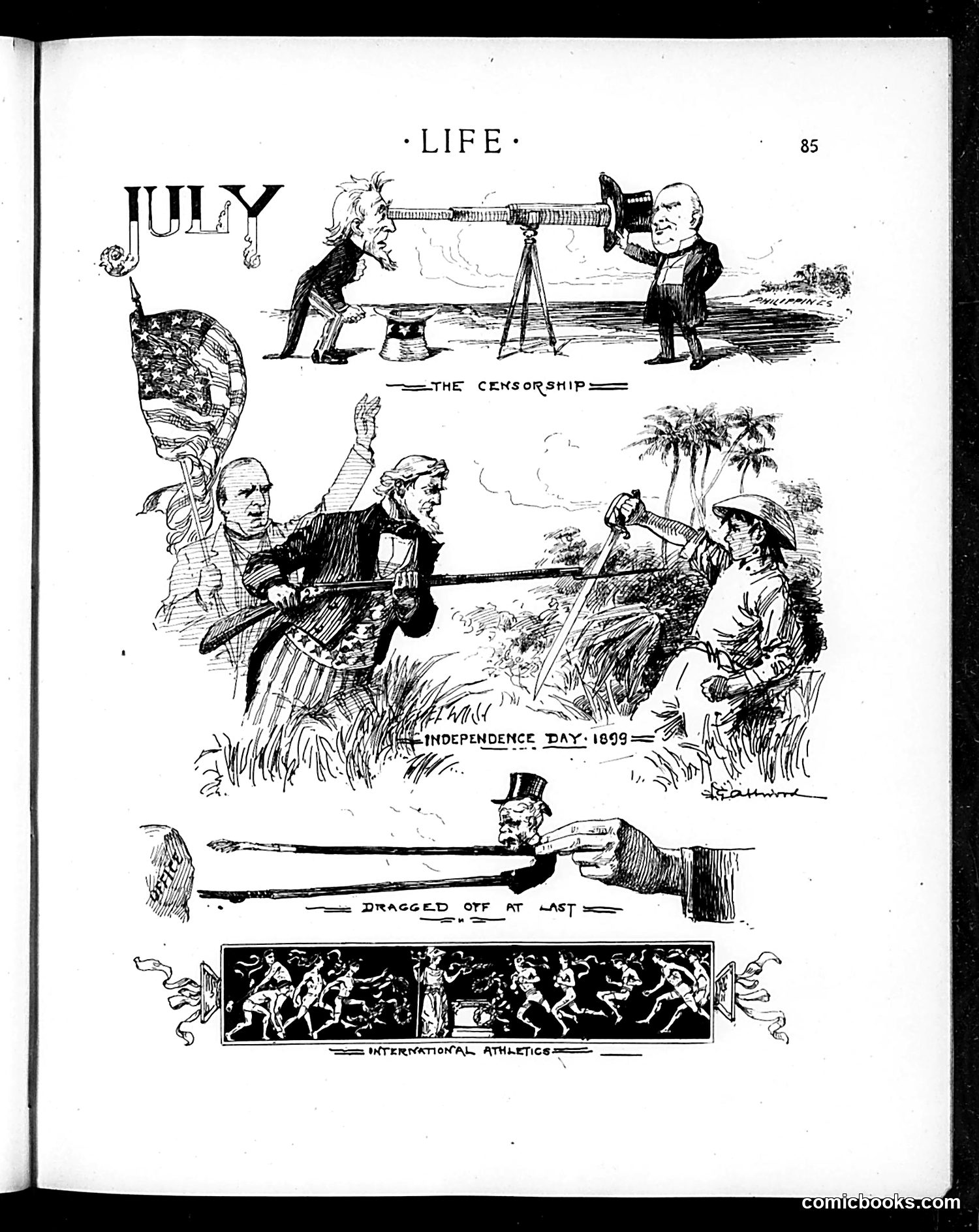
This satirical page contains three distinct political cartoons: **"The Censorship"** (top): Two figures peer through a telescope at opposite ends, satirizing mutual censorship or surveillance between nations—likely referencing tensions during the Boer War era. **"Independence Day: 1899"** (middle): A caricatured figure representing Uncle Sam is literally "dragged off" by two others in a tropical setting, suggesting American imperialism or overseas military interventions were constraining American independence itself—possibly referencing the Philippines conflict or Cuban affairs. **"Dragged Off at Last"** (bottom): Shows a small figure (Uncle Sam) being pulled by two large hands, reinforcing the imperialism theme. **"International Athletics"** (bottom panel): Depicts competitive struggle between nations. The overall message critiques American imperial expansion as contradicting founding democratic principles.
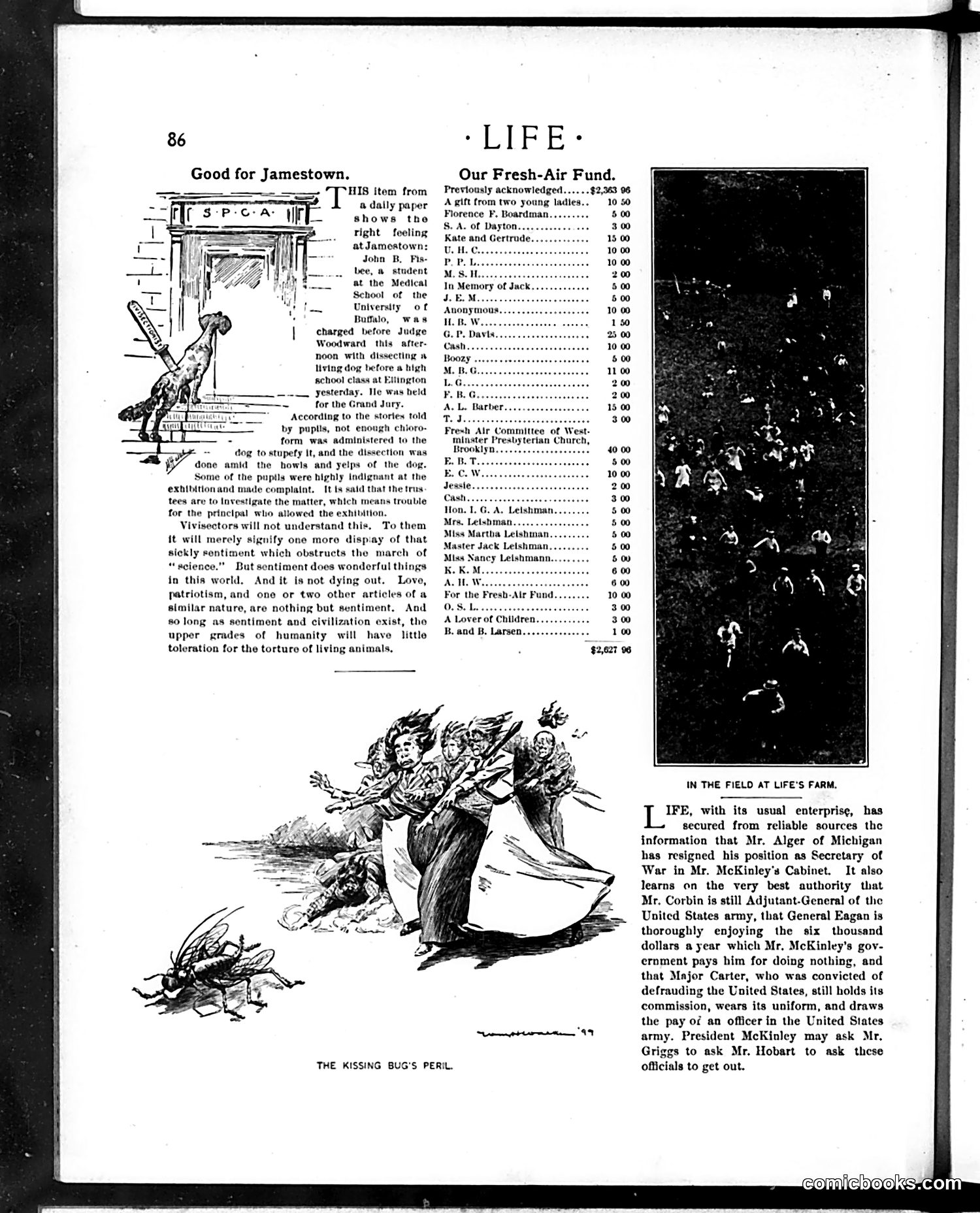
**"Good for Jamestown"** (top left): This cartoon depicts a dog being disciplined by pupils at a Medical School in Jamestown, Buffalo. The text explains a student named John B. Pike was charged before a judge for discharging a live dog before a high school class. The cartoon satirizes medical education practices, suggesting the casual cruelty involved in using live animals for vivisection demonstrations. The accompanying text criticizes such "displays of sickly sentiment" disguised as science, arguing that civilization should have zero tolerance for animal torture. **"The Kissing Bug's Peril"** (bottom): This political cartoon appears to satirize a contemporary figure or event through the metaphor of insects being threatened, though the specific reference is unclear without additional historical context. The page also lists donations to Life's "Fresh-Air Fund."
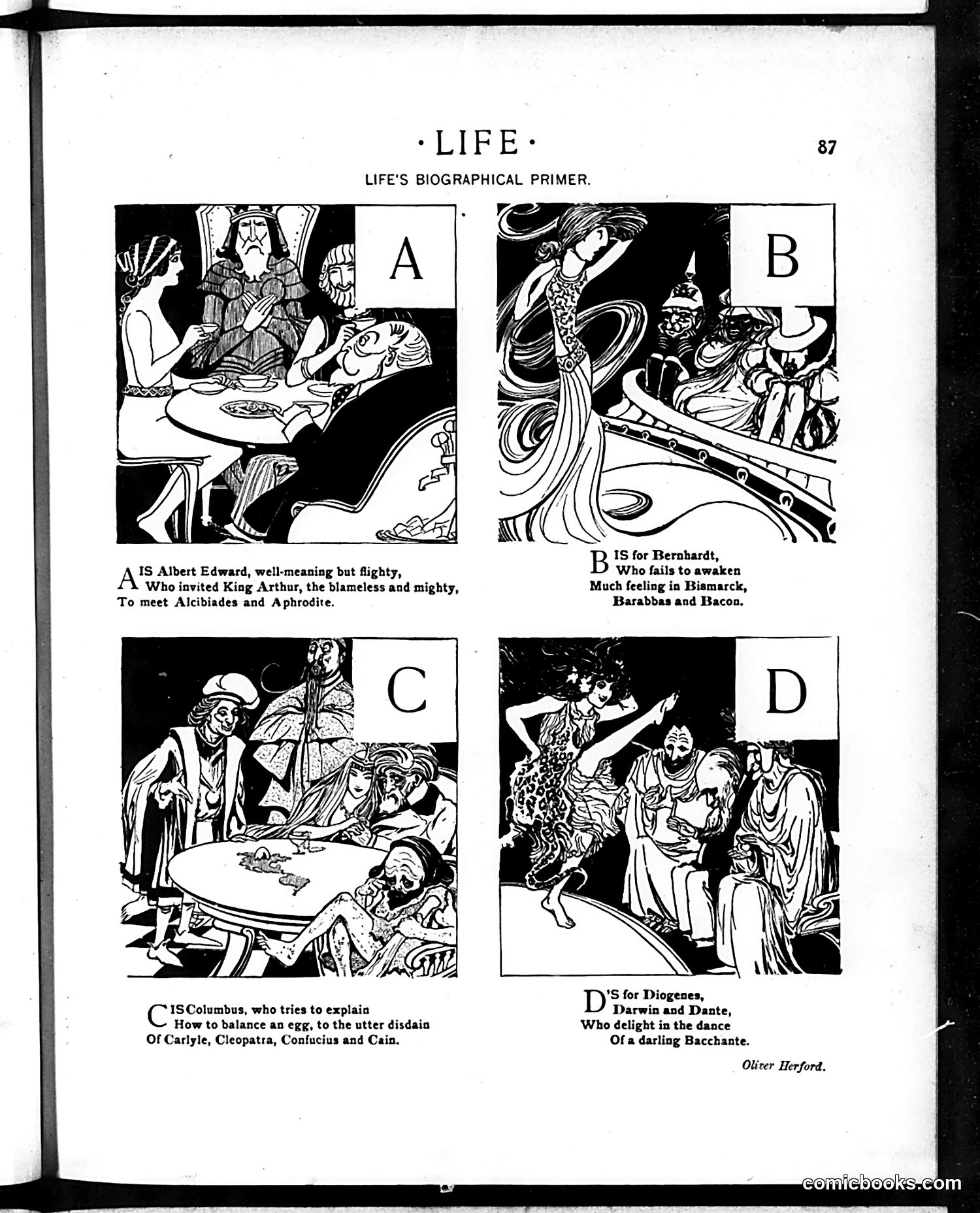
This is a satirical "primer" using historical and literary figures as educational alphabet entries. Each illustration pairs a letter with a rhyming couplet describing famous people: - **A**: Albert Edward (the Prince of Wales) as "well-meaning but flighty," meeting King Arthur - **B**: Bernhardt (the famous actress Sarah Bernhardt) who "fails to awaken / Much feeling in Bismarck, Barabas and Bacon" - **C**: Colombus attempting to balance an egg, alongside historical/mythological figures (Carlyle, Cleopatra, Confucius, Cain) - **D**: Diogenes, Darwin, and Dante depicted with "a darling Bacchante" The humor relies on readers recognizing these famous names and appreciating absurdist juxtapositions—mixing historical figures, literary characters, and contemporary celebrities in ridiculous scenarios. It's lighthearted intellectual mockery typical of *Life* magazine's approach.
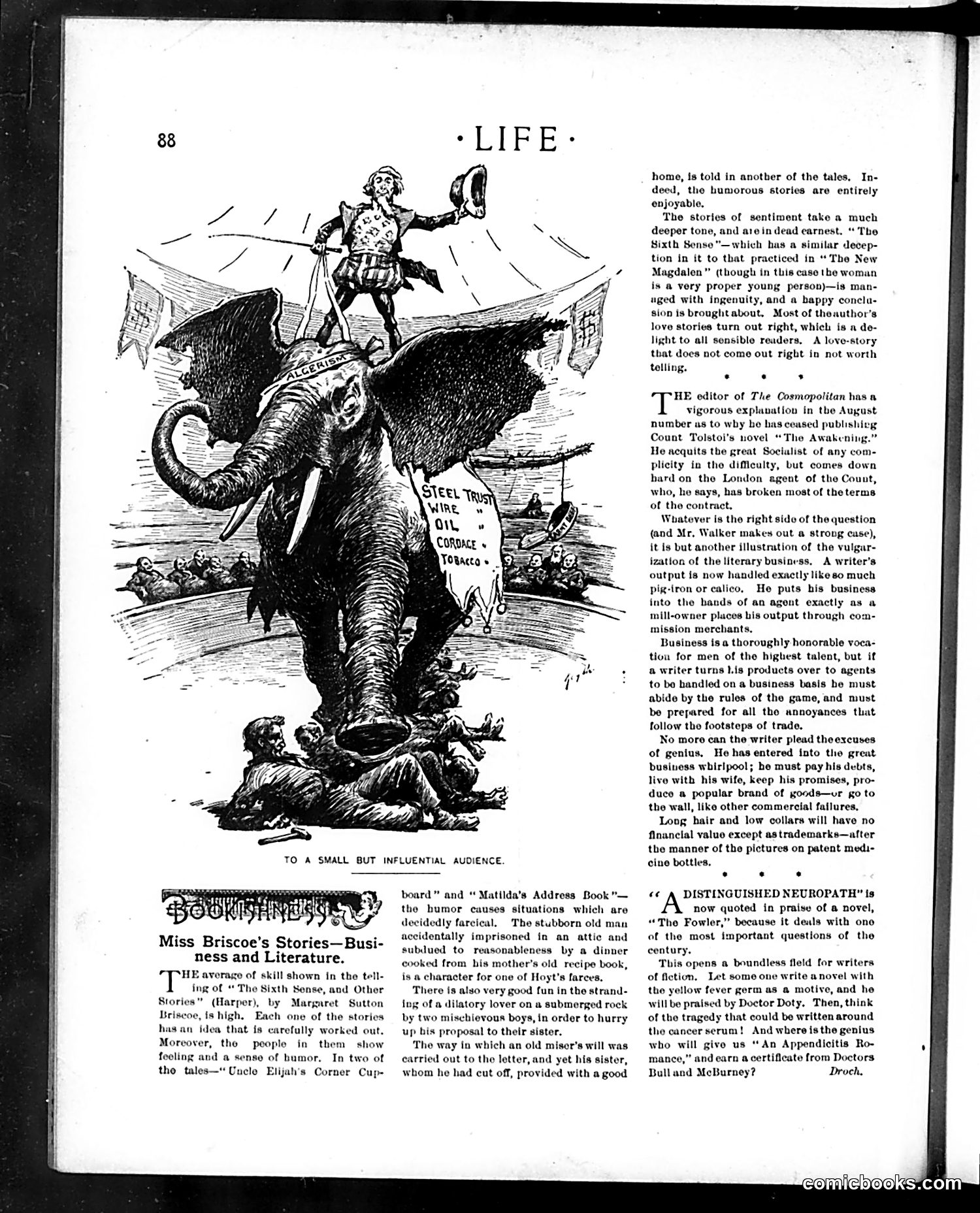
The main illustration depicts a figure standing triumphantly atop an elephant labeled with "STEEL TRUST," "WIRE," "OIL," "CORDAGE," and "TOBACCO"—references to major American monopolies/trusts of the early 20th century. The figure waves a hat to "A SMALL BUT INFLUENTIAL AUDIENCE" below, suggesting mockery of how trust leaders presented themselves as powerful despite representing narrow business interests. This satirizes the dominance of industrial monopolies in American commerce and their outsized political influence. The elephant—typically representing Republican policies—carries symbols of the biggest trusts, implying Republican support for corporate consolidation. The page also reviews Miss Briscoe's short story collection addressing business and literature, suggesting contemporary debate about capitalism's cultural impact.
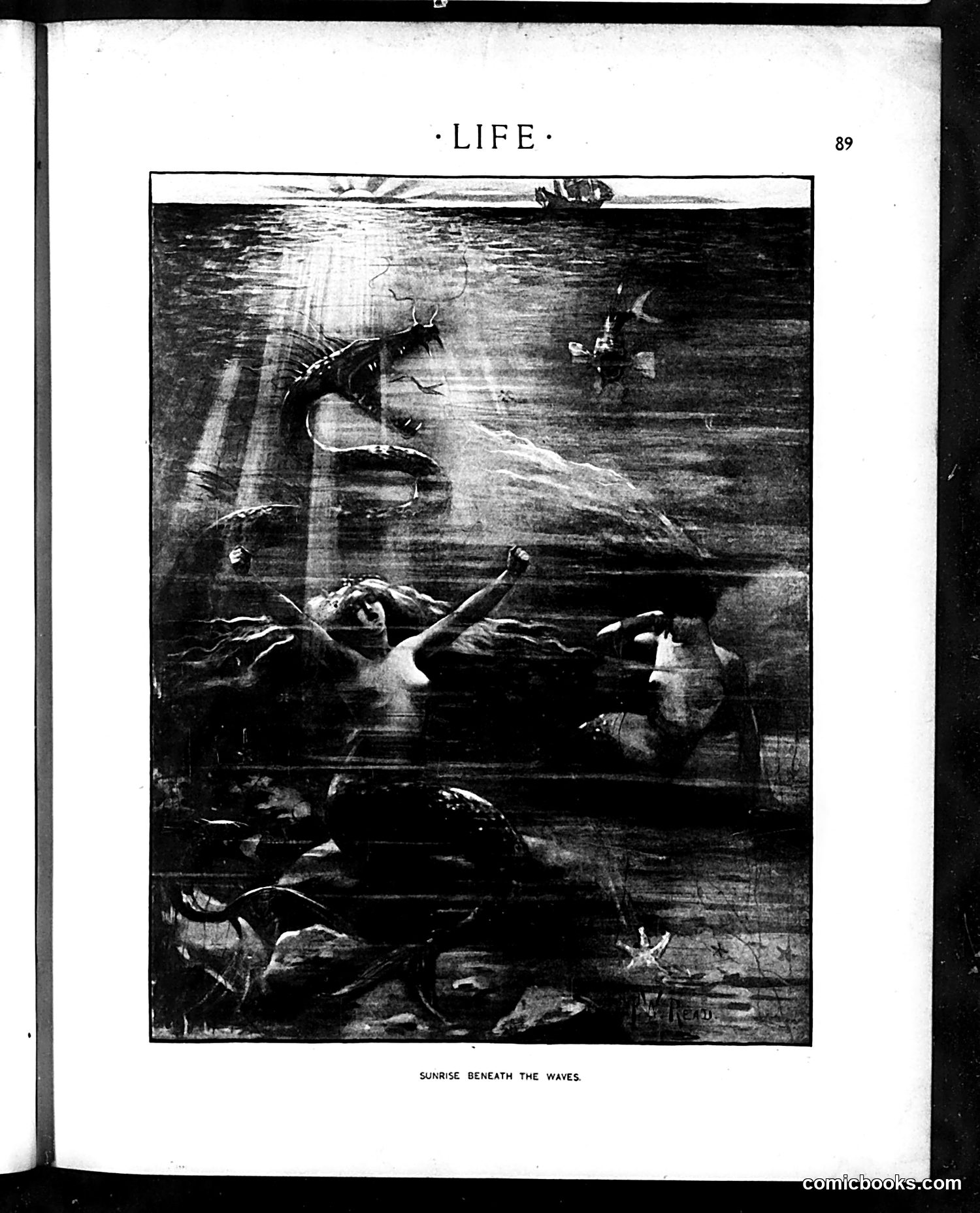
This appears to be a fantastical underwater scene rather than a political cartoon. The image depicts mythological or allegorical figures in an aquatic setting—mermaids or sea creatures, with one human figure (appearing to be a woman) gesturing upward among them. The composition suggests a romantic or dramatic narrative. Without clearer context or accompanying text explaining the specific reference, I cannot definitively identify what social or political commentary this may have intended. The artistic style and subject matter suggest it could reference classical mythology, escapism, or possibly commentary on desire and the unattainable—themes common in early 20th-century satirical magazines. However, the exact satirical point remains unclear from the image alone.
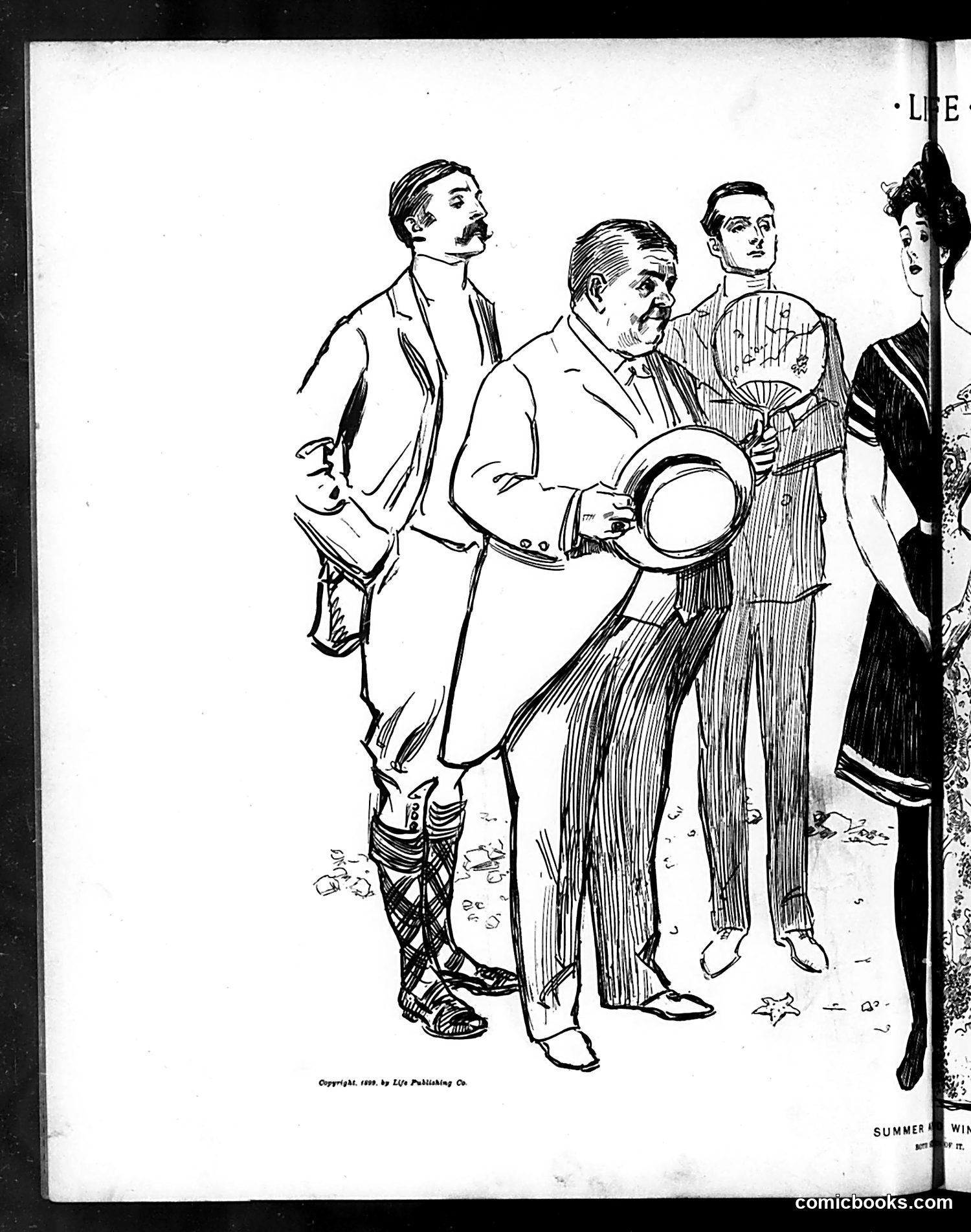
This appears to be a satirical illustration from Life magazine (copyright 1908) depicting a social scene with five figures in formal dress. The central figure, a heavyset man in a suit holding a large circular object (possibly a monocle or magnifying glass), is the apparent subject of ridicule. The cartoon likely satirizes upper-class or political pretension—the man's exaggerated features and the theatrical poses of surrounding figures suggest mockery of affected behavior or vanity. The formal attire and interior setting indicate this targets wealthy or socially prominent individuals. Without additional context or visible text identifying specific persons, the precise political target remains unclear, though the style is characteristic of Edwardian-era satire about social climbing, materialism, or public figures' pomposity.
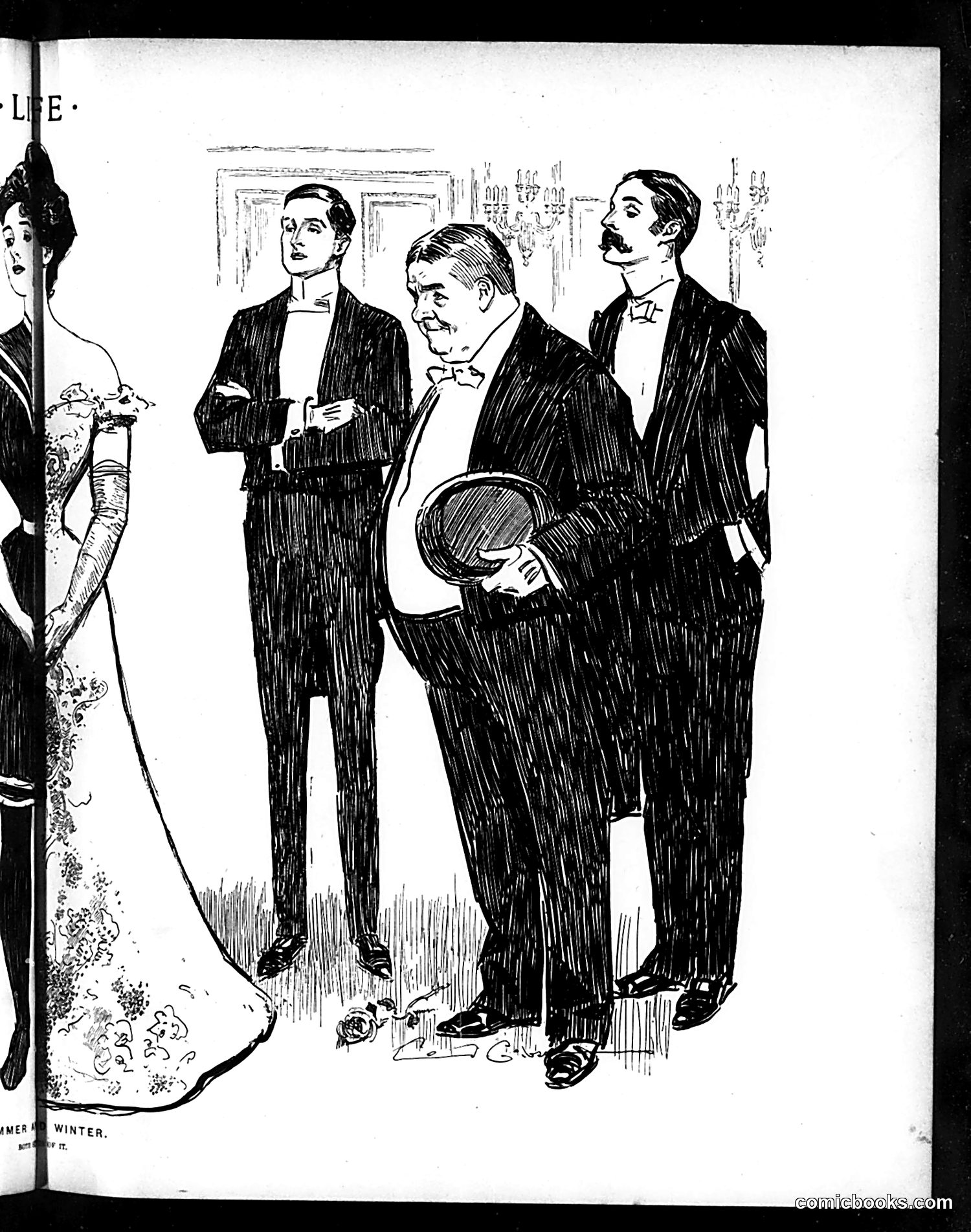
This black-and-white illustration depicts a formal social scene with a woman on the left in an elegant gown speaking with three men in evening dress (tuxedos). The men appear to be attendees at what looks like a high-society event or dinner party. Without visible text identifying specific individuals or a clear caption explaining the satire, the exact political or social commentary is unclear. However, the composition suggests this is satirizing upper-class social dynamics or interactions—possibly mocking formal etiquette, social pretension, or the conversations between society figures. The signature indicates "WINTER" and appears to be from Life magazine's satirical commentary section. The style and clothing suggest early-to-mid 20th century. Without additional context or captions, the specific targets of this satire cannot be definitively identified.
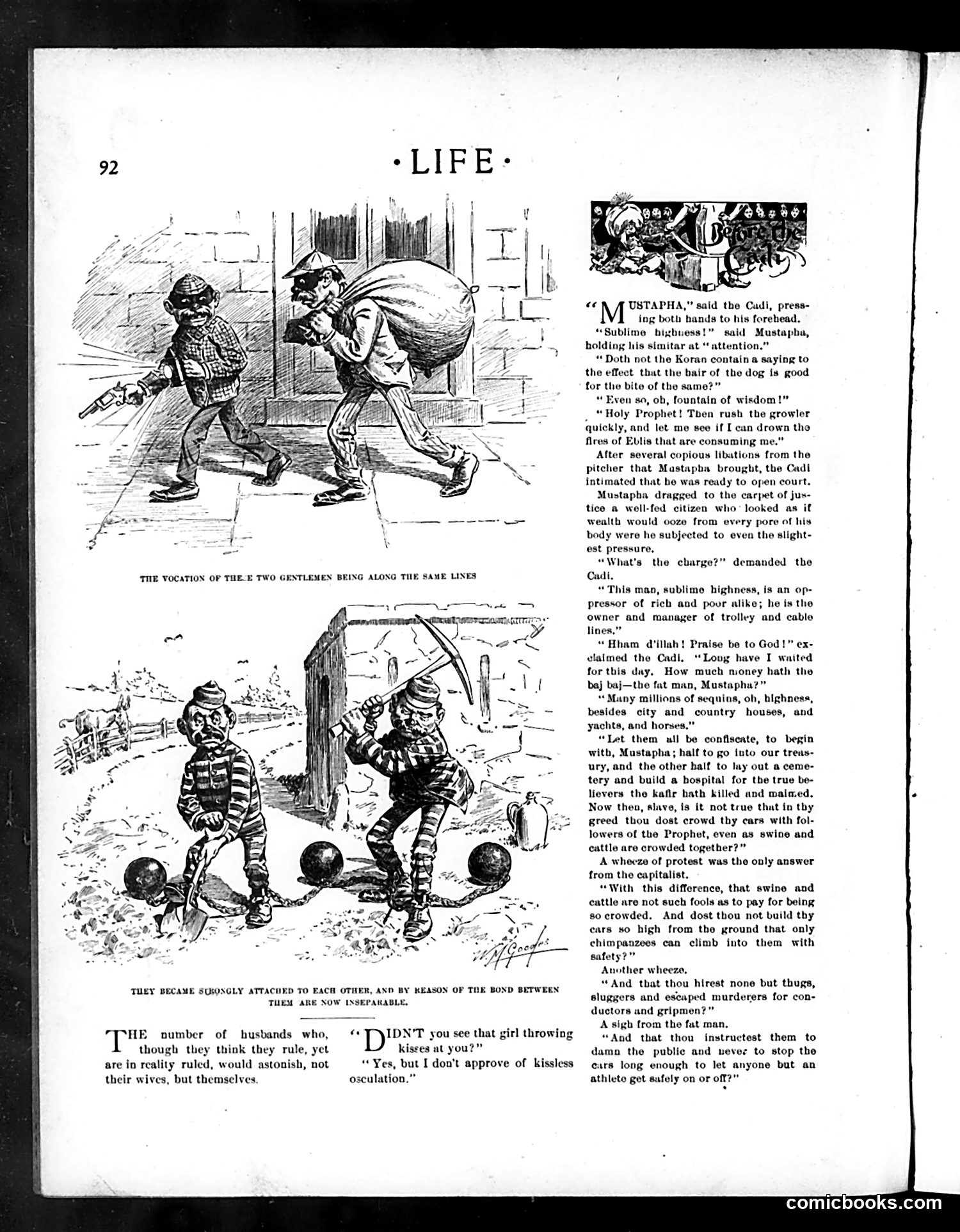
This page contains two satirical cartoons about class conflict and labor disputes. The top cartoon shows two working-class men carrying large bundles, captioned "The Vocation of E. Two Gentlemen Being Along the Same Lines" — likely referencing a Shakespeare play to mock their situation ironically. The bottom cartoon depicts two working-class figures in what appears to be a confrontation, titled "They Became Strongly Attached to Each Other, and by Reason of the Bond Between Them Are Now Inseparable." The accompanying text ridicules wealthy capitalists and their arguments defending low wages, excessive work hours, and poor treatment of laborers. The satire mocks capitalists who claim workers are "foolish" for demanding better conditions, and argues that employers deliberately keep workers impoverished and exhausted to maintain control. The page overall criticizes economic inequality and worker exploitation common in early 20th-century America.
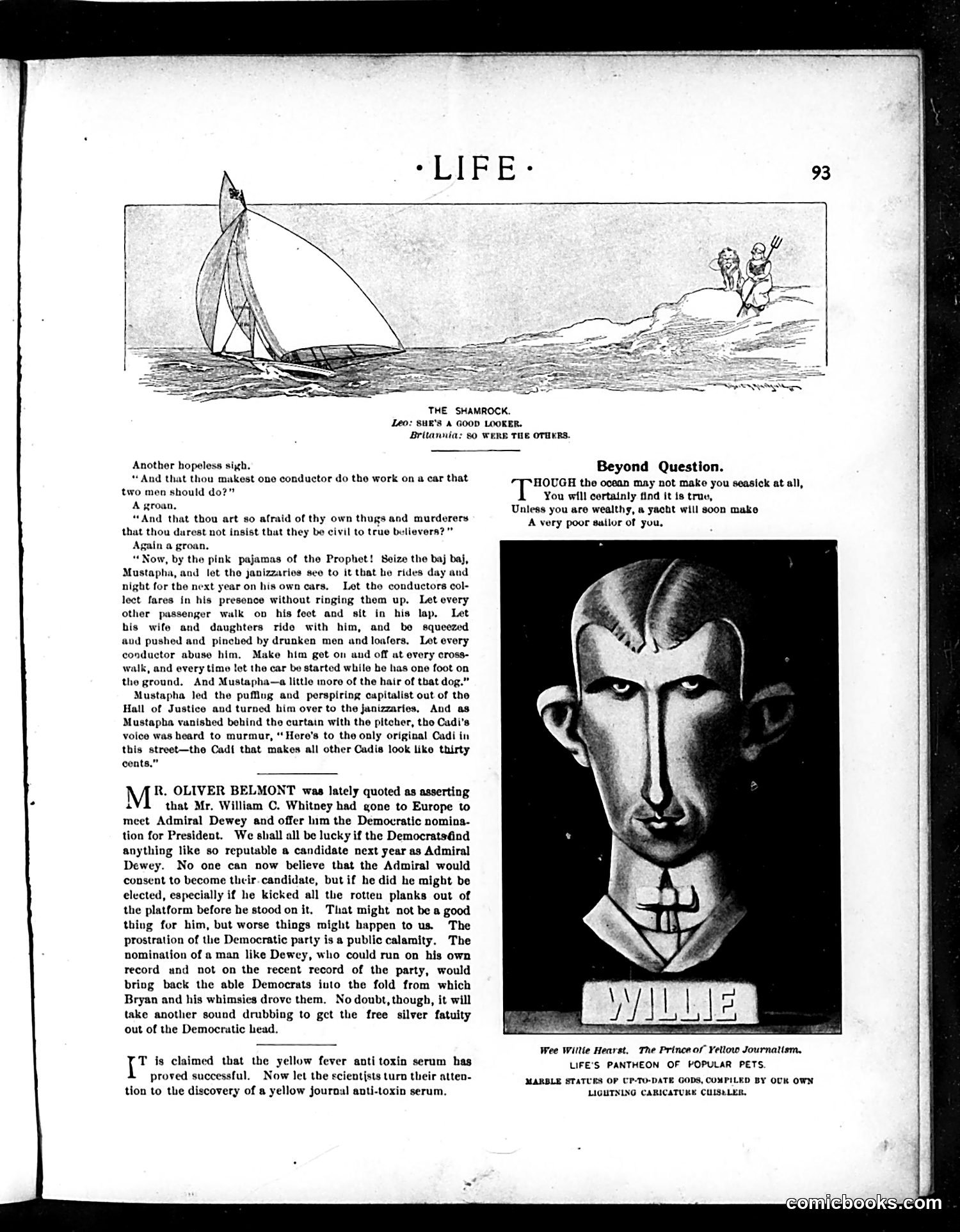
This *Life* magazine page contains political satire targeting **William Randolph Hearst**, the newspaper magnate, caricatured as "Wee Willie Hearst, The Prince of Yellow Journalism." The portrait's grotesque features mock Hearst's sensationalist publishing practices. The text references "yellow journal anti-toxin serum"—a barbed joke: just as scientists are developing yellow fever treatments, society needs a cure for "yellow journalism" (Hearst's inflammatory, truth-bending reporting style). The page also satirizes the Democratic Party's dysfunction, suggesting Admiral Dewey as a potential presidential candidate who could restore respectability. There's mockery of William C. Whitney's alleged backroom politicking and criticism of Bryan's "free silver" economic proposals. The top cartoon about a conductor illustrates labor exploitation—another social concern of the era. *Life* positioned itself as a voice of genteel upper-class critique against both sensationalist media and political corruption.
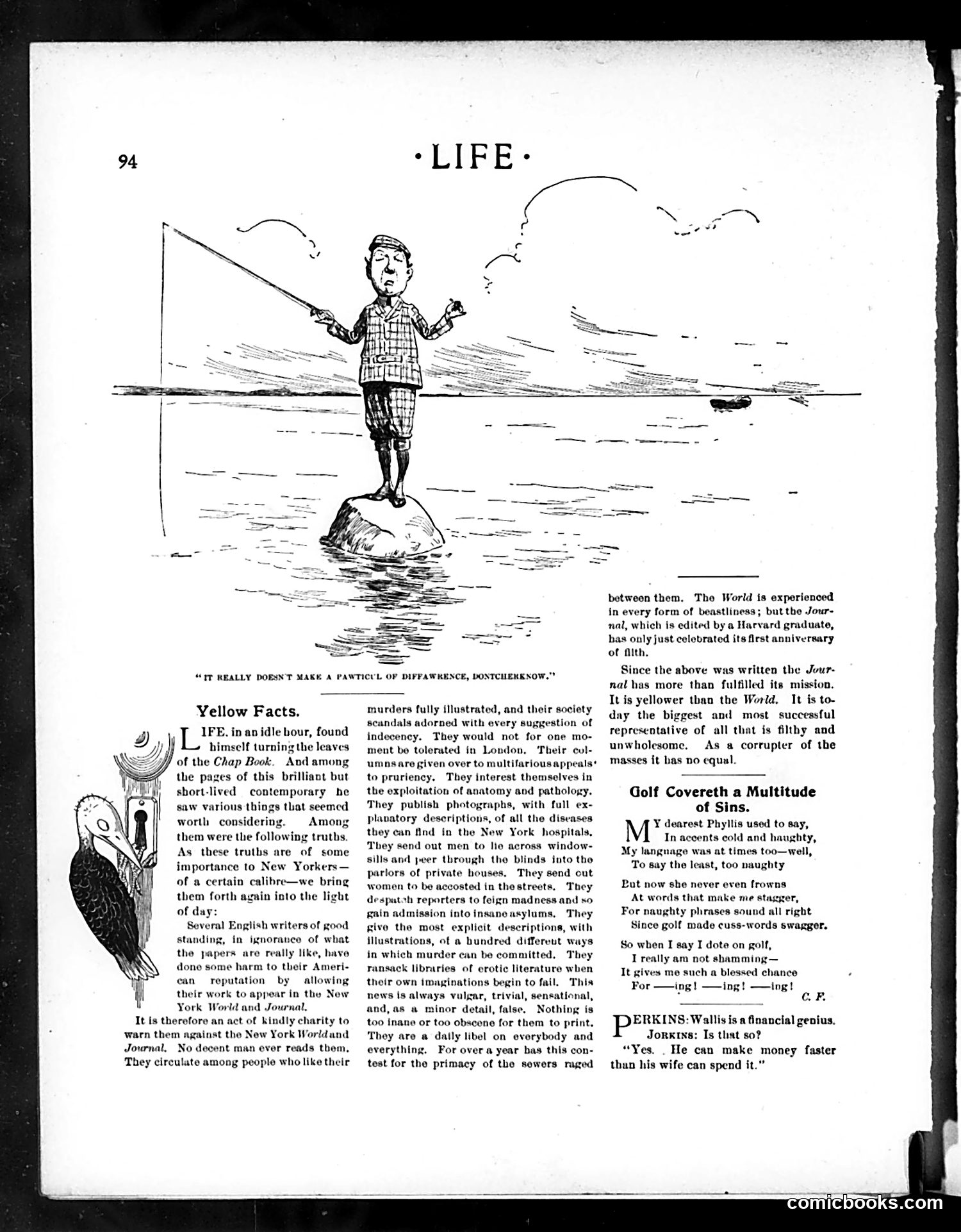
**Main Cartoon (Top):** The illustration shows a fisherman standing in water, holding a fishing rod, with the caption "IT REALLY DOESN'T MAKE A PAWTICUL OF DIPPAWENCE, DONTCUEKKNOW." This appears to be a humorous sketch with exaggerated speech patterns, likely mocking a particular accent or social type of the era. **"Yellow Facts" Section:** This is a scathing critique of two major New York newspapers—the *World* and the *Journal*—calling them purveyors of sensationalism, obscenity, and fabrication. The author accuses them of publishing graphic crime details, staged investigative stunts (reporters peering through windows), and erotic content. The term "yellow" refers to "yellow journalism," a real practice of the 1890s-1900s involving exaggerated, scandalous reporting. The piece warns English writers against publishing in these papers due to their disreputable nature. **"Golf Covereth a Multitude of Sins":** A humorous poem suggesting that golf provides a socially acceptable outlet for swearing—the protagonist's wife now tolerates his profanity because he blames it on golfing frustration. **The brief dialogue at bottom** is unrelated wordplay about financial acumen.
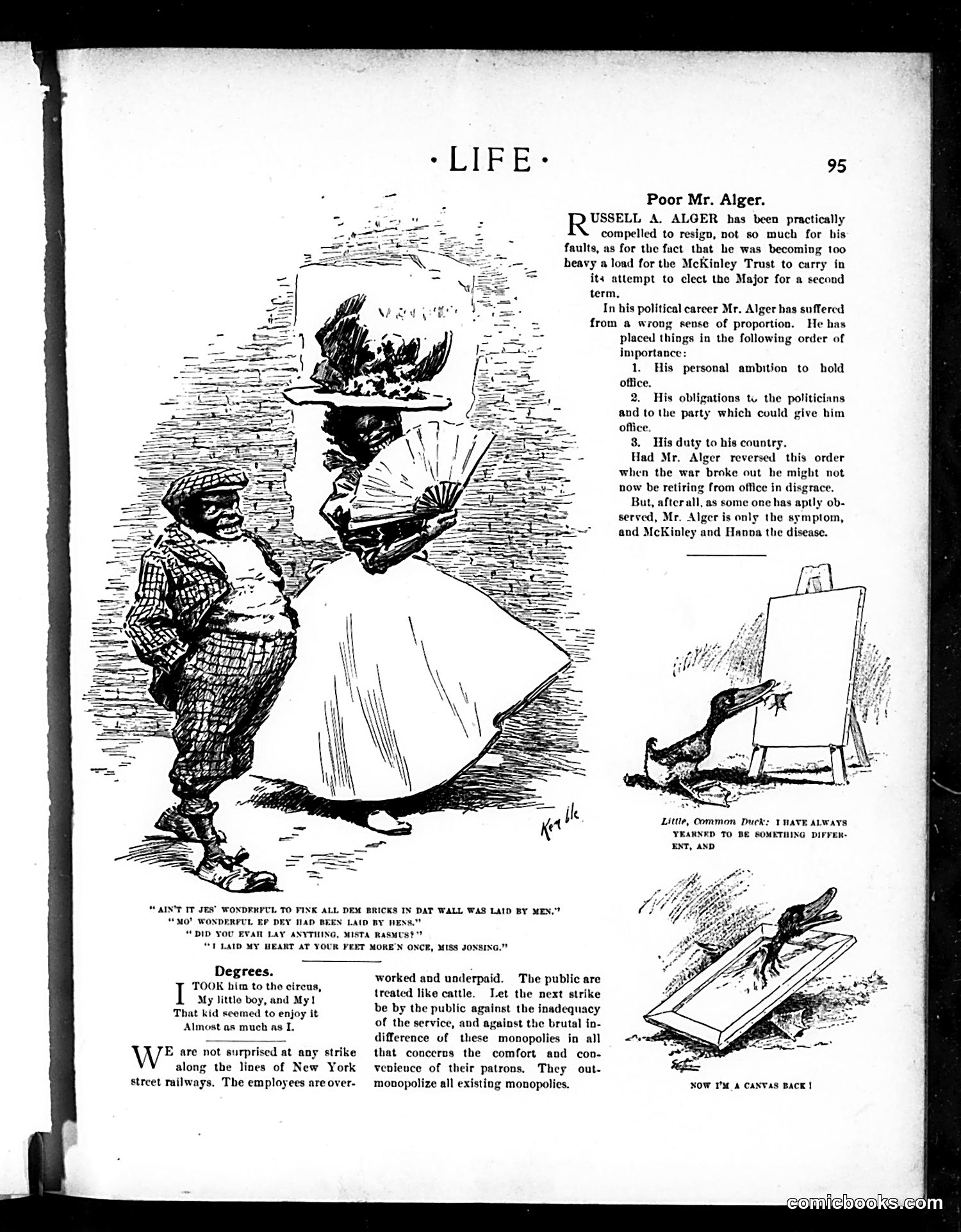
This page satirizes **Russell A. Alger**, Secretary of War under President McKinley, who resigned amid scandal (likely related to mismanagement during the Spanish-American War). The main cartoon depicts Alger as a figurehead—a fancy but hollow decoration—being manipulated by a small, ordinary figure representing the "McKinley Trust." The text argues Alger prioritized personal ambition over duty to country, making him merely a symptom of deeper corruption under McKinley and political boss Mark Hanna. The bottom section includes unrelated humor: dialogue between a duck aspiring to be different, and commentary on New York streetcar monopolies exploiting workers and passengers. The satire's point: Alger was expendable to Republicans precisely *because* he was dispensable—a placeholder whose resignation wouldn't hurt the party's re-election bid. McKinley and Hanna, the "real disease," remained untouched.
This page is primarily **advertising and filler content** rather than political satire. The main story, "At Scissors at Mills" by N.A. Jennings, is a humorous anecdote about a Philadelphia tenderfoot (inexperienced newcomer) who impresses rough Western lawmen with expert gun-handling tricks—a common frontier humor trope of the era. The story plays on stereotypes: the cultured Easterner initially appears incompetent but reveals hidden expertise, subverting the marshal's condescending assumptions. The "trick" of shifting a pistol's position to make it appear aimed demonstrates skill that earns respect in this lawless context. The page also includes historical anecdotes (Henry VIII and the abbey) and period advertisements (Wilson Whiskey, Life bound volumes, Hunter Whiskey). There is no discernible political cartoon or sustained satire—just period entertainment and commerce.
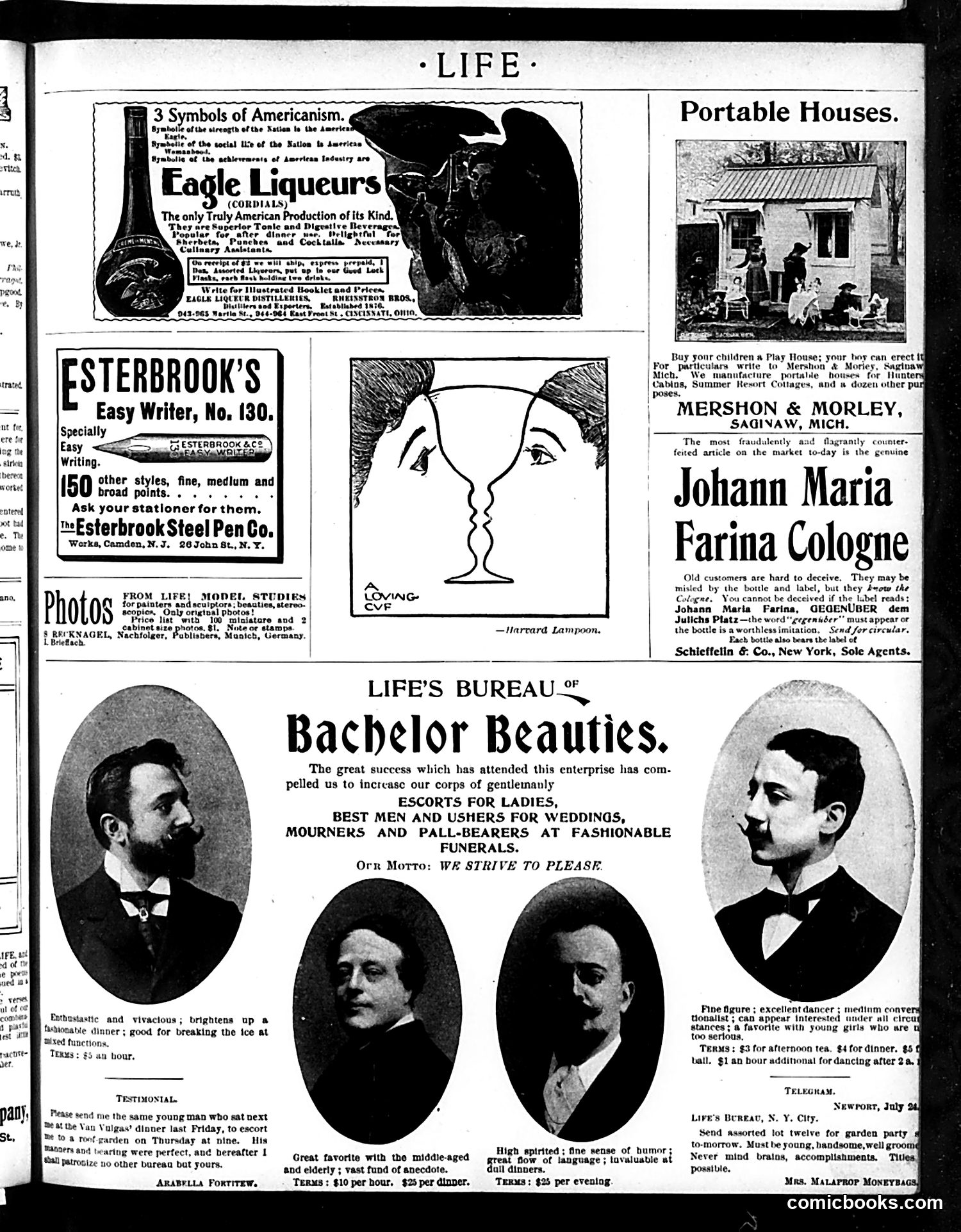
This page is primarily **advertisements and satirical humor** rather than political cartoons. The main satire appears in **"Life's Bureau of Bachelor Beauties,"** which mocks wealthy society women hiring male escorts for social events. The testimonials parody upper-class pretension—women booking men as "mourners" for fashionable funerals, dancers for dinners, and companions for social functions. The final telegram from "Mrs. Malaprop Moneybag" requesting "young, handsome" men where "brains" and "accomplishments" don't matter crystallizes the joke: wealthy society women reduce men to decorative accessories while caring nothing for intelligence. The other content consists of period product ads: Eagle Liqueurs (marketed as "American"), Esterbrook pens, portable houses, cologne, and photography services—typical Life magazine revenue sources. The "Loving Cup" cartoon by Harvard Lampoon (center) appears to be a separate visual joke, though its specific meaning is unclear from context alone. The page satirizes **Gilded Age social climbing and commodification** rather than partisan politics.
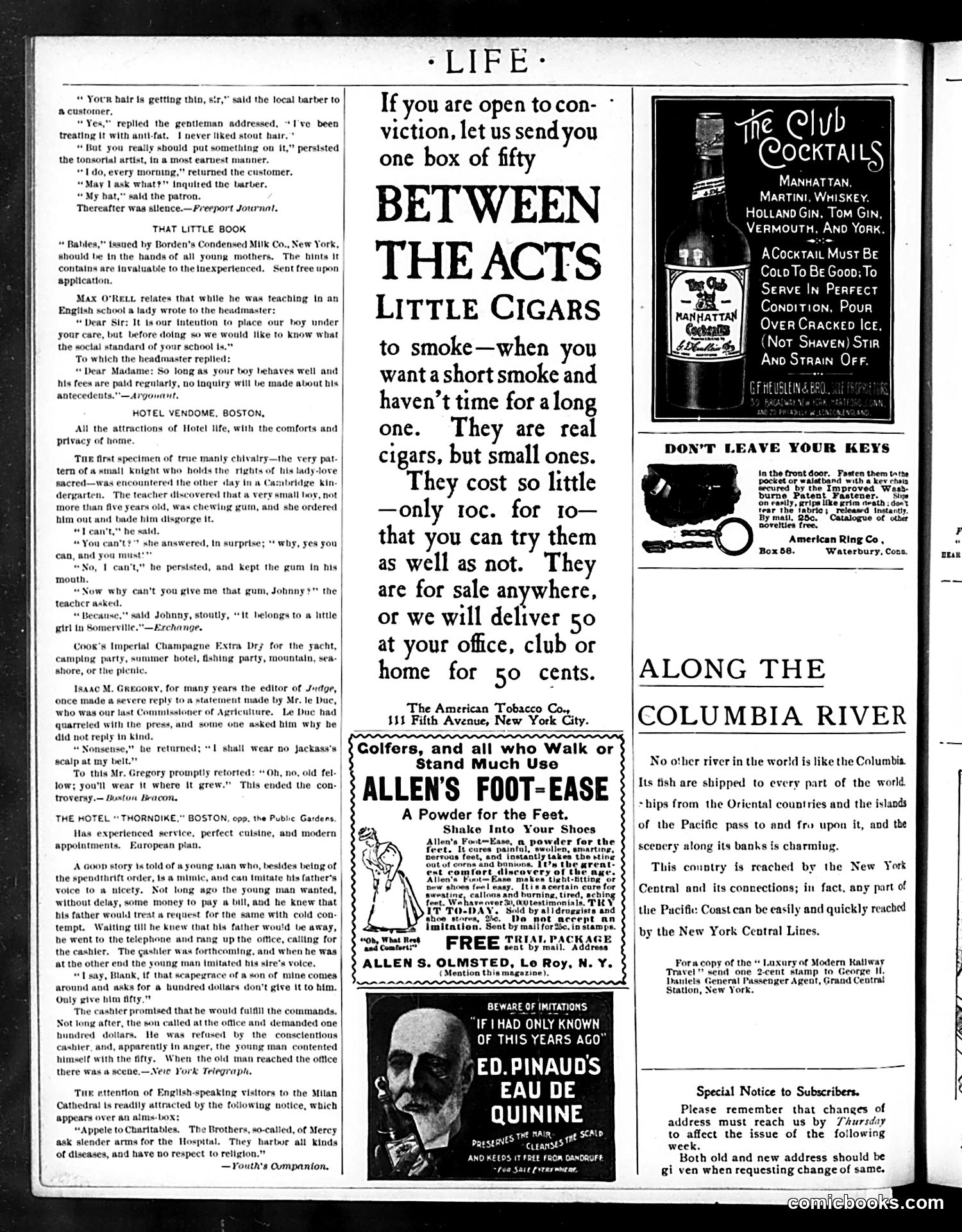
This page consists primarily of **humorous anecdotes and advertisements** rather than political cartoons. The "satire" is gentle, social comedy: ## Key Humor Pieces: 1. **Barber joke**: A man claims to treat his thinning hair with "anti-fat," then admits he only wears his hat—mocking both hair-loss remedies and the man's evasiveness. 2. **School standards**: A headmaster's reply that he cares only about behavior and fees, not social status—satirizing class pretension in English education. 3. **Kindergarten gum**: A boy refuses to spit out gum belonging to a girl, showing chivalry toward the opposite sex even at age five—gentle satire of exaggerated gentility. 4. **Isaac M. Gregory anecdote**: A witty comeback about wearing a "jackass's scalp"—Victorian-era insult humor. 5. **The mimicking son**: A young spendthrift impersonates his father's voice to trick the cashier into giving money—satire of both youthful deception and parental distrust. The page emphasizes **social observation and character comedy** typical of Life magazine's approach.
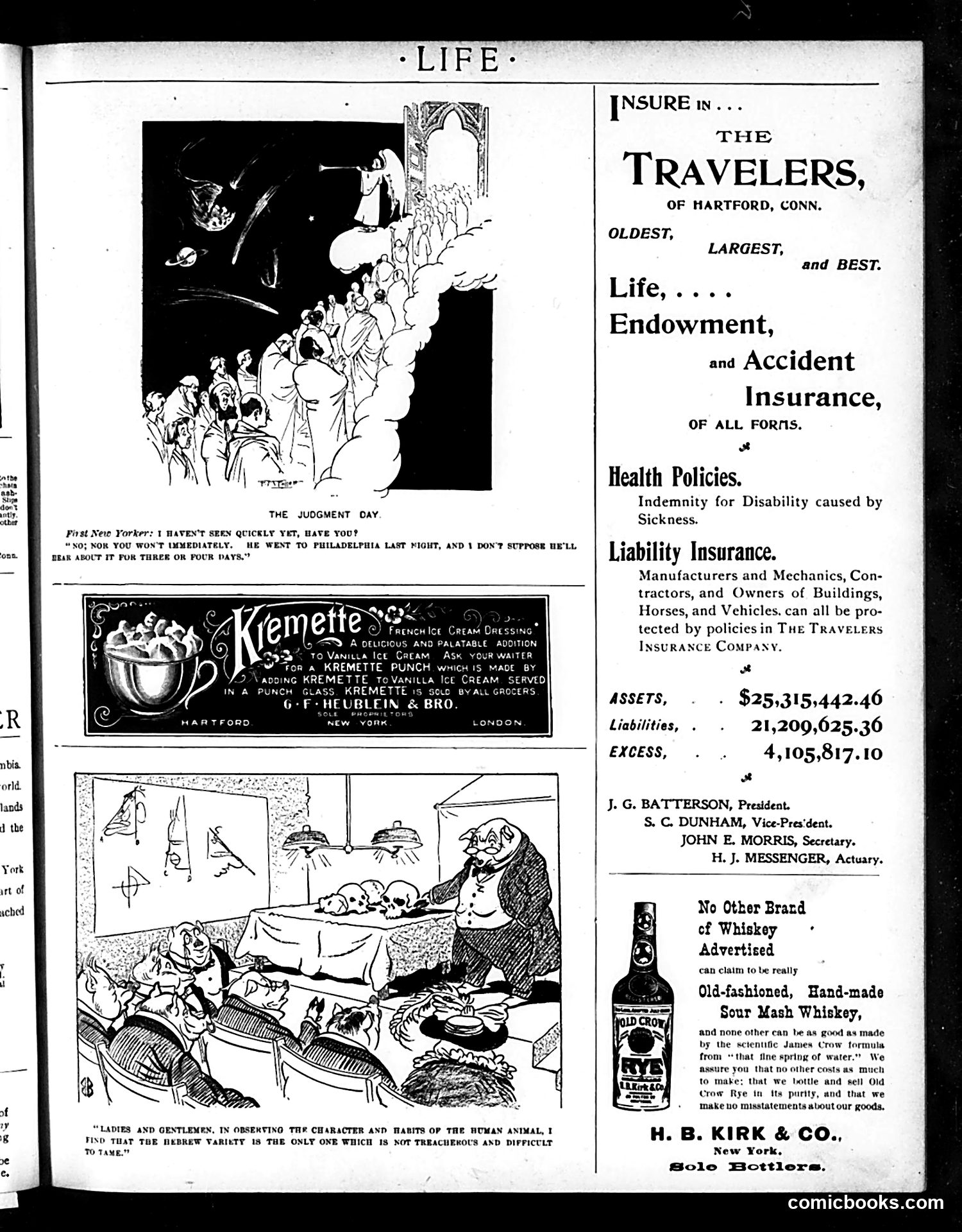
The top cartoon depicts the Christian Last Judgment—angels, demons, and souls ascending or descending. The joke turns on two New Yorkers discussing whether they've seen "Quicky" (likely a person's name). One says he went to Philadelphia last night and won't return for "three or four days"—implying that even on Judgment Day, a trip to Philadelphia takes several days to recover from. This is urban humor mocking Philadelphia as tediously distant or unpleasant compared to New York. The page is primarily advertising: The Travelers Insurance Company (Hartford), Kremette ice cream dressing, and Old Crow whiskey dominate the layout. A second cartoon below shows a doctor observing patients, with text praising "Hebrew variety" as uniquely obedient—a crude ethnic stereotype presented as scientific observation.
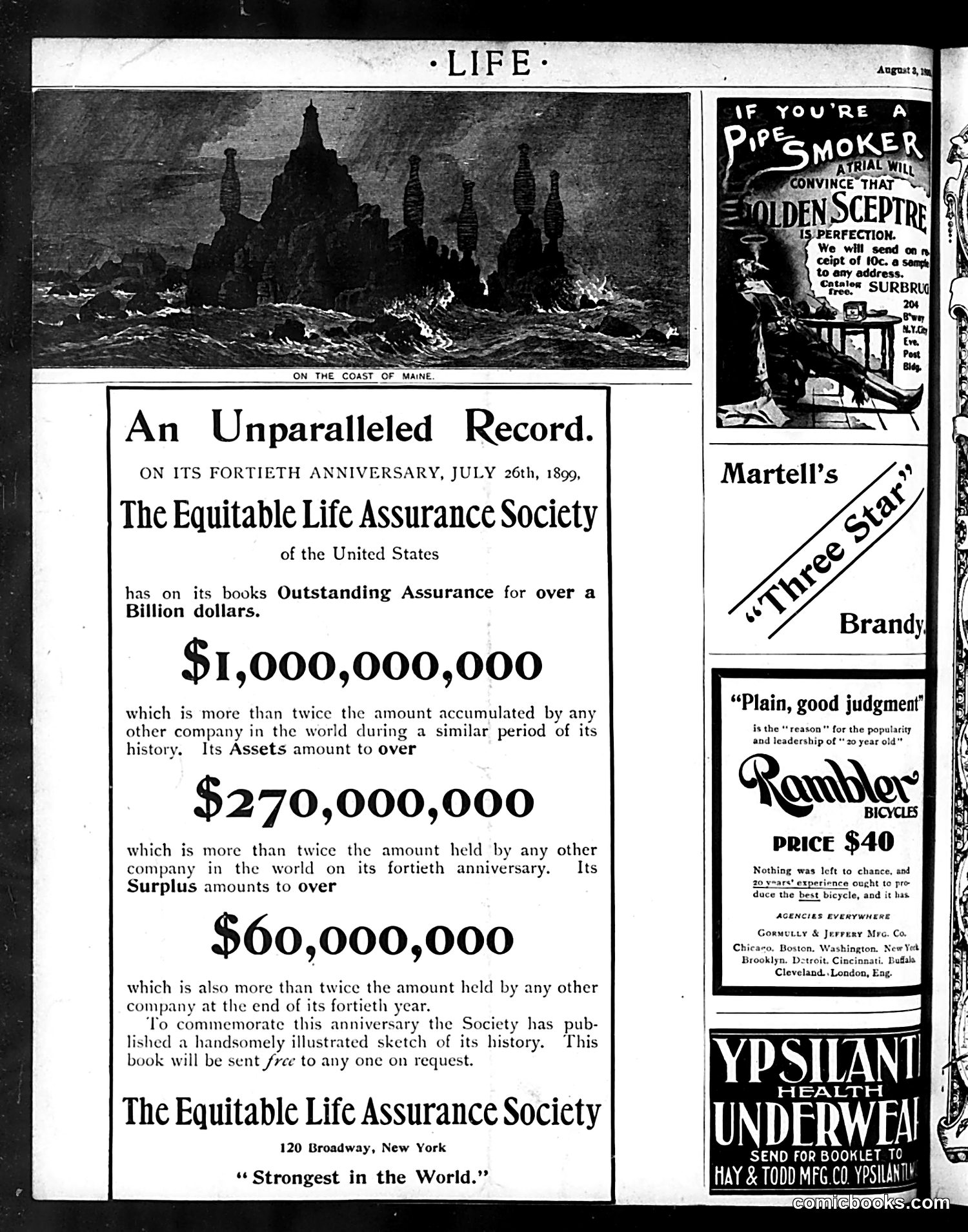
This page is primarily **advertising**, not satire. The dominant content is a full-page advertisement for the Equitable Life Assurance Society celebrating its 40th anniversary (July 26, 1899). The ad boasts record-breaking figures: over $1 billion in outstanding insurance, $270 million in assets, and $60 million in surplus—claiming these are "more than twice" what competitors held. The top image shows a dramatic coastal scene labeled "On the Coast of Maine," likely meant to evoke security and stability. The right column contains unrelated product advertisements for Golden Sceptre pipe tobacco, Rambler bicycles ($40), and Ypsilanti health underwear—typical commercial messaging of the era. There is **no political cartoon or satire** visible on this page. It represents straightforward turn-of-the-century corporate promotion and consumer advertising, reflecting the insurance industry's rapid expansion during the Gilded Age.