
Life, 1899-08-03 · page 8 of 20
Life — August 3, 1899 — page 8: what you’re looking at
What you’re looking at
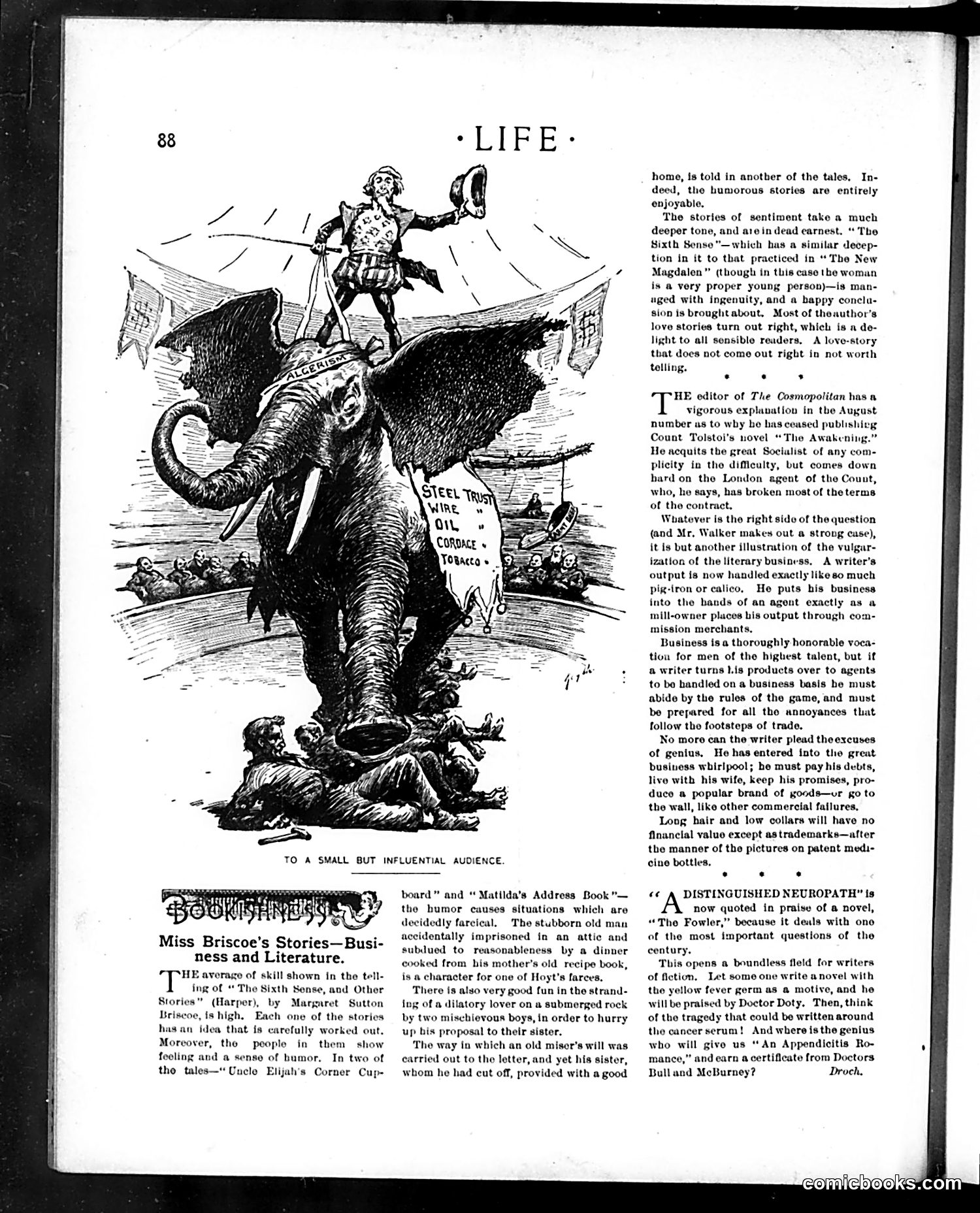
The main illustration depicts a figure standing triumphantly atop an elephant labeled with "STEEL TRUST," "WIRE," "OIL," "CORDAGE," and "TOBACCO"—references to major American monopolies/trusts of the early 20th century. The figure waves a hat to "A SMALL BUT INFLUENTIAL AUDIENCE" below, suggesting mockery of how trust leaders presented themselves as powerful despite representing narrow business interests. This satirizes the dominance of industrial monopolies in American commerce and their outsized political influence. The elephant—typically representing Republican policies—carries symbols of the biggest trusts, implying Republican support for corporate consolidation. The page also reviews Miss Briscoe's short story collection addressing business and literature, suggesting contemporary debate about capitalism's cultural impact.
📄 Transcribed text from this page (OCR, searchable)
Machine-transcribed from the original scan — historical spelling and the odd misread are preserved.
TO A SMALL BUT INFLUENTIAL AUDIENCE. Miss Briscoe's Stories—Busi- ness and Literature. T5 average of skill shown in the tell- ing of “ The Sixth Sense, and Other Stories” (Harper), by Margaret Sutton Briscoe, is high. Each one of the stories hasan idea that is carefully worked out. Moreover, the people in them show fecling and a sense of humor. In two of tho tales—" Uncle Elijah’s Corner Cup- board” and “ Matilda’s Address Book "— tho bumor causes situations which are decidedly farcical. The stubborn old man accidentally imprisoned in an attic and subdued to reasonableness by a dinner cooked from his mother’s old recipe book, is a character for one of Hoyt's farces. There is also very good fun in the strand- {ng of a dilatory lover on a submerged rock by two mischievous boys, in order to hurry up bis proposal to their sister. ‘Tho way in which an old misor’s will was carried out to tho letter, and yet his sister, whom he had cut off, provided with a good home, is told in another of the tales, In- deed, tho humorous stories are entirely enjoyable, Tho stories of sentiment take a much deeper tone, and are in dead earnest. “ The Sixth Senso"—which has a similar decep- tion in it to that practiced in “The New Magdalen” (though in this caso the woman is a vory proper young person)—is man- uged with ingenuity, and a bappy conclu- sion is broughtabout, Most of theauthor’s love stories turn out right, which is a de- light to all sonsible readers, A love-story that does not come out right in not worth tolling. . . ’ HE editor of The Cosmopolitan has a vigorous explavation in the August number us to why he has ceased publishieg Count Tolstoi’s novel “The Awakening.” He acquits the great Socialist of any com- plicity in tho difficulty, but comes down hard on the London agent of the Count, who, he says, has broken most of the terms of the contract, Whatever is the right sido of the question (and Mr, Walker makes out a strong case), it is but another illustration of the vulgar- ization of the literary business. A writer's output is now handled exactly like 60 much pig-iron or calico, Ho puts his business into the bands of an agent exactly as a mill-owner places bis output through com- mission merchants. Business is a thoroughly honorable voca- tiou for men of the highest talent, but it a writer turns Lis products over to agents to bo bandied on a business basis he must abide by the rules of the gamo, and must be preyared for all tho annoyances that follow tho footsteps of trade. No moro can the writer plead theexcuses of genius, He has entered {nto tho great business whirlpool; he must pay his debts, live with his wifo, keop his promises, pro- duco a popular brand of goods—ur go to the wall, like other commercial failures, Long hair and low collars will have no financial valuo except as trademarks—after the manner of the pictures on patent medi- cine bottles. . . . «¢ A DISTINGUISHED NEUROPATH" ts, A now quoted in praise of a novel, “Tho Fowler,” because it deals with ono of the most important questions of the century. This opens a boundless fleld for writers of fiction, Let some one write anovel with tho yellow fever gorm as a motive, and ho will be praised by Doctor Doty, Then, think of the tragedy that could be written around tho cancer serum! And where isthe genius who will givo us “An Appendicitis Ro- mance,” and earn a certificate from Doctors Bull and McBurney? Droch.