
A complete issue · 20 pages · 1899
Life — July 6, 1899
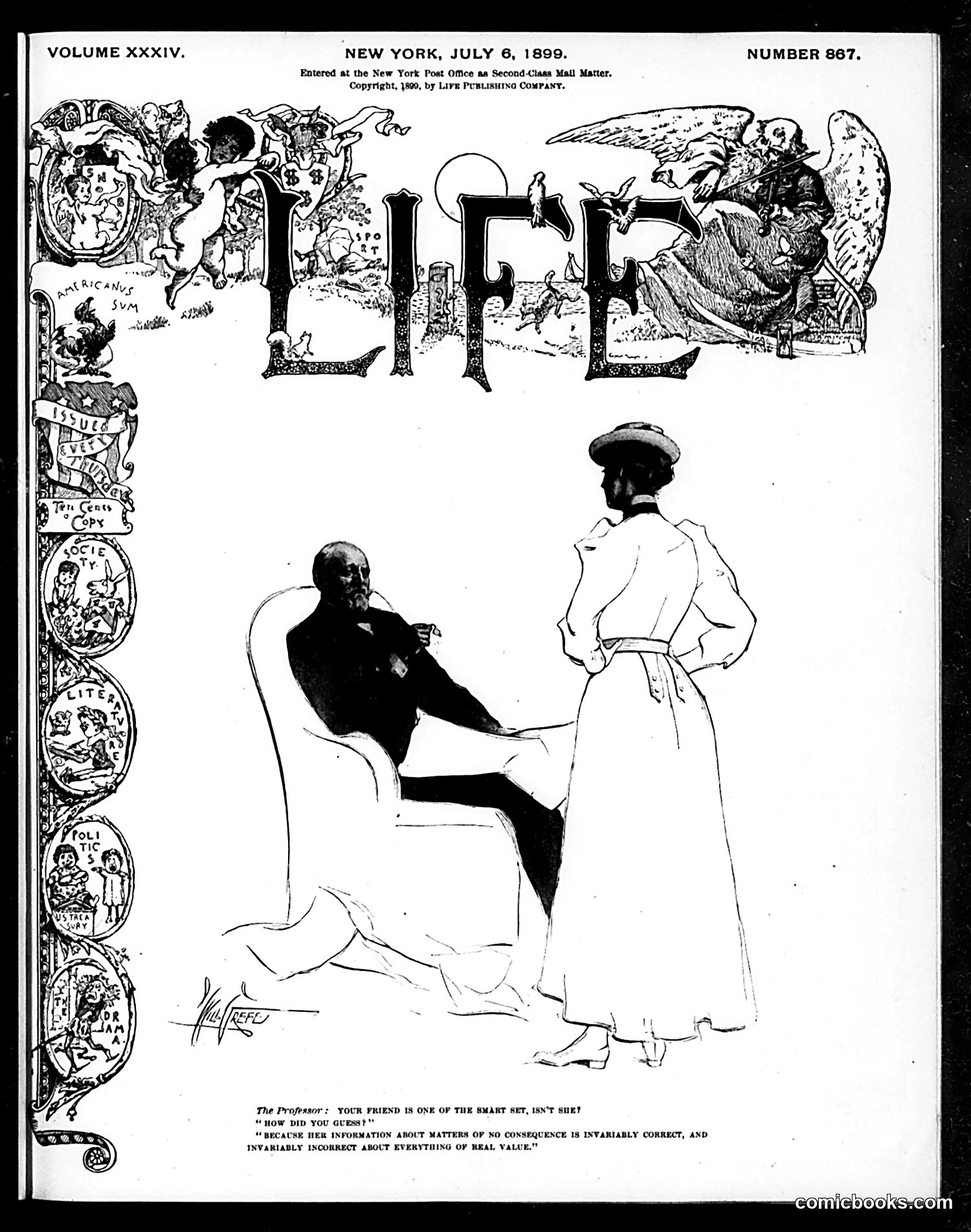
This satirical cover depicts a social scene from the Gilded Age. A well-dressed man sits comfortably in a chair while a fashionable woman stands before him. The caption quotes "The Professor" making a cynical observation about a friend: "Your friend is one of the smart set, isn't she?" followed by commentary that her information about matters is "invariably correct" about things of "no consequence" and "invariably incorrect about everything of real value." The satire targets the social pretensions of wealthy "smart set" society—mocking how fashionable people confidently assert themselves on trivial matters while remaining ignorant of substantive issues. The ornate left border and elaborate title design are typical of Life's decorative style. This reflects late-1890s social criticism of aristocratic superficiality and the gap between appearance and genuine knowledge.
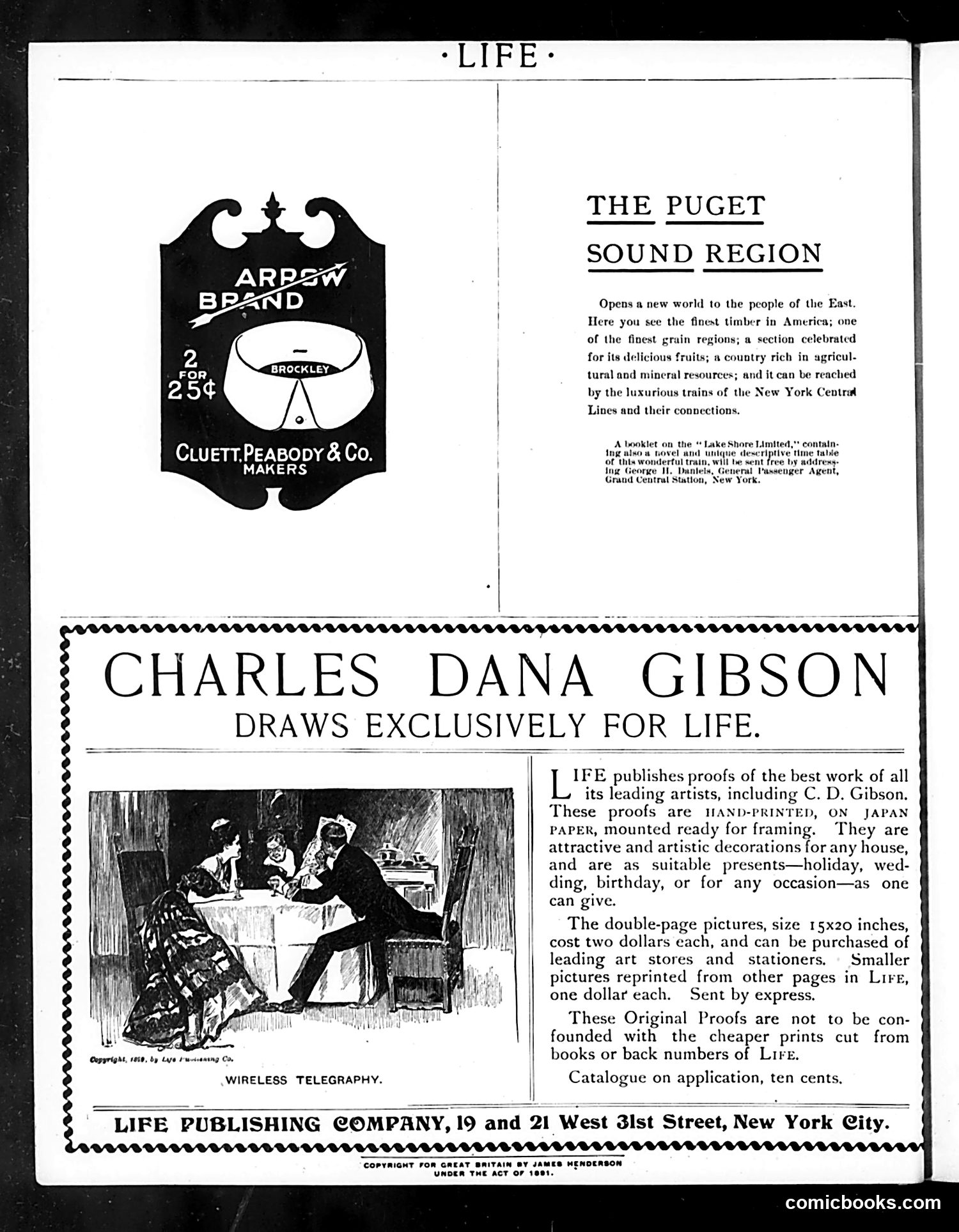
This page is primarily **advertising**, not political satire or commentary. The top advertises **Arrow Brand** collars (2 for 25¢) by Cluett Peabody & Co., featuring a product image of a detachable collar labeled "Brockley." The right side promotes the **Puget Sound Region** as a tourist destination, highlighting timber, grain, fruit, agriculture, and rail access via New York Central Lines. The lower half advertises **Charles Dana Gibson's artwork** available through LIFE Publishing Company. Gibson's drawings—hand-printed on Japan paper—are offered as decorative proofs suitable for gifts. Double-page pictures cost two dollars; smaller ones cost one dollar. A catalog is available for ten cents. The small illustration labeled "Wireless Telegraphy" depicts an interior dinner scene, likely demonstrating Gibson's artistic style rather than making a specific social point.
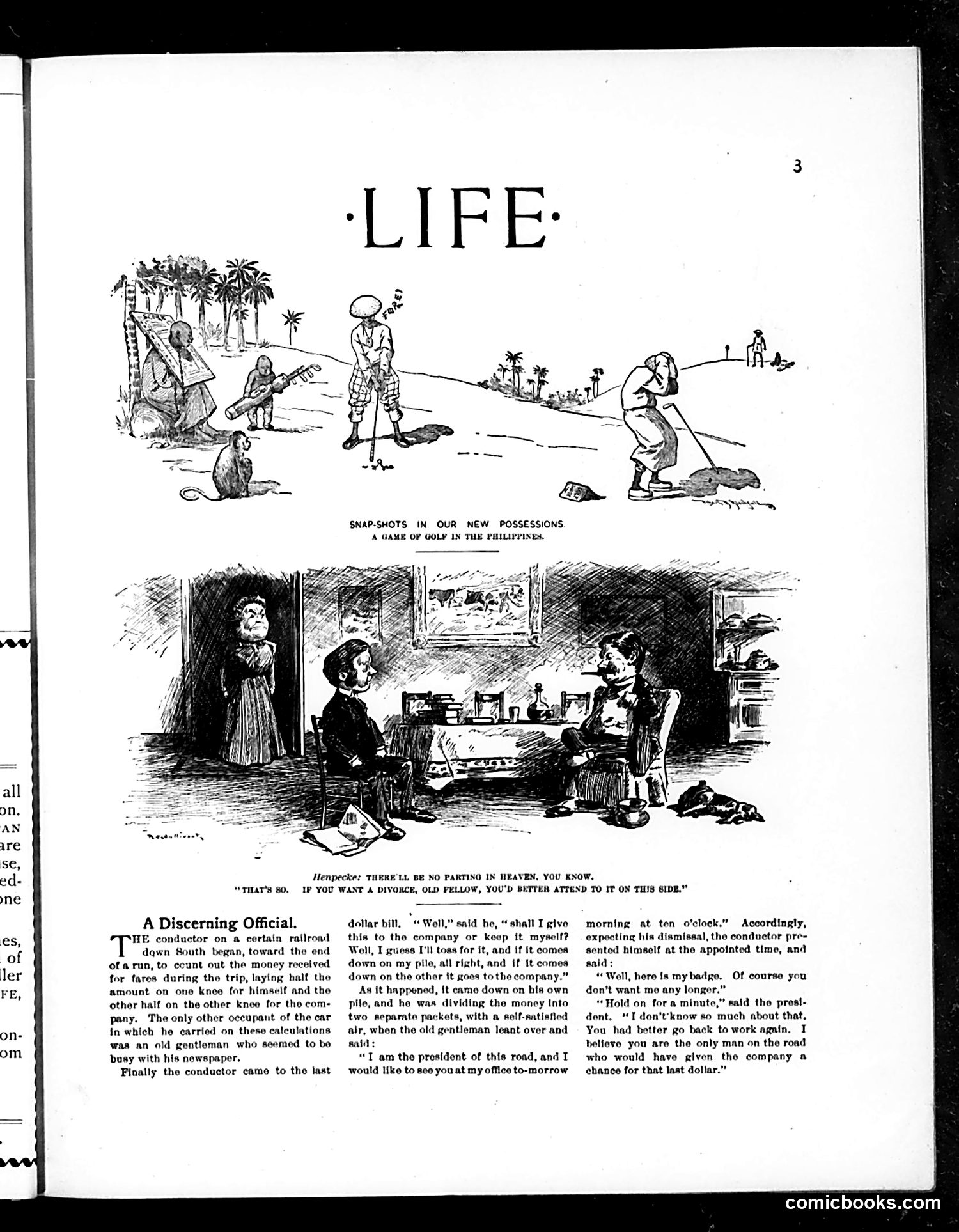
This page contains two separate pieces of early 20th-century American satire: **Top cartoon**: Depicts golf being played in the Philippines, labeled "Snap-shots in our New Possessions: A Game of Golf in the Philippines." This references America's colonial acquisition of the Philippines after the 1898 Spanish-American War, satirizing how American colonizers brought their leisure activities to occupied territories. **Bottom cartoon and story**: "A Discerning Official" depicts a railroad conductor discovering a stowaway and offering him money to leave quietly rather than report him—suggesting official corruption and bribery. The dialogue implies the conductor wants to avoid paperwork and protect company reputation more than enforce rules. Both pieces mock American institutions: colonialism and administrative dishonesty.
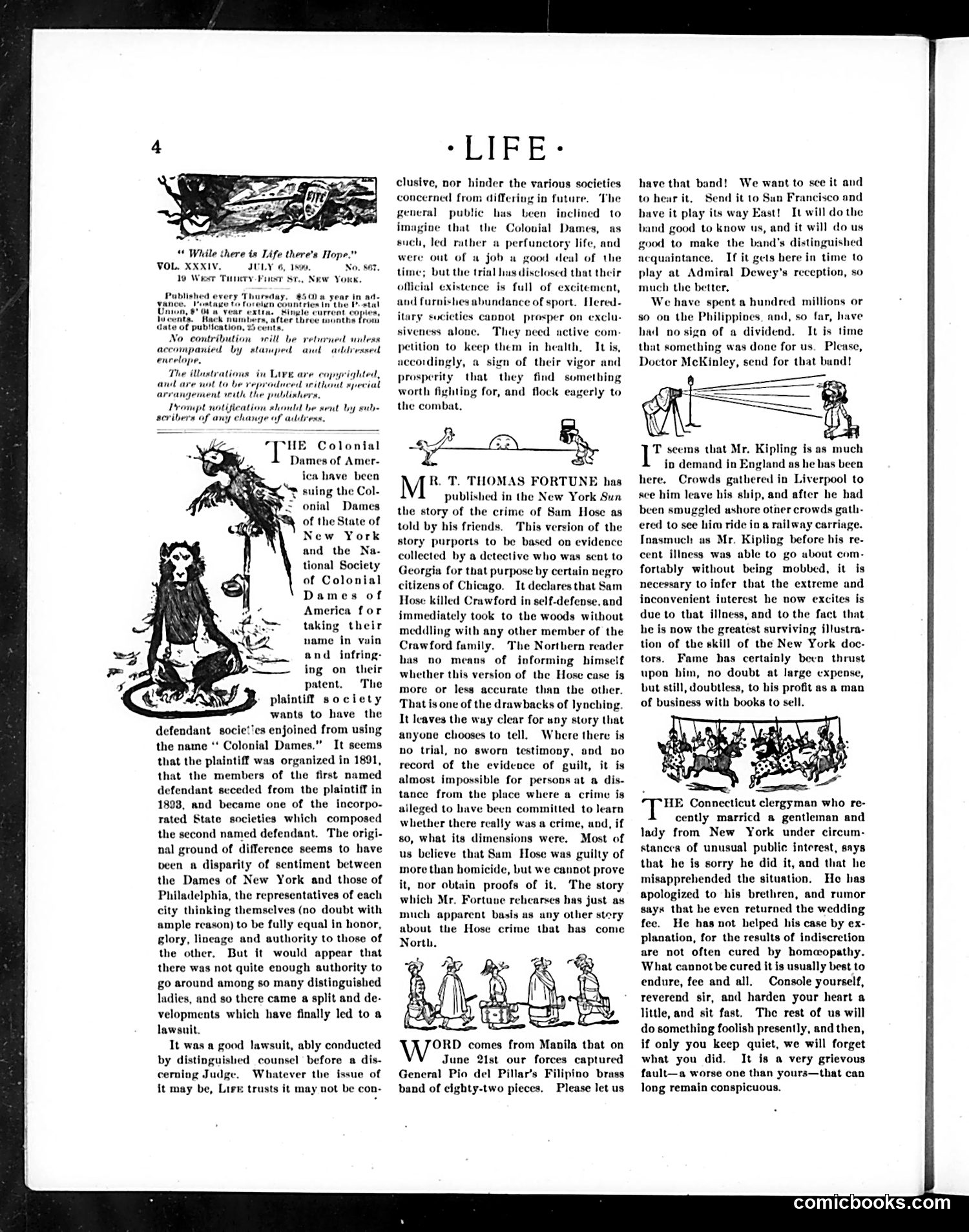
This page contains three satirical pieces about early 1900s social and legal matters: 1. **Colonial Dames controversy**: The text discusses a lawsuit over the "Colonial Dames" organization name, with New York and Philadelphia societies claiming rights. The satire mocks the dispute's pettiness among "distinguished ladies." 2. **Sam Hose case**: References T. Thomas Fortune's retelling of this crime story in the New York Sun, noting how the same facts produce different versions depending on who tells it—satirizing how unreliable accounts become when based on rumor rather than evidence. 3. **Kipling's popularity**: Notes Rudyard Kipling's immense popularity in England, with crowds gathering to see him, and jokes about illness excusing him from public appearances. The illustrations are decorative Victorian-style vignettes accompanying these commentary pieces. The satire targets legal pretension, journalistic bias, and celebrity culture.
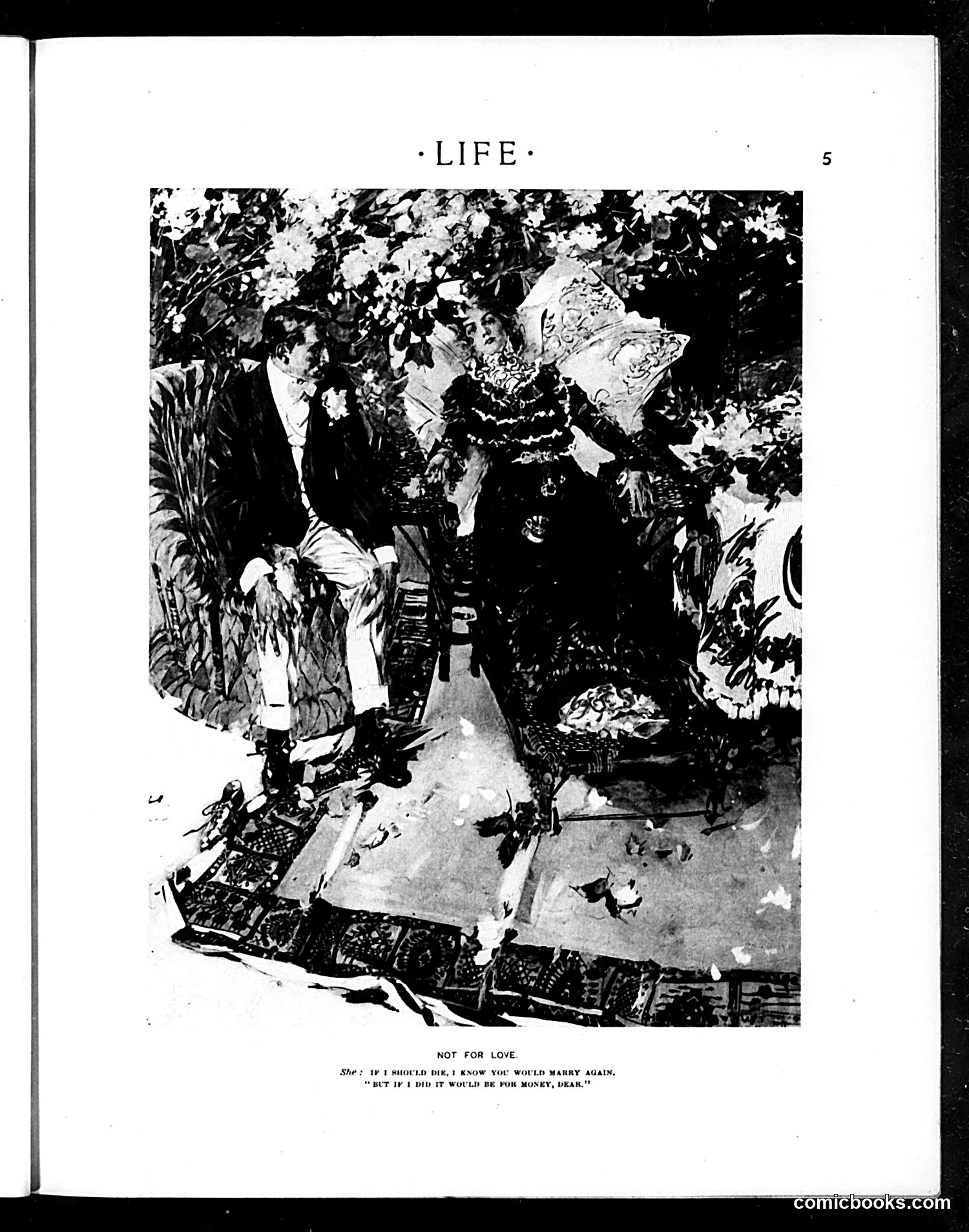
This is a satirical illustration from Life magazine titled "Not for Love," featuring what appears to be an elaborately dressed woman in ornate period costume speaking with a man in formal attire, surrounded by decorative garden elements. The caption reads: "She: 'IF I SHOULD DIE, I KNOW YOU WOULD MARRY AGAIN. BUT IF I DID IT WOULD BE FOR MONEY, DEAR.'" The satire targets marriage dynamics and female mercenary attitudes. The woman's elaborate, expensive costume emphasizes wealth-focused values. She implies her husband would remarry for love, while she herself would only do so for financial gain—reversing typical gender expectations of the era. This mocks wealthy women perceived as motivated primarily by material accumulation rather than sentiment, a common theme in early 20th-century satirical commentary on marriage and class.
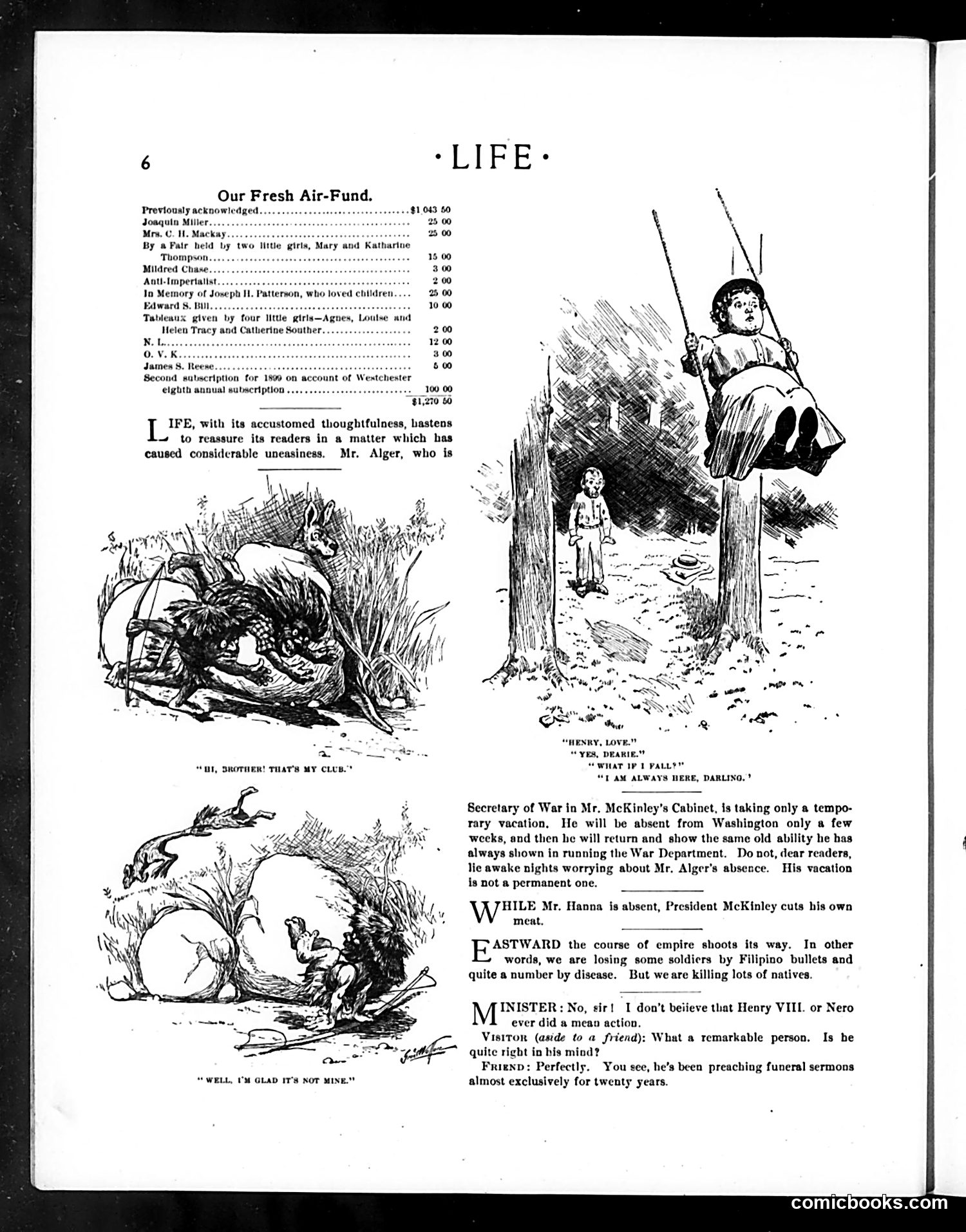
This page contains three satirical cartoon vignettes and political commentary. The cartoons depict children in various scenarios with captions like "Hi, Brother! That's my club," "Well, I'm glad it's not mine," and references to a child named Henry. The text discusses **Mr. Alger's absence** and concerns about the Secretary of War in McKinley's Cabinet taking vacation. It criticizes American imperial expansion ("EASTWARD the course of empire shoots his way"), referencing casualties among Filipino natives during the Philippine-American War. A dialogue mocks a visitor's comments about a "remarkable person" who's been "preaching funeral sermons almost exclusively for twenty years"—likely satirizing religious hypocrisy or a particular public figure's obsession with death-related topics. The "Fresh Air Fund" donation list at top shows contemporary charitable giving.
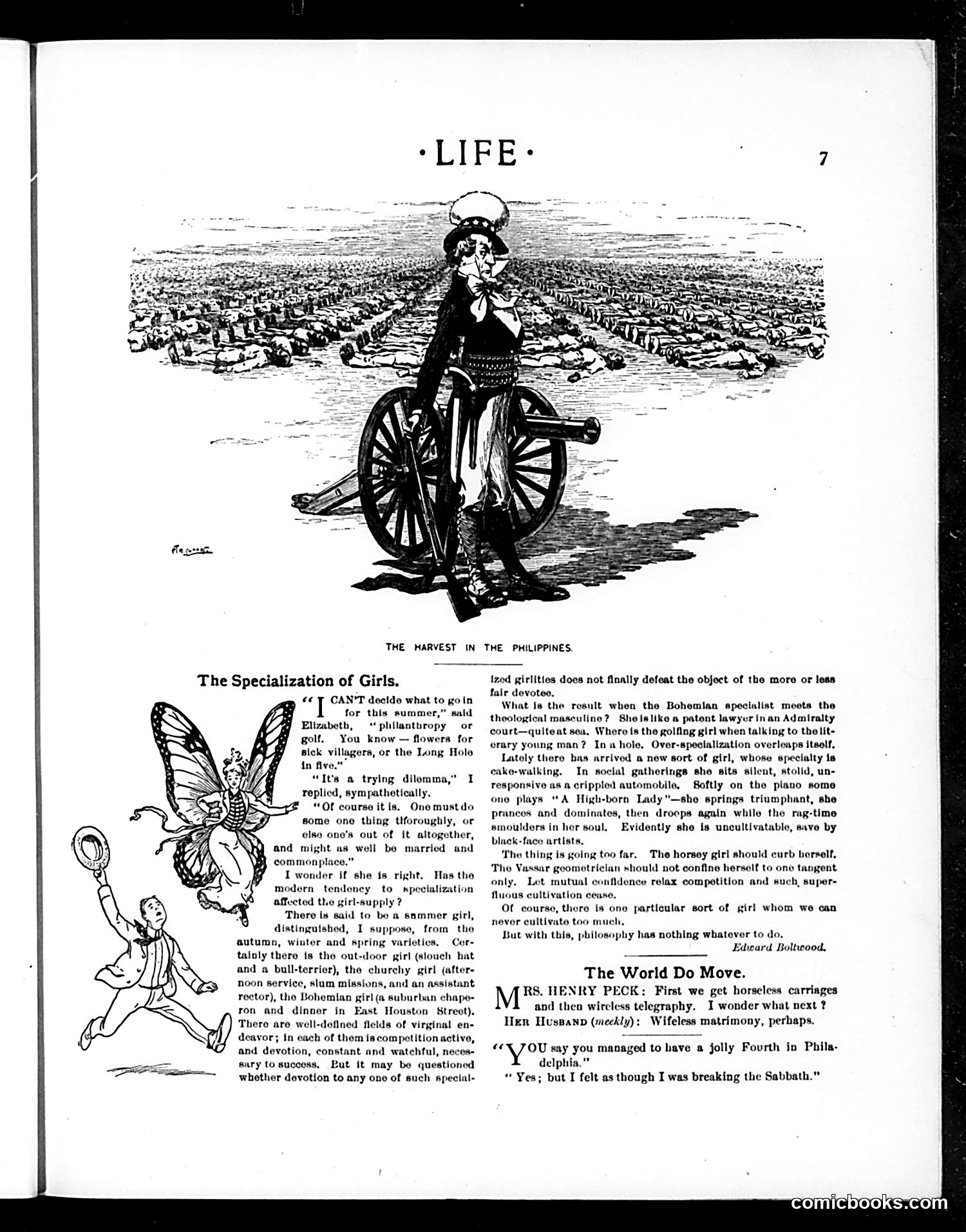
**Top Image:** "The Harvest in the Philippines" depicts Uncle Sam (identifiable by his top hat) standing beside a cannon overlooking a battlefield of casualties. This satirizes American military intervention in the Philippines, likely during the Philippine-American War (early 1900s), criticizing the human cost of colonial expansion. **"The Specialization of Girls":** This article mocks the trend of women specializing in narrow pursuits rather than developing well-rounded characters. The accompanying fairy-tale illustration contrasts this with traditional feminine ideals. **"The World Do Move":** A brief dialogue satirizing social change—Mrs. Henry Peck references "horseless carriages and wireless telegraphy," with her husband joking about wireless matrimony. This mocks how quickly technology was transforming society and relationships in the early 20th century.
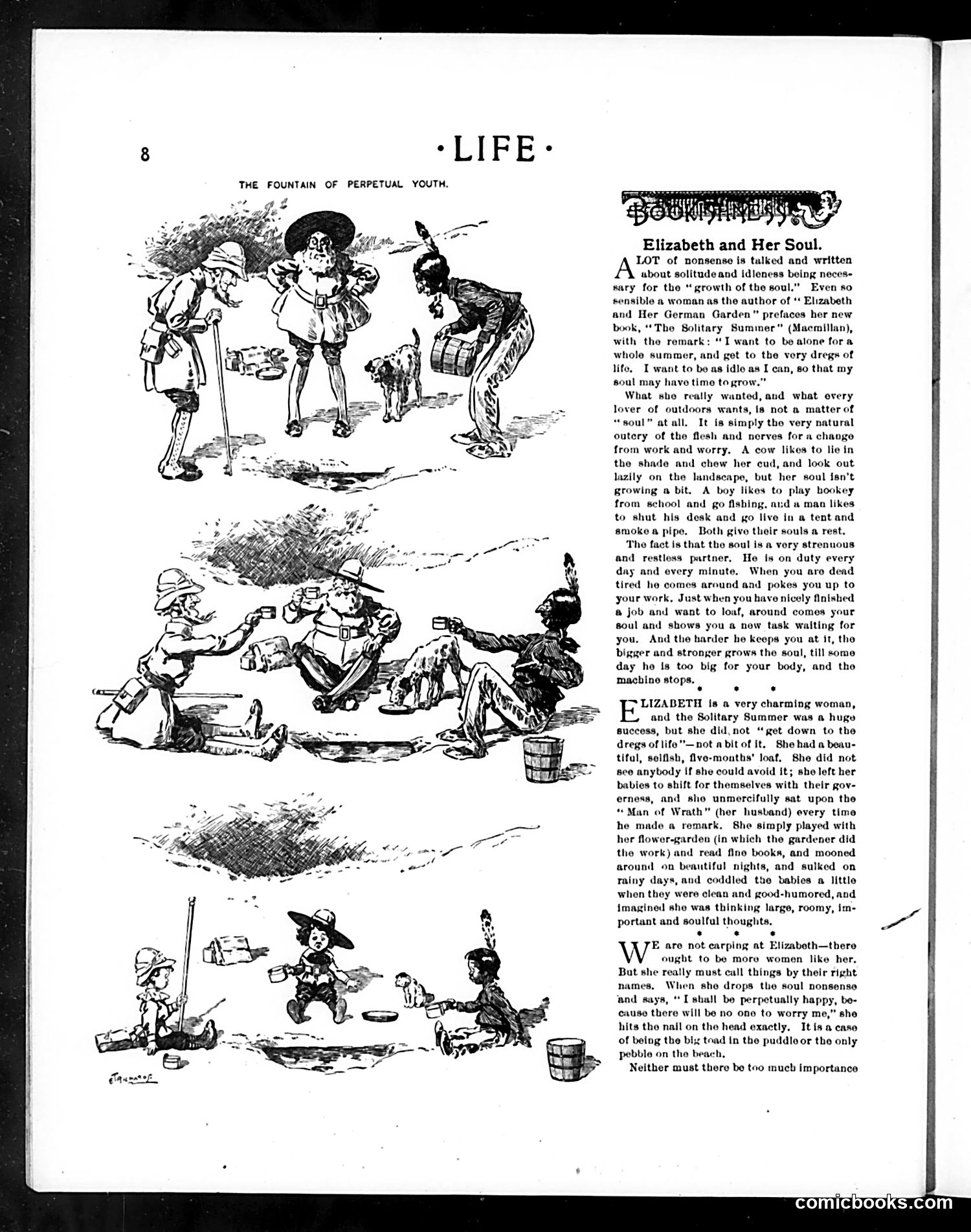
This page satirizes contemporary ideas about the "growth of the soul" through leisure and idleness. The illustrated vignettes show people—a woman named Elizabeth and her acquaintances—lounging, picnicking, and avoiding work under the guise of spiritual development. The satire targets the notion that rest and nature-contemplation constitute genuine personal growth. The text mocks this pretension: Elizabeth avoids housework, ignores social responsibilities, and spends time reading and daydreaming while claiming spiritual enrichment. The cartoon's point appears to be social criticism of wealthy or privileged individuals who romanticize idleness as "soulful" living, while dismissing practical obligations. The exaggerated depictions of lounging figures suggest the author finds this philosophy absurd and self-indulgent rather than genuinely noble or transformative.
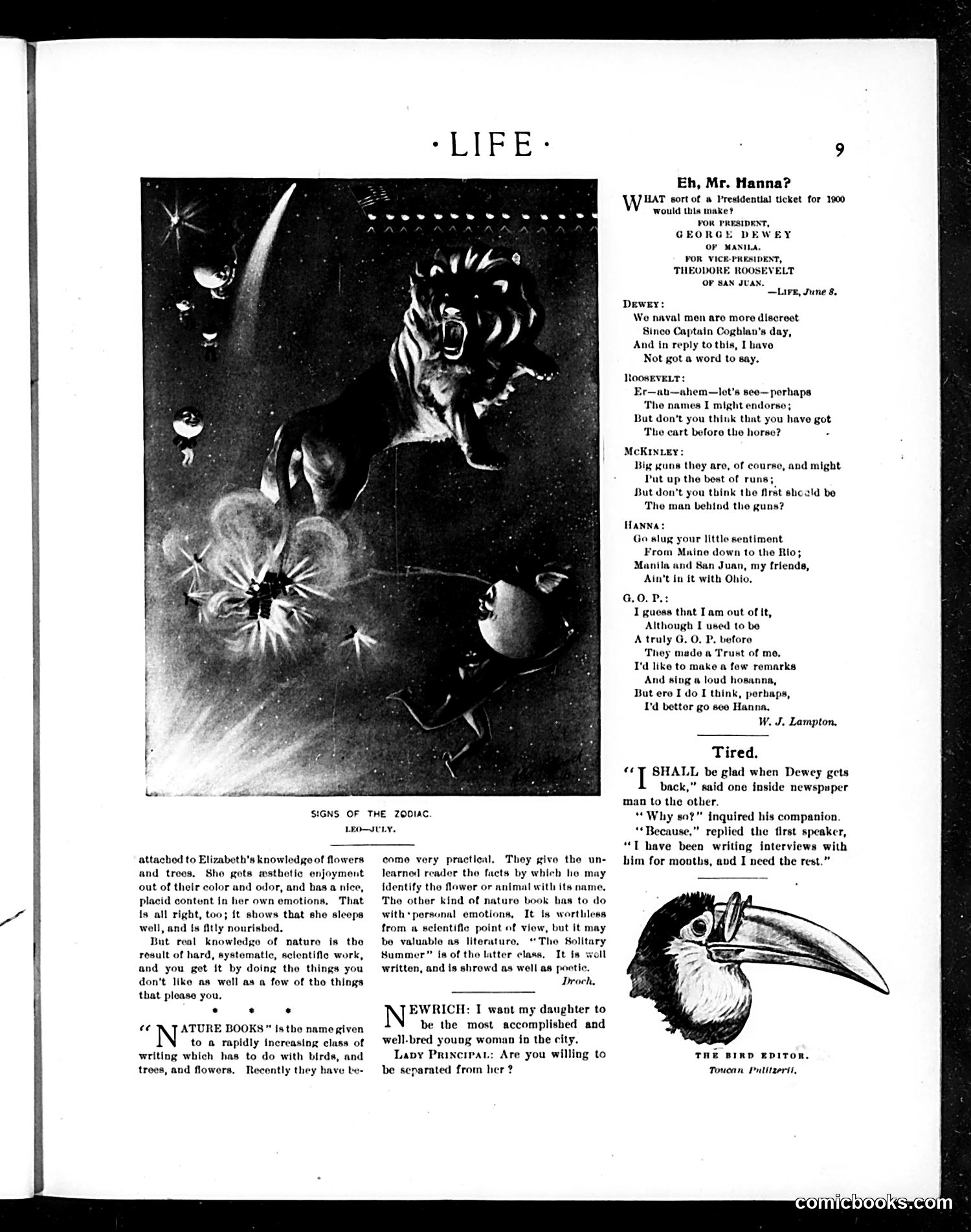
This page satirizes the 1900 U.S. presidential election through a dialogue about candidates. The central image shows zodiac signs, likely representing different political figures or factions. The text records a conversation between figures including **George Dewey** (the admiral famous from the Spanish-American War), **Theodore Roosevelt** (running as McKinley's VP), and **Mark Hanna** (McKinley's campaign manager). The satire mocks **Dewey's** political ambitions and the question of who should be on the Republican ticket. Roosevelt dismisses naval officers as "discreet," while McKinley's supporters debate strategy. Hanna tells Roosevelt to "slug your little sentiment / From Maine down to the Rio." The cartoon critiques the political maneuvering and deal-making behind the 1900 campaign.
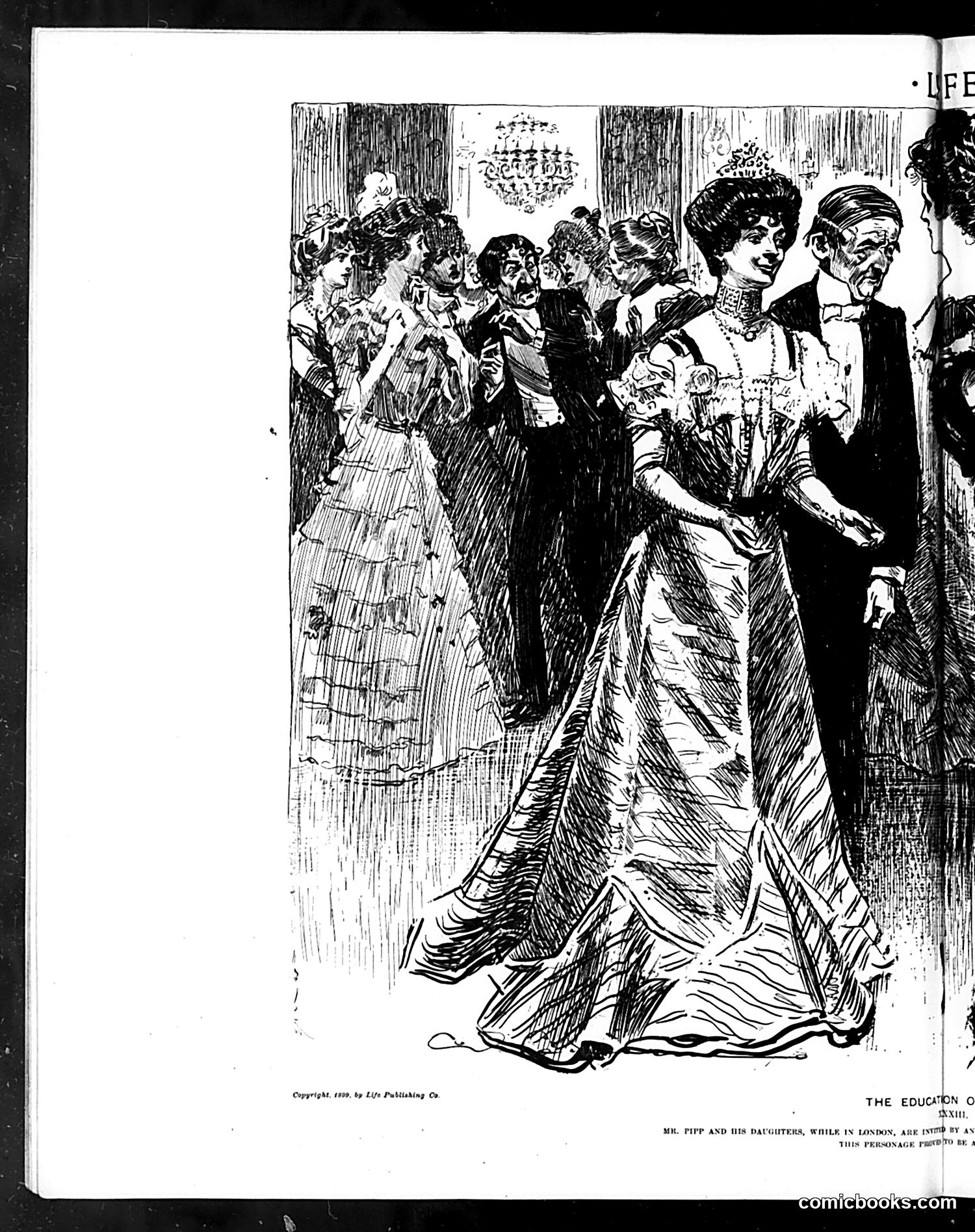
This 1909 illustration (per copyright mark) depicts a formal social scene, likely a ball or reception. The caption references "Mr. Piff and his daughters, while in London, are invited by an" [text cuts off], suggesting a satirical narrative about an American family visiting England. The satire appears to mock social pretension and class anxiety—a wealthy American family (the "Piffs") attempting to navigate British high society. The elaborate formal dress, the chandelier setting, and the crowded gathering of aristocratic figures all underscore the theme of social aspiration. The artist uses exaggerated facial expressions and body language to ridicule the characters' self-consciousness about their social standing. This reflects turn-of-the-century American anxieties about wealth versus established European aristocracy.
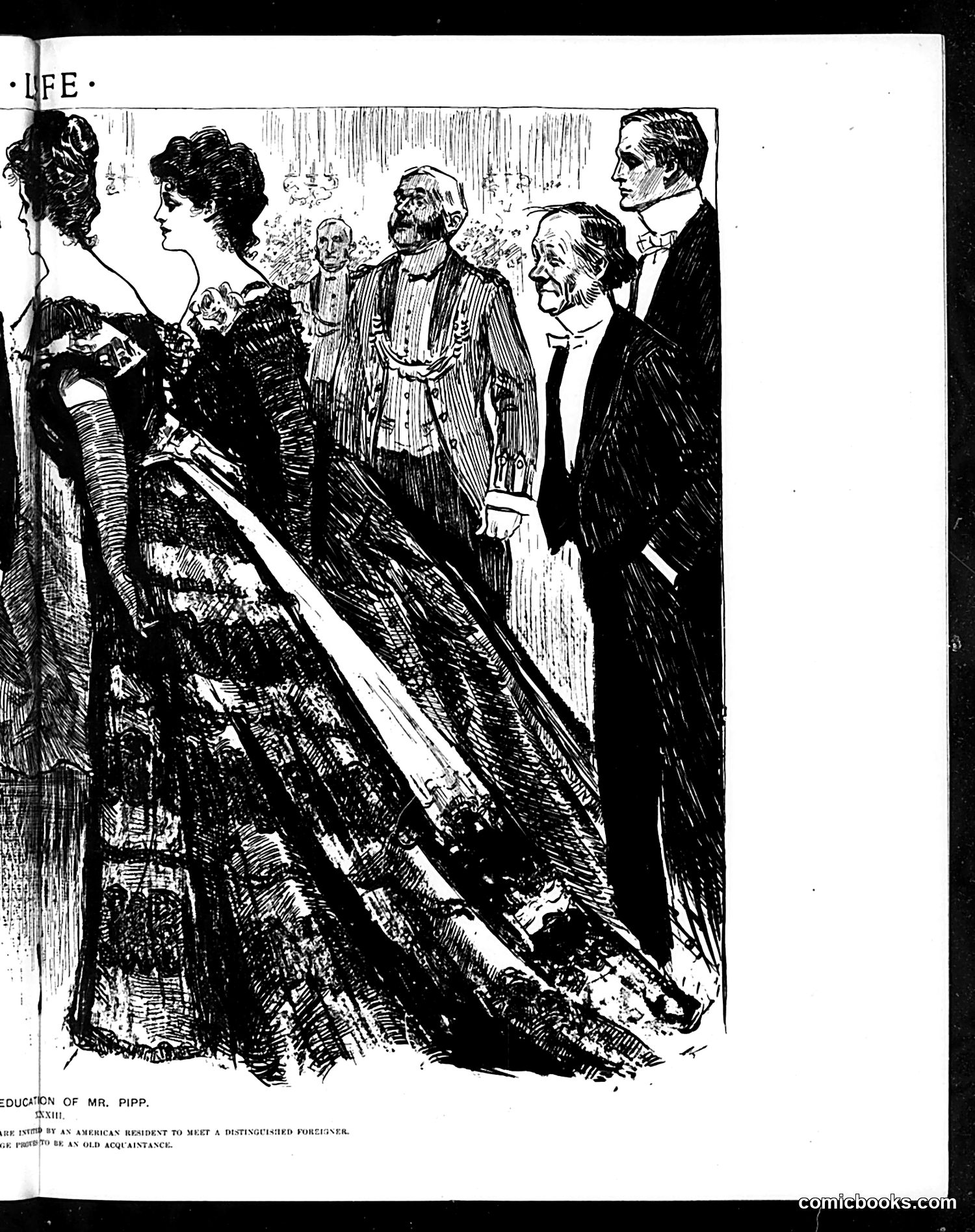
This is a satirical illustration titled "Seduction of Mr. Pipp" from Life magazine. The caption indicates it depicts "an American resident to meet a distinguished foreigner" and references "an old acquaintance." The cartoon shows a well-dressed woman in an elaborate gown with a train, accompanied by several men in formal attire at what appears to be a social gathering. The satire likely comments on American social climbing or the superficial "seduction" of an American by European aristocratic pretension. The woman's ornate clothing and the formal setting suggest themes of wealth, status, and the attempt to impress through elaborate display. Without additional context about "Mr. Pipp" or the specific historical moment, the exact political or social critique remains unclear, though it appears to mock American eagerness to associate with foreign distinction.
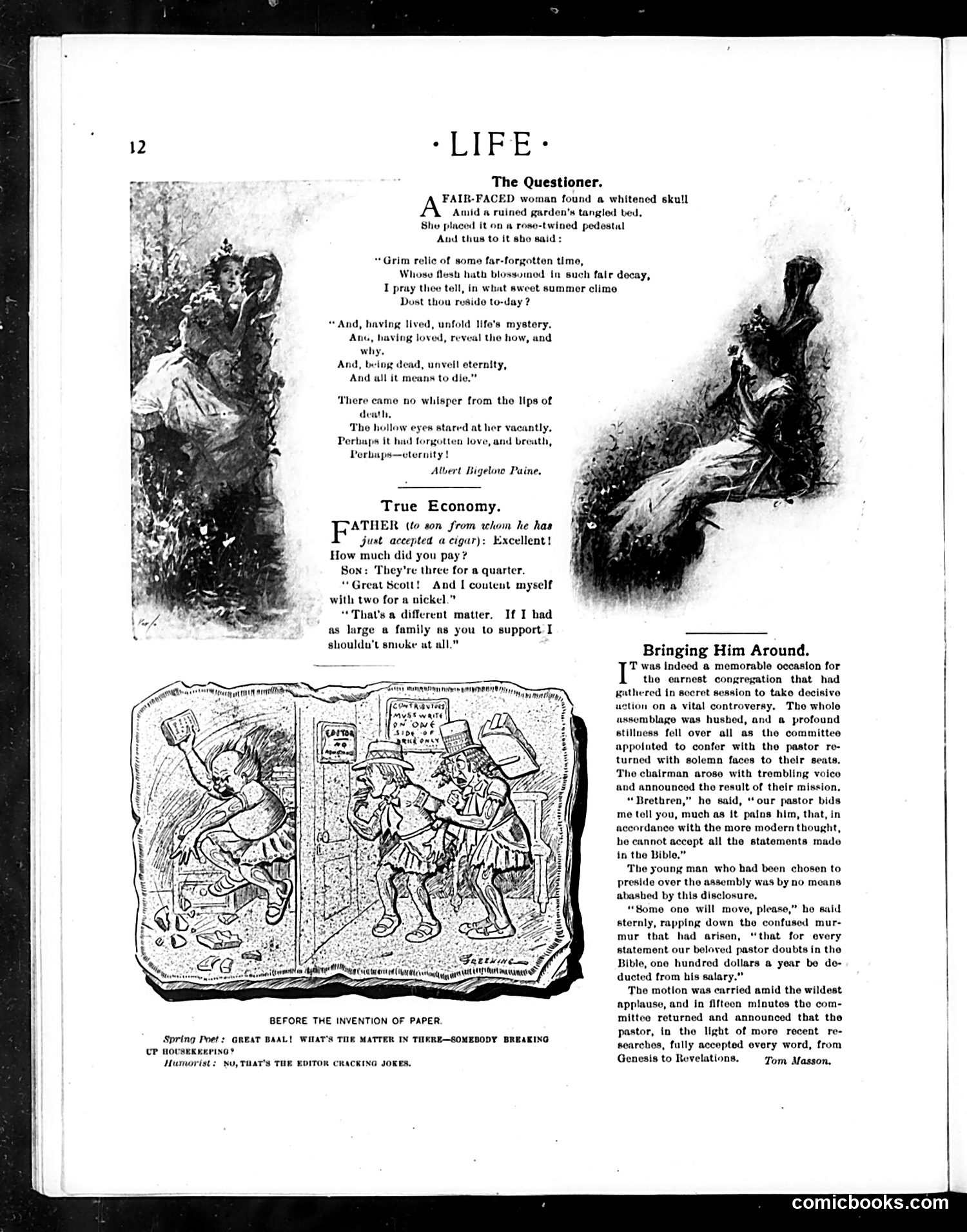
This *Life* magazine page contains three satirical pieces: 1. **"The Questioner"** (top): A poem by Albert Bigelow Paine depicting a fair-faced woman contemplating a skull in ruins, philosophically questioning death and eternity—typical Victorian memento mori sentimentality. 2. **"True Economy"** (middle): A brief comic dialogue where a father criticizes his son for spending three cents on cigars, then contradicts himself by admitting he smokes despite supposedly being unable to afford it. The satire mocks paternal hypocrisy and inconsistent moral posturing. 3. **"Bringing Him Around"** (right): A story about a church committee confronting their pastor over doctrinal statements. The satire likely critiques religious institutions prioritizing institutional reputation over honest theological debate. 4. **"Before the Invention of Paper"** (bottom): A humorous woodcut-style illustration about primitive communication methods, with accompanying jokes about housekeeping and editorial work.
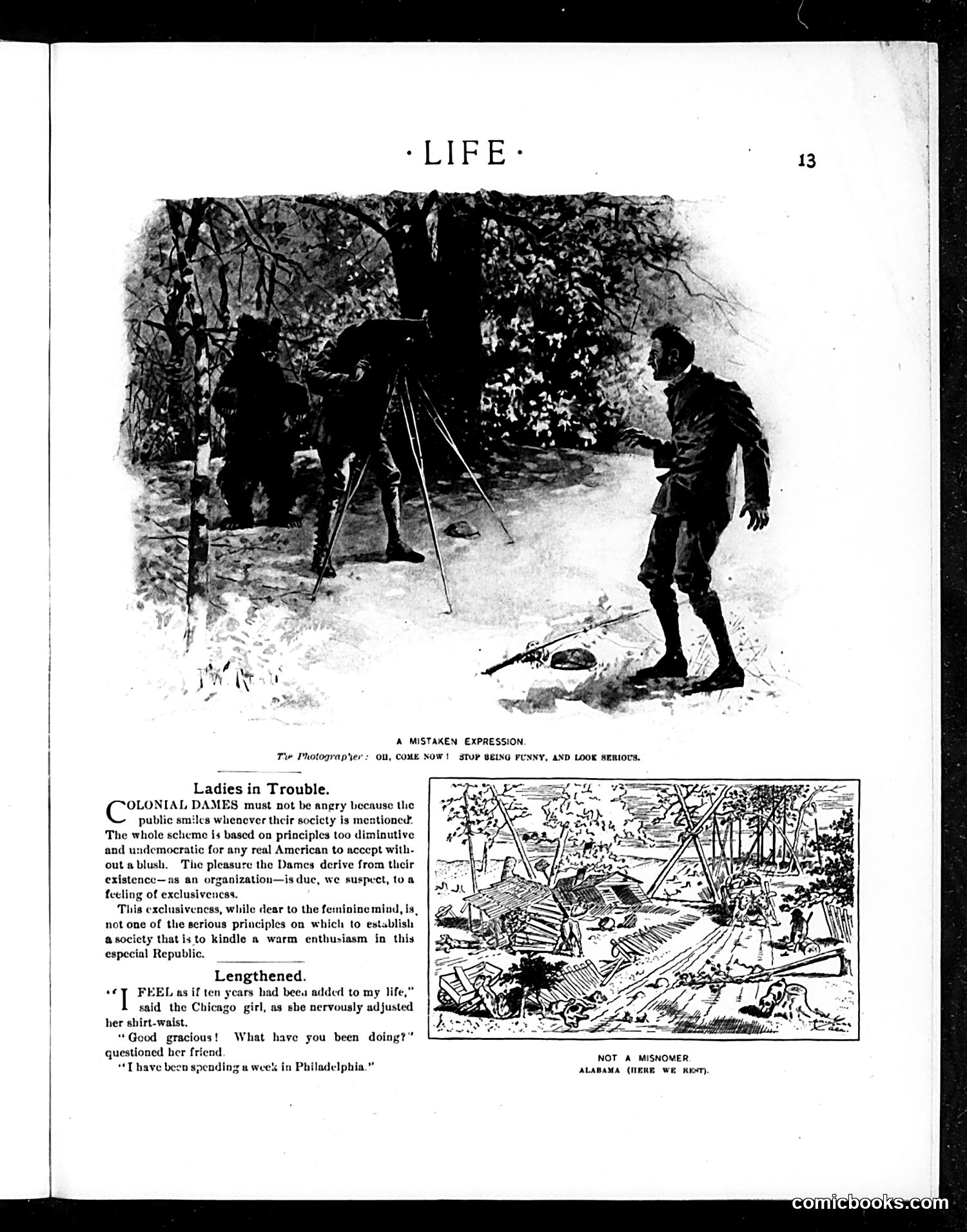
This page satirizes two distinct targets: **Top cartoon ("A Mistaken Expression"):** Mocks a photographer's difficulty getting a serious pose from his subject—a visual gag about the challenge of portrait photography. **"Ladies in Trouble":** Attacks the Colonial Dames of America, a women's hereditary society. The satire criticizes the organization as fundamentally undemocratic and un-American for its exclusivity principle. The author argues that such exclusiveness, while appealing to women, contradicts republican ideals and shouldn't inspire genuine patriotic enthusiasm. **"Lengthened":** A brief humor item playing on "lengthened" (extended) time—a Chicago girl claims a week in Philadelphia felt like ten years added to her life, sarcastically suggesting the city was tediously boring. **"Not a Misnomer":** The lower cartoon (Alabama reference unclear without fuller context) appears to be a separate satirical illustration. The page reflects early 20th-century progressive critiques of exclusionary social institutions as incompatible with democratic values.
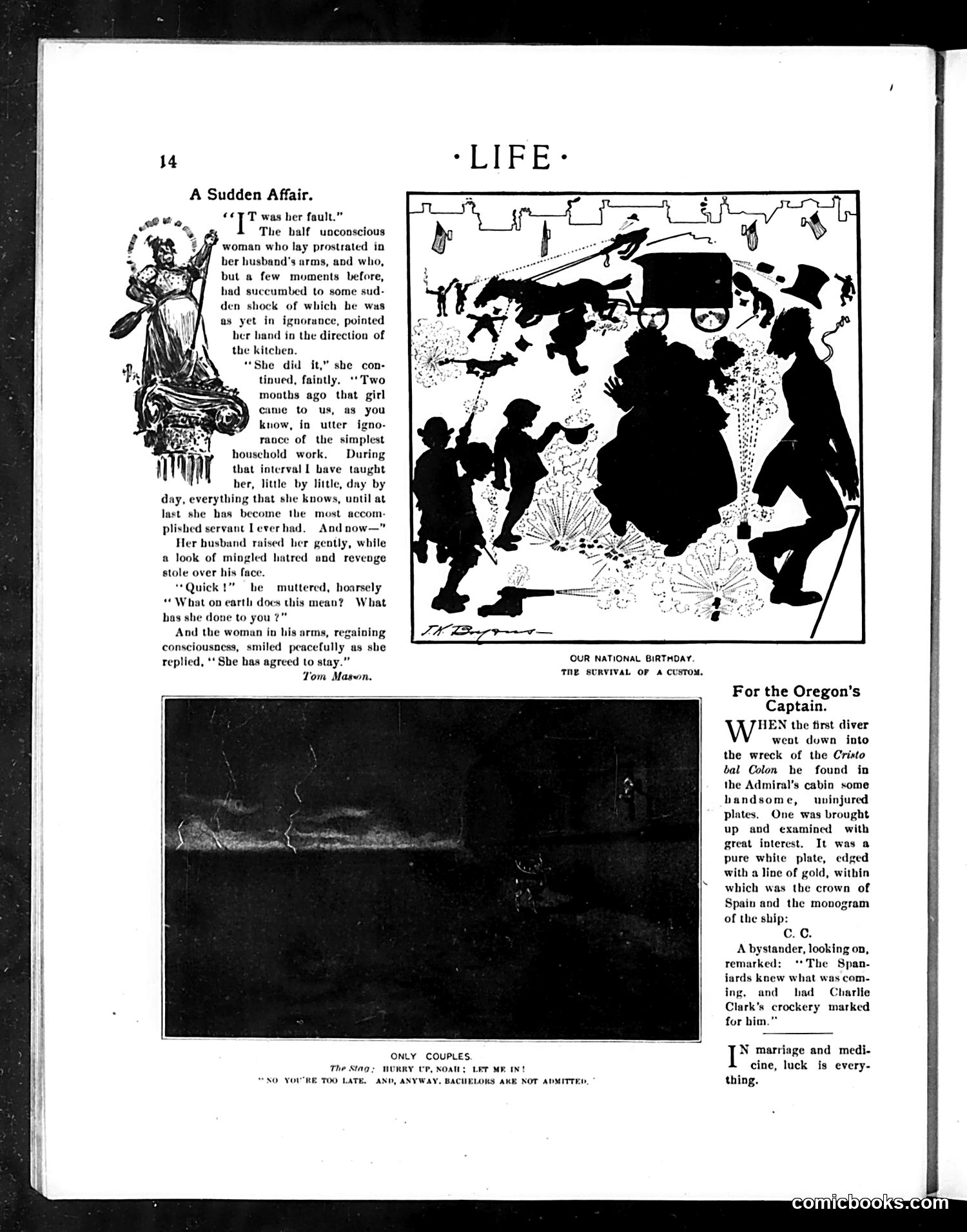
This page contains three satirical pieces: **"A Sudden Affair"** (top left): A domestic humor story by Tom Mason about a husband's shock when his wife reveals their newly trained servant has agreed to stay on. The joke centers on servant employment anxiety—the "sudden shock" that makes the wife faint is good news, but the husband initially fears bad news. The satire mocks both the difficulty of finding competent household help and spousal miscommunication. **"Our National Birthday: The Survival of a Custom"** (top right): A silhouette cartoon about Fourth of July chaos, showing an out-of-control celebration with children, animals, and fireworks creating mayhem. It satirizes how Independence Day festivities had devolved into dangerous, uncontrolled disorder. **"For the Oregon's Captain"** (bottom right): References the wreck of the *Cristóbal Colón* (a Spanish ship). A finder's joke: discovering Spanish royal plates marked "C.C." in the wreckage, someone quips they're marked for "Charlie Clark's crockery"—implying the Spanish anticipated losing them to American salvagers.
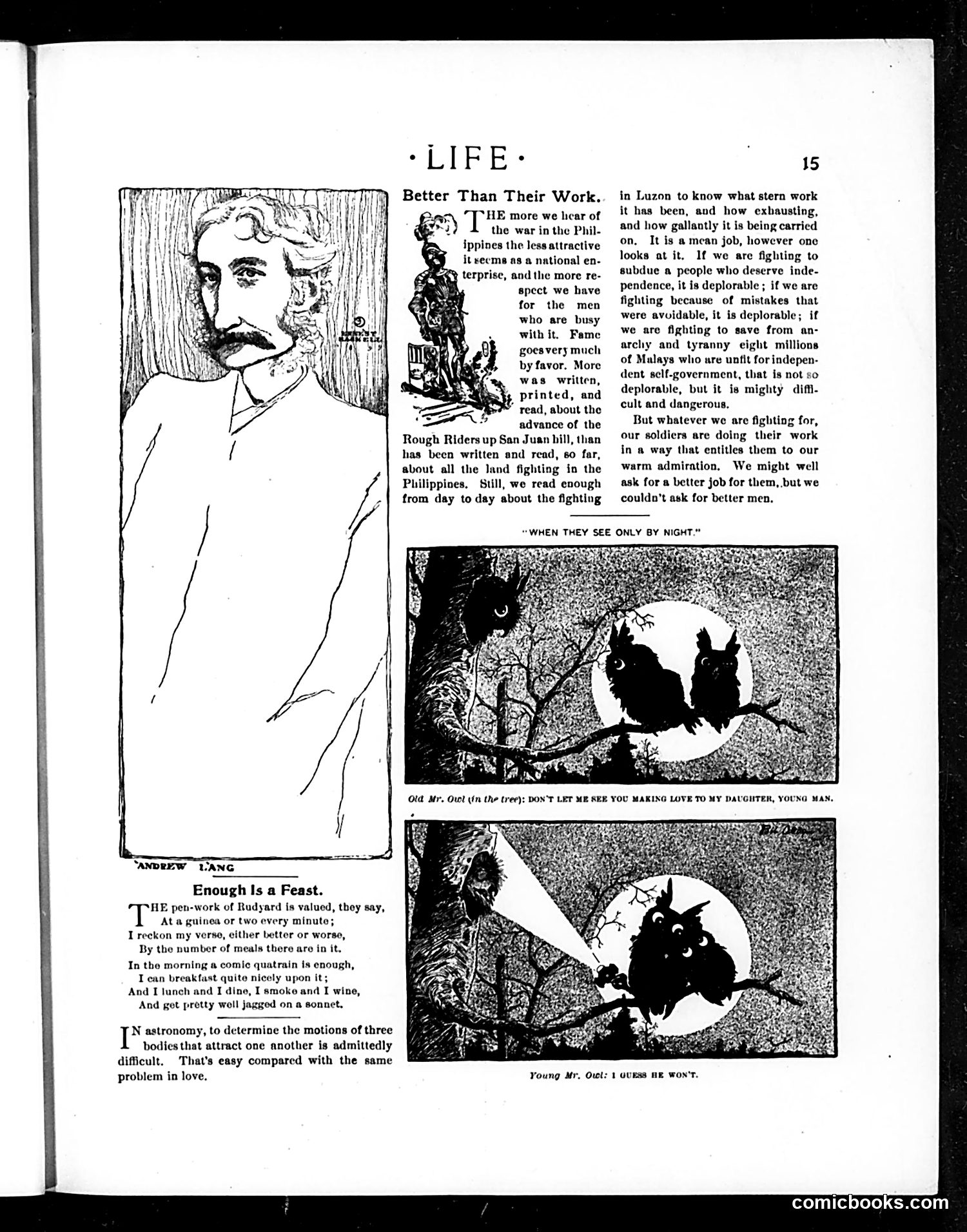
**Main Article: "Better Than Their Work"** This editorial criticizes American military operations in the Philippine-American War (ongoing at the time of publication). The author argues that while soldiers deserve admiration for their courage, the war itself is morally problematic—whether fought to suppress independence movements, correct avoidable mistakes, or impose governance on the Filipino population. The piece expresses ambivalence about the conflict's justification while praising the troops themselves. **Cartoons: "When They See Only by Night"** The two silhouette panels featuring Old Mr. Owl and Young Mr. Owl appear to be a humorous domestic scene where an older man warns a younger one against courting his daughter—a common Victorian-era joke format about courtship and parental protection. **"Enough Is a Feast" (by Andrew Lang)** A lighthearted poem comparing the financial value of Rudyard Kipling's writing to the author's own modest verse, measured humorously by meals it can afford rather than prestige. The page reflects early-1900s American debate over imperial expansion.
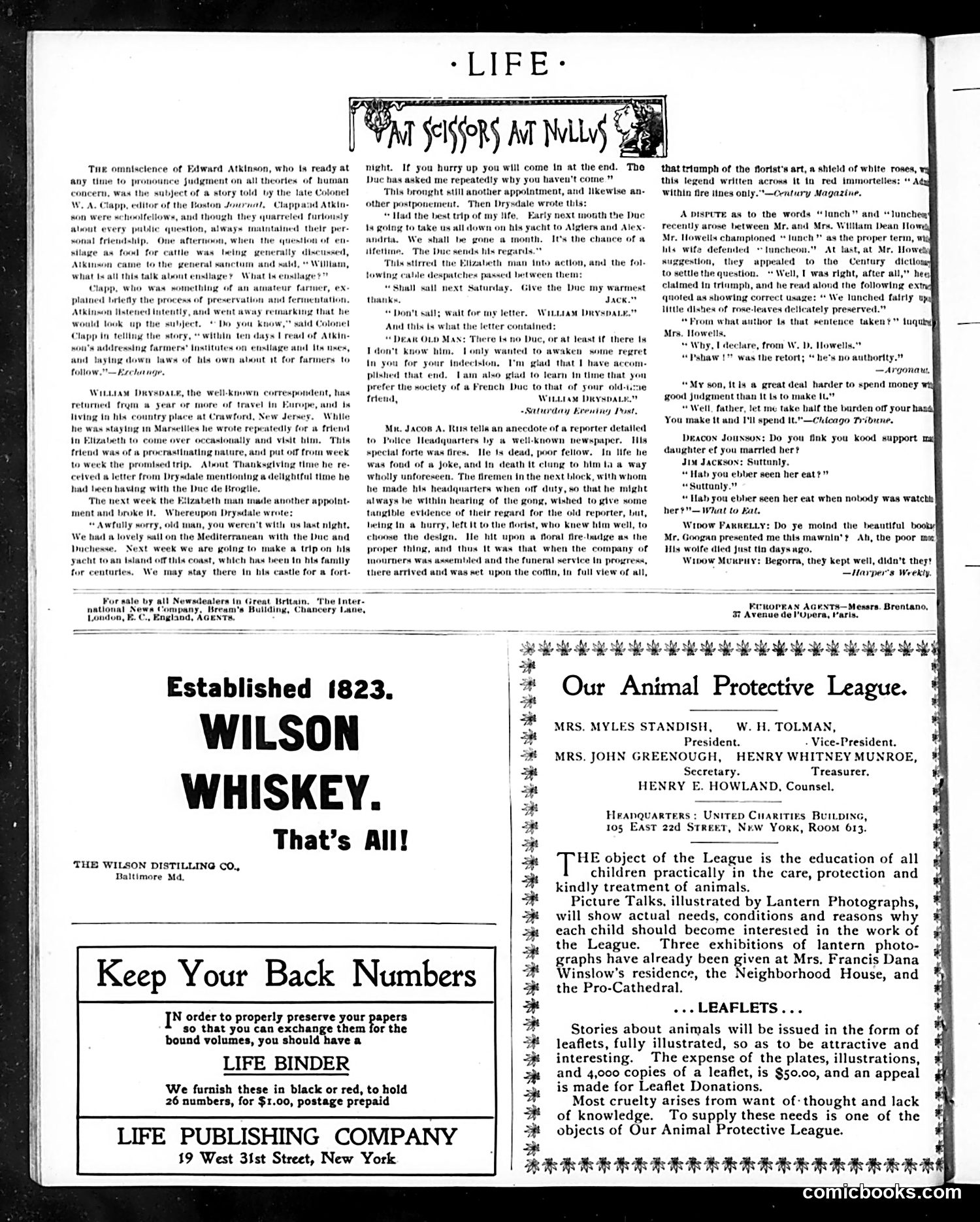
This page consists primarily of **advertisements and social commentary** rather than a unified cartoon. The main content is a humorous anecdote about **Edward Atkinson**, a prominent figure ready to pontificate on any subject. The satire mocks his omniscience through a story involving correspondent William Drysdale, who fabricates an elaborate lie about being invited by a French Duke to sail to Algeria. Atkinson falls for it completely, repeatedly asking why Drysdale hasn't departed yet. The joke targets intellectual pretension and gullibility among the educated elite. A secondary item debates whether "lunch" or "luncheon" is correct—William Dean Howells (the famous author) and his wife disagreed, appealing to *Century* magazine to settle it. This gentle satire pokes fun at bourgeois concern with proper language. The page also contains advertisements for **Wilson Whiskey** and **Life Publishing Company's binder service**, plus information about the **Animal Protective League**. The overall tone is lighthearted social criticism of Victorian-era intellectual pretension.
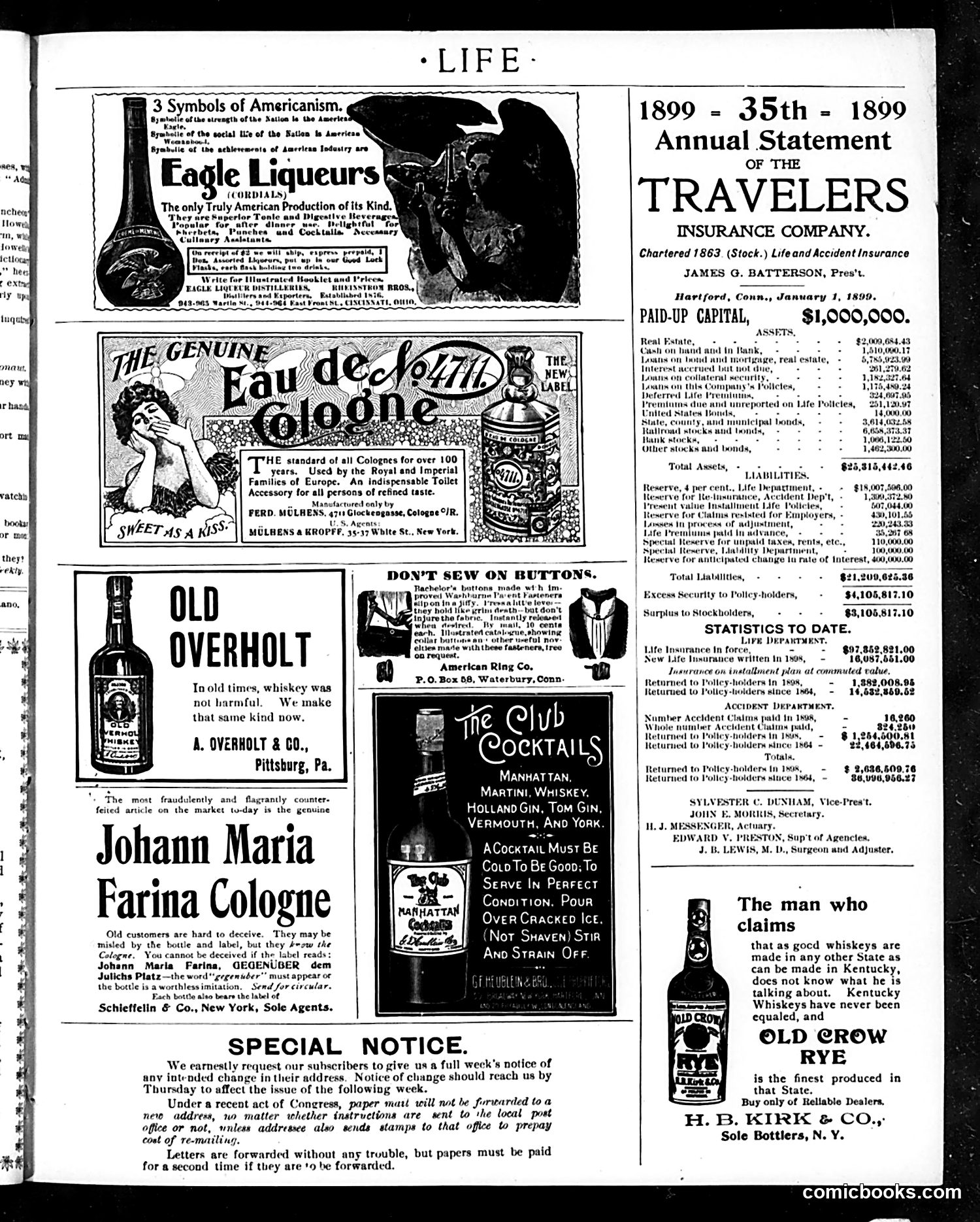
This page is primarily **advertising and corporate announcements**, not satirical content. The main items are: 1. **Product advertisements** for liqueurs, cologne, whiskey, and cocktails—typical turn-of-century marketing emphasizing "American" production and European prestige 2. **The Travelers Insurance Company's 35th Annual Statement**—a straightforward financial report showing assets of $45.2 million and surplus security for policyholders 3. **A "Special Notice"** warning subscribers about postal regulations under new Congressional law regarding mail forwarding The advertisements reflect period obsessions: establishing American manufacturing credibility (Eagle Liqueurs as "Truly American"), claims of authenticity against counterfeits (Farina Cologne), and Kentucky whiskey's purported superiority. There is no discernible political cartoon or satirical commentary on this page—it functions as a conventional business and advertising section.
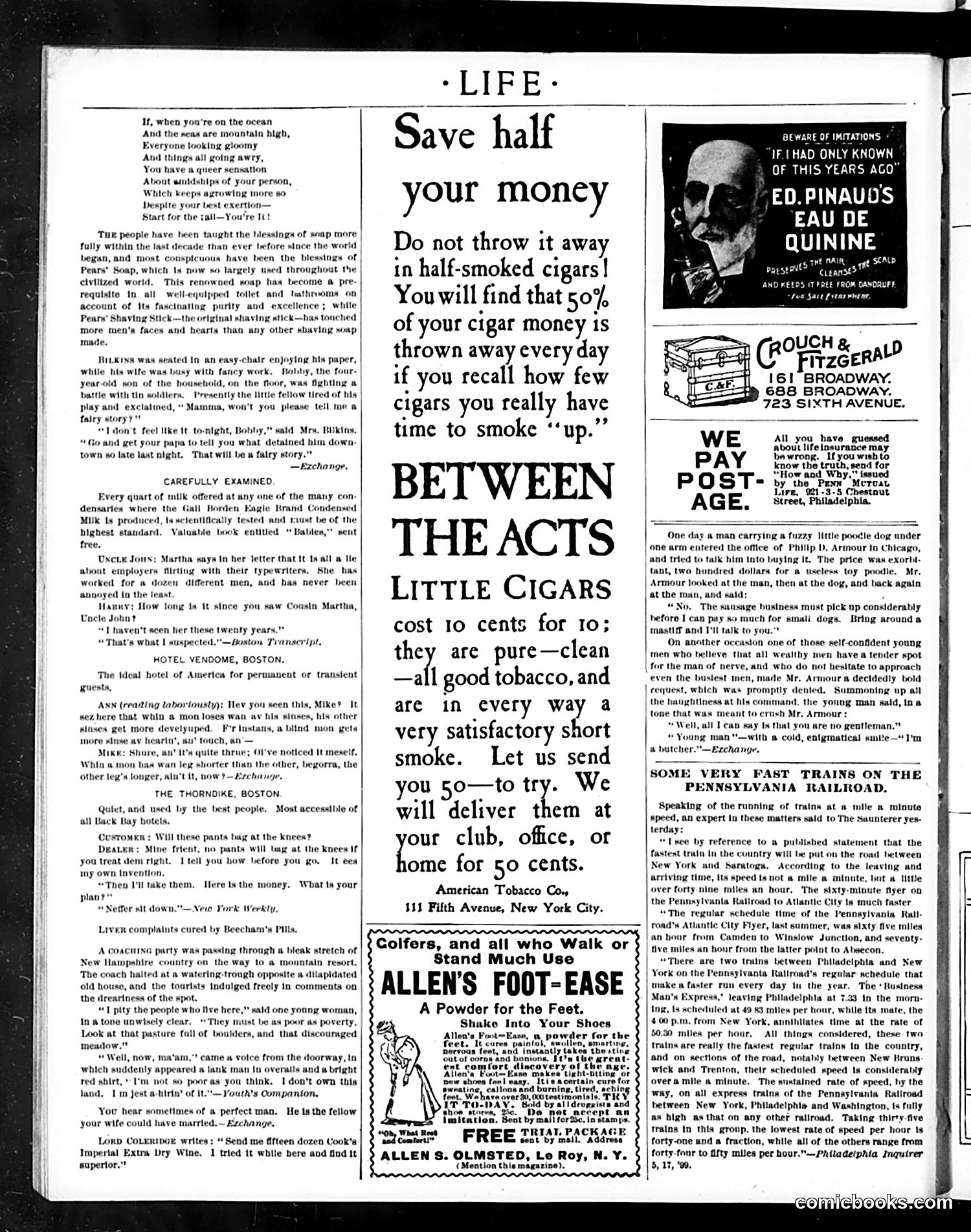
This page is primarily **advertising and humorous filler content**, typical of early Life magazine format. The main satirical content includes: **"Save Half Your Money" Advertisement**: A direct pitch for inexpensive cigars (10 for 50 cents), framed as money-saving advice. The satire is gentle—the copy humorously suggests most people waste cigar money on partially-smoked stubs anyway, so why not buy cheaper ones? **Scattered One-Liners**: Brief jokes about marriage, employment, and class differences. Most notable is the "Coaching Party" anecdote mocking wealthy tourists' condescension toward rural poverty, with a farmer's witty comeback about "rentin'" his poor land. **Product Endorsements**: Multiple ads for Pears' Soap, Borden's Condensed Milk, and foot powder—standard period advertising mixed with editorial content. The page reflects **turn-of-century Life**: satirical humor targeting middle-class anxieties (finances, marriage, social pretension) alongside commercial advertisements, with no explicit political commentary.
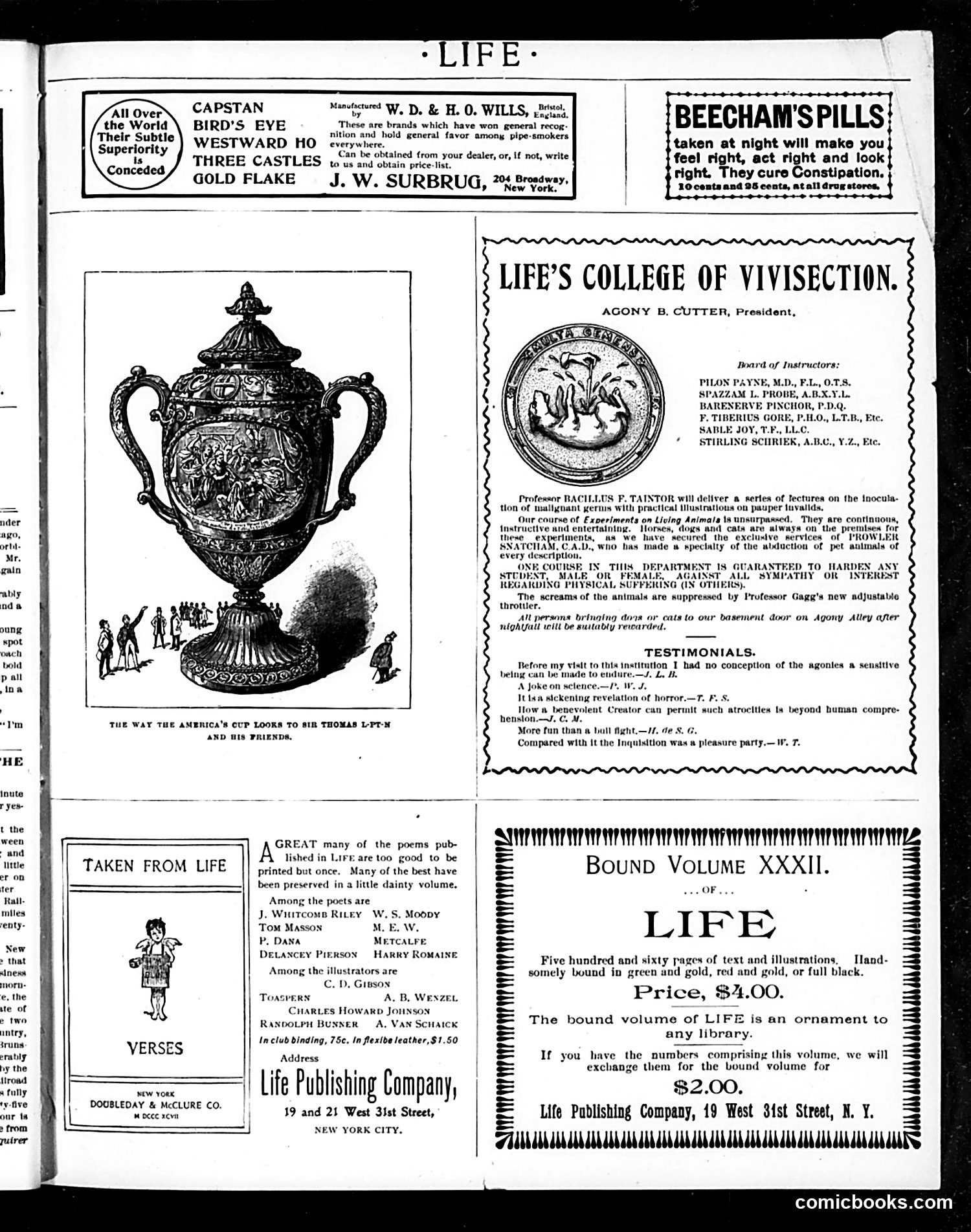
This page is primarily **advertisements and publishing notices** rather than editorial cartoons. The key content: **Top Section:** Tobacco and patent medicine ads (Capstan cigarettes, Beecham's Pills) — standard period advertising. **Center:** "Life's College of Vivisection" — a **satirical mock-institution** advertising a course on animal experimentation. The humor targets anti-vivisection sentiment of the era. Fake instructor names like "Agony B. Cutter" and "Bacillus F. Taintor" are puns. The "testimonials" satirize opposition to animal testing by presenting exaggerated moral outrage ("sickening revelation of horror," comparing it to the Inquisition). This mocks both vivisection critics AND those defending the practice as necessary science. **Bottom Section:** A decorative ornament vessel illustration is captioned about Sir Thomas Lipton and America's Cup — likely satirizing Lipton's yacht racing pursuits, though the specific joke is unclear without more context. **Lower Left:** Advertisement for a book of LIFE magazine's published poems and verses. **Lower Right:** Advertisement for bound volume XXXII of LIFE magazine itself ($4.00).
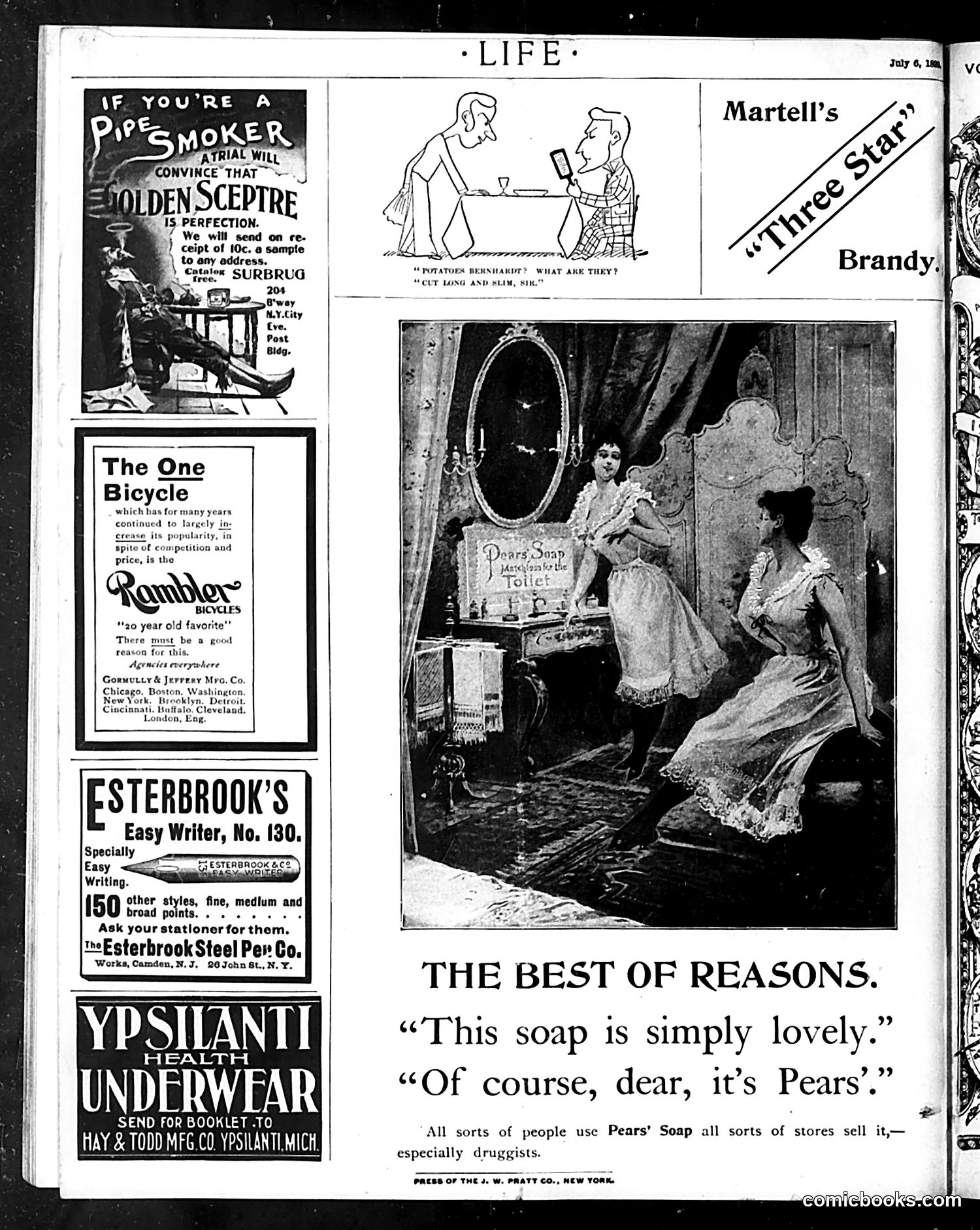
This page is primarily **advertising**, not political satire. It features multiple product advertisements typical of the era: Golden Sceptre pipe tobacco, Ramblers bicycles, Esterbrook pens, Ypsilanti underwear, and Pears' soap. The only cartoon is a small line drawing showing two people at a dining table with the caption "Potatoes Bernhardt? What are they? 'Cut long and slim, sir.'" This appears to be a mild visual pun—likely referencing actress Sarah Bernhardt's reputation for dramatic, elongated gestures or poses, humorously applied to potato preparation. The largest feature is a Pears' soap advertisement showing two elegantly dressed women examining themselves in a mirror, with the tagline "This soap is simply lovely." / "Of course, dear, it's Pears'." This reflects early 20th-century advertising's emphasis on luxury, beauty, and social aspiration to sell consumer goods.