
Life, 1899-07-06 · page 4 of 20
Life — July 6, 1899 — page 4: what you’re looking at
What you’re looking at
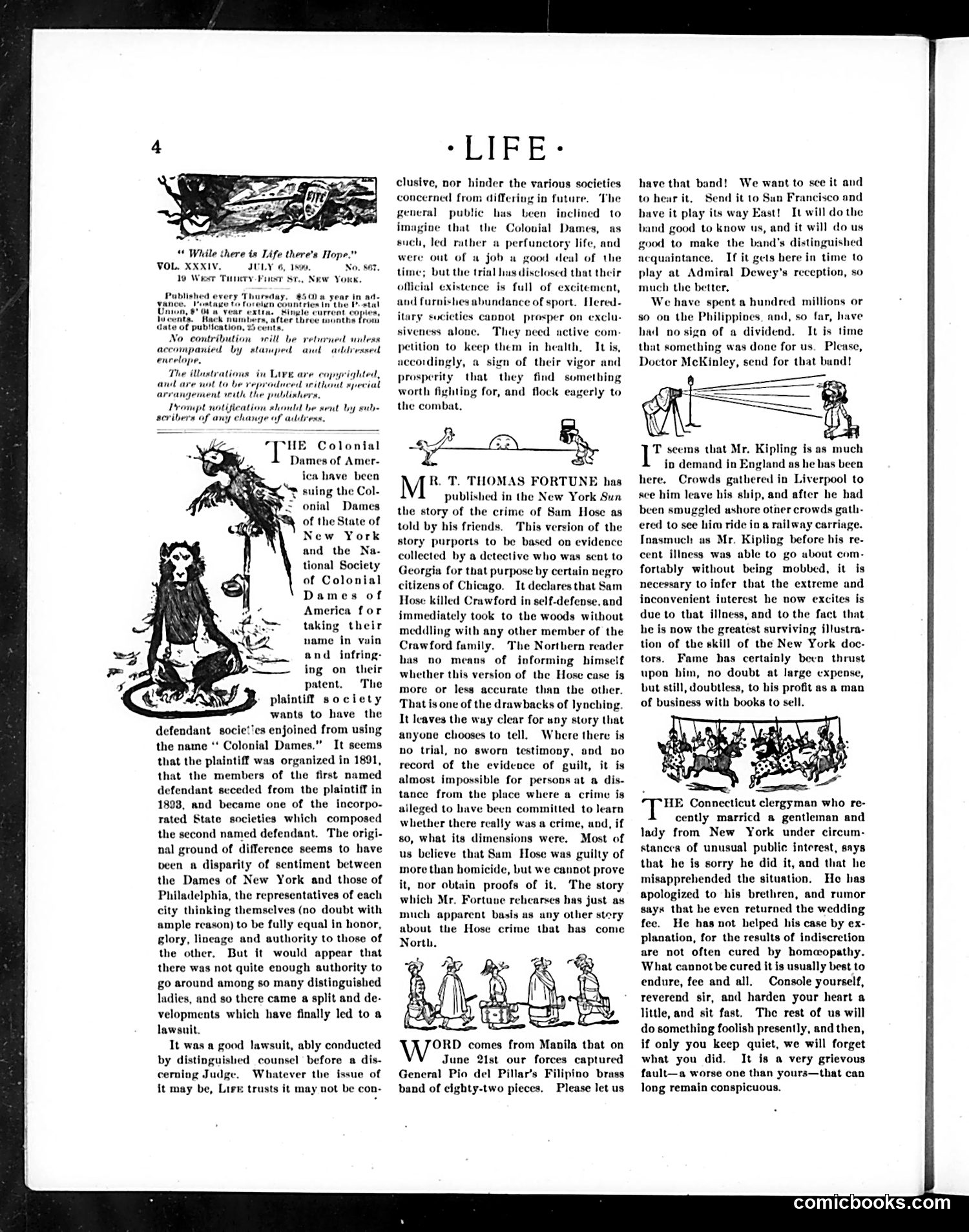
This page contains three satirical pieces about early 1900s social and legal matters: 1. **Colonial Dames controversy**: The text discusses a lawsuit over the "Colonial Dames" organization name, with New York and Philadelphia societies claiming rights. The satire mocks the dispute's pettiness among "distinguished ladies." 2. **Sam Hose case**: References T. Thomas Fortune's retelling of this crime story in the New York Sun, noting how the same facts produce different versions depending on who tells it—satirizing how unreliable accounts become when based on rumor rather than evidence. 3. **Kipling's popularity**: Notes Rudyard Kipling's immense popularity in England, with crowds gathering to see him, and jokes about illness excusing him from public appearances. The illustrations are decorative Victorian-style vignettes accompanying these commentary pieces. The satire targets legal pretension, journalistic bias, and celebrity culture.
📄 Transcribed text from this page (OCR, searchable)
Machine-transcribed from the original scan — historical spelling and the odd misread are preserved.
“ While there is Life there's Hope.” VOL. XXXIV. JULY 6, 180 No. 867. 19 Wrst Titiery Pits s Youk, Published every Thursday. #50) 0 year in ad~ va oat f tae Xingle ‘after thr its, Hack, date of pubiicatio No contribution will be returned unless accompanied by stamped enrelope. The illustrations in Li aul are not to be rep writhent special arrangement with the publishers, aul aiidressed Tronpt notification lil be sent by sube scribers of any change dress, THE Colonial Dames of Amer- ica have been forse’ “suring the Col- onial Dames of the State of New York and the Na- tional Society of Colonial Dames of America for taking their name in vain and infring- ing on their patent. The plainti®? society wants to have the defendant socie‘'es enjoined from using the name ‘' Colonial Dames.” It seems that the plaintiff was organized in 1891, that the members of the first named defendant seceded from the plaintiff in 1898, and became one of the incorpo- rated State societies which composed the second named defendant. ‘The origi- nal ground of difference seems to have been a disparity of sentiment between the Dames of New York and those of Philadelphia, the representatives of each city thinking themselves (no doubt with ample reason) to be fully equal in honor, glory, lineage and authority to those of the other. But ft would appear that there was not quite enough authority to go around among so many distinguished ladies, and so there came a split and de- velopments which have finally led to a lawsuit. It was a good lawsuit, ably conducted by distinguished counsel before a dis- cerning Judge. Whatever the issue of it may be, Lire trusts it may not be con- *LIFE* clusive, nor hinder the various societies concerned from differing in future. The general public has been inclined to imagine that the Colonial Dames, as led rather a perfunctory life, and were out of a job a good deal of the time; but the trial has disclosed that their oflicial existence is full of excitement, and furnishes abundance of sport. [Hered- itary sucicties cannot prosper on exclu sivencss alone. They need active com- petition to keep them in health. It is, accordingly, a sign of their vigor and prosperity that they find something worth fighting for, and flock eagerly to the combat, sf an © R. T. THOMAS FORTUNE has published in the New York Sun the story of the crime of Sam Hose as told by his friends. This version of the story purports to be based on evidence collected by a detective who was sent to Georgia for that purpose by certain negro citizens of Chicago. It declares that Sam Hose killed Crawford in self-defense, and immediately took to the woods without meddling with any other member of the Crawford family. The Northern reader has no means of informing himself whether this version of the Hose case is more or less accurate than the other. That is one of the drawbacks of lynching. It leaves the way clear for uny story that anyone chooses to tell. Where there is no trial, no sworn testimony, and no record of the evidence of guilt, it is almost impossible for persons at a dis- tance from the place where a crime is alleged to have been committed to learn whether there really was a crime, and, if so, what its dimensions were. Most of us believe that Sum Hose was guilty of more than homicide, but we cannot prove it, nor obtain proofs of it, The story which Mr. Fortuve rehearses has just as much apparent basis as any other story about the Hose crime that has come ORD comes from Manila that on June 21st our forces captured General Pio del Pillar’s Filipino brass band of eighty-two pieces. Please let us have that band! We want to sce it and to hear it, Send it to Sun Francisco and have it play its way East! It will do the band good to know us, and it will do us good to make the band’s distinguished acquaintance. If it gets here in time to play at Admiral Dewey's reception, so much the better, We have spent a hundred millions or so on the Philippines. and, so far, have had no sign of a dividend. It is time that something was done for us. Please, Doctor McKinley, send for that bund! T seems that Mr. Kipling is as much ip demand in England as he bas been here. Crowds guthered in Liverpool to sce him leave his ship, and after he had been smuggled ashore other crowds gath- ered to see him ride in a railway carriage. Inasmuch us Mr. Kipling before his re- cent illness was able to go ubout com- fortably without being mobbed, it is necessary to infer that the extreme and inconvenient juterest he now excites is due to that illness, and to the fact that he is now the greatest surviving illustra- tion of the skill of the New York doc- tors, Fame has certainly been thrust upon him, no doubt at large expense, but still, doubtless, to his profit as a man of business with books to sell. ae, ee HE Connecticut clergyman who re- cently marricd a gentleman and lady from New York under circum. stances of unusual public interest, says that he is sorry he did it, and that he misapprehended the situation. He has apologized to his brethren, and rumor says that he even returned the wedding fec. He has not helped his case by ex- planation, for the results of indiscretion are not often cured by homaopathy. What cannot be cured it is usually best to endure, fee and all, Console yourself, reverend sir, and harden your heart a little, and sit fast. The rest of us will do something foolish presently, and then, if only you keep quiet, we will forget what you did. It is a very grievous fault—a worse one than yours—that can long remain conspicuous. comicbooks.com